
Interventional Cardiology Job Market: Demand and Pay 2026
Most applicants matched. Dozens of seats stayed empty. In the cycle that followed interventional cardiology's first national match, 153 programs offered 307 fellowship positions, 244 physicians entered the Match, roughly 97% of applicants matched, and between 63 and 71 positions still went empty, depending on whether vacancies are counted by position or by program, according to Becker's ASC Review reporting on the match results.
The figure that sets hiring risk is how many credentialed operators a program needs to staff emergency PCI around the clock. Load that call onto three people and they resign. One open requisition does not describe the roster.
Demand for coronary intervention keeps climbing while the supply of newly trained operators barely moves. Treat every unfilled interventional role as a coverage problem, not as a single vacancy.
Table of Contents
Where the Interventional Cardiology Job Market Stands in 2026 - Coverage, not headcount, sets the real vacancy - The supply gap widens sharply outside metro areas
Fellowship Results and Why Seats Stay Empty - Why an unfilled seat signals a thinner candidate pool - Quantify the job before a posting goes live - Geography sorts the pool, and two levers decide who signs
Interventional Pay Premiums and What Shapes Offers - A single-digit premium against a heavier schedule
Procedural Volume Thresholds Employers Should Check - How to read a case log in an interview - The same thresholds test your own program
Metro and Rural Hiring Conditions Compared - Scenario one, a metropolitan program adding capacity - Scenario two, a rural hospital holding a STEMI program open - Salary is the smallest line in the model
Choose Your Next Move in the Interventional Market - For employers - For candidates
Where the Interventional Cardiology Job Market Stands in 2026
Supply barely moves. From 2025 to 2037, Healio's cardiology workforce reporting estimates U.S. cardiologist supply growing 2%, from about 37,000 to 37,730 physicians, against demand growth of 15.7%. The same projection puts supply adequacy at 88.9% in metropolitan areas and 29.2% in nonmetropolitan areas. Demand is expanding at roughly eight times the rate of supply. A single 2026 hiring cycle does not close a gap with that slope.
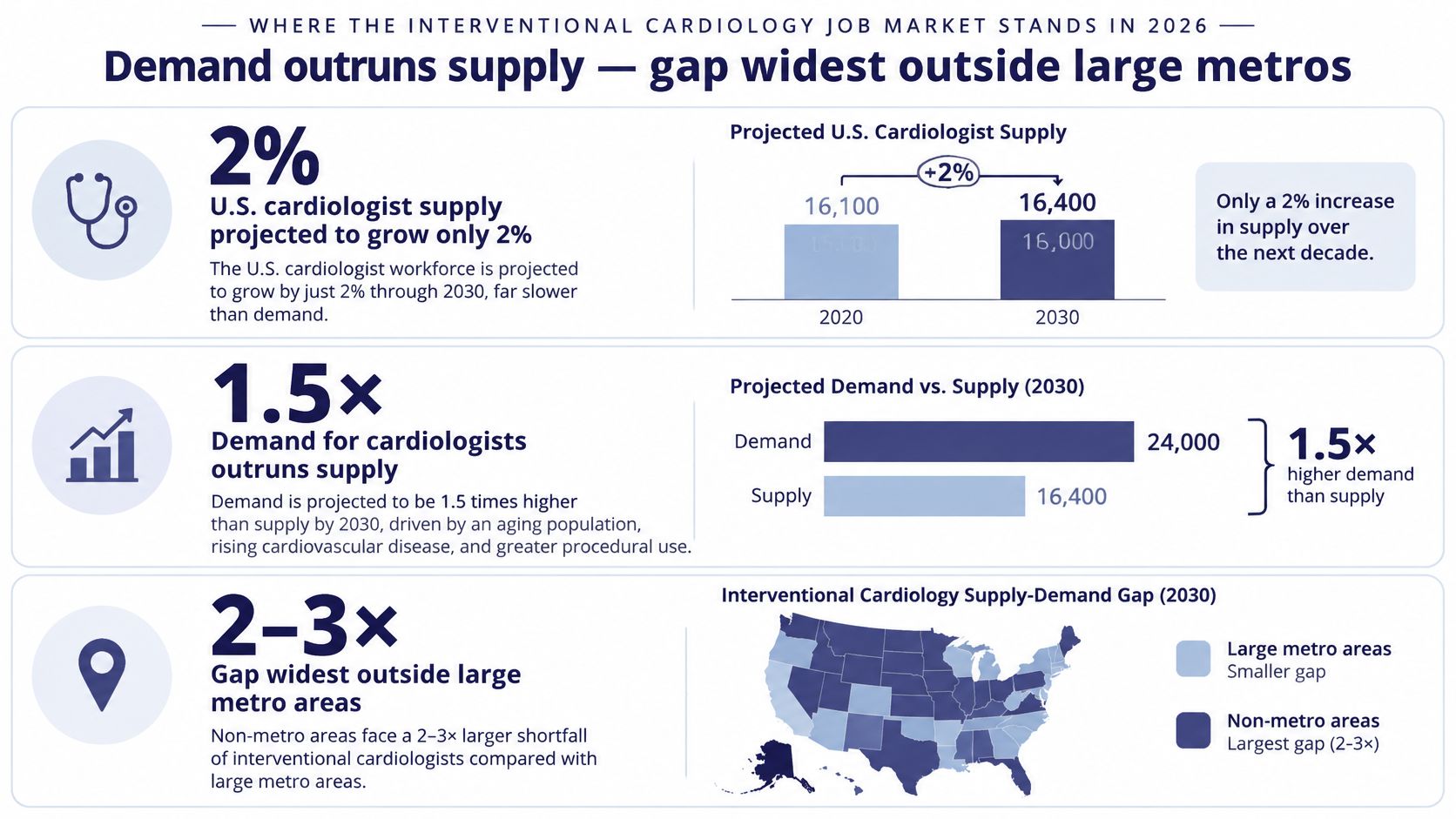
Coverage, not headcount, sets the real vacancy
An open interventional role is a coverage equation. Emergency percutaneous coronary intervention, catheterization-laboratory coverage for STEMI activation, and complex coronary work each require a credentialed operator. A hiring committee cannot hand that call schedule to a noninvasive colleague. The number that matters is how many operators it takes to cover every night of the year at a call frequency the group will still accept. On a small panel, one departure loads the remaining operators until people resign, and the STEMI program fails before the vacancy shows up as a budget line.
The supply gap widens sharply outside metro areas
Adequacy, the share of projected need that local supply can meet, splits hard by geography.
Measure | Value |
|---|---|
Cardiology supply adequacy, metropolitan areas | 88.9% |
Cardiology supply adequacy, nonmetropolitan areas | 29.2% |
Counties with no practicing cardiologist, all U.S. counties | Widespread, including populated counties |
Counties with no practicing cardiologist, rural counties | The usual rural pattern, not a rare exception |
Counties with no practicing cardiologist are common across the country, and that absence is the prevailing pattern in rural counties. Those are the markets where a single departing operator can suspend a STEMI program, because no second credentialed operator remains to take call.
Two segments look strongest on 2026 demand. High-volume metropolitan programs are adding structural heart or complex coronary capacity, where adequacy near 89% still leaves hiring room, but night coverage, not a missing generalist, is the constraint. Community hospitals need dependable local access for emergency and elective catheterization. At about 29% nonmetropolitan adequacy, that search runs long and the slate stays thin. Size the panel for safe emergency PCI call first. Then recruit to that number, whether the posted opening is one job or several.
Fellowship Results and Why Seats Stay Empty
Interventional cardiology joined the National Resident Matching Program's Specialties Matching Service for the 2025 appointment year, giving the field its first unified national measurement of training supply against employer demand. The Becker's ASC Review breakdown of the cardiology match recorded 326 positions across 156 programs, with 272 filled and 54 vacant, an overall fill rate near 83.4%. Before that cycle, programs recruited through their own institutional and fellowship-specific processes, which meant nobody could say with confidence how many funded slots went empty each year.
Now they can. The 54 vacancies represent a 16.6% vacancy rate, and 156 participating programs tell you something else useful: training capacity is spread across a broad national network rather than concentrated in a handful of elite academic centers.
Cycle | Positions and programs | Result | Unfilled positions |
|---|---|---|---|
2025 appointment year (NRMP Specialties Matching Service) | 326 positions, 156 programs | 272 filled, fill rate about 83.4% | 54 |
Following cycle (reported) | 307 positions, 153 programs | 244 applicants, about 97% matched | 63 to 71, depending on counting method |
The second cycle widened the mismatch. A PubMed Central analysis of the interventional cardiology pipeline reports 307 positions offered against 244 applicants entering the Match, leaving 63 vacancies even though nearly every applicant matched. Sources differ on the unfilled count for that cycle depending on whether vacancies are tallied by position or by program, which is one reason to read the direction of travel rather than the last digit.
Why an unfilled seat signals a thinner candidate pool
An empty fellowship chair doesn't mean the country has too many interventionalists. It means institutions expanded catheterization-laboratory training slots faster than the pool of qualified physicians willing to enter the field. For a hospital recruiting this year, the practical consequence is a graduating cohort smaller than the number of open clinical roles, particularly for programs that need high-acuity PCI, complex coronary intervention, structural heart collaboration or 24/7 STEMI coverage.
Hiring signal: when nearly every applicant matches and a fifth of the offered positions still go unfilled, the constraint has moved to the applicant side of the equation. Employers compete for people, not for slots.
The drivers are consistent and unglamorous. Call burden tops the list, because interventional call means STEMI activations, not phone advice. Procedural intensity comes second, followed by lifestyle expectations and the perception that compensation doesn't track the workload. Geography and program competitiveness then decide which unfilled positions stay unfilled longest.
Quantify the job before a posting goes live
A generic interventional posting competes badly against a specific one. Before advertising, put numbers in the listing:
Annual PCI volume, including primary PCI for acute myocardial infarction and the share performed after hours.
Call frequency and the number of STEMI activations the group handles per month.
Protected laboratory time, stated in sessions per week rather than described as support.
Advanced practice support, naming who rounds, who admits and who handles discharge.
A path to procedural specialization, whether complex coronary, structural heart or mechanical circulatory support.
Call-sharing structure, because a candidate evaluating a fourth night of call wants to know who else carries it.
Geography sorts the pool, and two levers decide who signs
Established urban academic markets pull applicants almost by default, and candidates there weigh research time and case mix alongside pay. Rural and community hospitals win differently: scope of practice, clinical autonomy, sign-on economics and a call-sharing model that's credible on paper and in practice.
Two levers move the odds. The first is national recruiting that engages fellows before graduation, so outreach lands a year ahead of the contract rather than the month it ends; understanding how physicians move through the interventional cardiology fellowship pathway helps a recruiter time that contact correctly. The second is locum tenens coverage that holds the service line open during a long search instead of letting volume drain to a competitor across town.
Treat graduating fellows below available clinical openings as a leading indicator. When that condition persists, expect longer searches, heavier call on the physicians already in place, and upward pressure on compensation and schedule design.
Interventional Pay Premiums and What Shapes Offers
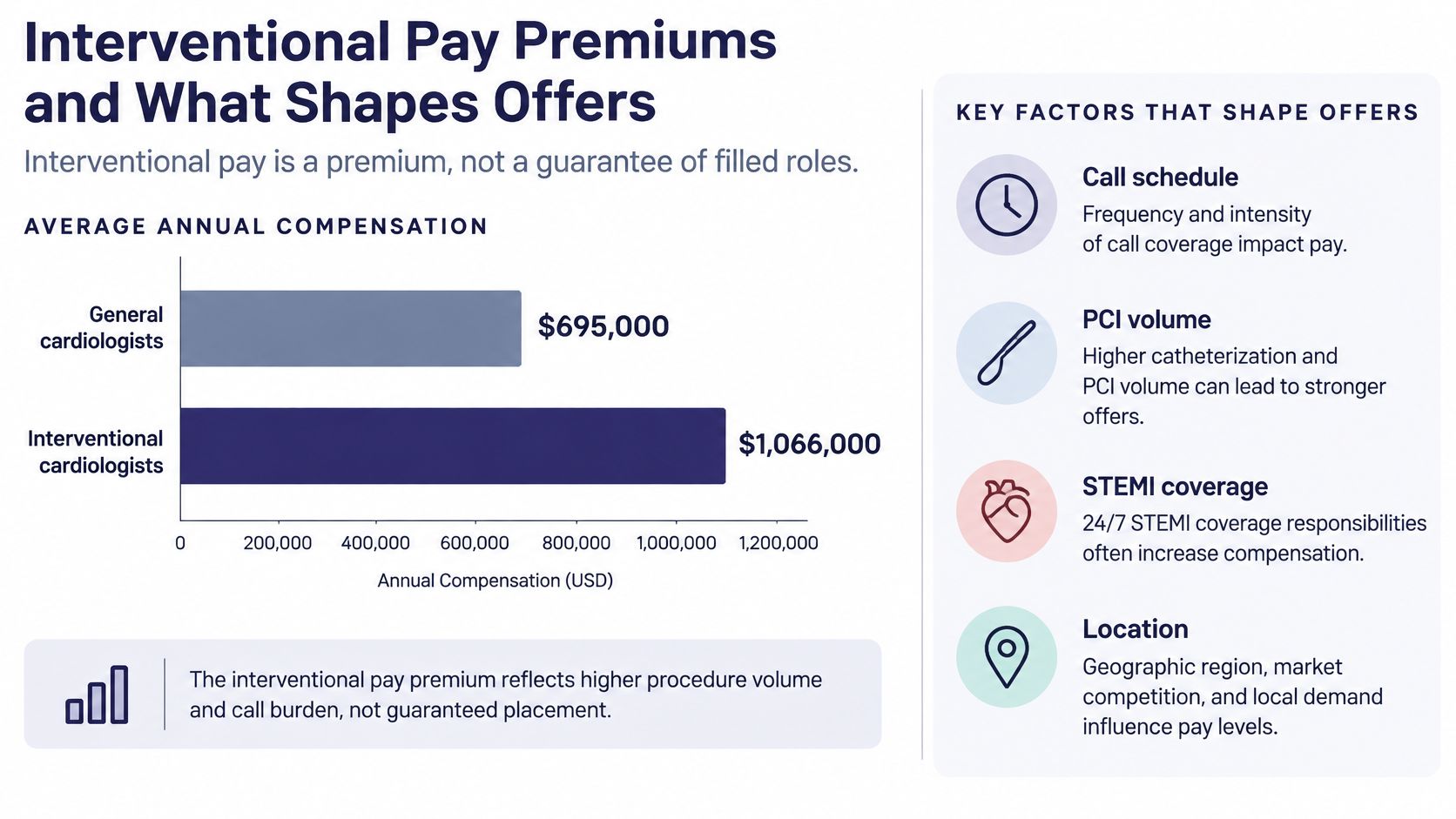
A MedAxiom compensation report cited for 2025 put average general cardiologist pay at approximately $695,000 and interventional pay at approximately $750,000. The difference is about $55,000, or 7.9%, per Medscape's reporting on interventional cardiology compensation and pipeline concerns. Hold that gap next to coverage, not next to the job title.
The comparison below sets the two averages side by side.
Benchmark | Figure | Year and context |
|---|---|---|
General cardiologist, average compensation | About $695,000 | 2025, MedAxiom report |
Interventional cardiologist, average compensation | About $750,000 | 2025, MedAxiom report |
Interventional premium over general cardiology | About $55,000 (about 7.9%) | 2025, derived from the two averages |
A single-digit premium against a heavier schedule
An open interventional role is a coverage problem. The constraint is how many operators the program needs to staff emergency PCI without unsafe call, not the single vacancy on the org chart. One missing physician shifts nights, weekends, catheterization-laboratory responsibility, and acute coronary syndrome activation onto the physicians still in place.
A 7.9% differential is thin pay for that package. Headline salary rarely closes the search. Candidates weigh total workload, night and weekend coverage, productivity expectations, and partnership tracks against the title.
Price the whole package against safe call coverage:
Guaranteed salary that reflects acuity and hours, not only the subspecialty label.
wRVU conversion stated explicitly, because productivity terms drive year-two earnings.
Call stipends paid separately from production, so night work is not invisible.
Quality and STEMI response incentives tied to measures the group can influence.
Sign-on payments and relocation, the fastest levers when several programs are bidding for the same operator.
Protected nonclinical time for teaching, program development, or structural heart planning.
Actual pay varies by geography, ownership model, procedural mix, and academic versus private-practice setting. Treat the MedAxiom averages as budgeting anchors, not as offer letters. Link variable pay to transparent procedural benchmarks such as PCI volume and STEMI response, and price nonprocedural duties separately. A transparent structure is easier to defend internally and easier for a candidate to compare against current interventional cardiologist salary data.
Procedural Volume Thresholds Employers Should Check
A minimum of 400 coronary interventional procedures per year is the ACGME threshold for an interventional cardiology program. For employers, that figure is a training floor, not a staffing plan: the question is how many operators the program needs to cover emergency PCI without an unsafe call burden.
Threshold | Requirement | What it signals to employers |
|---|---|---|
Program minimum (ACGME) | At least 400 coronary interventional procedures a year | Minimum program volume |
Fellow minimum, fourth year (ACGME) | At least 250 coronary interventional cases | Minimum hands-on exposure |
Case definition (ACGME) | All coronary interventional procedures during one hospitalization | Basis for comparing candidate logs |
The current ACGME program requirements for interventional cardiology set the program minimum at 400 coronary interventional procedures annually and require each fourth-year fellow to participate in at least 250 coronary interventional cases. Use these figures to assess training exposure, not as a recommended operating target for every hospital. Program needs depend on the coverage the service must provide.
How to read a case log in an interview
Ask how cases were counted before comparing totals. A coronary interventional case includes all coronary interventional procedures performed during one hospitalization, so a procedure count may differ from a hospitalization count. Comparing logs on the same basis makes the figures more meaningful.
Then examine the work behind the total. Ask about primary angioplasty for acute myocardial infarction, stenting, atherectomy, intravascular ultrasound and mechanical circulatory support. The mix helps distinguish logged volume from experience making decisions during acute care.
Rule of thumb: Look for documented fourth-year volume and acute MI exposure. Ask what the candidate decided during emergency cases, not only how many procedures they logged.
The same thresholds test your own program
A hospital's case volume is only one part of the staffing calculation. Leaders also need enough operators to cover emergency PCI and distribute call responsibly. A program may meet the ACGME training minimum yet still face a coverage gap if too few physicians share the workload.
Review the program's case mix and coverage model together when assessing whether a hire can be sustained. The overview of interventional cardiology programs provides context for comparing candidate training backgrounds.
Metro and Rural Hiring Conditions Compared
The economics of an interventional hire start with the salary and end with the program. Interventional compensation sits among the highest levels across cardiovascular subspecialties, and a 2022 national cardiovascular survey covering 198 programs and 5,806 providers documents the operational weight behind that figure in Cardiovascular Interventions' analysis of compensation and production trends. Reading a single number as evidence of physician supply or employer affordability misses the point.
Scenario one, a metropolitan program adding capacity
A large academic center expanding structural heart and complex coronary work draws applicants through training, research and procedural breadth. Its candidate pool runs deeper, so it can post a narrower role and still build a slate quickly. The trade-off cuts the other way: desirable locations can carry fewer openings and lower compensation precisely because the pool is deep.
Its operator count is a planned headcount. Leadership sets the call rotation first, typically filling the group to a level where night coverage lands at a frequency the department will accept, then recruits against that number.
Scenario two, a rural hospital holding a STEMI program open
Now consider a community hospital that needs dependable emergency PCI plus routine catheterization coverage. Say the group has three operators sharing call. One in three nights, plus the after-hours activations that follow, is the kind of schedule that produces a resignation within two years. Four operators moves the rotation to one night in four, which most groups can live with.
The candidate weighs isolation, call frequency and clinical autonomy. The hospital competes on scope of practice, sign-on terms, clinical autonomy and a call-sharing model that includes locum coverage when the rotation thins. Isolation is easier to sell when the schedule is predictable.
The number that matters: how many operators sustain emergency coverage without unsafe call. In most hospitals that calculation turns one vacancy into a team hire, not a single replacement.
Salary is the smallest line in the model
Interventional work requires capital-intensive catheterization-laboratory infrastructure, anesthesia and surgical backup, imaging technicians, nursing coverage, emergency availability and continuous quality oversight. The value of a hire therefore depends on the complete program model, not the salary line. A hospital can afford an interventionalist it can't keep busy; it can't afford a laboratory it can't staff.
Sequence the build in two tracks. Recruit the permanent core team against the operator count, then use interim locum coverage during ramp-up so volume doesn't migrate to a competing system while the search runs. The planning question at the start of every search is how many operators the service line needs, never how many vacancies are currently open.
Choose Your Next Move in the Interventional Market
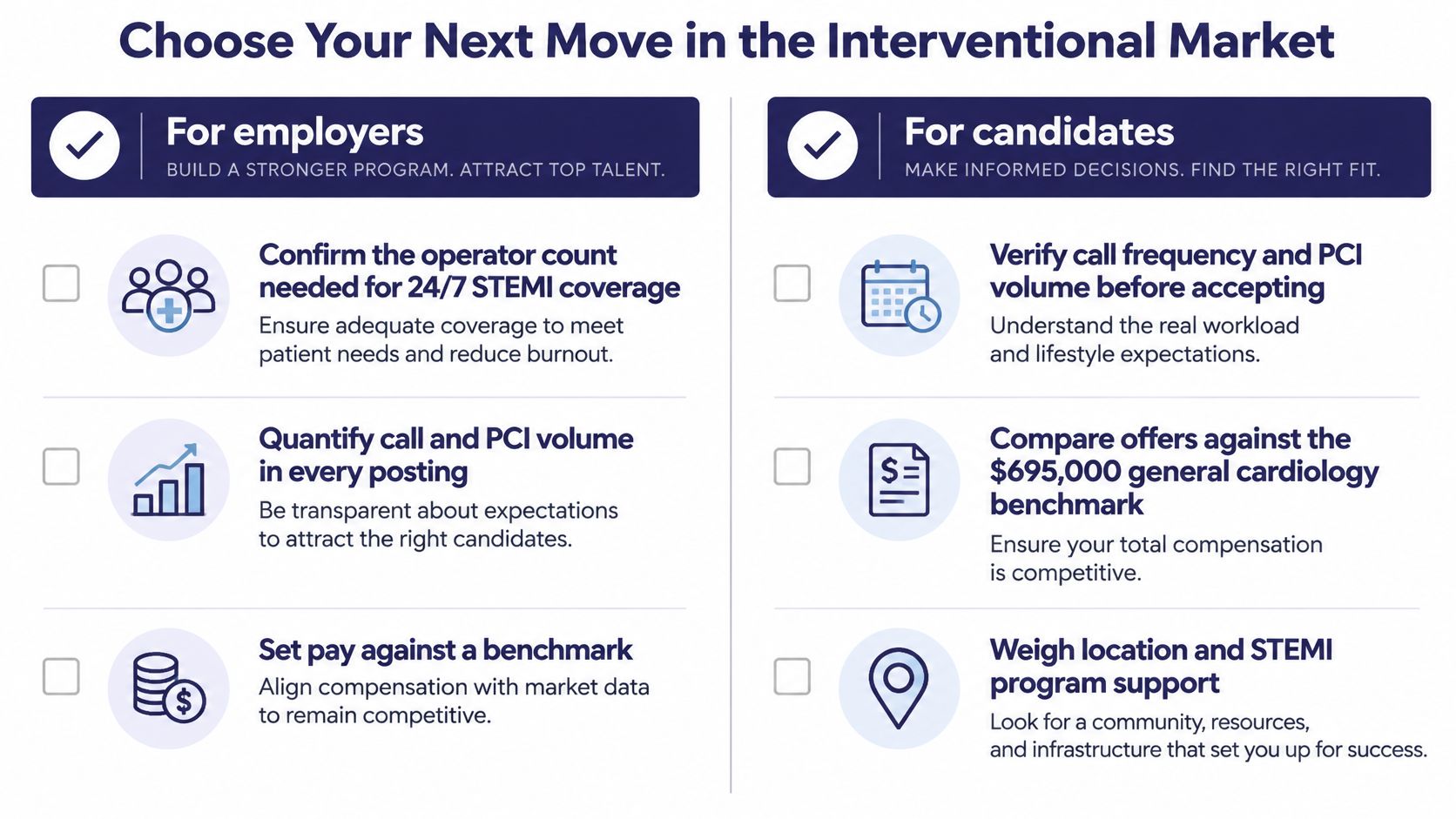
Decisions get easier once the unit of planning shifts from the vacancy to the coverage plan. The checklist below splits by reader.
For employers
Size the operator count first. Confirm how many interventionalists it takes to cover 24/7 STEMI and elective laboratory work at a call frequency the group will sustain.
Put numbers in the posting. Annual PCI volume, call frequency, protected laboratory sessions and APP support belong in the first paragraph.
Set pay against a benchmark, then extend it. Start from the premium average, then price call, quality and nonprocedural duties separately.
Choose the bridge deliberately. Decide up front whether the ramp-up period runs on permanent recruitment, locum coverage or both.
Protect the physicians already carrying call. Retention of the existing group is part of the staffing plan, not an afterthought to it.
For candidates
Audit your own log. Check fourth-year case volume and program thresholds before a conversation, and know your acute MI exposure in detail.
Compare schedules, not titles. Night and weekend frequency, STEMI activation volume and productivity expectations determine the job far more than the subspecialty label.
Weigh the metro and rural trade-offs. A deeper applicant pool in a desirable city usually means more competition; a rural program usually means more autonomy and a call rotation that needs scrutiny.
American Cardiology Group's services include permanent physician recruitment, locum tenens solutions, advanced practice recruitment and executive recruitment, all confined to cardiac care. Facilities can open a Request Staffing form with a first name, last name, email and state, and the team manages credentialing and compliance for locum providers so onboarding moves quickly.
The deliverable from this analysis is a sized staffing plan. A vacancy is just the symptom that started the conversation.
A stalled interventional search usually isn't a compensation problem, it's a coverage plan that was never sized. American Cardiology Group recruits exclusively within cardiology and cardiac surgery, placing interventional cardiologists into permanent roles and supplying locum tenens coverage while a service line rebuilds its operator count. Its team manages credentialing and compliance for locum providers so facilities can onboard quickly, and a Request Staffing form is all it takes to start. Visit American Cardiology Group to turn a coverage plan into an active search.
Comments