
Mid Level Providers in Cardiac Care: Roles and Teams
In 2023, 92% of rural counties were designated primary-care shortage areas, according to Rural Health Information Hub. For cardiovascular leaders, that figure reframes the discussion about mid level providers: adding clinicians matters only if the staffing model connects patients to the right expertise, escalation pathway, and follow-up.
A cardiac program shouldn't evaluate nurse practitioners and physician assistants as interchangeable replacements for cardiologists. The more useful question is which clinical work can be delegated safely, how much physician attention that work still requires, and whether the resulting arrangement improves access without weakening accountability.
Table of Contents
Who Mid Level Providers Are and How They Differ From Cardiologists - NP, PA and cardiologist roles compared - Authority follows the individual clinician
Where Mid Level Providers Fit on the Cardiac Care Team - Cardiac tasks and who typically owns them - Match specialty experience to the service
How to Meet Incident-To Billing Conditions - Verify the conditions in sequence - Build a billing decision into the visit
Measuring Safe Role Expansion in Cardiology Programs - Use a capability matrix before expanding duties - Measure recovered capacity, not transferred burden
Credentialing and Vetting a Cardiology Mid Level Provider - Verify the evidence behind the title - Separate recruitment screening from institutional approval
Choose the Mid Level Provider Model for Your Program - Match the assignment to the setting - Define the role before opening the search
Who Mid Level Providers Are and How They Differ From Cardiologists
Mid level providers are nurse practitioners (NPs) and physician assistants (PAs) who deliver clinical care within their professional scope, often through physician collaboration or supervision. Cardiology programs commonly call them advanced practice providers (APPs). Their authority comes from licensure, education, certification, state law, and facility privileges, not from the APP designation itself.
The workforce is substantial. HRSA's State of the U.S. Health Care Workforce report reports 374,970 NPs and 29,433 PAs in primary care in 2024, compared with 340,319 primary-care physicians in 2023, and describes an AAMC-projected national physician shortage of 13,500 to 86,000 by 2036, with greater APRN and PA utilization needed to meet additional demand. The primary-care figures use different reporting years and aren't equivalent full-time staffing measures; they establish workforce scale, not cardiology capacity.

NP, PA and cardiologist roles compared
Role | Entry training | Certification | Prescribing | Supervision model | Typical cardiology role |
|---|---|---|---|---|---|
Nurse practitioner (NP) | Master's or DNP after RN licensure | National certification in a population focus, such as acute care or family | Prescriptive authority in all states, subject to state restrictions | State law sets requirements, from collaboration to full practice | Heart failure follow-up, post-procedure clinics |
Physician assistant (PA) | Master's from an accredited PA program, about 2 to 3 years | PANCE, then state licensure | Prescriptive authority in all states, subject to state restrictions | Practice agreement with a supervising physician, as required by state law | Inpatient consults, first assist, clinic evaluation |
Cardiologist (MD or DO) | Medical degree plus internal medicine residency and cardiovascular disease fellowship | Specialty board certification following fellowship and examination | Full physician prescribing authority within applicable law | Independent practice within licensure and privileges | Complex diagnosis; interventional and electrophysiology procedures with additional training and privileges |
The NP pathway builds on nursing education and RN licensure. Population-focus certification matters because preparation for family practice isn't identical to preparation for adult acute care. A DNP is a nursing doctorate, not a medical degree or evidence of cardiology subspecialty training.
PAs complete a medical-model educational program and pass the Physician Assistant National Certifying Examination. Their subsequent cardiovascular preparation needs separate evaluation. An experienced cardiothoracic surgical PA and a newly graduated outpatient PA may hold the same professional title but require very different onboarding.
Cardiologists complete physician training followed by specialty preparation in cardiovascular disease. Interventional cardiology and electrophysiology require further subspecialty preparation and appropriate privileges; general cardiology credentials don't automatically authorize every cardiac procedure.
Authority follows the individual clinician
Prescribing authority doesn't mean unrestricted authority over every medication, setting, or clinical service. Hospital leaders must distinguish legal permission to practice from facility permission to perform a particular task. American Cardiology Group's APRN versus physician assistant comparison provides additional role distinctions for recruitment planning.
Staffing principle: An APP is a second set of clinical hands scheduled around the physician's attention, not a replacement for that attention.
Two NPs in the same hospital can have different authority because their certification, experience, and approved privileges differ. The job title alone never defines scope.
Where Mid Level Providers Fit on the Cardiac Care Team
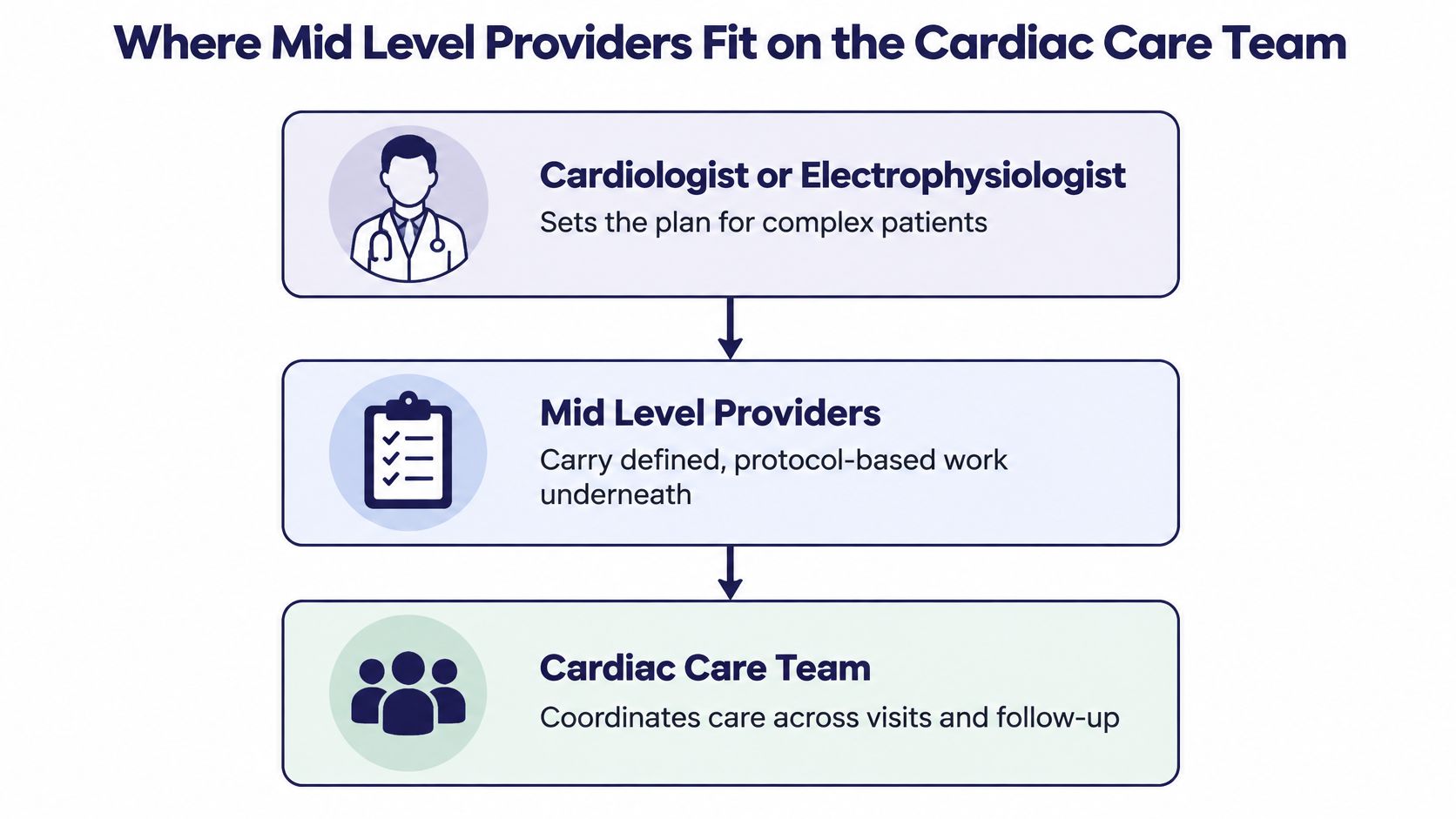
A cardiologist or electrophysiologist sets the plan for complex patients, while mid level providers carry defined, protocol-based work within an agreed clinical framework. Nurses, pharmacists, device specialists, and care coordinators connect that plan across visits and transitions. The operational task is assigning responsibility precisely enough that abnormal findings reach the accountable clinician rather than remaining in an inbox.
This distinction matters because delegation changes who performs the work, not who owns the overall course of care. A clinically appropriate assignment also needs a separate billing and supervision review before the visit is treated as physician-delivered work.
Cardiac tasks and who typically owns them
The following assignments describe a governance model, not universal legal permissions. Every assignment requires appropriate individual competence and privileges.
Cardiac task | Typical mid level role | Physician responsibility |
|---|---|---|
Heart failure medication titration | NP or PA under protocol | Cardiologist reviews changes in reduced ejection fraction and advanced therapy decisions |
Post-PCI and post-discharge follow-up | NP in clinic | Cardiologist manages new complications and escalations |
Inpatient consults and rounding | PA or NP on the daily census | Attending cardiologist makes admission and acuity decisions |
Cath lab and EP procedural support | PA first assist or credentialed NP | Interventionalist or electrophysiologist performs and is accountable for the procedure |
Device clinic checks | NP | Electrophysiologist decides on device programming changes and complex alerts |
For heart failure medication titration, the APP can reconcile medications, assess symptoms, review renal function and electrolytes, and implement an approved titration pathway. The protocol should identify when hypotension, worsening congestion, renal deterioration, or diagnostic uncertainty requires cardiologist review rather than another routine adjustment.
Post-percutaneous coronary intervention follow-up combines medication reconciliation with assessment of symptoms, adherence, and access-site concerns. A scheduled follow-up shouldn't remain an APP-only encounter when the patient develops new chest discomfort, suspected bleeding, or another potential complication. The workflow needs an immediate route to physician assessment.
Inpatient APPs can collect clinical information, prepare assessments, coordinate testing, and maintain continuity across the daily census. The attending cardiologist retains the admission and acuity decisions in this model. Night coverage needs equally explicit instructions for unstable arrhythmias, ischemic symptoms, and hemodynamic deterioration.
The service should judge expansion through specific controls rather than appointment volume alone. Relevant measures include protocol deviations, unresolved alerts, escalation timing, physician review of flagged findings, and the share of delegated visits that change acuity or treatment strategy. High throughput can conceal weak delegation if those exceptions accumulate without review.
Match specialty experience to the service
NPs and PAs work across surgical and outpatient settings, but those broad workforce patterns do not indicate which clinicians are ready for a particular cardiac service. Program leaders should evaluate experience at the task level: procedural assistance, device assessment, inpatient management, and clinic follow-up require different preparation.
In cardiothoracic, structural-heart, and vascular programs, defined PA assignments may include first assisting, perioperative management, clinic evaluation, procedural preparation, and postoperative follow-up. Device-clinic assignments require another competency profile, including interrogation review and recognition of alerts that need electrophysiologist interpretation.
Procedure-room presence doesn't confer operator authority. A PA or NP supports the operator within approved privileges; the physician remains accountable for the procedure and decisions that change procedural strategy or patient acuity. APPs remain accountable for their own professional practice.
How to Meet Incident-To Billing Conditions
An APP's presence during a visit doesn't make the service billable under a physician's name. Clinical delegation and billing eligibility are separate decisions, and a compliant clinical encounter can still fail the requirements for incident-to payment.
The AAPA Medicare billing guidance describes the relevant incident-to conditions and the payment distinction: qualifying services billed under the supervising physician or practitioner receive 100% of the Medicare Physician Fee Schedule amount, while services furnished directly by an eligible nonphysician practitioner generally receive 85%. Organizations must evaluate the applicable setting and billing pathway before applying those rates.
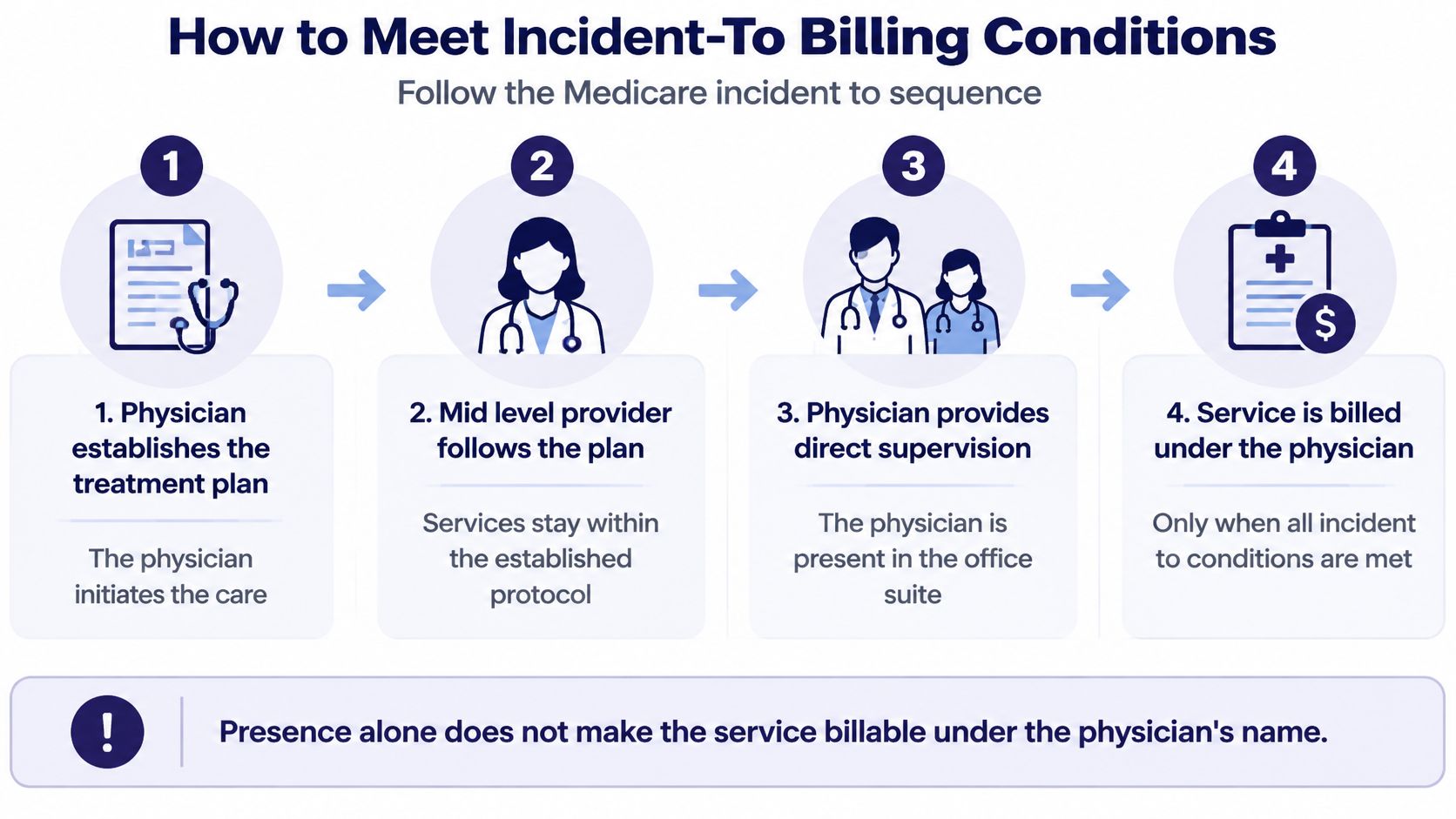
Verify the conditions in sequence
The service must be integral to the patient's normal treatment. The documentation should connect the APP encounter to an established treatment plan. A familiar patient presenting with a new problem doesn't automatically satisfy this condition because the appointment was labeled follow-up.
A physician or other authorized practitioner must personally perform the initial service. Staff should be able to identify the initiating encounter and the resulting plan. A copied physician name or an unsigned template isn't a substitute for the required initial professional service.
The initiating practitioner must remain actively involved. The record should demonstrate continuing participation in treatment, rather than a historical consultation followed by indefinite APP-only management. The common failure is treating a longstanding physician-patient relationship as sufficient evidence of current involvement.
The service must comply with state law. Billing eligibility doesn't expand prescribing authority or clinical scope. Scheduling staff and coding personnel shouldn't assume that payer recognition overrides restrictions applying to the individual clinician.
The required supervision must be in place. The practice must verify the applicable supervision standard for the service and current rules. Where on-site presence is required, listing an off-site physician as supervisor doesn't satisfy that requirement.
Build a billing decision into the visit
The compliance team should approve a setting-specific workflow covering scheduling, supervisor availability, documentation, and claim submission. The infographic depicts an office-based sequence; it shouldn't be applied automatically to hospital inpatient or facility encounters, which require their own billing analysis.
Billing control: The appointment label describes the schedule. The documented service and applicable rules determine the claim.
Consider a stable heart failure patient attending an NP-led clinic for medication titration under an established plan. That visit may qualify when every applicable condition is met. If the patient instead presents with a new complaint outside that plan, the practice shouldn't force the encounter into incident-to billing; it must arrange the appropriate initial service or use another valid billing pathway.
Measuring Safe Role Expansion in Cardiology Programs
Cardiology programs averaged roughly six to seven APPs for every 10 physicians, while inpatient and outpatient cardiac APP employment grew 50% over eight years, according to a report described by Becker's Cardiology. Those figures describe utilization, not an optimal staffing ratio or proof of safety.
The executive mistake is treating APP headcount as the intervention. Selective delegation is the intervention: assigning suitable moderate-complexity work to prepared clinicians while preserving physician capacity for higher-acuity decisions. Adding a position without defining its dependencies can shift unfinished work into physician message queues.
Use a capability matrix before expanding duties
Each proposed assignment needs a written capability assessment. The examples below are planning specifications, not substitutes for local clinical policies.
Task complexity | Required training | Escalation triggers | Physician availability | Outcome metrics | State-law constraints |
|---|---|---|---|---|---|
Stable chronic-disease management | Disease-specific pathways and medication assessment | Deterioration or findings outside protocol | Named reviewing cardiologist | Therapy optimization, access, readmissions | Prescribing and collaboration requirements |
Rounding, admissions and consult support | Acute cardiovascular assessment and supervised case review | Instability or uncertain diagnosis | Attending coverage with clear contact route | Escalation timeliness, length of stay, return utilization | Authorized scope and admission-related requirements |
Night coverage | Emergency recognition and service-specific orientation | Ischemia, unstable arrhythmia, hemodynamic change | Defined urgent response and backup | Response reliability, safety events | Supervision and ordering authority |
Subspecialty support | Electrophysiology, structural-heart, cardio-oncology or adult congenital preparation | Complex alerts or deviation from treatment pathway | Designated subspecialist | Follow-up completion, protocol adherence, patient experience | Permitted services and facility privileges |
Bed management and discharge coordination also need ownership rules. An APP can coordinate progress, but unresolved clinical questions shouldn't become administrative discharge targets.
Measure recovered capacity, not transferred burden
A dashboard should include access and wait times, readmissions, guideline-directed therapy use, physician capacity, turnover, and patient experience. Definitions must distinguish case complexity and setting so an APP clinic isn't judged against a physician clinic managing a different population. A consistent cardiology quality metrics framework helps connect staffing decisions to service-line performance.
Economic evaluation must include compensation pressure. SullivanCotter's 2024 APP Compensation and Workforce Survey found that median total cash compensation since 2021 increased 17% in primary care, 15% in surgical specialties, and 14% in medical and hospital-based specialties.
Hospitals should weigh compensation, onboarding, physician review time, and coverage costs against access gains and usable physician capacity recovered. More APP encounters aren't a sufficient return if cardiologists must duplicate the work.
Expansion should pause when training, supervision, credentialing, or patient-safety infrastructure can't support the next assignment, even when recruitment remains possible.
Credentialing and Vetting a Cardiology Mid Level Provider
Physician supply keeps tightening, and AAMC workforce studies project the gap will widen while the NP and PA workforce grows substantially. A larger advanced-practice labor pool doesn't establish a correspondingly larger supply of cardiology-ready candidates. Licensure is common; cardiovascular preparation is not.
Credentialing must test fit for the actual assignment, not just confirm that a candidate holds an NP or PA license. Acute inpatient coverage, longitudinal heart failure management, and procedural support require different evidence of preparation. A candidate cleared for routine outpatient follow-up may be entirely unproven in a CCU.
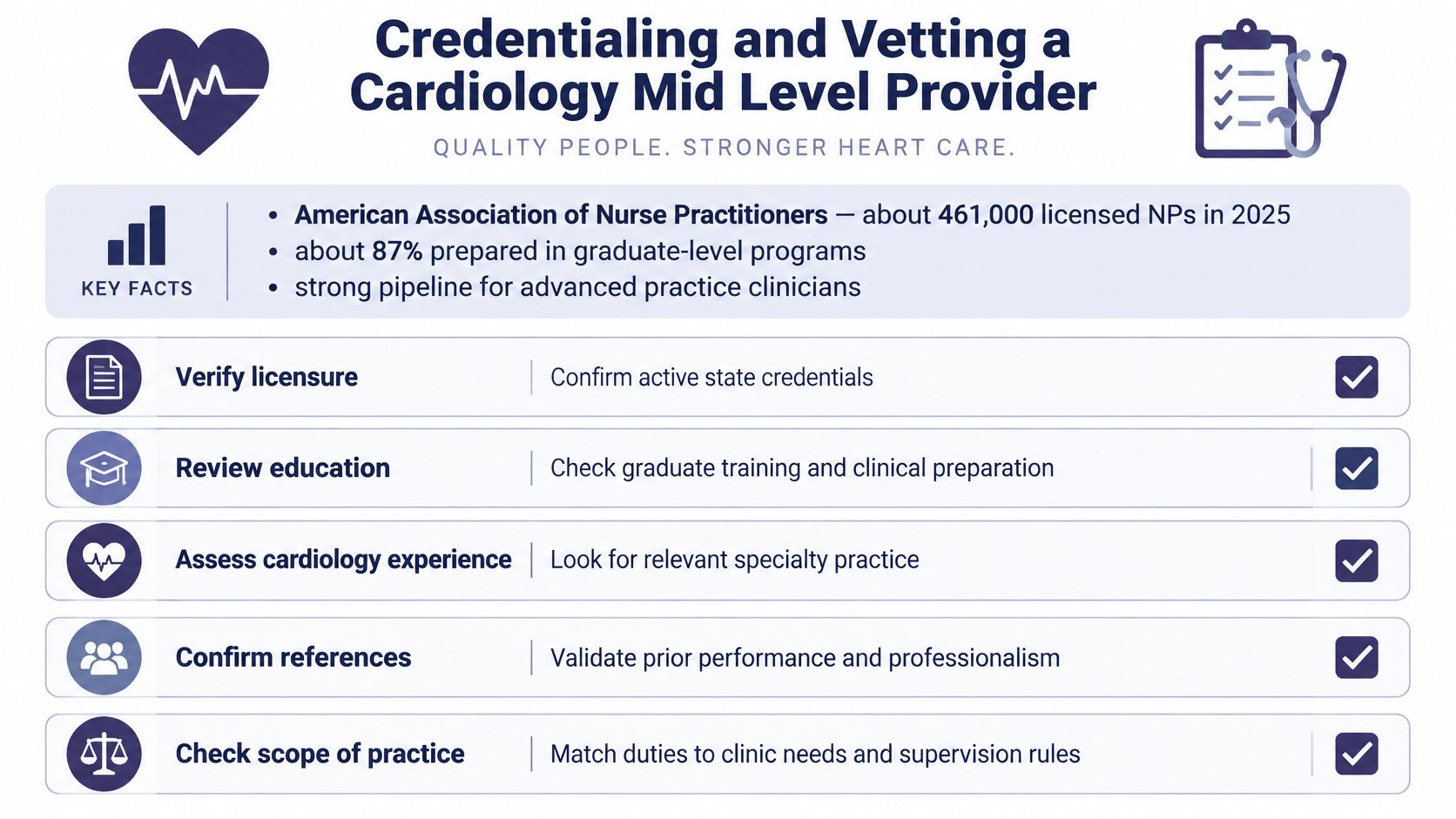
Verify the evidence behind the title
Match certification to the intended population and setting. Verify acute-care preparation where relevant and examine any claimed cardiovascular certification directly. A specialty course is no replacement for the population-focus preparation the role requires.
Document cardiovascular experience. Review prior duties, case mix, references, and evidence of independent execution within approved scope. Time in general outpatient medicine doesn't establish competence in decompensated heart failure or complex rhythm management.
Confirm prescribing authority and state requirements. Check active licensure, applicable registrations, restrictions, and required agreements before assigning medication duties the candidate may not be authorized to perform.
Assess procedural competencies individually. For cath lab or electrophysiology roles, obtain evidence supporting each proposed privilege and use supervised assessment where appropriate. Employment in a procedural department doesn't itself demonstrate first-assist competence.
For PAs, verify specialty preparation and facility privileges. Review relevant surgical or cardiovascular training and prior privileging records. A previous employer's approval informs the receiving facility's assessment without substituting for it.
Define the collaboration or supervision arrangement. Name the responsible physician, coverage boundaries, consultation triggers, and backup arrangements. An agreement that exists only as a signed document won't resolve a clinical escalation during an uncovered shift.
Separate recruitment screening from institutional approval
Primary-source verification, reference assessment, competency review, and privileging serve different purposes. A complete healthcare credentialing process assigns each item a verifier and a final approver. Facilities should also document an orientation plan for duties the candidate is authorized to perform but hasn't yet demonstrated locally.
Recruitment partners can reduce administrative work for locum and permanent placements, while hospitals retain their institutional approval responsibilities. Each locum professional in American Cardiology Group's network is carefully vetted before placement, and its team manages credentialing and compliance for locum providers so facilities can onboard quickly. That support should connect to the hospital's medical staff process rather than run as a separate, uncoordinated checklist. A recruiter's file review narrows the funnel. The privileging committee still owns the final decision.
Choose the Mid Level Provider Model for Your Program
The appropriate model follows the service bottleneck, not the availability of a particular applicant. Hospital executives should identify which patient encounters are delayed, why they're delayed, and what clinical decision prevents the next step.
Match the assignment to the setting
Program profile | Model to evaluate | Initial performance measure |
|---|---|---|
Outpatient-heavy practice with follow-up backlog | Protocol-based NP or PA clinics for heart failure and post-discharge care | Median days to the first clinic appointment |
Inpatient-heavy academic or community hospital | APP rounding and consult support aligned with census peaks | Readmissions among APP-covered admissions, adjusted for case mix |
Rural or critical-access hospital | APP coverage integrated with telecardiology, physician escalation and procedural access | Share of cardiology referrals completed locally |
For an outpatient practice, the strongest candidate model may be a clinic that removes routine follow-up from congested physician schedules without generating duplicate evaluations. Leaders should examine completed care pathways, not merely appointment slots opened.
An inpatient program needs coverage aligned with actual census and consultation demand. APP assignments should preserve continuity across handoffs while making the attending cardiologist's decision responsibilities explicit.
Rural programs require particular caution. Local APP availability won't solve a referral bottleneck if patients still lack diagnostic services, remote specialist input, or a reliable transfer pathway.
Define the role before opening the search
The implementation order should remain clear:
Confirm scope. Approve the role's patient population, setting, and boundaries.
Map tasks. Complete the capability matrix and identify operational dependencies.
Validate billing. Check incident-to eligibility and other applicable pathways before go-live.
Verify candidates. Apply the credentialing checklist to the proposed duties.
Then recruit. Search against an approved clinical role rather than a generic APP title.
The resulting requisition should describe both the work assigned and the physician support available. That's the basis for a sustainable match.
American Cardiology Group offers Permanent Physician Recruitment, Locum Tenens Solutions, Advanced Practice Recruitment, and Executive Recruitment for cardiac programs. Hospitals defining an NP or PA role can visit American Cardiology Group to discuss recruitment aligned with their care setting, specialty requirements, and physician coverage model.
Comments