
Rural Physician Recruitment Playbook
The most popular advice in rural physician recruitment is also the least durable: increase the signing bonus, expand the marketing campaign, and wait for the right specialist to appear. That approach treats a structural workforce problem as a vacant-position problem. A rural hospital may fill a role this way, but it won't necessarily build the clinical infrastructure, professional support, or community conditions that persuade a cardiologist to stay.
The access gap makes the weakness of transactional recruiting clear. Roughly 20% of the U.S. population lives in rural areas, but only about 10% of physicians practice there, and only about 1% of graduate medical training programs are located in rural communities, according to a review of rural physician distribution and training. Rural physician recruitment must therefore connect training, service-line design, incentives, and retention. For cardiovascular programs, that means building a system in which an interventional cardiologist, electrophysiologist, heart failure specialist, or cardiovascular advanced practice provider can practice safely and develop professionally without being isolated.
Table of Contents
Rethinking the Rural Staffing Crisis - Why transactional searches fail - The operating model must change
Conducting a Targeted Cardiovascular Needs Assessment - Define the service-line gap - Match specialty ambition to local capacity
Sourcing Specialists Through Federal and Academic Pipelines - Start with shortage-area intelligence - Build academic relationships before a vacancy appears
Engineering Retention Through Incentives and Clinical Support - Make the financial package durable - Treat clinical support as compensation
Onboarding and Measuring Long-Term Placement Success - Use a staged onboarding model - Track cohorts, not anecdotes
Partnering for Sustainable Cardiac Program Growth - Select for strategic depth
Rethinking the Rural Staffing Crisis
Signing bonuses can start a conversation. They cannot repair a weak pipeline, an undefined scope of practice, or a clinical program that expects one physician to cover every cardiovascular need. Hospital boards should judge rural physician recruitment by whether the organization can build a dependable supply of clinicians, not by how quickly a vacancy disappears.
The national distribution problem is substantial. In 2022, urban areas had nearly three times as many active physicians per 100,000 population as rural areas, 286 compared with 98, and more than 60% of primary medical, dental, and mental health shortage areas were rural in 2023, according to the authoritative rural workforce review. These figures are not specific to cardiology, but they define the labor market surrounding every rural service line. A cardiovascular program is competing for specialists, trainees, advanced practice providers, and clinical support staff in communities that already have fewer training connections and thinner coverage.
Why transactional searches fail
A conventional search starts with a generic job description and ends with compensation negotiations. It may emphasize lifestyle, a signing payment, and distance from metropolitan congestion. Those points matter, but they do not answer the operational questions that determine whether a cardiovascular specialist can succeed:
Clinical scope: Will the physician perform interventional procedures, interpret diagnostic studies, manage structural cases, or provide longitudinal heart failure care?
Coverage model: Who handles nights, inpatient consults, emergency transfers, and follow-up when the physician is away?
Professional support: Can the physician discuss complex cases with tertiary colleagues and use reliable transfer protocols?
Family and community fit: Can a spouse find suitable employment, and can the family establish a durable life in the community?
The supply trend makes this mismatch more dangerous. A national study found that rural family physicians declined from 11,847 in 2017 to 10,544 in 2023, a net loss of 1,303 physicians, or 11.0%, as reported in the national rural family physician analysis. A separate PAI-Avalere analysis found that rural areas lost nearly 2,500 physicians between January 1, 2019, and January 1, 2024, while the number of independent rural physicians fell 43%, from 21,956 to 12,467. Rural recruitment is becoming harder as independent practice options shrink.
Board-level rule: A bonus should support a workforce strategy, not substitute for one.
The operating model must change
Rural systems are shifting from one-time physician searches toward training pipelines, advanced practice provider integration, and flexible staffing models, according to coverage of the rural recruiting shift. The same coverage reports that 58% of rural respondents rated APPs extremely important, while 25% planned to reduce APP locums use in 2026 and 38% reported using no APP locums.
For cardiovascular services, redesign the team around defined responsibilities. APPs can support inpatient rounding, chronic disease management, post-procedure follow-up, medication titration, and care coordination. A cardiologist still owns work requiring specialist training, including complex assessment and procedural decisions. This structure protects specialist time, extends access between physician visits, and gives the program a staffing pipeline beyond a single hard-to-fill vacancy.
Conducting a Targeted Cardiovascular Needs Assessment
A rural hospital should not open a search for “a cardiologist” until its leaders define the clinical work, support structure, and growth path the role must carry. Vacancy filling is the wrong starting point. The assessment should connect local demand, referral patterns, procedural capacity, coverage obligations, and available infrastructure to a sustainable care-team design.
Define the service-line gap
Start with a written inventory of current cardiovascular services. Clinical directors and administrators should review five areas:
Referral leakage and access delays. Identify conditions routinely sent to tertiary centers. Separate cases that require transfer from those the hospital could manage locally with the right physician, equipment, and escalation process.
Procedural capability. Record procedures the hospital performs, plans to add, or cannot safely support. An interventional cardiologist needs a different environment from a noninvasive cardiologist or electrophysiologist.
Coverage exposure. Map inpatient consults, emergency evaluations, clinic sessions, diagnostic interpretation, call duties, and time away from the hospital. Broad scope requires a defined plan for sharing the workload.
APP utilization. Determine whether NPs and PAs can handle follow-up, patient education, medication surveillance, and care transitions under physician supervision.
Technology and escalation. Assess whether telecardiology, remote rhythm review, remote hemodynamic monitoring, or tertiary consultation can extend local capacity.
The resulting candidate profile should separate minimum requirements from the intended program-building opportunity. A rural hospital seeking an electrophysiologist should specify diagnostic, procedural, consultative, and governance responsibilities. A broad cardiovascular posting that expects the hire to create a rhythm program leaves the organization without a clear staffing plan and attracts poorly matched candidates.
Match specialty ambition to local capacity
Career goals must fit the hospital's operating model. An advanced heart failure physician may require a reliable relationship with a transplant or mechanical circulatory support center. An interventional cardiologist needs transfer protocols for cases beyond local capability. An electrophysiologist may require equipment, trained technical staff, device-clinic support, and access to colleagues who can help manage complex arrhythmia cases.
Separate the immediate access problem from the longer-term program design. The hospital may need permanent outpatient cardiology coverage now while building an academic relationship that could support electrophysiology or structural heart services later. Interim coverage can protect patients while leaders validate demand and infrastructure, but it should remain a bridge with a defined endpoint, not the workforce model.
End the assessment with a decision document approved by the medical staff and board. It should name the target subspecialty, clinical duties, support team, referral relationships, call design, equipment requirements, and measures of success. Those measures must show whether the role expands access through a workable team or merely transfers an unsustainable workload to one physician.
Sourcing Specialists Through Federal and Academic Pipelines
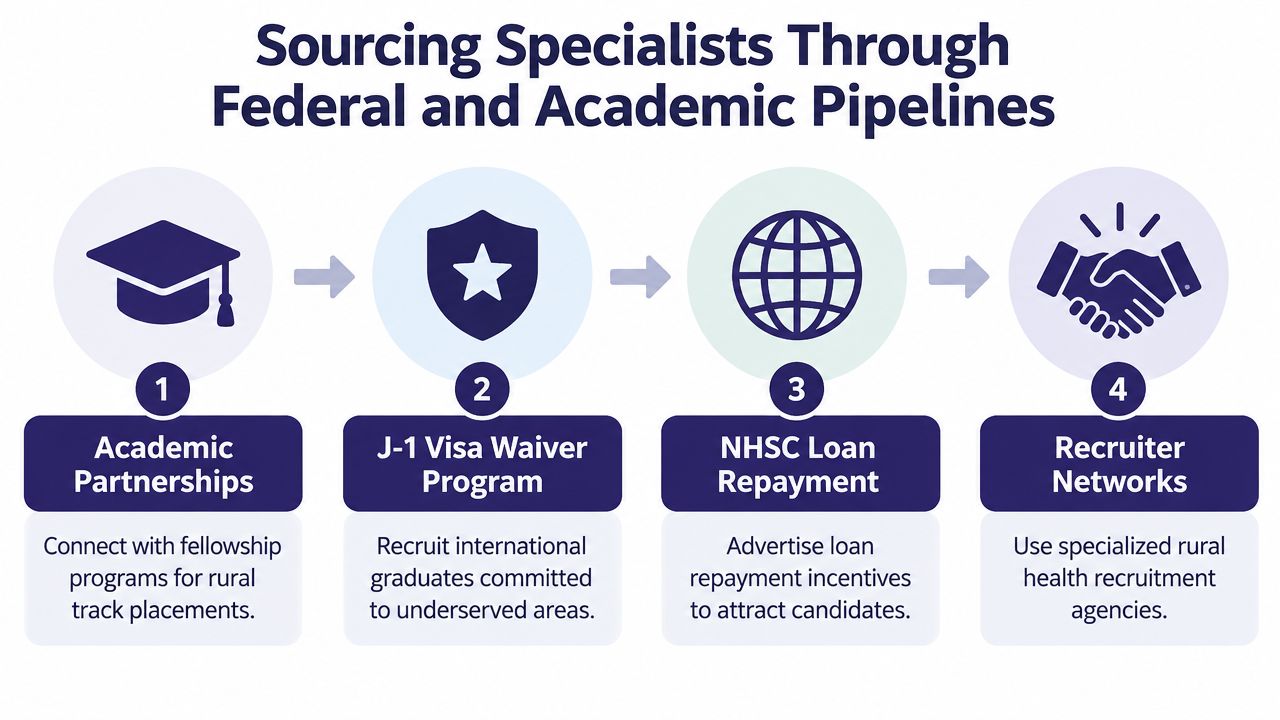
Rural cardiovascular recruitment fails when hospitals wait for a vacancy and then publish a generic job advertisement. The stronger strategy starts earlier, using federal eligibility data, academic relationships, and specialist networks to build a clinical pipeline. Candidates in cardiology subspecialties respond to a credible practice model, including autonomy, community impact, expert backup, and a defined role in developing local services.
Start with shortage-area intelligence
HRSA's Health Workforce Shortage Areas database lets organizations filter by location, discipline, HPSA type, HPSA score, HPSA status, rural status, and update date. The database was last updated on 2026-08-26. Recruitment leaders should check these fields before setting the search strategy. The designation can affect incentive eligibility and shape how the opportunity is presented to candidates.
The AMA reports just under 8,500 primary care HPSA designations covering more than 92 million people and identifies incentives for physicians in HPSAs, including NHSC scholarships and loan repayment, J-1 visa waivers, and Medicare bonus payments, in its policy report on shortage-area physician incentives. These programs can improve the offer, but they cannot repair an unsupported practice. Pair financial and immigration pathways with staffing, referral, and clinical support that make the position workable.
Use a clear sourcing sequence:
Validate designation status: Confirm that the facility and role meet applicable shortage-area requirements before promising an incentive.
Prepare an incentive brief: State eligibility, service obligations, application timing, and repayment conditions in plain language.
Target training audiences: Reach cardiology fellowship leaders, rural-track programs, academic department chairs, and clinicians already interested in underserved care.
Present the operating model: Include call coverage, APP support, tertiary consultation, procedural plans, and family integration resources.
The National Health Service Corps Loan Repayment Program illustrates why the details belong in the employment design. Two years of full-time service requires at least 40 hours per week for 45 weeks per year and can repay up to $75,000. Two years of half-time service requires at least 20 hours per week for 45 weeks per year and can repay up to $37,500, according to the NHSC loan repayment fact sheet. Present the obligation beside the benefit. Candidates need the complete commitment before accepting the role.
Build academic relationships before a vacancy appears
Start with fellowship programs, not recruiting advertisements. A rural hospital can offer longitudinal rotations, teleconsultation, quality-improvement projects, and defined post-training positions. For electrophysiology, structural heart, or advanced heart failure recruitment, the academic relationship should also clarify case review, referral access, and opportunities to develop services without isolating the physician.
Leaders should examine HRSA's Rural Residency Planning and Development program. HRSA states that awards can provide up to $750,000 over three years to create new rural residency programs and that it had invested nearly $54 million since 2019, according to its rural workforce recruitment and training overview. A new rural residency will not directly fill every cardiology vacancy, but it can strengthen the training ecosystem that produces future specialists.
Candidates also need a clear view of how training choices shape practice options. A resource such as Understanding Medical Education can support that discussion. The recruitment message should state what the physician will build, who will provide backup, and how the hospital will measure pipeline growth rather than merely vacancy closure.
Engineering Retention Through Incentives and Clinical Support
Retention is an operating model, not a recruiting afterthought. Financial incentives can bring a physician to a rural market, but professional isolation, excessive call, weak infrastructure, and family dissatisfaction can still drive that physician away. Hospital boards should fund the clinical environment that makes a long-term practice workable.
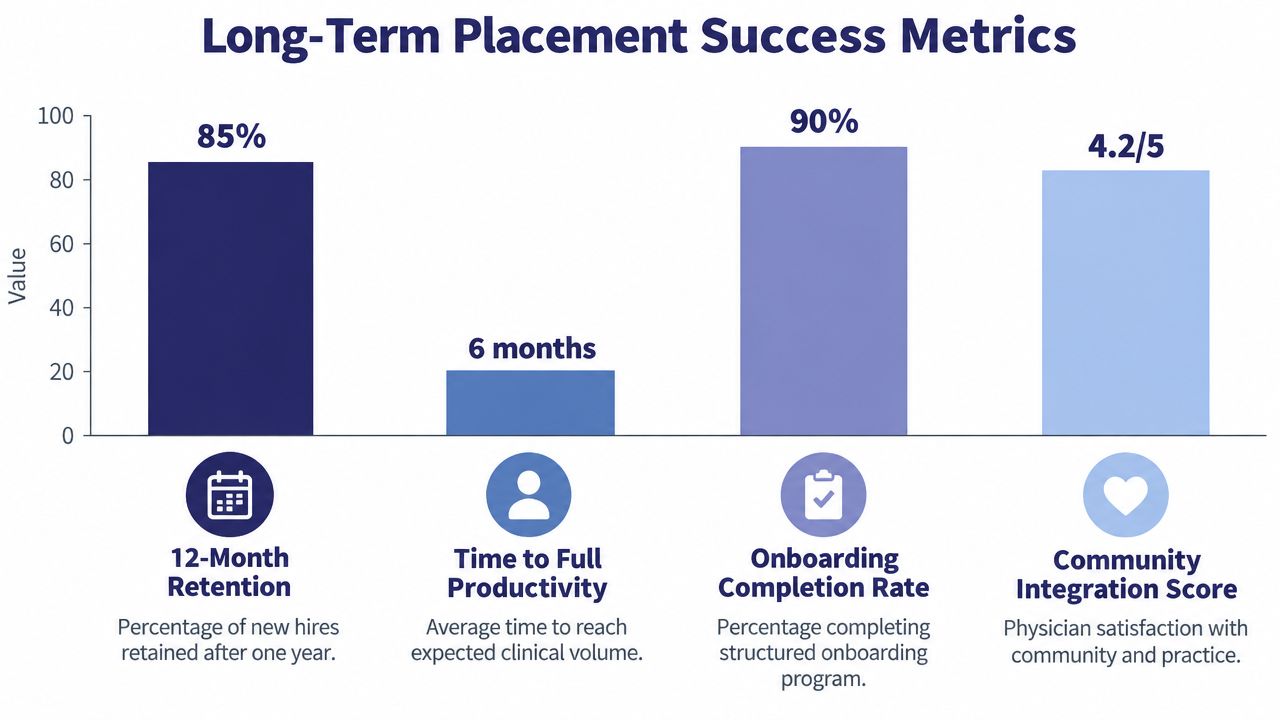
The evidence supports disciplined use of incentives. A recent scoping review of rural retention interventions found state loan repayment and scholarship programs reporting rural retention rates of 50% to 100%. The review also noted that follow-up periods varied substantially and that many programs did not report retention. Use these programs to support a broader retention plan, not as proof that a repayment agreement creates lasting commitment.
Rural training pathways offer a stronger pipeline signal. Reviews found that most retained physicians for at least three years, with some reporting average retention of four to five years and others extending beyond 14 years. The strongest “1+2” rural training models placed 49% to 86% of graduates in rural areas and retained 35% to 50% of those graduates in rural practice for up to seven years, according to the same review. Placement shows early performance. Retention shows whether the model works.
Make the financial package durable
A compensation plan should combine salary, productivity expectations, call burden, relocation assistance, loan repayment eligibility, and future leadership responsibilities. Model the package against the actual clinical workload. A large upfront payment can create pressure to overproduce if the hospital has not funded adequate coverage.
State programs, NHSC support, J-1 visa waiver pathways, and Medicare incentives may contribute where eligibility exists. These tools fit within the broader HPSA incentive framework described earlier. Counsel and compliance leaders should verify every requirement before recruitment materials promise an incentive or service arrangement.
Treat clinical support as compensation
A cardiologist evaluates whether complex cases can be managed safely, colleagues are available for consultation, and time away from practice can occur without destabilizing coverage. That standard applies across cardiology subspecialties. Electrophysiology, structural heart, and advanced heart failure services require explicit backup, referral, transfer, and case-review arrangements.
A rural cardiovascular program should define:
Telemedicine access for diagnostic review and complex case consultation.
Remote hemodynamic monitoring when clinically appropriate and operationally supported.
Transfer protocols identifying receiving centers, escalation triggers, transport responsibilities, and communication standards.
APP role clarity for follow-up, medication management, education, and care transitions.
Scheduled peer connection with subspecialists at an academic or tertiary partner.
Retention is engineered through the daily practice environment. The physician needs to know who answers difficult questions, who covers the service, and how the organization responds when demand exceeds local capacity.
The NHSC experience shows why incentives alone cannot carry the strategy. A PubMed study found that rural retention among NHSC physicians fell from 29.8% three years after residency to 21.3% at six years, as summarized in coverage of persistent rural physician shortages. Pair every incentive with clinical support, protected coverage, and a scheduled review of workload, collegial access, and service capacity.
Onboarding and Measuring Long-Term Placement Success
A signed contract fills a vacancy. It does not build a durable rural practice. Retention starts before arrival, with a transition plan that protects clinical capacity, assigns accountability, and addresses the conditions shaping the physician's daily work and family life.
Credentialing, privileging, payer enrollment, technology access, housing guidance, school information, and spousal employment resources should each have a named owner. The physician should arrive ready to practice, not responsible for resolving administrative gaps the hospital could have prevented.
Use a staged onboarding model
Onboarding should continue beyond the first 90 days and follow a defined sequence:
Pre-arrival preparation: Complete licensing and privileging work, establish clinical access, and provide a written schedule for orientation, call, clinic, procedures, and governance.
Initial clinical integration: Assign a medical staff sponsor, introduce referral partners, review transfer pathways, and confirm that equipment and support staff match the agreed scope.
Early operational review: Address workload, documentation, scheduling, APP collaboration, and patient access before operational frustration becomes a resignation risk.
Community integration: Connect the physician and family with schools, civic organizations, professional groups, and local resources. The hospital can make introductions, while belonging develops through repeated participation.
Ongoing professional development: Schedule peer consultation, continuing education, quality-improvement work, and subspecialty case review.
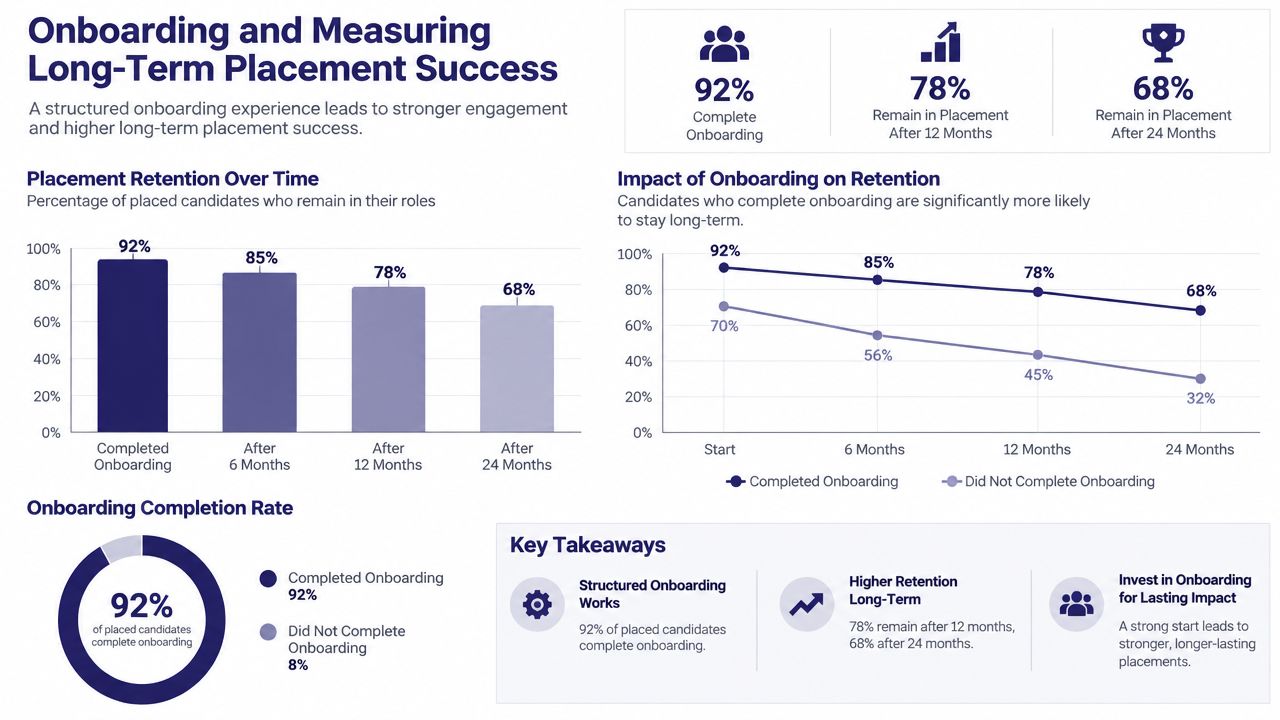
Structured onboarding improves the odds that recruitment produces a stable clinical pipeline rather than a short-term placement.
Cardiovascular onboarding also needs clear governance. The physician should know who approves procedural expansion, how quality metrics are reviewed, how complications are escalated, and which cases require tertiary referral. That structure matters when a rural cardiologist covers outpatient, inpatient, emergency, and procedural care. It also gives subspecialists, including electrophysiologists and advanced heart failure physicians, a defined path for consultation and program development.
Track cohorts, not anecdotes
Recruitment leaders should maintain a multi-year placement dashboard. Acceptance, start date, and first-year productivity provide useful operating signals, but they do not establish retention. Track:
Retention by service year
Procedural and diagnostic volume
Patient access and referral completion
APP collaboration and panel distribution
Call burden and schedule stability
Provider satisfaction and reported isolation
Participation in community and medical staff activities
Reasons for departure when turnover occurs
A systematic review reported an average placement rate of 44% for providers-in-training entering rural practice after graduation, with programs ranging from 30% to 65%. A VA systematic review reported a median recruitment success rate of 53%, with programs clustering between 35% and 65%, as detailed in the systematic review of rural healthcare provider recruitment. The review identified selection bias and supported benchmarking against multi-year cohort data instead of short-term acceptance counts.
Hospital leaders should review the dashboard with the physician, department chair, APP leadership, and executive sponsor. Rising call burden, weaker procedural support, or declining satisfaction requires action before the physician starts an external search. For cross-state coverage and future staffing flexibility, administrators should also review the Interstate Medical Licensure Compact as part of their licensing strategy.
Partnering for Sustainable Cardiac Program Growth
Rural cardiovascular recruitment fails when hospitals treat every vacancy as the same assignment. An interventional cardiologist, electrophysiologist, advanced heart failure physician, and cardiothoracic surgeon require different credentialing, facility capabilities, call structures, referral relationships, and career expectations. A search that ignores those differences may generate résumés while leaving the program unable to support the eventual hire.
The right partner helps the hospital build a clinical pipeline, not fill an open position. It should understand the cardiac service line, including procedural privileges, APP deployment, cardiac surgery relationships, tertiary transfers, and academic affiliations. That knowledge lets leaders define a credible role, redesign team support where needed, and present an opportunity that fits the candidate's clinical goals.
Select for strategic depth
Hospital executives should assess a retained recruitment firm against these criteria:
Cardiovascular specialization: The firm should recruit across general cardiology, interventional cardiology, electrophysiology, heart failure, cardiac surgery, and related advanced practice roles.
Nationwide reach: Rural searches need access to candidates beyond the immediate region.
Clinical matching: Screening should address training, procedural experience, desired scope, call tolerance, and long-term career objectives.
Pipeline capability: The partner should support permanent recruitment and understand academic relationships, fellowship outreach, and interim coverage.
Credentialing coordination: The process should account for licensing, privileging, payer enrollment, and timing constraints.
Retention orientation: Candidate discussions should cover clinical support, governance, community fit, and development opportunities alongside compensation.
A specialized firm does not fix an underfunded practice or an unstable call model. The hospital must define the role, fund the support structure, and act on retention findings. The partner's value lies in reaching appropriate candidates and testing alignment before either side commits substantial time.
Leaders can use this guide to physician placement agencies to distinguish a broad staffing vendor from a firm equipped for complex cardiovascular searches. The decisive question is whether the partner can connect a clinician's goals with the hospital's clinical plan and community realities.
American Cardiology Group provides cardiology-focused permanent recruitment, locum tenens coverage, advanced practice placement, and executive recruitment for hospitals, health systems, academic centers, private practices, and rural community hospitals. Its work includes general cardiology, electrophysiology, heart failure, interventional cardiology, and cardiothoracic surgery, with candidate matching and credentialing support built around cardiac staffing needs.
Hospital executives should define the service-line gap and support model before engaging candidates. American Cardiology Group can help source permanent and interim cardiac physicians, surgeons, and APPs through a specialized, data-driven process. Visit American Cardiology Group to discuss a rural physician recruitment strategy aligned with long-term cardiac program growth.
Comments