
Healthcare Staffing Agencies for Cardiology Programs
A cardiology service line can lose an electrophysiologist, miss a replacement hire, and discover that the cath lab schedule is now constrained by one vacancy. The chief medical officer still has to protect access, the medical director still has to cover call, and finance still sees an agency bill rate before anyone calculates the cost of leaving clinical capacity unused.
That is the wrong starting point. Healthcare staffing agencies are not interchangeable vendors. For cardiology programs, they function as a workforce strategy layer that should be matched to specialty scarcity, geography, coverage urgency, and program maturity. A rural hospital seeking temporary interventional coverage needs a different partner from an academic center building an electrophysiology program or a private group replacing a retiring general cardiologist.
Table of Contents
The Reality Facing Cardiology Leaders Today - Geography changes the recruitment equation
What Healthcare Staffing Agencies Actually Do - The agency doesn't replace clinical governance
Service Models Built for Cardiology Programs - Permanent recruitment builds the operating base - Locums protect capacity while the program decides - Advanced practice and executive searches solve different constraints
How to Choose the Right Agency for Your Program - Evaluate the pipeline before evaluating the pitch - Match the agency type to the program
Contracts, Pricing, and KPIs That Keep the Relationship Accountable - Clauses that deserve executive attention - Build a quarterly scorecard
Working Effectively with a Cardiology Recruiter - Set a working rhythm - Correct bad submissions without damaging the partnership
The Reality Facing Cardiology Leaders Today
Cardiology leaders are managing a labor market shaped by both shortage and mismatch. The American College of Cardiology projected the general cardiologist deficit would rise from about 1,700 in 2008 to about 16,000 by 2025, with shortages across the assessed subspecialties, including electrophysiology and interventional cardiology. The ACC cardiovascular workforce assessment remains important because it frames recruitment as a structural operating issue, not an isolated search problem.
The supply pressure also reflects workforce age and attrition. A later JACC cardiology workforce analysis reported that more than 25% of cardiologists are over age 60 and estimated a net annual loss of 547 cardiologists when retirements and reduced hours are considered alongside fellowship output. A program that waits for a resignation before opening a search has already surrendered valuable time.
Geography changes the recruitment equation
A national candidate database doesn't solve a geographic mismatch. A 2026 projection found that nonmetropolitan cardiologist adequacy could fall to 29.2% by 2037, compared with 88.9% in metropolitan areas, with the weakest supply projected in the West and states including Idaho, Nevada, and Alaska, according to the PubMed-indexed workforce projection.
That distinction matters for rural hospitals, regional referral centers, and systems trying to expand specialty access outside major metros. The recruitment strategy must account for call design, procedural support, family relocation, telehealth infrastructure, and the candidate's willingness to practice in a smaller market.
Executive position: An agency should be evaluated as part of the program's capacity plan, not as a directory of resumes.
The broader market confirms that this is durable infrastructure. One estimate places the U.S. healthcare staff recruitment agencies market at $32.6 billion in 2026, while a broader U.S. healthcare staffing estimate places the market at $45.48 billion in 2025 and projects growth to $89.71 billion by 2033 at a 6.98% CAGR, as reported by IBISWorld's healthcare staff recruitment agencies market analysis. The scale supports a clear conclusion: hospitals need a disciplined agency strategy, not ad hoc vendor calls.
What Healthcare Staffing Agencies Actually Do
A healthcare staffing agency operates like an external workforce control tower. The hospital identifies a clinical need, the agency translates that need into a candidate profile, the recruiter sources and screens clinicians, and the credentialing team moves an acceptable candidate through the facility's approval process. The agency then supports scheduling, assignment logistics, compensation administration, and communication through the placement.
The analogy matters because executives often see only the visible transaction, a candidate submission or a locum bill rate. The agency's value sits in the work surrounding that transaction:
Demand definition. The recruiter clarifies whether the need involves inpatient consults, outpatient cardiology, cath lab coverage, electrophysiology procedures, imaging interpretation, heart failure management, or call. A vague request produces a broad candidate pool and weak matches.
Market access. The agency reaches clinicians who may not respond to a public job posting. Specialty recruiters can distinguish a physician with relevant procedural volume from one whose credentials look similar on paper but don't fit the program's case mix.
Evaluation. Screening should cover board certification, licensure, procedural competence, schedule availability, communication style, and cultural fit. In cardiology, the question isn't whether a physician is qualified. It is whether the physician can function safely within the hospital's team, equipment, referral base, and call model.
Credentialing coordination. The agency gathers documentation and helps manage licenses, references, malpractice information, privileges, and payer enrollment where applicable. The hospital still owns final approval, but a capable agency reduces administrative friction.
Assignment support. Locum coverage can last from a few days to 12 months or more, according to the 2024 AMN locum tenens provider survey. The agency therefore needs to manage different assignment lengths, travel, housing, schedule changes, and handoffs rather than treating every placement as a standard short-term shift.
The agency doesn't replace clinical governance
The hospital retains responsibility for privileging, supervision, quality review, and local orientation. The agency supplies recruiting reach and operational coordination. Those roles should be explicit in the agreement and in the search kickoff.
Historical market development explains why agencies now offer more than temporary coverage. The sector expanded from a mainly temporary function into travel nursing, locum tenens, allied health placement, and permanent recruitment. An industry report estimated U.S. healthcare staffing revenue at $21.8 billion from 2015 to 2020, with annualized growth of 4.9%, and projected annual growth of 5.8% from 2021 to 2026, according to the healthcare staffing industry report from Davis Capital Advisors. For cardiology executives, the practical lesson is simple. A partner that can connect temporary coverage to a permanent workforce plan is more useful than one that only fills the immediate gap.
Service Models Built for Cardiology Programs
The four core models solve different operational problems. Leaders should select the model based on the program's time horizon, clinical risk, and expected permanence, not on whichever recruiter responds first.
Service Model | Typical Use Case | Time to Fill | Cost Structure | Best-Fit Cardiology Scenario |
|---|---|---|---|---|
Permanent physician recruitment | Long-term employment search | Depends on specialty, market, and credentialing | Contingency or retained search fee | Building a durable general cardiology, EP, heart failure, or imaging team |
Locum tenens | Temporary clinical coverage | Often faster than permanent recruitment, subject to licensing and privileges | Daily or hourly bill rate, plus applicable travel and agency costs | Covering resignation, leave, call, volume surge, or delayed permanent hiring |
Advanced practice placement | NP or PA recruitment for defined clinical functions | Varies by role and market | Placement fee or employment-related arrangement | Extending inpatient, outpatient, heart failure, or procedural team capacity |
Executive recruitment | Leadership and program development | Longer search cycle with deeper assessment | Retained or structured executive search fee | Recruiting a service-line chair, medical director, or cardiovascular program leader |
Permanent recruitment builds the operating base
Permanent search earns its place when the program needs continuity, referral development, committee participation, and long-term ownership of clinical growth. A general cardiologist may support broad access, while an electrophysiologist, interventional cardiologist, or heart failure specialist may determine whether the program can expand a specific service.
Permanent hiring shouldn't be used as a crisis response alone. The search needs a defined role, compensation authority, call expectations, clinical resources, and a realistic decision process.
Locums protect capacity while the program decides
Locum tenens is the right tool when a vacancy is immediate, the duration is uncertain, or the hospital needs to test a coverage design before committing to a permanent hire. It can preserve inpatient consult volume, cath lab activity, echo turnaround, or EP scheduling while recruitment continues.
The model isn't automatically cheaper. It is valuable when the cost of unfilled capacity exceeds the premium for flexibility.
Advanced practice and executive searches solve different constraints
A nurse practitioner or physician assistant can support protocols, follow-up, inpatient coverage, and care coordination when the supervising structure is sound. That does not substitute for a missing procedural cardiologist, but it can prevent physicians from spending scarce time on work that another qualified clinician can perform.
Executive recruitment addresses a different bottleneck. A program that needs growth, integration, or academic alignment requires leadership selection, not just another clinical CV.
The Real Cost of Open Coverage and How Agencies Price It
Finance teams often begin with the agency's daily rate. Cardiology leaders should begin with the cost of uncovered capacity. An open role can reduce cath lab utilization, delay echo interpretation, lengthen an EP procedure backlog, divert inpatient consults, and send referrals to competing systems. The relevant comparison is agency spend versus the contribution and access that the vacant role would otherwise support.
Locum economics make the trade-off visible. Independent estimates place specialist locum coverage at roughly $2,200 to $3,200 per day, with a 30-day gap above $66,000 and a 90-day gap above $200,000 before agency markup, according to Benefit Plus's locum cost-avoidance analysis. A separate benchmark places subspecialist coverage near $3,500 per day and a family physician locum at about $1,350 per day, compared with a modeled permanent daily cost of about $1,140 after salary, benefits, and malpractice are converted to a daily rate, from the same analysis.
Cost Category | 60 Days Open | 90 Days Open | 180 Days Open | Agency Cost Equivalent |
|---|---|---|---|---|
Lost clinical capacity | Reduced service availability and delayed access | Persistent pressure on consults, procedures, and referrals | Structural loss of capacity and possible program redesign | Locum coverage converts unused capacity risk into variable spend |
Call coverage diversion | Existing physicians absorb more call | Burnout and schedule compression become harder to avoid | Retention risk can affect the wider team | Temporary coverage can protect the call model |
Referral leakage | Some patients may seek care elsewhere | Referral relationships may weaken | Rebuilding volume can take longer than filling the role | Compare bill rate with the value of retained access |
Recruitment delay | Candidate urgency rises | Permanent search competes with active operational strain | Vacancy may become embedded in the budget | Hybrid locum and permanent search may be rational |
A cardiology locum staffing agency resource can help frame the decision, but the hospital must still run its own economics. Pricing may include a locum bill rate, travel and housing, malpractice treatment, overtime, holiday or call differentials, and administrative markups. Permanent searches may use contingency or retained fees, while advanced practice placements follow their own fee structure.
Director diagnostic: Before approving agency spend, calculate the weekly value of the clinical capacity at risk, then compare it with the fully loaded coverage cost and the expected vacancy duration.
That calculation identifies the break-even window. A higher daily rate can be financially sensible when it preserves procedure access, protects referrals, or prevents existing cardiologists from leaving. A lower rate can still be wasteful if the placement lacks the privileges, procedural skills, or schedule fit required by the program.
How to Choose the Right Agency for Your Program
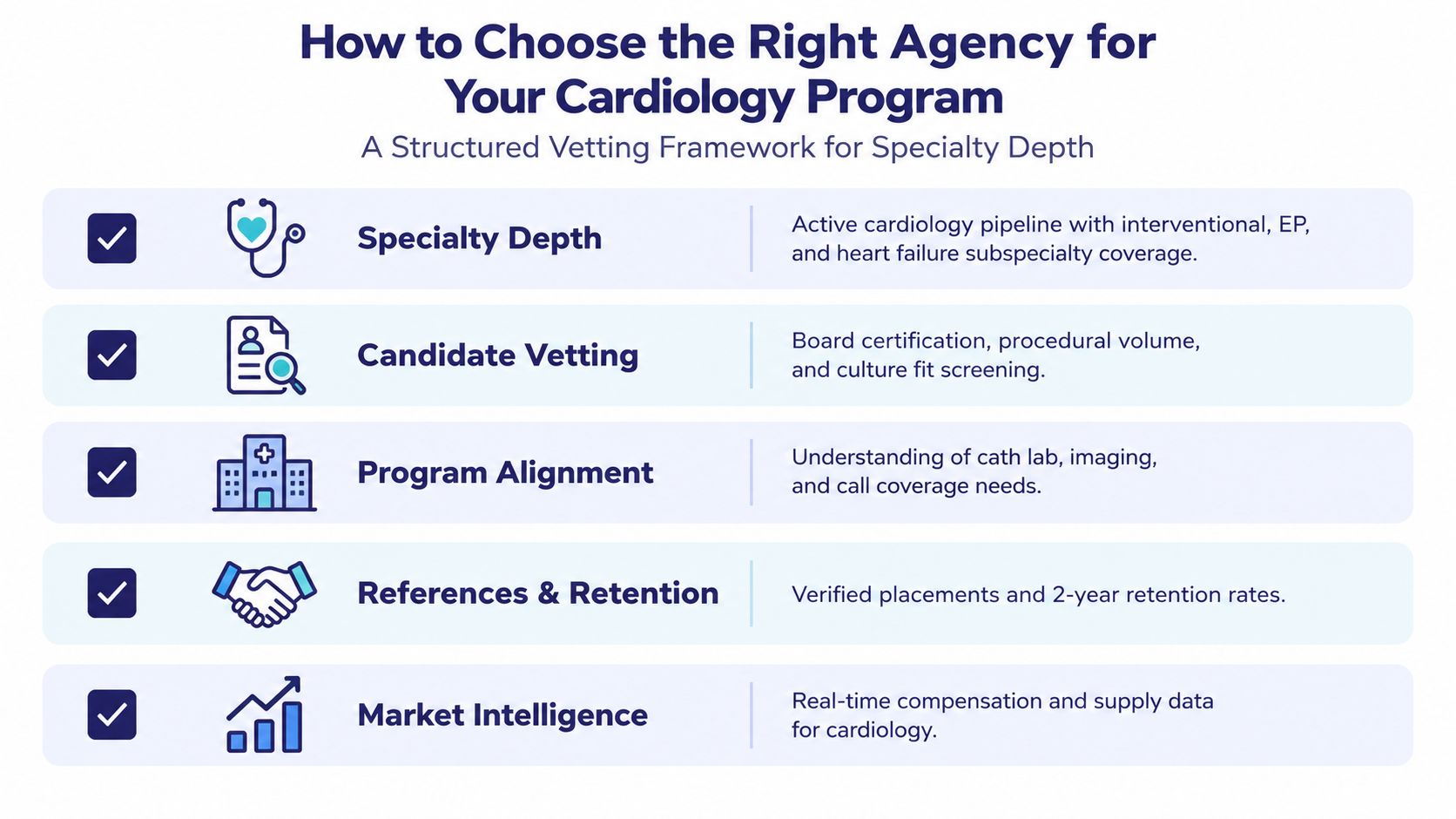
The strongest agency evaluation starts with specialty depth, not brand recognition. A cardiology program should ask whether the firm maintains an active candidate pipeline for the roles it needs. General cardiology, interventional cardiology, electrophysiology, heart failure, cardiovascular imaging, and cardiac surgery each require different sourcing conversations.
Evaluate the pipeline before evaluating the pitch
Ask the recruiter to describe recent candidate activity by subspecialty and geography. The answer should identify how candidates are sourced, how current the relationships are, and which markets require a different approach. A firm that claims broad reach but cannot discuss the actual interventional, EP, or heart failure pipeline is offering marketing, not market access.
The vetting process should be equally specific:
Clinical screening: Confirm how the agency evaluates board certification, procedural volume, fellowship training, references, and culture fit.
Credentialing workflow: Require a clear owner for license verification, privileging documents, payer enrollment support, and exception management.
Malpractice handling: Clarify coverage, claims reporting, tail obligations, and the documents supplied before placement.
Communication discipline: Identify who provides updates, how often, and how quickly the hospital receives candidate feedback requests.
Match the agency type to the program
A boutique cardiology firm may offer deeper specialty fluency and closer recruiter access. A large multispecialty MSP may provide broader geographic reach, centralized compliance, and consolidated purchasing. A locum-only house may be efficient for urgent temporary coverage but less useful for a permanent succession plan.
No model is universally superior. The right choice depends on program maturity, geography, budget posture, and the complexity of the vacancy. An academic center expanding EP may value subspecialty depth, while a community hospital needing predictable coverage may prioritize responsiveness and credentialing execution.
Use physician placement agency guidance as one input, then demand evidence from each shortlisted firm. Useful questions include:
Which cardiology subspecialties has the firm filled recently?
Who owns credentialing, and what happens when documentation is incomplete?
How does the firm measure placement retention at 12 and 24 months?
What is the conversion rate from locum assignment to permanent employment?
Can the agency provide references from clinical directors with similar programs?
How are bad-fit candidates removed from future submissions?
The hospital should also separate recruiter confidence from verified outcomes. References, retention data, director feedback, and transparent sourcing methods expose weak vendors early.
Contracts, Pricing, and KPIs That Keep the Relationship Accountable
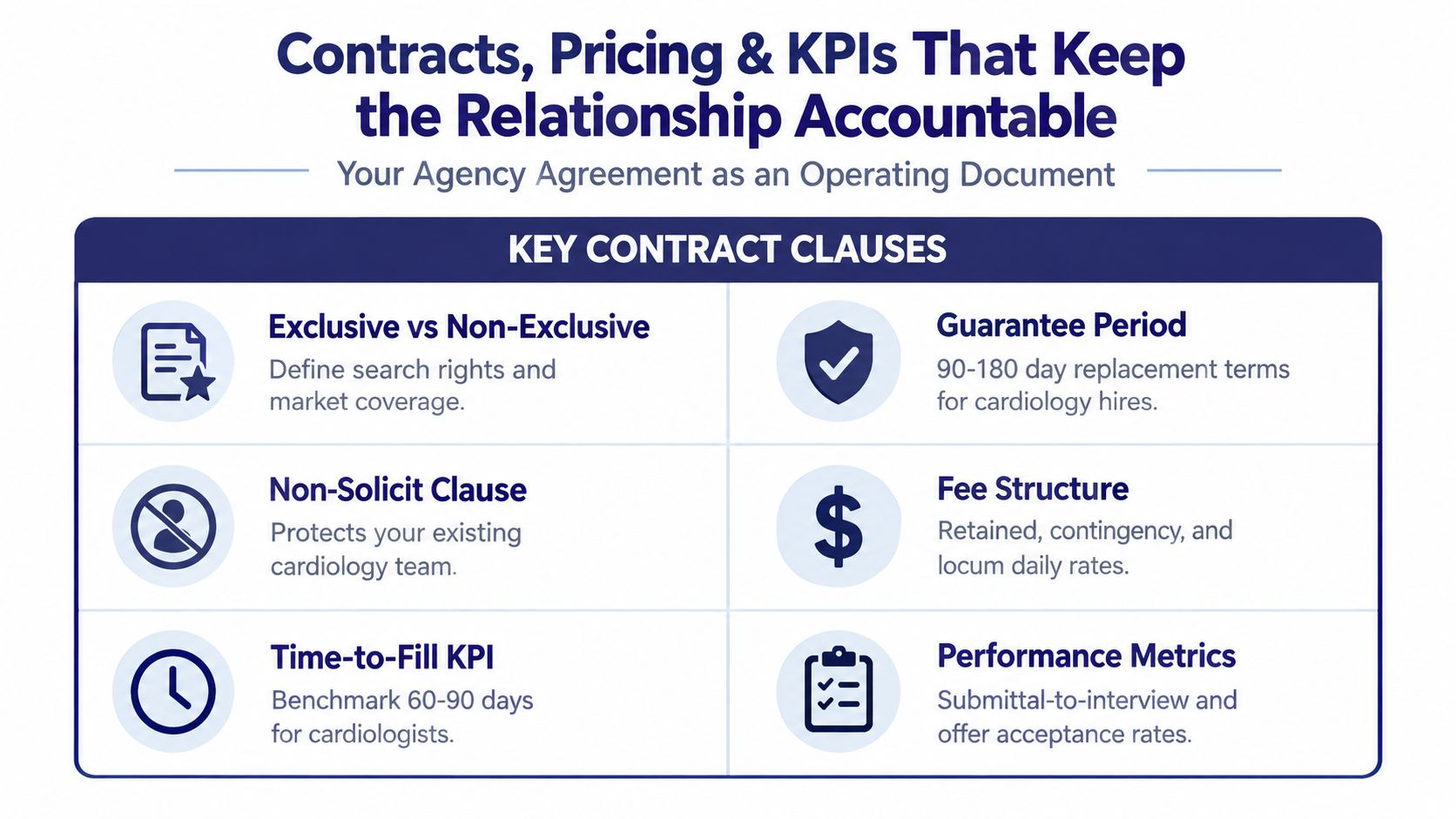
An agency agreement should function as an operating document. Boilerplate language rarely reflects the practical realities of cardiology coverage, especially when the hospital is balancing permanent search, locum assignments, advanced practice support, and leadership recruitment.
Clauses that deserve executive attention
The agreement should define whether the search is exclusive or non-exclusive, what geographic or specialty coverage the agency controls, and how the guarantee period operates. Replacement terms for permanent cardiology hires need precise triggers, exclusions, and notice requirements. A non-solicit clause should protect the hospital's existing team without restricting reasonable clinical recruitment.
Conversion fees require equal clarity. If a locum physician becomes a permanent employee, the contract should state the fee, the timing, any credit for prior assignment spend, and the circumstances that trigger payment. Travel, housing, mileage, licensing, and reimbursement rules should be written before the first assignment.
Pricing also moves through operational details. Regional bill-rate bands, holiday and on-call differentials, overtime, cancellation windows, pass-through expenses, and MSP markups can materially change the invoice. Finance and clinical leadership should review the same schedule, not separate versions of the economics.
Build a quarterly scorecard
A useful scorecard measures the agency's process and the placement's outcome:
Time to fill by subspecialty: Separate general cardiology from interventional cardiology, electrophysiology, imaging, and heart failure.
Credentialing cycle time: Track the period from accepted candidate to privileges granted.
Cancellation rate: Distinguish agency cancellations from hospital cancellations and document the cause.
Credentialing audit findings: Record missing, expired, or inconsistently maintained documents.
90-day retention: Review whether permanent hires remain in role after onboarding.
Annualized cost per FTE placed: Compare the full fee and support cost with the resulting employment outcome.
A quarterly business review should include the service-line leader, medical staff office, finance, human resources, and the agency account executive. The meeting should examine open searches, aging candidates, rejected submissions, upcoming coverage risks, and corrective actions.
Contract warning: Pause signature when the agency can't define liability, cancellation exposure, conversion fees, data ownership, or the person accountable for credentialing exceptions.
Vague guarantees, unilateral fee changes, automatic exclusivity, broad non-solicit language, and uncapped pass-through expenses deserve legal review before negotiation proceeds. A low headline fee doesn't compensate for an agreement that transfers operational risk to the hospital.
Working Effectively with a Cardiology Recruiter
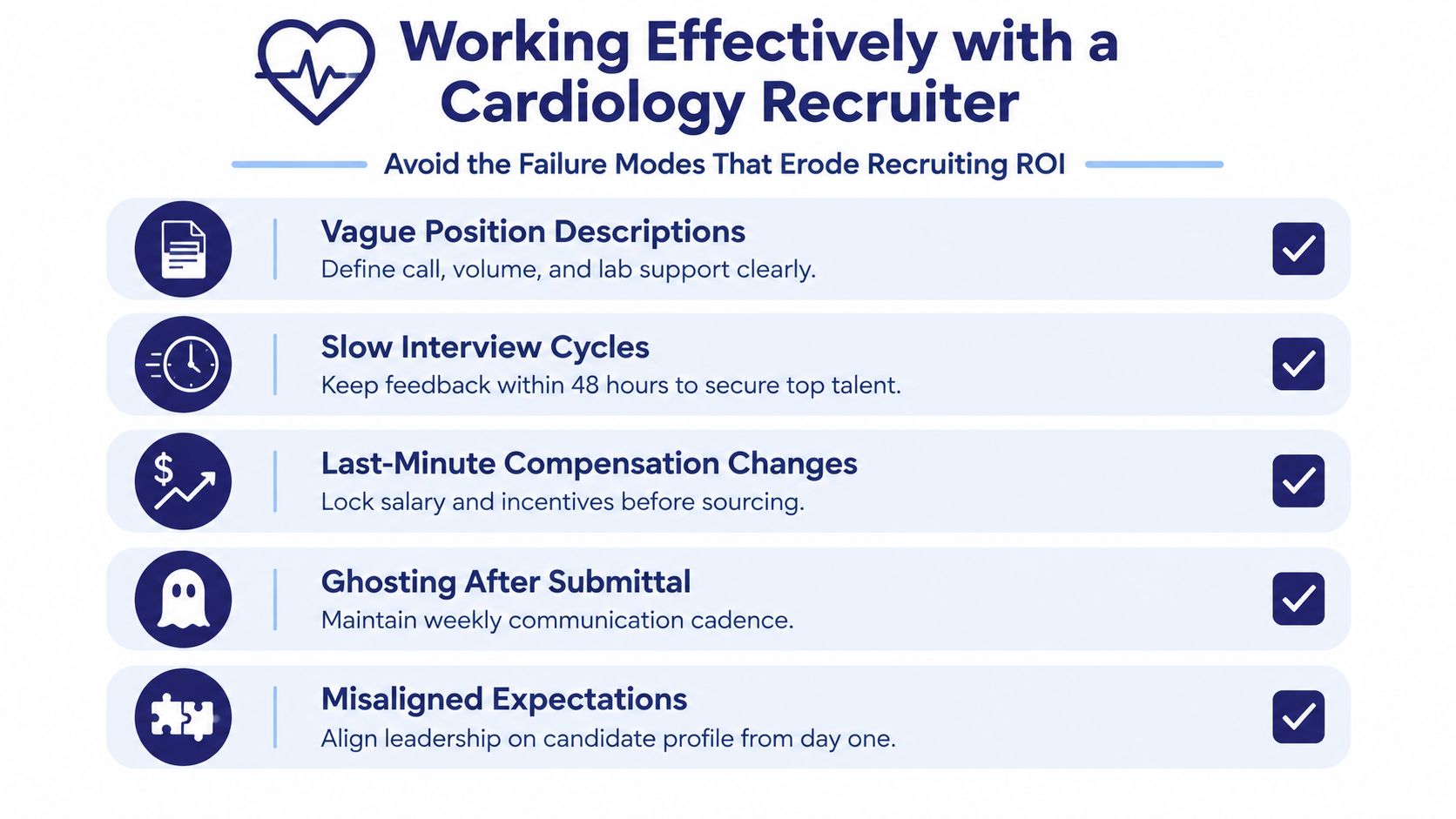
Recruiting failures often begin inside the hospital. A vague position description forces the recruiter to guess about call, volume, lab support, procedural expectations, and leadership authority. Slow interview cycles then allow viable candidates to accept another opportunity while the hospital is still aligning calendars.
The remedy is operational discipline. One internal owner should control feedback, coordinate stakeholders, and prevent the recruiter from chasing multiple conflicting decision-makers. The hiring group should approve a written candidate scorecard before interviews begin, with clinical, operational, cultural, and compensation criteria separated clearly.
Set a working rhythm
Active searches need a weekly recruiter check-in. The discussion should cover candidate pipeline, market objections, compensation feedback, interview scheduling, credentialing readiness, and decisions required from the hospital.
A 48-hour decision rule after a site visit keeps the process credible. The hospital doesn't need to make an offer within that window, but the recruiter should receive a clear disposition, identified concerns, and the next action. Silence is interpreted as disinterest by candidates and as process failure by recruiters.
The hospital also needs to provide honest market intelligence. If candidates consistently reject the call burden, procedural volume, location, or compensation, leadership should treat that pattern as evidence requiring a role redesign or pricing review.
Correct bad submissions without damaging the partnership
A bad-fit submission should receive specific feedback. “Not a fit” teaches the recruiter nothing. A useful response identifies the missing requirement, such as inadequate EP experience, insufficient cath lab volume, an unacceptable call arrangement, or a mismatch with the program's culture.
Credentialing delays create another avoidable failure. Clear ownership, complete documentation, and a defined escalation path protect candidate confidence. A practical healthcare credentialing resource can support shared expectations, but the hospital still needs an internal process that responds quickly.
The recruiter should be treated as a strategic partner because sourcing quality depends on information quality. Reset an underperforming relationship when submissions remain misaligned, updates become irregular, compensation changes arrive late, or the agency can't explain its pipeline. The reset conversation should establish one owner, a written profile, response standards, and a review date. If performance doesn't improve, the hospital should change the panel rather than prolonging a nonproductive engagement.
Where Cardiology Staffing Is Heading and What to Do Now
Cardiology workforce planning is moving toward hybrid coverage. Subspecialty constraints, geographic mismatch, tighter hospital margins, telehealth-enabled consult and imaging support, and consolidation among large staffing firms will make single-model recruitment less reliable.
The pipeline problem is especially visible in advanced subspecialties. 2026 reporting noted that advanced heart failure and transplant cardiology programs had more than 50% of positions unfilled, while interventional cardiology had 71 positions unfilled across 49 programs in the 2026 match, according to SG2's cardiovascular workforce analysis. Hospitals can't recruit their way out of every training bottleneck. They need locums, permanent search, program redesign, and development partnerships working together.
Three decisions should happen before the next vacancy:
Build a multi-agency panel: Use specialty-focused and broader partners according to the role, market, and urgency. Avoid dependence on one supplier.
Invest in credentialing infrastructure: A faster, cleaner process improves every search and reduces avoidable candidate loss.
Budget workforce coverage as recurring operations: Treat locum, permanent, advanced practice, and leadership recruitment as planned capacity tools rather than emergency purchases.
Programs that thrive will forecast specialty needs, maintain recruiter relationships before vacancies occur, and use temporary coverage to protect access while permanent strategy develops. Programs that wait for crisis conditions will continue paying a premium for urgency, limited choice, and preventable delays.
American Cardiology Group provides permanent physician recruitment, locum tenens coverage, advanced practice placement, and executive recruitment for cardiology and cardiac surgery programs across the United States. Hospital leaders evaluating a specialty-specific workforce partner can visit American Cardiology Group to discuss coverage needs, candidate matching, and long-term cardiac program growth.
Comments