
Cardiology Salary Texas: What Recruiters Actually Pay
Cardiologists in Texas had a median annual wage of $410,150 in May 2025, yet that statewide figure masks a spread from roughly $97,140 at the 10th percentile to $703,430 at the 90th percentile. That spread is the central problem for professionals researching Cardiology Salary Texas data to set a budget, evaluate an offer, or defend a pro forma to a service line committee. A single median can't tell a hiring team what an electrophysiologist with heavy call will accept, what a general cardiologist in an academic program expects, or why a recruitment-market offer can sit far above a government wage estimate. Compensation leaders who treat the median as a target, rather than as a midpoint in a very wide distribution, will misprice roles in both directions.
Table of Contents
Why a Single Texas Cardiology Salary Is Misleading - What the Percentiles Actually Signal
Texas Cardiology Demand and Workforce Pressure - How Scarcity Changes the Negotiation
Cardiology Subspecialty Compensation Compared - Where Premiums Concentrate
Metro Wage Spread Across Texas - Texas Cardiology Median Pay by Metropolitan Area - How Recruiting Teams Should Use Metro Data
Inside a Cardiology Compensation Package - Components That Must Be Normalized
How Compensation Models Shape Take-Home Pay - Three Models and Three Different Risks
Recruitment Strategies for Hard-to-Fill Cardiology Roles - Contingency Versus Retained Search
Why a Single Texas Cardiology Salary Is Misleading
The statewide benchmark is useful only when it's read as a distribution. May 2025 Bureau of Labor Statistics data put the Texas cardiologist median at $410,150, with $97,140 at the 10th percentile, $544,670 at the 75th percentile, and $703,430 at the 90th percentile across approximately 2,050 employed cardiologists. That range reflects different practice models, experience levels, subspecialties, and compensation structures folded into one occupational category.
A hospital executive who budgets at the median for a procedural subspecialist isn't being conservative. That executive is ignoring the upper half of the distribution where interventional cardiology, electrophysiology, heart failure leadership, call coverage, and productivity incentives typically sit. A candidate who anchors on the median makes the opposite error, because base salary, bonuses, collections-based pay, and signing incentives aren't separated in a single occupational wage estimate.
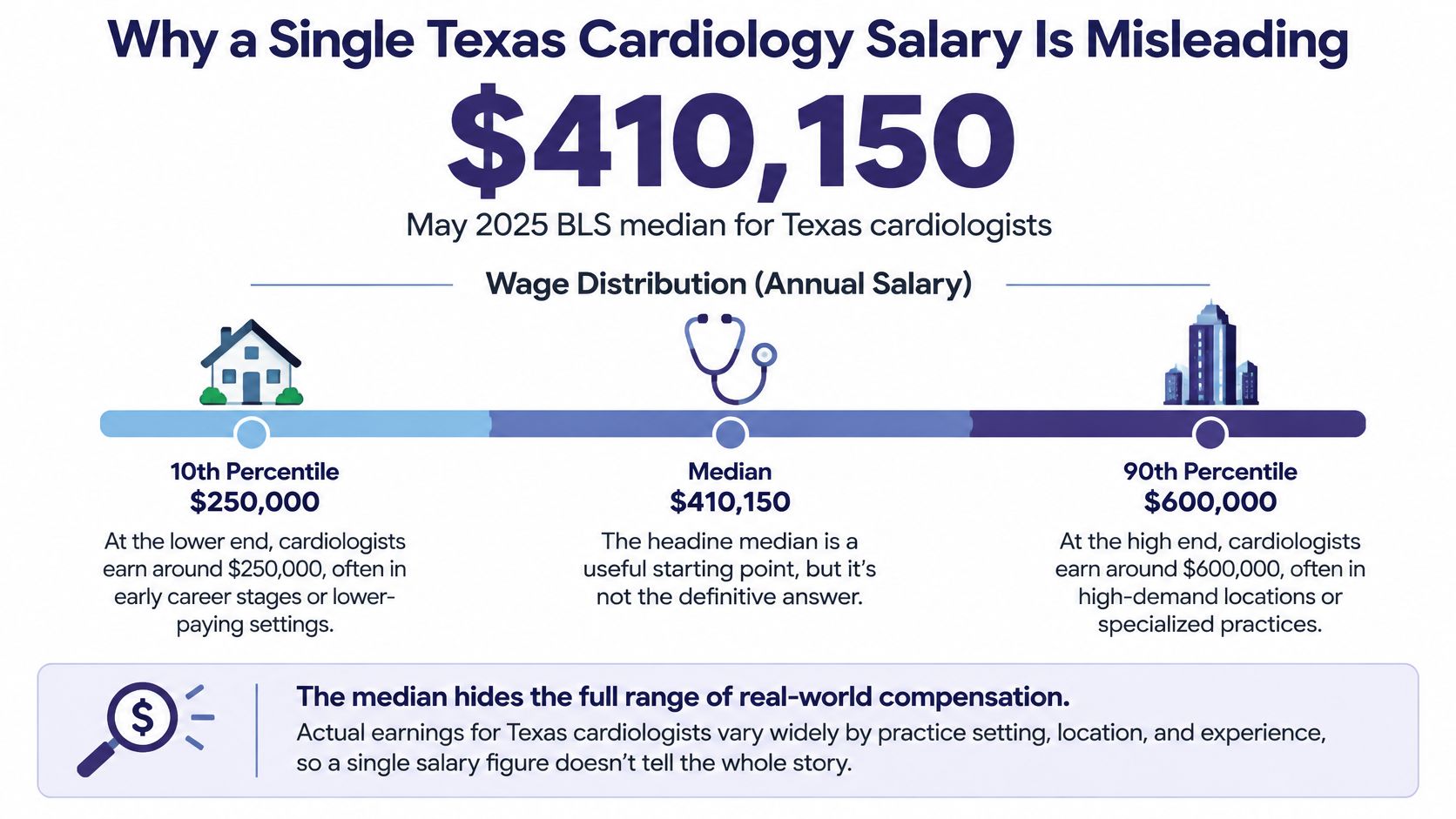
What the Percentiles Actually Signal
The lower percentiles don't describe a typical full-time attending offer in a competitive search. They describe the bottom of a broad occupational pool. The upper percentiles, by contrast, show how far total earnings can move when procedural volume, scarce subspecialty training, and program responsibility concentrate in one role.
Practical rule: Use the median to orient the conversation, then price the specific role by subspecialty, call burden, metro, and compensation model before any number reaches a candidate.
That discipline matters because Texas doesn't recruit in a vacuum. The same May 2025 release placed the Texas median approximately 17.3% below the national cardiologist median of $496,010. A health system recruiting from outside Texas therefore can't assume a local median will persuade a physician who's comparing offers nationally. The offer has to be competitive against the candidate's alternatives, not against a state table.
The correct question isn't what cardiologists earn in Texas on average. It's where a specific role should fall within that distribution, and which components of pay explain the position. Once a hiring team can answer that question with evidence, the median becomes a reference point instead of a trap.
Texas Cardiology Demand and Workforce Pressure
Compensation pressure in Texas cardiology is structural. It's driven by supply that doesn't match where patients live, an aging population with rising cardiovascular disease burden, and program expansion that requires subspecialists who are already scarce. Hospital leaders feel those forces as longer searches, heavier call panels, and candidates with multiple competing options.
Texas has only 4.4 cardiologists per 100,000 residents, and national projections indicate the United States may face a shortfall of roughly 22,000 cardiologists by 2030. A projected national gap of that scale doesn't stay national in practice. It shows up locally when a community hospital tries to sustain STEMI coverage, when an academic center expands structural heart volume, or when a private group needs electrophysiology capacity to keep referrals inside the system.
How Scarcity Changes the Negotiation
Scarcity shifts power toward candidates who can credibly walk away. A cardiologist who brings procedural capability, referral relationships, or program-building experience isn't selling general labor. That physician is selling access, downstream revenue protection, and call stability for an entire service line.
Access pressure: Thin local supply means a vacancy quickly becomes a wait-time and transfer problem, not just an open requisition.
Call sustainability: Fewer available cardiologists make each additional night of call more valuable and more likely to require explicit compensation.
Program dependence: Tertiary services such as electrophysiology, structural heart, and advanced heart failure can't scale without named clinical leaders.
Those pressures explain why compensation doesn't move in a neat statewide line. Two Texas hospitals can recruit for the same specialty title and face completely different market conditions because one needs a physician to join an established panel while the other needs a physician to build a service across a large referral territory. The second role carries recruitment risk, ramp-up responsibility, and retention exposure that a standard salary band won't capture.
Workforce pressure also affects retention. Incumbent cardiologists see the same job market that candidates see, and a compensation plan that looked adequate at signing can become uncompetitive when call intensity rises or a competing system opens a new program nearby. Employers who review pay only at recruitment are managing yesterday's market. Employers who model supply, call burden, and program dependence before a vacancy occurs can adjust guarantees, stipends, and productivity terms while they still control the timeline.
Cardiology Subspecialty Compensation Compared
Subspecialty is where the statewide median breaks down fastest. General cardiology, interventional cardiology, electrophysiology, and heart failure don't produce the same procedure mix, call profile, or revenue pattern, so they shouldn't be priced from the same benchmark. A compensation committee that averages them together will overpay for some roles and lose finalists for others.
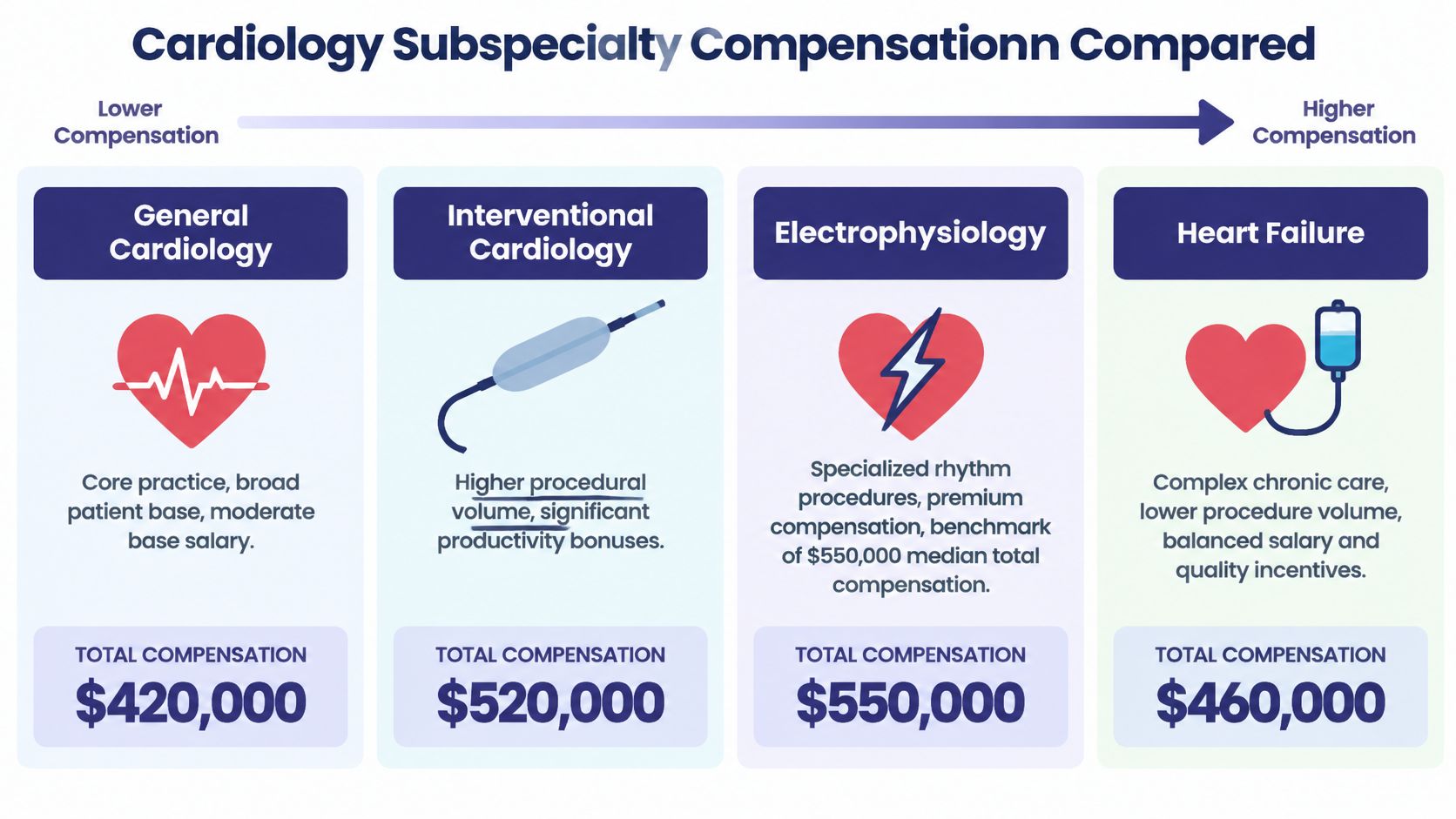
Electrophysiology provides the clearest Texas example of a subspecialty premium. A Texas electrophysiology compensation dataset reported an average of $982,104, consisting of an $886,500 base and $95,604 in bonuses, with example positions ranging from $750,000 for an academic role to $1,440,500 for a high-productivity community-hospital post. Those figures shouldn't be treated as a universal electrophysiology guarantee. They do show how far a procedural subspecialty can move above an all-cardiologist benchmark when productivity and practice setting align.
Where Premiums Concentrate
General cardiology typically centers on clinic volume, imaging interpretation, inpatient consultation, and longitudinal disease management. Compensation depends heavily on panel growth, noninvasive testing access, and whether the role carries meaningful call. A general cardiology offer with limited call and strong advanced practice support isn't interchangeable with a solo coverage model in an underserved market.
Interventional cardiology adds cath lab dependence, emergent call, and procedural productivity that can change both earnings and lifestyle risk. Hiring teams evaluating that premium should review detailed interventional cardiologist salary benchmarks alongside expected case mix, lab access, and backup coverage, because a high conversion rate means little if lab time is constrained.
Electrophysiology combines scarce fellowship training with device and ablation volume, which is why its Texas examples sit so far above the statewide median. Heart failure presents a different value proposition. Advanced heart failure roles often carry complex inpatient management, transplant or mechanical circulatory support collaboration, and program quality responsibility that may not generate the same procedural wRVU pattern. Employers who pay heart failure leadership purely on procedural logic will undervalue work that protects length of stay, readmission performance, and referral credibility.
A subspecialty premium isn't a reward for a title. It's payment for scarce capability, measurable workload, and the revenue or access that disappears when the role stays vacant.
The analytical task is to separate those elements. Base salary should reflect guaranteed clinical availability. Productivity terms should reflect realistic procedure access. Call pay should reflect frequency and intensity, not be buried inside a headline number. When those pieces are explicit, candidates can compare offers and employers can defend why one cardiology role is priced far above another.
Metro Wage Spread Across Texas
Texas is too large and too unevenly supplied for one geographic assumption. Dallas-Fort Worth, San Antonio, Austin, and Houston have different employer mixes, academic footprints, referral patterns, and subspecialty composition, and their reported medians reflect that dispersion. A recruitment budget built for one metro can fail in another even when the job description looks identical.
BLS-derived May 2025 estimates place Texas cardiologist median pay at roughly $403,340 in Dallas-Fort Worth, $382,000 in San Antonio, $341,080 in Austin, and $187,550 in the Houston metropolitan area. Those figures require caution because occupational wage estimates can shift with sample structure, reporting coverage, and the mix of employers included. They shouldn't be read as precise offer sheets for any individual hospital.
Texas Cardiology Median Pay by Metropolitan Area
Metro Area | Median Annual Wage | Notes |
|---|---|---|
Dallas-Fort Worth | $403,340 | Closest to the statewide median, with deep tertiary program competition |
San Antonio | $382,000 | Below Dallas-Fort Worth, still within a competitive large-metro range |
Austin | $341,080 | Lower reported median despite strong growth and subspecialty demand |
Houston | $187,550 | Markedly lower estimate that signals methodological and employer-mix caution |
All values in the table come from the BLS-derived estimates cited above. The Houston figure illustrates why compensation leaders shouldn't copy a metro median into a budget without asking who was counted and how pay was reported. A large academic presence, trainee-adjacent structures, part-time arrangements, or differences in incentive reporting can distort a simple comparison.
How Recruiting Teams Should Use Metro Data
Metro data works best as a calibration layer, not a final answer. A Dallas-Fort Worth system building electrophysiology or structural heart capacity is competing for experienced candidates who have options across North Texas and nationally. A lower-benchmark market may need signing support, relocation assistance, loan repayment, protected administrative time, or a clearer productivity pathway to offset perceived risk.
Location also interacts with call territory. A metro role inside a large call pool is materially different from a regional role covering multiple facilities, even if both carry the same specialty label. Candidates price that difference, whether the employer names it or not. Hiring teams should therefore pair metro medians with call frequency, transfer burden, facility resources, and referral access before setting a range.
The strategic conclusion is counterintuitive. A lower reported metro median doesn't necessarily mean a cheaper hire. It may mean the benchmark is incomplete, the local supply is thinner, or the role requires non-salary value to close. Employers who investigate those explanations before posting will set more credible ranges than employers who merely choose the lowest defensible number.
Inside a Cardiology Compensation Package
A Texas cardiology offer is an assembly of guarantees, variable pay, and risk transfer. Base salary is only the most visible part. Signing incentives, relocation, loan repayment, call stipends, retirement contributions, malpractice terms, and productivity bonuses can change the actual value of a package without changing the headline salary at all.
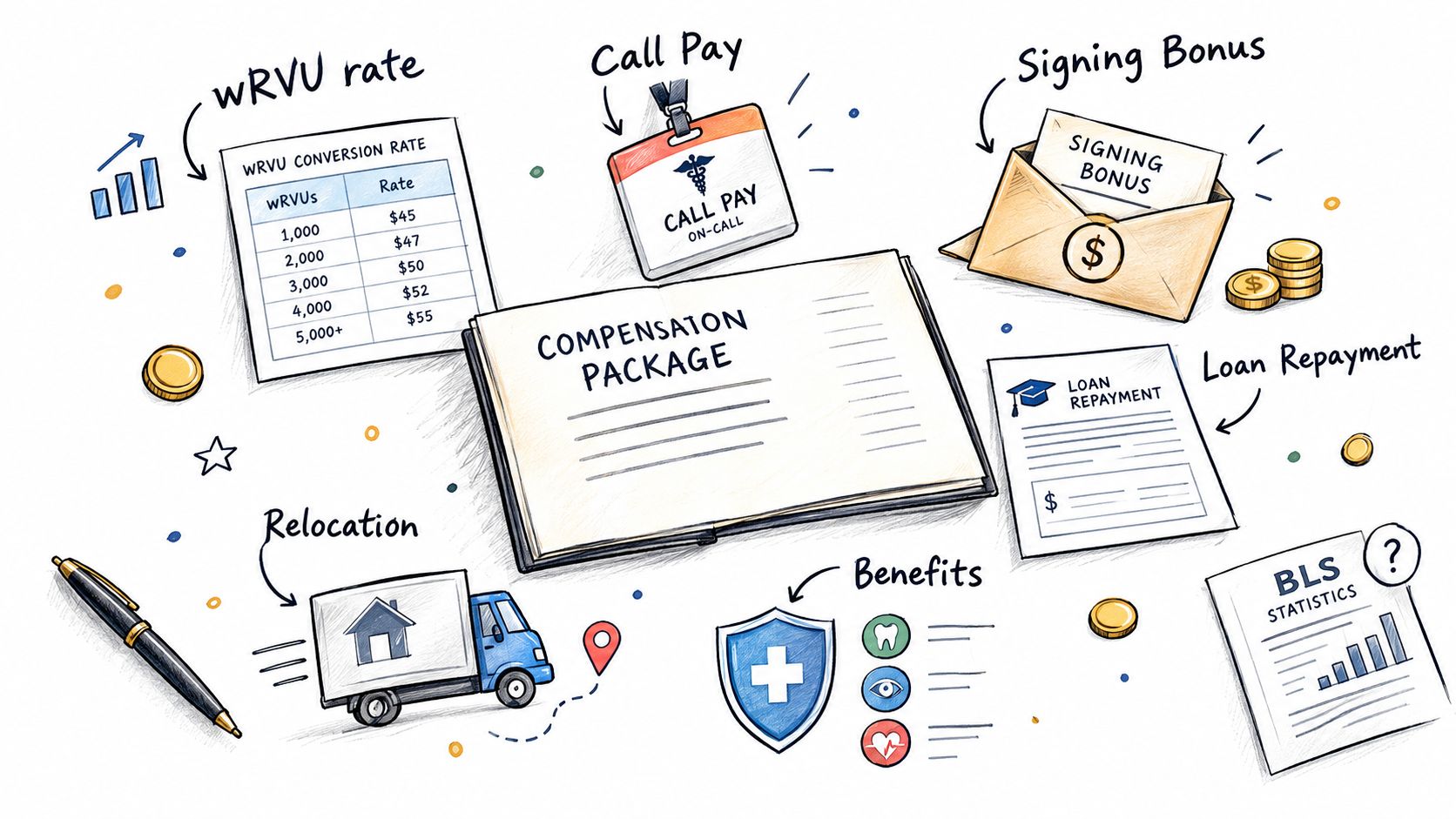
The gap between occupational wages and recruitment-market pay shows why component-level analysis matters. Permanent cardiology placements in Texas averaged roughly $527,000 per year, about 28.5% above the May 2025 BLS median of $410,150, while the highest reported permanent role reached $1 million annually. That isn't an apples-to-apples trend line. Placement figures can disproportionately reflect difficult-to-fill roles, experienced physicians, subspecialists, and packages built around incentives.
Components That Must Be Normalized
Guaranteed base: The amount paid regardless of collections or wRVU output, and the period during which that guarantee applies.
Productivity terms: The wRVU threshold, conversion factor, timing of reconciliation, and whether deficits carry forward.
Call compensation: Whether call is included in base, paid separately, or triggered only after a defined frequency.
Signing and retention incentives: Cash timing, repayment obligations, and service commitments attached to each payment.
Benefits and protection: Retirement contributions, malpractice coverage, tail responsibility, disability insurance, and paid time off.
BLS wage concepts don't capture every economic element in that list. Employer benefits, signing bonuses, and some nonproduction payments can sit outside an occupational wage estimate, while certain incentive and production payments may be included. Two offers with the same salary can therefore produce very different total annualized value once benefits and one-time incentives are separated.
Candidates should ask what happens after the guarantee period. Employers should ask whether expected wRVUs are supported by clinic templates, cath lab or electrophysiology lab access, referral volume, and payer mix. Those questions expose whether a package is competitive or merely advertised at a high ceiling.
Red flag in an offer review: A large total compensation figure with no clear separation between guaranteed pay, at-risk productivity, call stipends, and one-time incentives isn't transparent. It's unpriced risk.
The strongest packages make trade-offs explicit. A lower base can be rational when productivity access is real and call is predictable. A higher base can be necessary when a physician is relocating, building a program, or accepting heavier call. The number that matters is workload-adjusted total compensation under realistic operating conditions.
How Compensation Models Shape Take-Home Pay
Compensation model design determines whether a headline figure becomes actual earnings. Salary, productivity, and hybrid structures distribute risk differently between employer and physician, and that distribution matters as much as the stated total. Texas data from different sources can't be compared responsibly until those models are separated.
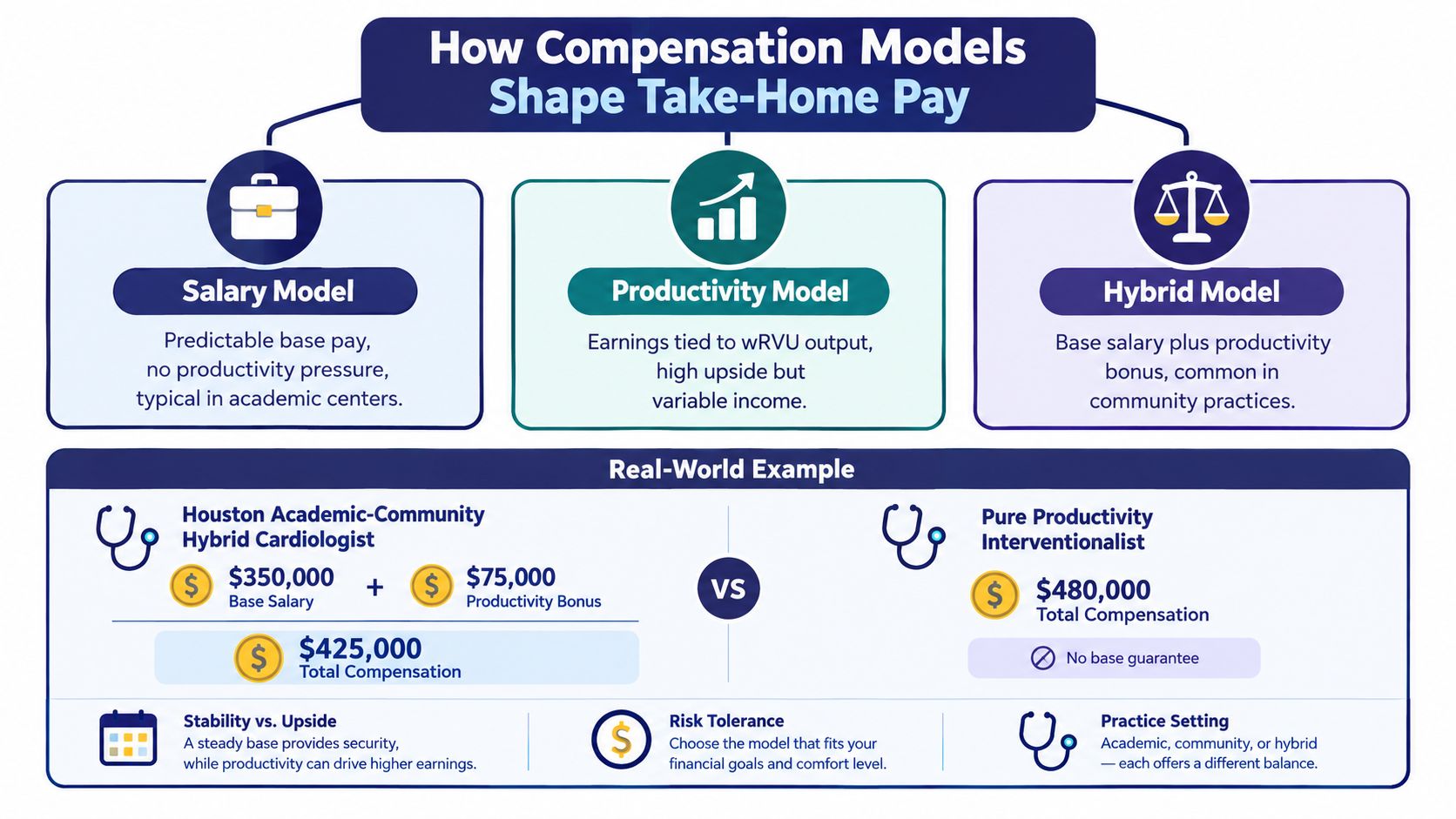
Texas cardiology averages from listing-based datasets land near $514,000, with academic compensation around $485,000 versus nonacademic compensation around $531,000, while individual listings show a $393,000 base within a $425,000 total package or per-wRVU rates of $67. Those figures come from different samples and definitions, so they shouldn't be merged into a single market average. Their value is in showing how setting and payment mechanics alter the same specialty's economics.
Three Models and Three Different Risks
A salary model gives predictability and can suit academic roles, program leadership, or positions where teaching, research, and complex care coordination aren't rewarded well by pure productivity. Its weakness is ceiling risk. A high-performing proceduralist may outgrow the structure unless quality incentives, administrative stipends, or periodic market adjustments are built in.
A productivity model ties earnings closely to wRVUs, collections, or both. It can create substantial upside for interventional cardiology and electrophysiology when volume and lab access are strong. It can also punish a physician for referral leakage, scheduling constraints, payer delays, or a slow program ramp that the physician doesn't control.
A hybrid model combines a guaranteed base with productivity or quality incentives above a threshold. For many Texas employers, that structure balances recruitment credibility with performance alignment. Leaders designing that balance should examine physician compensation models in operational detail before choosing thresholds, conversion factors, and clawback terms.
The Houston academic and community example cited above is instructive because the base and total package are close. That structure signals relatively limited variable upside compared with a productivity-heavy private role. A per-wRVU rate, by contrast, is meaningless without expected volume, threshold design, and the employer's definition of credited work.
The highest headline offer isn't automatically the best offer. A lower base with realistic volume, protected time, and predictable call can outperform a larger package built on productivity assumptions that the facility can't support.
Employers should model low, expected, and high-volume scenarios with the candidate. Candidates should request the same scenarios in writing. That shared model turns compensation from a sales figure into an operating agreement, and it reduces the chance that either side discovers the actual economics after the contract is signed.
Recruitment Strategies for Hard-to-Fill Cardiology Roles
Hard-to-fill cardiology searches fail for predictable reasons. The compensation range is set from a statewide median, the call burden is described vaguely, the procedural resources are overstated, or the search is handed to a contingency process that rewards speed of submission over candidate fit. In a scarce subspecialty market, those errors compound quickly.
Job-placement data for Texas cardiology shows compensation roughly 28.5% above the statewide median and upper-end permanent offers reaching $1 million, conditions that reinforce the value of retained, sector-exclusive recruitment for hard-to-fill roles. Those market conditions don't mean every role requires a retained search. They do mean employers should match the search model to the scarcity and consequence of the vacancy.
Contingency Versus Retained Search
Contingency recruitment can work when the candidate pool is broad, the role is well defined, and several firms can source without diluting the employer's message. Retained, sector-exclusive search is stronger when the employer needs confidential outreach, subspecialty mapping, compensation calibration, and sustained engagement with passive candidates who aren't applying to job boards.
Electrophysiology, interventional cardiology, structural heart, and advanced heart failure searches often fall into the second category. The viable candidate pool is smaller, the cost of a failed hire is higher, and finalists evaluate lab resources, call partners, referral credibility, and program strategy in detail. A focused partner can test those issues before an on-site visit, which protects executive time and reduces late-stage withdrawals. Employers can compare that approach through specialized cardiology recruitment strategies that emphasize sector knowledge over general physician volume.
Compensation strategy and search strategy shouldn't be separated. A recruiter who knows the Texas metro, subspecialty premium, and competing program market can tell an employer when a range won't produce a credible slate. That feedback is uncomfortable early in a search. It's far less expensive than reopening the search after finalists decline.
Building a Texas Cardiology Compensation Strategy
A defensible Texas cardiology compensation strategy starts with the statewide distribution, then adjusts for subspecialty, metro, call, and payment model. The median orients the budget. It doesn't approve the offer. Employers should document why a role sits above or below that reference point, using workload and market evidence that finance, clinical leadership, and the candidate can all inspect.
Three guardrails make that process repeatable. First, separate guaranteed base from productivity, call pay, signing incentives, and benefits in every internal comparison. Second, model wRVU expectations against real clinic, lab, and referral access rather than aspirational volume. Third, review incumbent pay whenever a new search reveals that the external market has moved, because recruitment data is also retention data.
Candidates should apply the same discipline. The right questions concern guarantee duration, threshold math, credited wRVUs, call frequency, tail coverage, repayment terms, and what resources support the promised volume. A clear answer to those questions is worth more than a larger but unverifiable headline.
Texas cardiology pay isn't one number, and treating it as one creates avoidable hiring risk. Systems that price the actual role, in the actual metro, under an explicit compensation model will compete more credibly for scarce cardiac talent.
Hospitals, academic centers, and private groups that need to price and fill general cardiology, interventional cardiology, electrophysiology, heart failure, or cardiac surgery roles can work with a recruitment partner focused exclusively on cardiac talent. That support can connect compensation calibration with permanent recruitment, locum tenens coverage, advanced practice placement, and executive search for hard-to-fill Texas programs. Visit American Cardiology Group to discuss a current vacancy or an upcoming cardiology search.
Comments