
How Much Does a Pediatrician Get Paid in 2026
Pediatricians earn average annual compensation of approximately $265,230, while the national median wage is approximately $210,040. For hospital leaders, those benchmarks are starting points for compensation strategy, not interchangeable estimates of a guaranteed paycheck.
The operational question behind “how much does a pediatrician get paid” is whether an offer can attract the right physician, support sustainable clinical expectations, and justify the organization's investment. Answering it requires separating wages from total compensation, historical observations from current offers, and contractual guarantees from income that depends on performance.
Table of Contents
What Pediatricians Earn Nationally in 2026 - Different measures support different decisions
Regional Pay Variation and Geographic Pressure - Pediatrician Pay by Region and Market Type
How Productivity and RVU Models Shape Pediatric Pay - Interpret the evidence without overstating it
Practice Setting and Employer Type - Match the package to the employment proposition
Pediatric Subspecialties and Career-Path Variation - General Pediatrics vs Selected Pediatric Subspecialties
Building a Compensation Package Beyond Base Salary - Review the contract in negotiation order
Retention, Fairness, and the Real Cost of Low Offers - Separate warning signals from financial outcomes
Compensation Strategy for Pediatric Programs in 2026 - Model decisions rather than extrapolating headlines
What Pediatricians Earn Nationally in 2026
For compensation planning in 2026, the relevant benchmarks describe earlier reporting periods rather than newly measured earnings. Doximity's 2025 Physician Compensation Report, drawing on approximately 37,000 physician responses collected in 2024, reported pediatrician compensation of $265,230, compared with $429,808 across physicians, a gap of approximately 38%, according to the report data summarized in the physician compensation reporting.
The wage benchmark answers a different question. The May 2025 OEWS figures summarized by Salary Atlas place employed general pediatricians at a $210,040 median, a $212,110 mean, and a $91,470 to $338,500 range between the reported lower and upper wage percentiles.
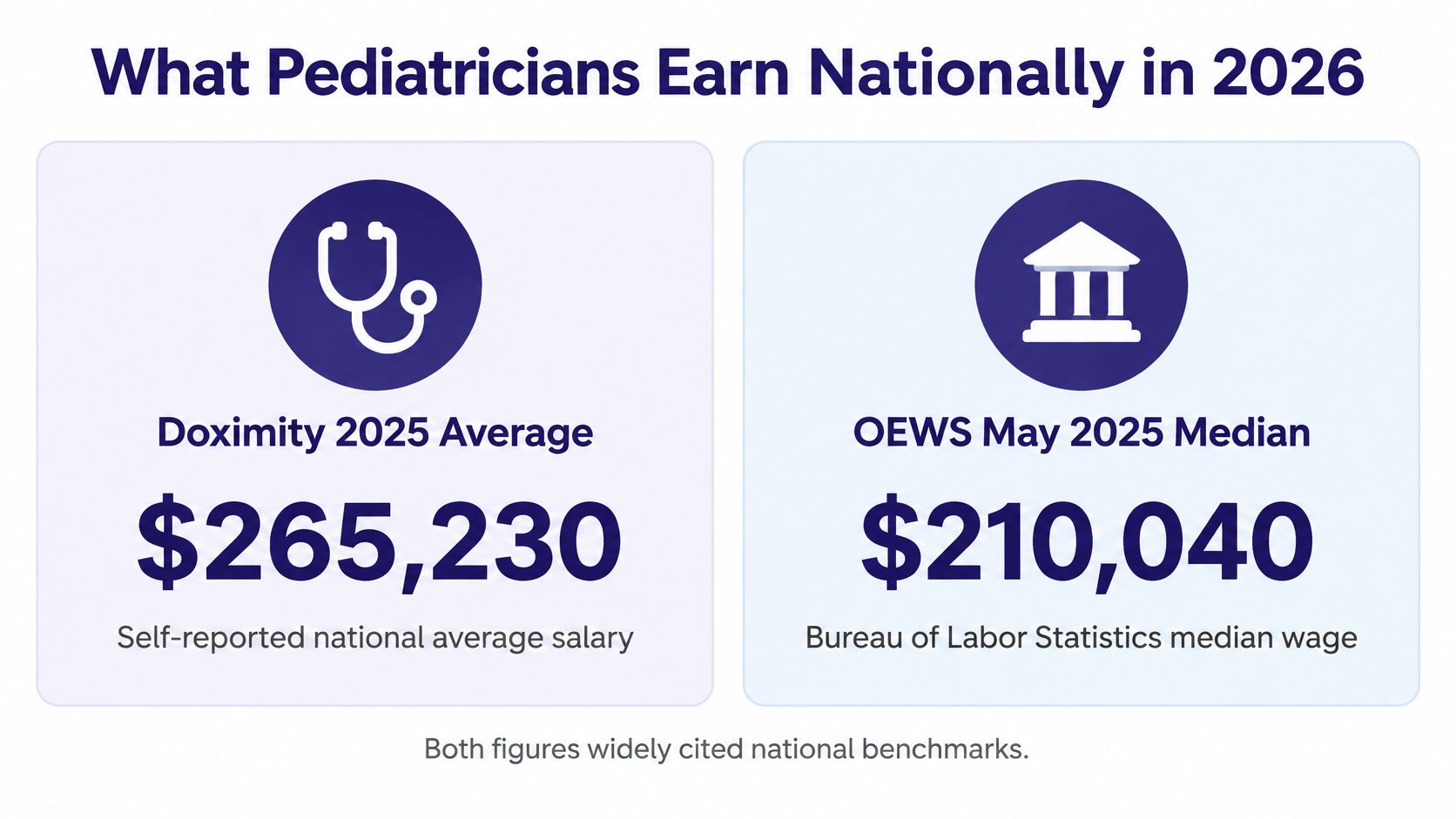
Different measures support different decisions
Mean compensation describes an average within a survey population. Median wage identifies the midpoint of a wage distribution. Neither establishes what a particular hospital must guarantee, and their difference shouldn't be interpreted as a standard bonus allowance.
The American Academy of Pediatrics salary resources distinguish physician compensation reporting from Department of Labor occupational wage information. That distinction supports using wage data to assess guaranteed employment income while evaluating physician surveys alongside workload, practice structure, and incentive opportunities.
For budgeting: Separate contractual salary from variable compensation and employer-paid benefits.
For recruiting: Match the benchmark population to the actual role before selecting a target.
For candidates: Compare achievable compensation with the obligations required to earn it.
Pediatrics also sits below other major primary-care specialties. The national comparison identifies pediatrics as the lowest-paid major primary-care specialty, with family medicine averaging $318,959, approximately 20% higher, in the compensation data discussed through the Bureau of Labor Statistics physician career reference.
A hospital therefore shouldn't describe an offer as competitive merely because it exceeds a pediatric wage median. Competitiveness also depends on which physicians the employer hopes to recruit and what those physicians must deliver.
Regional Pay Variation and Geographic Pressure
A national benchmark can't establish a local recruiting price. A hospital competing for a physician who must relocate, cover an isolated service area, or accept substantial call needs a market-specific assessment rather than a national-average adjustment.
Historical comparisons illustrate the problem. Alaska's average pediatrician compensation exceeded Kansas's by more than double, while Michigan's average fell from $183,330 in 2013 to $132,310 in 2018, a 27.8% decline; Kansas experienced an approximately 13% decline over the same period, according to the historical geographic analysis discussed in Doximity's examination of pediatric compensation pressure.
Pediatrician Pay by Region and Market Type
Market context | Indicative average or median pay | Driver of premium or discount |
|---|---|---|
Alaska versus Kansas, historical comparison | Substantial historical difference; not a current offer range | Assess recruiting difficulty, geography, and local workforce availability |
Michigan, historical comparison | Declining historical average; not a current salary recommendation | Revalidate older benchmarks before budgeting |
Rural or underserved community | Local offer assessment required | Evaluate coverage obligations, relocation barriers, and available support |
Metropolitan health system | Employer-specific comparison required | Examine competing employers, role scope, and benefits |
These observations establish variation, not a causal explanation for every state's results. Labor shortages, cost of living, payer mix, rurality, and recruiting difficulty belong in an employer's analysis, but the historical comparisons alone don't isolate each factor's contribution.
The practical response is to build a local decision file. Recruiters should document comparable vacancies, the clinical responsibilities attached to each opening, candidate objections, and which compensation terms remain negotiable.
Practical rule: Historical state averages can flag a market for closer review, but they shouldn't become an offer schedule without current local validation.
For a rural community hospital, a relocation package or clearly bounded call commitment may address an objection that a small salary adjustment doesn't resolve. Conversely, an attractive headline salary may still leave candidates concerned about professional isolation or inadequate coverage support.
The strategic implication is straightforward: geographic competitiveness must be demonstrated at the role level. An employer should explain why its package fits the local assignment rather than relying on the prestige of a national benchmark.
How Productivity and RVU Models Shape Pediatric Pay
Work relative value units, or work RVUs, measure the physician-work component assigned to clinical services. They aren't interchangeable with total RVUs, which also include practice-expense and malpractice-cost components.
A base-plus-incentive agreement may provide guaranteed salary and additional compensation when credited work RVUs exceed a defined threshold. The agreement must specify both the threshold and the conversion factor, meaning the payment applied to eligible units.
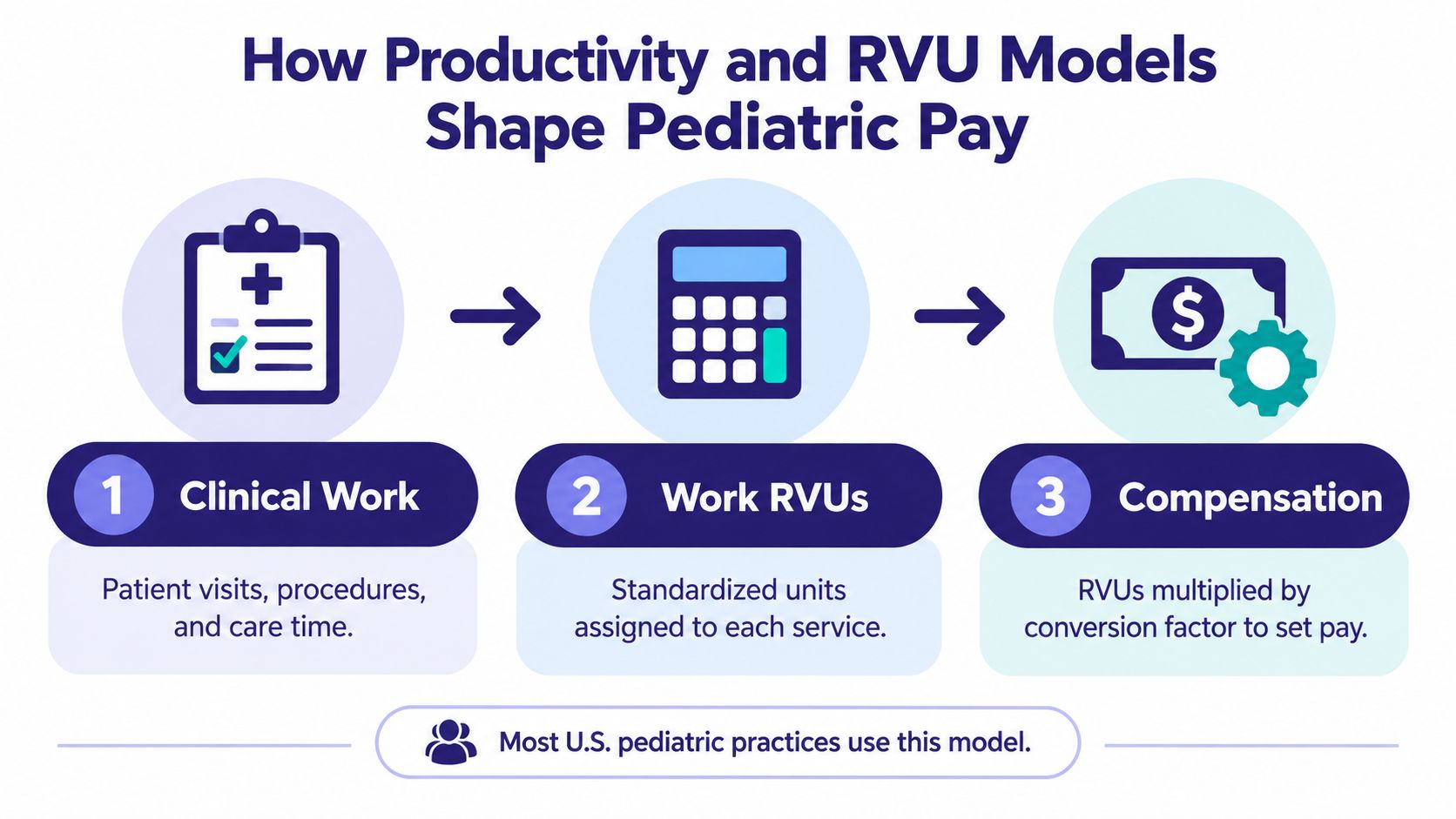
Interpret the evidence without overstating it
An academic pediatric review of RVU-based compensation reported increased clinical productivity for 89% of faculty after an incentive model was introduced; a related review described a 22% productivity increase with a 3% increase in costs. Those findings support examining incentive design, but they don't establish that another institution will reproduce the same results.
A compensation committee should distinguish productive clinical activity from scheduling more visits. Coding accuracy, patient complexity, extended hours, and attribution rules can change credited work without making visit counts a sufficient measure of contribution.
Threshold design: Clarify the clinical effort expected before incentive eligibility begins.
Credit attribution: Specify how shared services, coverage assignments, and documentation corrections affect credited work.
Nonclinical responsibilities: Assign explicit recognition for teaching, research, and administration.
Quality safeguards: Define the measures that prevent productivity expectations from overriding care standards.
A broader comparison of physician compensation models can help committees distinguish salary guarantees, production incentives, and hybrid arrangements. The pediatric application still requires role-specific assumptions.
For candidates, the central question isn't whether an incentive opportunity exists. It's whether the employer supplies the patient access, staffing, clinical time, and transparent reporting needed to make that opportunity credible. For employers, a high theoretical ceiling shouldn't substitute for a defensible estimate of achievable earnings.
Practice Setting and Employer Type
The employer's operating model changes what a compensation offer means. A guaranteed salary, an ownership opportunity, and a faculty appointment represent different economic and professional propositions, even when their headline income appears similar.
The appropriate comparison begins with the work arrangement, not an assumption that every pediatric position belongs in the same salary category. The compensation distinctions already established between wage data and physician surveys make this matching especially important.

Match the package to the employment proposition
Setting | Primary offer questions |
|---|---|
Hospital-employed practice | How long does the guarantee last, and what changes after it expires? |
Private practice | Is ownership available, and what financial obligations accompany it? |
Academic medical center | How are faculty responsibilities and protected time documented? |
Federally qualified health center | What clinical support, mission alignment, and eligible debt assistance are available? |
Rural community hospital | How are coverage continuity, relocation, and backup arrangements addressed? |
These are evaluation criteria, not claims that every employer in a category offers the same benefits. Loan assistance shouldn't be assumed, ownership shouldn't be valued without reviewing its terms, and an academic title shouldn't be treated as a substitute for documented protected time.
Career stage also changes the comparison. An early-career candidate may prioritize predictable income and debt support, while an established physician may place greater weight on leadership authority or control over clinical commitments.
A package should be evaluated against the physician's intended work, not against the employer's label.
Temporary staffing belongs in a separate comparison. A locum tenens physician arrangement should be assessed according to its assignment terms rather than treated as an annual employment offer.
Hospital leaders should document which parts of the employment proposition are contractual, discretionary, or dependent on eligibility. That prevents recruiters from presenting potential benefits as guaranteed value and helps candidates distinguish a durable employment arrangement from an attractive initial offer.
Pediatric Subspecialties and Career-Path Variation
General pediatric compensation isn't a sufficient benchmark for every fellowship-trained pediatric role. The relevant comparison must account for clinical scope, procedural responsibilities, coverage expectations, and the allocation of academic effort.
A Medscape-based comparison published in 2025 placed pediatrics 28th among 29 physician specialties, with approximately $260,000 in compensation, about 28% below the overall physician average and approximately $313,000 below orthopedic surgery. Those figures come from a different comparison than the Doximity benchmark and shouldn't be combined into a single calculated market average.
General Pediatrics vs Selected Pediatric Subspecialties
Role or subspecialty | Typical training length after medical school | Indicative compensation band |
|---|---|---|
General pediatrics | Residency pathway; duration not established by the cited compensation evidence | National benchmarks above; not a role-specific offer band |
Pediatric cardiology | Pediatric and subspecialty training; duration not established here | No defensible numeric band in the cited evidence |
Neonatology | Pediatric and subspecialty training; duration not established here | Requires a role-specific benchmark |
Pediatric critical care | Pediatric and subspecialty training; duration not established here | Requires a role-specific benchmark |
Pediatric hospital medicine | Verify the candidate's training and position requirements | No separate band established here |
Developmental-behavioral pediatrics | Verify subspecialty training requirements | No separate band established here |
The absence of a defensible band is a benchmarking limitation, not a reason to invent one. A committee should obtain the appropriate specialty and responsibility-level data before establishing an offer range.
For pediatric cardiology, a recruiter should specify whether the assignment involves general outpatient care, interventional cardiology, electrophysiology, or another defined clinical scope. Those descriptions identify different responsibilities; they don't independently prove a compensation premium.
Negotiations should then address the actual assignment. Procedure expectations, call coverage, academic commitments, and debt assistance deserve explicit discussion rather than being compressed into a starting-salary comparison.
The strongest recruiting case connects compensation to the service the hospital intends to build. A fellowship credential alone doesn't supply enough information to price that service, particularly when leadership, teaching, and clinical coverage are combined.
Building a Compensation Package Beyond Base Salary
A complete offer should distinguish guaranteed recurring compensation, contingent earnings, nonrecurring payments, and employer-paid benefits. Adding every component into a single headline total can obscure what the physician will receive after the initial employment period.
The Association of Administrators in Academic Pediatrics Faculty Compensation and Productivity Survey separates base from incentive and bonus compensation by rank, subspecialty, region, and responsibility, drawing on more than 100 academic pediatric departments. That framework supports comparing like responsibilities rather than treating faculty compensation as an undifferentiated salary.
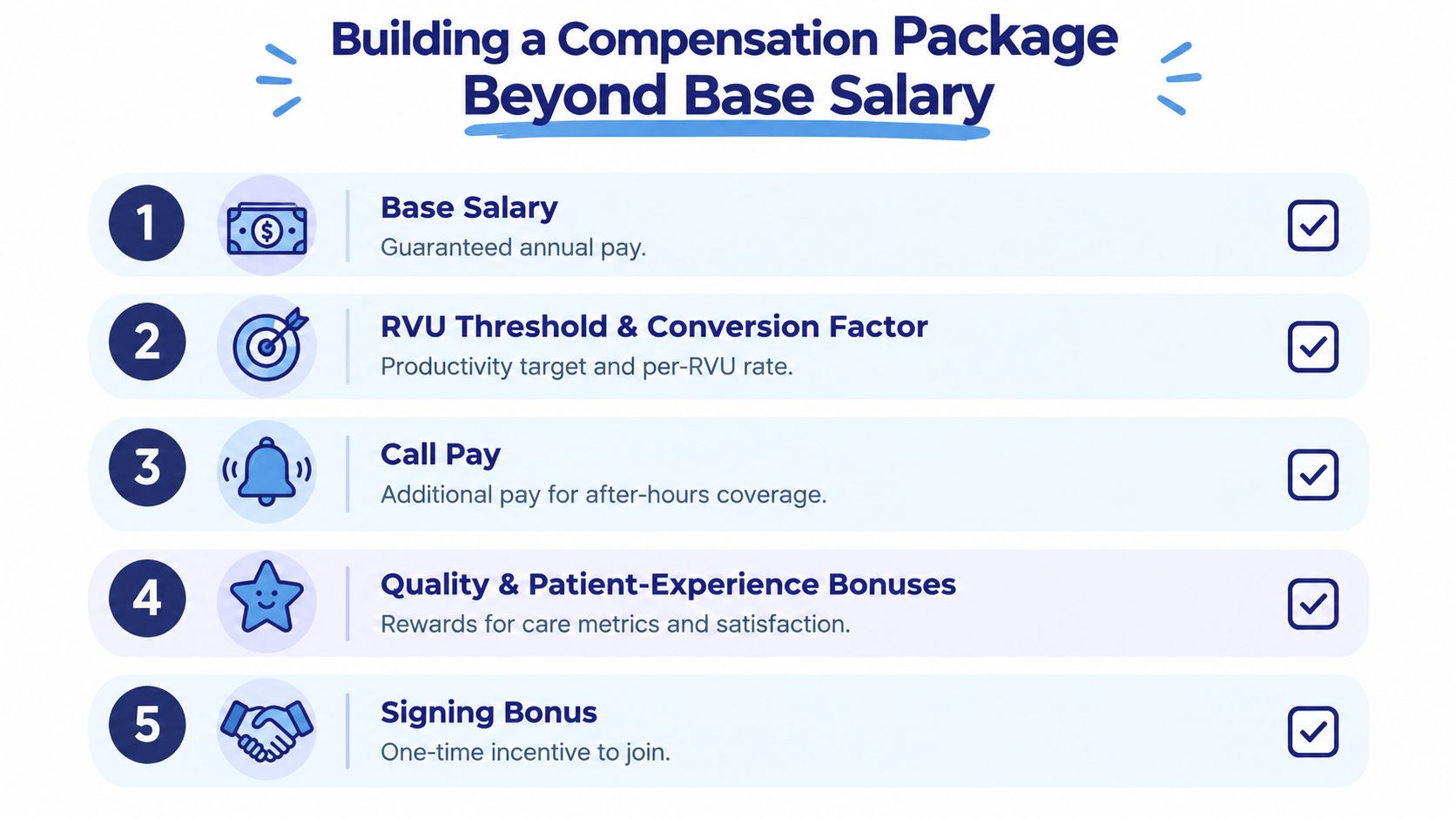
Review the contract in negotiation order
Base salary: Establish the guarantee period, clinical effort, and conditions under which the employer may adjust pay.
RVU terms: Document the threshold, conversion factor, reporting process, reconciliation schedule, and treatment of leave.
Call compensation: Define covered duties, frequency, backup, and whether payment is additional or embedded.
Quality and patient-experience bonuses: Identify the measures, eligibility rules, and data used to determine payment.
Signing and relocation payments: Review payment timing and repayment obligations.
Student-loan assistance: Confirm eligibility, service commitments, and what happens upon departure.
Retirement and insurance: Compare employer contributions and malpractice coverage, including responsibility for applicable tail coverage.
CME and paid time off: Clarify funding, permitted use, and interaction with productivity expectations.
A committee should model the agreement under ordinary performance and under a less favorable operating scenario. That exercise can expose an incentive structure that looks attractive on paper but depends on clinic access or staffing the employer hasn't secured.
Contract review principle: A signing payment shouldn't be presented as though it permanently raises recurring annual compensation.
Candidates also need an itemized offer comparison rather than a single total-value estimate. Some benefits have clear employer costs but different personal value, while protected time has limited practical value unless the schedule and workload preserve it.
Retention, Fairness, and the Real Cost of Low Offers
A hospital can meet its internal salary target and still lose the physician's confidence. Compensation fairness includes the relationship between pay, clinical complexity, financial obligations, and the demands the employer places on the physician.
The Doximity report cited in the national benchmarking discussion included a June 2025 survey of more than 1,200 pediatricians and pediatric subspecialists: 87% believed they weren't fairly compensated, 87% said lower pay affected debt repayment, retirement savings, or other financial goals, and 69% had considered a career change. Because those findings describe perceptions and intentions, they shouldn't be presented as measured turnover rates.
Separate warning signals from financial outcomes
The same survey reported that 23% had already changed or planned to change careers, while the report's longer-term compensation analysis described a 6.7% inflation-adjusted decline in pediatrician purchasing power since 2017. These findings warrant attention, but they don't establish the replacement cost of a vacancy or prove that a particular salary increase will prevent departure.
For hospital leaders, the appropriate response is a structured review of local evidence:
Exit and stay interviews: Distinguish pay objections from workload, staffing, leadership, or advancement concerns.
Offer outcomes: Record why candidates decline rather than assuming compensation explains every rejection.
Coverage stability: Examine whether the existing team depends on persistent additional duties.
Financial progression: Consider whether experienced physicians can see a credible path beyond their initial agreement.
A broader set of physician retention strategies can organize those discussions, but pediatric leaders still need to test interventions against their own workforce experience.
Low compensation is a workforce-planning concern, not merely a benefits complaint. Employers shouldn't expect mission alignment to resolve a mismatch between demanding responsibilities and an unsustainable financial trajectory.
The business case for a stronger package should remain specific. Leaders should evaluate recruiting expense, coverage alternatives, service disruption, and candidate acceptance locally rather than borrowing an unsupported return-on-investment claim. Fairness becomes actionable when the organization can explain both its compensation decisions and the work expectations behind them.
Compensation Strategy for Pediatric Programs in 2026
Pediatric program leaders should treat compensation as a documented investment decision. The relevant question isn't whether the salary clears a national benchmark, but whether the entire arrangement supports the clinical service the organization intends to maintain.
A useful decision file combines the source and period of each benchmark, the exact duties being recruited, local candidate feedback, and the contractual package. It should also distinguish observations from assumptions so that a historical average doesn't become a forecast.
Model decisions rather than extrapolating headlines
Maintain benchmark discipline: Keep general pediatrics, subspecialty, academic, and leadership comparisons distinct.
Test operational feasibility: Confirm that staffing, facilities, and scheduling support the compensation agreement.
Expose uncertainty: Identify which earnings depend on patient demand, productivity, quality results, or continued eligibility.
Review outcomes: Track whether accepted offers produce sustainable coverage and lasting employment relationships.
For forward planning, compensation committees should model alternative assumptions rather than apply an unsupported national growth rate. Scenario analysis can show how an agreement behaves when clinical capacity, coverage needs, or available resources differ from expectations.
The resulting conversation is more useful for both parties. Candidates can assess whether the role supports their professional and financial priorities, while executives can evaluate whether the package fits the program's mission and operating requirements.
The best compensation strategy is explainable. Leaders should be able to show why the benchmark fits, how the physician can earn the proposed compensation, and which commitments the organization will make in return.
American Cardiology Group offers permanent physician recruitment, locum tenens coverage, advanced practice placement, and executive recruitment exclusively for cardiology and cardiac surgery. Hospital leaders applying these compensation principles to cardiovascular programs can visit American Cardiology Group to discuss role-specific recruiting needs, coverage priorities, and long-term workforce alignment.
Comments