
Enumeration Date Meaning in Healthcare and Cardiology
A cardiology service line can recruit an excellent interventional cardiologist, finish privileging, load the physician into the EHR, and still hit a preventable revenue wall on day one. The reason is often not clinical readiness. It's a single administrative field that many teams notice too late: the enumeration date tied to the provider's National Provider Identifier.
For hospital administrators, medical group executives, and new fellows entering practice, enumeration date meaning isn't abstract terminology. It's a control point for claims validity, payer enrollment sequencing, onboarding speed, and compliance hygiene. In high-acuity specialties such as electrophysiology, heart failure, interventional cardiology, and cardiothoracic surgery, even brief delays can disrupt scheduling, billing workflows, and staffing plans.
Table of Contents
The Critical Role of the Enumeration Date in Healthcare Operations - Where the risk shows up first
NPI vs Census Enumeration A Critical Distinction - Same logic, different consequence - What this distinction means in practice
Impact on Cardiology Credentialing and Revenue Cycles - Credentialing pressure points - Revenue cycle consequences in procedural cardiology - Hiring and coverage delays - Compliance exposure
How to Locate and Verify an Enumeration Date - A simple verification workflow - If the provider does not yet have an NPI - What works and what creates delays - Build the date into pre-employment diligence
Best Practices for Managing NPI Enumeration - Operational habits worth adopting - What leadership should insist on
The Critical Role of the Enumeration Date in Healthcare Operations
A rejected claim for a newly hired cardiologist usually sends teams looking at coding, payer setup, or authorization. Sometimes the failure sits further upstream. If the provider's NPI timeline doesn't align with the date of service, the billing system and payer review process may treat the transaction as invalid before anyone debates medical necessity.
That's why the enumeration date meaning matters operationally. In the NPPES context, it isn't just a date on a record. It's the point that establishes when a provider's administrative identity became active for HIPAA-standard transactions. For a hospital trying to turn on a new electrophysiologist, structural heart specialist, or locum cardiothoracic surgeon, that date affects when billing can start cleanly and when downstream enrollment work makes sense.
Where the risk shows up first
The risk usually appears in three places:
Revenue cycle timing: Revenue integrity teams can't assume a physician who is clinically ready is also administratively billable.
Credentialing workflow: Enrollment staff need a verified provider identity before payer files, rosters, and linked records move smoothly.
Recruitment execution: Search firms, service line leaders, and department administrators need to treat the NPI timeline as part of go-live planning, not post-offer cleanup.
Practical rule: A provider start date and a provider billing-ready date are not always the same thing.
For cardiology leaders managing procedural revenue and coverage gaps, this field belongs on the same operational checklist as licensure, privileges, DEA registration where applicable, malpractice coverage, and call scheduling. Administrative details that seem minor in lower-volume settings become strategic in service lines where one physician's activation affects cath lab throughput, inpatient consult coverage, and outpatient follow-up access.
Teams that want a broader operating lens on physician onboarding and service line execution can compare this issue against wider cardiology practice management priorities. The common theme is simple. Revenue and compliance problems often begin with small data errors long before they appear in a denial report.
The NPI Enumeration Date Explained
A cardiologist can have a signed contract, approved privileges in progress, and a clinic template ready to open. If the NPI record is not aligned with the onboarding timeline, billing, payer enrollment, and EHR build can all stall on a single date field. That is why the enumeration date deserves more attention than it usually gets.
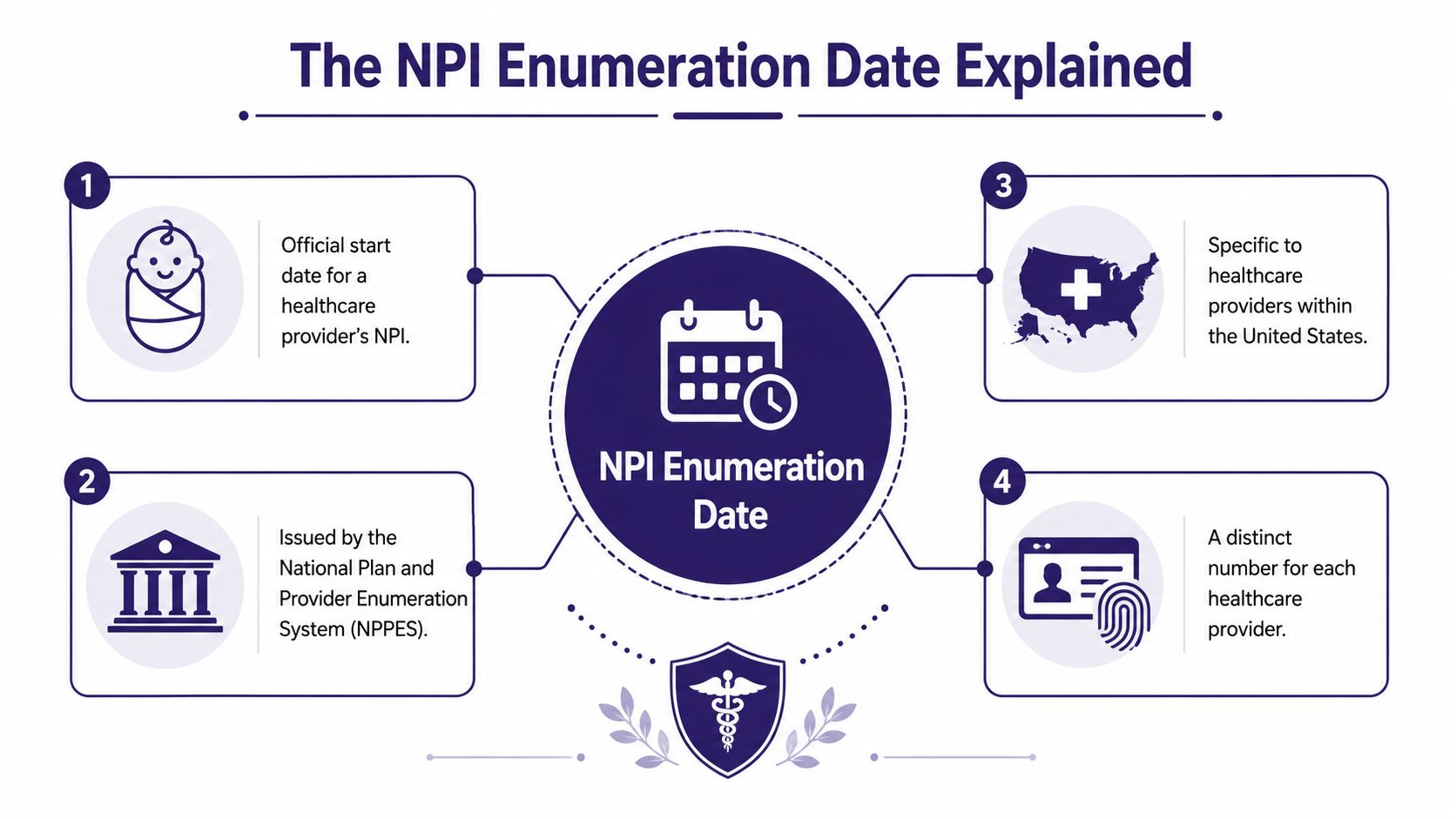
In U.S. healthcare administration, the NPI enumeration date is the calendar date on which a National Provider Identifier was first assigned to an individual clinician or organization in NPPES, the federal National Plan and Provider Enumeration System. CMS maintains the NPI application and record framework through the NPPES system and NPI registry resources.
That date stays fixed.
It is not the date a physician joined your group, started fellowship, completed training, or became credentialed with a health plan. It is also not the same as the last updated date on the NPI record. Updates can reflect address changes, taxonomy revisions, name changes, or other record maintenance. The enumeration date remains the original assignment date for that identifier.
The last updated date shows record maintenance. The enumeration date shows record origin.
For cardiology operations, that distinction matters because the NPI is tied to how a physician is identified across claims, enrollment files, clearinghouse transactions, directory listings, and internal provider master data. If the chronology looks wrong, staff lose time reconciling records that should have matched on the first pass. In a procedural service line, that delay can affect clinic scheduling, cath lab case billing, and downstream collections.
The issue shows up often with physicians in transition. A fellow finishing training may have an existing NPI from residency or earlier practice activity, while a newly hired cardiologist relocating across state lines may need separate attention on licensure, payer enrollment, and identity verification at the same time. For groups expanding recruitment across markets, the operational sequence often intersects with Interstate Medical Licensure Compact planning for multi-state physician hiring.
A short comparison keeps the field meanings clear:
Field | What it means | Does it change |
|---|---|---|
Enumeration date | Original assignment date of the NPI | No |
Last updated date | Most recent change to NPI record details | Yes |
From an administrative standpoint, the most important takeaway is simple. Treat the enumeration date as a control point, not a background data field. Teams that confirm it early make payer enrollment, roster validation, and first-claim readiness easier to manage. Teams that wait until the first denial or enrollment mismatch usually end up fixing avoidable timing and identity problems under pressure.
NPI vs Census Enumeration A Critical Distinction
Search results for enumeration date meaning can be misleading because the term also appears in census and demographic contexts. The underlying concept is similar. Both uses rely on a fixed point in time. But for healthcare operations, they serve very different purposes.
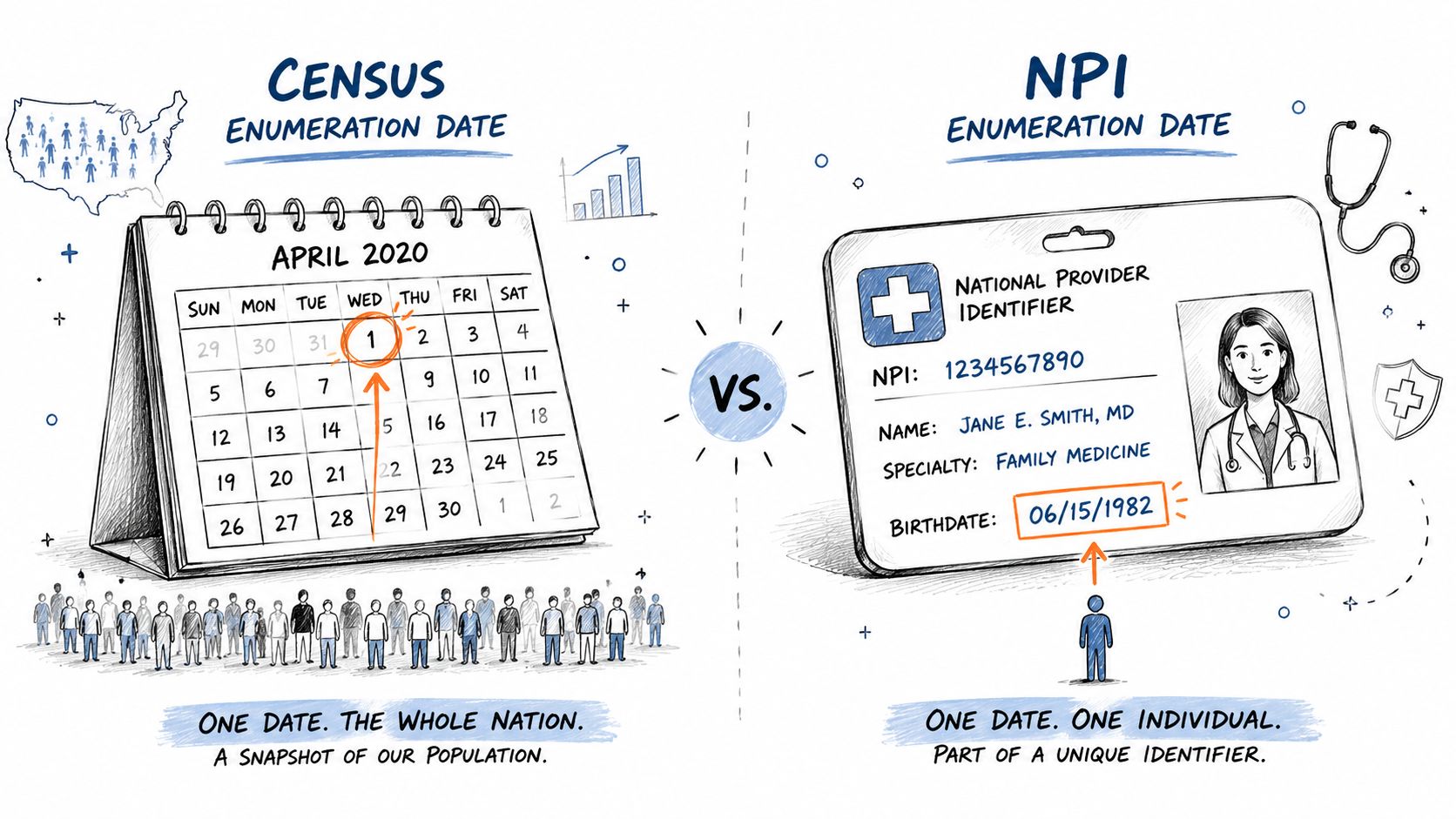
In census work, the enumeration date is the “as of” moment used to count a population at a single point in time. In the United States, that date has been fixed as April 1 since 1930, while from 1790 to 1820 it was the first Monday in August, as documented in this historical summary of United States census dates.
Same logic, different consequence
Census enumeration solves a population-counting problem. It prevents double counting and omissions by tying the count to one reference point rather than the entire fieldwork period.
NPI enumeration solves an administrative identity problem. It establishes when a healthcare provider or entity formally entered the NPPES framework and became identifiable for healthcare transactions.
That difference matters for a hospital executive. A census reference date may matter for population planning, physician-to-population analysis, or service area strategy. It does not determine whether a newly hired electrophysiologist can submit claims correctly.
What this distinction means in practice
For healthcare leaders, the operational question is narrow:
If the issue is population statistics, workforce modeling, or public planning, census enumeration may be relevant.
If the issue is credentialing, claims, payer enrollment, or provider onboarding, the relevant term is the NPI enumeration date.
This distinction becomes especially important when administrators manage physicians across multiple states. Workforce expansion already involves enough complexity around licensure, privileging, and payer participation. Confusing a demographic term with an NPPES data field only slows execution. Teams dealing with multi-state physician movement often face related timing questions in the Interstate Medical Licensure Compact context, where sequence and documentation matter just as much as speed.
In provider operations, the only enumeration date that directly affects billing readiness is the one attached to the NPI.
Impact on Cardiology Credentialing and Revenue Cycles
A cardiology group hires a new interventionalist, builds the cath lab schedule, opens clinic templates, and lines up consult coverage for day one. Then billing stops because the provider record does not support the service timeline. In cardiology, that kind of sequencing failure hits fast because high-value encounters start early and claim volume builds immediately.
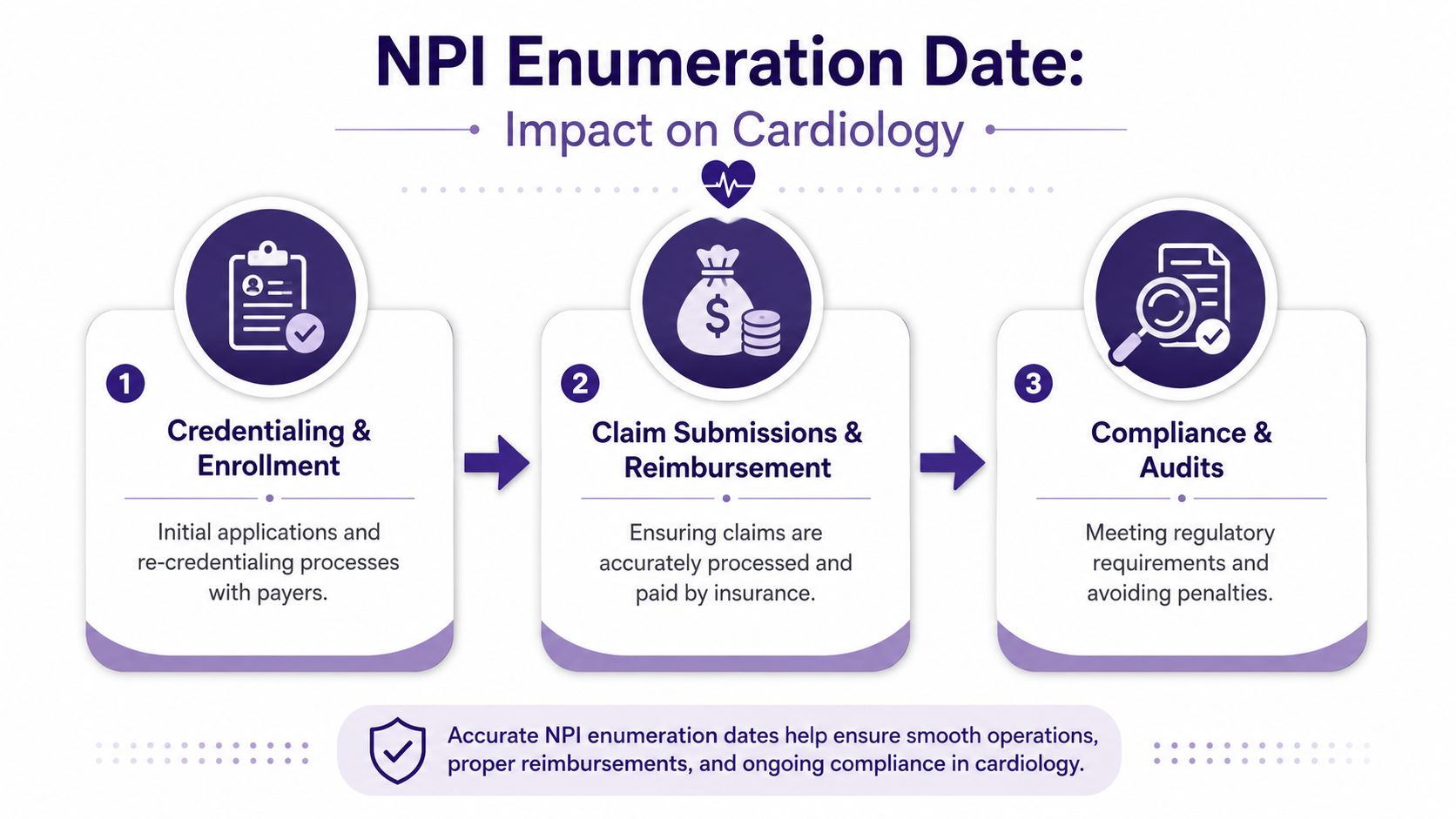
The enumeration date matters here as an operational control point. It helps credentialing, enrollment, and billing teams confirm that a physician's administrative identity was in place before the organization pushes claims, loads schedules, or activates payer-facing workflows. For a hospital administrator, this is not clerical detail. It affects whether a new cardiologist can generate clean revenue on schedule.
Credentialing pressure points
Cardiology onboarding often compresses several timelines at once: fellowship completion, state licensure, medical staff approval, payer enrollment, EHR build, and procedural scheduling. A recent enumeration date does not automatically signal a problem, but it does justify closer review of the file. Teams should confirm that the NPI, taxonomy, licensure data, legal name, and employment records align before the first billable encounter.
This is especially important for physicians moving from training into attending practice. I have seen organizations assume that because a fellow is clinically ready and privileges are approved, the rest of the file will sort itself out. It does not. Small identifier mismatches at the front end create avoidable delays in payer loading, claim submission, and downstream payment posting.
A practical review looks like this:
Workflow area | What staff should verify | Why it matters |
|---|---|---|
Initial credentialing | NPI exists and chronology fits hiring plan | Prevents enrollment delays and file exceptions |
Payer enrollment | Provider identifiers match across applications and source documents | Reduces rework and mismatch denials |
Claims setup | Planned dates of service align with the active provider record | Protects reimbursement and claim acceptance |
Internal records | HR, credentialing, EHR, and billing systems carry the same NPI data | Limits correction work after go-live |
Revenue cycle consequences in procedural cardiology
The financial risk is larger in cardiology than many leaders expect. A physician may begin with office consults, but revenue often shifts quickly into stress testing, imaging, device work, cath lab procedures, electrophysiology studies, and hospital follow-up. If the provider file is not aligned before those services are billed, the organization can face rejected claims, held charges, manual corrections, and delayed cash.
Those delays are expensive.
A signed contract does not solve the problem. Approved privileges do not solve it. Completed orientation does not solve it. Each milestone has value, but none replaces a provider record that supports billing readiness across payer systems and internal platforms.
Revenue safeguard: Do not release a new cardiology provider for billable scheduling until credentialing, payer enrollment, and billing operations confirm that the NPI record and service timeline match.
Hiring and coverage delays
Enumeration timing also affects recruiting execution. Cardiology service lines rarely hire under relaxed conditions. Programs are trying to reduce call strain, protect referral patterns, expand procedural capacity, or cover a sudden departure. If onboarding stalls over provider identity data, the cost shows up in lost clinic access, slower procedural throughput, and more strain on the physicians already carrying the schedule.
Recruitment partners can help, but only if they understand operational readiness instead of stopping at candidate delivery. The strongest physician placement agencies for hard-to-fill cardiology roles account for the administrative sequence that determines a real start date, not just a signed offer date.
Compliance exposure
Compliance teams should treat the enumeration date as a chronology check across the provider file. It helps test whether the story told by the record makes sense: who the provider is, when the provider entered the transaction system, and whether enrollment and billing activity line up with that timeline.
If that field is ignored, errors spread across credentialing software, payer rosters, EHR provider masters, and claim edits. Fixing those problems after services are rendered takes staff time, delays payment, and creates audit risk that was avoidable at the start. In cardiology, where each activated physician can affect substantial revenue within days, that is a preventable operational loss.
How to Locate and Verify an Enumeration Date
A cardiology group can sign a physician on Monday, load the schedule on Tuesday, and still miss the first clean claim because no one verified the NPI record. The enumeration date looks minor until it blocks payer enrollment, raises identity questions, or exposes a mismatch between the provider file and the billing timeline.
The fastest way to prevent that failure is to check the field early, then make it visible across credentialing, enrollment, recruiting, and revenue cycle operations. In practice, this is not a clerical lookup. It is a control point for start-date accuracy and first-bill readiness.
For an existing provider, use the NPI Registry. Search by provider name or NPI number, open the record, and confirm that the NPI belongs to the correct individual or entity. Then verify the enumeration date against the onboarding file, payer enrollment status, and planned service dates. Do this before templates are opened, hospital privileges go live, or billable visits hit the schedule.
A simple verification workflow
Use a repeatable five-step check:
Search the provider in the NPI Registry.
Confirm the record matches the correct clinician or organization.
Review the enumeration date and compare it with the planned start date and expected billing timeline.
Reconcile the same NPI data across HR, credentialing, EHR, and billing systems.
Escalate discrepancies before payer enrollment or claim submission begins.
One owner should be accountable for this checkpoint.
That matters because the common failure is not lack of access to the data. The common failure is fragmented ownership. Recruiting may have one NPI, credentialing another, and the billing team may not discover the mismatch until a claim rejects. In cardiology, where a single physician can generate substantial professional and facility revenue soon after activation, that delay is expensive.
Strong onboarding treats NPI verification as pre-service revenue protection.
If the provider does not yet have an NPI
The task changes from verification to application. Providers can obtain an NPI through the online NPPES application, by mailing a paper form to the NPI Enumerator, or by authorizing a trusted organization to submit through bulk enumeration or Electronic File Interchange, according to this CMS enrollment sheet on obtaining an NPI.
Method affects timing. CMS indicates that properly completed online applications are typically processed faster than paper submissions. For a cardiology service line trying to activate a fellow, APP, or locum coverage assignment, that gap can change when the provider is ready to work, document, and bill.
What works and what creates delays
Several operating habits reduce avoidable drag:
Start with the online route when appropriate: It is usually the fastest path.
Collect NPI status during recruitment or contract finalization: Late discovery compresses the rest of onboarding.
Reconcile the registry record before go-live: The same NPI should appear consistently in internal systems.
Several habits create predictable problems:
Waiting until orientation week: That turns a known dependency into a last-minute risk.
Treating paper submission as operationally equivalent to online submission: It can extend the activation timeline.
Allowing separate departmental spreadsheets to stand as source records: Conflicting files create downstream denials and manual cleanup.
Build the date into pre-employment diligence
Every employed physician, APP, and locum candidate should have documented NPI status before the final onboarding calendar is approved. If the NPI already exists, verify the enumeration date and record it in the provider file. If no NPI exists, start the application immediately and build the processing time into the launch plan.
Cardiology leaders often push for compressed starts because patient demand, call coverage, and procedural capacity leave little slack. Administrative dependencies still set the floor. Teams that verify the enumeration date early protect hiring plans, speed clean billing, and reduce avoidable compliance exposure.
Best Practices for Managing NPI Enumeration
Organizations that handle NPI data well don't treat it as a clerical afterthought. They build it into recruitment, credentialing, provider master data governance, and first-bill readiness. That approach is especially valuable in cardiology, where a delayed start can affect referral capture, procedural scheduling, inpatient coverage, and continuity across outpatient and hospital settings.
For individual clinicians, preparation starts with the application itself. For Type 1 NPI applicants, the enumeration process requires submission of specific data elements including full legal name, date of birth, home address, Social Security Number or Tax Identification Number, area of specialization, and business structure, as outlined in this overview of NPI application requirements. Incomplete or inconsistent inputs create avoidable friction later.
Operational habits worth adopting
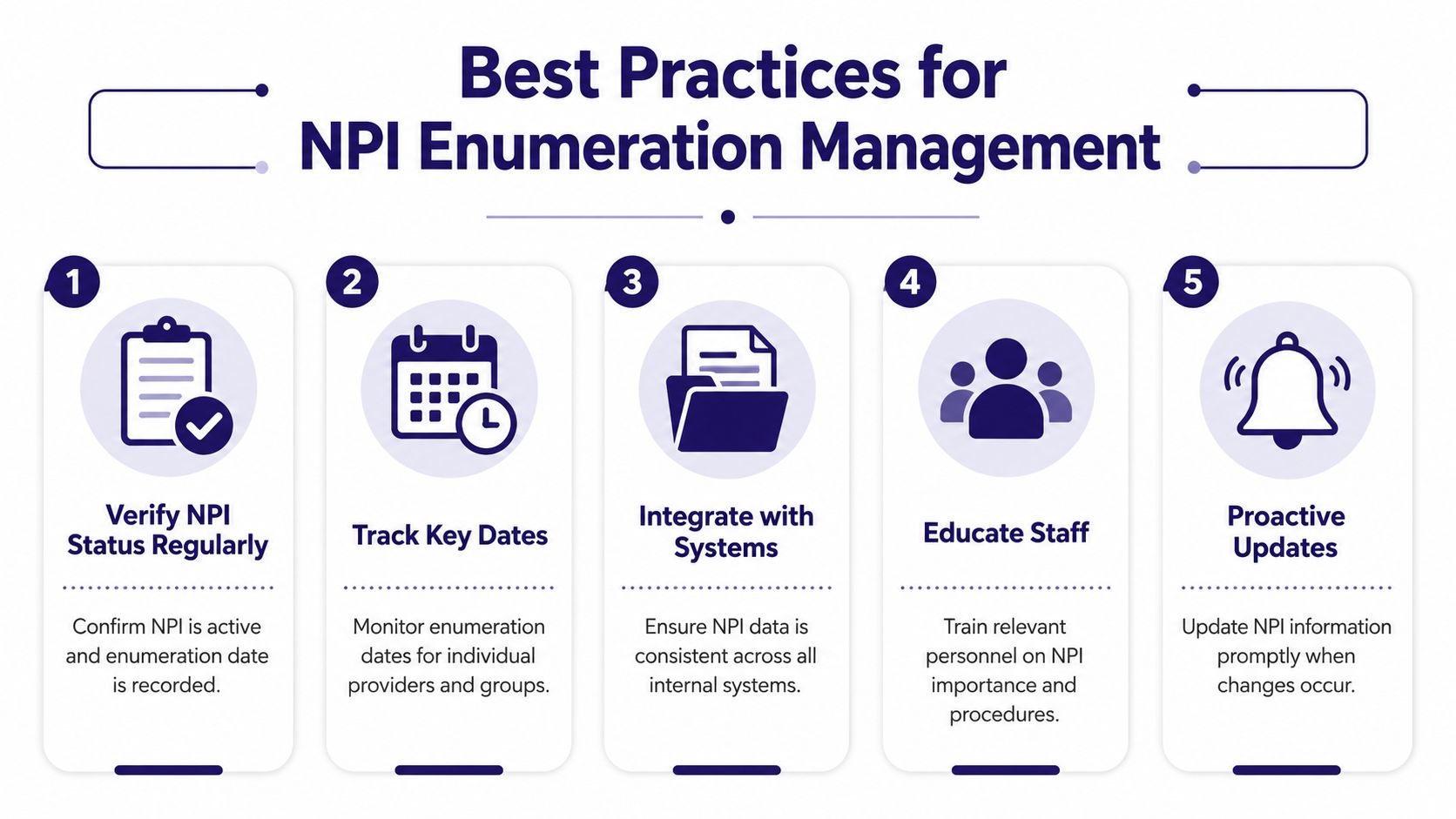
The strongest operating model usually includes five habits:
Move NPI review to the front of recruitment: Don't wait for payer enrollment staff to discover a missing or newly issued NPI late in the process.
Assign ownership clearly: One team should own verification, but related teams should all see the status.
Standardize provider data entry: Legal name, specialty, and identifying details should match across systems.
Prepare fellows before graduation: New cardiologists should enter the market billing-aware, not just clinically ready.
Use the date as a release criterion: A provider shouldn't be opened for independent billable services until the administrative record supports it.
What leadership should insist on
Hospital leaders often focus on larger physician access problems, and that's appropriate. But execution discipline lives in small fields and small checklists. If the NPI enumeration date isn't part of the standard onboarding packet, the organization is leaving a known dependency unmanaged.
A concise governance model helps:
Leadership area | Best practice |
|---|---|
Service line administration | Require documented NPI status before finalizing start plans |
Credentialing | Validate enumeration date early in file build |
Revenue cycle | Tie scheduling release to administrative readiness checks |
Medical staff operations | Educate new physicians on why NPI timing matters |
Administrative readiness should be treated as part of clinical readiness for every new cardiology hire.
Clinicians also benefit directly from this mindset. A cardiology fellow who applies early and keeps core identifying data accurate becomes easier to onboard, easier to enroll, and easier to activate across hospital and clinic settings. In a competitive hiring market, that makes the candidate more deployable from the employer's perspective.
American Cardiology Group helps hospitals, health systems, and cardiac programs secure billing-ready cardiology and cardiac surgery talent across the United States. For organizations hiring in general cardiology, interventional cardiology, electrophysiology, heart failure, or cardiothoracic surgery, and for clinicians exploring their next move, American Cardiology Group offers specialized recruitment support built with an understanding of cardiac staffing, onboarding, and long-term program growth.
Comments