
Locum Tenens Staffing Agencies: A Strategic Guide
An interventional cardiologist has left unexpectedly, and the service line is now trying to cover eight weeks of procedures, clinic, and call. Outpatient waitlists are growing, inpatient teams are absorbing overflow, and the medical director is still refreshing email late at night for a candidate who can work inside the lab's privilege scope.
That situation exposes the value of locum tenens staffing agencies. The right partner doesn't forward résumés. It protects procedural capacity, manages credentialing risk, coordinates travel and coverage logistics, and gives hospital leadership a practical alternative to leaving a revenue-producing service line exposed.
Table of Contents
What Locum Tenens Staffing Agencies Actually Do - The agency workflow
The Market Shift From Backfill to Strategic Workforce Tool - What workforce leaders should change
Credentialing and Compliance for Cardiology Locums - Build the file from primary sources - Match privileges to actual competence - Protect the first weeks
Negotiation and Onboarding Best Practices - Same-day onboarding controls
Treating Locum Partners as Strategic Infrastructure - Decisions for the next thirty days
What Locum Tenens Staffing Agencies Actually Do
A locum tenens staffing agency is a working intermediary between a healthcare organization and a temporary physician or advanced practice provider. The agency sources candidates, screens clinical qualifications, coordinates licensing, supports credentialing, negotiates the contract, arranges travel and housing, and commonly provides malpractice coverage and administrative support.
That model differs from a permanent placement firm. A permanent recruiter generally introduces a candidate for an employment or partnership process. A locum agency manages a time-bound clinical engagement, often using billable daily or hourly rates, assignment schedules, travel arrangements, licensure logistics, and an ongoing support structure throughout the placement.
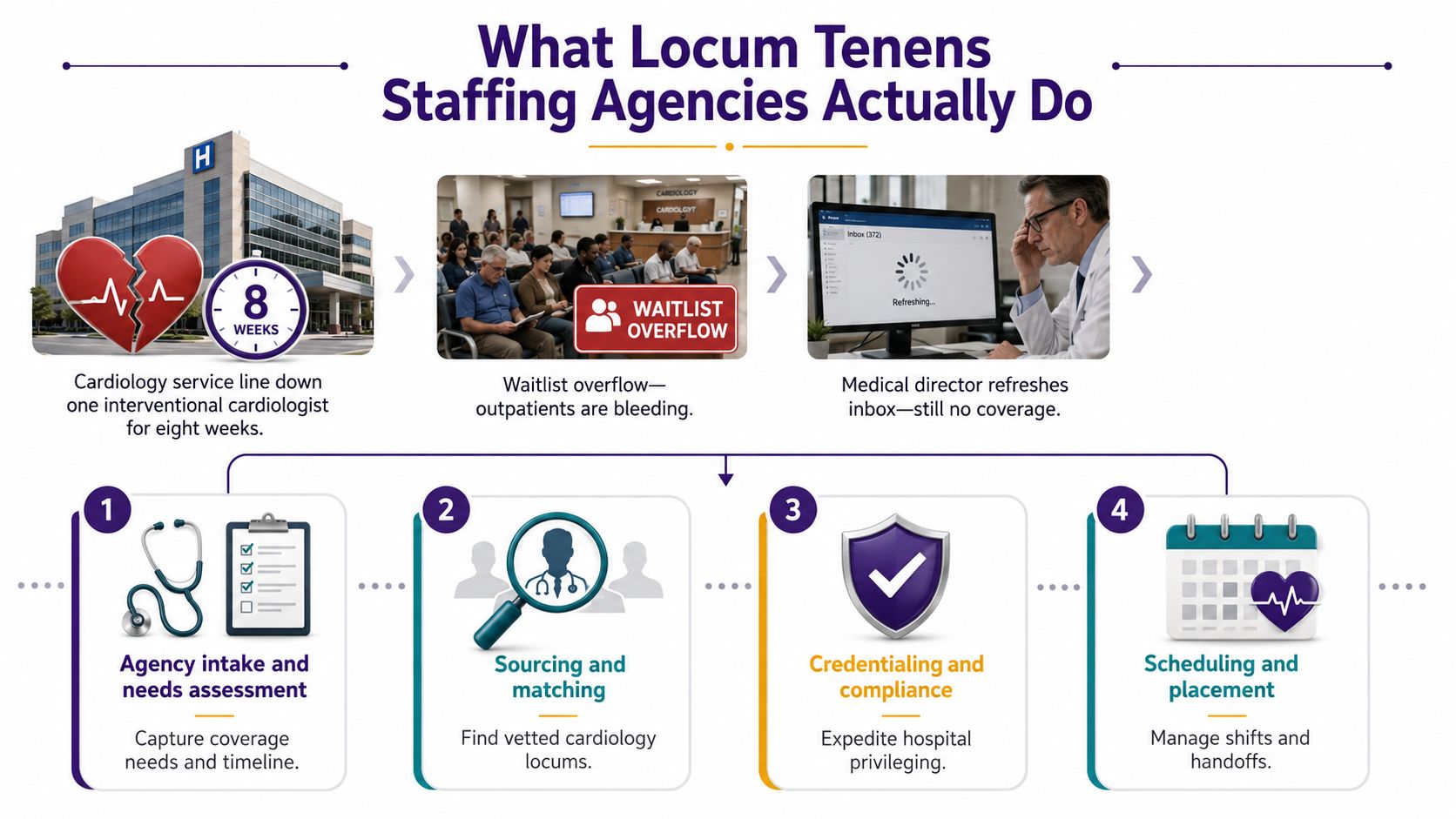
The agency workflow
The hospital should expect four practical deliverables:
Needs assessment: The recruiter documents specialty, procedure mix, call expectations, schedule, start date, assignment length, facility type, and required privileges.
Candidate matching: The agency searches its clinician network for physicians whose training, recent experience, availability, and geographic requirements align with the assignment.
Credentialing support: The agency assembles a primary-source file, supports state licensing, tracks missing documents, and coordinates the hospital's privileging workflow.
Assignment management: The agency handles scheduling changes, travel, housing, invoicing, compensation administration, and clinical troubleshooting during the engagement.
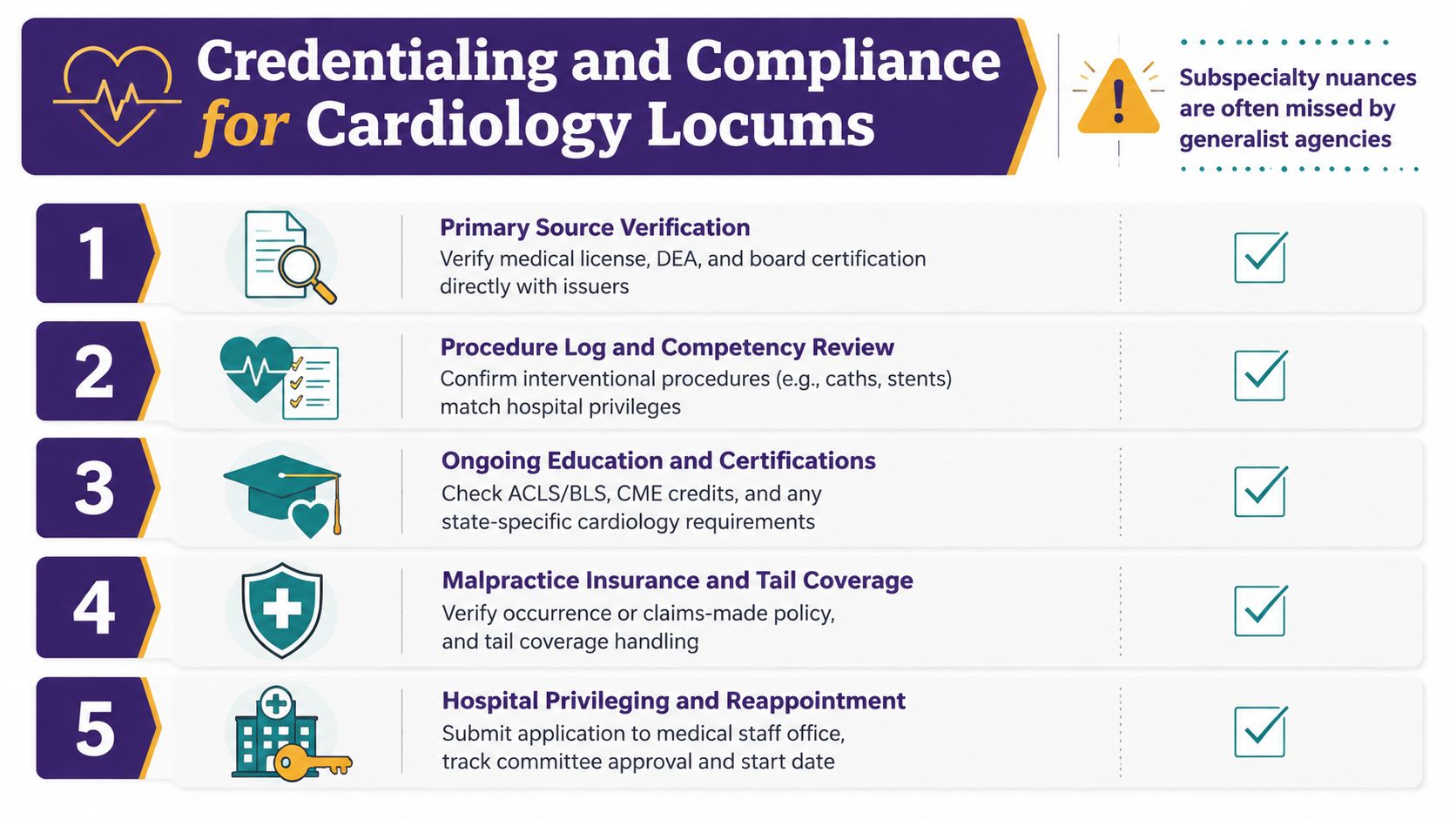
The agency usually carries or arranges malpractice coverage, but the contract must specify whether the policy is occurrence-based or claims-made and who handles extended reporting obligations. Housing, flights, rental transportation, licensure reimbursement, and cancellation terms also need written treatment rather than informal promises.
Operational rule: A shortlist isn't a solution until the candidates can be privileged for the work the service line actually needs.
For a cardiology department, that distinction matters. A general cardiologist who can cover clinic and inpatient consults may not be suitable for interventional cardiology, electrophysiology, structural heart work, or high-acuity call. A strong agency reduces administrative drag while protecting against the larger cost of an empty call panel, delayed procedures, diverted patients, and lost outpatient continuity.
The Market Shift From Backfill to Strategic Workforce Tool
Locum tenens has outgrown the idea of an emergency substitute. An independent market estimate places the global market at USD 9.43 billion in 2024 and projects USD 14.61 billion by 2030, representing a 7.6% CAGR, while another estimate places North America at 51.94% of global revenue in 2023. Those figures position temporary clinical staffing as a large international labor channel, not a niche workaround. Grand View Research's locum tenens staffing market analysis
The U.S. remains central to the model's development. Locum tenens originated as a structured staffing category in the United States and has served as many as one in three U.S. patients each year. In 2024, locums appeared in 16.4% of physician searches and 8.1% of advanced practice provider searches, the highest recorded rates in the cited industry report. The 2025 State of Locum Tenens report shows that temporary coverage now sits inside mainstream recruiting workflows.
What workforce leaders should change
Healthcare organizations used locums 25% more than expected in 2024. At the same time, the share using locums primarily for backfill declined from 82% in 2023 to 67% in 2024, while 35% used it to meet rising patient demand and 28% used it for peak periods. The reported 2024 locum usage shift supports a different budgeting approach.
Cardiology leaders should treat locum capacity as workforce buffer inventory, much like surge capacity in beds, procedural rooms, or imaging. A single departure can expose a program because interventional cardiology and electrophysiology rely on narrow skill sets, coordinated teams, and privileges that aren't easily transferred between physicians.
The planning question is no longer, “What will the hospital do if someone resigns?” It is, “Which coverage scenarios deserve a preapproved locum pathway?” A service line can budget for predictable leave, recruitment gaps, seasonal demand, program expansion, and call protection before those pressures become expensive emergencies.
A practical referral point for executives evaluating the broader recruiting ecosystem is this overview of physician placement agencies. The key decision is whether locum coverage remains an episodic purchase or becomes part of the annual workforce plan.
Agency Models Compared for Cardiology Service Lines
The right agency model depends on the clinical risk of the assignment. Large generalist agencies provide broad geographic reach, established workflows, and access to physicians across many specialties. Specialty cardiology recruiters offer a smaller, more clinically relevant network. That distinction matters when the hospital needs a physician qualified for a defined procedure, call schedule, and privilege set.
Digital marketplaces can give facilities direct access to available clinicians and clearer visibility into rates. They fit straightforward assignments when the hospital has enough internal capacity to review credentials, negotiate terms, and manage onboarding. Tele-locums platforms can support virtual consults, follow-up clinics, triage, and selected overnight workflows. They do not replace bedside procedural coverage in a catheterization laboratory or electrophysiology suite.
Model | Best For | Time-to-Fill | Credentialing Depth | Rate Structure | Limitation |
|---|---|---|---|---|---|
Large generalist agency | Broad geographic coverage and common cardiology assignments | Often fast for standard roles | Standardized, with specialty variation | Contract-specific | May miss subspecialty detail |
Specialty cardiology recruiter | Interventional cardiology, electrophysiology, advanced heart failure, and complex call | Focused on clinical fit | Detailed procedure and privilege review | Contract-specific | Smaller overall network |
Digital marketplace | Direct matching for facilities with internal staffing capacity | Depends on available clinicians | Hospital carries more review responsibility | More visible, contract-specific | Less hands-on coordination |
Tele-locums platform | Virtual consults, overflow clinics, and selected remote coverage | Depends on clinician availability and state rules | Must address remote-practice requirements | Contract-specific | Cannot provide bedside or procedural care |
For interventional cardiology, electrophysiology, and advanced heart failure, specialty recruitment usually deserves preference. The recruiter should test procedure experience, review procedure logs, verify current privileges, and confirm that availability matches the actual call burden. Hospitals evaluating this model can also review guidance on interventional cardiology locum tenens.
Generalist agencies remain practical for routine inpatient coverage, clinic volume, and broad regional searches. Their scale can shorten sourcing when the clinical requirements are familiar and the credentialing review is manageable.
Set the model by the consequence of failure. A delayed routine consult may be manageable through several channels. An uncovered STEMI call schedule requires clinical depth, verified procedural fit, and coordinated credentialing, not the largest physician database.
Direct Hire Versus Agency Economics
Direct contracting can look cheaper because the hospital removes the agency margin. That calculation is incomplete. The hospital still pays the physician's rate and assumes the work of sourcing, screening, contracting, credentialing, licensing, scheduling, travel, invoicing, and coverage troubleshooting.
The more relevant comparison is landed cost, not the visible hourly or daily rate. A 2024 Monte Carlo simulation comparing locum tenens and full-time anesthesiologists found an average breakeven point of 665 hours, or just over 11 weeks at 60 hours per week. Beyond that period, the model found permanent hiring becomes more cost-effective for the institution. The published anesthesiology cost simulation supports a disciplined duration test, although cardiology assignments still require specialty-specific modeling.
Cost Component | Direct Hire | Agency |
|---|---|---|
Physician compensation | Paid directly by the hospital | Included in contracted bill rate |
Recruiting and sourcing | Hospital absorbs internal labor or external search cost | Agency performs sourcing and matching |
Malpractice coverage | Hospital or physician must arrange policy and confirm tail terms | Agency commonly arranges coverage, subject to contract |
Credentialing and licensing | Medical staff office and physician manage the process | Agency provides file preparation and tracking support |
Travel and lodging | Hospital coordinates or reimburses expenses | Agency commonly coordinates under agreed terms |
Invoicing and collections | Hospital manages payment workflow | Agency invoices the facility and pays the clinician |
Schedule changes and troubleshooting | Hospital handles operational issues | Agency provides account and after-hours support |
Cancellation exposure | Hospital carries more direct administrative risk | Contract allocates cancellation obligations |
Claims-made tail coverage deserves special attention. When coverage ends, tail protection can cost roughly 1.5 to 2 times the annual premium, according to the direct-versus-agency locum analysis. The agreement should identify the carrier, policy type, limits, tail responsibility, and timing of certificates.
Agencies may charge a premium over the clinician's compensation, but that premium buys administrative capacity and risk transfer. Agencies generally win for short, uncertain, surge-based, or difficult subspecialty gaps. Direct engagement becomes more attractive for stable, long-term coverage when the hospital has the infrastructure and the assignment duration justifies internal ownership.
For U.S. independent contractors, Form 1099-NEC is generally required when payments reach $600 or more in a tax year. When an agency pays the clinician directly, the agency usually handles the filing. The locum tenens 1099 filing guidance illustrates how contract structure changes administrative responsibility.
Credentialing and Compliance for Cardiology Locums
Credentialing determines whether a cardiologist can practice safely within your program's actual scope. A strong clinician can still fail the assignment if the hospital has not verified procedure volume, call readiness, or specific privileges. Generalist recruiters often miss those distinctions.
The medical staff office should control a written sequence and require primary documentation, not rely on a recruiter's summary.
Build the file from primary sources
Verify medical school, residency, fellowship, licenses, board status, DEA registration, and professional references directly from the issuing sources. Confirm cardiovascular disease certification through board records, then verify subspecialty qualifications for electrophysiology, interventional cardiology, structural heart, or advanced heart failure as applicable.
Include malpractice history, sanctions screening, NPI information, ACLS or BLS records, and state-specific documents. OIG and SAM exclusion checks belong in the compliance workflow before the start date, not in a rushed final review.
Match privileges to actual competence
For interventional candidates, review recent procedure logs. Compare PCI, catheterization, structural, peripheral, and other relevant activity with the lab's case mix, equipment, call intensity, and privilege thresholds. The right question is whether the physician can perform the work your service line needs.
A specialty recruiter should assemble board documentation, license details, ACLS records, references, malpractice history, and procedure logs. Primary-source verification should precede review by interventional leadership, which assesses procedural scope, recent experience, call suitability, and case complexity. That level of specialty control matters more for hard-to-fill interventional and electrophysiology assignments than a broad database alone.
The privilege form should name high-risk procedures. “Cardiology coverage” does not define whether the physician may perform radial or femoral access, complex PCI, structural procedures, device work, or overnight STEMI response.
Protect the first weeks
The onboarding package should include:
Privilege delineation: State what the physician may perform independently and what requires supervision.
Proctoring plan: Define review for unfamiliar workflows or high-acuity procedures.
Handoff protocol: Transfer active patients, pending studies, follow-up duties, and call escalation rules.
Systems access: Confirm EMR, badge, paging, dictation, imaging, and procedural documentation access before the start date.
Use this healthcare credentialing process as a shared documentation reference for recruiting, medical staff, and compliance teams. A specialty agency earns its fee when it delivers a candidate whose credentials, privileges, and availability align before the assignment begins.
Selection Criteria That Predict a Good Match
The first agency call should function as a due-diligence interview. A hospital executive shouldn't ask only whether the agency has cardiologists. The meaningful question is whether it can present credentialable candidates with the exact procedural and scheduling profile within the hospital's required window.
Ask how many actively credentialed interventional cardiologists the agency can present for the region within fourteen days, and how many are repeat travelers rather than first-time locums. Ask whether the agency owns its medical staff operations function or outsources it. Request its average days-to-privilege metric, but require a definition of “privileged,” because a completed application isn't the same as committee approval.
Malpractice terms deserve their own review. The buyer should request the policy type, carrier, limits, tail arrangement, exclusions, and the carrier's AM Best rating. A low bill rate isn't attractive if the hospital inherits unclear liability or an expensive post-assignment obligation.
References should come from similarly sized cardiology programs. The reference call should ask about after-hours responsiveness, holiday coverage, schedule changes, clinician documentation, and the agency's response to a mid-assignment cancellation. Those answers reveal more than a polished sales presentation.
Criterion | Weight | What to Ask | Score (1-5) |
|---|---|---|---|
Subspecialty network | High | How many suitable interventional or EP candidates are active and available? | |
Credentialing infrastructure | High | Who owns verification, licensing, and privilege tracking? | |
Malpractice strength | High | Is coverage occurrence-based or claims-made, and who handles tail? | |
Comparable references | Medium | Can the agency provide references from similar cardiac programs? | |
Contract flexibility | Medium | How are cancellations, schedule changes, travel, and extensions handled? | |
Communication coverage | High | Who responds after hours when a clinician or schedule issue arises? |
The winning agency isn't necessarily the largest. It is the one whose network, compliance process, insurance structure, and contract behavior match the risk profile of the gap. A generalist may be adequate for routine clinic coverage. A specialty recruiter is usually the more defensible choice when procedural privileges and call reliability determine whether the assignment succeeds.
Negotiation and Onboarding Best Practices
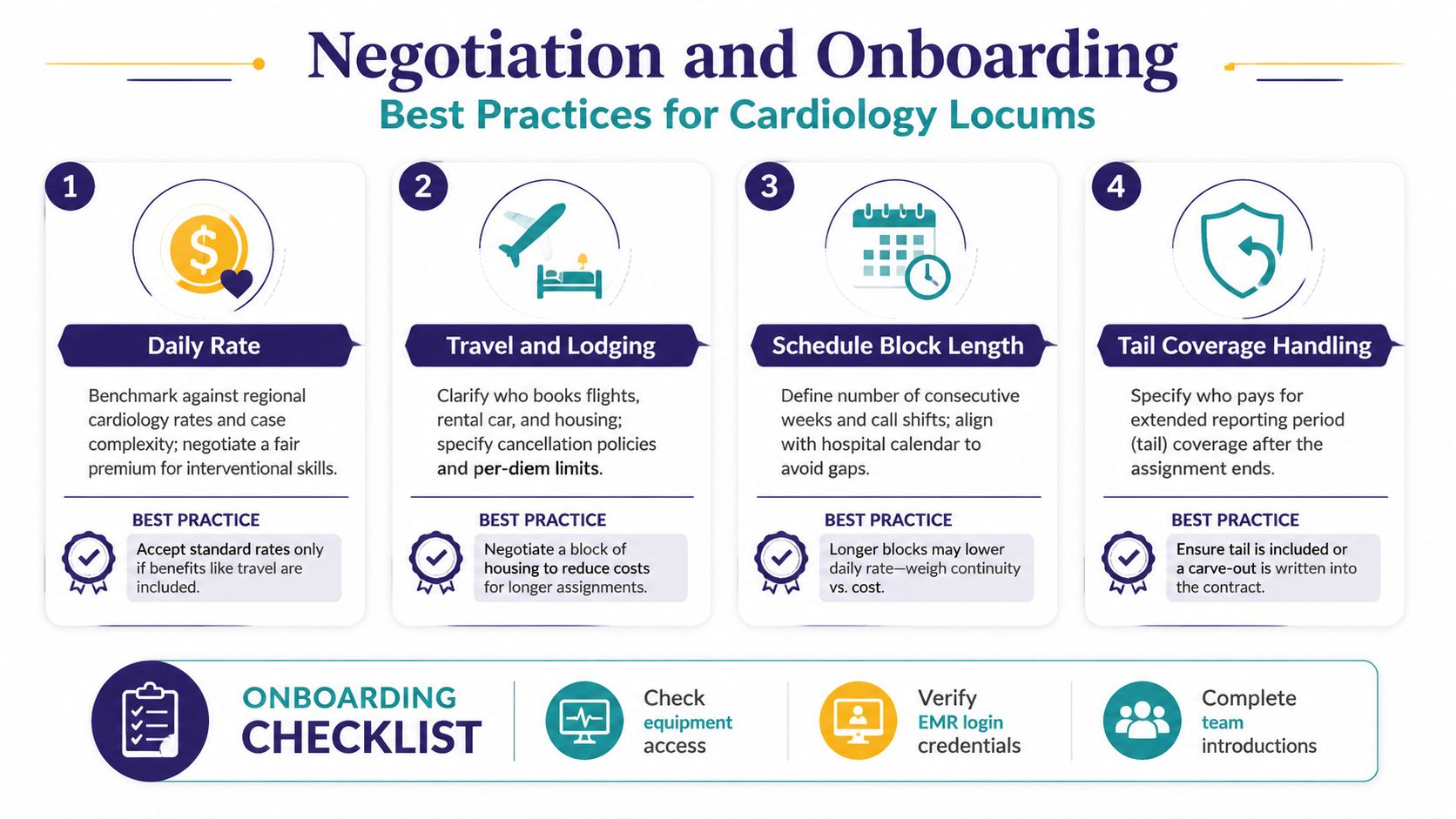
Four contract levers deserve attention before a cardiology locum signs: daily rate, travel and lodging, schedule block length, and tail coverage. Negotiation should start with the clinical requirements, not with a rate copied from a different specialty or a lower-acuity assignment.
The daily rate should reflect procedure complexity, call burden, documentation expectations, and local market conditions. Travel terms should state who books flights, rental cars, and housing, who pays cancellation costs, and whether per diem limits apply. Schedule blocks should identify consecutive clinical days, call shifts, clinic sessions, procedure days, and protected time.
Longer blocks can improve continuity and may support a lower daily rate, but the hospital shouldn't trade away flexibility without calculating the operational benefit. The contract must also state who pays for tail coverage if the malpractice policy is claims-made.
Same-day onboarding controls
The clinical director, medical staff office, IT team, and nursing leadership should use one start-date checklist:
EMR access: Confirm login, templates, imaging access, order sets, and dictation.
Badge and facility access: Issue credentials for the hospital, cath lab, electrophysiology suite, and relevant work areas.
Team introductions: Identify the charge nurse, cath lab manager, hospitalist lead, anesthesia contact, and escalation chain.
Handoff cadence: Schedule a structured review with the outgoing cardiologist and define how unresolved cases transfer.
Competency check: Review high-acuity procedure readiness within the first seventy-two hours, including equipment, workflow, and escalation expectations.
The most common contracting mistake is accepting a schedule block that exceeds the physician's stated availability. That creates cancellations, resentment, and avoidable coverage instability. Another is treating after-hours interventional call as interchangeable with general cardiology call. It isn't.
Contract test: Every obligation should be traceable to a named person, a defined shift, a privilege, or a written coverage term.
Standard boilerplate can work for routine travel and invoicing. It deserves pushback when it obscures cancellation liability, high-acuity call ratios, tail responsibility, or the exact scope of procedures the hospital expects.
Treating Locum Partners as Strategic Infrastructure
A specialty cardiology recruiter becomes infrastructure when the relationship produces operational readiness before the vacancy occurs. Repeat engagement lets the partner learn the service line's procedure mix, call design, EMR, credentialing sequence, travel constraints, and physician culture. That knowledge can produce prioritized candidate access, reusable credentialing files, and better alignment with volume forecasts.
The hospital should stop measuring the relationship only by fill rate. A placement that fills a schedule but cannot perform the required procedures, integrate with the call team, or complete documentation has failed operationally.
Decisions for the next thirty days
A cardiology director should make five decisions:
Identify recurring coverage scenarios: Separate predictable leave, recruitment gaps, peak demand, program expansion, and emergency vacancies.
Select a specialty partner model: Decide which assignments require cardiology-specific recruiters and which can use broader platforms.
Create a rolling master agreement: Replace repeated one-off negotiations with defined terms for rates, insurance, travel, credentialing, cancellation, and extensions.
Add the recruiter to workforce planning: Include the partner in quarterly discussions about retirements, departures, new programs, call sustainability, and volume projections.
Create a performance dashboard: Track time to qualified shortlist, time to privilege approval, schedule adherence, cancellation response, documentation quality, call coverage, and conversion to permanent recruitment when appropriate.
The broader market is also moving beyond physician-only staffing. Independent market coverage reports that locum APP staffing grew nearly 25% year over year in the first half of 2024, while digital marketplaces, tele-locums, and AI-assisted matching emerged as notable trends. The reported locum agency industry trends point toward hybrid workforce design, but technology doesn't remove the need for clinical judgment.
Tele-locums may support remote follow-up, overflow, and selected consult workflows. They don't solve an uncovered interventional lab or replace a physician who must respond physically to a high-acuity case. Likewise, automated matching may accelerate discovery, but a cardiology leader still needs procedure-log review, privilege control, and a realistic call assessment.
The strategic question is simple. Can the partner help the hospital preserve access, protect quality, and forecast coverage before the vacancy becomes a crisis? If not, the agency is a transactional vendor, regardless of its size.
A separate market estimate projects global locum tenens staffing from USD 10.98 billion in 2025 to USD 24.37 billion by 2035, with USD 11.8 billion projected for 2026 and an implied 8.3% CAGR for 2026 to 2035. Research Nester's market projection reinforces the scale of the channel, but hospitals should judge partners by execution rather than market size.
American Cardiology Group provides cardiology-focused locum tenens coverage, including temporary placement support, candidate matching, credentialing coordination, and ongoing assignment assistance for hospitals and cardiac programs. Hospital executives evaluating specialty coverage can visit American Cardiology Group to discuss a structured locum strategy for interventional cardiology, electrophysiology, advanced heart failure, and related cardiac service lines.
Comments