
7 Interventional Cardiology Jobs in California for 2026
Two California interventional jobs can share a title and still be different practices. One is a high-volume coronary PCI seat in a physician-led group. Another is a faculty role that adds teaching, research, and structural heart. A third is a community hospital post that mixes clinic, consults, and STEMI call. Pay formulas diverge as sharply as the labs.
Those differences matter more because the training pipeline has not kept pace with open seats. Interventional cardiology fellowship positions have repeatedly gone unfilled in recent application cycles. A higher advertised salary does not, by itself, refill that pipeline. Candidates screen for call, volume, mentorship, and schedule design, and hiring leaders who ignore that lose people who look identical on paper.
This roundup reads seven current California opportunities as decision profiles, not as a job-board list. Each role is judged on the four variables that separate interventional positions: regional market and cost of living, practice model (academic, integrated system, private practice, or community hospital), procedural case mix (coronary versus structural), and how call and compensation are structured.
The comparison that holds up is what the employer has already disclosed, set against the open questions a candidate or hiring leader should resolve before anyone negotiates.
Table of Contents
1. Find Jobs
Statewide interventional searches fail when every posting with the same title gets the same CV. Find Jobs at American Cardiology Group sits inside a firm that recruits only for cardiology and cardiac surgery. Candidates can contact those recruiters to discuss a California search and their cardiac specialty focus, so the first conversations sort academic, integrated-system, private-practice, and community-hospital seats before a file goes to the wrong model.
Treat that contact as the start of a focused conversation, not a finished inventory. The page does not confirm live interventional openings in California. Current openings, call, and case mix still have to be verified with the recruiter.
What the California market actually looks like
In May 2023 the Bureau of Labor Statistics reported about 1,260 cardiologists employed in California, a mean hourly wage of $187.08 ($389,120 annual mean), a location quotient of 0.70, and about 520 of those jobs in Los Angeles–Long Beach–Anaheim at an annual mean of $362,920. BLS does not split interventional cardiology from the broader cardiologist category. The absolute market is large. A location quotient of 0.70 still means the state's share of cardiologist employment sits below the national average, so a coastal metro base and an inland community salary are not the same offer. Cost of living, practice model, coronary versus structural case mix, and the call-and-compensation formula are the four variables that separate these seats.
Practical rule: Ask which of the four variables is fixed, and which is still negotiable, before anyone books a site visit.
Open questions are straightforward. Is the target coronary PCI, a structural program with TEER, or a mixed general-plus-interventional seat? Is call true STEMI coverage or a lighter shared rotation? Will the employer put volume and the production formula in writing?
2. Sutter Health, Palo Alto Foundation Medical Group, Palo Alto
Palo Alto Medical Foundation, inside Sutter Health, is advertising a full-time interventional cardiology role aimed at high-volume, complex coronary work in a physician-led multispecialty group. The Sutter Health clinician posting lists $472,500–$525,000, plus benefits, practice growth, and shareholder production-based income. Applicants need an interventional fellowship and board certification in interventional cardiology.
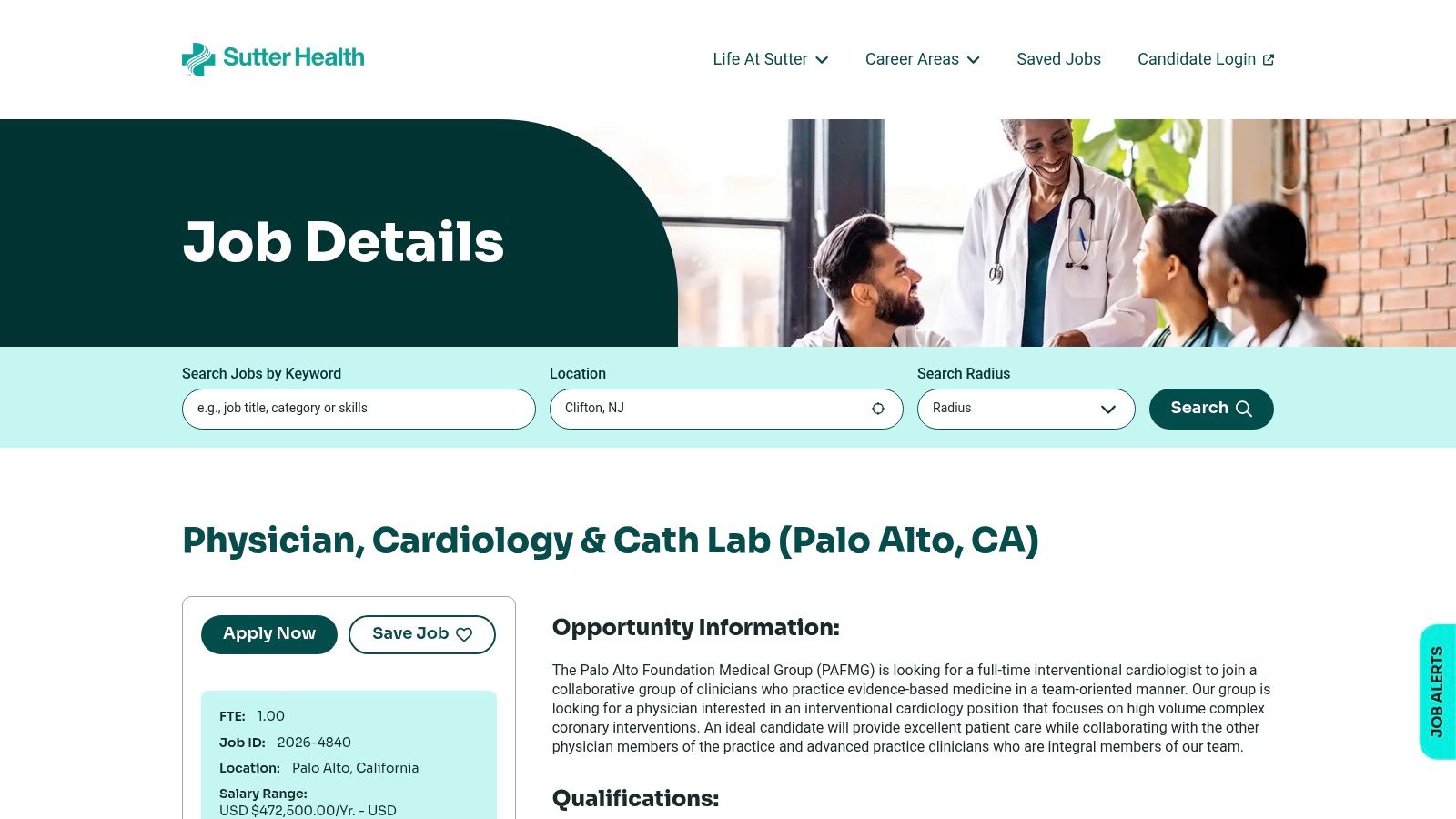
That published range sits near a broader California benchmark. SalaryExpert places average cardiologist pay in the state at about $518,063, with an average bonus of $38,907, and estimates about 11,919 annual wRVUs at roughly $59 per wRVU. Those figures aren't interventional guarantees. They show why a candidate shouldn't stop at the base band. Ask whether the shareholder formula uses a comparable conversion, and what counts as compensable work, including call.
Schedule flexibility, sabbaticals, a relocation allowance, and retirement benefits are on the listing. The clinical description is coronary, not a structural-heart primary seat.
Practice model: Physician-led group inside a large multispecialty network.
Case mix: Complex coronary intervention, not a TEER-first structural job.
Cost of living: Palo Alto is a high-cost coastal market, so the base has to be read against housing.
A published range is useful only after production terms, call burden, and first-case expectations are written down.
Set the band next to how an interventional cardiologist salary is built before treating the top of the range as the whole offer. Confirm historical panel wRVUs and whether peripheral work sits inside or outside the base.
3. UC Irvine, Interventional Cardiologist, Orange or Irvine
This is a faculty job, not a pure clinical seat. UC Irvine is hiring a full-time interventional cardiologist at assistant, associate, or full professor rank. Clinical work covers inpatient consults and catheterization-lab coverage in Orange or Irvine, and the appointment also expects teaching and scholarly activity. The UC Irvine recruitment posting lists $506,950–$528,682, with possible added pay through the health sciences compensation plan. Applications run through January 12, 2027, and later files may be reviewed if the role is still open.
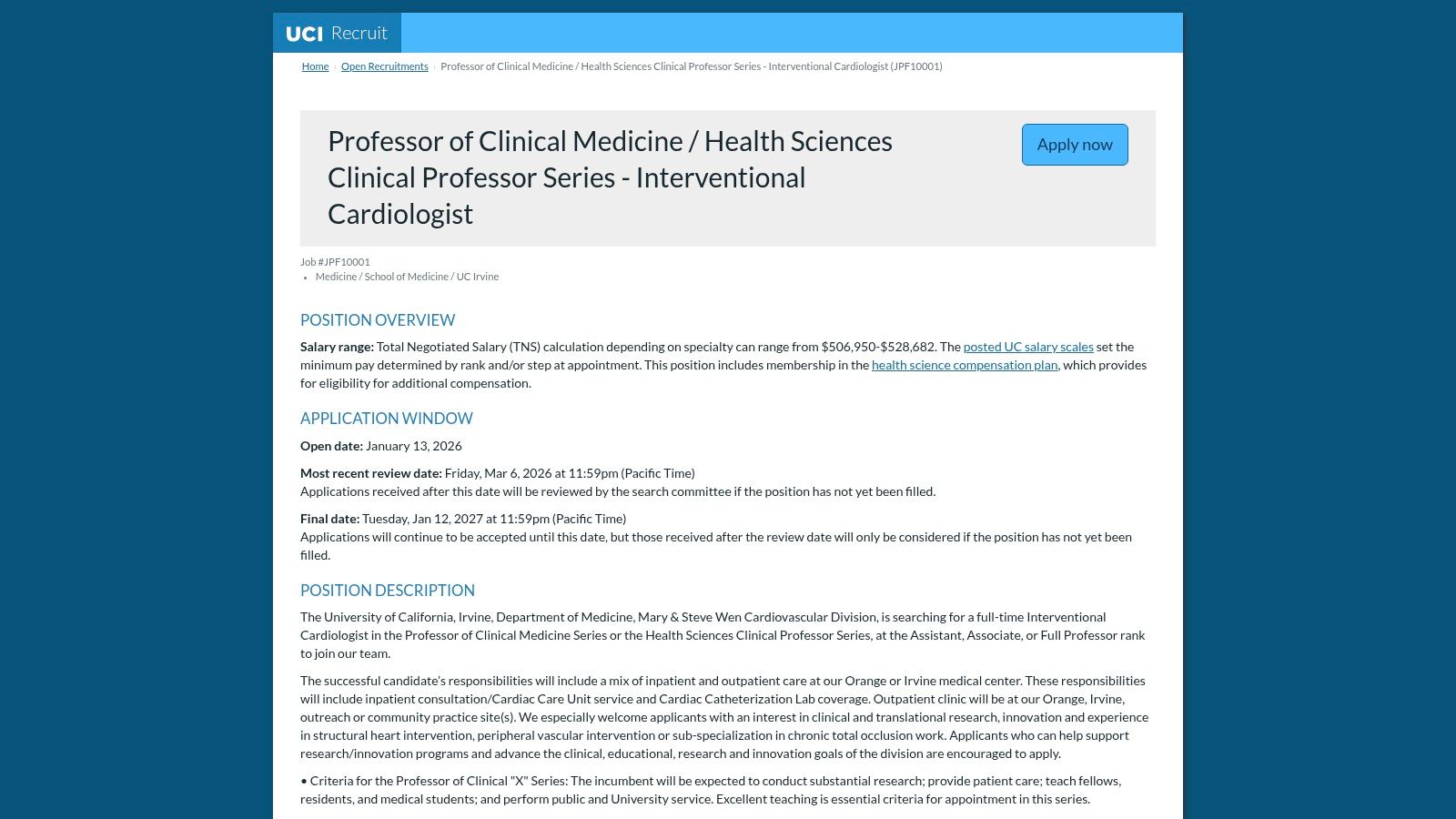
Academic cash often sits well below non-academic procedural cash. A 2026 dataset puts California interventional compensation near $649,056 overall, with academic roles around $472,914 and non-academic roles around $712,201, according to Marit Health. Don't read the UC range as total cash.
The posting flags possible interests in structural heart, peripheral intervention, and chronic total occlusion work. That suits an operator who wants CTO and structural volume inside an academic division. It is a poor fit for someone who wants no teaching load. The file requires a CV, a research statement, a teaching statement, and three references.
Candidates leaving training should see how an interventional cardiology fellowship maps onto a faculty search, because scholarly output is part of the hire. Ask what share of the week is cath lab versus clinic and protected academic time, and what annual CTO, peripheral, and structural volume is done on site.
4. Tenet Healthcare, Emanuel Medical Center, Turlock
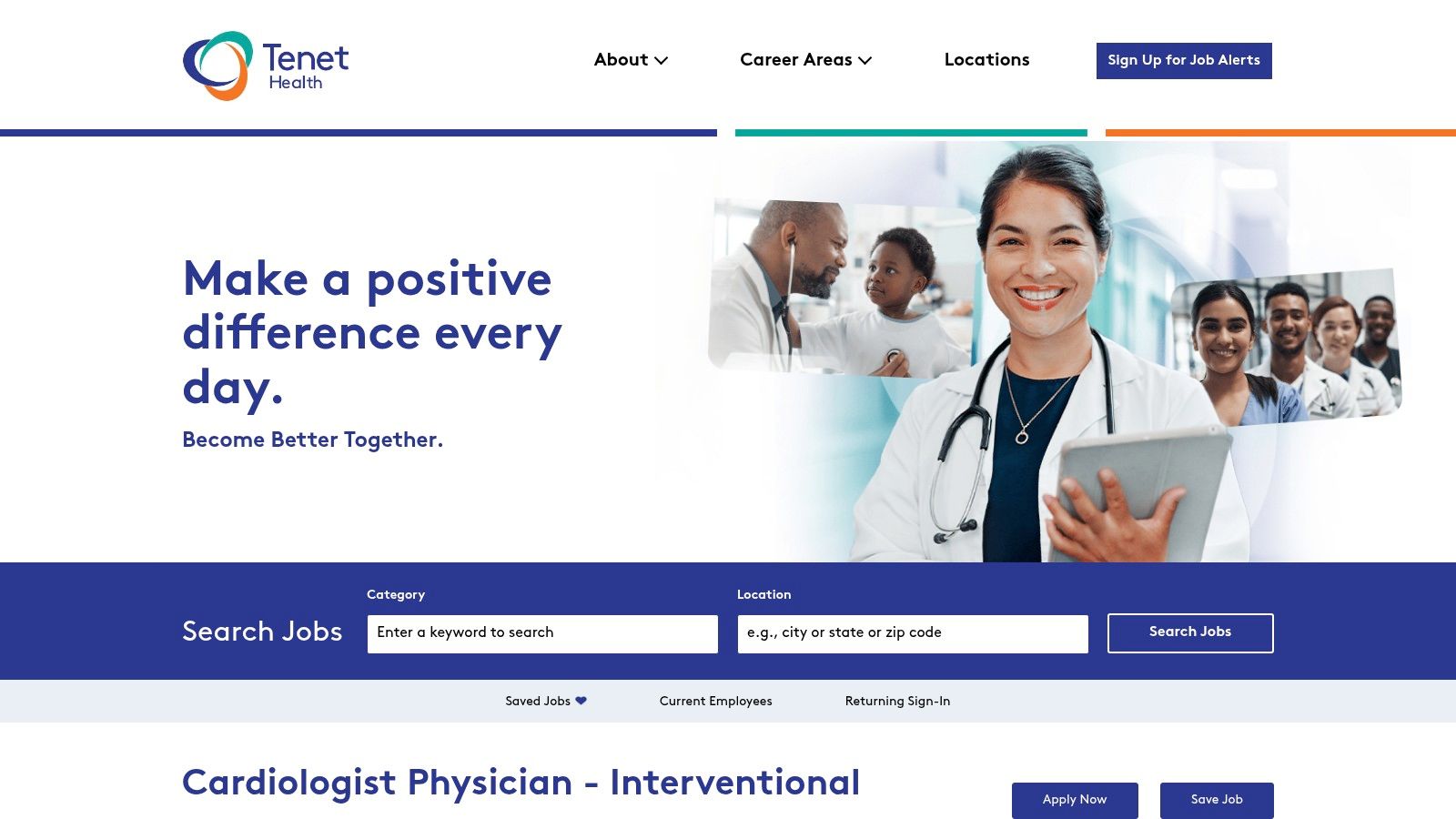
Central Valley pay is the outlier on this list, and it should be read as a recruitment signal, not automatically as a better career. Tenet's employed role with Central Valley Doctors Health System Physician Group at Emanuel Medical Center in Turlock lists $675,000–$835,000, depending on qualifications, experience, and productivity. The Tenet Health posting describes an established hospital practice, Monday through Thursday 8 a.m. to 5 p.m., Friday 8 a.m. to noon, shared call of about five days a month, and a typical load of 13 to 16 patients a day.
A nearby listing shows the same pattern. PracticeLink's Sutter Health Greater Central Valley posting for Stockton/Lodi advertises a $653,744 base, a two-year income guarantee, production incentives, and a 12% employer-funded 401(k), with a coronary PCI focus. High advertised cash can mean call burden, thin subspecialty backup, or a service line that still has to be built.
The Turlock job isn't cath-lab only. It includes general cardiology and office diagnostics. Relocation, malpractice, health, and retirement benefits are included, but the top of the range isn't earned income until the productivity formula is known.
Schedule clarity: Weekday hours and approximate call days are already on the page.
Case-mix gap: Coronary volume versus clinic volume isn't.
Geography: Turlock is an inland alternative to Palo Alto, with a different cost structure and referral base.
Get annual PCI volume, transfer protocols, and door-to-balloon performance before comparing this range with a coastal base.
5. MemorialCare Medical Group, Long Beach
Long Beach is the structural and critical-care screen on this list. MemorialCare, a nonprofit integrated system, wants a full-time board-certified or board-eligible interventional cardiologist. The MemorialCare careers page describes a supported cardiology program and a network of more than 200 primary care providers. Pay is salary plus incentives. Shareholder or partner status may be considered after two years of full-time employment.
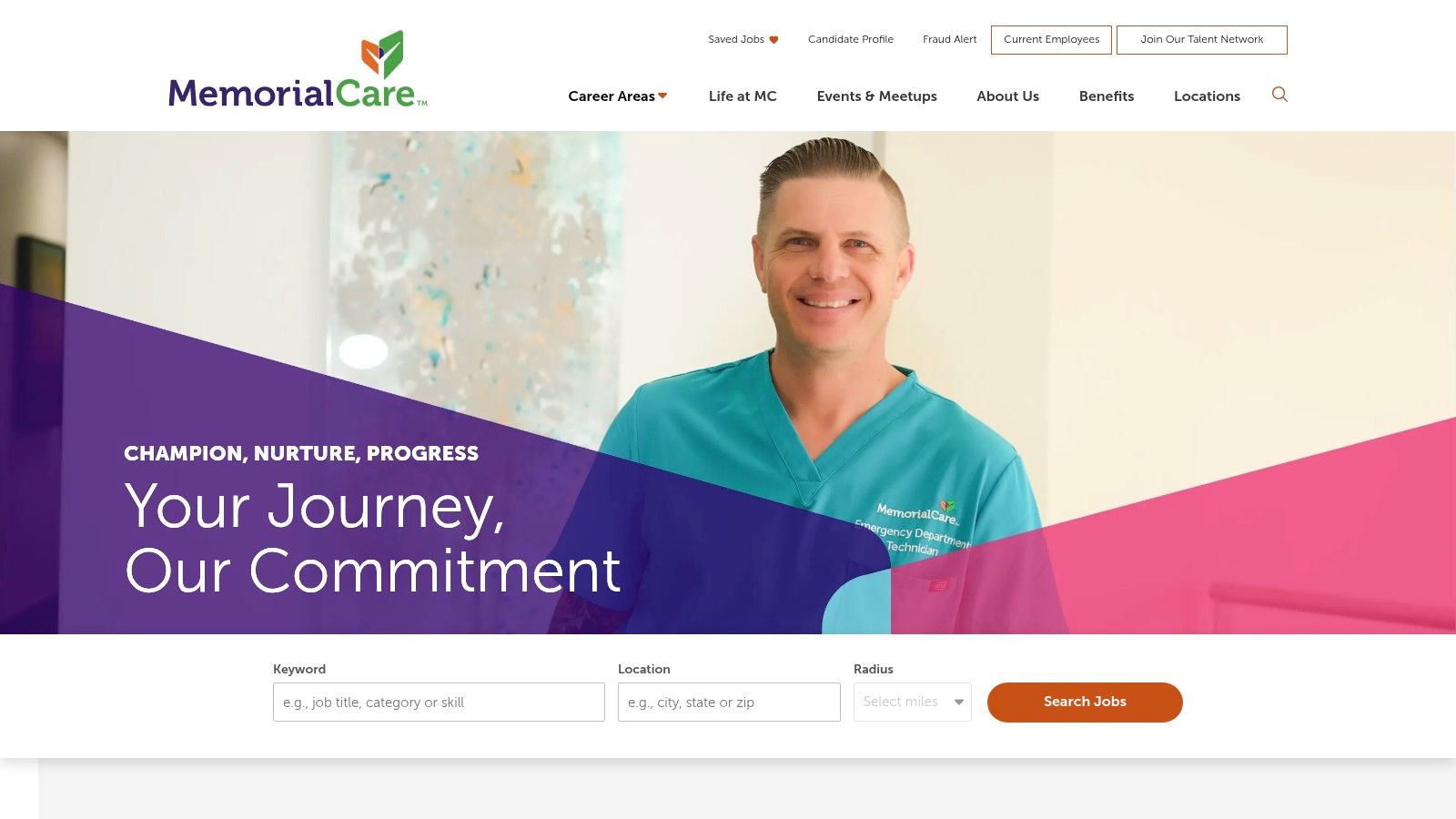
ECMO experience is required. Structural heart experience, especially TEER, is preferred. An operator whose book is straightforward coronary PCI won't clear that screen. An operator who already covers mechanical support and mitral TEER should still ask what share of the lab is structural versus coronary, who runs the heart team, and whether surgical backup and imaging are in house.
No salary range is published. That is the main disclosure gap. Integrated-system offers often look modest on base and then move on incentives, call pay, and a later partnership track. Get the incentive formula and the two-year partner criteria in writing before stacking this seat against a Central Valley number that looks larger on day one.
Retirement matching, CME reimbursement, malpractice insurance, and paid time off are listed. Multiple hospitals and outpatient sites can also mean travel between campuses, so that footprint belongs in the workload conversation, not in a footnote after signing.
6. Prime Healthcare, Shasta Regional Medical Group, Redding
Price this Redding seat on the four variables that separate interventional offers: inland market and living costs, private-practice structure, coronary versus structural case mix, and how call sits next to the base.
The Prime Healthcare posting is a private-practice role affiliated with Shasta Regional Medical Center. It combines general and interventional cardiology, inpatient and outpatient care, Monday through Friday 8 a.m. to 5 p.m., and a clinic across from the hospital. ER and STEMI call is 1-in-4, with a possible drop to 1-in-5. Pay is described as starting around $500,000+, with a negotiable production bonus, sign-on, and relocation support. Visa-waiver candidates may be considered.
Separate guaranteed base, production conversion, call pay, weekend frequency, and expected PCI volume before you stack that plus sign against a coastal number. The interventional cardiology job market is easier to read once those pieces are pulled apart.
Far Northern California is a smaller referral market. Ask what local housing and travel cost against the base, who else is on the STEMI roster, what happens when that operator is away, and whether surgical backup is local or by transfer. Clinic and general cardiology fill the weekday, not an add-on. The posting describes coronary work and longitudinal care. It does not spell out a structural slate, so confirm the lab's PCI versus structural mix before you assume one.
I would settle roster depth and case mix before arguing the base. Predictable 1-in-4 call, a credible PCI volume, and coverage that does not leave one physician filling every gap decide whether an inland private-practice offer holds.
7. Prime Healthcare, Centinela Hospital Medical Center, Inglewood
Inglewood is the community-hospital profile in the Los Angeles basin. The Centinela posting covers general interventional work, including cardiac catheterization and PCI, plus inpatient consults and outpatient follow-up. Compensation is $450,000 and up, with shared call. Requirements include an MD or DO, cardiology and interventional board certification or eligibility, and eligibility for California licensure.
That license isn't a formality for an out-of-state hire. The Medical Board of California requires a Physician's and Surgeon's License before practice, unless a specific statutory exception applies. U.S. and Canadian graduates generally need at least 12 months of Board-approved postgraduate training. International graduates generally need 24 months, plus the required exams. Privileges wait on that credential.
The listing is thin everywhere else. Schedule, cath-lab volume, benefits, incentive math, and shared-call frequency aren't specified. A Los Angeles community hospital can be a strong longitudinal practice, or it can be an undefined call burden. Confirm the posting is still open.
Location: Los Angeles cost and referral density, not a rural premium.
Model: Community hospital, PCI plus longitudinal care.
Disclosure: Starting pay is visible. Almost everything that decides whether the job is sustainable isn't.
Ask for annual PCI volume, who shares call, and whether structural procedures stay in house or go out.
California Interventional Cardiology Roles at a Glance
Item | Location | Practice setting | Listed compensation | Call or schedule detail |
|---|---|---|---|---|
Find Jobs | Nationwide | Cardiology and cardiac-surgery recruitment; specific openings not confirmed | Not listed | No schedule or call details |
Sutter Health, Palo Alto Foundation Medical Group, Palo Alto | Palo Alto, California | Full-time, physician-led multispecialty group; complex coronary interventions | $472,500–$525,000 annually, with potential additional production-based income | Schedule flexibility; call details not listed |
UC Irvine, Interventional Cardiologist, Orange or Irvine | Orange or Irvine, California | Full-time academic faculty role with clinical care, teaching, and scholarship | $506,950–$528,682, with potential additional compensation | Call or schedule details not listed |
Tenet Healthcare, Emanuel Medical Center, Turlock | Turlock, California | Full-time employed, hospital-based practice with general and interventional cardiology | $675,000–$835,000 annually, depending on qualifications, experience, and productivity | Monday–Thursday, 8 a.m.–5 p.m.; Friday, 8 a.m.–noon; shared call about five days per month |
MemorialCare Medical Group, Long Beach | Long Beach, California | Full-time employed role in a nonprofit integrated health system | Salary and incentives; amount not listed | Call or schedule details not listed |
Prime Healthcare, Shasta Regional Medical Group, Redding | Redding, California | Full-time private practice combining general and interventional cardiology | Starting around $500,000+, with negotiable production bonus | Monday–Friday, 8 a.m.–5 p.m.; ER/STEMI call 1-in-4, potentially reducible to 1-in-5 |
Prime Healthcare, Centinela Hospital Medical Center, Inglewood | Inglewood, California | Full-time community-hospital practice with procedures, consultations, and follow-up | $450,000 and up | Shared call; frequency and schedule not specified |
How to Pressure-Test an Interventional Offer Before You Sign
Across these seven California postings, headline salary is the least reliable separator. Case mix, call structure, and the way compensation is earned move the actual job. A coastal coronary seat, a faculty appointment, an inland employed range, an ECMO and TEER screen, a 1-in-4 STEMI rotation, and a community post with shared call aren't substitutes for one another.
Before anyone signs, request three documents.
Procedural volume by type: Annual PCI, CTO, peripheral, TEER or other structural work, and the share that is clinic or consults.
Call and backup: The STEMI rotation, coverage when the second operator is out, and whether surgical, anesthesia, and ICU support are real.
The formula: Base, production or wRVU conversion, quality incentives, call pay, and what "and up" or "shareholder" pays.
A cath lab is a team, not a single physician FTE. California employment of cardiovascular technologists and technicians was estimated at 4,700 in 2022 and is projected to reach 5,400 by 2032, a 14.9% increase, with about 3,760 openings over that decade, according to the California Employment Development Department. If the technologist roster, nursing coverage, or APP support is thin, the physician offer won't produce a stable PCI or STEMI program.
American Cardiology Group's recruiters can support that conversation for candidates and for facilities. The team manages credentialing and compliance so a verified offer can move to onboarding without an avoidable delay. Ask for the volume report, the call calendar, and the compensation formula in the same packet. If an employer won't produce them, that is the answer.
American Cardiology Group recruits exclusively in cardiology and cardiac surgery, including permanent placement of interventional cardiologists and short-term locum coverage when a California program can't leave a STEMI or PCI gap open. Hospitals, academic centers, and private groups use that cardiac-only focus to compare practice model, case mix, and call before an offer goes out. Visit American Cardiology Group to start a search or a candidate conversation.
Comments