
Texas NP Jobs: 7 Top Employers for Cardiology-Focused NPs
Why do Texas cardiac programs with competitive budgets still take months to fill an advanced practice seat while a primary care clinic down the road hires in weeks? The state's nurse practitioner market is large, and it's uneven. The U.S. Bureau of Labor Statistics reported 20,170 nurse practitioner jobs in Texas in May 2023 at an average annual wage of $130,010, yet the state's location quotient of 0.81 shows NPs make up a smaller share of total employment than they do nationally.
That gap is where Texas NP jobs get complicated. Houston's Texas Medical Center, Dallas-Fort Worth academic medicine, and community systems across East and South Texas hire from different pools under different constraints. Cardiovascular service lines, from interventional cardiology and structural heart to electrophysiology and advanced heart failure, are among the most active hiring areas in the state. The seven employer pathways below are organized by setting and specialty fit, so credentials land in the right system instead of the biggest job board.
Table of Contents
1. Advanced Practice Recruitment
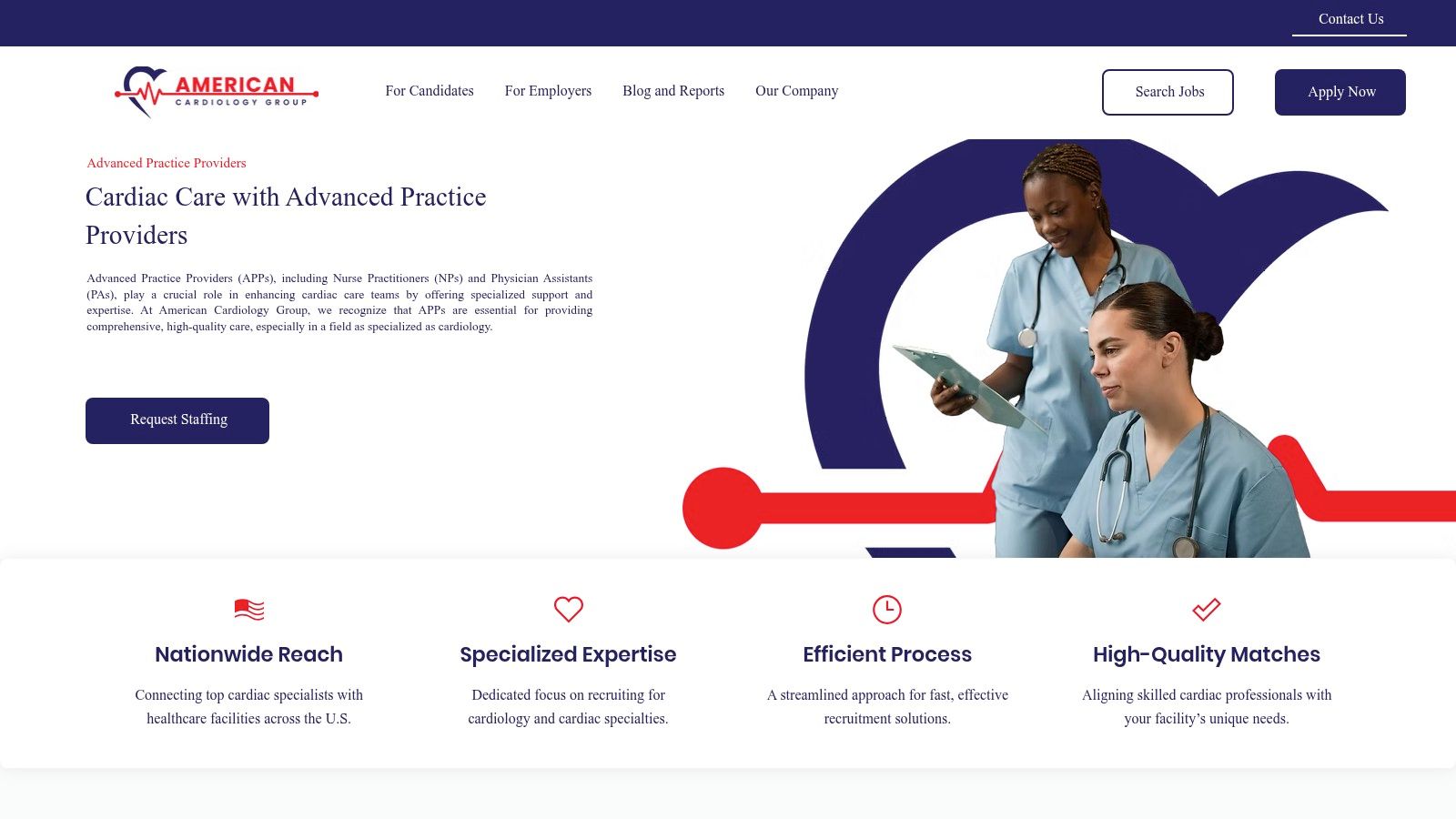
Cardiology service lines rarely fail to hire because no NPs exist. They fail because the search starts in the wrong pool. American Cardiology Group's Advanced Practice Recruitment places nurse practitioners and physician assistants into cardiology and cardiac surgery roles, drawing on a network built around cardiovascular care rather than general advanced practice hiring.
The Texas numbers explain why the distinction matters. The Texas Department of State Health Services counted 30,498 actively licensed NPs in the state in 2023 and still identified medical-specialty NPs as the category with persistent unmet demand, while primary care, psychiatry, women's health, and other categories were projected to exceed demand. A cardiac vacancy sits on the tight side of that split. Post the same requisition on a general board and the hiring manager sorts through hundreds of résumés to find one candidate who has run a heart failure titration clinic.
What the service covers
Employers include hospitals, health systems, academic centers, and private practices, and the desk places both NPs and PAs. It sits alongside the firm's permanent physician recruitment, locum tenens coverage, and executive search, so a program standing up a new structural heart line can source the interventionalist, the advanced practice support, and the service chief through one relationship.
Practical rule: When a cardiac NP posting has been open for a quarter, the salary band is rarely the problem. The sourcing pool is.
Strengths
Cardiovascular-only scope: cardiology and cardiac surgery, not general advanced practice.
Both provider types: NPs and PAs placed into the same service lines.
National employer base: hospitals, systems, academic centers, and private groups.
Fit-first matching: clinical expertise and career goals weighed against the role and the organization.
Watch-outs
Terms live in the conversation: the service page doesn't publish fees, timelines, or placement guarantees, so those details surface in discussion.
Narrow by design: a group hiring outside cardiovascular care, such as orthopedics or primary care, needs a different partner.
2. Houston Methodist Nurse Practitioner Careers
Which Houston Methodist setting fits your cardiovascular experience: intensive care or a surgical service line? Its NP-specific search covers hospitals and specialty physician groups in Greater Houston, with listings that have included acute care, critical care, cardiovascular surgery, and cardiac intensive care. Candidates can compare cardiac roles within one health system while assessing the clinical setting that best matches their skills.
Texas NP employment is projected to grow, making it important to assess each opening on its own terms. Graduate volume does not guarantee a supply of experienced cardiac NPs. Read postings closely for unit and shift details.
Inside the listings
Unit-level detail: Listings identify location, job type, and shift, including full-time and PRN.
Benefits vary by posting: Some listings include health coverage, retirement plans, paid time off, tuition assistance, or professional development. Confirm which apply to the specific role.
Free to search: Candidates can browse and apply at no cost.
Trade-offs
Greater Houston focus: Out-of-state candidates should be prepared to relocate for these roles.
Inconsistent salary transparency: Many postings omit pay, so benchmark compensation separately. Before an interview, review the nurse practitioner role in cardiology to distinguish inpatient consult responsibilities from clinic panel work.
3. Baylor Scott & White Health Advanced Practice Provider Careers
Baylor Scott & White Health keeps a dedicated advanced practice provider section that separates NP openings from other APP categories, with roles spread across its Texas footprint. The organization describes APP work as team-based and physician-collaborative, which matters to cardiac candidates who will practice inside a delegation model rather than stand-alone.
Two Texas rules shape onboarding more than any negotiation point. A nurse practitioner needs full APRN licensure before prescriptive authority is issued, and interim APRN approval doesn't qualify, per Title 22 of the Texas Administrative Code. The applicant documents graduate-level coursework in advanced pharmacotherapeutics, advanced pathophysiology, advanced health assessment, and diagnosis and management of diseases within the role and population focus.
The second rule is a staffing constraint. Outside facility-based hospital practice and practices serving medically underserved populations, a physician may generally delegate prescriptive authority to no more than seven full-time-equivalent APRNs and PAs, as the Texas Medical Board sets out. Hospitals and underserved clinics get room to scale. Outpatient groups don't.
Ask how many FTE APRNs sit under each delegating physician before signing. It determines supervision load, schedule flexibility, and how quickly a new clinic can add capacity.
Where it fits: multi-site searches, system-wide relocation, and candidates comparing cardiology salary benchmarks across Texas region by region.
4. UT Southwestern Advanced Practice Careers
UT Southwestern posts advanced practice roles across hospital, ambulatory, outpatient, and partner settings in Dallas, inside an academic environment where clinical work sits alongside research and teaching. Cardiac NPs who want complex cases, multidisciplinary conferences, and a subspecialty identity rather than a general cardiology panel tend to find more of that here.
Scope of practice is the piece candidates misread. The Texas Board of Nursing states that an APRN's scope is determined by education, role, population focus, competence, accepted standards of care, and applicable law, not by the clinical setting. A posting labeled autonomous can still carry a narrow privilege set once an academic credentialing committee finishes with it.
The paperwork that decides start dates
A Texas prescriptive authority agreement must be written, then reviewed, signed, and dated annually by both parties. It identifies the physician and the APRN with license numbers, names practice locations and settings, defines which drug and device categories may or may not be prescribed, and establishes processes for consultation, referral, emergencies, and information sharing, per Texas Medical Board guidance. Employers who treat that document as boilerplate lose weeks before a start date.
Strengths
Academic depth: complex specialty care with teaching and research exposure.
Setting variety: inpatient, clinic, and partner sites inside one system.
Free search and application: pay and benefits appear in individual postings.
Watch-outs
North Texas concentration: most roles sit in the Dallas area.
Credentialing lead time: experience and certification requirements vary by department.
5. Memorial Hermann NP and PA Careers
For cardiovascular candidates, Memorial Hermann's careers site is the most explicit of the Houston systems about heart work. Its provider listings have featured roles in cardiology, the cardiovascular ICU, and heart failure or transplant care, alongside hospital and clinic NP and PA openings across the metro.
The legal frame for those roles runs through delegation. Under Texas Occupations Code Chapter 157, a physician may delegate authority to prescribe or order drugs and devices only through a prescriptive authority agreement and under adequate physician supervision. The agreement has to address practice setting, authorized and excluded drug and device categories, consultation and referral, patient emergencies, communication, and quality assurance. Read that list against an inpatient cardiac posting and the week comes into focus.
A heart failure service with a standing titration protocol and a named collaborating physician is a different job from a transplant clinic that routes every medication change through a committee.
Why it stands out
Specialty alignment: cardiology, CVICU, and advanced heart failure work inside one regional system.
Detailed postings: some listings spell out role expectations and required qualifications.
Free to apply: no recruiter gatekeeping.
Limits to plan around
Houston only: relocation is generally required.
Shifting inventory: openings and shifts change, and pay often isn't shown on the general careers page.
6. CHRISTUS Health Advanced Practice Clinician Jobs
Which Texas setting fits your clinical priorities: a metro service line or a regional practice with broader day-to-day responsibilities? CHRISTUS Health is worth considering when Houston and North Texas competition narrows your options, or when location matters less than the work. Its advanced practice clinician listings span East Texas, South Texas, and the Gulf Coast. Roles have included inpatient and outpatient cardiology NP and PA positions in Longview, as well as cardiovascular surgery, primary care, and rural-health openings.
East Texas pay is not a discount market. The BLS Southwest Regional Office reported 300 nurse practitioner jobs in Tyler in May 2024, with a mean annual wage of $131,730. Outside larger metros, the clinical model may involve thinner specialty backup, more telehealth coordination, and NP participation in transfer decisions. Assess the support structure, escalation process, and call expectations before applying.
Rural access remains uneven across Texas. The Texas Department of State Health Services workforce presentation provides workforce context, but does not establish a county-level count of areas without NPs. For candidates, the practical point is to check what specialist and transfer support each site provides.
Strengths
Regional reach: Filter listings by location and job type across urban, regional, and community settings.
Cardiology options: Inpatient and outpatient cardiac roles appear alongside surgical openings.
Schedule choices: Listings include full-time, part-time, and PRN categories.
Watch-outs
Confirm location: CHRISTUS also operates outside Texas, so check the state and site on each posting.
Shared NP and PA listings: Review qualifications closely; not every posting accepts both credentials.
Clinical directors writing a requisition should specify the role's scope and required credentials. See what health systems get wrong about mid-level providers for guidance on defining advanced practice roles.
7. Texas Children's Hospital Advanced Practice Roles
Pediatric cardiology is its own labor market. Texas Children's Hospital posts advanced practice roles built around pediatric care, and listings have included pediatric inpatient cardiology positions in Houston, with a careers site covering multiple Texas locations including Austin.
The scarcity is structural. A Texas Department of State Health Services supply and demand report projected a deficit of 6,126 full-time-equivalent medical-specialty NPs even as primary-care NP supply was expected to exceed demand, and found that more than 85% of Texas NPs practice in metropolitan, non-border counties. Congenital heart disease experience narrows the pool further, because a pediatric NP with cardiology exposure or acute care preparation in pediatrics competes for a handful of roles at a handful of centers.
Pediatric cardiac openings reward preparation over volume. A candidate who can document congenital heart disease case mix, echocardiography exposure, and inpatient unit tenure moves to the front of a short queue.
Strengths
Pediatric focus: specialty care, education, and research inside a large pediatric network.
Cardiology positions appear: inpatient pediatric cardiology roles have been listed.
Multi-site footprint: Houston and Austin locations.
Watch-outs
Not an adult NP source: general adult cardiology candidates won't find a fit here.
Certification expectations: pediatric or cardiology experience and specialty certification are often preferred.
Demand-driven timing: openings depend on service-line hiring cycles.
Comparing Texas NP Job Sources by Region, Specialty, and Practice Setting
Item | Region | Specialty Focus | Practice Settings |
|---|---|---|---|
Advanced Practice Recruitment | Nationwide United States | Cardiology and cardiac surgery | Hospitals, health systems, academic centers, and private practices |
Houston Methodist Careers, Nurse Practitioner Jobs | Greater Houston | Acute care, critical care, cardiovascular surgery, and cardiac intensive care | Hospitals and specialty physician groups |
Baylor Scott & White Health, Advanced Practice Provider Careers | Texas | Nurse practitioner roles across specialties | Team-based practice across a broad health system |
UT Southwestern Medical Center, Advanced Practice Careers | Dallas–Fort Worth | Complex specialty care and academic medicine | Hospital, ambulatory, outpatient, and partner settings |
Memorial Hermann, NP/PA and Physician Careers | Greater Houston | Cardiology, CVICU, heart failure, and transplant care | Hospitals, clinics, and specialty services |
CHRISTUS Health, Advanced Practice Clinician Jobs | East Texas, South Texas, and Gulf Coast | Cardiology, cardiovascular surgery, primary care, and rural health | Inpatient, outpatient, regional, and community settings |
Texas Children's Hospital, Careers and Advanced Practice Roles | Houston and Austin | Pediatric care, including pediatric cardiology | Pediatric specialty care, including inpatient settings |
Choosing Your Texas NP Pathway and Matching Talent to Cardiac Programs
Three variables decide which of these seven employers deserves the application. Region comes first. Houston systems place a candidate in the densest cardiac market in the state, North Texas academic medicine puts them inside a research and teaching structure, and East and South Texas community systems trade metro volume for autonomy and, often, stronger bargaining position. Specialty depth comes second. Interventional cardiology, electrophysiology, structural heart, advanced heart failure, and transplant all read as separate service lines to a credentialing committee, and the closest match on a CV should drive the order of applications. Practice setting comes third, because an inpatient consult service, a clinic panel, and a procedural follow-up role carry different schedules and different delegation arrangements.
Candidates should apply directly through the employer career sites listed above, then verify two things before accepting: the collaborating physician structure behind the prescriptive authority agreement, and whether the posting accepts NPs, PAs, or both.
For hospitals, health systems, and practices building cardiac programs, the harder problem is usually the specialty pool rather than the geography. American Cardiology Group runs Advanced Practice Recruitment specifically for cardiology and cardiac surgery NPs and PAs, and its recruiters support both the facility and the clinician through the placement. Candidates can search and apply for positions through the firm's site, and facilities can submit a Fill a Position request to move straight to scheduling with a recruiter.
The right placement aligns three things: clinical credentials, the service line's actual coverage need, and the program's growth plan over the next several years. A cardiac NP hired into a role designed around those three elements stays. One hired into a generic cardiology requisition usually doesn't.
American Cardiology Group recruits exclusively for cardiology and cardiac surgery, placing nurse practitioners and physician assistants into general cardiology, electrophysiology, heart failure, transplant, imaging, and surgical roles, and it manages credentialing and compliance for its locum providers so facilities can onboard quickly. Texas programs that need an inpatient heart failure NP, an EP clinic APP, or a procedural follow-up provider can start by submitting a Fill a Position request or browsing the current openings. Visit American Cardiology Group to search jobs as a candidate or to schedule with a recruiter as an employer.
Comments