
Retained Executive Search: Fees and Timelines Explained
The electrophysiology director's resignation lands on a Friday. Two interventional cardiologists are already talking to other systems, the cath-lab expansion is only half funded, and the board packet asks for a search firm by the next meeting. Commissioning an external search that week feels decisive. It can also lock a hospital into a permanent hire before anyone has tested whether an interim leader, or a stronger internal pipeline, should come first.
Retained executive search is a precise tool for a senior, confidential appointment. It is the wrong first move when strategy is unsettled, physician relations are fragile, or the gap is an underfunded bench. The pages below separate the model from contingency recruiting, then put fees, calendars, scorecards, and interviews in the order a hiring committee uses them.
Table of Contents
What Retained Executive Search Is and How It Differs From Contingency - Exclusivity, fee timing, and fit
How a Retained Search Moves From Kickoff to Signed Offer - The sequence a committee actually runs
What a Retained Search Costs and How Fees Are Billed - A worked hospital example
Building the Capability Scorecard for a Cardiac Leader - Split the criteria before the first name appears
Structured Interviews and References That Hold Up to Scrutiny - What the finalist actually experiences
When a Retained Search Fits and When to Pause It - Run the pipeline audit first - Use an interim when the mandate is not ready
Confirm the Search Scope Before You Commission One - Six checks before any firm is called
What Retained Executive Search Is and How It Differs From Contingency
Treat the choice the way a health system treats a building. One architect is hired for one project. The drawings are not posted so every contractor who answers an advert can race to the same job.
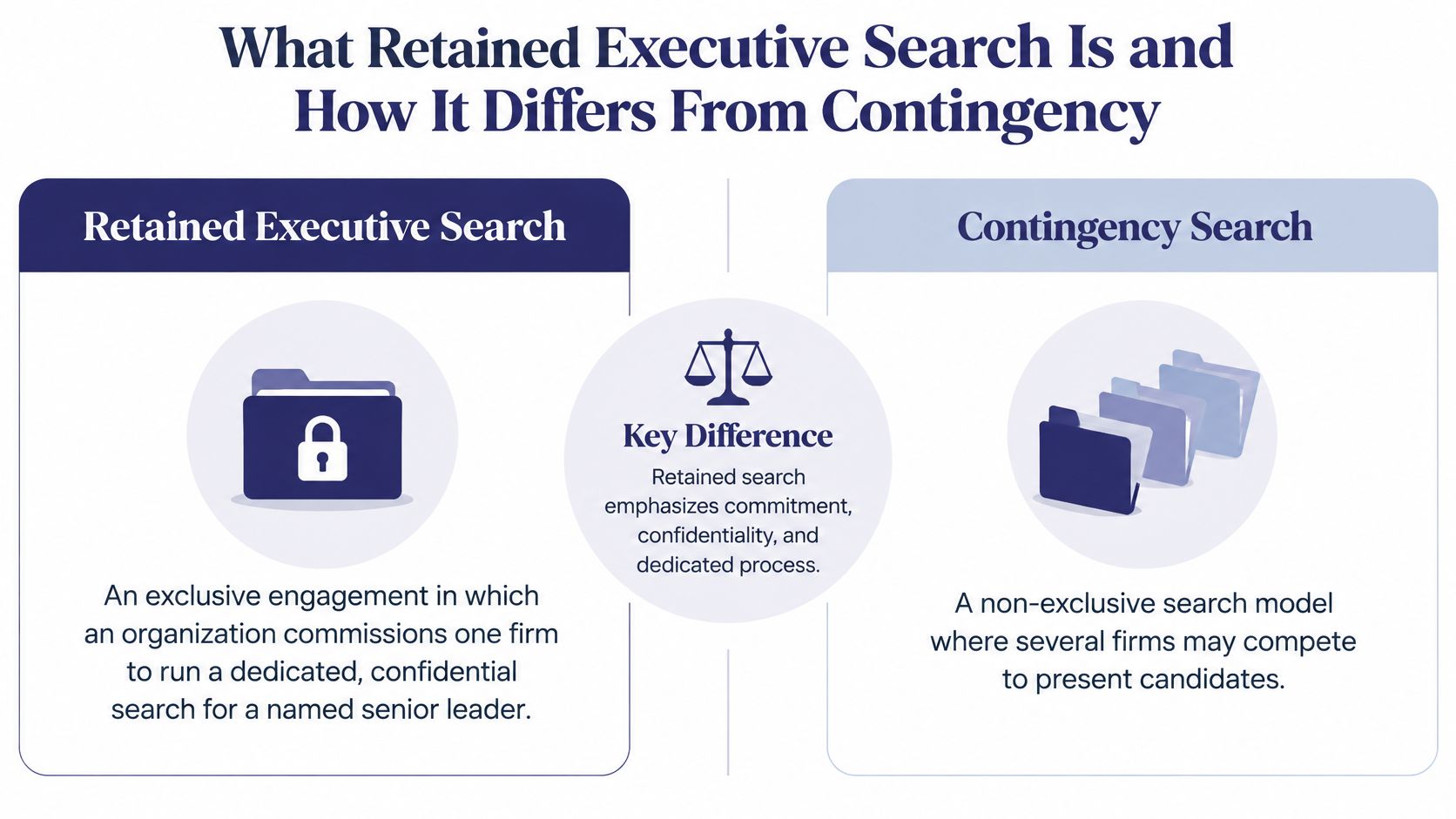
Retained executive search is an exclusive engagement in which an organization commissions one firm to run a dedicated, confidential search for a named senior role. The client commits that firm to the seat. The firm assigns a team to define the mandate, map the market, approach people who are not applying, assess finalists, complete references, and support the offer. SPMB's comparison of retained and contingency search notes that the fee is paid in installments as that work proceeds, not only after someone accepts.
The habit of going out to find leaders, rather than waiting for applications, is old. Thorndike Deland founded what is widely described as the first executive search firm in 1926, and he focused on identifying and evaluating candidates proactively, as an Aviation Pros history of the profession records. The commercial weight of that model is current. A Mordor Intelligence market estimate put retained assignments at 62.88% of global executive-search market share in 2025, about $36.55 billion of a $58.13 billion market, with North America the largest region at 38.20%.
Exclusivity, fee timing, and fit
Contingency recruiting is the opposite commercial bet. Several firms may work the same opening, and a fee is earned only if that firm's candidate is hired. Coverage tends to follow whoever is already looking. That can suit higher-volume or less senior hiring. It is a poor fit when the conversation itself must stay quiet.
Model | Exclusivity | Fee timing | Best fit |
|---|---|---|---|
Retained | One firm holds the mandate | Paid in installments during the search | Confidential or high-impact senior roles |
Contingency | Several firms may compete for the same role | Payable on placement | Higher-volume or lower-seniority hiring |
Practical rule: If the best person is already employed and must not learn about the vacancy from a job board, the engagement has to be exclusive.
That is why the cost is earned on seats such as chief of cardiology, electrophysiology division director, heart-failure program chief, and cardiothoracic surgery chair. Those searches need systematic coverage past the active applicant pool, plus discretion with medical staff who already know one another.
How a Retained Search Moves From Kickoff to Signed Offer
A heart-failure program loses its chief in March and wants a successor in the building by July. Before anyone commissions a retained search, test two cheaper paths. Can an interim leader hold clinical operations for a defined period? Did a fair internal review already fail, or did the committee never run one? If either path still works, the outside search is the wrong tool. If the seat needs a new leader and the internal pipeline has already been tested, the retained clock can start.
That clock works like a construction schedule. Research and outreach are the drawings. Client interviews, references, privileging, and the close are the inspections the owner still has to book. A typical retained search runs about 90 to 120 days from kickoff to a signed offer. Specialized, global, or confidential assignments take longer. The qualified shortlist usually arrives about 30 to 45 days after kickoff, according to the McKenny Group retained search guide. Time to shortlist measures research and outreach. Time to fill also includes the client's interviews, references, credentialing, and the close.
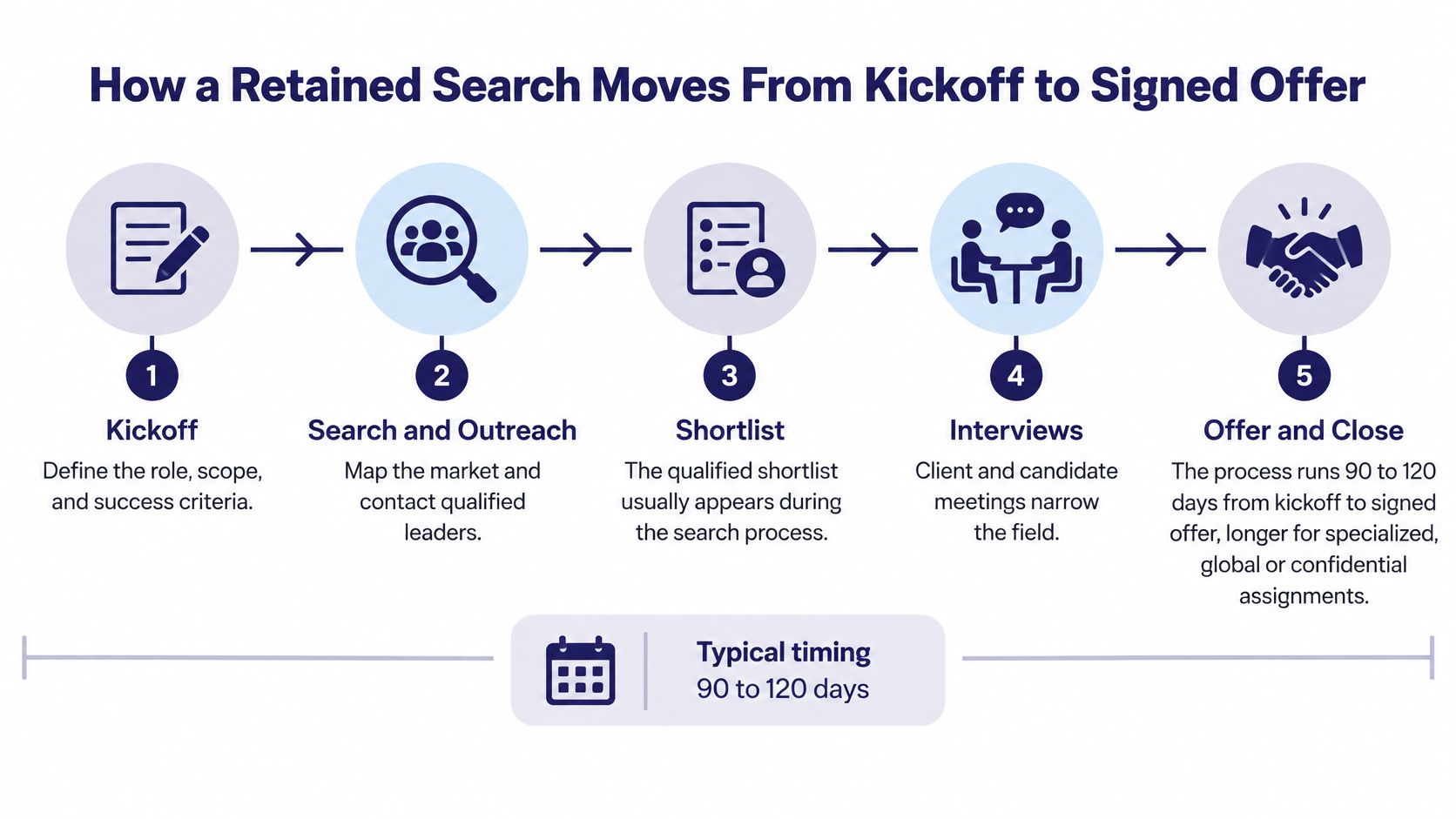
Phase | Typical timing | Output |
|---|---|---|
Mandate calibration with hiring committee | Weeks 1-3 | Approved role profile and scorecard |
National market mapping and outreach | Weeks 2-6 | Long list including passive candidates |
Qualified shortlist delivered | Days 30-45 | Shortlist of qualified candidates |
Structured assessment and references | Days 45-90 | Ranked finalists with reference reports |
Offer negotiation and close | Days 90-120 | Signed offer |
The sequence a committee actually runs
Calibrate the mandate. In the first weeks the hiring committee locks the role, the reporting line, the success conditions, and the scorecard. If the committee cannot meet, the search waits.
Map the national market. Research covers general cardiology, electrophysiology, heart failure, and cardiothoracic surgery, including leaders who are not on any job site.
Reach passive candidates discreetly. Outreach is direct and quiet. The client's message on compensation range and authority has to be settled before those calls, or strong people decline early.
Deliver the qualified shortlist. Plan on days 30 to 45. This is the research milestone, not the day a start date is promised.
Run structured leadership assessment. Client assessors use the same incidents and score independently. Committee calendars, not the research, usually set this pace.
Complete references and credential verification. Privileging and board certification checks sit on the hospital's clock. Build that lag into the target start date.
Support the offer and the close. Compensation, start date, and any academic or call expectations are negotiated against the scorecard, not against whoever interviewed last.
Hospitals should set interview windows and credentialing deadlines against time to fill, and judge the firm's market work against time to shortlist. A missed on-site week can add a month even when the slate was ready on day 40. A useful companion is a written view of the executive recruitment process a cardiac program should expect.
American Cardiology Group treats each engagement as highly customized and works with the client on needs, values, and organizational goals, so the phase dates above should be adapted to each search.
Work backward from the target start date, then book committee dates before kickoff. An empty calendar is the most common reason a 90-day search becomes a 150-day one.
What a Retained Search Costs and How Fees Are Billed
Most hospital budgets should start from one rule. The commonly reported retained-search fee is about one-third of the selected executive's first-year cash compensation, as FloodGate Medical's fee briefing describes. The fee base generally includes salary plus target annual bonus and may include a signing bonus. Equity is usually excluded.
A worked hospital example
Say the offer letter shows $500,000 in first-year cash compensation. One-third of that base is a professional fee near $166,667. The hospital does not write that check on the start date. Billing is commonly split into three installments: one at search launch, one at an intermediate milestone such as delivery of the qualified shortlist, and one at placement or acceptance. The fee is therefore not wholly contingent on the hire. The client is paying for the research and the assessment, including the months before a name is chosen.
Direct expenses sit outside that professional fee. Travel, assessment, background checks, and advertising should be itemized in the contract. A clean agreement also answers three questions before anyone signs.
Bonus treatment: Confirm the contract counts the annual bonus at target, not at a theoretical maximum.
Signing bonus: Include it in the fee base only when the contract names it. Leave it out when the agreement is silent.
A cancelled search: Spell out which installments remain due if the client stops the work after launch or after the shortlist.
Fee component | In the fee base? | Contract note |
|---|---|---|
Base salary | Yes | Core of first-year cash compensation |
Target annual bonus | Yes | Usually counted at target, confirm in contract |
Signing bonus | Sometimes | Include it only when the contract names it in the fee base |
Equity or long-term incentives | Usually no | Excluded from the professional fee |
Travel, background checks, assessment and advertising | Billed separately | Itemize as direct expenses in the contract |
People often compare the one-third figure with a contingency percentage payable only on placement. That comparison is misleading if it uses the headline rate alone. Put both models on full first-year cash cost, then add the direct expenses the retained contract will bill anyway. A lower percentage on base salary only, paid solely if someone starts, is a different product. It does not buy an exclusive team for a confidential cardiology chair.
Apply the same arithmetic to any offer letter. Add base salary and target bonus, add a signing bonus only if the contract includes it, leave equity out, take one-third, and budget the three installments plus a separate expense line.
Building the Capability Scorecard for a Cardiac Leader
Boards still pick leaders by the prestige of a prior employer, years in the title, a pleasant interview, and reputation in the specialty. Those are distal proxies. They often fail to match what the next role demands. A technically defensible search converts strategy into a weighted capability profile before anyone is sourced. An International Journal of Selection and Assessment paper treats career history and reputation as context, not as a substitute for the role's success conditions.
Split the criteria before the first name appears
Name the domains that will carry weight: service-line growth, physician alignment, quality governance, financial stewardship, academic development, and change leadership. Then split every line into one of two groups.
Threshold criteria are essential. Clinical credibility, board certification where it applies, and experience leading a cardiovascular program either clear or they do not. A candidate who cannot hold the room with interventional cardiology teams should not advance because the CV looks familiar.
Differentiating criteria describe this market. One system needs someone who has integrated hospital-employed and private-practice cardiologists. Another needs someone who has expanded electrophysiology capacity without letting quality slip. Copying the predecessor's profile misses both tests.
Take a heart-failure program chief as the worked case. The criterion states a capacity target, such as clinic access and advanced-therapy volume. The interview asks for the behavior, the action, and the measured result. Reference questions use the same wording. Outcomes are dated at 6, 12, and 24 months, so the board can audit the hire later. That structure cuts halo effects. Finalists become comparable on evidence, and the board selects for the market it has, not for a résumé that resembles the last chief.
Criterion type | Cardiology example | Evidence to collect |
|---|---|---|
Threshold | Clinical credibility with interventional cardiology teams | Peer and medical staff references |
Threshold | Board certification where applicable | Verified credentials |
Threshold | Experience leading a cardiovascular program | Program size, outcomes and reporting lines |
Differentiating | Integrating hospital-employed and private-practice cardiologists | Behavioral examples with measured retention |
Differentiating | Expanding electrophysiology capacity | Procedural volume and quality trend |
Draft six to eight criteria before the first candidate is named. Mark which lines are threshold. Give each line one measurable outcome. If the committee cannot agree on those lines, it is not ready to see a slate.
Structured Interviews and References That Hold Up to Scrutiny
A 2022 re-analysis of selection research reported operational validity of about 0.42 for structured interviews, against 0.19 for unstructured ones. Validity is higher when every finalist gets the same role-specific questions and at least two assessors score the answers independently, as summarized by the AESC leadership assessment briefing. A conversational lunch with the chair does not produce a record a medical executive committee can defend.
What the finalist actually experiences
The interview is built on four or five critical incidents, not on a tour of the CV. For a cardiovascular executive, use these.
Physician conflict: How the leader separated a private-practice group and an employed group without losing either.
Access and throughput: How clinic templates, lab slots, or OR time moved.
A quality or safety event: What was owned in the first 48 hours, and what changed in the protocol.
Capital among competing programs: How dollars were split between electrophysiology, structural heart, and cardiac surgery.
Scarce subspecialists: How retention was measured, not merely described as "culture."
Interviewers write the behavior, the action, and the measurable result on separate lines. Scores are calibrated against anchors before the debrief. "Participated in growth" is a lower anchor than "increased procedural capacity while maintaining quality and margin." Affinity for a familiar training program should not move the number.
Work samples sit beside the interview. Give finalists a real decision the seat will face, such as a cath-lab capital tradeoff or an APP staffing model, and score the written recommendation against the same anchors. References are not a courtesy call. They repeat the scorecard questions. Reference checking best practices keep those conversations tied to evidence rather than reputation. Ask each finalist for a 90-day entry plan so the board can see how the person would use the first quarter, not only how the last job was described.
Structured methods also show lower adverse-impact concerns than several other high-performing selection methods. That matters when the choice must be explained to the medical staff and the executive committee. The deliverable is a written interview guide: four or five incidents, anchors for each score level, and named assessors who score independently before any discussion.
When a Retained Search Fits and When to Pause It
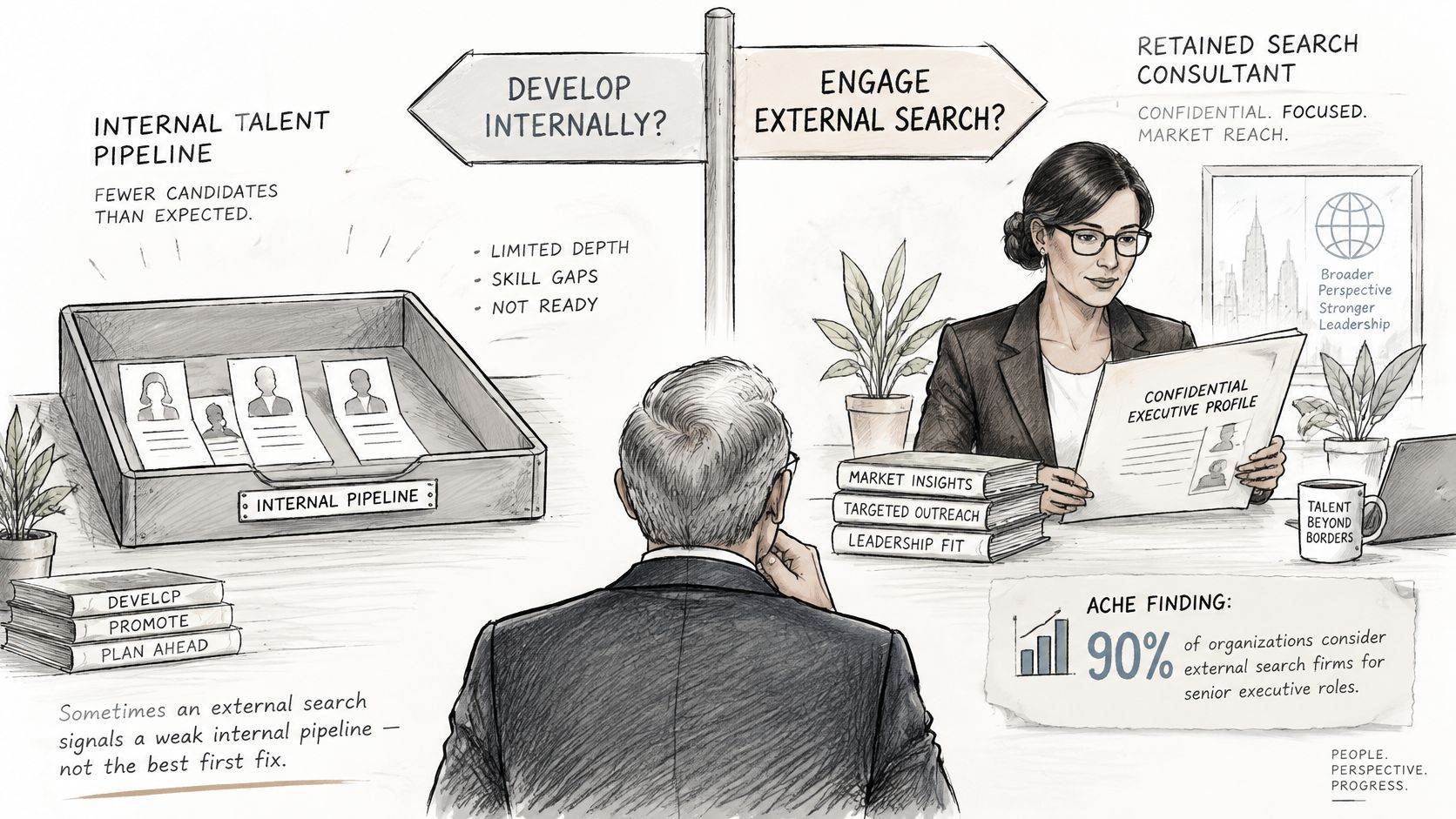
A board facing a cardiac leadership vacancy has three choices to test before commissioning a retained search: promote an internal successor, stabilize the service with interim leadership, or recruit a permanent external leader. The right choice depends on whether the role is ready to be filled and whether the internal pipeline can produce a qualified candidate.
Run the pipeline audit first
Before signing a search mandate, assess whether internal successors are ready, not merely well liked, and whether leadership development receives actual investment. Then examine the job itself: Does it have authority over cardiologist recruitment, operating-room or cath-lab investment, APP models, and cross-site integration? Is compensation competitive after accounting for call, academic time, and geography? What burnout risks come with the role as designed, and does the board agree on the strategy?
Leadership stress among hospital CEOs is widely reported to be high, and some clinicians further down the pipeline are increasingly reluctant to accept promotions. A prestigious title cannot compensate for a role without a voice in capital decisions or with a divided board. Redesign the position before seeking candidates.
Use an interim when the mandate is not ready
Hospitals recorded 68 CEO exits in the first half of 2025, up from 66 in the same period of 2024. Interim appointments made up 33% of new hospital CEOs, up from 9% in both 2023 and 2024, according to PSQH's turnover report. For cardiac programs, these figures underscore the value of separating immediate continuity from the decision about permanent leadership.
Consider an interim when a vacancy follows a failed transformation, the board has not agreed on strategy, clinical operations are unstable, or the candidate market for a subspecialty is thin. Pending physician-relations repairs or a cath-lab investment decision may also need attention before a permanent leader can succeed. Stabilize the situation, then define the permanent role.
An interim appointment can become an open-ended delay without a decision date. Set a 90- to 180-day diagnostic period, specify measurable milestones, and agree in advance on what will trigger the permanent search. Retained search fits when the mandate is permanent, the board supports the strategy, and reaching passive leaders requires targeted outreach.
Confirm the Search Scope Before You Commission One
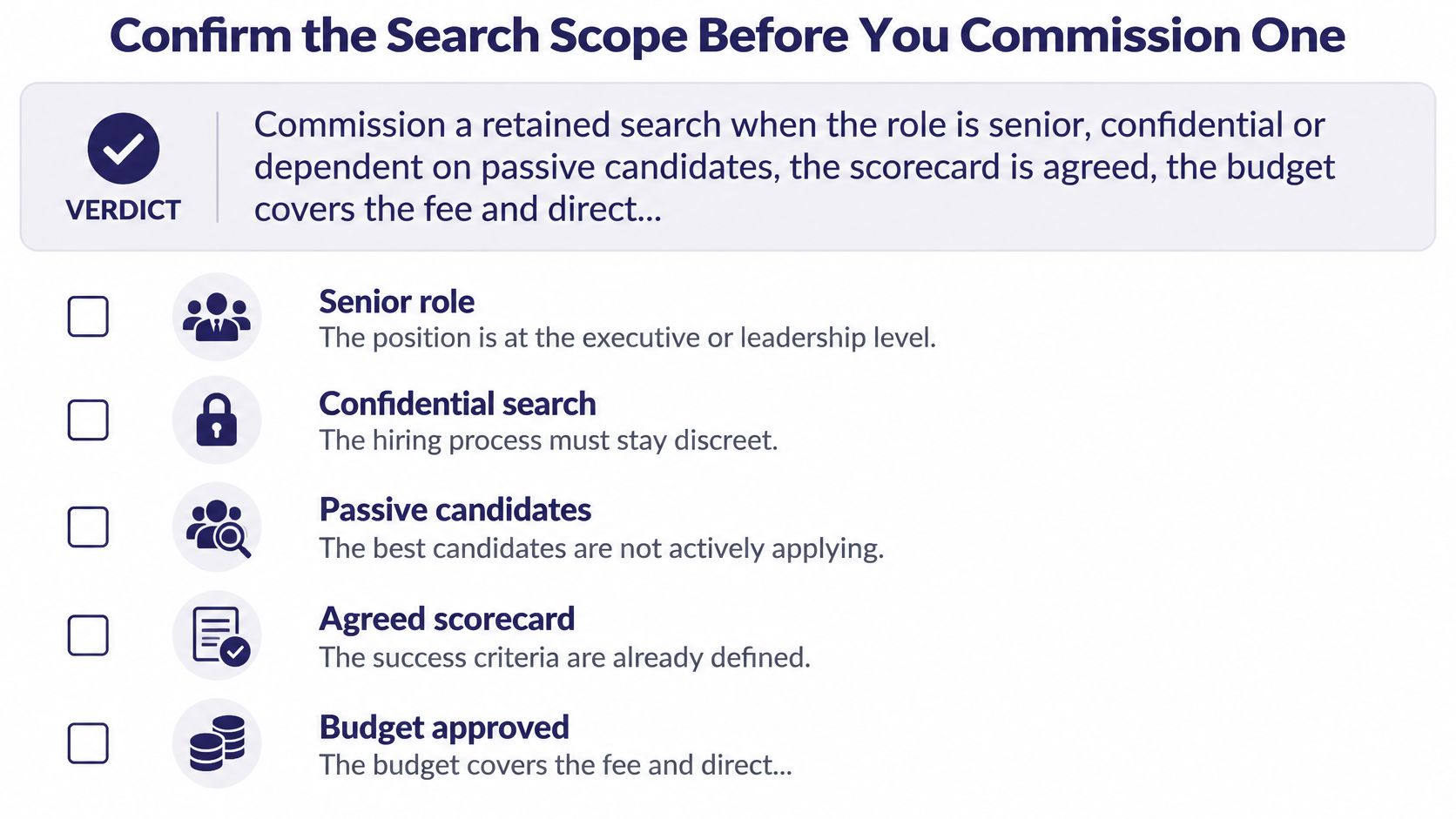
A cardiac leadership vacancy can look ready for a permanent search while key decisions remain unsettled. Before commissioning an external retained search, confirm the role, budget, decision process, and whether interim leadership or an internal candidate could address the need.
Six checks before any firm is called
Name the role and its reporting line. General cardiology, electrophysiology, heart failure, and cardiothoracic surgery involve distinct leadership needs. Define the role clearly rather than using a broad label such as “cardiac leader.”
Agree on threshold and differentiating criteria with the hiring committee, in writing, before candidates are assessed.
Set the target start date and work backward from it. Identify dates for the shortlist, interviews, and credentialing.
Confirm the fee base and billing schedule, including which expenses fall outside the professional fee.
Name the decision makers and confirm they can attend assessments. A committee without time to meet can delay decisions.
Decide whether interim coverage is needed while physician relations or capital decisions are addressed. Use a clear physician job description to distinguish the permanent role from any coverage position.
American Cardiology Group offers permanent physician recruitment, locum tenens solutions, advanced practice recruitment, and executive recruitment. Its Fill a Position request asks for a name, organization, state, type of placement, and a note. A clear role description, approved budget, and available decision makers give the search a defined starting point.
Submit the request once those pieces are in place. American Cardiology Group specializes exclusively in cardiology and cardiac surgery recruitment across the United States, including executive recruitment for cardiac leadership roles. Its services also include permanent physician, locum tenens, and advanced practice recruitment. A settled scope helps the hiring team assess candidates against the role it needs to fill.
Comments