
Cardiology Jobs Near Me: 7 Employers to Review in 2026
A nearby opening can be the hardest cardiology job to land. A 2024 analysis reported in Becker's ASC coverage of the cardiologist shortage found that 46.3% of U.S. counties had no practicing cardiologist, including 86.2% of rural counties. Distance alone tells executives and candidates almost nothing about local supply, referral depth, or whether a role can be credentialed on the required timeline.
Searches for cardiology jobs near me often collapse unlike hiring models into one list. A permanent interventional cardiology appointment, a locum electrophysiology block, an advanced practice role, and an executive search can share the same city while differing on call, malpractice coverage, hospital privileges, state licensing, and subspecialty backup. Credentialing and licensing decide whether "nearby" means a start measured in weeks or in months. A rural regional hub with a cath lab and transfer support can be more viable than a closer facility without procedural infrastructure.
The seven options below are compared by hiring model, subspecialty coverage, and the logistics that decide viability.
Listing volume matters less than fit between employment structure, clinical scope, and onboarding readiness.
Table of Contents
1. American Cardiology Group - Hiring Models in One Search - Proof and Limits
2. American College of Cardiology Career Center - Where Direct Search Works Best
How the seven options differ on hiring model, job types, and best-fit candidate
Turning a Local Search Result into a Viable Appointment - Compare Call and Volume Before Compensation
1. American Cardiology Group
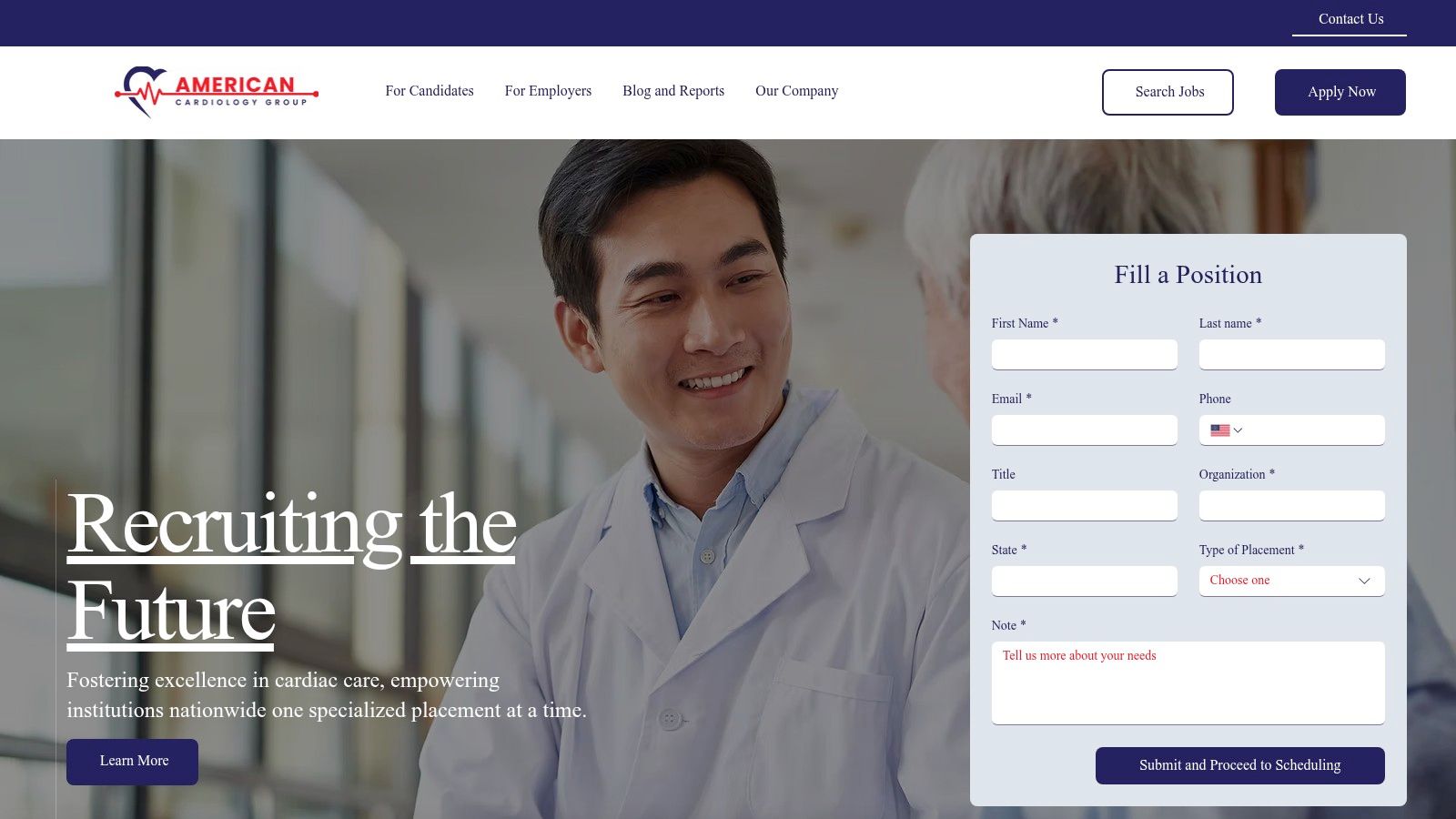
The differentiator at American Cardiology Group is scope discipline. The firm recruits exclusively for cardiology and cardiac surgery rather than treating cardiology as one desk inside a general physician agency, and that matters when a search turns on privileges, procedural volume, or subspecialty backup. Coverage spans general cardiology, electrophysiology, heart failure, imaging, interventional cardiology, and cardiothoracic surgery.
That focus is relevant as capacity tightens. The American College of Cardiology workforce feature projects that cardiovascular patients per cardiologist will rise from approximately 1,087 in 2025 to 1,700 by 2035. Employers can't rely on active applicants alone under those conditions. Pipeline development by subspecialty and geography becomes the work, not posting a generic vacancy and waiting.
Hiring Models in One Search
American Cardiology Group offers Permanent Physician Recruitment, Locum Tenens Solutions, Advanced Practice Recruitment, and Executive Recruitment. Candidates can search for jobs and apply through the website, while facilities can request locum tenens staffing through a dedicated form. Each locum professional in its network is carefully vetted before placement, and its team manages credentialing and compliance for locum providers so facilities can onboard quickly.
Exclusive cardiac focus: Searches cover physician, surgical, NP, and PA roles without diluting into unrelated specialties.
Nationwide reach: Placements serve large health systems, academic programs, private practices, and rural or community hospitals.
Cultural alignment: Matching emphasizes clinical strength and long term fit, not only availability.
Flexible coverage: Short term locum tenens staffing is customized to cardiac care across general, interventional, and surgical roles.
Proof and Limits
Testimonials on its own website include a Tennessee CEO stating, "In just one year, they've helped us fill critical roles in cardiology across multiple facilities," and a Montana rural hospital CMO crediting the firm because "They found specialists willing to make a difference in a rural setting." Those accounts support geographic breadth, but they're self published. Pricing and fee structures aren't provided, and independent outcome data, placement statistics, and awards aren't stated.
Practical rule: Ask any specialist recruiter to map the exact subspecialty, call pool, and credentialing pathway before discussing candidate names.
For a hospital that needs permanent program building and interim coverage in parallel, that combined model is the strongest fit on this list. For a candidate comparing an academic appointment with a rural program building role, the value lies in seeing both through one cardiac specific lens.
2. American College of Cardiology Career Center
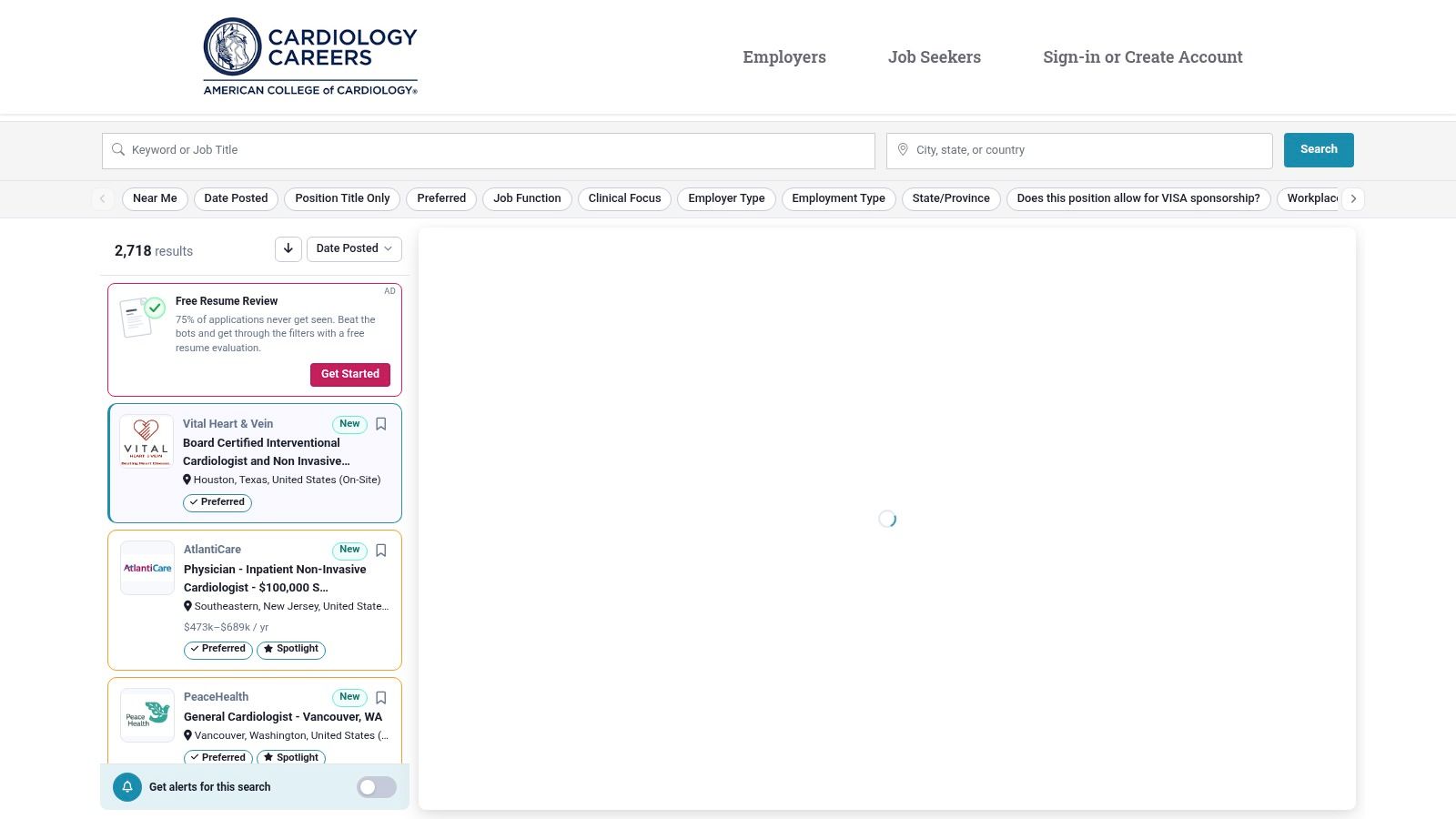
A board isn't a recruiter, and candidates shouldn't expect it to behave like one. The American College of Cardiology Career Center aggregates openings from hospitals, medical groups, and academic programs, then leaves follow up, negotiation, and due diligence to the applicant. That self directed model suits physicians who want to compare employers directly without an intermediary framing the shortlist.
Search functions cover location, job type, and employer, including by city or ZIP code. Listings may include electrophysiology and interventional cardiology roles, though some postings are broader cardiovascular or advanced practice opportunities rather than physician cardiology jobs. Freshness and depth vary by location and subspecialty, so a thin local result doesn't prove a thin market.
Where Direct Search Works Best
Geography needs careful reading. Subspecialty pools are smaller than the general cardiology pool, so an advanced heart failure or electrophysiology search may return regional or national results while a general search returns local ones. Candidates should widen the radius by subspecialty before concluding that no suitable role exists nearby.
Cardiology specific audience: Employers post to reach cardiovascular clinicians rather than a general job seeking pool.
Employer comparison: Multiple systems can be reviewed side by side on setting and role type.
Permanent role discovery: The board is most useful for exploring employed positions across regions.
The trade off is workload. A listing rarely discloses call structure, cath lab access, referral volume, or malpractice terms, and the board won't flag a stale posting or explain a credentialing timeline. Candidates carry that verification themselves, including confirming whether the employer sponsors state licensing or expects an active license on day one. Those weighing temporary work against a permanent search can compare the staffing model through locum tenens cardiology jobs before committing to a timeline.
3. AMN Healthcare
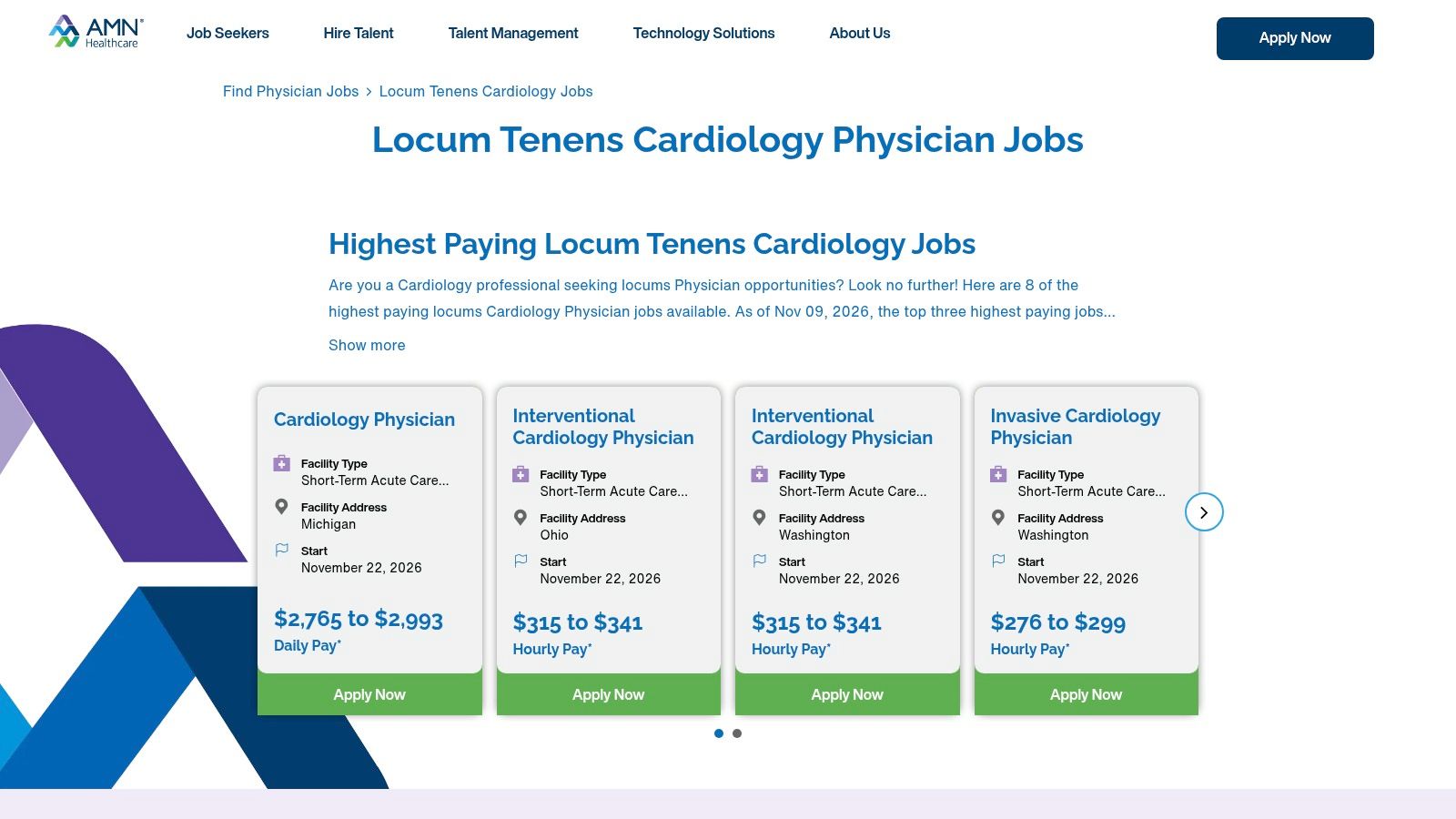
Flexibility is the product at AMN Healthcare cardiology locum tenens jobs. Assignments span hospitals, physician groups, clinics, ambulatory surgery centers, and critical access hospitals, which gives physicians a way to test a market or cover income gaps without accepting a permanent appointment. Some listings disclose location, schedule, start date, and hourly or daily pay ranges before application.
Assignment Breadth and Team Context
Roles cover general, invasive, non invasive, and advanced heart failure or transplant cardiology. Candidate profiles, saved searches, job alerts, and recruiter support reduce search friction, but they don't answer the operational question that decides whether an assignment works. That question is team design.
A 2025 cardiovascular workforce survey in MedAxiom publications and reports covering 232 programs and 6,830 providers found programs managing nearly 2,000 patients per physician FTE, with APP to physician staffing rising to approximately 0.75. A locum stepping into that model needs to know whether APPs independently manage follow up, who covers the inbox, and whether the physician supervises APP panels. Pay transparency doesn't substitute for those answers.
A locum rate is only comparable after call, panel responsibility, and APP supervision duties are defined in writing.
Postings and pay rates can change quickly, and the focus is locums rather than permanent search. Candidates should clarify call, travel, malpractice coverage, credentialing, and licensing for every assignment. Executives comparing agency models can also review locum tenens staffing agencies to see how large national firms differ from specialty specific providers.
4. CompHealth
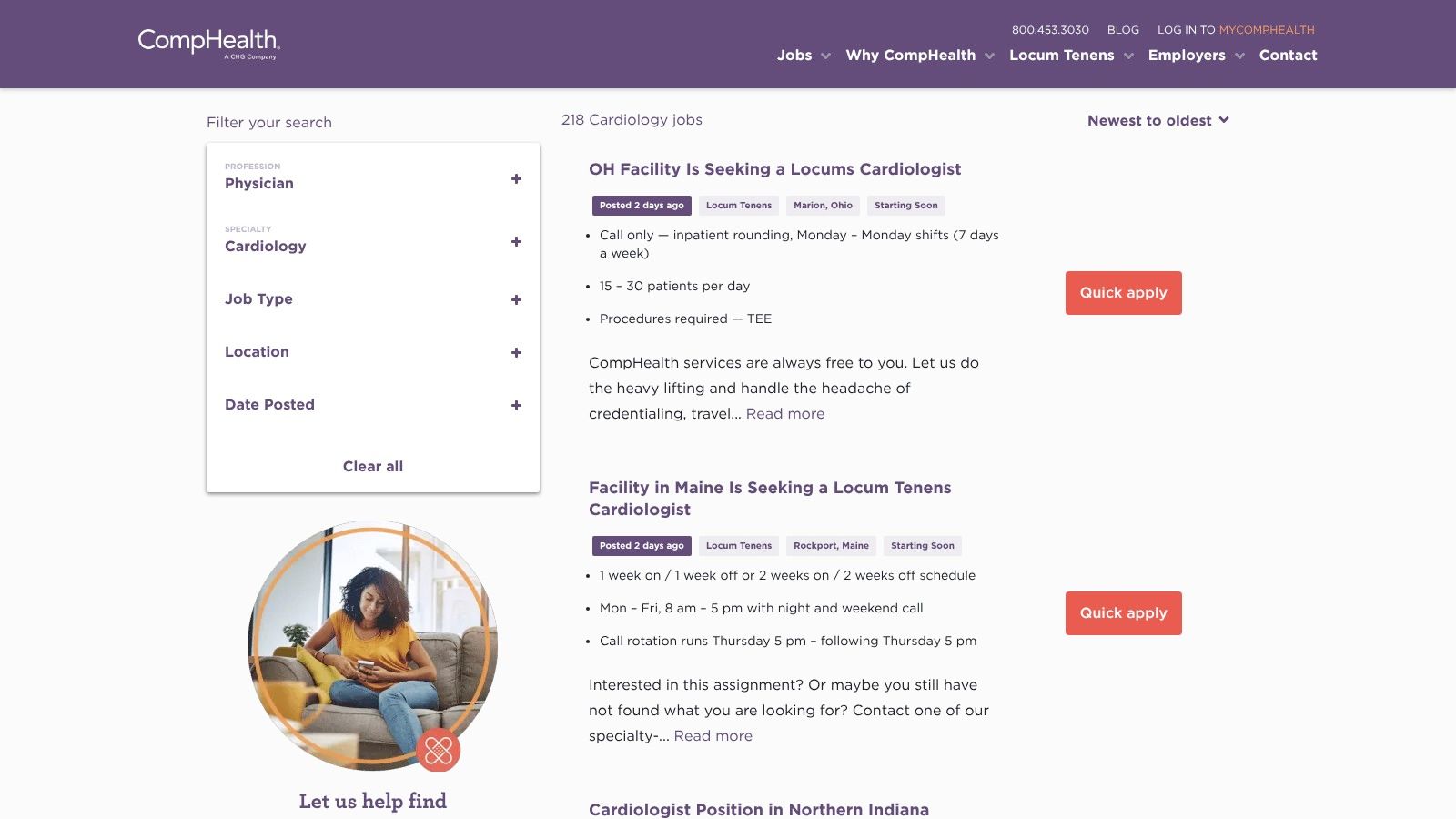
Say a general cardiologist is open to either a permanent move or a block of locum assignments within driving distance. CompHealth cardiology jobs is built for that undecided stage because one nationwide search with location filters surfaces both models. Candidates aren't forced to choose an employment structure before seeing what the local market offers.
Some postings describe schedule, workload, call expectations, patient volumes, clinical duties, or compensation. That practical detail helps candidates screen out roles with incompatible call before a recruiter call, though full details for many locum postings still require direct contact. CompHealth states its candidate services are free, and recruiters can assist with credentialing and travel for locum assignments.
Reading Compensation Against Workload
Compensation needs a workload denominator. Cardiovascular Business coverage of cardiologist compensation reported that median total compensation for full time cardiologists reached $694,954 in 2024 in MedAxiom's 2025 survey. A posting near that level with heavy call and no APP support may be less sustainable than a lower paid role with protected administrative time. Candidates should compare pay against call frequency, procedural expectations, and clinic volume, not against headline figures alone.
Dual model search: Permanent and locum tenens openings appear in one workflow.
Operational detail: Selected postings specify workload and call rather than only title and city.
Logistics support: Credentialing and travel help is available for locum assignments.
Coverage varies over time, so availability should be confirmed before planning around a specific posting. The complete compensation package, including call pay and malpractice terms, also needs verification since listing summaries rarely capture total value.
5. LocumTenens.com
Administrative burden decides many locum placements before clinical fit is even tested. LocumTenens.com cardiology services positions its value in that layer, offering specialty focused recruiters plus support with credentialing, state licensing, malpractice coverage, travel, and housing. For a facility covering a sudden departure, those logistics determine the actual start date.
The firm handles short and longer term coverage for clinicians and healthcare facilities, with job board and employer services alongside recruiter led matching. Because recruiters focus on a medical specialty, conversations can move quickly to subspecialty scope and facility requirements. Candidates still typically need a recruiter discussion to assess fit and complete terms, and available roles depend on facility demand and licensing timelines.
Virtual Care Roles Need Policy Checks
Some cardiology coverage now includes remote follow up or virtual rehabilitation, and that work isn't policy neutral. The Centers for Medicare and Medicaid Services telehealth guidance states that additions or deletions to Medicare telehealth services take effect on January 1, with the final rule generally published by November 1. Employers should confirm that any remote duties in a locum assignment align with current covered service definitions and billing requirements.
Specialty recruiters: Cardiology focused staff handle matching rather than a generalist pool.
Reduced paperwork: Licensing, credentialing, malpractice, travel, and housing support are coordinated centrally.
Two sided service: Employers and clinicians both use the platform, which helps recurring coverage planning.
The limitation is clear. It's a locum tenens service, not a permanent job search, so candidates seeking program building or partnership should look elsewhere. Readers comparing providers can benchmark the model against best locum tenens companies before registering with several agencies at once.
6. Hayes Locums
Registration first, detail later. That sequence defines Hayes Locums cardiology jobs, where candidates submit contact information and an optional CV to express interest in active or future opportunities. The approach suits physicians who aren't chasing one posted vacancy but want a recruiter watching for assignments in preferred states.
Postings carry state and specialty labels, with examples across outpatient, inpatient, general cardiology, and advanced heart failure coverage. Specialty and location are visible on the job page, which makes initial screening fast. Deeper terms often stay limited until a recruiter is contacted, so candidates should verify schedule, call, duration, pay, and travel support before treating a listing as viable.
Why Future Interest Lists Matter
Pipeline registration reflects national supply conditions. The Association of American Medical Colleges workforce studies projected in 2024 that the United States could face a shortage of between 13,500 and 86,000 physicians by 2036. That's a projection, not a guarantee of openings in a particular ZIP code, but it explains why locum firms cultivate candidate pools ahead of confirmed demand. Facilities benefit when credentialing can start before a vacancy becomes urgent.
Screening question: Is a listed assignment funded and dated, or is the recruiter building a pool for anticipated demand?
Most opportunities here are locum tenens rather than permanent positions. Candidates who value full posting detail upfront may find the recruiter gated model slower, while those planning months ahead may find the future interest list useful. Either way, written confirmation of assignment status should precede any licensing paperwork.
7. Weatherby Healthcare
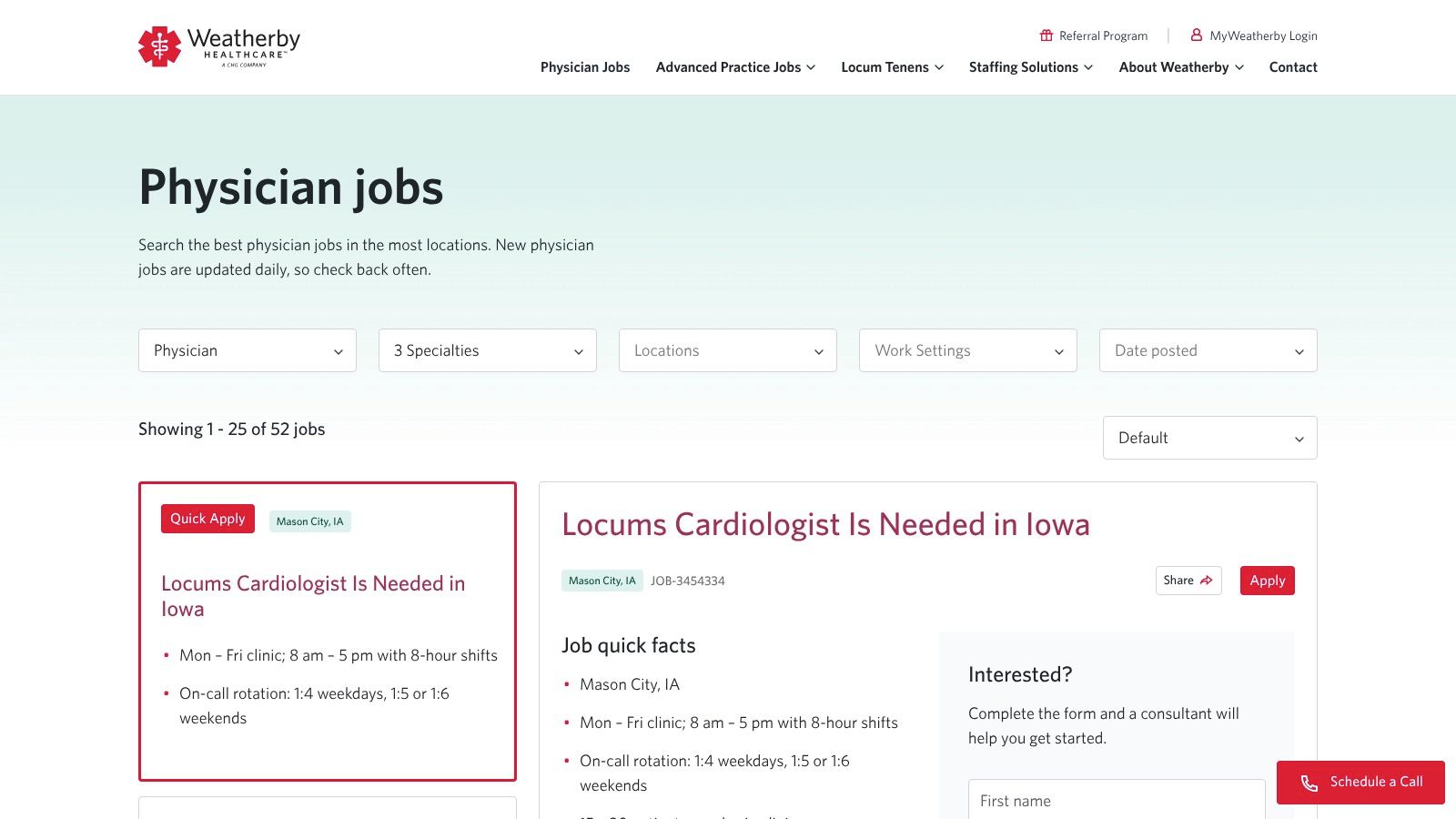
Cardiology and cardiac surgery are often staffed as one service line, and Weatherby Healthcare cardiovascular locum jobs reflects that reality. Its search covers cardiology alongside cardiovascular and cardiothoracic surgery, with examples of outpatient and inpatient coverage. A service line leader covering a surgical program gap and a clinic gap simultaneously can review both in one place.
Some listings show schedule and patient volume details, and quick apply options shorten initial contact. That speed helps with recurring coverage blocks where the facility, scope, and call pattern are already familiar. It helps less when a candidate is entering a new state or a facility with unfamiliar privileging requirements.
Speed Versus Diligence
Quick apply shouldn't become quick commitment. Role details and pay may require recruiter follow up, and credentialing time and state license requirements vary by assignment. Candidates should confirm whether privileges cover the procedures they expect to perform and whether subspecialty backup exists for cases beyond their scope.
Service line breadth: Cardiology and related surgical specialties appear in one search.
Visible expectations: Some listings show schedule, call, and volume before application.
Recurring coverage: Short term blocks suit clinicians building a locum schedule across facilities.
The reviewed page focuses on locums rather than permanent recruitment. For a surgeon or cardiologist seeking a durable appointment with program responsibility, Weatherby works better as a market scan than as the primary channel. For interim coverage across a cardiovascular service line, its combined categories are a practical advantage.
How the seven options differ on hiring model, job types, and best-fit candidate
Item | Primary Hiring Model | Job Types Covered | Best For |
|---|---|---|---|
American Cardiology Group | Specialty-focused recruitment | Permanent, locum tenens, advanced-practice, and executive roles | Organizations hiring across cardiology and cardiac surgery |
American College of Cardiology Career Center | Specialty job board | Cardiology openings, including subspecialty and some APP roles | Candidates comparing cardiology jobs across employers |
AMN Healthcare | Locum tenens staffing | Temporary cardiology assignments across specialties and care settings | Physicians seeking flexible or interim work |
CompHealth | Permanent and locum tenens recruitment | Permanent and temporary cardiology positions | Candidates exploring both ongoing and short-term roles |
LocumTenens.com | Specialty-focused locum tenens staffing | Short- and longer-term cardiology coverage | Clinicians seeking locum roles with logistics support |
Hayes Locums | Locum tenens recruitment | Cardiology assignments across states and care settings | Candidates interested in current or future locum opportunities |
Weatherby Healthcare | Locum tenens staffing | Cardiology and cardiovascular surgery assignments | Clinicians seeking temporary work across cardiovascular specialties |
Turning a Local Search Result into a Viable Appointment
Proximity starts the search. Terms decide it. Executives and candidates should convert any promising result for cardiology jobs near me into a short diligence file before interviews consume clinical time, starting with the hiring model. Permanent employment, locum tenens, advanced practice placement, and executive search carry different risk, cost, and retention profiles, and a listing that doesn't state its model clearly isn't ready for comparison.
Credentialing and licensing come next because they control the start date. Candidates should confirm state license status, hospital privileging scope, required case logs for interventional cardiology or electrophysiology, and who manages paperwork and fees. Employers should state whether temporary privileges are available and what happens to the start date if a license is delayed. A nearby candidate without the right license can start later than a distant candidate who's already credentialed.
Compare Call and Volume Before Compensation
Headline pay misleads without workload context. Both sides should document call frequency, clinic sessions, procedural expectations, inpatient census, APP supervision, and inbox coverage in the same conversation where compensation is discussed. Malpractice terms deserve the same precision, including who pays, whether coverage is occurrence or claims made, and who funds tail coverage at exit.
Confirm the model: Permanent, locum, APP, or executive, with conversion terms stated if locum to permanent is possible.
Verify readiness: Licensing, credentialing, privileging scope, and earliest realistic start date.
Test sustainability: Call pool size, subspecialty backup, cath lab access, referral volume, and team composition.
Infrastructure completes the picture. A community role with transfer agreements, imaging capacity, and program investment can offer more autonomy and influence than a metropolitan post with constrained lab time. Distance patients travel, outreach obligations, and telecardiology expectations should be explicit rather than discovered after start.
The practical endpoint is a shortlist of two or three openings that survive those checks, followed by direct conversation with the employer or recruiter. That conversation should end with written terms on model, call, volume, malpractice, and onboarding timeline. Anything less leaves both sides negotiating against assumptions.
Facilities that need a cardiac specific partner across permanent, locum tenens, advanced practice, and executive hiring can review current services and opportunities at American Cardiology Group. Candidates evaluating local roles by subspecialty, setting, and long term fit can use the same destination to search openings and start a focused conversation.
Comments