
State Medical License Requirements: A Cardiology Guide
A chief medical officer approves an electrophysiology hire. A service line leader has catheter lab time blocked. The credentialing team is ready to move. Then the placement stalls on the least visible part of the process: state licensure. For hospitals trying to secure interventional cardiology, electrophysiology, heart failure, or cardiac surgery talent, this is often the point where urgency collides with regulation.
That collision matters most when the role is hard to replace. A delayed general cardiologist creates access strain. A delayed interventionalist can affect STEMI coverage plans. A delayed EP physician can slow ablation program growth, device clinic expansion, and referral retention. In rural markets, a licensure lag can also leave call schedules exposed for far longer than leadership expected.
State medical license requirements aren't just compliance details. They shape hiring timelines, telecardiology strategy, locum tenens deployment, IMG recruitment, and the economics of every placement. The organizations that treat licensure as an early-stage strategic workflow, rather than an end-stage administrative task, usually move faster and miss fewer start dates.
Table of Contents
The High-Stakes Challenge of Physician Licensing - Why cardiology feels the delay more acutely - What strong organizations do differently
The Universal Licensure Dossier Core Document Requirements - The required file set - Primary source verification sets the pace - IMG and visa-holder files require earlier assembly - Budget and ownership matter
State-by-State Variations A Strategic Overview - High-barrier states - Moderate-barrier states - Streamlined or compact-oriented states - A practical sorting model for executives
Licensing Pathways Initial Endorsement and Temporary - How the pathways differ in real recruiting scenarios - Temporary licensure is a tactical tool, not a universal shortcut - Choosing the pathway before the offer letter is finalized
Accelerating Placement with the IMLC and Telemedicine - Why the IMLC matters so much in cardiology - What executives often misunderstand - A better use case than emergency rescue
Navigating IMG and Visa-Holder Licensing Complexities - The Conrad 30 timing gap - California and the SSN or ITIN bottleneck - The IMG licensing risk map
A Cardiology Recruiters Licensing Timeline and Checklist - The working timeline from acceptance to practice start - The checklist that prevents most avoidable delays - A role-based accountability model
Frequently Asked Questions on Physician Licensure - Does a state medical license automatically allow telemedicine across state lines - Does the IMLC create one license for nationwide cardiology practice - What should hospitals gather first when hiring a cardiologist - Are temporary licenses the best option for urgent locum tenens coverage - How should hospitals think about IMG licensure risk - How should executives set realistic start dates - Do fees and administrative requirements matter strategically - What's the biggest mistake in managing state medical license requirements
The High-Stakes Challenge of Physician Licensing
A hospital can identify the right cardiologist and still lose the quarter operationally if licensure isn't managed with the same discipline as recruitment. That is especially true when the position supports procedural volume, regional referral capture, or around-the-clock call coverage. The physician may be fully trained, fully committed, and fully credentialable by the employer. None of that authorizes patient care until the relevant state board does.
The core constraint is structural. There is no single national medical license in the United States; physicians must obtain a separate, unrestricted license in each state where they practice medicine, including for in-person and telemedicine care. The result is a fragmented framework that creates a multi-state burden for cardiology recruitment, and each new placement requires a distinct application process that can take months to complete, as outlined in this state medical licensing guide.
For hospital executives, the licensing problem is easy to underestimate because it sits between recruitment and revenue. Finance teams see an open req. Clinical teams see coverage pressure. Patients see longer waits. The board sees strategic growth plans that appear approved on paper but haven't translated into physician availability. Licensing is the hinge point connecting all four.
Why cardiology feels the delay more acutely
Cardiology recruitment is unusually sensitive to start-date slippage because many hires aren't interchangeable.
Subspecialty scarcity: An interventional cardiologist or electrophysiologist can't be replaced quickly with a generalist.
Program dependency: Structural heart, device management, advanced imaging, and heart failure programs often depend on a narrow mix of credentials and training.
Geographic spread: Multi-hospital systems frequently need physicians to practice across more than one state, especially for outreach clinics and telemedicine consults.
Practical rule: In cardiology, every licensing delay becomes an operations problem before it becomes an HR problem.
What strong organizations do differently
The strongest hiring teams don't ask whether licensure will be complicated. They assume it will. Then they build the hiring model around that assumption.
A disciplined approach usually includes early document collection, parallel processing between legal, recruiting, and medical staff offices, and state selection based on actual licensing friction rather than convenience. That last point is where competitive advantage often appears. Two hospitals may target the same EP candidate. The one that launches licensure planning first usually looks more organized, more credible, and more likely to deliver a workable start date.
The Universal Licensure Dossier Core Document Requirements
A cardiology search can look ready on paper and still miss its start date because the file is incomplete in ways that only surface after board review. That problem appears often with interventional cardiologists, electrophysiologists, locums, and IMG candidates, where the training trail is longer, the documentation chain is wider, and one missing verification can stall the entire application.
Across states, forms differ. The underlying evidence does not. The fastest hiring teams build a universal licensure dossier before they choose the filing sequence for each state because boards are evaluating the same categories of proof: education, training, examination history, license history, identity, and any state-specific background checks.
The practical point is simple. Boards rely on primary source verification for core credentials. Medical schools, residency and fellowship programs, exam administrators, and prior licensing boards often must send records directly. A physician's personal copy may help the recruiter audit the file, but it usually does not satisfy final review.
The required file set
For cardiology recruitment, the dossier should cover the documents that repeatedly determine whether an application can move from submission to active review.
Dossier element | Why it matters for cardiology recruitment |
|---|---|
MD or DO education record | Full licensure depends on verified medical education, and name variations or institutional mergers can slow retrieval. |
Postgraduate training verification | Cardiology hires often require verification across residency, fellowship, and sometimes multiple subspecialty appointments. |
USMLE or COMLEX-USA record | Boards review exam history as part of eligibility for independent practice. |
Current and prior licenses | Any inactive license, lapse, or prior state file can trigger added review and follow-up questions. |
Identity and background materials | Fingerprinting, photo identification, and criminal background checks often move on separate administrative tracks. |
ECFMG documentation for IMGs | IMG files usually require added screening before the board will treat the application as complete. |
Recruitment teams lose time they assumed they had. If document collection starts only after contract signature, the longest-lead items begin last. In cardiology, that delay is expensive because fellowship verification, prior hospital privilege history, and multi-state licensure plans often sit on the critical path for call coverage and procedure scheduling.
Primary source verification sets the pace
Primary source verification is not a formality. It controls the timeline because the slowest outside institution often determines when the board can start meaningful review.
That matters more in cardiology than in many other specialties. An electrophysiologist may need residency verification, general cardiology fellowship verification, EP fellowship verification, prior state license reports, and documentation from hospitals where device implantation or procedural privileges were held. An interventional cardiologist may face similar sequencing issues if prior appointments spanned multiple health systems or states.
Three operating realities follow:
Training chronology must be clean. Boards scrutinize gaps, overlapping dates, and differences between CVs, application forms, and program letters.
Subspecialty training increases administrative touchpoints. More programs usually means more registrars, GME offices, and compliance staff who must respond in the right format.
Recruiters need escalation contacts at source institutions. Delays often start with a fellowship coordinator, registrar, or prior board that has not completed its portion of the file.
Boards license verified records, not candidate readiness.
IMG and visa-holder files require earlier assembly
IMG candidates usually face a second layer of timing risk. ECFMG verification, identity consistency across countries, and visa-related documentation can create delays that have nothing to do with clinical quality. Hospitals that recruit J-1 waiver physicians, H-1B physicians, or other visa holders should align licensure planning with immigration counsel early because some states require documents, attestations, or timelines that intersect with work authorization and public file obligations.
State-level bottlenecks are often administrative rather than legal. A board may request an original document format, a translated record, a specific notarial standard, or a direct institutional response from outside the United States. Those requests are manageable. They are not fast.
Budget and ownership matter
Licensure costs should sit inside the recruitment model from the start. Application fees, fingerprinting, background checks, transcript requests, courier costs, and repeated verifications can add up quickly for locum tenens cardiologists and for physicians who need more than one active state license for outreach clinics or telecardiology coverage.
The better operating model is centralized ownership. Build one master dossier, assign one accountable owner for each missing item, and track every external verification by request date, contact name, and expected turnaround. Hospital executives usually focus on candidate compensation, sign-on support, and relocation. For hard-to-fill cardiology roles, file management often determines whether the physician is available when the service line needs coverage.
State-by-State Variations A Strategic Overview
No executive team needs a 50-state directory in the middle of a search. What they need is a practical framework for deciding which states will move smoothly, which will require heavy project management, and which may disrupt a service-line launch if licensing starts late.
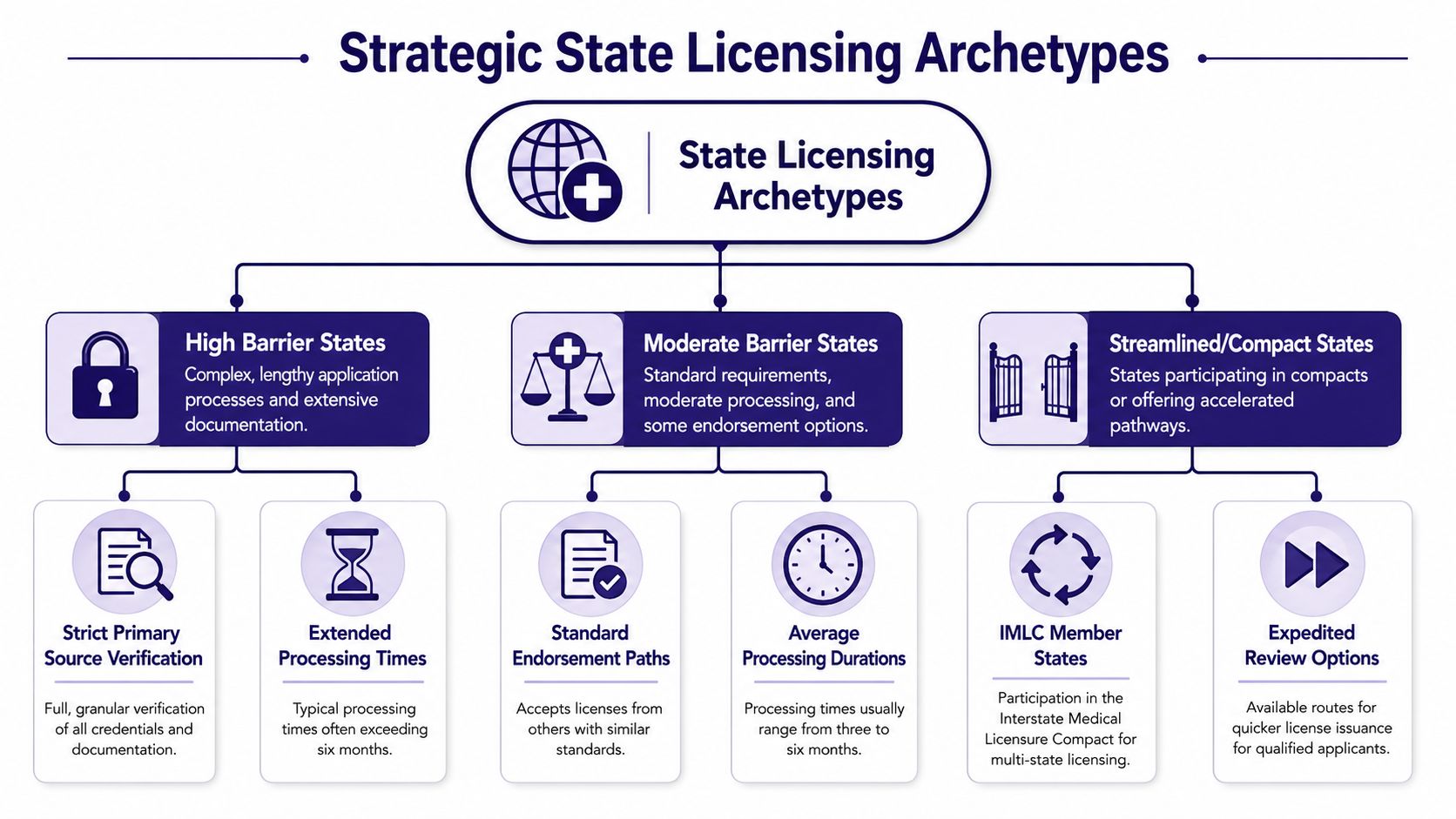
The easiest way to think about state medical license requirements is by licensing archetype, not by alphabetized geography.
High-barrier states
Some states function as high-friction environments for physician deployment. These are the jurisdictions where leadership should expect deeper document review, more follow-up, and less tolerance for missing or inconsistent training records.
Typical traits include:
Granular verification culture: Boards may scrutinize training chronology, prior licenses, name variations, and institutional source documents very closely.
Administrative dependencies: Fingerprinting, separate forms, or state-specific attestations can hold the file even when the physician is otherwise qualified.
Poor fit for urgent starts: These states are the least forgiving when the hospital is trying to activate a cath lab schedule or replace a departing EP specialist quickly.
For cardiology, high-barrier states are especially difficult when the physician trained across several institutions or holds a complex practice history involving locums, telemedicine, moonlighting, or visa transitions.
Moderate-barrier states
These states generally follow familiar licensing patterns and are manageable with disciplined execution. They aren't simple, but they tend to be predictable.
A moderate-barrier state often works well for:
permanent general cardiology recruitment
standard endorsement applications for experienced physicians
regional outreach builds where the physician already has a stable practice footprint
The key issue here isn't usually unusual law. It's volume. A board may process many applications, and a file can still stall if one training verification arrives late or a background item needs clarification.
Streamlined or compact-oriented states
A third group is more receptive to accelerated pathways or compact-based processing. That doesn't eliminate the state's authority, and it doesn't waive the requirement for a state-specific license. It does mean eligible physicians may move through a more efficient channel.
The best recruiting teams don't ask which states are easy. They ask which states are predictable for this specific candidate profile.
A practical sorting model for executives
A service-line leader doesn't need board-level legal detail at the outset. A short planning matrix usually works better.
Archetype | Best recruiting use case | Main risk if planning starts late |
|---|---|---|
High Barrier | Permanent strategic hires with enough runway | Missed start dates and prolonged coverage gaps |
Moderate Barrier | Standard permanent hires and regional expansion | Avoidable delays from incomplete files |
Streamlined Compact | Multi-state practice, telecardiology, and some locum models | Lost speed advantage if eligibility isn't confirmed early |
That framing helps hospital teams make a better early decision. A physician may be excellent clinically, but if the intended market sits in a high-friction licensing category, the onboarding plan must reflect that from day one.
Licensing Pathways Initial Endorsement and Temporary
Not every cardiologist should enter the same licensing lane. The right pathway depends on training stage, prior licensure footprint, urgency of coverage, and whether the role is permanent or episodic. Leaders who treat all applications as standard submissions usually add avoidable time.
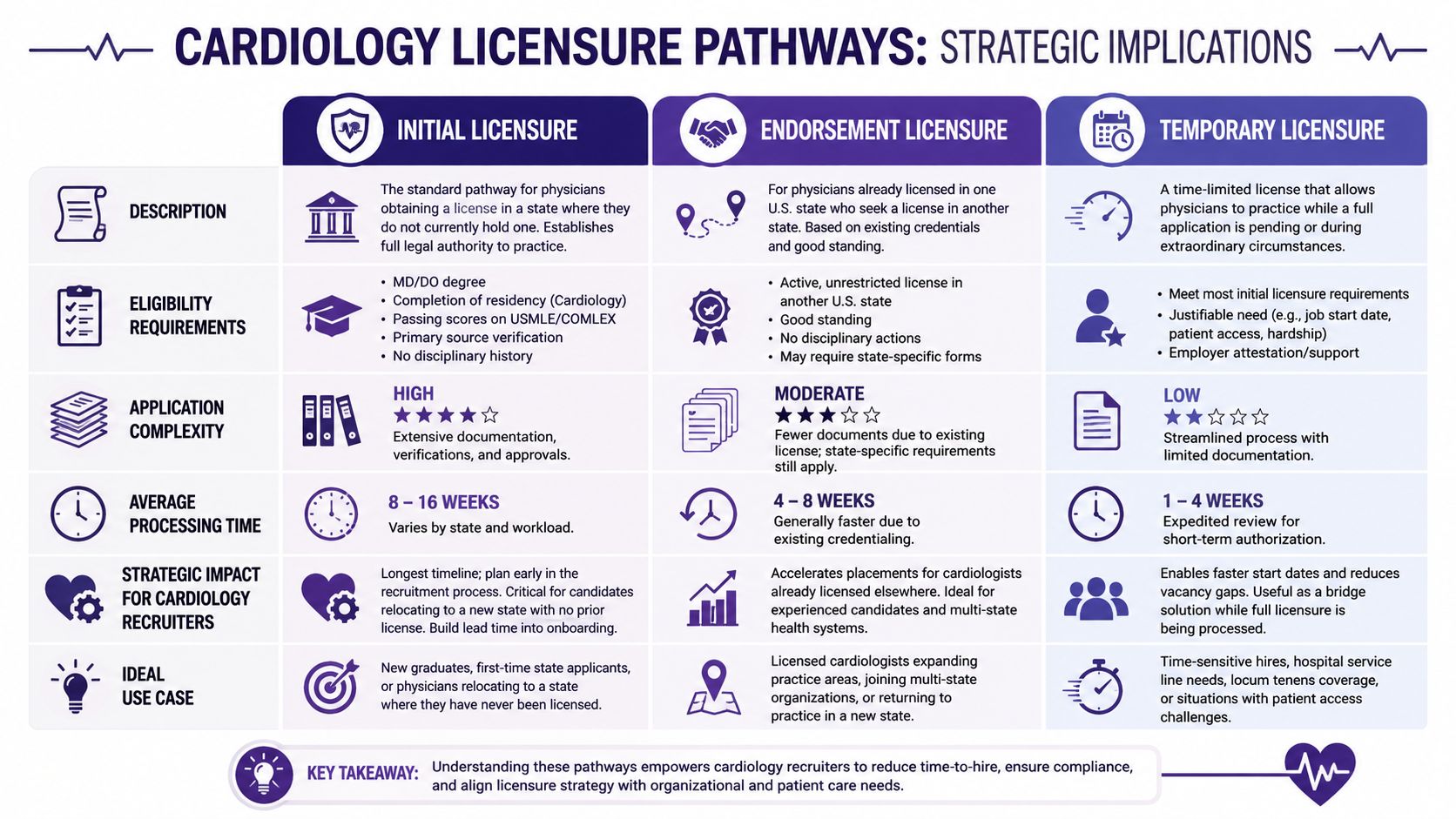
The three practical pathways are initial licensure, endorsement licensure, and temporary licensure. The labels sound administrative. Their strategic effect is operational.
How the pathways differ in real recruiting scenarios
Pathway | Best fit in cardiology | Main limitation |
|---|---|---|
Initial | New fellowship graduate entering first independent role | Full application burden starts from the ground up |
Endorsement | Established cardiologist already licensed elsewhere | Prior licensure helps, but state-specific review still controls timing |
Temporary | Short-term call coverage or urgent locum need | Scope and duration can be limited by the jurisdiction |
A newly trained electrophysiologist is the clearest initial-license candidate. Even with excellent fellowship pedigree, that physician may have a short post-training track record and limited prior practice documentation. The organization should expect a more foundational review.
An established interventional cardiologist moving from one permanent post to another often fits endorsement better. Prior active licensure, clean history, and completed training verification can make the file more straightforward. But "straightforward" doesn't mean automatic. Endorsement is still a state decision, not a transfer.
Temporary licensure is a tactical tool, not a universal shortcut
Temporary or locum-oriented pathways can be highly valuable when a hospital needs near-term coverage for call, clinic backfill, or procedural continuity. They are most useful when the candidate already has a mature practice history and the assignment is narrow in scope.
That said, executives should be cautious about assuming temporary always means fast. The state may still require core vetting, and the hospital still has internal credentialing responsibilities. Temporary authority can solve a coverage problem, but it doesn't erase compliance work.
A temporary license is most effective when the hospital has already defined the assignment precisely. Vague role design creates slow review, even in urgent coverage situations.
Choosing the pathway before the offer letter is finalized
The best time to select the pathway is before compensation terms are fully papered. That allows legal, recruiting, and medical staff offices to align on the onboarding model.
A useful decision screen looks like this:
Career stage: Is the physician a first-time independent applicant or already licensed in several states?
Assignment duration: Is the need permanent, transitional, or episodic?
Coverage urgency: Does the hospital need immediate clinic support, procedural support, or a long-range service-line builder?
Geographic footprint: Will the physician work in one state only, or across multiple patient-location states?
For cardiology leaders, the point isn't just administrative efficiency. It's matching the licensure route to the economics of the hire. A permanent heart failure physician and a short-term cath lab backfill shouldn't be onboarded as if they were the same type of placement.
Accelerating Placement with the IMLC and Telemedicine
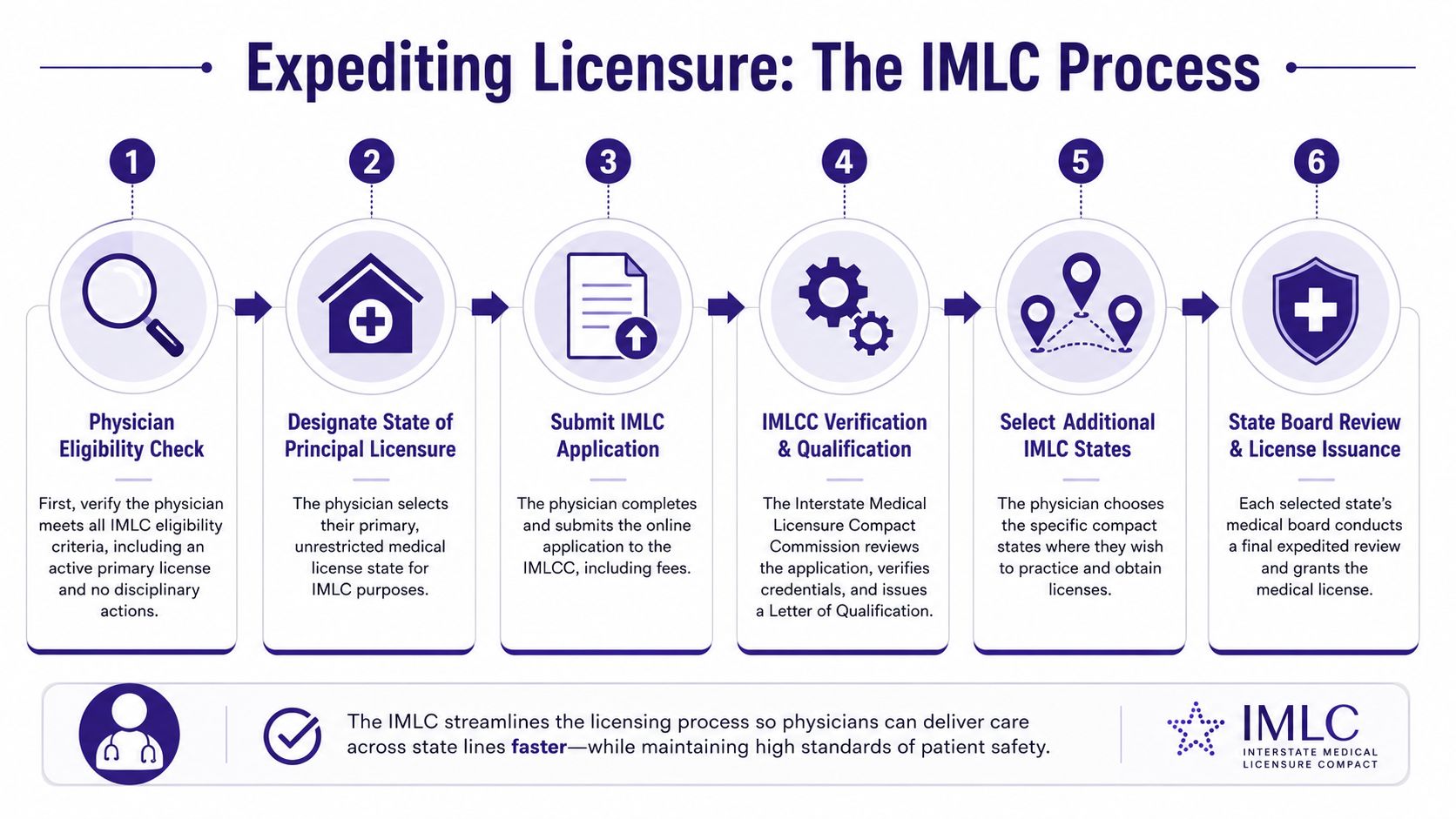
For multi-state cardiology staffing, the Interstate Medical Licensure Compact is one of the few tools that can materially improve deployment speed for the right candidate. It doesn't simplify medicine. It simplifies access to additional state licenses for physicians who already meet a high threshold.
The eligibility standard is strict. According to the Federation of State Medical Boards overview of physician licensure and the Interstate Medical Licensure Compact, the IMLC requires a full, unrestricted State of Principal License in a participating state, time-unlimited specialty certification from an ABMS or AOABOS board, and a successful USMLE or COMLEX-USA history with no more than three attempts per step. It accelerates licensing, but physicians still receive separate licenses for each state.
Why the IMLC matters so much in cardiology
Cardiology practices increasingly rely on distributed coverage models. A physician may read studies remotely, conduct follow-up visits virtually, support satellite clinics, or provide service-line coverage across a health system that spans multiple states. In that environment, licensure delay isn't just an onboarding issue. It constrains care design.
The IMLC is particularly useful for:
Telecardiology expansion: Virtual consults still require licensure in the patient's location state.
Regional referral systems: One cardiologist can support several facilities more compliantly and with less administrative drag.
Locum flexibility: Eligible physicians can be positioned for broader assignment options through a more efficient multi-state strategy, especially in locum tenens cardiology coverage models.
What executives often misunderstand
The most common misconception is that the compact creates a national license. It doesn't. Each state still issues its own license. The value lies in the expedited pathway and the common qualification standard.
That distinction matters in telemedicine. A hospital may have a highly capable electrophysiologist based in one state and assume virtual follow-up can cross borders freely. It can't. The physician generally needs authority in the state where the patient is located. Federal facilities create limited exceptions, but they don't define the broader private-sector rule.
A better use case than emergency rescue
The IMLC works best when used as a force multiplier for already-strong candidates. An ABMS-certified cardiologist with a stable primary license, clean record, and multi-state strategic value is the ideal profile.
This makes the compact less of an emergency fix and more of a planning advantage. If a health system knows it will need telemedicine reach, rural outreach, and occasional cross-coverage, it should prefer candidates who can likely qualify for the compact. That changes the economics of the search before the contract is signed.
The compact isn't a substitute for planning. It's the reward for planning around the right physician profile.
Navigating IMG and Visa-Holder Licensing Complexities
International Medical Graduates remain indispensable in many cardiology recruitment markets, especially where hospitals need sustained coverage in rural, academic, or hard-to-fill settings. Yet the licensing issues affecting IMGs rarely arise from one single rule. Delays usually come from the interaction between immigration timing, state board definitions, tax identity requirements, and postgraduate verification.
That interaction is what makes IMG recruitment more fragile operationally. A hospital can have federal immigration progress underway and still be unable to activate patient care if state-level prerequisites remain unresolved.
The Conrad 30 timing gap
One of the least understood pressure points is the relationship between a Conrad 30 waiver and state licensure timing. As described in this analysis of Conrad 30 waivers and medically underserved area practice, many states don't require a full license to obtain the waiver, but they do require proof that the physician applied for a license.
That creates a narrow operational gap. Federal waiver progress can move ahead while the physician still lacks practical authority to work. If the state board's view of "qualifying for a license" doesn't line up with the immigration timeline, the physician may face a nonproductive interval between approval milestones.
For cardiology programs serving underserved populations, this matters more than many generic IMG guides acknowledge. Conrad 30 often supports exactly the kinds of markets where cardiac shortages are hardest to absorb. If waiver strategy and licensure sequencing are handled separately, the hospital can lose valuable time after it believed the hardest immigration hurdle had been cleared.
California and the SSN or ITIN bottleneck
Some barriers are even more basic. California's BreEZe system requires a U.S. Social Security Number or Individual Taxpayer Identification Number before the application can be submitted at all. That requirement can delay cardiology recruitment by 3 to 6 months for otherwise qualified candidates who have completed residency but don't yet have the necessary tax ID, according to this California medical license overview discussing the BreEZe application process.
This issue is strategically important because it blocks the front door. A physician can't even enter the queue. For rural hospitals and academic centers hoping to use expedited pathways tied to underserved service, that means the promised acceleration may be irrelevant until the identity prerequisite is solved.
The IMG licensing risk map
A practical recruitment review for IMGs should include these checkpoints:
ECFMG dependency: International graduates often need ECFMG documentation and additional postgraduate proof before the board will complete review.
Visa and licensure synchronization: Immigration counsel and licensure coordinators should work from one integrated timeline.
State entry barriers: Some states create hard-stop prerequisites that prevent application submission entirely.
Training-source response time: Cross-border education and U.S. postgraduate records can create longer verification chains.
A qualified IMG candidate can still miss a start date if the team treats immigration and licensure as parallel workstreams instead of one connected project.
Hospitals that recruit internationally should also give candidates one clear pathway for support. Mixed messaging from legal, HR, department leadership, and medical staff offices can force the physician to reconcile contradictory instructions during the most time-sensitive stage of the move. That is where strong recruitment operations produce disproportionate value.
For physicians evaluating opportunities, the same principle applies. A cardiologist considering a U.S. transition should favor organizations that can explain the licensing sequence in detail and point candidates toward structured guidance for cardiology career opportunities and candidate support. The quality of that explanation often predicts how the rest of the onboarding process will go.
A Cardiology Recruiters Licensing Timeline and Checklist
The most reliable way to reduce licensure friction is to treat onboarding like a managed project with owners, dependencies, and realistic gates. Hospitals often lose time because everyone assumes someone else is tracking the file. The candidate thinks HR is following up. HR thinks medical staff services owns it. The department assumes the recruiter has visibility. Meanwhile, the board is waiting on one missing item.
A practical timeline solves that by assigning action before urgency escalates.
The working timeline from acceptance to practice start
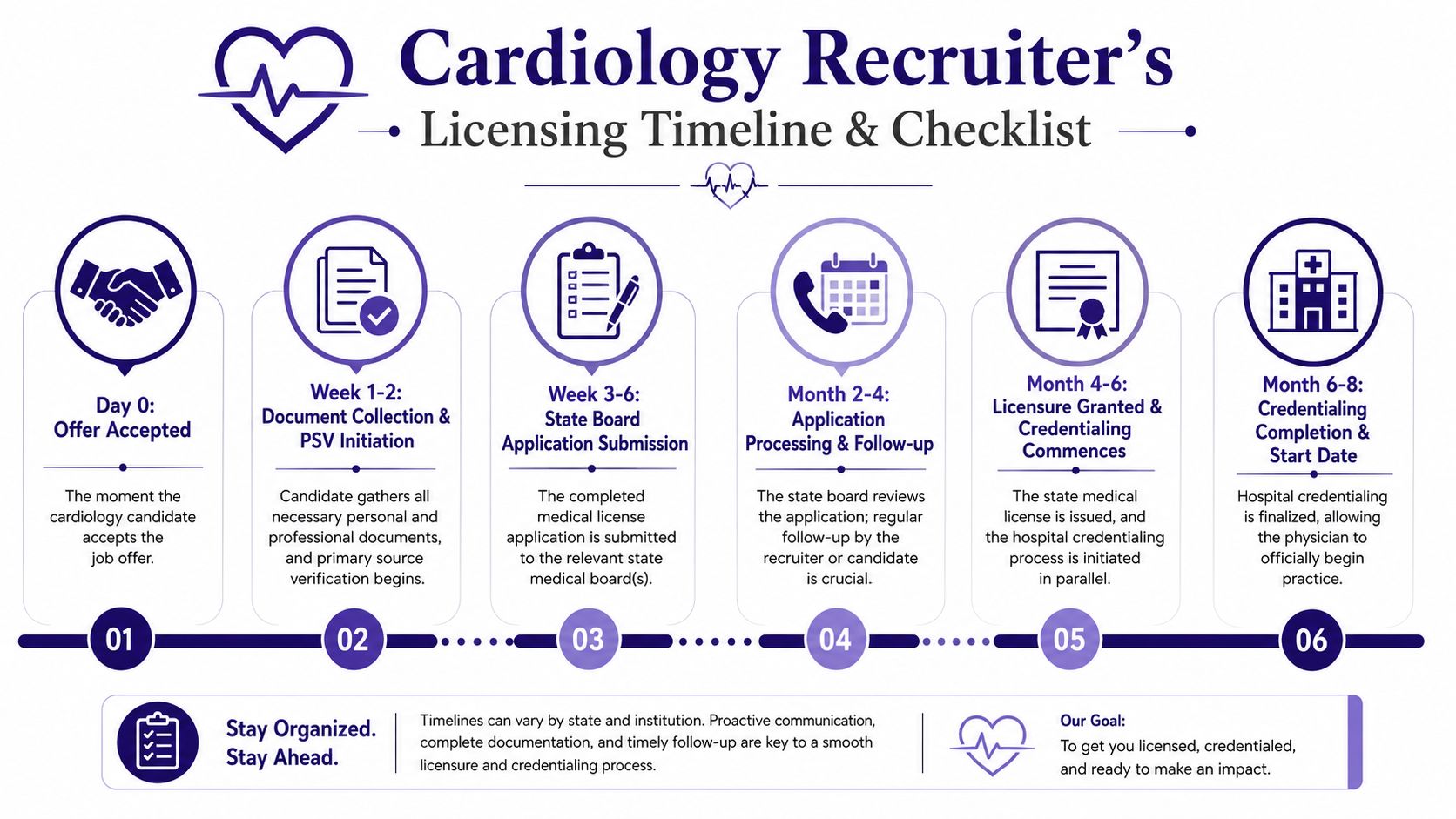
The following milestones align with the planning model used by many recruitment teams and reflect the timeline structure commonly applied to physician onboarding in this area.
Stage | Approximate timing | Primary owner | Critical output |
|---|---|---|---|
Offer accepted | Day 0 | Hospital and candidate | Signed commitment and onboarding launch |
Document collection and PSV initiation | Week 1 to 2 | Candidate and licensure coordinator | Complete dossier requests sent to source institutions |
State board application submission | Week 3 to 6 | Candidate with coordinator oversight | Application filed with required attachments and releases |
Application processing and follow-up | Month 2 to 4 | Licensure coordinator | Board questions answered and file monitored |
Licensure granted and credentialing begins | Month 4 to 6 | Medical staff office | State license in hand and internal privilege review starts |
Credentialing completed and start date | Month 6 to 8 | Hospital leadership and medical staff office | Physician cleared to begin practice |
These are planning ranges, not guarantees. Complex files, multi-state roles, and IMG matters can extend them. Still, a visible timeline keeps executive expectations anchored to process reality.
The checklist that prevents most avoidable delays
A strong checklist doesn't just list tasks. It identifies failure points.
Confirm the intended practice map early. If the physician will cover clinics, call, telemedicine, or outreach across state lines, every patient-location state needs review before dates are promised.
Launch primary source verification immediately. This stage often causes the longest delays for many files, a process not fully within the candidate's control.
Audit name consistency. Training records, prior licenses, exam records, and identity documents should match or be reconciled before submission.
Separate licensure from privileging. A granted state license doesn't automatically complete hospital credentialing.
Escalate silent delays. If a school, residency office, or board vendor hasn't responded, waiting passively usually extends the problem.
A role-based accountability model
Different actors should own different portions of the process.
Candidate: signs releases, provides background disclosures, completes forms accurately, responds fast to deficiencies
Recruiter or coordinator: tracks document requests, confirms application completeness, follows up with source institutions and board contacts
Hospital medical staff office: aligns privileging requirements, start-date planning, and payer enrollment expectations
Service-line leadership: avoids announcing launch dates before licensure milestones are credible
Recruitment strategy and execution quality converge. Organizations building permanent coverage in cardiology should look for partners that can manage both physician fit and process control through a structured permanent physician recruitment model for specialized practices.
Operational takeaway: The start date should be built from licensure evidence, not from candidate enthusiasm or departmental urgency.
Frequently Asked Questions on Physician Licensure
Does a state medical license automatically allow telemedicine across state lines
No. For most private-sector practice models, the physician generally needs licensure in the state where the patient is located. That matters for telecardiology, virtual follow-up, and remote consultative care. A cardiologist may be physically located in one state and still need separate authority for each patient-location state involved in the practice model.
Does the IMLC create one license for nationwide cardiology practice
No. The compact speeds access for eligible physicians, but it still results in separate licenses issued by each participating state. That distinction affects telemedicine planning, outreach clinic design, and any staffing model built around regional physician mobility.
What should hospitals gather first when hiring a cardiologist
The fastest first step is the universal dossier: medical education verification, postgraduate training records, national exam transcripts, current and prior licensure history, identity documentation, and IMG-specific materials when relevant. The goal is to begin source verification before secondary issues consume time.
Are temporary licenses the best option for urgent locum tenens coverage
Sometimes, but not automatically. Temporary pathways can be useful for urgent call coverage or short assignments, particularly when the physician has an established record. They still require proper vetting, and hospitals should avoid assuming that "temporary" means unrestricted or immediate.
How should hospitals think about IMG licensure risk
They should treat it as a sequencing issue, not solely a candidate issue. IMG placements often depend on the timing relationship between immigration status, state application prerequisites, tax identity requirements, and postgraduate verification. When those tracks are coordinated well, the file moves more predictably. When they aren't, delays tend to surface late.
How should executives set realistic start dates
They should build start dates from the longest regulatory dependency, not from contract signature alone. That usually means aligning expectations around document collection, state board review, and hospital credentialing as separate but connected milestones.
Do fees and administrative requirements matter strategically
Yes. Multi-state practice models can increase both direct application cost and internal administrative burden because boards may impose separate charges and distinct supporting steps. For systems deploying physicians across more than one state, licensure should be forecast as part of workforce planning rather than handled as an afterthought.
What's the biggest mistake in managing state medical license requirements
Treating licensure as a back-office task after the hire is already "done." In cardiology, the practical hire isn't complete until the physician can lawfully treat patients in the intended setting. Organizations that understand that earlier usually fill critical roles with fewer avoidable setbacks.
Hospitals, health systems, and cardiology candidates that need a specialized partner can explore American Cardiology Group for focused support in cardiac physician recruitment, locum tenens coverage, and long-term placement strategy across complex licensing environments.
Comments