
Advanced Practice Provider Recruitment: Cardiology Guide
Cardiology leaders cannot solve a physician shortage through physician searches alone. The Association of American Medical Colleges workforce projection estimates an overall U.S. physician shortage of 13,500 to 86,000 physicians by 2036. Federal workforce projections also point to a substantial cardiologist shortage. That makes Advanced Practice Provider Recruitment a capacity decision, not just a vacancy to fill.
A signed offer does not restore clinic access. Credentialing, privileging, payer enrollment, billing setup, and supervised ramp determine when a nurse practitioner or physician assistant can add capacity. Price the search against the weeks the service remains short after acceptance, not just salary and time to offer. Define scope before posting, assess competency against that scope, model collections under the applicable billing rules, and track retention from day one.
Table of Contents
Cycle Time Targets to Set Before You Post - Find the One Stage That's Costing the Most Time
Job Descriptions That Filter for Cardiology Scope - Before and After - The Seven Items Every Posting Must Specify - Why the Procedural Boundary Does the Heavy Lifting
Interviews and Competency Checks for Cardiology APPs - Run the Sequence in Order - Rural and Community Roles Need Different Evidence
Compensation Models and Billing Rules That Shape Offers - Structure the Offer Around the Billing Reality
How to Credential and Onboard Cardiology APPs in 90 Days - The Sequence From Signature to Day 90
Set Up Retention and Metrics Before the First Offer - Metrics That Belong on the Same Dashboard as Time-to-Fill - Career Levers That Keep Cardiology APPs
Cycle Time Targets to Set Before You Post
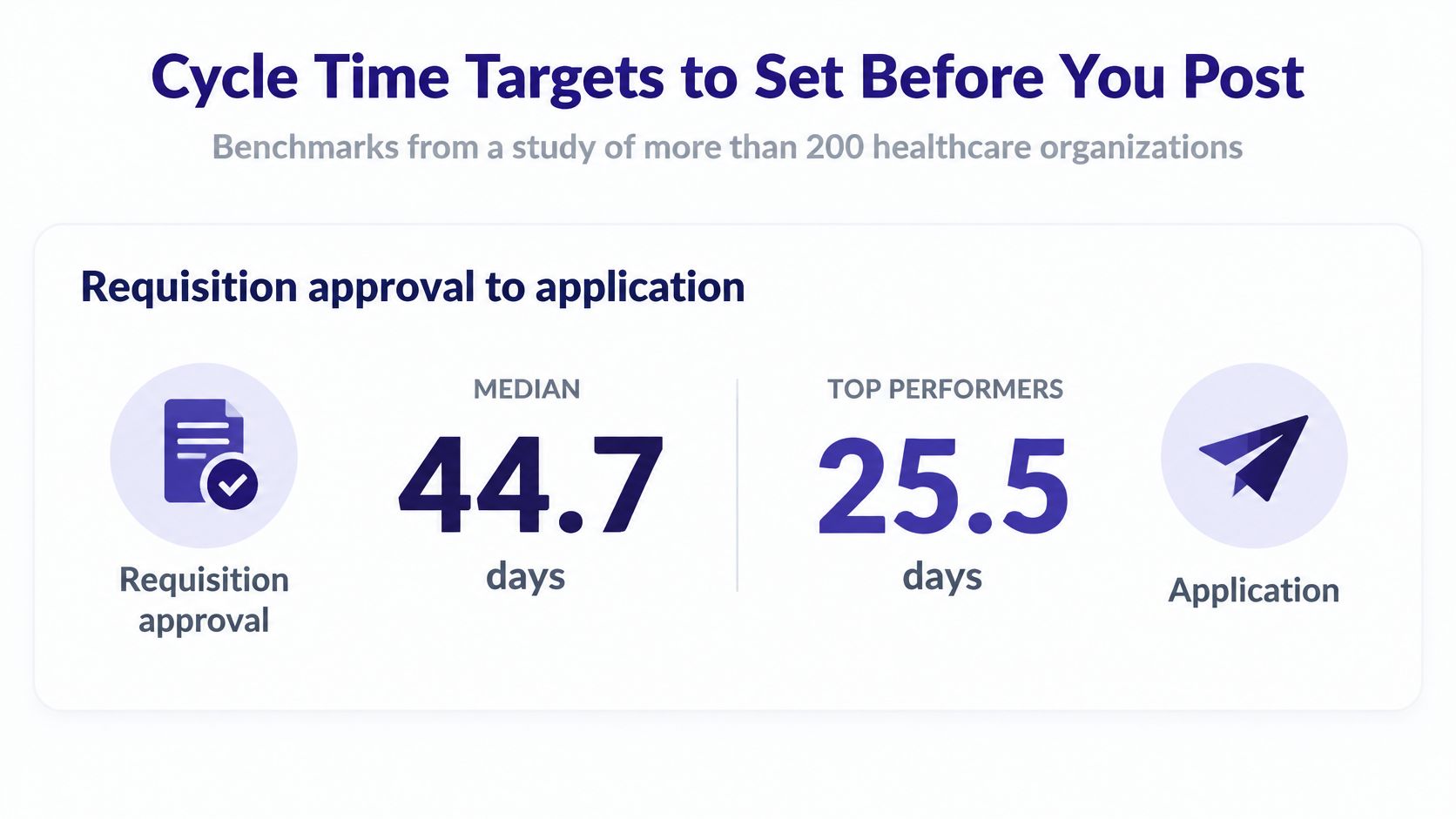
A total time-to-fill number hides the broken stage. Manage the funnel as four separately measured intervals and assign each one an owner before the requisition opens. The healthcare recruiting benchmark covering more than 200 organizations reports medians of 44.7 days from requisition approval to application, 16.3 days from application completion to offer acceptance, 27.8 days from offer acceptance to start, and 59.6 days for total time-to-fill.
Top performers hit 25.5, 11.1, 20.5, and 41.9 days on those same intervals. The largest absolute gap sits at the front of the funnel. That's an intake and sourcing problem, not an interviewing problem, and it won't be fixed by asking hiring managers to move faster.
Advanced practice provider funnel benchmarks by interval
Funnel interval | Median (days) | Top performers (days) | Usual owner |
|---|---|---|---|
Requisition approval to application | 44.7 | 25.5 | Recruiter and clinical director |
Application completion to offer acceptance | 16.3 | 11.1 | Recruiter and hiring manager |
Offer acceptance to start | 27.8 | 20.5 | Credentialing and medical staff office |
Total time-to-fill | 59.6 | 41.9 | Executive sponsor |
Find the One Stage That's Costing the Most Time
Track median and 75th-percentile cycle time by stage, not averages. One stalled electrophysiology search skews a mean for a full quarter and tells leaders nothing about the typical search. Stage-level medians show whether delays sit in sourcing, selection, or onboarding.
Pull the last 12 months: Date-stamp every requisition at approval, first qualified application, offer acceptance, and start.
Compare each stage: Calculate the gap to the top-performer value for all four intervals.
Set one target first: Fix the stage with the largest gap this quarter instead of setting four targets nobody owns.
Review weekly: Put the clinical director and recruiter in the same 20-minute review until that stage moves.
Treating offer acceptance as completion is the costliest error in this funnel. Credentialing, privileging, payer enrollment, and EHR training create a second vacancy after signing, while patients still can't get appointments. A standardized intake covering scope, clinic and inpatient mix, call, procedures, supervision, productivity expectations, and required certifications prevents late-stage renegotiation. Publishing compensation and schedule details also improves fit, and consistent follow-through on how to improve candidate experience keeps qualified candidates from drifting during long approval gaps.
By the end of this exercise, leaders should hold a baseline table with internal numbers beside the benchmark and one named stage to fix. That's the target set. Everything else waits.
Where to Source Experienced Cardiology APPs
National supply isn't the binding constraint anymore. Matching by specialty, geography, and care setting is. HRSA projected nurse practitioner supply rising from 57,330 FTEs in 2013 to 110,540 FTEs in 2025 in its HRSA workforce projections to 2025. Growth at that scale widens the pool without delivering a heart-failure APP to a specific community hospital.
Competition for experienced clinicians is intensifying anyway. The Bureau of Labor Statistics employment projections overview for 2023 to 2033 projects nurse-practitioner employment growth of 46.3%, from 292,500 jobs in 2023 to 427,900 in 2033. Cardiology postings compete with outpatient practices, academic centers, ambulatory settings, and other specialties for the same candidates.

Test channels in this order.
Specialty retained or placement recruiters: Options include American Cardiology Group's advanced practice placement for NPs and PAs. Best when an electrophysiology, structural heart, or heart-failure role has stalled. Judge by qualified cardiology candidates presented, not total submissions.
Cardiology training alumni lists: NP and PA fellowship and residency alumni suit early-career roles with procedural exposure. Judge by interview-to-offer conversion.
Internal pipeline: Cath lab, echo, and device clinic staff enrolled in NP or PA programs, supported by a tuition clause with a service commitment. Judge by graduation-to-start retention.
State association boards and rural health networks: State NP and PA boards suit community hospitals. Judge by local applicants who meet licensure requirements.
Current APP referrals: Cardiology-trained APPs know who can handle the service. Judge by referral hire rate.
Reposting one generic listing across every board widens volume without improving fit. It burns recruiter time and slows the first funnel stage.
Job Descriptions That Filter for Cardiology Scope
A weak posting attracts volume and forces the interview team to do the filtering. A strong posting works as an operating contract and lets the wrong candidates screen themselves out before a recruiter spends an hour on the phone.
If a candidate can't tell from the posting whether the role includes device checks, the posting has failed.
Before and After
Before: "Seeking an experienced cardiology APP to join a busy, growing practice. Cardiology experience preferred. Must work well in a fast-paced team environment. Competitive salary."
That text says nothing about setting, call, procedures, supervision, or ramp. Every applicant looks plausible, and every interview starts from zero.
After: "Three clinic days and one inpatient rounding day weekly. Post-ablation follow-up and heart-failure clinic. Device interrogation review with physician oversight, no independent generator changes. Call 1 in 6, telephonic first, with the named electrophysiology attending as backup. Productivity ramps over 90 days. National board certification and ACLS required."
Experienced electrophysiology candidates can judge fit in seconds. New graduates can see the training path and the boundary they won't cross alone.
The Seven Items Every Posting Must Specify
Scope split: State the procedural and consultative mix in plain terms, such as post-ablation follow-up plus heart-failure clinic. "Cardiology experience preferred" filters nothing.
Setting mix as a weekly template: Write three clinic days and one inpatient rounding day, or the actual equivalent for an ASC or hospital service. Candidates plan commutes, call, and family logistics around that template.
Call frequency and backup: Name the frequency, whether call is telephonic or in person, and the backup physician role. Undefined call is the fastest route to a declined offer.
Named procedures and privilege level: List what the APP will do, under what supervision, and what the APP will not do independently. This line protects patients and prevents a mismatch with a candidate expecting cath lab time the role doesn't offer.
Supervision or collaboration terms: State co-signature rules and chart review expectations under state law. Candidates comparing roles across states need this early, especially when weighing NP and PA pathways described in the comparison of APRN vs physician assistant roles.
Productivity as a ramp: Publish expected volume at 30, 60, and 90 days rather than a steady-state number on day one. A transition-to-practice hire and a ten-year cardiology APP shouldn't carry identical templates in month one.
Required versus preferred credentials: Put ACLS and national board certification under required. Put cardiovascular certifications and subspecialty training under preferred unless the privilege set genuinely demands them.
Why the Procedural Boundary Does the Heavy Lifting
Clear boundaries do two jobs at once. They let an experienced candidate who wants independent procedural work walk away before either side invests weeks. They also show a strong early-career candidate exactly which competencies lead to expanded privileges later.
Vague language reverses that effect. It pulls in applicants whose expectations the program can't meet and hides the development path from applicants the program could train. The hiring manager can complete all seven items in one sitting with the clinical director and medical staff office in the room. If any item can't be filled in, the role isn't ready to post.
Interviews and Competency Checks for Cardiology APPs
Interviews fail when each panelist scores a different job. Build a competency matrix from the job description before the first conversation, then score every candidate against the same anchors. Don't let a polished interview override a weak work sample.
Cardiology APP competency domains and assessment methods
Competency domain | Evidence to collect | Assessment method |
|---|---|---|
ECG interpretation | Reads 12-lead tracings with clinical context | Timed read of ten tracings, scored against cardiologist reads |
Heart-failure management | Titration decisions for GDMT and diuretics | Structured case with labs and vitals, written plan within 20 minutes |
Post-procedure care | Access-site, anticoagulation and discharge criteria | Chart review of a post-PCI case |
Escalation judgment | Criteria for calling the attending | Role-play with a deteriorating patient |
Device follow-up | Pacemaker and ICD interrogation interpretation | Walkthrough with the device clinic nurse |
Team and community fit | Communication with cath lab and clinic staff, rural ties | Cross-functional panel with structured questions |
Run the Sequence in Order
Verify first: Confirm licensure, national certification, and privileging history before scheduling clinical interviews. A credentialing surprise after a site visit wastes everyone's time.
Send a timed work sample: Use ten 12-lead ECG tracings with clinical context plus a short discharge-plan case. Score against cardiologist reads, not against other candidates.
Hold the clinical case interview: A cardiologist presents a scenario, such as a patient one day after a catheter-based procedure with rising creatinine, access-site concerns, and anticoagulation questions. Listen for what the candidate checks first, what gets held, and when the attending gets paged.
Run a cross-functional panel: Include the cath lab or clinic RN who'll work beside the hire daily. That nurse hears communication habits the physician panel misses.
Score before discussing: Each panelist rates every domain on a three-point anchor, independently, before group discussion. Discussion first produces consensus around the loudest voice.
Rural and Community Roles Need Different Evidence
Distribution, not headcount, is the rural problem. The Rural Health Information Hub healthcare workforce topic guide notes rural areas contain 63.1% of primary-care Health Professional Shortage Areas, with NPs more likely than PAs to practice rurally. Higher salary alone doesn't solve that pattern.
Assess rural ties, rural training background, and willingness to split work across outpatient, inpatient, and telehealth settings. Ask what specialty mentorship the candidate expects when on-site physician coverage is thin. Probe comfort with escalation protocols, structured case review, and defined procedural boundaries. A candidate with modest cardiology tenure and strong community ties often outlasts a highly experienced candidate treating the role as a short, well-paid stop.
Community hospitals building heart-failure clinics, electrophysiology follow-up, or post-discharge programs should present that support architecture during interviews. Funded cardiovascular education, scheduled case review with a cardiologist, and a clear escalation ladder are recruiting assets, not onboarding details to reveal later.
Practical rule: Weigh the escalation answer more heavily than the ECG read. ECG gaps can be taught in structured review. Poor judgment about when to page the attending is where safety events and early turnover begin.
Compensation Models and Billing Rules That Shape Offers
Two identical salary offers can produce different margins depending on where and how an APP's services are billed. Set the compensation model against the actual billing path, then price in the weeks the service may operate short while credentialing and billing setup are completed.
Medicare generally pays 85% of the physician fee-schedule amount when an NP or PA bills under their own NPI, compared with 100% when qualifying services are billed incident to a supervising physician, according to the MedPAC analysis of Medicare payment policies for APRNs and PAs. Incident-to billing is not available in institutional settings, and new-patient services in a physician office cannot use it.
Billing path and Medicare payment basis for cardiology APP services
Setting | Billing NPI rule | Payment basis to model |
|---|---|---|
Physician office, established patient | Incident-to under the supervising physician's NPI if conditions are met | 100% of fee-schedule amount when incident-to applies |
Physician office, new patient | APP's own NPI, incident-to not available | Generally 85% of fee-schedule amount |
Hospital outpatient department, new or established | APP's own NPI required | Generally 85% of fee-schedule amount under the APP's own NPI, confirmed with revenue cycle |
Ambulatory surgery center | APP services bill under the APP's own NPI | Generally 85% of the Medicare professional-fee schedule; model facility fees separately and confirm the final figures with revenue cycle |
Structure the Offer Around the Billing Reality
Model collections under the actual billing path for each site, patient mix, and proportion of new and established patients. A hospital outpatient heart-failure clinic and an office-based practice need different productivity assumptions, even when the job titles match. For an ASC, separate professional fees from facility fees in the pro forma, then have revenue cycle confirm the figures before finance approves the offer.
Base salary plus deferred productivity: Begin the productivity component after the ramp, rather than assuming a full template in month one.
Call stipend: Pay call separately and state its frequency in the offer letter.
Procedural add-on: Tie any procedural component to documented, granted privileges.
CME allowance: Fund the cardiovascular education the role requires, including device and heart-failure training.
Relocation support: Give it meaningful weight in rural searches, where housing and spousal employment can affect acceptance.
Treat credentialing, billing setup, and early productivity as hiring costs. A fast offer can secure a candidate, but it does not restore capacity while billing enrollment and clinical ramp-up remain unfinished. Model that service gap alongside salary, and avoid tying expected collections to a full clinic template before the APP can support it.
Pay alone will not fix a rural vacancy. Pair the offer with escalation protocols, structured case review, defined procedural boundaries, and funded cardiovascular education. Candidates need credible clinical support to accept a hard-to-fill location. Premium pay cannot compensate for an isolated practice.
How to Credential and Onboard Cardiology APPs in 90 Days
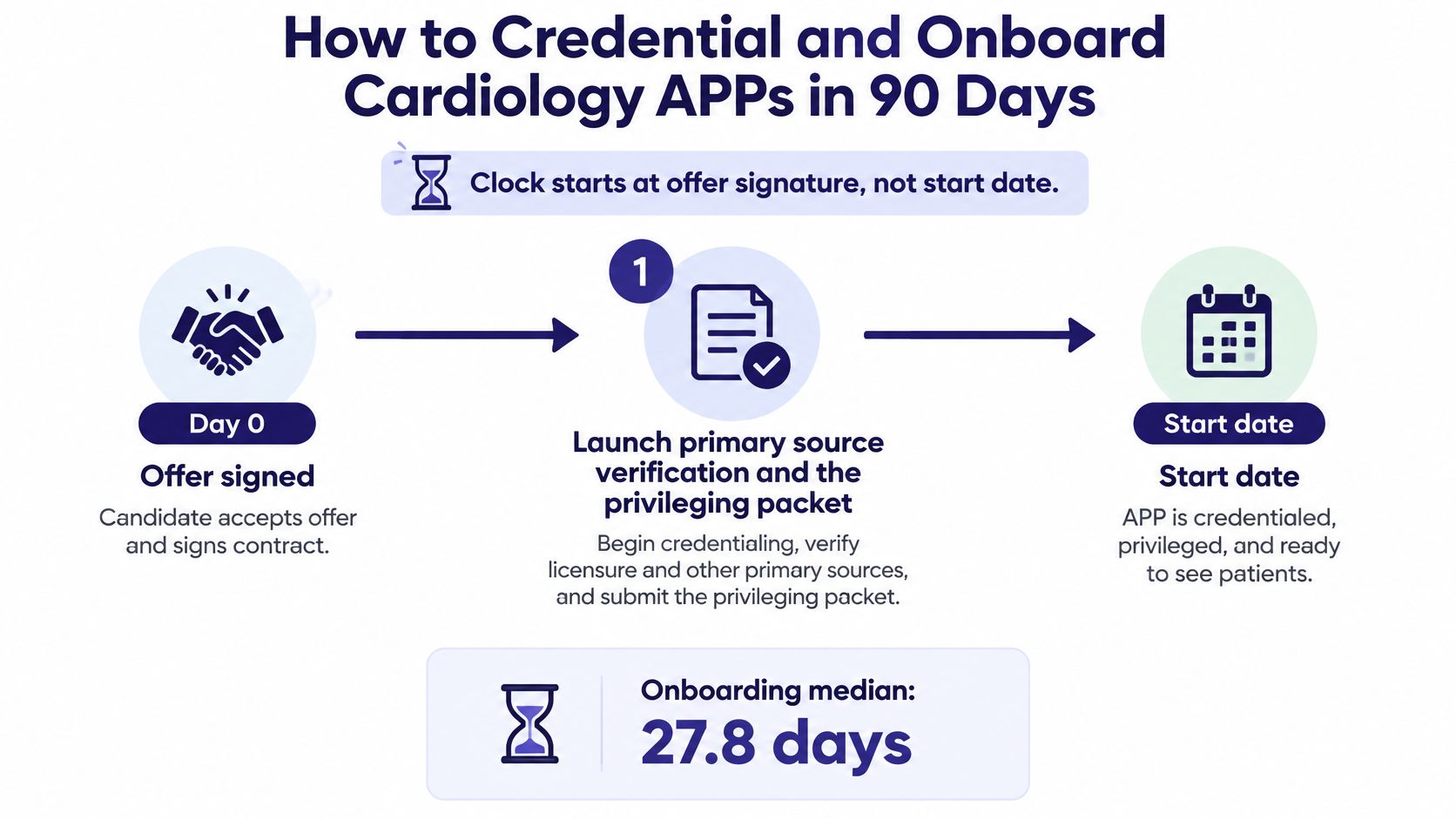
The 90-day clock starts at offer signature, not the first day on the job. Every week paperwork sits idle adds to the time the cardiology service runs short, even though a candidate has accepted and cannot yet see patients or bill. Treat credentialing, billing setup, and onboarding as part of the hiring cost, not administrative work to begin after the offer.
Formal onboarding is not consistent across settings. A cross-sectional survey of 518 critical-care APPs found 68.6% reported formal onboarding. The survey reported rates of 72.3% in academic hospitals and 27.7% in community hospitals, a statistically significant difference at p < 0.001. Those figures describe critical-care APPs, not cardiology programs. Community cardiology programs benefit from a written onboarding plan that sets expectations, supervision, and readiness gates instead of leaving the ramp to chance.
The Sequence From Signature to Day 90
Launch on signature: Send primary source verification and the privileging packet as soon as the offer is signed. Delays at this stage extend the vacancy after acceptance.
Run enrollment in parallel: Start payer enrollment and NPI setup at the same time. Confirm the billing NPI before the first clinic day; seeing patients without correct billing setup creates rework and lost revenue.
Schedule systems training early: Book EHR training and a cardiology escalation walkthrough before the start date. Cover order sets, inbox routing, and after-hours paging pathways.
Name the preceptor: Assign a preceptor who works in the same clinic or cath lab and has protected review time. A name on a schedule is not enough.
Days 1 to 30: Pair clinic and rounding work with reduced volume and no independent call. Check EHR workflows and escalation habits.
Days 31 to 60: Add independent clinic visits and supervised procedures. Document a competency check before expanding scope.
Days 61 to 90: Increase call and procedure volume only after the named owner signs off.
Use a clear guide to healthcare credentialing to align medical staff office timelines with the start date promised to the candidate. An offer that moves quickly but leaves payer enrollment, privileging, or training until later can still leave the service understaffed for weeks.
Phased 90-day APP ramp for cardiology hires
Window | Scope | Gate to next phase |
|---|---|---|
Offer signature to day 0 | Primary source verification, privileging packet, payer enrollment, NPI setup, EHR training | Billing NPI confirmed before first clinic day |
Days 1 to 30 | Paired clinic and rounding, no independent call | Named preceptor review |
Days 31 to 60 | Independent clinic visits and supervised procedures | Documented competency check |
Days 61 to 90 | Call and procedure volume added | Sign-off owner approves expanded call and productivity targets |
Do not set identical productivity expectations for experienced hires and transition-to-practice hires. A new graduate entering inpatient cardiology needs different templates, supervision, and readiness gates from an experienced electrophysiology APP changing employers. Rushing either clinician to full volume can undermine safe learning and erase the apparent savings of a faster search.
Onboarding is part of the recruitment cost. It determines when the hire can contribute at full capacity.
Assign a named sign-off owner to each milestone: privileging, billing readiness, the 30-day preceptor review, and the 90-day expansion of call. Clinic pressure can push unsigned gates aside. Put ownership and approval dates in the plan before the candidate starts.
Set Up Retention and Metrics Before the First Offer
Speed is an incomplete success metric. The 2025 APP workforce data summary shows median search time falling from 80 days in 2024 to 65 days in 2025, yet 31.8% of APP searches still remained open at year-end and cardiology was among the specialties with only about one-third filled. APP turnover also remained high at 7.9%, above pre-pandemic levels.
A fast hire is a false economy when the role lacks onboarding, physician sponsorship, workload clarity, or advancement pathways. The program fills the vacancy, loses the clinician within two years, and pays the full search and ramp cost again. Cardiology leaders should measure whether Advanced Practice Provider Recruitment improves access and program performance, not whether a requisition closed.
Metrics That Belong on the Same Dashboard as Time-to-Fill
Time-to-productivity: Weeks from start date to a full, independently managed template.
Retention at 12 and 24 months: Reported by cohort, setting, and hiring source.
Panel or procedure capacity: Visits, device checks, or supervised procedures added per month.
Avoidable cardiology readmissions: Tracked for heart-failure and post-discharge panels the APP manages.
New-patient access wait times: Measured before posting and quarterly after start.
Contribution margin: Modelled under the actual billing path, including ramp months.
One test separates a capacity-building hire from labor substitution. Physician panel size and sponsor time stay steady while the APP panel grows. If physician workload merely shifts into supervision, inbox overflow, and rework, the hire hasn't added capacity. It's redistributed burnout.
Career Levers That Keep Cardiology APPs
Retention improves when experienced APPs can see a next step that isn't leaving. Build a clinical ladder with expanded privileges tied to documented competency. Fund cardiovascular education in heart failure, electrophysiology, or structural heart. Offer teaching and protocol-development roles for senior APPs who precept new hires. Schedule predictability and honored call commitments matter as much as formal programs, because broken schedule promises surface at every exit interview.
Take three actions before the next posting.
Set baselines: Record every metric above before the requisition opens.
Name an owner: Assign each metric to a specific leader, not a committee.
Review quarterly: Put the clinical director and finance lead in the same review, with retention and margin beside access.
Programs that set these measures before the first offer can tell, within a year, whether a hire expanded cardiac access or merely closed a vacancy on paper.
American Cardiology Group recruits nurse practitioners and physician assistants for non-invasive cardiology, interventional cardiology, electrophysiology, structural heart, and cardiac surgery programs, with customized searches matched to scope, setting, and community. Hospital, practice, and ASC leaders who need a cardiology APP search built around cycle time, credentialing readiness, and long-term retention can start the conversation at American Cardiology Group.
Comments