
7 Best Physician Recruiting Firms for Cardiology in 2026
Cardiovascular patients per cardiologist could rise from approximately 1,087 in 2025 to 1,700 by 2035, a projected increase of roughly 56%, according to the American College of Cardiology's cardiovascular workforce analysis. For hospital executives, an unfilled electrophysiology or interventional cardiology position therefore warrants more than a vacancy report. Leaders should assess exposure across call coverage, procedural capacity, referral access, and program growth.
A general physician-search capability doesn't establish competence in cardiac subspecialty recruitment. Recruiters should distinguish electrophysiology procedural requirements from interventional cardiology privileges, advanced heart failure training, and cardiothoracic surgical experience. Employers also need the appropriate engagement model: permanent placement for durable growth, locum tenens for coverage gaps, or executive search for division chiefs and program directors.
The best physician recruiting firms for cardiology depend on that combination of clinical requirements and hiring purpose. The firms below are evaluated for cardiac specialty depth, engagement models, geographic reach, and disclosed cost structure, not presumed superiority based on size or reputation.
Evaluation principle: Firm-published service descriptions establish what a provider offers to discuss. They don't establish subspecialty placement quality, retention, or contractual accountability.
Table of Contents
1. American Cardiology Group - Where the Specialty Focus Matters
2. Jackson Physician Search - Evaluate the Recruiter, Not Just the Reach
6. AMN Healthcare Physician Solutions - Require Service-Line Accountability
Matching Your Cardiac Hiring Need to the Right Recruiting Model - Compare Durable Outcomes
1. American Cardiology Group
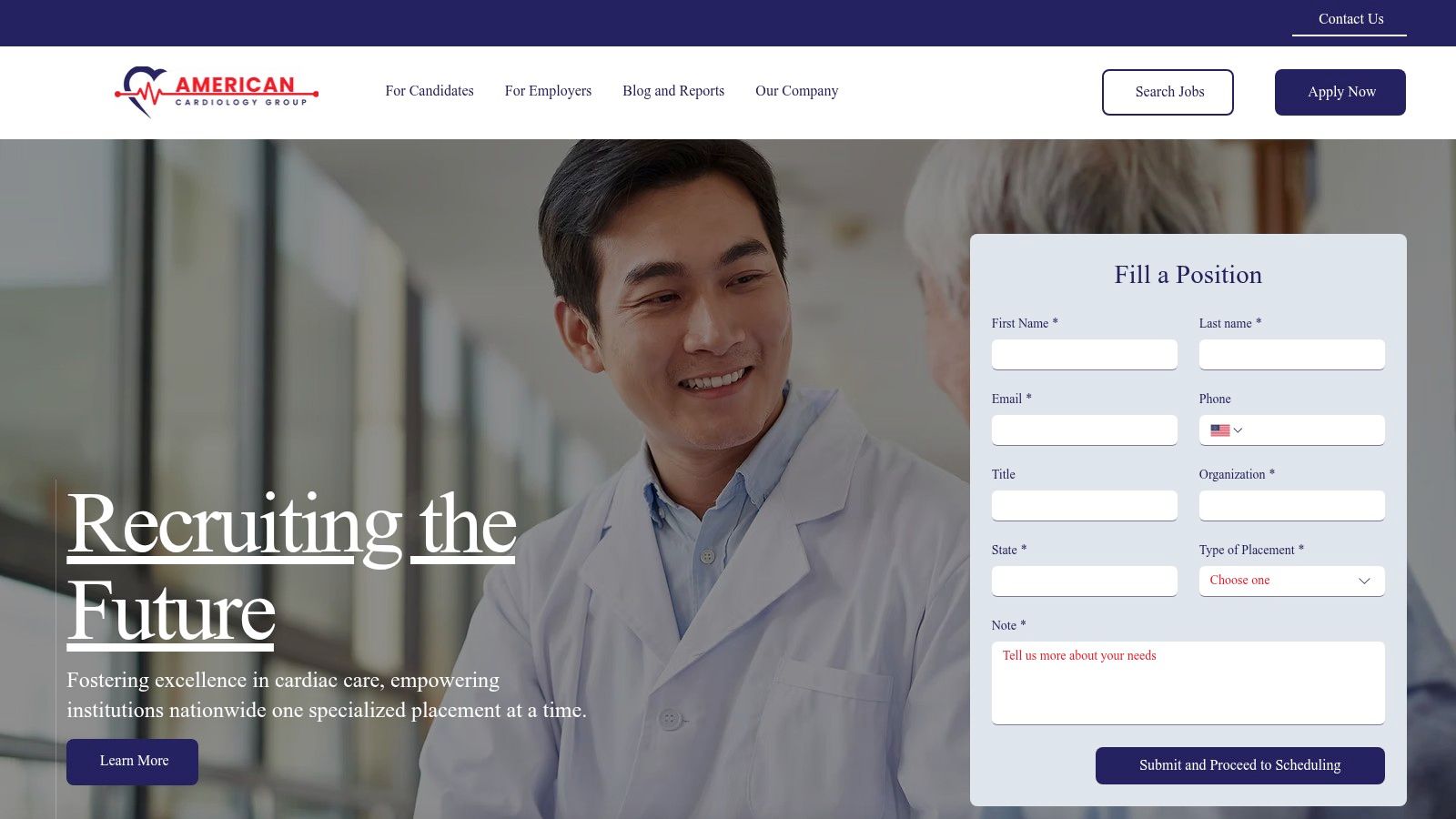
American Cardiology Group (ACG) differentiates itself through an exclusive focus on cardiology and cardiac surgery, rather than a multispecialty physician-search portfolio. Its stated scope includes general cardiology, electrophysiology, interventional cardiology, heart failure, and cardiothoracic surgery, with nationwide recruitment for hospitals, health systems, academic centers, private practices, and rural facilities.
Its engagement options span permanent physician recruitment, locum tenens, advanced practice placement, and executive search. That breadth makes ACG relevant to a cardiovascular service line evaluating physician succession, immediate coverage, NP and PA recruitment, and program leadership together. Its discussion of healthcare staffing agencies provides additional context for comparing staffing relationships.
The clinical distinction remains important: interventional cardiology is a cardiology subspecialty, not a surgical specialty. A department should require separate candidate criteria for catheter-based intervention, electrophysiology procedures, advanced heart failure care, and cardiothoracic surgery rather than accepting a single cardiac screening template.
Where the Specialty Focus Matters
ACG emphasizes clinical qualifications, cultural alignment, and lasting placements. Its published testimonials describe searches across academic, private-practice, health-system, and rural settings, but those accounts shouldn't be treated as independently verified performance measures.
Principal advantage: An exclusively cardiovascular remit offers a relevant starting point for discussing difficult subspecialty requirements and coordinated service-line hiring.
Service breadth: Permanent, temporary, advanced practice, and executive recruitment allow employers to discuss related workforce needs with the same partner.
Cost limitation: Public materials don't disclose a fee schedule. Employers need written pricing, payment triggers, expenses, and replacement provisions.
Evidence limitation: Public materials don't establish independent placement outcomes, formal awards, or certifications. Relevant references and search-level results remain necessary.
The strongest potential fit is a department seeking a cardiovascular-focused relationship rather than unrelated specialty searches. That's a fit assessment, not evidence that ACG will fill every cardiac vacancy faster or at lower cost.
Questions before signing: Who will own the search, and what placements has that recruiter completed in the exact subspecialty? How will ACG document procedural qualifications, geographic commitment, and compensation expectations? Which comparable clients can discuss retention, and what fee, cancellation, and replacement terms will appear in the agreement?
2. Jackson Physician Search
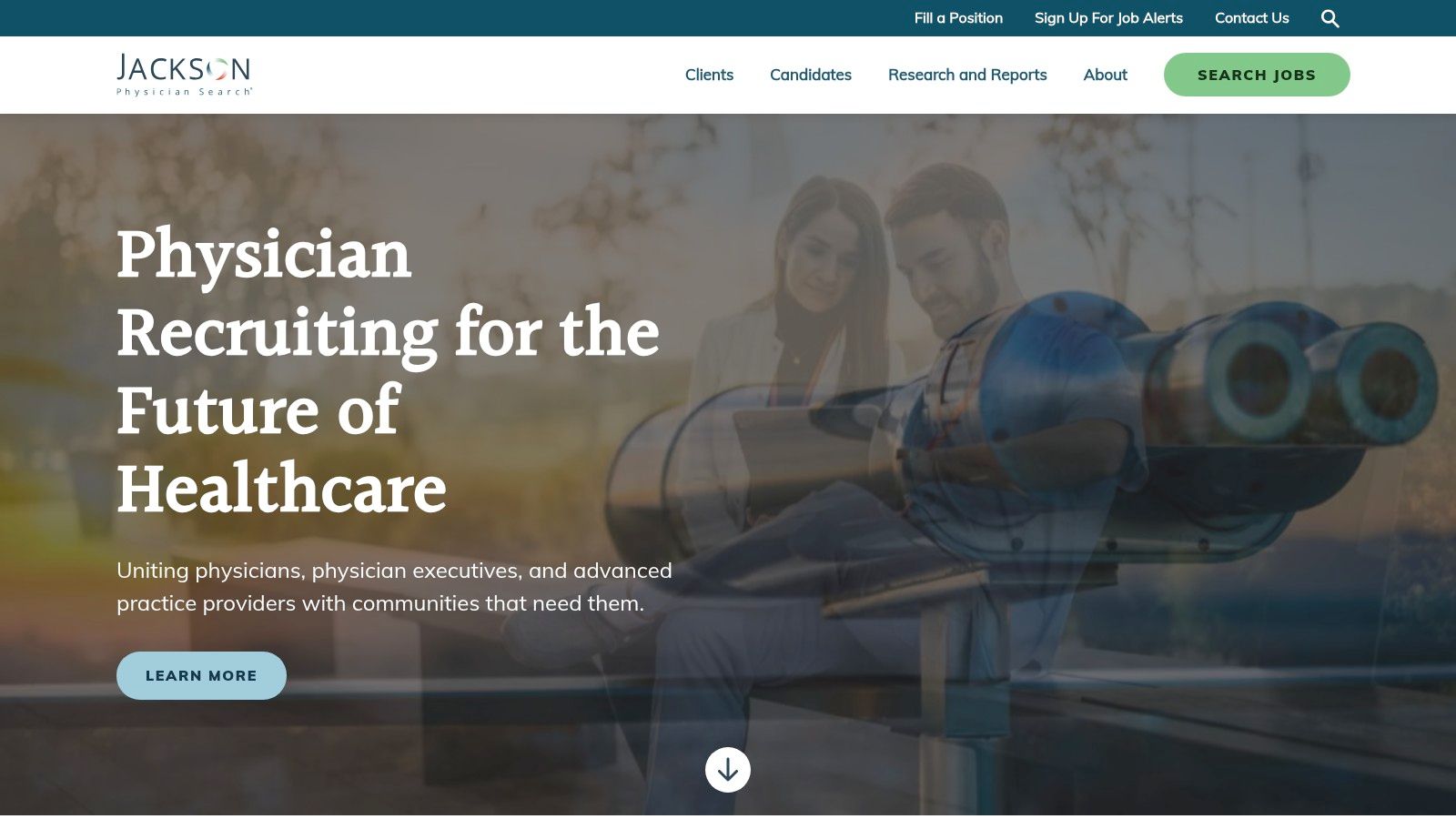
A hospital seeking a permanent cardiologist, rather than immediate temporary coverage, can consider Jackson Physician Search. The national firm describes recruitment for physicians, physician executives, and advanced practice providers across hospitals, health systems, medical groups, and academic medical centers.
Jackson publishes a digital sourcing approach involving job boards, email, social media, and an opted-in physician database. It also describes dedicated recruiters and on-site visits to understand the position and community. Those components offer employers a process to examine, but they don't establish the availability of qualified electrophysiologists or advanced heart failure candidates.
For departments comparing physician placement agencies, Jackson's permanent-search orientation is the central distinction. It shouldn't be selected as a substitute for a defined locum coverage arrangement.
Evaluate the Recruiter, Not Just the Reach
The advantage is a structured national search process with a named recruiter and community profiling. The limitation is that broad specialty coverage doesn't establish equivalent depth in electrophysiology, interventional cardiology, heart failure, and cardiothoracic surgery.
Jackson states that it avoids hidden or surprise fees and earns fees upon successful placement. Those statements aren't a complete contract: employers should obtain the actual fee, payment trigger, expense provisions, candidate ownership rules, and replacement terms.
A community profile should also address the clinical proposition. For a cardiac search, that means discussing call expectations, available procedural infrastructure, referral relationships, and the candidate's preferred practice environment.
Questions before signing: Which cardiac searches has the assigned recruiter completed? Does the proposed agreement cover only permanent placement? What precisely constitutes successful placement, and what happens if the physician withdraws before starting or leaves after joining?
3. The Medicus Firm

Academic cardiac recruitment requires more than clinical availability. An employer should define the expected balance of patient care, teaching, scholarship, and leadership before evaluating candidates. The Medicus Firm is relevant because its published services include physician recruitment, a dedicated academic-search division, allied-health recruitment, and executive search.
Its national scope may suit medical schools and academic cardiovascular programs hiring faculty or leaders. However, an academic-search offering alone doesn't establish experience recruiting an electrophysiology section chief, an advanced heart failure faculty member, or a cardiothoracic surgeon.
The firm describes a client portal for search activity, candidate history, and progress reporting. Employers should request a demonstration using a sample search rather than treating portal access as proof of useful reporting.
Potential advantage: Academic and executive-search capabilities alongside permanent clinician recruitment.
Operational feature: Search tracking that employers can evaluate for candidate visibility and accountability.
Commercial limitation: The firm describes performance-based agreements without monthly billings, but exact fees, payment timing, and replacement obligations require written confirmation.
A performance-based agreement isn't sufficiently defined until the contract identifies the event that triggers payment.
For academic departments, candidate reporting should distinguish clinical suitability from appointment eligibility and leadership fit. A promising clinician isn't automatically appropriate for a position requiring a particular scholarly profile or responsibility for faculty development.
Firm-published client awards and testimonials can inform reference discussions, but they shouldn't substitute for comparable cardiac-search evidence.
Questions before signing: Who leads the academic cardiac search? How will the team evaluate clinical expertise alongside research and teaching expectations? Can the portal separate sourced, screened, interviewed, offered, and accepted candidates, and what contractual event creates the fee obligation?
4. Enterprise Medical Recruiting

Enterprise Medical Recruiting publishes a national permanent-search offering built on customized candidate marketing, recruiter outreach, and its proprietary provider database. The commercial question is which engagement model the contract creates, because contingency and retained search produce different incentives for both sides.
In a standard contingency agreement, the firm earns its fee only when a placement is made, the hospital can run competing searches in parallel, and the recruiter allocates effort across whichever openings are likeliest to close. A retained agreement works differently. The hospital grants exclusivity on the search and commits to staged payments in exchange for a defined sourcing effort and a recruiter accountable to milestones. For an electrophysiology or interventional cardiology vacancy, the distinction matters practically: a retained recruiter is contracted to pursue passive candidates, while a contingency recruiter has no obligation beyond producing a hireable physician.
Published cardiology-related listings confirm that cardiac roles sit within its scope. They say nothing about placement experience across electrophysiology, interventional cardiology, advanced heart failure, or cardiothoracic surgery, and that subspecialty breakdown should be requested directly. The same applies to geography. A national footprint describes where the firm accepts searches, not where it has recently placed cardiologists, so the proposal should identify the regions where its last comparable searches closed.
Strength: A permanent-search offering that can run alongside an internal recruitment team without displacing it.
Flexibility: Contingency and retained structures let the department match recruiter commitment to vacancy urgency.
Boundary: Published materials center on permanent recruitment. Whether interim coverage is handled in-house or referred to an affiliated organization is a contract question, not an assumption.
Unresolved cost: Neither model is tied to a published fee schedule, so fee basis, invoicing points, and replacement terms all require written confirmation.
Questions before signing: Which engagement model is being proposed, and what does it change about exclusivity, payment timing, and recruiter accountability? Which subspecialty cardiac searches has the assigned recruiter completed, and in which states? How are candidates already known to the hospital handled, and under what conditions does the placement guarantee apply?
5. Pinnacle Health Group

Rural cardiac recruitment requires a different assessment from recruitment into an established metropolitan referral program. MGMA reported that 38% of medical groups experienced longer physician vacancy times, identifying geographic disadvantages among the challenges and cardiology among difficult specialties to staff, in its physician vacancy analysis.
Pinnacle Health Group describes experience in rural, academic, and large-hospital markets. Its offering combines permanent physician and advanced practice recruitment with locum tenens, making it relevant when a hospital needs both interim coverage and a long-term appointment.
The firm's materials describe credential and reference checks, dedicated search contacts, and regular updates. Those are useful process commitments to clarify, but they don't establish a candidate's readiness for a particular hospital's privileges or call responsibilities.
Rural-search test: Ask how the recruiter will evaluate commitment to the community, not simply willingness to interview.
For a rural interventional cardiology position, the search discussion should address procedural infrastructure, referral support, call burden, and the institution's service-line plan. Family relocation needs and the physician's preferred career trajectory should also be part of screening.
The potential advantage is the ability to discuss temporary and permanent staffing with the same provider. The limitation is that general rural experience doesn't prove success in a particular cardiac discipline, and no public fee schedule resolves the commercial comparison.
Questions before signing: Which similar rural cardiac searches can references discuss? Who performs screening, and what documentation reaches the hospital? Are locum and permanent services governed separately, and what costs or restrictions apply if a temporary physician becomes a permanent candidate?
6. AMN Healthcare Physician Solutions

For a health system managing recurring vacancies across facilities, the relevant choice may extend beyond an individual search. AMN Healthcare Physician Solutions describes permanent placement, locum tenens, advanced practice staffing, leadership services, and physician recruitment process outsourcing (RPO).
RPO should be evaluated separately from a discrete placement agreement. An employer considering embedded recruiting capacity needs clarity about which activities AMN will own, how its team will coordinate with internal recruiters, and how performance will be reported.
AMN's breadth suits a system combining cardiac succession planning, interim coverage, and recurring recruitment. A single-site practice filling one electrophysiology vacancy needs far less infrastructure.
Require Service-Line Accountability
The practical risk is fragmented ownership. Access to multiple service lines does not guarantee that one recruiter coordinates electrophysiology, interventional cardiology, advanced heart failure, and cardiothoracic surgery requirements under a single accountability structure.
Potential strength: Permanent, temporary, advanced practice, and leadership services within a national organization.
Best-fit scenario: Recurring or multisite cardiac hiring that warrants coordinated workforce support.
Verification priority: A named owner for the cardiac search plus explicit handoffs between service lines.
Cost comparison: Separate review of permanent-search fees, temporary staffing charges, RPO scope, and leadership-search terms.
Ask for a live reporting demonstration before signing. It should confirm workflow visibility, reporting access, and data export inside the actual working environment.
Questions before signing: Who owns the cardiovascular relationship? What work remains with the internal recruitment team? How will duplicate candidates, reporting access, data export, service transitions, and separate contractual obligations be managed?
7. CompHealth
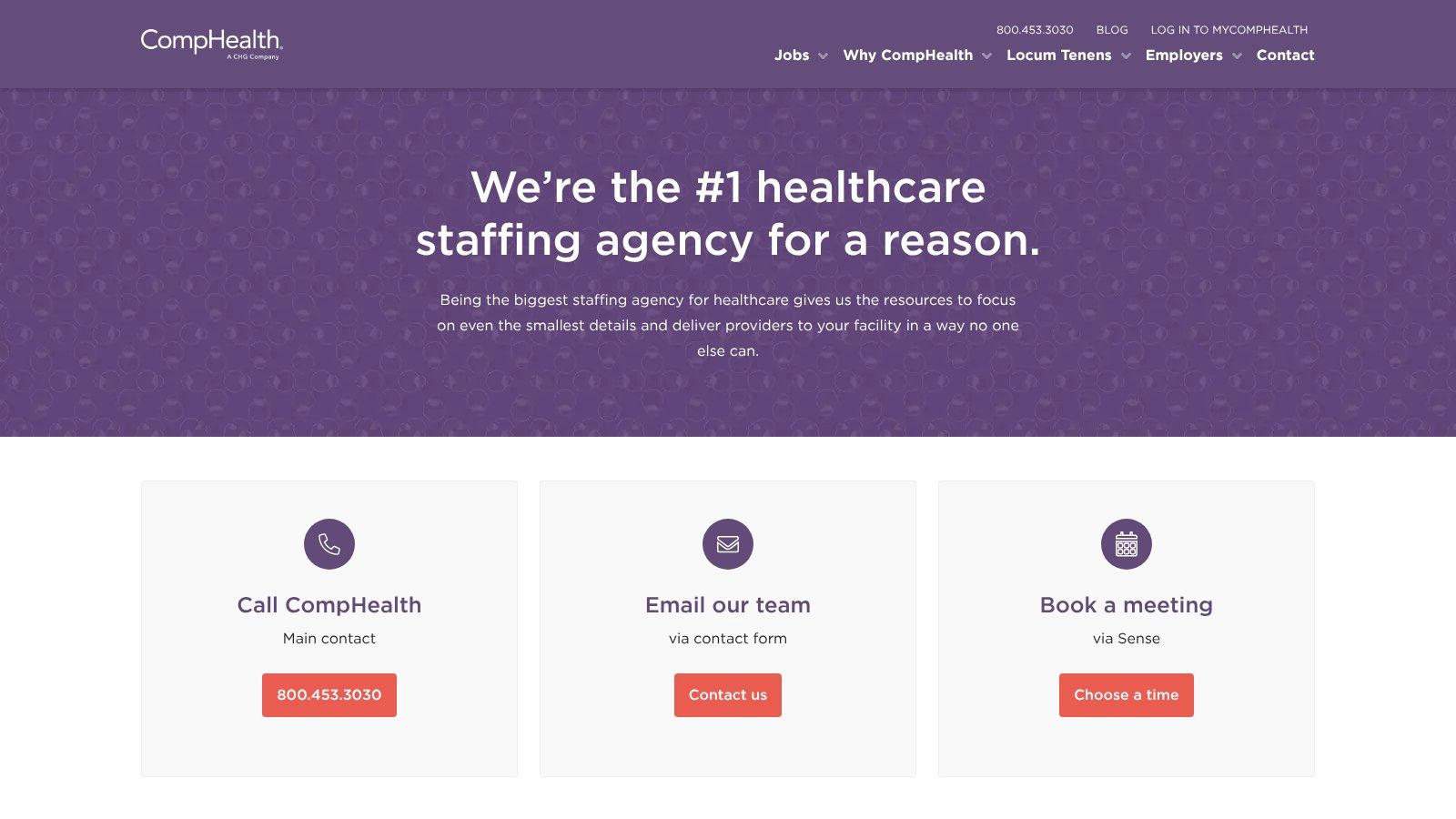
CompHealth explicitly lists cardiology, electrophysiology, interventional cardiology, cardiothoracic surgery, and cardiovascular surgery among its physician specialties. That published specificity provides a clearer starting point for a cardiac coverage discussion than an undifferentiated physician-staffing description.
Its national offering includes permanent placement and locum tenens, with staffing across physician, NP, PA, and other healthcare roles. Its locum materials describe support for credentialing, privileging, licensing, travel, housing, and malpractice arrangements.
Those services make CompHealth relevant when a department is comparing locum tenens staffing agencies alongside permanent recruitment options. The department still needs to confirm the availability of the exact subspecialist and the clinician's fit for the proposed procedural scope.
Published advantage: Explicit coverage of several cardiac disciplines.
Operational benefit: Assignment support extending beyond candidate introduction.
Clinical uncertainty: Advanced heart failure requirements should be confirmed specifically rather than inferred from general cardiology coverage.
Commercial limitation: No standard public employer price list establishes the final cost.
For temporary electrophysiology coverage, employers should define expected procedures, clinic responsibilities, call duties, and required privileges before requesting candidates. For cardiothoracic surgery, they should separately establish operative scope and institutional support requirements.
CompHealth isn't cardiology-exclusive. Its breadth can be useful, but it doesn't remove the need to evaluate the assigned specialty team or distinguish recruiter coordination from the hospital's formal credentialing decisions.
Questions before signing: Which team handles the exact cardiac discipline? What costs are included for travel, housing, malpractice, call, and assignment changes? What happens if credentialing delays the start, and which terms govern a later permanent hire?
How the Leading Physician Recruiting Firms Compare on Engagement Model, Cardiology Focus, and Fee Transparency
The seven firms converge on permanent search and diverge on locum capacity, cardiac specialization, and published pricing. Each cell below records what the firm's reviewed materials state; where a service is not described, the cell notes the omission rather than presuming the firm lacks it.
Item | Core Model | Locum Tenens | Cardiology Focus | Pricing Disclosure |
|---|---|---|---|---|
American Cardiology Group | Permanent, advanced-practice, and executive recruitment | Offered | Exclusive cardiology and cardiac surgery focus | Not publicly listed |
Jackson Physician Search | National permanent physician and advanced-practice search | Not stated in reviewed materials | Broad specialty coverage; verify cardiac-search experience | No public fees; says no hidden fees and charges upon successful placement |
The Medicus Firm | Physician, academic, allied-health, and executive search | Not stated in reviewed materials | Broad national focus; cardiac expertise not guaranteed | Exact fees and terms require confirmation |
Enterprise Medical Recruiting | Permanent physician and advanced-practice recruitment | Temporary coverage may be available through a sister company | Cardiology-related roles included; broad specialty coverage | Negotiated; fees and guarantees not published |
Pinnacle Health Group | Permanent physician and advanced-practice placement | Offered | Serves rural, academic, and large-hospital markets; cardiology not named as a listed specialty | No public fee schedule |
AMN Healthcare Physician Solutions | Permanent, locum, advanced-practice, RPO, and leadership staffing | Offered | Broad multi-specialty staffing; confirm which team leads cardiac searches | Terms vary by arrangement; no specific pricing disclosed |
CompHealth | Permanent and locum physician staffing | Offered | Lists cardiology and several cardiac subspecialties | No standard employer price list publicly displayed |
Fee transparency is the weakest column. Jackson Physician Search is the only firm here that publicly describes a payment condition, and none publishes a full employer rate schedule, so written pricing belongs in every signed agreement. Cardiac specialization separates the group just as clearly: American Cardiology Group recruits only within cardiology and cardiac surgery, CompHealth lists named subspecialties, and the other five firms leave the department to confirm who would run an electrophysiology, interventional, heart failure, or cardiothoracic surgery search.
Matching Your Cardiac Hiring Need to the Right Recruiting Model
Permanent search fits durable subspecialty growth, physician replacement, and succession planning. Locum tenens fits defined gaps in call, clinic, or procedure coverage. Executive search fits division chiefs and program directors whose responsibilities extend beyond individual clinical production.
Those models shouldn't be compared as interchangeable purchases. A permanent-search proposal should explain sourcing and long-term fit; a locum proposal should define coverage and assignment obligations; a leadership-search proposal should specify governance, stakeholder assessment, and leadership criteria.
Speed alone is an inadequate selection measure. AAPPR reported a median physician time-to-fill of 118 days and physician offer acceptance of 71% in 2024, down from 83% in 2023, in its recruitment demand and search-duration report. Those benchmarks provide context, not a promised timeline for a cardiac subspecialty search.
Compare Durable Outcomes
Hospitals should request subspecialty-specific search duration, candidate withdrawals, offer acceptance, and post-placement retention wherever the firm can substantiate them. The employer should also ask how many presented candidates met the position's clinical requirements, rather than judging activity by introductions alone.
ACG's distinguishing proposition is its exclusive cardiology and cardiac surgery focus, combined with permanent, locum, advanced practice, and executive recruitment. Its emphasis on clinical qualifications and cultural alignment is relevant to departments seeking a focused partner across cardiovascular workforce needs. Those attributes still require validation through the assigned recruiter, comparable references, and written deliverables.
Before signing with any firm, the department's shortlist should resolve these questions:
Search ownership: Which named recruiter will lead the engagement, and who provides backup?
Subspecialty evidence: How many placements has that recruiter completed in the exact cardiac discipline, and which were comparable in geography and practice setting?
Written economics: What triggers fees, which expenses are additional, and how do guarantees, cancellation, and replacement provisions work?
Callable references: Which clients can discuss similar searches, candidate quality, communication, and retention?
Clinical screening: What evidence will accompany each candidate, and which credentialing responsibilities remain with the hospital?
The best physician recruiting firms make those distinctions clear before an agreement is signed. Executives should select the partner whose demonstrated capabilities match the clinical role, local market, and required engagement model.
American Cardiology Group offers nationwide permanent recruitment, locum tenens coverage, advanced practice placement, and executive search exclusively for cardiology and cardiac surgery. Hospital and practice leaders can visit American Cardiology Group to discuss a specific subspecialty vacancy, clarify the engagement model, and request written search terms and relevant references.
Comments