
Locum Tenens Rules: A 2026 Compliance Reference
“Use Q6 for 60 days” is incomplete advice about locum tenens rules. Medicare's temporary-substitution framework applies only when the arrangement satisfies its underlying conditions, not merely because a physician has a temporary contract. Hospital leaders therefore need separate approvals for clinical authority, controlled substances, facility privileges, billing and contractual risk.
The central distinction is operational: permission to treat a patient is not permission to submit a particular claim. A hospital can engage a fully licensed interventional cardiologist, approve the physician's clinical work and still choose a billing structure that doesn't match the reason for coverage.
Table of Contents
Core Locum Tenens Rules at a Glance - Separate the approval owners - Route unresolved questions to the correct gate
Medicare Q6 Billing and the 60-Day Limit - Apply the continuous-period ceiling - Build an auditable evidence chain
Absence Coverage Versus Vacancy Coverage - Classify the assignment before recruitment closes - Obtain payer-specific decisions
State Licensure, Compacts and DEA Registration - Match controlled-substance authority to the work
Credentialing and Privileging Timelines by Gate - Plan backward from committee approval - Verify the file, then approve the scope
Malpractice, Tax and Employment Status Rules - Apply the US employment-classification test
Contract Clauses Worth Negotiating Before Signature - Review payment and readiness together - Allocate continuing and exit risks
Confirm Every Gate Before the First Shift - Assign owners and retain evidence - Keep recruitment support separate from hospital approval
Core Locum Tenens Rules at a Glance
Each compliance gate answers a different question, so an approval in one column cannot substitute for missing evidence in another.
Compliance gates for a locum tenens assignment
Gate | Governing rule | Controlled by | Blocks first shift? |
|---|---|---|---|
State medical license | Active license or appropriate authorization in each state where patients are located | Clinician; verified by facility | Yes |
Interstate compact or temporary authorization | Compact pathway or state-recognized temporary, emergency or other authorization; not a substitute for required state approval | State medical board | Yes, if this is the authorization pathway |
National Provider Identifier | Federal identifier needed for Medicare claims; not evidence of clinical authority | Clinician | No by itself, but blocks claims |
Medicare Q6 billing identity | Qualifying substitute services billed under the absent physician's identity, with Q6 and the applicable continuous-period limit | Billing office | Not clinical authority, but blocks unsupported claims |
DEA and state controlled-substance registration | Applicable registration and authority for the location and medication activities | Clinician; facility | Yes, for controlled-medication activities requiring that authority |
Facility privileges | Facility approval for the actual clinical services and procedures | Medical staff office and credentials committee | Yes |
Primary-source verification, NPDB and exclusion checks | Verification, screening and competency review remain facility responsibilities | Credentialing office | Yes, under the facility's clearance process |
Malpractice coverage | Policy scope should match the facility, setting, assignment and procedures | Agency and facility risk management | Treat unresolved coverage as a start-date hold |
Tax and employment classification | Assess actual behavioral control, financial control and the parties' relationship, rather than relying on a contract label | Agency, facility and clinician, with tax counsel | Not clinical authority, but creates classification exposure |
A fully licensed cardiologist may still lack privileges for a structural-heart intervention. A privileged locum may still generate denied claims when the payer's enrollment requirements or the purpose of the assignment don't support the proposed billing arrangement.
Separate the approval owners
Executives should assign an owner to each gate rather than accepting a single “cleared” status from recruiting. The credentialing office, department chair, pharmacy leadership, revenue-cycle team and risk manager answer different questions and should document their decisions independently.
A useful clearance record distinguishes:
Evidence received: An agency has supplied a license, certificate or credential file.
Evidence verified: The responsible hospital office has checked the underlying information.
Authority granted: The relevant board, facility or payer has approved the activity.
Effective dates confirmed: The authorization applies when the scheduled work will occur.
The difference matters because receipt of a document doesn't establish its scope, validity or effective date. Nor does a signed staffing agreement resolve a missing clinical or payer approval.
Route unresolved questions to the correct gate
The Medicare billing and coverage-purpose checks below address claim identity and enrollment. The state licensure and DEA checks address where and how the physician may practise, while credentialing addresses facility-specific clinical authority. Malpractice, classification and contract review address risks that remain even after clinical and billing approvals are complete.
The practical management rule is to release the assignment by documented approval, not by recruitment status. A candidate's acceptance establishes availability. It doesn't establish readiness for every service on the proposed schedule.
Medicare Q6 Billing and the 60-Day Limit
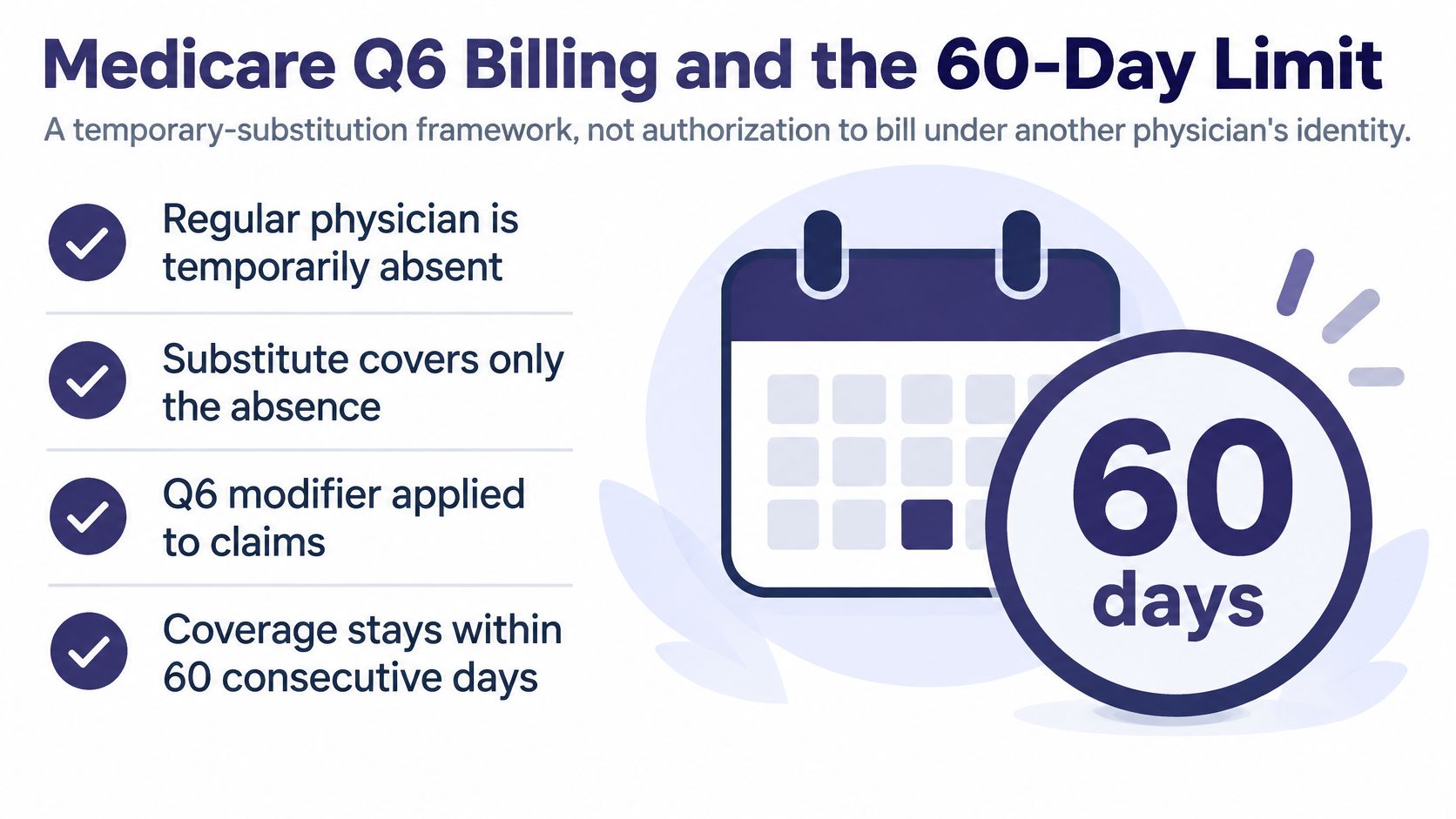
Medicare's rule is a temporary-substitution framework, not general authorization to bill another physician's services under an established physician's identity. The arrangement must satisfy the following conditions, alongside the applicable duration requirement, under CMS's Medicare Part B substitute-physician guidance:
Regular physician unavailable: The established physician cannot provide the services during the relevant absence.
Patient relationship established: The patient arranged or sought care from that regular physician.
Fee-for-time compensation documented: The regular physician pays the substitute on a per-diem or similar fee-for-time basis.
Q6 identification applied: Each affected claim identifies the qualifying substitute service with HCPCS modifier Q6, meaning service furnished by a locum tenens physician.
The claim uses the absent physician's billing identity, rather than replacing it with the substitute's identity. Services outside the regular physician's office can qualify when the other conditions are satisfied.
Apply the continuous-period ceiling
The substitute generally cannot furnish Medicare patient services for the regular physician over a period exceeding 60 continuous days; the statutory exception concerns a regular physician called to active duty as a member of a reserve component of the Armed Forces, as specified in the CMS substitute-physician guidance above.
This is a calendar-management obligation, not merely a coding choice. Scheduling should identify the beginning of the coverage period, and revenue cycle should decide whether the planned end date requires a different billing arrangement.
For a hypothetical cardiologist taking a 10-week leave, otherwise eligible services during days 1 through 60 can be billed under the regular physician's identity with Q6; services beginning on day 61 must instead be billed by the substitute in her own name, with the applicable enrollment arrangements, consistent with the CMS claims manual's continuous-period billing example.
That example assumes the arrangement qualified from the outset. A short assignment that fails the absence, patient-relationship or compensation conditions doesn't become eligible merely because it ends before the ceiling.
Billing control: A correctly entered modifier cannot repair an arrangement that never qualified for substitute billing.
Build an auditable evidence chain
The billing office should maintain a record connecting the absence, compensation terms, covered services and claim submission. A staffing agreement alone may establish who was hired without establishing why the regular physician was unavailable or how individual services qualified.
The recommended audit file includes:
Unavailability documentation: Identify the regular physician, the reason for absence and the expected return.
Payment evidence: Preserve the agreement and payment records supporting the fee-for-time arrangement.
Claim-line review: Confirm Q6 appears on each affected service line and that the billing identity matches the approved arrangement.
Scheduling counter: Maintain the coverage start, planned end and escalation point in a shared scheduling and billing record.
Transition decision: Identify who will approve ordinary enrollment and billing if coverage must continue.
The useful executive question isn't whether the billing system accepts Q6. It's whether the hospital can reconstruct why the service qualified when the claim was submitted.
Absence Coverage Versus Vacancy Coverage
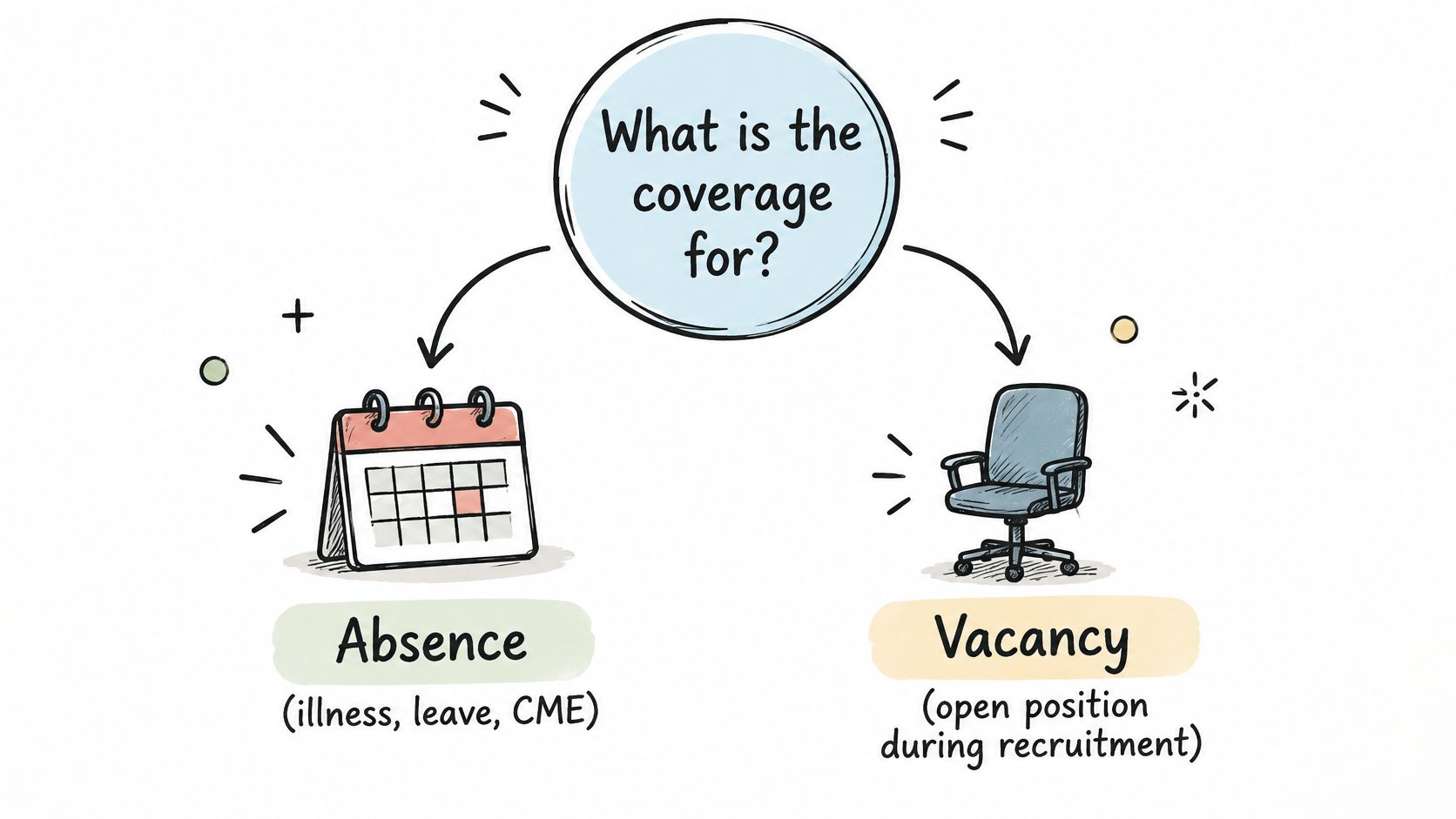
Before selecting a modifier, the revenue-cycle lead should answer these questions in order:
Is an identifiable regular physician absent and still responsible for the patients? If not, the arrangement shouldn't be treated as ordinary absence substitution.
Will coverage end within the permitted period? If not, enrollment and billing need an advance transition plan.
Does the assignment replace an absence rather than add capacity or permanently replace a physician? Added capacity and replacement purposes point toward ordinary enrollment.
The word locum describes the staffing arrangement. It doesn't decide the billing treatment. The distinction between an absent physician and an open position is central to the American Academy of Ophthalmology's explanation of when locum tenens billing applies.
Billing structure by coverage type and payer
Coverage type | Medicare fee-for-service | Medicare Advantage | Medicaid | Commercial plans |
|---|---|---|---|---|
Absence coverage for illness, leave or CME within the permitted period | Q6 under the absent physician's identity when all qualifying conditions apply | Confirm substitute-billing acceptance and documentation in writing | Verify the state program's substitute-billing rule | Check contract and payer policy |
Vacancy coverage during recruitment | Use ordinary enrollment rather than assuming Q6 eligibility | Confirm plan enrollment and credentialing requirements | Confirm state enrollment requirements | Verify enrollment and contract requirements |
Service-line expansion, including a new electrophysiology or heart-failure program | Ordinary enrollment, not absence-based substitute billing | Confirm plan credentialing and effective dates | Confirm state enrollment and billing requirements | Verify payer enrollment and contract |
Permanent replacement | Ordinary enrollment under the incoming physician | Confirm plan credentialing | Confirm state enrollment | Verify payer enrollment and contract |
Classify the assignment before recruitment closes
Consider an electrophysiology position that remains open while the hospital recruits. The temporary physician may restore clinic access and procedural coverage, but there may be no absent physician whose patient relationship supports the proposed Q6 claims.
Launching a heart-failure program raises a different issue. The clinician may be temporary, yet the hospital is adding services rather than preserving an absent physician's existing practice. The staffing duration doesn't change that underlying purpose.
These distinctions explain why a valid contract, unrestricted license and complete privilege letter can coexist with an unsupported claim. The clinical arrangement and the billing arrangement must describe the same operational reality.
Obtain payer-specific decisions
For Medicare Advantage, Medicaid and commercial business, the recommended evidence is a written payer determination addressing the proposed arrangement. The file should identify the billing identity, substitute enrollment requirements, effective dates and required claim indicators.
A payer's response should match the actual coverage purpose. Asking whether a plan “accepts locums” is too broad when the hospital intends to fill a vacancy or expand a service line.
An arrangement that preserves patient access can still require a different billing structure from an arrangement that substitutes for an absent physician.
If the hospital incorrectly classifies a vacancy as absence coverage, compliance should assess both future claims and previously submitted services. Correcting the schedule prospectively doesn't resolve potential repayment exposure associated with an unsupported billing identity.
State Licensure, Compacts and DEA Registration
Licensure follows the patient's location. Remote interpretation, follow-up and prescribing shouldn't be assumed lawful merely because the cardiologist holds a license at the originating site.
The scheduling team should build a state-by-state assignment record:
Map the footprint: Identify every patient state and physical practice site.
Record the pathway: Document the active license or state-recognized temporary, emergency or other authorization, including expiration.
Check compact implications: Confirm whether the Interstate Medical Licensure Compact facilitates the application, without treating participation as a nationwide license.
A state medical license requirements review should remain separate from facility approval and payer enrollment.
Match controlled-substance authority to the work
Under 21 U.S.C. § 822(e) and 21 C.F.R. § 1301.12(a), DEA registration generally attaches to each principal practice location involving controlled substances; a registration based on one state's license doesn't authorize dispensing in another, as explained in DEA registration guidance.
The available pathways may include changing the registration address, obtaining separate registration, or using the hospital or clinic's registration when the facility agrees and 21 C.F.R. § 1301.22(c) conditions are satisfied.
Pharmacy leadership should distinguish prescribing only from administering or directly dispensing. Procedural sedation, controlled analgesics and inpatient medication administration warrant explicit review in cardiology assignments.
An authorization expiring during the engagement deserves a scheduling alert. Clearance should cover the assignment's duration, not merely its opening shift.
Credentialing and Privileging Timelines by Gate
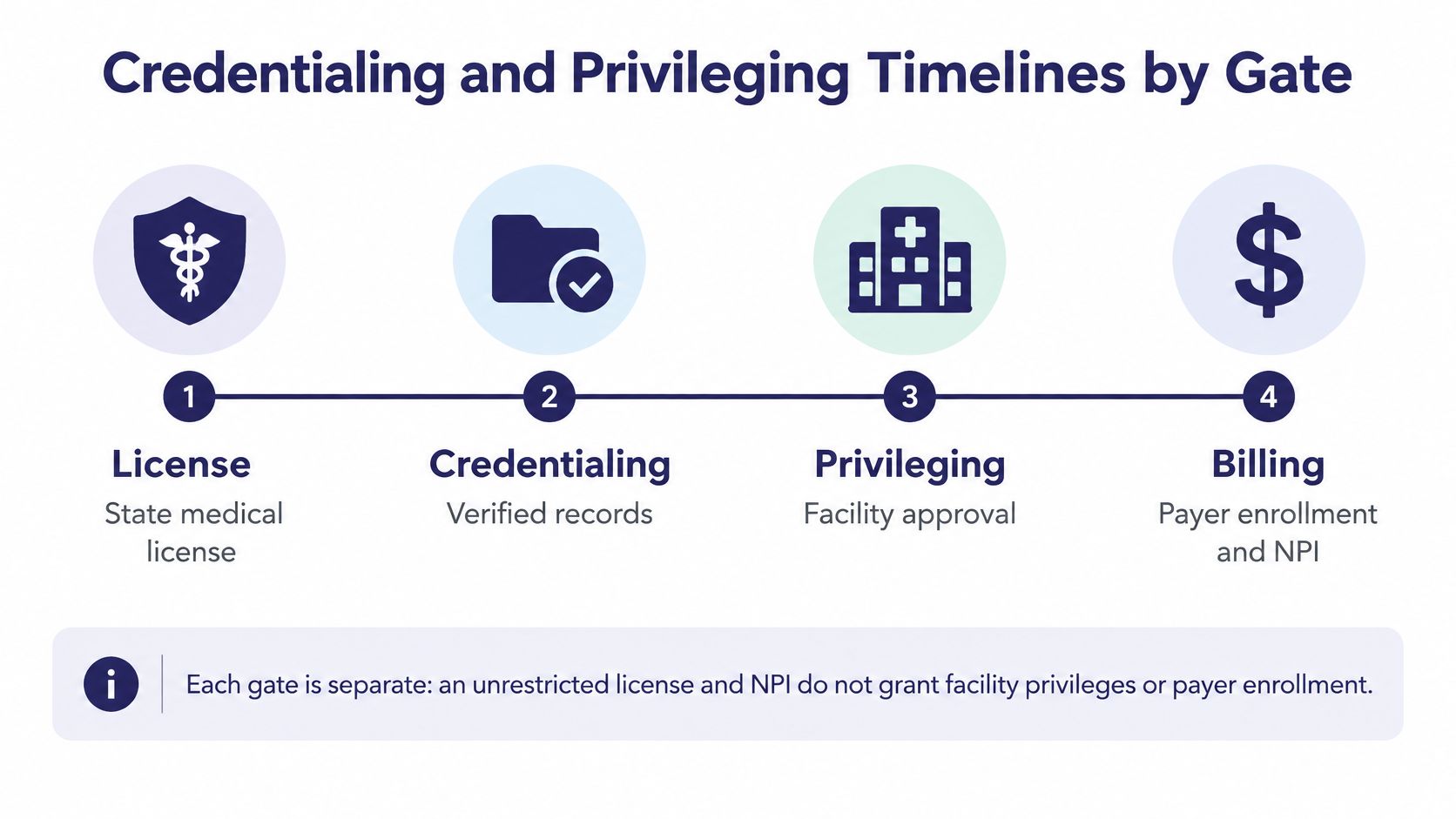
Usually, a cardiologist cannot begin clinical work merely because the contract is signed. An unrestricted license and NPI don't establish facility privileges or payer enrollment, and the hospital remains accountable for verification even when an agency supplies the credential file, as described in this locum tenens credentialing overview.
For electrophysiology ablation, structural-heart interventions, cardiac surgery and transesophageal echocardiography, the department must match the proposed work to procedure-specific privileges and competency evidence. A broad specialty designation isn't a substitute for the facility's approval of the actual procedures.
Plan backward from committee approval
The following are illustrative planning assumptions, not regulatory deadlines or measured processing averages. The medical staff office should replace them with its own documented workflow before committing to a start date.
Credentialing stages and planning ranges
Stage | Planning range | Controlled by | Runs in parallel? |
|---|---|---|---|
Application and complete credential file | Allow an initial document-collection period; depends on completeness | Clinician and agency | Yes, start first |
Primary-source verification of license, DEA, board certification and training | Depends on source responses and discrepancies | Credentialing office | Partly |
NPDB query and OIG and SAM exclusion screening | Schedule within the facility's screening workflow | Credentialing office | Yes |
References and competency review | Depends on reference availability and departmental review | Department chair | Yes |
Procedure-specific privileges for EP ablation, structural heart and TEE | Added at the applicable committee cycle | Credentials committee | Not independently of required review |
Medical staff committee and board approval | Next eligible approval cycle after prerequisites are complete | Medical executive committee and governing body, as applicable | No |
A universal calendar promise would conceal the variables that matter: jurisdiction, specialty, committee availability, missing records and whether the physician is new to the health system. Hospitals should distinguish processing work from waiting for an authorized decision.
Verify the file, then approve the scope
The working sequence begins with a complete application and primary-source verification of relevant credentials. The credentialing office then documents the NPDB query, exclusion screening, references, malpractice review and any unresolved discrepancies.
Departmental reviewers should assess current competency against the requested privileges, not merely confirm previous employment. The medical staff office should also identify whether advanced practice provider supervision changes the approval pathway.
A practical healthcare credentialing workflow should distinguish the following decisions:
Credential validity: Are the underlying qualifications verified?
Clinical competency: Does the evidence support the requested activities?
Facility authorization: Has the authorized committee or governing body granted the necessary privileges?
Billing readiness: Does the payer pathway permit claims for the planned services?
Scheduling safeguard: A proposed start date should remain conditional until the facility has issued the applicable clinical approval.
For specialized candidates, the most useful preparation is a precise requested-privilege list and supporting evidence organized around it. For hospital executives, the useful milestone is the approval letter's effective date and scope, not the date the agency marked the file complete.
Malpractice, Tax and Employment Status Rules
A valid contract and active license do not settle malpractice or tax status. Before the first shift, confirm that the policy covers the facility, practice setting, procedures and assignment dates, and check whether the facility must be named as an additional insured. Match the policy's actual terms to facility limits and the contract's insurance requirements.
The policy form determines whether tail coverage may be needed. An occurrence policy generally covers an incident that happens during the policy period, even if a claim is filed later. A claims-made policy generally requires both the incident and claim to fall within its coverage terms. If claims-made coverage ends with the assignment, verify who will buy any required tail coverage, when it takes effect and whether it covers the physician's work at that facility.
Apply the US employment-classification test
For federal tax purposes, the IRS common-law test examines the actual relationship, including behavioral control, financial control and the parties' relationship. A locum's contract label does not decide whether the physician is an employee or independent contractor. If the hospital or staffing firm controls the schedule and how work is performed, supplies key resources, or maintains an ongoing employment relationship, those facts require review alongside the agreement.
Classification affects payroll and benefits: an employee is generally treated as W-2, with the employer handling employment-tax withholding, while an independent contractor is generally paid on a 1099 basis and handles their own tax obligations. State rules may apply different tests, so confirm the relevant state requirements as well.
Behavioral control: Record who sets schedules, provides instructions and directs work procedures.
Financial control: Identify who provides equipment, pays expenses and sets compensation.
Relationship: Review duration, termination terms and benefits.
A provider business-structure review can inform the review, but classification depends on the assignment's actual facts. If control and contractor terms conflict, resolve the tax and legal classification before onboarding.
Contract Clauses Worth Negotiating Before Signature
A signed contract doesn't make an assignment clinically or financially ready. Negotiators should use the agreement to allocate responsibility for unresolved gates, rather than assume those gates will clear before the physician arrives.
The following review order puts the most immediate operational dependencies first. These are contract-drafting recommendations, not uniform legal requirements.
Review payment and readiness together
Rate basis and guaranteed work: Specify hourly, daily, per-diem or per-procedure compensation, guaranteed hours and treatment of idle days. The payment method must also support the intended billing structure where fee-for-time compensation is required.
Start-date contingency: Make clinical commencement contingent on required authorizations and privileges. Distinguish the contract's signing date, administrative preparation and the date patient care may begin.
Cancellation rights: Define notice, payments owed by each party and responsibility for booked travel if credentialing fails or the assignment changes.
Expense reimbursement: Allocate travel, housing, licensing and continuing-education expenses. Identify approval requirements and negotiated caps rather than leaving reimbursement to later interpretation.
Billing responsibility: Name the party responsible for enrollment checks, claim submission and payment documentation. For qualifying substitute arrangements, assign responsibility for the coverage counter, modifier review and escalation before the permitted period ends.
These clauses should be internally consistent. A start-date contingency offers limited protection if another provision guarantees payment from the original arrival date regardless of clearance.
Allocate continuing and exit risks
Insurance and indemnification: Match the agreement to risk management's policy review, including required limits, procedural scope and responsibility for uncovered obligations.
Permanent-hire conversion: State whether conversion or buyout fees apply, the triggering event and the negotiated period.
Restrictive terms: Require counsel to review non-solicitation and non-compete language, including duration, geography and applicable law. Enforceability shouldn't be assumed from inclusion in a template.
Governing law and termination: Establish an exit pathway if the physician loses required licensure or privileges, or an exclusion-screening result changes eligibility. Specify notice, handoff and responsibility for unresolved records and claims.
For a hypothetical per-procedure agreement, a guaranteed minimum or idle-day clause without a clearance contingency could create payment obligations while committee approval remains pending. Per-procedure pricing alone doesn't determine whether the hospital pays for unavailable clinical capacity; the surrounding terms do.
The negotiator's final check should compare the contract with the assignment's operational record. The agreement, privilege request, compensation model and payer decision should describe the same work, locations and coverage purpose.
Confirm Every Gate Before the First Shift
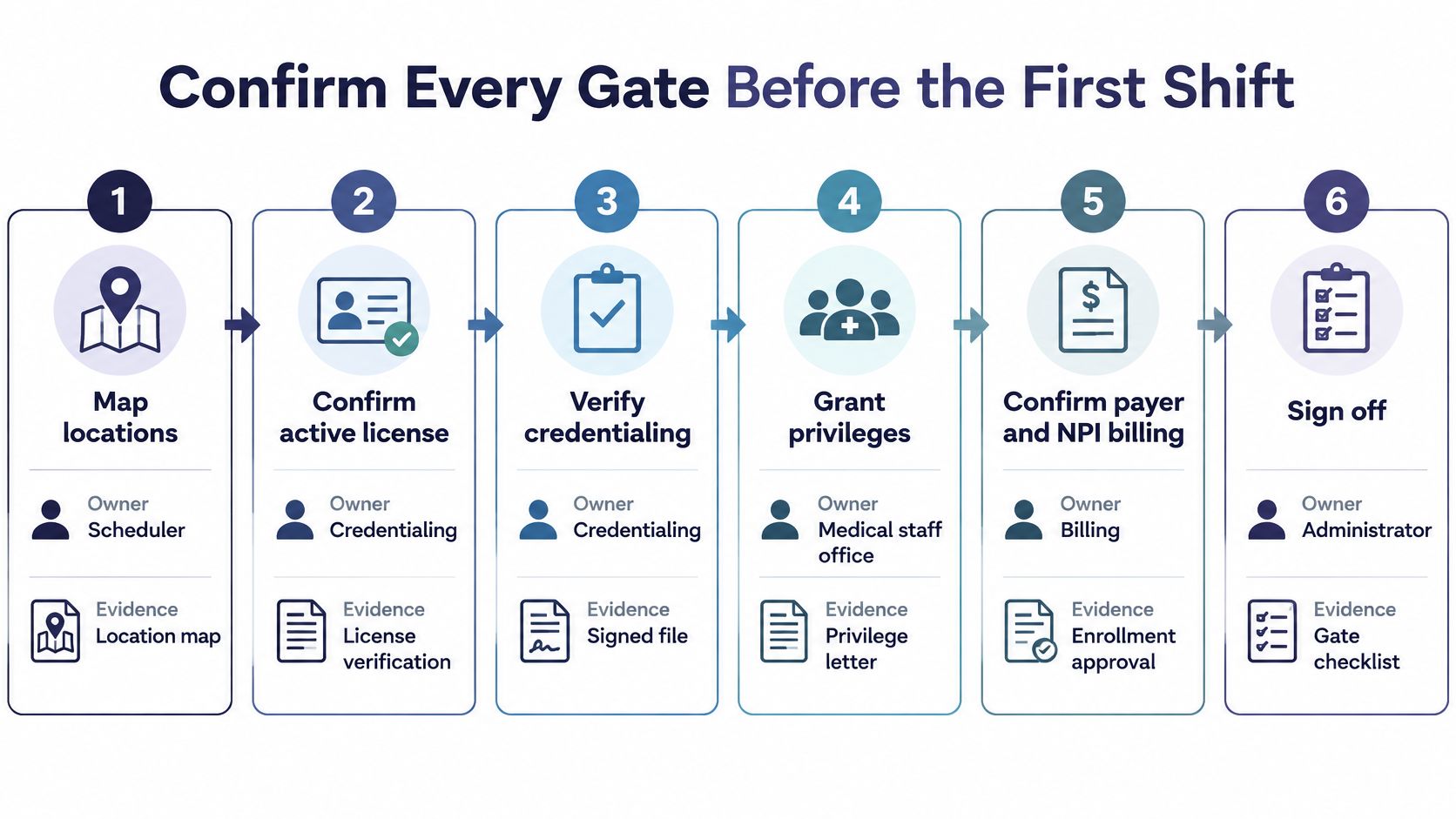
The hospital should issue a go decision only when every applicable gate is documented as passed. A conditional approval should identify the unresolved item, responsible owner and activity that remains prohibited.
The location review is foundational. CMS's licensure and telemedicine guidance supports checking authorization where the patient is located, rather than treating the physician's originating site as the only relevant jurisdiction.
Assign owners and retain evidence
Map the assignment. The scheduler and clinical director should identify physical practice sites, patient locations, telehealth modality and assignment dates. File the coverage map and a service description that distinguishes outpatient visits, interpretation, inpatient care and procedures.
Confirm state authorization. Credentialing should verify the relevant active license or recognized authorization for each patient jurisdiction. Retain verification, effective dates, expiration dates and any practice restrictions; a compact application should not be mistaken for completed authorization.
Resolve controlled-substance authority. The physician, pharmacy leadership and credentialing office should reconcile DEA status, state authority and intended medication activities. File the registration evidence or the documented facility-registration basis, including facility agreement where that pathway applies.
Complete verification and screening. The credentialing office should finish primary-source verification, the NPDB query and OIG and SAM exclusion screening under the hospital's process. Retain dated results, reviewer identity and the resolution of discrepancies rather than only a completion checkbox.
Issue procedure-specific privileges. The medical staff office and department chair should confirm the scope and effective date for EP ablation, structural-heart work, TEE and any other requested services. File the approval letter and communicate restrictions to scheduling, procedural areas and clinical leadership.
Approve malpractice coverage. Risk management should confirm that the policy addresses the relevant facility, setting, procedures and dates, including any required facility-related wording. Retain the coverage determination and supporting documents, not merely an unreviewed certificate.
Release the billing pathway. Revenue cycle should classify the coverage purpose and establish the payer-specific claim structure. For eligible substitute billing, retain absence evidence, fee-for-time payment documentation, claim instructions and the coverage counter; unresolved enrollment or effective-date questions require escalation.
Close and retain the record. The accountable administrator should sign the gate checklist and identify where the evidence is stored. Retain documentation for the period required by applicable obligations and facility policy, with ownership for monitoring changes during the assignment.
Keep recruitment support separate from hospital approval
A cardiology-focused recruitment partner is one option for identifying candidates and assembling credential materials; an internal recruitment team or another staffing organization may perform similar administrative work. The hospital must still perform its own primary-source verification and grant its own clinical approvals.
The final sign-off should distinguish clinical clearance, billing clearance and contractual clearance. If a gate fails, the administrator should withhold the affected work or resolve the deficiency before release, rather than treating a successful placement as evidence that the entire assignment is compliant.
American Cardiology Group offers locum tenens cardiology coverage and can help assemble candidate credential materials for hospital review. Hospitals seeking temporary cardiovascular coverage can visit American Cardiology Group to discuss the specialty, locations and assignment purpose while retaining responsibility for verification, privileges and payer-specific billing approval.
Comments