
Cardiac Surgery Fellowship Pathways for 2026
In 2024, 155 applicants competed for 92 positions in the thoracic surgery fellowship match, producing a 59% match rate with no positions left unfilled, according to 2024 thoracic surgery match results published in The Journal of Thoracic and Cardiovascular Surgery00784-0/fulltext). That's not a routine hiring market. It's a constrained pipeline where pathway, operative log, and program culture carry more information than the shared label of cardiac surgery fellowship.
For hospital executives and candidates, the analytical error is treating traditional, 4+3, and integrated training as interchangeable routes to an identical surgeon. They don't produce identical timelines, subspecialty patterns, or first-job profiles. The decision has to rest on case mix, documented operative role, retention signals, and the measured cost of teaching.
Table of Contents
Cardiac Surgery Fellowship Pathways Side by Side - Three Routes, Three Clocks
Entry Requirements Beside Interventional Cardiology - The Interventional Cardiology Contrast
Operative Volume Rules That Separate Real Training - Why a Favorable Ratio Can Mislead
What High-Volume Programs Let Fellows Do - Questions That Verify Readiness
How Pathway Choice Shapes the First Job - Matching Pathway to Intended Practice
Culture Signals Women Trainees Say Matter - Interview Questions With Verifiable Answers
What Teaching Fellows Costs the Operating Room - Building a Deliberate Teaching Business Model
Cardiac Surgery Fellowship Pathways Side by Side
The 2024 thoracic surgery fellowship match had 155 applicants for 92 positions, a 59% match rate with no positions unfilled, according to The Journal of Thoracic and Cardiovascular Surgery's 2024 match results00784-0/fulltext). That figure describes the thoracic match, not every cardiac surgery route. Traditional, 4+3, and integrated I-6 training differ in duration and structure, so their position counts cannot be treated as one interchangeable market.
Three Routes, Three Clocks
Traditional independent pathway: Five years of general surgery residency, followed by two or three years of cardiothoracic fellowship. That means at least seven clinical years after medical school, and as many as ten when research or academic development years are added.
4+3 track: Four years of general surgery and three years of cardiothoracic training, for seven years in total. Trainees enter the cardiothoracic phase earlier while retaining a general surgery base.
Integrated I-6 pathway: Six continuous years of cardiothoracic-focused training beginning after medical school. It eliminates a separate general surgery residency and a later fellowship application.
The 2024 match figure gives a clear measure of the traditional thoracic pipeline, but it does not establish the supply of 4+3 or I-6 positions. Those routes require separate comparison. The shorter I-6 timeline may appeal to candidates committed to cardiac surgery early, but it is not automatically the better start: case mix, program culture, and the cost of teaching determine what that time delivers.
Pathway | Clinical years after medical school | Recent positions | Applicants and match result |
|---|---|---|---|
Traditional independent fellowship after five years of general surgery | At least 7, up to 10 with added research | 92 positions in the 2024 thoracic surgery fellowship match | 155 applicants, 59 percent match, zero unfilled |
Integrated I-6 | 6 | Not reported in the 2024 thoracic match | Not reported in the 2024 thoracic match |
Four-plus-three general surgery and cardiothoracic track | 7 | Not reported in the 2024 thoracic match | Not reported in the 2024 thoracic match |
Two board-eligible surgeons can hold the same job title yet differ in training time, research experience, and operative focus. Employers reviewing current cardiac surgery and cardiology openings should treat pathway as an initial screen, then assess the program's case mix, teaching demands, and preparation for the available role. A hiring plan built around interchangeable pathways risks misjudging both candidate fit and the time required to develop it.
Entry Requirements Beside Interventional Cardiology
Entry gates differ sharply across surgical routes, and they differ even more from catheter based training. The traditional cardiac surgery fellowship starts only after five years of general surgery, then runs two or three years. The 4+3 track starts its cardiothoracic phase after four years of general surgery and runs three cardiothoracic years.
I-6 removes the second gate entirely. It starts immediately after medical school and runs six years, so there's no later application after a general surgery residency. That structure commits a trainee to cardiothoracic surgery earlier and compresses general surgery exposure into an integrated curriculum.
The Interventional Cardiology Contrast
Interventional cardiology follows a medical, not surgical, sequence. The ACGME program requirements for interventional cardiology specify a 12-month educational program following a three-year cardiovascular disease fellowship, with all 12 months combining clinical experience and protected research time. Each fellow should perform at least 250 coronary interventions.
Infrastructure thresholds accompany that individual target. The primary catheterization laboratory must perform at least 400 interventional procedures annually, each secondary laboratory must perform at least 200 per year, and clinical and educational assignments may not exceed 24 consecutive hours. Accreditation therefore depends on laboratory throughput, staffing, supervision, and duty hour compliance, not only on fellow selection.
Cardiac surgery training is multi-year operative work measured across a different skill set. Fellows learn patient selection, cannulation, cardiopulmonary bypass, myocardial protection, reconstruction, hemostasis, and postoperative care in the intensive care unit. Interventional cardiology training is one catheter based year measured principally in coronary interventions, with electrophysiology and other cardiovascular subspecialties following their own distinct pathways.
Operating room hiring: Credential against the surgical log, operative role, and bypass experience.
Cath lab hiring: Credential against the 250 coronary intervention requirement and laboratory volume.
Program planning: Fund the infrastructure each accreditation model demands, rather than assuming one cardiovascular fellowship template fits both.
Hospital leaders who blur these credentials create two risks. A surgical service can overvalue catheter volume that doesn't demonstrate operative competence, and a cath lab can undervalue the laboratory throughput an interventional fellow needs. Precise terminology isn't academic polish. It's how recruitment specifications match the work being staffed.
Operative Volume Rules That Separate Real Training
Volume is a competency floor, not a marketing claim. The ACGME program requirements for independent thoracic surgery require 24-month programs to provide at least 125 major cardiothoracic procedures per year, or 250 total, while 36-month programs require 375 total cases. A program that can't distribute that volume to every fellow doesn't meet the basic test.
Program | Minimum major cases | What else must be true |
|---|---|---|
Independent thoracic surgery, 24 months | 125 per year or 250 total | Repeated exposure across bypass, protection, reconstruction, hemostasis, and postoperative care |
Independent thoracic surgery, 36 months | 375 total | Progressive autonomy with faculty supervision and enough annual volume for every fellow |
Congenital cardiac surgery fellowship | 150 as primary surgeon | At least 50 in the first 12 months, required index procedures, and excess cases above caps excluded |
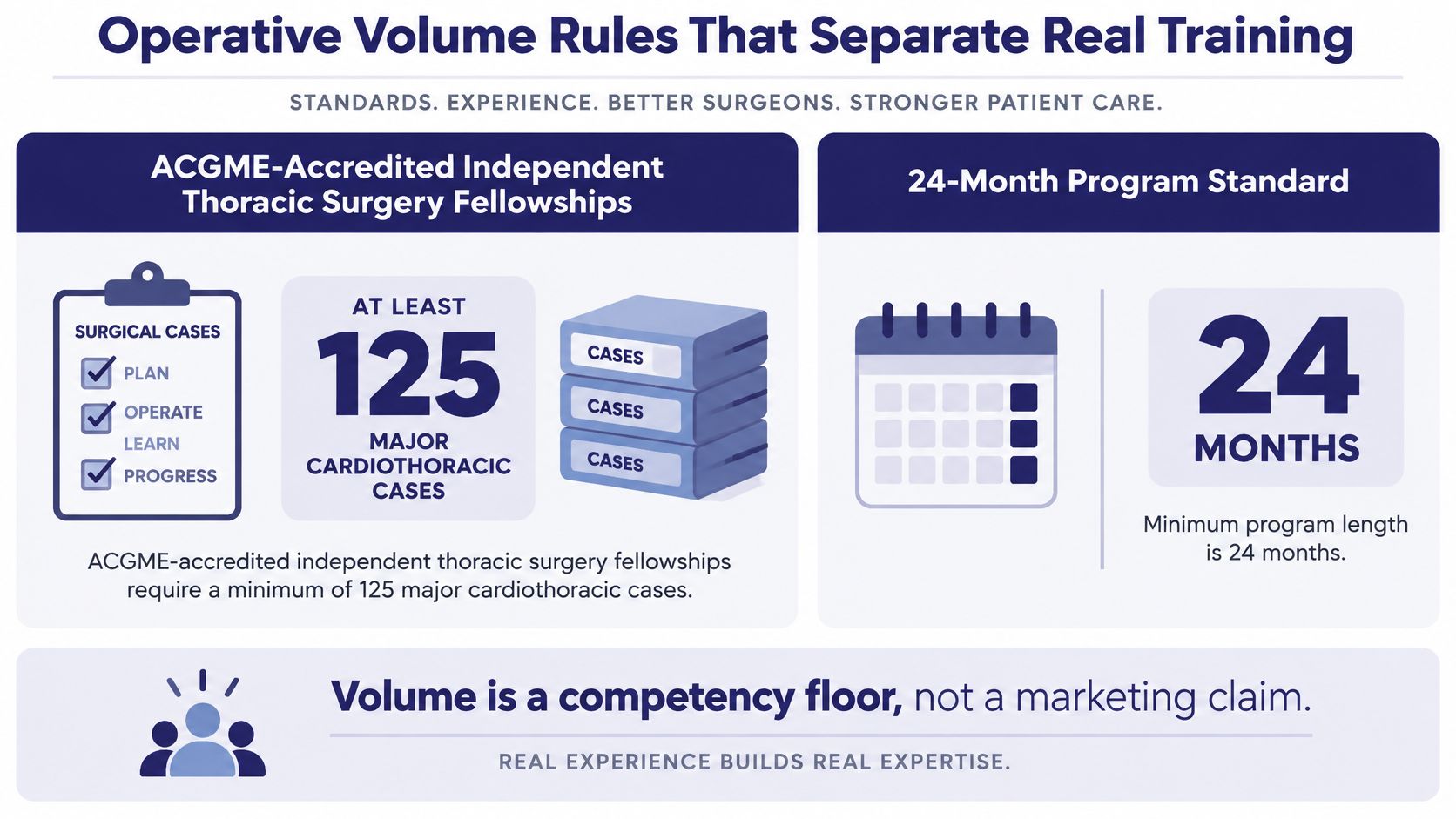
The threshold exists to force repetition of the full perioperative cycle. Fellows need repeated exposure to patient selection, cannulation and cardiopulmonary bypass, myocardial protection, reconstruction, hemostasis, and postoperative management, with autonomy increasing under attending supervision. One excellent rotation doesn't substitute for that repetition.
Why a Favorable Ratio Can Mislead
A low fellow to faculty ratio looks attractive in a brochure. It means little if the hospital can't supply 125 qualifying operations per fellow without weakening service coverage or supervision. Annual case volume, ICU exposure, faculty coverage, and case diversity all have to scale together.
Executive test: Case count alone isn't competence. Operative role, complexity, technical independence, simulation, morbidity review, and milestone based assessment have to travel with the log.
Congenital cardiac surgery adds a stricter primary surgeon rule. The ACGME program requirements for congenital cardiac surgery require fellows to document at least 150 major congenital cardiac surgery procedures as primary surgeon, with at least 50 completed during the first 12 months. Cases beyond applicable maximums may not count toward the 150 case total.
Distribution rules then test breadth. Required index experience includes tetralogy of Fallot repair, aortic arch reconstruction or coarctation repair, atrioventricular septal defect repair, systemic to pulmonary artery shunts, pediatric coronary artery bypass grafting, and reoperations in patients older than five years. A high aggregate built from a narrow case mix can fail the requirement.
Institutions therefore need reliable documentation in the case log system, progressive responsibility, and enough index diversity to satisfy both total and mix. Candidates should ask how many cases were performed as primary surgeon, not merely attended. Executives should ask whether volume survives after caps, distribution rules, and competing learners are applied. When those answers are vague, the fellowship's headline number shouldn't be trusted.
What High-Volume Programs Let Fellows Do
Two established programs show scale without creating a ranking. The University of Florida thoracic and cardiovascular surgical fellowship is a three year program entered after five years of general surgery and reports average graduate operative experience of approximately 700 cases. Documented graduating class totals included 734 cases in 2016, 650 in 2019, and 748 in 2020.
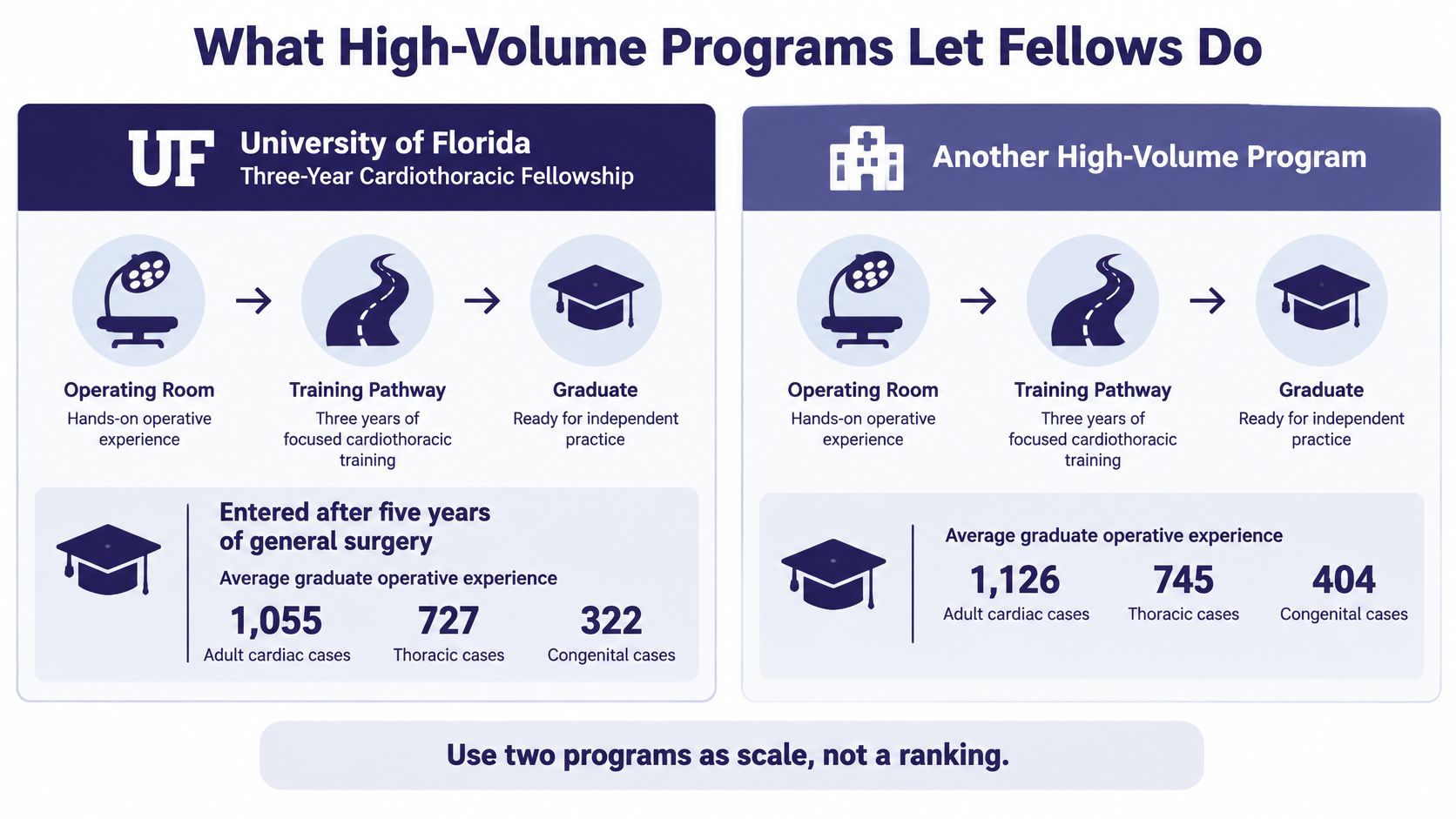
That graduate experience sits well above independent program floors and illustrates the purpose of a cardiac surgery fellowship. It isn't an additional academic credential added to a résumé. It's a high volume transition into independent practice, where repetition has to convert supervised participation into operative judgment.
Baylor College of Medicine describes a three year independent thoracic surgery fellowship accepting three fellows annually, two on the cardiothoracic track and one on the general thoracic track. Across affiliated hospitals, trainees can participate in more than 1,700 adult cardiac surgery cases each year, including over 150 ventricular assist device and heart lung transplant cases and more than 200 complex aortic reconstructions.
Program | Fellows and entry | Reported volume |
|---|---|---|
University of Florida three-year cardiothoracic fellowship | After five years of general surgery | About 700 cases per graduate; class totals 734 in 2016, 650 in 2019, and 748 in 2020 |
Baylor College of Medicine three-year independent thoracic fellowship | Three fellows a year; two cardiothoracic track and one general thoracic | More than 1,700 adult cardiac cases a year, over 150 VAD and heart-lung transplant cases, and more than 200 complex aortic reconstructions |
Questions That Verify Readiness
Pump experience: How many cardiopulmonary bypass cases did the fellow run, and in what role?
Complex aortic work: How many root or arch cases were performed rather than observed?
Advanced therapies: Were transplant and mechanical circulatory support available across training years, or concentrated in one rotation?
A hiring chief should compare operative breadth, advanced mechanical circulatory support, transplantation, and aortic work against the service being built. Duration alone proves little. A three year label attached to thin complex case exposure doesn't equal readiness for a program centered on aortic reconstruction or ventricular assist devices, and a shorter pathway with dense, well documented primary surgeon experience shouldn't be dismissed on label alone.
How Pathway Choice Shapes the First Job
Pathway predicts training time and subspecialty direction more clearly than it predicts the first job. A national cohort analysis of cardiothoracic graduates from 2013 to 2023 found that integrated and independent graduates differed in their demographic profiles and subspecialty choices.
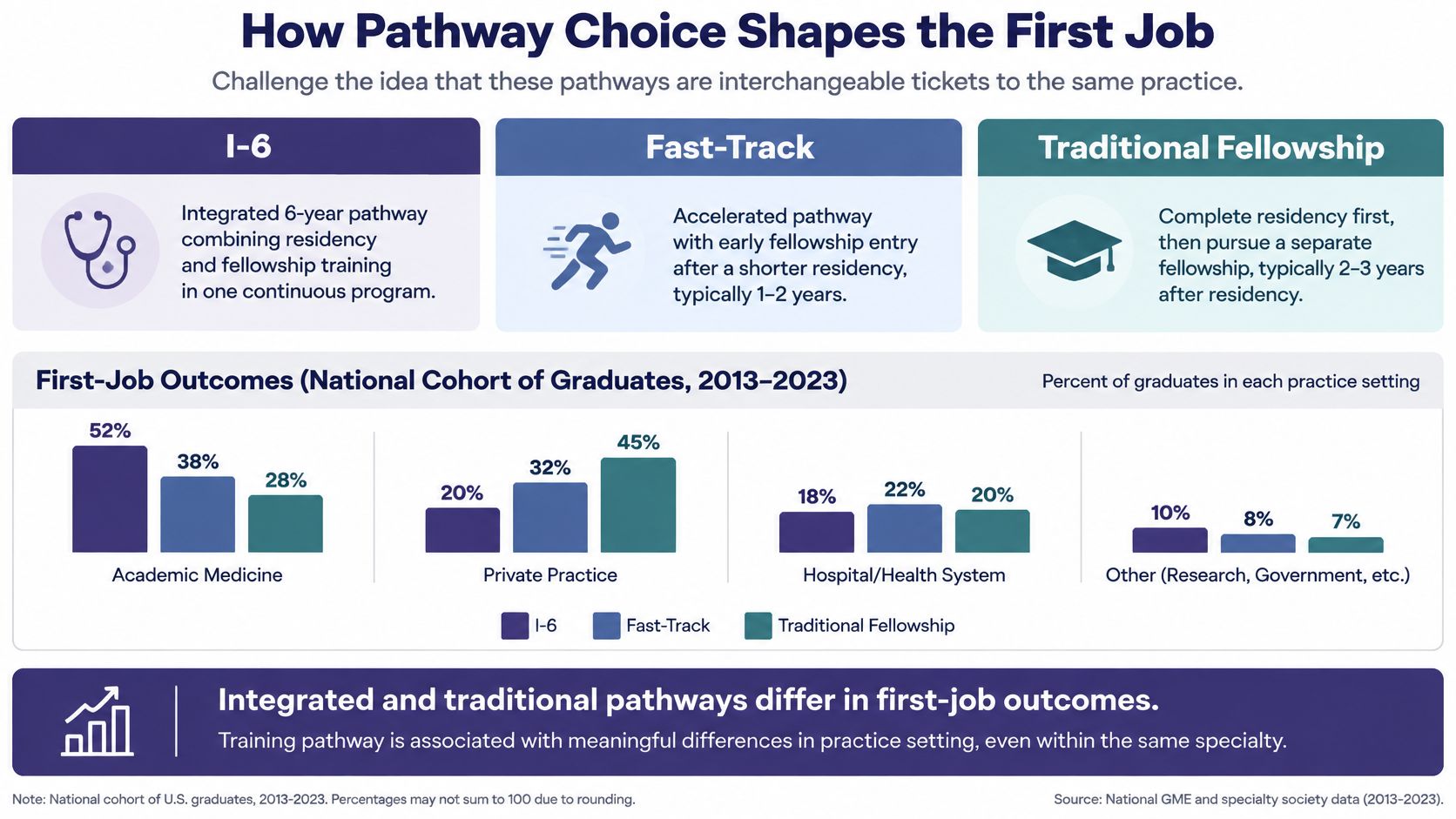
Independent-pathway graduates were more likely to pursue thoracic subspecialization and less likely to enter adult cardiac subspecialization than integrated graduates, according to the Johns Hopkins cohort analysis. Integrated graduates also completed fewer postgraduate training years. The trade-off is a shorter route that may align less directly with a thoracic focus; neither route guarantees a particular first job.
After accounting for subspecialty, early-career outcomes, including entry into academic practice, were broadly comparable across pathways in the same cohort analysis. That finding makes pathway a poor stand-alone hiring filter. Programs should compare case mix, teaching culture, and the measured cost of training, while candidates should match the route to the intended practice.
Matching Pathway to Intended Practice
Adult cardiac ambition: Candidates targeting aortic reconstruction, mechanical circulatory support, or transplant should check whether those cases are represented in the operative log, not just in program descriptions.
General thoracic ambition: Candidates targeting thoracic oncology or general thoracic surgery should compare actual subspecialty exposure across programs. The cohort's pathway differences are a reason to ask about case mix, not assume an I-6 label guarantees a thoracic focus.
Research planning: Research years extend the training timeline. The cohort's adjusted comparison suggests that, once subspecialty is accounted for, pathway alone does not determine early-career outcomes.
Candidates can compare career resources for cardiology and cardiac surgery candidates against their target subspecialty, training time, case exposure, research expectations, and likely first-job setting.
Pathway is a route to a subspecialty, not a quality ranking.
Hospitals should assess graduates by the work their service needs and the operative experience documented in their logs. Academic and nonacademic practice are both represented across pathways, so excluding candidates by pathway alone can narrow the hiring pool without clarifying their readiness.
Culture Signals Women Trainees Say Matter
Competitiveness measures who enters. Culture helps determine who stays. A 2024 national survey of cardiothoracic trainees reported by the American Association for Thoracic Surgery covered 440 trainees across 74 programs and found that 31.1% identified as female. Representation alone didn't signal an equitable environment.
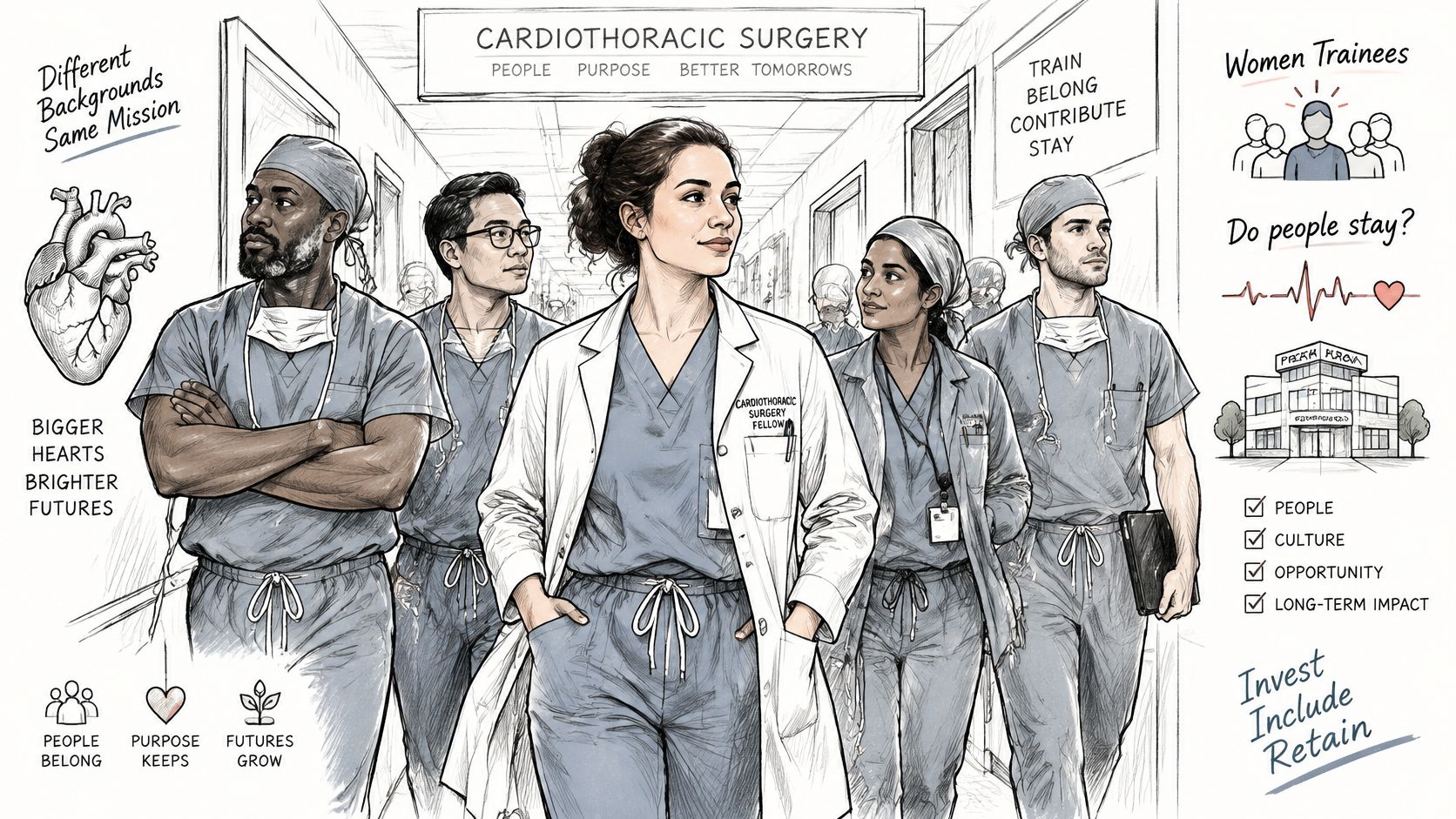
Female trainees were significantly more likely than male trainees to have considered leaving their program, at 20.4% versus 11.4%. They were also more likely to report dissatisfaction with becoming a cardiothoracic surgeon, at 8.8% versus 3.6%, and reported greater concerns involving work life balance, mentorship, opportunities, and support. Recruitment and retention are separate problems, and the survey shows both need explicit measurement.
Interview Questions With Verifiable Answers
Parental leave: Is the policy written, how is call covered when leave is used, and who absorbs the service load?
Mentorship and sponsorship: Is mentorship assigned with named faculty and scheduled meetings, or left to accidental relationships?
Operative autonomy: How is graduated independence granted, documented, and reviewed when a fellow's progression stalls?
Harassment reporting: Who receives a report, what protection exists against retaliation, and what happens after a complaint?
Household logistics: Can a partner find suitable work locally, and does call flexibility exist in practice?
Women faculty retention: How many women faculty are still operating at the institution, and in what leadership roles?
Programs should read the same checklist as a retention audit. A department that celebrates a higher share of women matching into a cardiac surgery fellowship but loses trainees through rigid call, weak sponsorship, or unequal autonomy has a workforce problem, not a branding problem. Attrition during multi-year training wastes scarce positions and delays service capacity for years.
Candidates comparing offers with similar case logs should treat these answers as part of training quality. A program that a substantial share of trainees considers leaving won't reliably graduate independent surgeons, whatever its operative volume claims. Belonging, mentorship, and support aren't soft additions to surgical education. They affect whether the education gets completed at all.
What Teaching Fellows Costs the Operating Room
Teaching carries a measured operating room penalty, and executives should budget for it rather than discover it. In a 1,997 patient coronary artery bypass grafting cohort reported on PubMed, fellows participated in 632 cases, or 31.5%. Participation was associated with operations approximately 61 minutes longer and a median hospitalization cost increase of about $2,200.
The clinical result changes the interpretation. There was no significant difference in postoperative clinical outcomes with fellow participation. Longer, costlier cases didn't translate into worse short term outcomes in that cohort.
The mechanism is supervised teaching. Fellows perform or assist with technically demanding steps while attending surgeons coach, correct, and maintain safety oversight during the learning curve. Intraoperative time and personnel cost rise because two surgeons are doing the combined work of operating and instruction.
Building a Deliberate Teaching Business Model
Case allocation still has to give each fellow adequate complexity and graduated responsibility. Restricting fellows to low complexity work to protect throughput undermines the training purpose and can leave graduates unprepared for independent adult cardiac practice. The operational goal isn't eliminating the time penalty immediately. It's shortening that penalty as proficiency develops.
Time measures: Operative duration and cardiopulmonary bypass time by fellow and training stage.
Safety measures: Conversion, re-exploration, complications, and postoperative outcomes.
Throughput measures: Length of stay, ICU use, and downstream hospitalization cost.
Education measures: Case complexity, primary surgeon role, and progression toward independence.
Longer cases are acceptable when quality holds. They aren't acceptable when nobody measures them.
A program that cannot staff the extra hour, ICU capacity, or attending coverage should not open fellowship positions just to fill a workforce gap. Education paired with a faculty plan distributes teaching across surgeons and protects supervision. Education treated as unmeasured inefficiency becomes permanent overtime for the same attendings, with predictable effects on retention and case access.
For service chiefs, the dashboard also protects fellows. When outcomes remain stable and times fall with experience, the data justify graduated autonomy to operating room leadership. When times stay high without progression, the data identify a coaching or case allocation problem early enough to correct.
Choose the Pathway and the Hiring Plan
Candidates have three sequential decisions. First, choose I-6, 4+3, or traditional training by target subspecialty and total year count, not by which label sounds newer. Second, check personal operative role against the applicable 24 month, 36 month, or congenital primary surgeon floor before submitting a rank list. Third, use interviews to test leave coverage, mentorship, operative autonomy, harassment reporting, and retention of women faculty.
Hospitals have four parallel obligations. Annual volume, ICU capacity, and faculty coverage must support every fellow at the required minimum. Case mix must match actual demand across adult cardiac, aortic, mechanical support, transplant, or thoracic services. Budgets must staff the added operative time and hospitalization cost associated with teaching coronary bypass cases, with outcomes tracked so time falls as skill rises. Finally, a durable faculty seat should be planned before a fellowship seat when the goal is retention rather than a rotating trainee.
One option for executing that hiring plan is American Cardiology Group, a recruitment firm working only in cardiology and cardiac surgery across permanent, locum, and leadership searches. Health systems using permanent physician recruitment for cardiac programs can align a finished operative log with service needs, while surgeons can align pathway and subspecialty evidence with the next role. The decision standard stays constant either way: documented cases, demonstrated role, and a culture people complete training in.
American Cardiology Group recruits exclusively in cardiology and cardiac surgery, covering permanent, locum tenens, advanced practice, and executive roles for hospitals, academic centers, and practices nationwide. For a cardiac surgery fellowship graduate aligning an operative log with a first faculty role, or a health system building adult cardiac, thoracic, interventional cardiology, or electrophysiology capacity, visit American Cardiology Group to start a targeted search.
Comments