
Plastic Surgeon Salary in 2026: Benchmarks by Setting
Average plastic surgeon compensation ranges from $516,000 to $621,445 across the cited survey measures. These are averages that include bonuses, not guaranteed base salaries.
Hospital leaders who use either endpoint as an offer target risk mispricing the job. A 2024 physician compensation survey of more than 7,300 physicians across at least 29 specialties reported $544,000 in full-time plastic surgeon compensation, including incentive bonuses. A different survey series reported $619,000 for 2023, a gap of about $75,000, or 12.1%, between the two measures. That difference is not, by itself, evidence of a year-over-year pay decline. A benchmark is a starting band, not a contract.
Table of Contents
Plastic Surgeon Salary Benchmarks Compared - What a government wage adds, and what it doesn't
How Plastic Surgeon Pay Has Changed Since 2013 - What the dip does and doesn't mean
Plastic Surgeon Pay by Practice Setting - Private practice - Academic medical centers - Hospital-employed programs - Locum tenens
Base Salary Versus wRVU Incentive Pay - The gap between median and high production
Factors That Move Plastic Surgeon Pay - Geography - Career stage and the cost of getting there
Gender and Career Stage Gaps to Audit - What remains after volume is held constant
Plastic Surgeon Salary Benchmarks Compared
A reported average can differ by more than $277,000 across the figures below. That spread reflects benchmarks built from different populations and pay definitions, so the figures should not be treated as interchangeable salary targets.
Source | Year | Reported figure | What it measures |
|---|---|---|---|
Physician compensation survey series | 2023 | $619,000 | Average annual physician compensation, may include bonuses and profit sharing |
Physician compensation survey | 2024 | $544,000 | Full-time employment, includes incentive bonuses, 7,300+ physicians |
Doximity Physician Compensation Report | 2025 | $621,445 | Average annual compensation |
BLS surgeons, all other (not plastic surgery) | 2023 | $343,990 | Mean annual wage for a broad occupational category |
The Doximity 2025 Physician Compensation Report lists plastic surgery at $621,445 in average annual compensation. Other published surveys use different methods, respondent groups, and definitions of compensation. Those differences make a single headline figure a poor substitute for examining what the benchmark includes.
What a government wage adds, and what it doesn't
The U.S. Bureau of Labor Statistics reported a 2023 mean annual wage of $343,990 for “surgeons, all other.” The category covered 26,370 workers and had a 2.8% wage relative standard error. It does not isolate plastic surgeons, so it provides a broad occupational comparison rather than a specialty-specific offer target. The same release reported $406,420 for that group in outpatient care centers, illustrating how setting can affect observed wages.
Practical rule: Before using a benchmark, identify whether it reports base salary, total cash compensation, or total compensation that includes productivity and partnership distributions.
Use the linked survey figures as reference points, not as a single national pay band: their populations and compensation definitions differ. A finance committee reviewing an average surgeon salary comparison should apply the same scrutiny. The headline average is a starting point; the benchmark's definition determines what it can support.
How Plastic Surgeon Pay Has Changed Since 2013
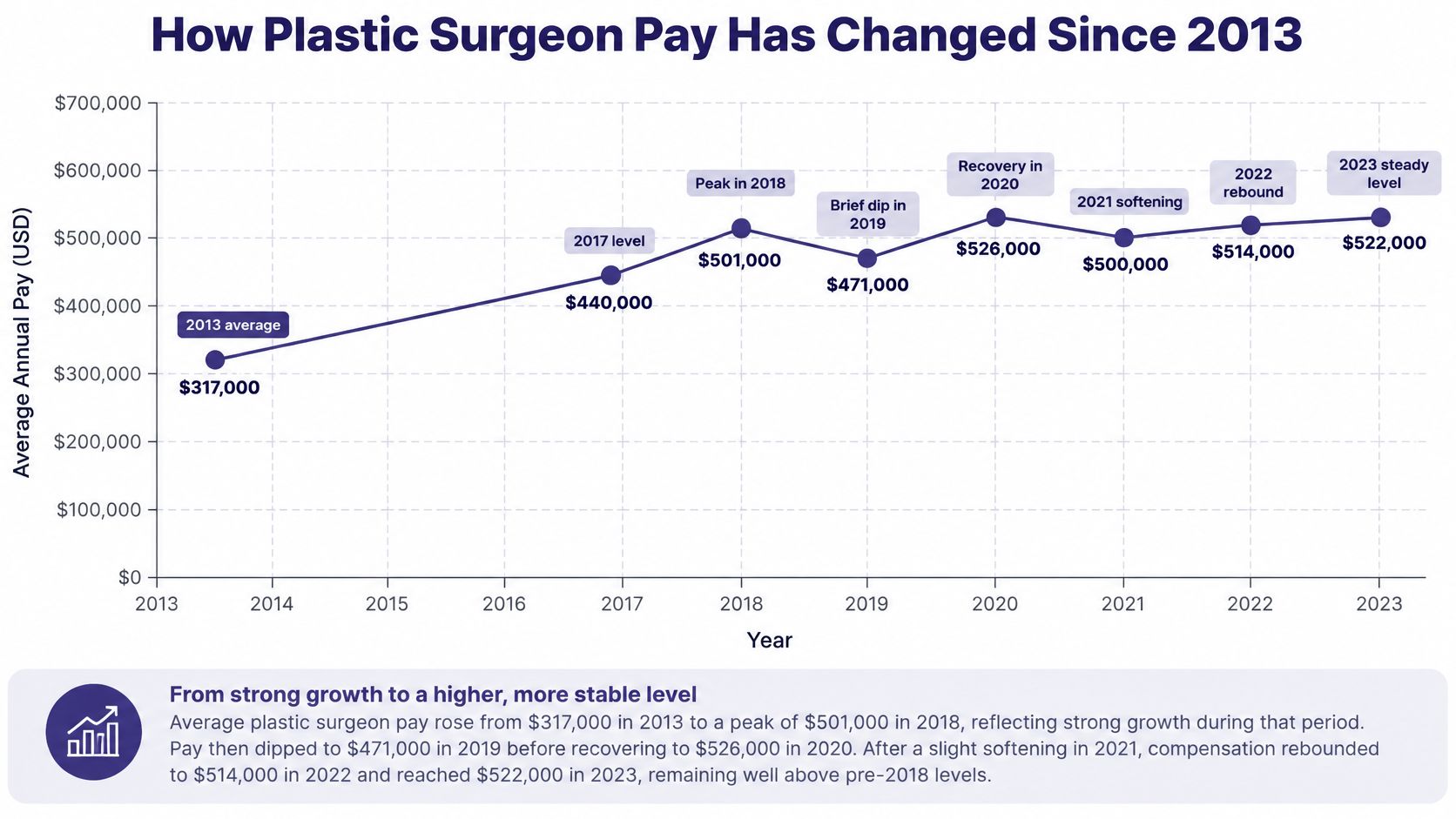
Plastic surgery has sat among the highest-paid physician specialties for more than a decade, and the path up was uneven. Becker's Physician Leadership compiled annual physician compensation surveys showing average plastic-surgeon compensation rising from $317,000 in 2013 to $619,000 in 2023. That is an increase of $302,000, or about 95%. These are average annual physician compensation figures, not guaranteed base salary, and they may include bonuses, profit sharing, and other income.
Year | Average compensation | Note |
|---|---|---|
2013 | $317,000 | Start of the 2013 to 2023 series |
2017 | $440,000 | Mid-series level |
2018 | $501,000 | Peak before the dip |
2019 | $471,000 | Decline from 2018 |
2021 | $526,000 | Recovery year |
2022 | $576,000 | Continued growth |
2023 | $619,000 | Series high in the cited survey |
2024 | $544,000 | Separate survey, not a strict continuation of the series |
What the dip does and doesn't mean
Walk the series as a budget owner would. The average reached $440,000 in 2017, then $501,000 in 2018, and fell to $471,000 in 2019. It recovered to $526,000 in 2021, $576,000 in 2022, and $619,000 in 2023. The 2018-to-2019 drop was real inside that series. It didn't reset the decade. A plan still built on pre-2021 averages understates what recruiting costs now.
The 2024 row is a different instrument. It isn't a strict continuation of the 2013-2023 line, so it shouldn't be read as a precise year-over-year market index. Methodology, who responded, and how compensation was defined all shift the print.
A single national salary also hides practice type, geography, subspecialty, and ownership. Packages that ignore productivity, call, procedural volume, and local competition will lose candidates even when the "average" looks generous on a slide.
Refresh the benchmark every survey cycle, and write the source and year beside every number in the compensation file.
Plastic Surgeon Pay by Practice Setting
Public surveys rarely publish a clean dollar average for each practice setting. A more useful comparison is how compensation is structured, which factors affect it, and what belongs in negotiations.
Setting | Typical pay structure | What moves pay | Negotiation focus |
|---|---|---|---|
Private practice | Owner or partner income tied to collections | Cosmetic cash-pay volume, overhead, payer mix | Ownership terms and overhead allocation |
Academic medical center | Base salary plus wRVU bonus | Teaching, research, call and clinical productivity | Base floor, bonus threshold and protected time |
Hospital-employed program | Base salary plus incentives | Call coverage, reconstructive volume, regional supply | Call pay and productivity thresholds |
Locum tenens | Daily or hourly rate | Coverage gap length, urgency, travel | Rate, travel costs and malpractice cover |
Private practice
Take-home pay follows collections and expenses, not a posted salary. Cosmetic cash-pay volume, payer mix, and overhead shape the result. A strong aesthetic book and low facility costs can support higher income; a reconstructive-heavy practice with substantial staff and implant costs can produce less. Ownership terms and overhead allocation determine how much collected revenue reaches the surgeon.
Academic medical centers
Academic compensation commonly combines a base salary with a work-RVU bonus. Teaching, research, and call may receive uneven credit, or none, in the bonus formula. Negotiations should define the base floor, bonus threshold, and protected time so that clinical productivity targets account for duties outside patient care.
Hospital-employed programs
Employed offers may pair a base with incentives tied to call coverage, reconstructive volume, and regional supply. A trauma-heavy call panel in a thin market differs from an elective reconstructive service in a saturated city. Compare the expected call burden and productivity terms, not just the annual figure.
Locum tenens
Locum rates depend on the length and urgency of the coverage need, travel, and malpractice arrangements. A short-notice assignment with travel and tail coverage can cost the hospital more per day than a planned local week.
Compare offers by total compensation after overhead, call, and benefits, not by base salary alone.
Government wage data for “surgeons, all other” show higher pay in outpatient settings than the all-employer mean. That broad labor-market comparison is not a plastic-surgery offer, but it illustrates why practice setting affects observed wages before specialty-specific benchmarks are considered.
Base Salary Versus wRVU Incentive Pay
A base salary protects income while a practice ramps up; a wRVU bonus ties additional pay to measured clinical output. In a 13-program sample, a 2023 study of academic plastic-surgery compensation structures found that most departments used a base-plus-bonus model, with only three not relying mainly on it. Typical rates were about $35 to $60 per work relative value unit (wRVU).
The study reported three-year MGMA benchmarks of 7,230 wRVUs at the 50th percentile, 7,654 at the 60th, and 9,270 at the 75th. Applying the typical rates produces the following implied incentives. These figures are arithmetic, not reported compensation.
Percentile | MGMA wRVUs (3-year) | Implied incentive at $35 | Implied incentive at $60 |
|---|---|---|---|
50th | 7,230 | $253,050 | $433,800 |
60th | 7,654 | $267,890 | $459,240 |
75th | 9,270 | $324,450 | $556,200 |
The gap between median and high production
The difference between the 50th- and 75th-percentile benchmarks is 2,040 wRVUs. At $35 per wRVU, that adds about $71,400 in incentive pay; at $60, about $122,400. The conversion rate and threshold determine whether a plan turns higher production into meaningful compensation. Candidates should calculate both against the expected first-year workload, using a framework for comparing physician compensation models.
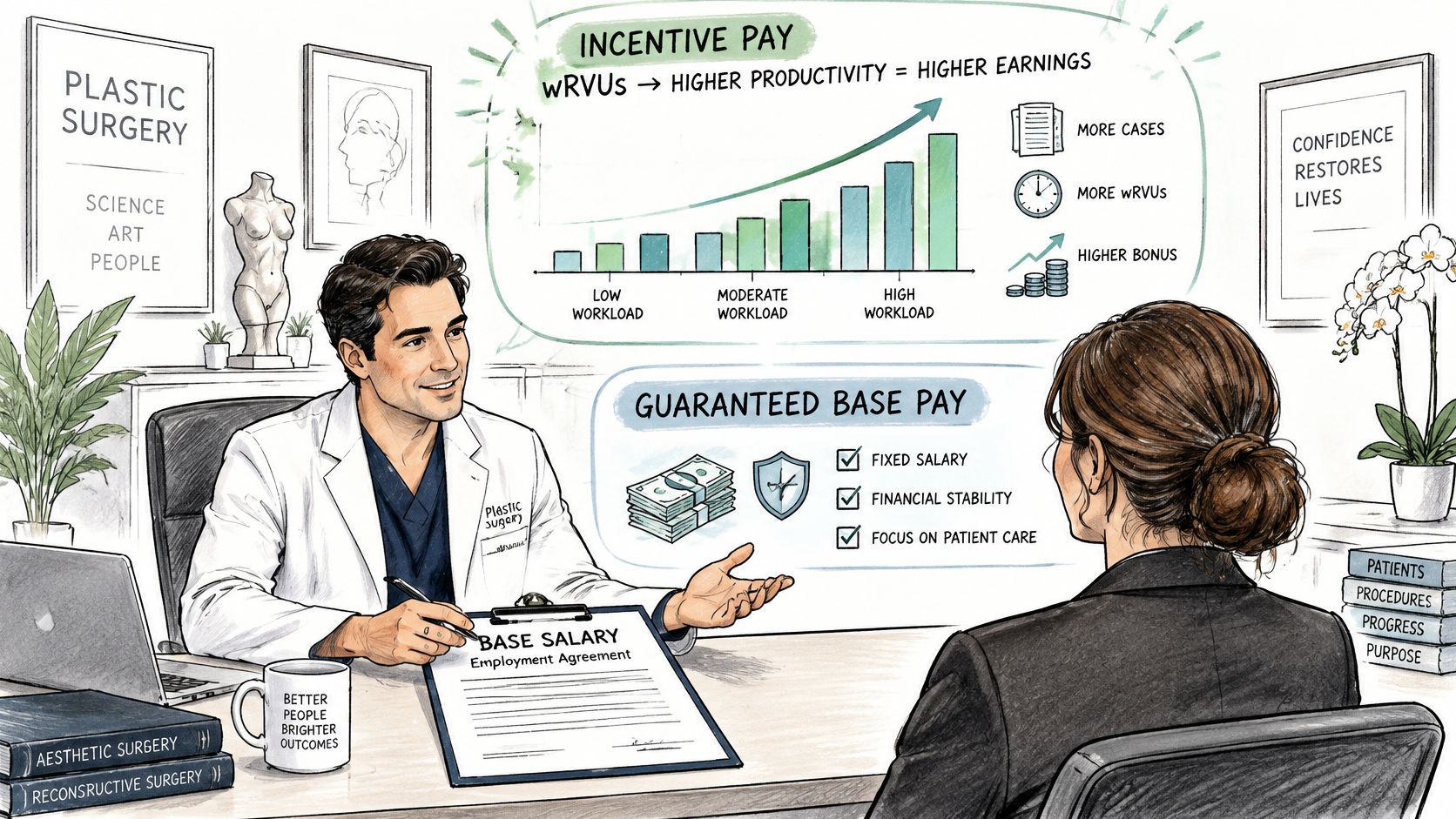
wRVUs measure clinical output, but they do not fully capture payer mix, cosmetic cash-pay work, teaching, research, call, or program building. A plan that pays only on wRVUs can therefore leave work such as staffing a flap service, a cleft program, or a heavy call panel outside the incentive calculation. Define which duties receive separate credit, and set the threshold and rate so the formula reflects the work the employer expects.
Factors That Move Plastic Surgeon Pay
A national average is a starting point, not an offer benchmark. Geography, case mix, career stage, and leadership duties can shift compensation substantially. Compare those four factors before judging an offer against a headline figure.
Geography
The available comparison should match the market type. A rural package judged only against a coastal headline can look rich or cheap for the wrong reason. Compare like with like.
Case mix affects revenue even within one city. Reconstructive versus cosmetic work, the share of cash-pay procedures, and additional training in hand or craniofacial surgery all shape volume and collections. A hospital seeking microsurgical reconstruction should not benchmark against a cash-pay aesthetic practice and label the difference a retention problem.
Career stage and the cost of getting there
Starting compensation is typically below mature-practice earnings. Longer careers and earlier board certification can bring greater procedural volume and negotiating room. A six-figure attending salary, on its own, does not show whether an early-career offer is competitive. Model delayed earnings, debt interest, and foregone income across the first decade after medical school rather than judging the contract by its first year alone.
Leadership duties sit outside most base benchmarks. Program direction, quality leadership, and service-line building add responsibilities that a specialty average does not capture. If the role includes this work, price it as a separate line item.
For each offer, record market type, case mix, years since training, and named leadership duties. Those adjustments make comparisons more meaningful than an unsegmented average.
Gender and Career Stage Gaps to Audit
A single salary average hides who sits above it. A national survey of plastic surgeons found that 60.5% of male respondents reported annual income above $400,000, compared with 39.6% of female respondents, a statistically significant difference. The same publication put median starting compensation at about $219,000, while mean compensation across academic and private-practice settings rises to about $366,141. Higher pay tracked longer careers and earlier board-certification years, which can increase negotiating autonomy and procedural volume.
That distribution is not, by itself, proof of unequal pay for equal work. It is proof that an unsegmented average is a poor equity tool. Entry-level guarantees and mature-practice production expectations don't belong on the same line.
What remains after volume is held constant
A Medicare Part B analysis of more than 42,000 U.S. plastic-surgeon entries from 2013 through 2022 found reimbursement up an average of 25% over the decade. Urban surgeons consistently received more than rural and semirural peers. After adjustment for practice volume and style, male plastic surgeons received about $9,000 more annually, described as a 12% gap. Iowa, Florida, Virginia, and Texas showed notable disparities. Louisiana, Nebraska, and Oklahoma were among a small group of outliers where female surgeons earned more. Medicare is one payer. It isn't a total salary schedule for cosmetic, private, or hospital-employed practice. Use it to spot geographic and equity pressure.
Audit in this order:
Pull pay by gender and career stage. Separate starters from surgeons many years past boards.
Control for wRVUs, call, leadership duties, and years since board certification. Volume and style first, then the residual.
Compare within each setting and region. A national pool mixes markets that don't compete for the same surgeon.
Review bonus formulas for unadjusted measures. A threshold that ignores call or program building will recreate the gap.
Set a remediation plan with dates. Name the owner, the dollar action, and the next survey cycle for a recheck.
Building a Competitive Plastic Surgeon Offer
Run this list before an offer leaves the building. Skip a step and the letter will quote a national average the candidate's accountant will dismantle.
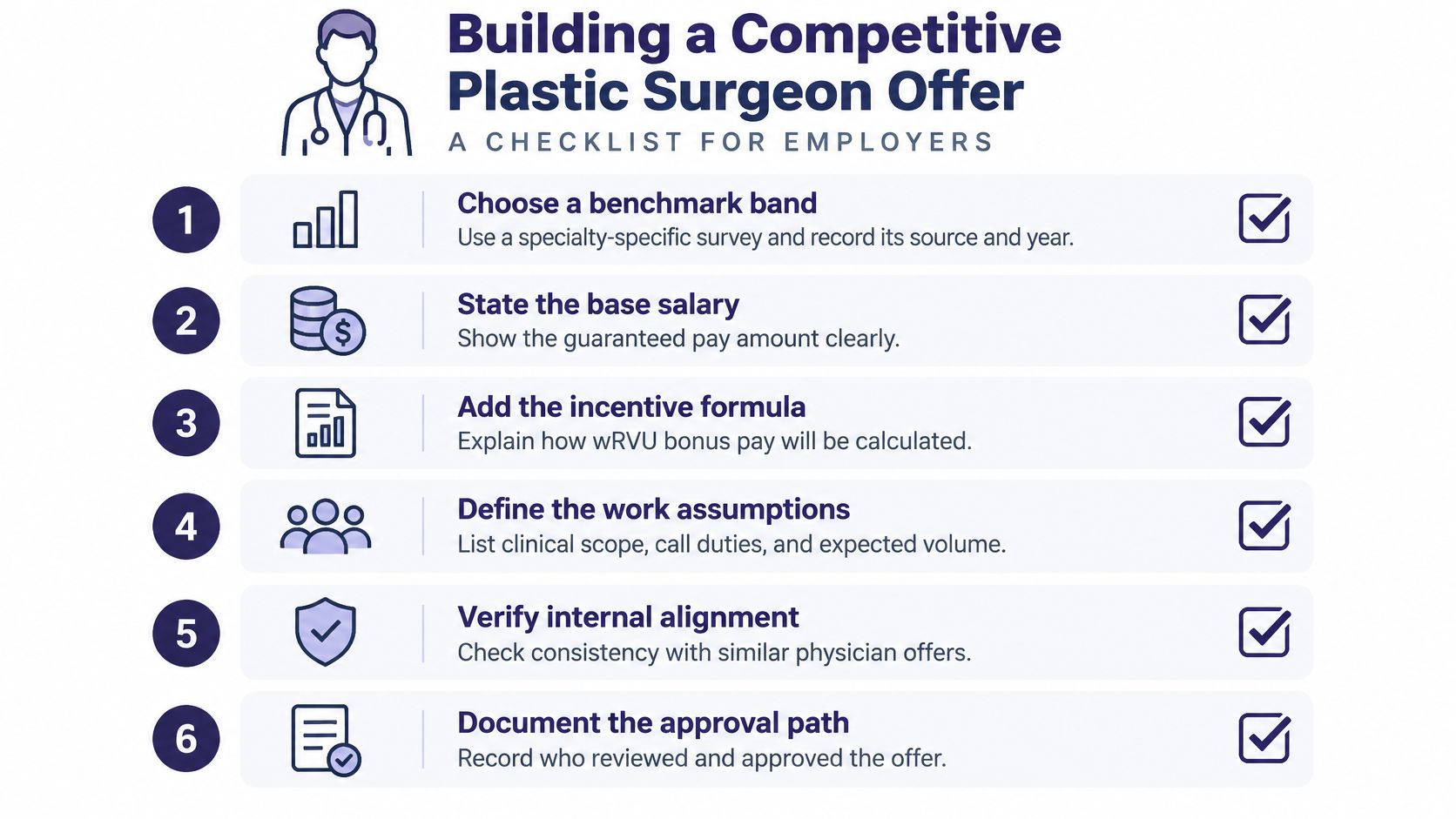
Choose a benchmark band from a specialty-specific survey, and record the source and year on the term sheet.
State the pay basis as base salary, total cash compensation, or total compensation. The word "salary" alone is ambiguous.
Set a base floor that covers ramp years, before productivity is real.
Agree the wRVU conversion rate and the first threshold year. Put both numbers in the letter, not in a side spreadsheet.
Price call per shift or per night, including weekends and trauma.
List benefits: malpractice cover, CME, retirement contributions, and relocation.
Credit non-wRVU work explicitly: teaching, research, leadership, and program building.
Set a review date tied to the next survey cycle, not "when volume stabilizes."
Urban reimbursement runs higher than rural and semirural reimbursement, so a rural offer needs its own comparison group rather than a national average. The same worksheet applies when a health system prices interventional cardiology, electrophysiology, or other hard-to-fill surgical roles, including cardiothoracic surgeon jobs. Production incentives, call, and market type still decide whether the headline is real.
This quarter, run the eight items against one open plastic surgery role and file each assumption in writing. The next candidate will negotiate the gaps you didn't write down.
American Cardiology Group recruits cardiology and cardiac surgery talent for hospitals, academic centers, and private practices, and the same compensation discipline used here keeps those offers credible. Permanent search, locum tenens coverage, and advanced practice placement all depend on a clear pay basis rather than a single national average. Visit American Cardiology Group to brief an open cardiac role against current market structure.
Comments