
VP of HR Role: Duties, Reporting and Pay in Health Systems
Cardiac capacity depends on a VP of HR who treats workforce gaps as operating risks. The role shapes whether cardiac programs have the physicians, advanced practice providers and support teams needed to staff clinics, cath labs and operating rooms.
Boards that assess candidates on policy knowledge alone overlook the cost of vacancies and their impact on clinical capacity. Require the VP of HR to own vacancy economics, workforce planning and the hiring systems that support timely staffing. That mandate makes the role directly accountable for matching available talent to service-line needs.
Table of Contents
What a VP of HR Owns in a Health System - Decision Rights Behind the Domains
Where the Role Reports and Who Reports In - Scale of the Function
Skills and Experience a Health System Should Require - Must-Haves - Differentiators That Matter in Healthcare
Compensation Benchmarks for a VP of HR - Why Setting Changes the Package
How to Evaluate VP of HR Candidates - A Six-Step Evaluation Process
Workforce Planning That Protects Cardiac Capacity - Plan by Subspecialty, Not by Headcount
Governing Data and AI in Talent Decisions - Governance Checklist
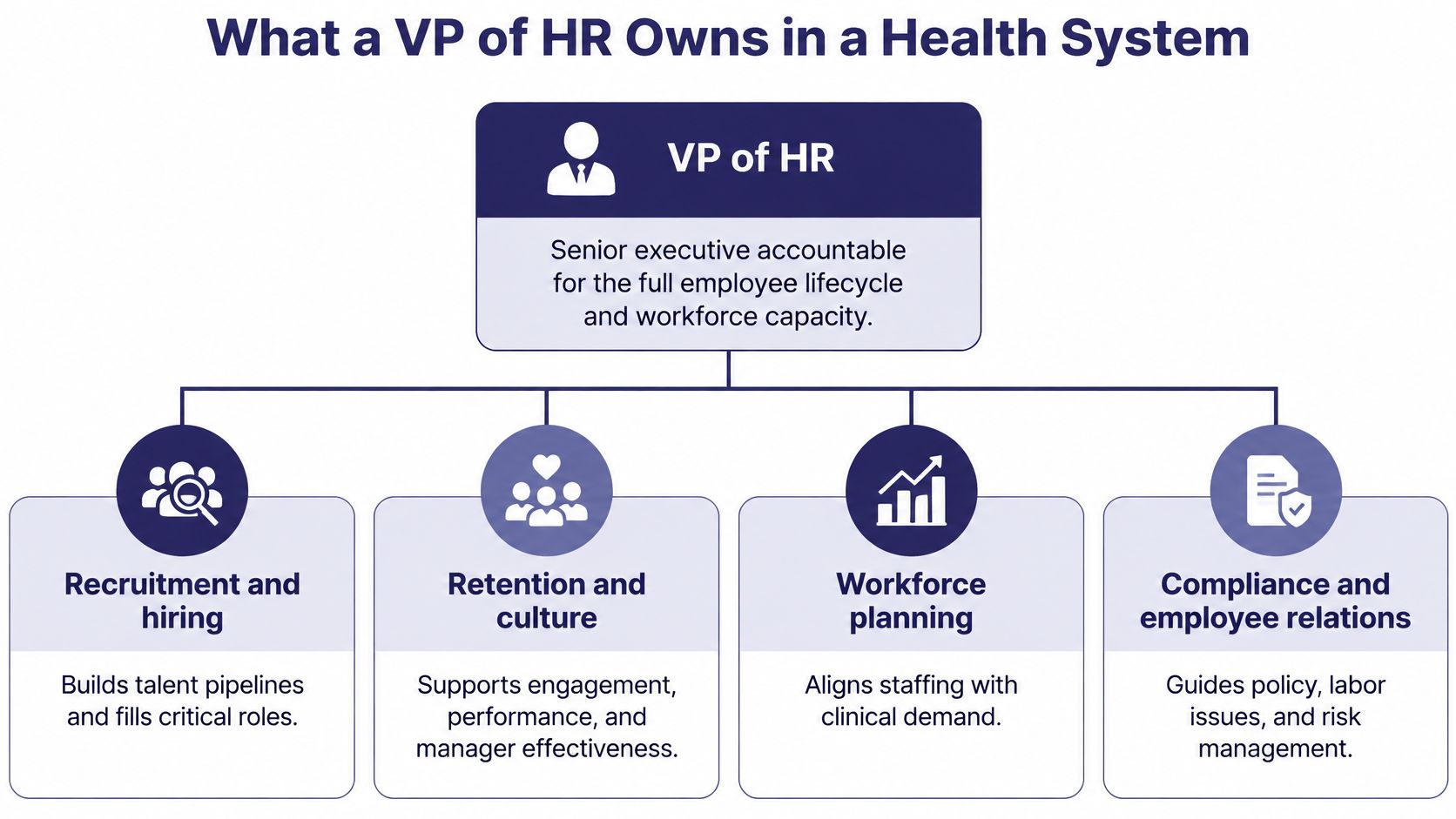
What a VP of HR Owns in a Health System
The VP of HR is the senior executive accountable for the full employee lifecycle and for the workforce capacity that clinical services depend on.
Domain | What the VP Owns | Health-System Example |
|---|---|---|
Workforce planning | Three-year headcount and skills forecast | Subspecialty coverage model for cardiology |
Talent acquisition | Physician, APP and executive pipelines | Electrophysiology search run with a retained partner |
Compensation and benefits | Pay structure, incentives and total rewards | Market-indexed bands for physicians and APPs |
Employee relations and labor | Grievances, policy and union contracts | Resolution of a nurse staffing grievance |
Compliance and employment risk | Wage-hour, leave and anti-discrimination compliance | Onboarding gate tied to credentialing status |
Development and succession | Leadership pipeline and succession plans | Named successor for a cardiac service-line chief |
Culture and retention | Engagement, turnover analysis and retention programs | Turnover analysis broken out by specialty |
Workforce analytics | Shared metrics and dashboards | Time-to-fill and offer acceptance by specialty |
Decision Rights Behind the Domains
The VP sets the three-year workforce plan, approves the pay structure for physicians and APPs, and decides which searches get internal recruiters, retained support or temporary coverage. Those aren't recommendations. They're decisions with direct consequences for referral capture, procedural volume and call coverage.
The VP also holds service-line leaders accountable for their part. A cardiology chief who delays interview feedback, a practice manager who stalls credentialing paperwork and a finance leader who blocks a market adjustment all affect time-to-fill. The VP names the bottleneck, assigns an owner and sets a deadline.
Board test: If a specialty stays unfilled for two quarters, the VP of HR should be able to explain the cost, the capacity lost and the specific decision that changes the outcome.
Three responsibilities separate a strategic VP from an administrative one. First, owning the workforce plan rather than reacting to requisitions. Second, owning the cost of vacancy rather than reporting openings. Third, sitting in the board's talent discussions where expansion, succession and program risk are decided.
That mandate matters most in difficult-to-fill clinical roles. In electrophysiology and interventional cardiology, physician recruitment, compensation design, labor relations and leadership development intersect. A weak VP treats those as separate workflows. A strong VP runs them as one capacity system.
Where the Role Reports and Who Reports In
The reporting line should give the VP authority over the constraint limiting clinical capacity. A CEO, COO, CFO or CHRO line can each work, but the trade-offs differ.
Reporting Line | Strength | Watch-Out |
|---|---|---|
CEO | Direct access to board strategy | HR priorities can become reactive to executive crises |
COO | Connects staffing to OR throughput, clinic access and call coverage | Retention may lose ground to short-term throughput |
CFO | Supports labor-cost discipline and benchmark rigor | Culture and clinical-capacity planning may receive less attention |
CHRO | Fits systems with several HR leaders and shared services | Gives the VP less direct influence on system-level capacity decisions |
Scale of the Function
Human-resources management spans employers and functions well beyond health systems. Within a health system, the VP coordinates work across talent acquisition, compensation, employee relations and workforce analytics, with direct reports typically covering:
Talent acquisition: Physician, APP, nursing and executive recruitment pipelines
Compensation and benefits: Pay bands, incentive plans and total rewards administration
Employee relations: Grievances, investigations, policy and union contract administration
HR business partners: Embedded support for hospitals, service lines and ambulatory sites
Workforce analytics: Vacancy, turnover, offer acceptance and time-to-fill reporting
A CEO reporting line fits when workforce risk is a board-level constraint and the VP needs authority across operations and finance. A COO line is a better fit when staffing is restricting throughput, clinic access or procedural scheduling. A CFO line can suit a turnaround, but labor-cost control alone will not protect clinical capacity. A CHRO line works when HR responsibilities are distributed across a larger leadership team, though the VP may have less direct influence over system-wide capacity decisions.
The reporting box matters less than the capacity constraint. Put the VP under the executive who can remove it.
Make decision rights explicit across the relevant relationships. If physician compensation is blocking recruitment, the CFO must have a clear role in resolving the pay constraint. If unfilled electrophysiology coverage is closing lab time, the COO must be able to act on coverage and scheduling. The VP should own the workforce decisions that affect vacancies and service-line capacity, while the reporting line provides access to the executive authority needed to resolve barriers. Choose the structure that connects those decisions, not the one that looks tidy on an organization chart.
Skills and Experience a Health System Should Require
Boards should separate must-haves from differentiators and score them differently. Must-haves are pass or fail. Differentiators determine who wins among qualified finalists.
Must-Haves
Progressive HR leadership: A decade or more of HR experience, with at least five years leading an enterprise HR function
Employment law fluency: Working knowledge of wage-hour, leave, anti-discrimination and labor relations requirements
Compensation design: Experience building pay structures across clinical and non-clinical roles without creating internal equity problems
Workforce analytics: Demonstrated ability to link hiring, turnover and vacancy data to operational results
A candidate who can't explain how a pay band change affects physician recruitment, APP retention and labor cost in the same answer isn't ready. The same applies to analytics. Reporting headcount isn't analytics. Connecting vacancy duration to lost clinic sessions, delayed procedures and temporary coverage spend is.
Differentiators That Matter in Healthcare
Medical staff literacy: Understanding of credentialing, privileging and onboarding dependencies
Physician contracting: Experience with productivity-based pay, call pay and recruitment incentives
Collective bargaining: Direct exposure to nursing or allied health negotiations
Board communication: A record of presenting workforce scenarios, not status updates, to directors
Credentials such as SHRM-SCP, SPHR or CCP signal technical depth. Weigh them below operating results. A credential doesn't prove a candidate can staff a cath lab schedule or resolve a call-coverage dispute.
Executives from manufacturing or retail often run disciplined talent systems. They still need a ramp period for clinical scheduling, on-call rules and credentialing timelines. Interviews should test those gaps directly with scenario questions, not rely on general leadership references.
Ask for evidence before final interviews. Request a workforce plan the candidate owned, a headcount-to-capacity model and an account of a difficult termination or union negotiation handled with counsel. Score differentiators from 1 to 5, require evidence for every score above 3 and reject polished answers that contain no numbers, owners or trade-offs.
Compensation Benchmarks for a VP of HR
A VP of HR package should reflect the clinical capacity and vacancy costs the role controls. No BLS series isolates this executive role, so use published medical and health services manager wages as context, then price the job with a matched executive survey. The BLS May 2023 figures in the AAMC workforce studies reference cover 515,100 medical and health services managers nationally, with a mean annual wage of $134,440.
Setting | Employment | Mean Annual Wage |
|---|---|---|
All medical and health services managers | 515,100 | $134,440 |
General medical and surgical hospitals | 147,250 | $145,390 |
Outpatient care centers | 38,150 | $129,500 |
VP of HR, health system | Not separately reported | Set using a matched executive survey |
Why Setting Changes the Package
Hospital roles carry broader operating demands: inpatient staffing, union exposure, physician recruitment, call coverage and round-the-clock operations. Outpatient centers usually have narrower service lines and fewer labor contracts. A hospital board that prices its VP role against an outpatient benchmark risks understating its scope and the cost of unfilled clinical positions.
The AAMC workforce outlook projects 24% growth between 2025 and 2035, representing 155,100 additional positions for medical and health services managers. Hospitals employed 28% of that group, while physician offices employed 13%. That demand strengthens the case for a competitive package when the VP owns workforce decisions that protect cardiac service capacity.
Boards can compare executive pay structures with benchmarks for chief operating officer compensation to assess internal equity. Use the comparison as a check, not a substitute for a VP-specific survey cut. The survey should match the health system's setting, scope and responsibilities.
Adjust the package for:
System scope: Number of hospitals, ambulatory sites and employed physicians
Union exposure: Number of contracts and bargaining complexity
Local labor market: Cost and scarcity in the system's recruiting footprint
Physician recruitment accountability: Direct ownership increases the role's scope and risk
Incentive design: Tie variable pay to retention, quality of hire and capacity outcomes
Match the role before setting pay. Then budget for the total cost of vacancy, including the clinical capacity lost while critical positions remain open, rather than relying on a flat percentage of salary.
How to Evaluate VP of HR Candidates
Evaluate finalists against a written mandate and a live operating problem. Personality, polish and HR philosophy are weak predictors. A candidate's workforce model is a stronger one.
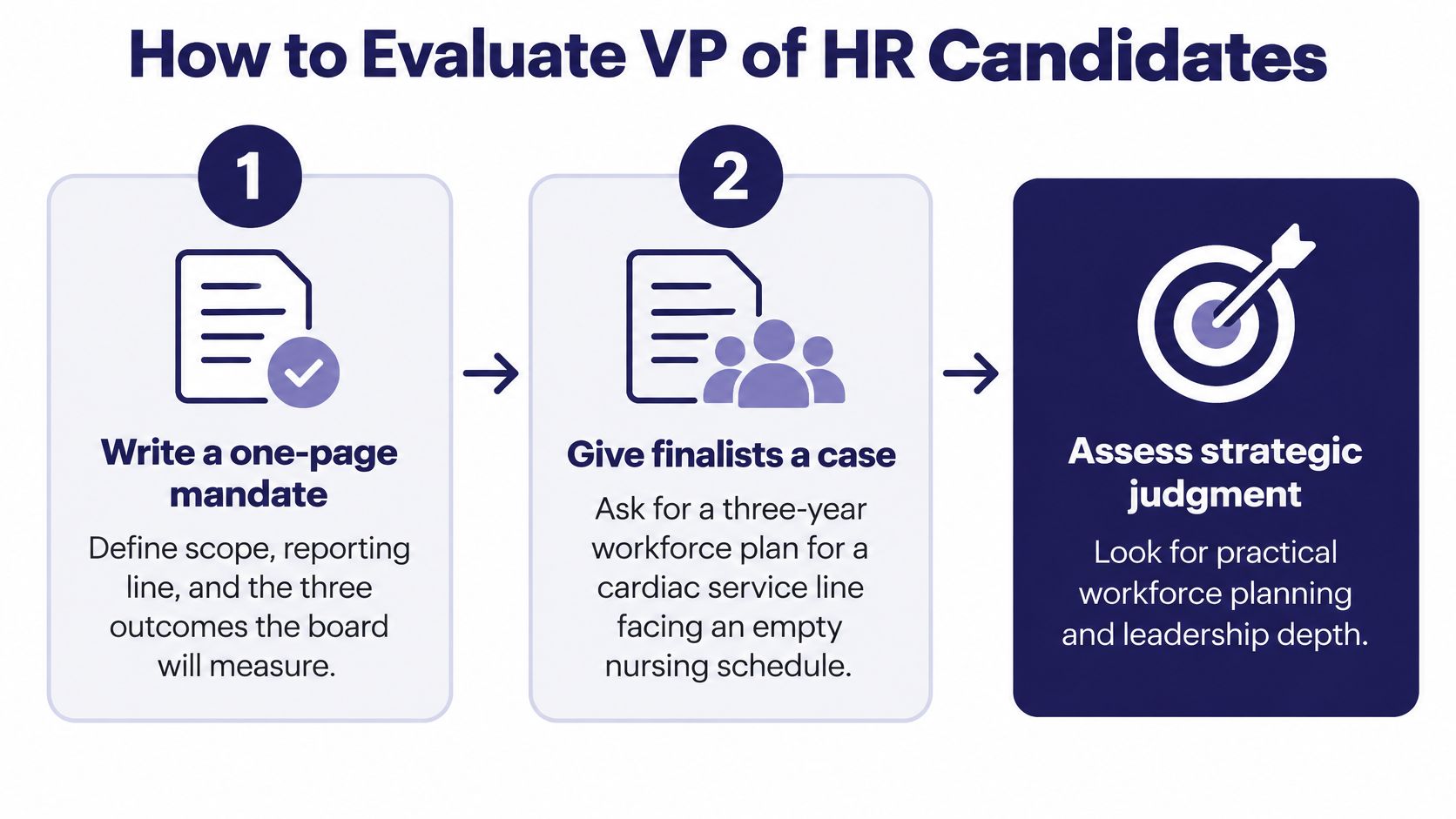
A Six-Step Evaluation Process
Write a one-page mandate. Define scope, reporting line and the three outcomes the board will measure. Without that page, every interviewer scores a different job.
Give finalists a case. Require a three-year workforce plan for a cardiac service line facing an electrophysiology vacancy and a retirement wave. Strong candidates model APP deployment, device-clinic staffing and referral risk, not just replacement hiring.
Test clinical literacy. Ask how the candidate would staff 24-hour call coverage across two hospitals. Listen for credentialing timelines, call burden, backup coverage and physician contract constraints.
Review vacancy economics. Ask for a total-cost model that the candidate would use in the first 90 days.
Check references across the lifecycle. Include one turnover case and one labor-relations case. Ask what the candidate decided, what it cost and what changed afterward.
Score quality of hire. Track outcomes at 6, 12 and 24 months, including retention, performance and program contribution. Don't let time-to-fill stand alone as success.
The cost test deserves rigor. SHRM's 2025 benchmarking survey found executive hires averaged $35,879 in recruiting cost versus $5,475 for nonexecutive hires, nearly seven times more expensive. The same survey found recruiting represented an average 26% of total HR budgets, ranging from 10% at the 25th percentile to 39% at the 75th percentile.
A credible model includes search fees, interview and credentialing labor, temporary coverage, lost clinical revenue, onboarding expense and early attrition risk. Boards should also ask for cost per successful 12-month placement. That measure exposes cheap searches that produce short-tenure hires.
The structured steps in an executive recruitment process help committees keep scoring consistent across finalists. Consistency matters because executive interviews reward confidence. A rubric forces evidence.
Decision rule: Advance only candidates who can show a model connecting hiring decisions to clinical capacity and total cost.
The common mistake is choosing the lowest search fee or the candidate who promises the fastest fill. Both choices can raise total cost through longer vacancies, poor fit and early turnover. Speed without retention is expensive.
Workforce Planning That Protects Cardiac Capacity
66% of HR leaders say workforce planning remains limited to headcount, and 61% say it covers only a one-year horizon, according to Gartner's priorities for HR leaders. A cardiac program needs a longer view. Headcount alone cannot show which services will lose capacity, where referrals may go elsewhere, or which call schedules are at risk.
Plan by Subspecialty, Not by Headcount
Physician workforce projections vary across scenarios and assumptions. National estimates cannot tell a hospital whether its local electrophysiology service has enough coverage. The VP of HR should model staffing against the clinical service plan, then show the board how each gap affects service-line capacity and vacancy costs.
Subspecialty | Capacity Risk | Planning Metric |
|---|---|---|
General cardiology | Clinic access and call coverage | Panel-to-provider ratio and new-patient wait time |
Interventional cardiology | Cath lab and PCI volume | Procedure hours per FTE and lab utilization |
Electrophysiology | Ablation capacity and device clinic follow-up | EP call coverage and device-clinic visits per FTE |
Heart failure | Advanced HF clinic continuity | New-patient wait time and continuity visit rate |
Cardiothoracic surgery | OR utilization and surgical call | OR block utilization and surgeon call burden |
Turn the service plan into staffing scenarios by subspecialty. Expanding ablation capacity requires electrophysiologists, device-clinic APPs, anesthesia support, and lab staff. Expanding a heart failure clinic requires continuity capacity, not just another physician on the roster.
Recruiters cannot solve a capacity constraint the system has not identified. Higher pay will not create more lab time or resolve excessive call burden. If retirements are concentrated in one subspecialty, the plan must address that exposure before it disrupts service.
Show the board four staffing options, with their effects on time to capacity, continuity, and cost:
Permanent recruitment: Takes longest to start, but supports continuity and program building.
Locum coverage: Bridges a gap quickly, but carries continuity and cost risks if it becomes a permanent substitute.
APP deployment: Adds clinic and device follow-up capacity when scope and supervision are clear.
Internal development: Builds succession depth, but requires lead time and protected mentoring capacity.
Retention belongs in the same workforce model as recruitment. Use physician retention strategies that address call burden, clinic support, and career progression. A retention effort protects clinical capacity only when it reduces avoidable departures or makes existing coverage sustainable.
Judge the plan by what patients and referring physicians experience. Track new-patient wait time, procedural throughput, call coverage stability, and referral leakage. A lower vacancy count is not a meaningful result if access worsens or cardiac services lose capacity.
Governing Data and AI in Talent Decisions
The VP of HR should govern workforce technology, not just buy it. That distinction determines whether AI improves hiring quality or accelerates weak decisions at scale.

SHRM findings in the iCIMS 2025 CHRO Report show integrating AI into hiring was the leading talent-acquisition priority for 22% of surveyed CHROs, followed by expanding diverse talent pipelines at 21% and improving talent analytics at 20%. Deloitte found 66% of managers and executives said recent hires were not fully prepared, with lack of experience the most common shortcoming, in findings summarized in that report.
Faster screening amplifies whatever definition of readiness sits underneath it. If the criteria undervalue clinical judgment, teamwork, research experience or program-building ability, automation will reject strong cardiologists and surgeons more efficiently. That's not innovation. That's scaled error.
Governance Checklist
Validate selection criteria against job outcomes before automating them.
Disclose AI use to candidates in plain language.
Require human review before any cardiologist, surgeon, NP or PA is rejected.
Monitor adverse impact by group and investigate unexplained differences.
Set data-retention limits for resumes, assessments and interview records.
Name one accountable owner for model performance, audits and candidate appeals.
The data architecture needs the same discipline. McKinsey's interviews with more than 100 CHROs and senior people leaders in its HR operating model research point to a consistent workforce-data backbone and a reliable service-delivery backbone. For a health system, that means one governed view across applicant tracking, credentialing, compensation, retention and workforce planning.
Set a single source of truth, data ownership rules, role-based access and service-level agreements for physician onboarding. Define time-to-fill, offer acceptance, vacancy cost and quality of hire the same way at every site. Without shared definitions, dashboards create arguments instead of decisions.
A VP who can't explain why a tool scored a candidate shouldn't deploy that tool.
The VP must be prepared to reject, audit or limit an algorithmic product that can't document its criteria or show outcome validity. Trust is the asset. Once physicians and hiring managers believe the system is arbitrary, adoption collapses and shadow processes take over.
Confirm the Mandate Before You Open the Search
Boards should complete five steps before posting the role. Skipping them produces a broad candidate pool, inconsistent interviews and a compensation dispute at offer stage.
Confirm reporting line and scope in writing. The CEO and the board compensation committee should sign the memo.
Choose the search model. Retained search fits a confidential, high-stakes executive profile. Contingency search rarely gives a board enough control over assessment quality.
Assemble the benchmark pack. Include the setting-matched BLS proxy, executive survey data and a total-cost model for current vacancies.
Set the first-year scorecard. Use the delivered workforce plan, vacancy cost per successful placement and cardiac access measures as headline results.
Decide on parallel clinical hiring. If the VP search runs alongside cardiac physician searches, the partner should align both tracks. American Cardiology Group provides permanent recruitment, locum tenens, APP placement and executive recruitment for cardiology organizations, which makes it one option when those tracks overlap. If only the HR executive role is open, a generalist healthcare executive search firm may fit better.
Do not post the role until the mandate, benchmarks and scorecard are agreed in writing.
The first action is specific. Get the signed reporting-line memo completed before any candidate outreach begins.
Health systems that need a VP of HR search aligned with cardiology recruitment can review permanent physician placement, locum tenens coverage, APP recruitment and executive search services at American Cardiology Group. The firm works with hospitals, academic centers and practices hiring across general cardiology, electrophysiology, interventional cardiology, heart failure and cardiothoracic surgery.
Comments