
Cardiac Surgery Specialty: Training Paths and Careers
By 1994, approximately 2,000 cardiac operations were being performed worldwide each day, or roughly 730,000 annually, according to the American College of Cardiology history. That scale reframes the cardiac surgery specialty as more than a demanding career path. It's a capacity commitment that determines whether a hospital can sustain coronary, valve, congenital, aortic, transplant, and structural heart services at all.
For hospital executives and surgical candidates, the central question isn't prestige. It's whether training, subspecialty depth, team infrastructure, and long-term staffing align with the cases a program intends to treat.
Table of Contents
What Cardiac Surgery Covers and How the Specialty Took Shape - Milestones That Set the Current Scope
Training Pathway From Medical School to Board Certification - Training Stages and Time to Independent Practice - What Certification Proves and What It Doesn't
Cardiac Surgery Subspecialties and What Each Involves - Cardiac Surgery Subspecialties Compared
Surgeon Supply Versus Demand Through 2075 - Cardiothoracic Surgeon Workforce Indicators
Where Cardiac Surgeons Practice and How Programs Are Staffed - Practice Settings and Coverage Requirements
Outcome Metrics Hiring Teams Should Check - Why Small Differences Need Context - Paired Measures for Credentialing Review
What Cardiac Surgery Covers and How the Specialty Took Shape
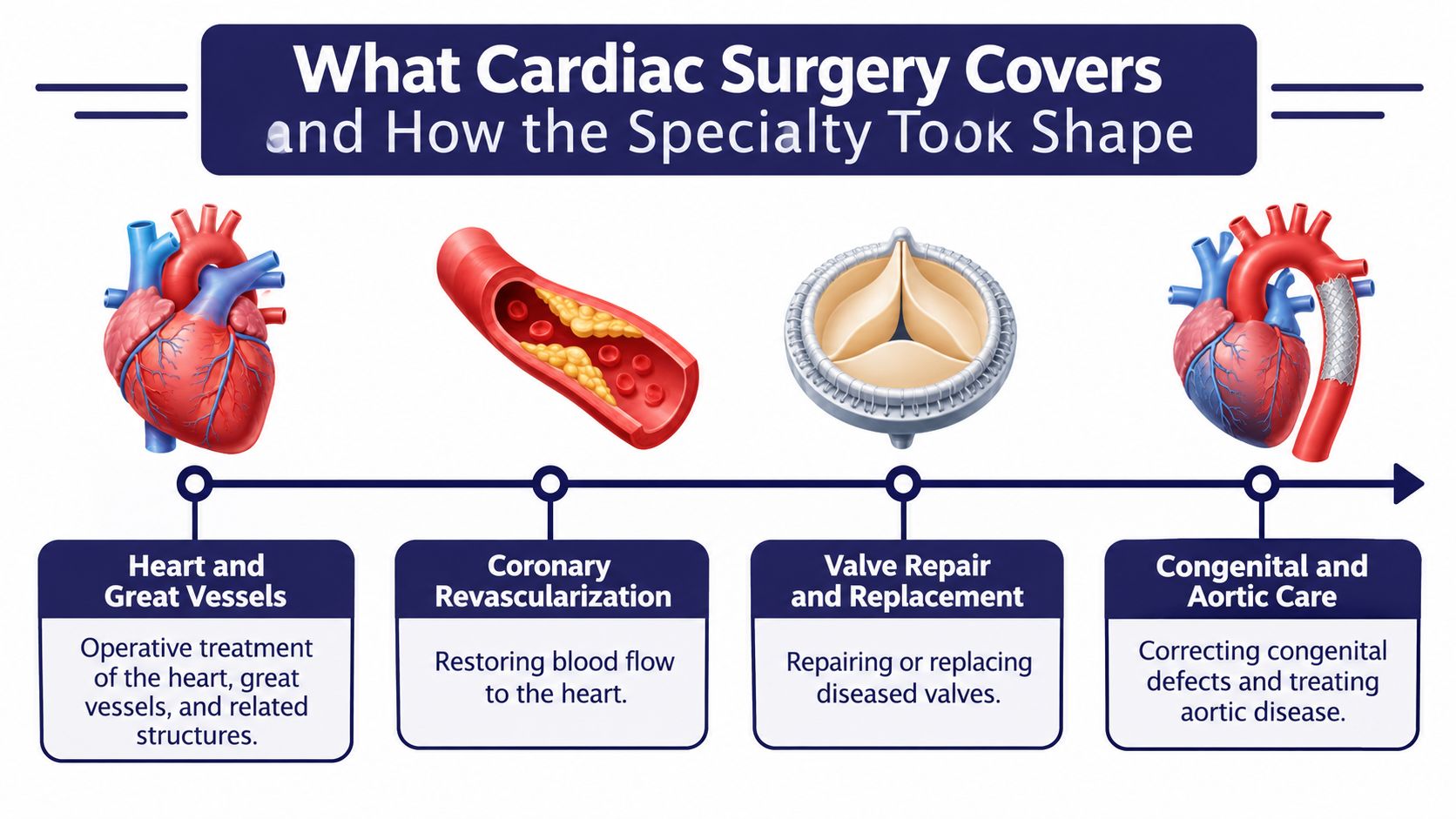
Cardiac surgery covers operations on the heart, great vessels, and related structures. Its scope includes coronary revascularization, valve repair and replacement, congenital heart correction, aortic procedures, mechanical circulatory support, and heart transplantation. Each area requires a distinct mix of surgical expertise and program capacity.
Milestones That Set the Current Scope
Early wartime repairs of penetrating heart wounds showed that direct surgery on the heart could be survivable. A mid-century operation for children with tetralogy of Fallot helped establish congenital heart surgery as a distinct area of care. Coronary artery bypass surgery expanded the field to treat obstructed heart vessels, while the first human heart transplant extended it to organ replacement.
These milestones reflect a widening clinical remit, not a single standard operation. A patient referred with multivessel coronary disease, severe aortic stenosis, and reduced ventricular function may require coordinated decisions across surgical judgment, imaging, anesthesia, perfusion, blood management, intensive care, rehabilitation, and follow-up.
Cardiac surgery works like structural repair performed while a building remains occupied: circulation, oxygenation, and organ protection must continue during the operation. Anesthesia, perfusion, and intensive care are therefore integral to the service, not peripheral support.
A cardiac surgery program should be evaluated as an operating system, not as one surgeon's case list.
For hospital leaders, the practical implication is that case capability depends on more than recruiting a surgeon. The procedures a program can sustain depend on the surrounding team and its capacity. Subspecialty choices shape that case mix, while the time required to train new surgeons affects how quickly a program can replace or expand its workforce.
Training Pathway From Medical School to Board Certification
The traditional route from medical school to independent cardiac surgical practice takes roughly eleven years. That timeline shapes workforce planning: a vacancy cannot be filled by accelerating training, so hospitals need to anticipate retirements and match recruitment to the cases their programs perform.
Medical school is a four-year MD or DO program. It provides training in anatomy, physiology, pharmacology, and clinical care, and makes graduates eligible for surgical residency. It does not qualify them to operate independently.
The traditional next stage is a five-year residency in an ACGME-accredited general surgery program. Residents develop operative technique, perioperative judgment, critical-care skills, and experience managing surgical emergencies. This broad preparation matters because cardiac patients may also have pulmonary, renal, vascular, or metabolic problems.
Training Stages and Time to Independent Practice
Stage | Typical length | Requirement | Outcome |
|---|---|---|---|
Medical school | 4 years | MD or DO degree | Eligibility for surgical residency |
General surgery residency | 5 years | ACGME-accredited program | Core operative and perioperative skills |
Cardiothoracic surgery fellowship | 2 years | ACGME-accredited fellowship after general surgery | Adult cardiac, thoracic, and congenital training |
Integrated cardiothoracic residency | 6 years | Direct entry after college, no separate general surgery residency | Alternative route to the same cardiothoracic credential |
Board certification | Written and oral examinations | American Board of Thoracic Surgery | Board certification after required training and examinations |
After general surgery residency, candidates on the traditional route complete a two-year cardiothoracic surgery fellowship. Training covers adult cardiac operations, thoracic procedures, congenital exposure, cardiopulmonary bypass, mechanical support, and postoperative critical care. Responsibility increases as candidates take on more complex operative planning and complication management under supervision.
The integrated cardiothoracic residency is a six-year direct-entry pathway that skips a separate general surgery residency. It begins after college, as shown in the table, and distributes training differently from the traditional sequence while leading to the same cardiothoracic credential.
What Certification Proves and What It Doesn't
The American Board of Thoracic Surgery awards certification after candidates complete training and pass written and oral examinations. On the traditional route, medical school and postgraduate training together take roughly eleven years before independent practice. Hospitals therefore need long-range succession planning rather than relying on a short recruitment cycle to replace a departing surgeon.
Board certification confirms training and examination completion. It does not by itself establish readiness for every procedure.
Case logs show operative exposure. Hiring teams can compare documented experience with the role's expected case mix.
Subspecialty experience varies. Experience in congenital, transplant, aortic, and structural heart surgery is not interchangeable.
Recent practice provides context. Current case volume and familiarity with the care team help assess readiness for a program's needs.
Two board-certified surgeons may have different experience with redo sternotomy, aortic arch reconstruction, durable ventricular assist devices, or neonatal congenital repair. Credentialing should pair certification with procedure-specific logs, references from operative colleagues, and a clear agreement on which cases the surgeon will perform independently, with proctoring, or not at all. That distinction helps hospitals recruit for actual service capacity, not credentials alone.
Cardiac Surgery Subspecialties and What Each Involves
Subspecialty labels only help when hospitals compare them on consistent criteria. Core procedures, added training, and typical setting reveal whether a candidate fits a program's actual referrals.
Cardiac Surgery Subspecialties Compared
Subspecialty | Core procedures | Added training | Typical setting |
|---|---|---|---|
Adult cardiac surgery | CABG, valve repair and replacement, aortic root and arch surgery | Adult cardiac fellowship | Academic and large community hospitals |
Congenital cardiac surgery | Repair of congenital defects in infants, children and adults | Pediatric or congenital fellowship | Children's and quaternary centers |
Structural heart surgery | Surgical and hybrid valve procedures, redo and multivalve surgery | Heart-team and structural heart experience | High-volume valve programs |
Transplant and mechanical circulatory support | Heart transplant, durable left ventricular assist devices | Transplant or advanced heart failure fellowship | Transplant centers |
Thoracic surgery | Lung, esophageal and chest wall operations | Thoracic surgery fellowship | Thoracic and cancer centers |
Adult cardiac surgery forms the volume base for most programs. Coronary artery bypass grafting, valve operations, and aortic root and arch surgery require reliable perfusion, anesthesia, transfusion, and intensive care capacity.
Congenital cardiac surgery operates on a different scale of anatomy and physiology. Repairs in infants and children, plus reoperations in adults with congenital disease, concentrate in children's and quaternary centers because pediatric anesthesia, perfusion, imaging, and intensive care must be specialized together.
Structural heart surgery sits at the overlap between open surgery and transcatheter therapy. Surgeons manage hybrid valve procedures, multivalve disease, failed prior interventions, and redo operations with interventional cardiology colleagues. Programs evaluating modern valve capability should also understand where minimally invasive cardiac surgery fits within operative selection, training, and infrastructure.
The risk profile explains why that expertise can't be assumed. The Society of Thoracic Surgeons introduced three additional valve-surgery risk calculators in April 2024, and its STS valve surgery risk calculator announcement reports that surgical aortic-valve replacement after prior TAVR carried operative mortality of 9.3% and stroke in 3.8% of patients.
Transplant and mechanical circulatory support adds donor evaluation, immunologic management, durable left ventricular assist devices, and long-term heart failure care. Thoracic surgery shifts focus to lung, esophageal, mediastinal, and chest wall operations, often within cancer programs.
Electrophysiology and interventional cardiology are cardiology disciplines, not surgical subspecialties. They still share the heart team, especially for structural disease, complex coronary disease, arrhythmia management, and bailout planning. Before referral, that team weighs age, frailty, anatomy, life expectancy, prior interventions, expected durability, institutional expertise, and the patient's willingness to accept a larger operation for potentially longer-lasting treatment. A credible surgical candidate must contribute to that evaluation, not accept cases after another service has selected them.
Surgeon Supply Versus Demand Through 2075
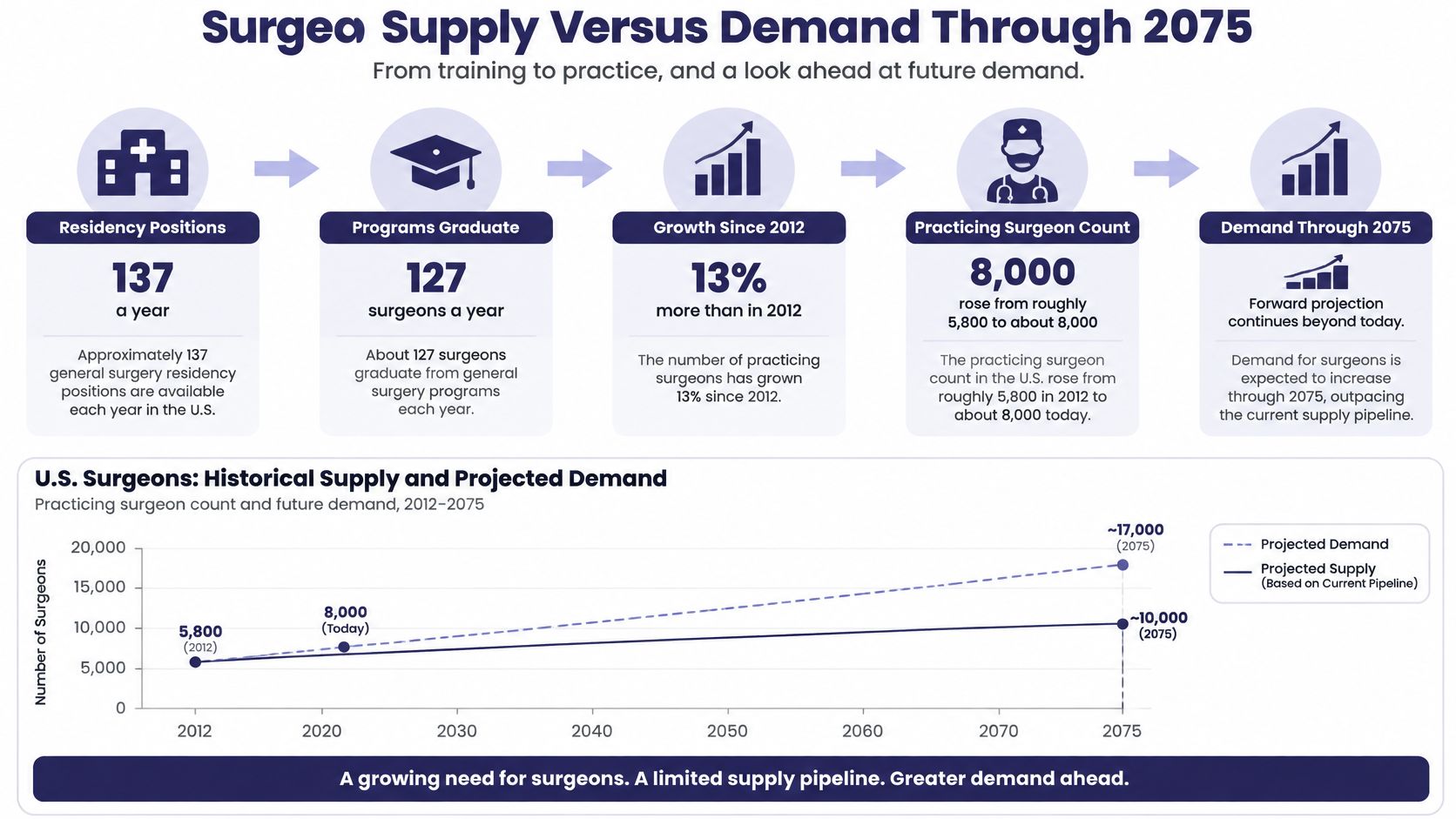
The cardiac surgery workforce is growing, yet the pipeline remains small relative to projected need. A 2025 cardiothoracic workforce analysis reported an average of 137 first-year cardiothoracic residency positions offered annually from 2019 through 2022. Programs graduated an average of 127 surgeons each year from 2018 through 2022, a 13% increase compared with 2012.
Cardiothoracic Surgeon Workforce Indicators
Indicator | Figure | Year or projection |
|---|---|---|
First-year cardiothoracic residency positions | Average 137 per year | 2019-2022 |
Surgeons graduating from programs | Average 127 per year, 13% above 2012 | 2018-2022 |
Practicing U.S. cardiothoracic surgeons | About 4,000 rising to 5,200 | 2005 to 2021 |
Annual attrition | Average 31 surgeons | Recent analysis |
Projected need | Substantial growth in surgeon capacity | By 2050 |
Projected workforce gap, recent modeling | Projected shortfall | By 2050 |
Projected workforce gap, recent modeling | Projected shortfall | By 2075 |
Earlier model shortfall | Substantial projected shortage | By 2035 |
Average caseload per surgeon | Projected increase in annual cases | By 2075 |
The number of practicing U.S. cardiothoracic surgeons rose from about 4,000 in 2005 to 5,200 in 2021, while annual attrition averaged 31 surgeons. Workforce projections indicate that growth has not closed the gap between available surgeons and anticipated demand.
Earlier models forecast a substantial shortfall. More recent modeling narrows, but does not eliminate, the projected gap through 2075. For hospitals, the distinction matters: training takes years, and subspecialty choices shape which services a new surgeon can support. Workforce planning must therefore account for both the number of surgeons and the mix of skills needed across cardiac programs.
Demography adds pressure. A 2025 U.S. workforce analysis in Heart Surgery Forum states that the U.S. population is projected to grow 8% by 2050, while the population aged 65 and older grows 42%. A larger older population can increase demand for cardiac care, while a limited training pipeline restricts how quickly hospitals can expand surgical capacity.
Executives reviewing the cardiothoracic surgeon job outlook should consider geography as well as total supply. More graduates will not resolve access gaps if they cluster in metropolitan centers. Succession planning, rural coverage design, and recruitment need to begin before vacancies appear.
Where Cardiac Surgeons Practice and How Programs Are Staffed
Practice settings differ less by prestige than by case complexity and backup requirements. The right staffing model follows the cases a hospital can support safely every day, including nights, weekends, and complications.
Practice Settings and Coverage Requirements
Setting | Case mix | Coverage model | Team requirement |
|---|---|---|---|
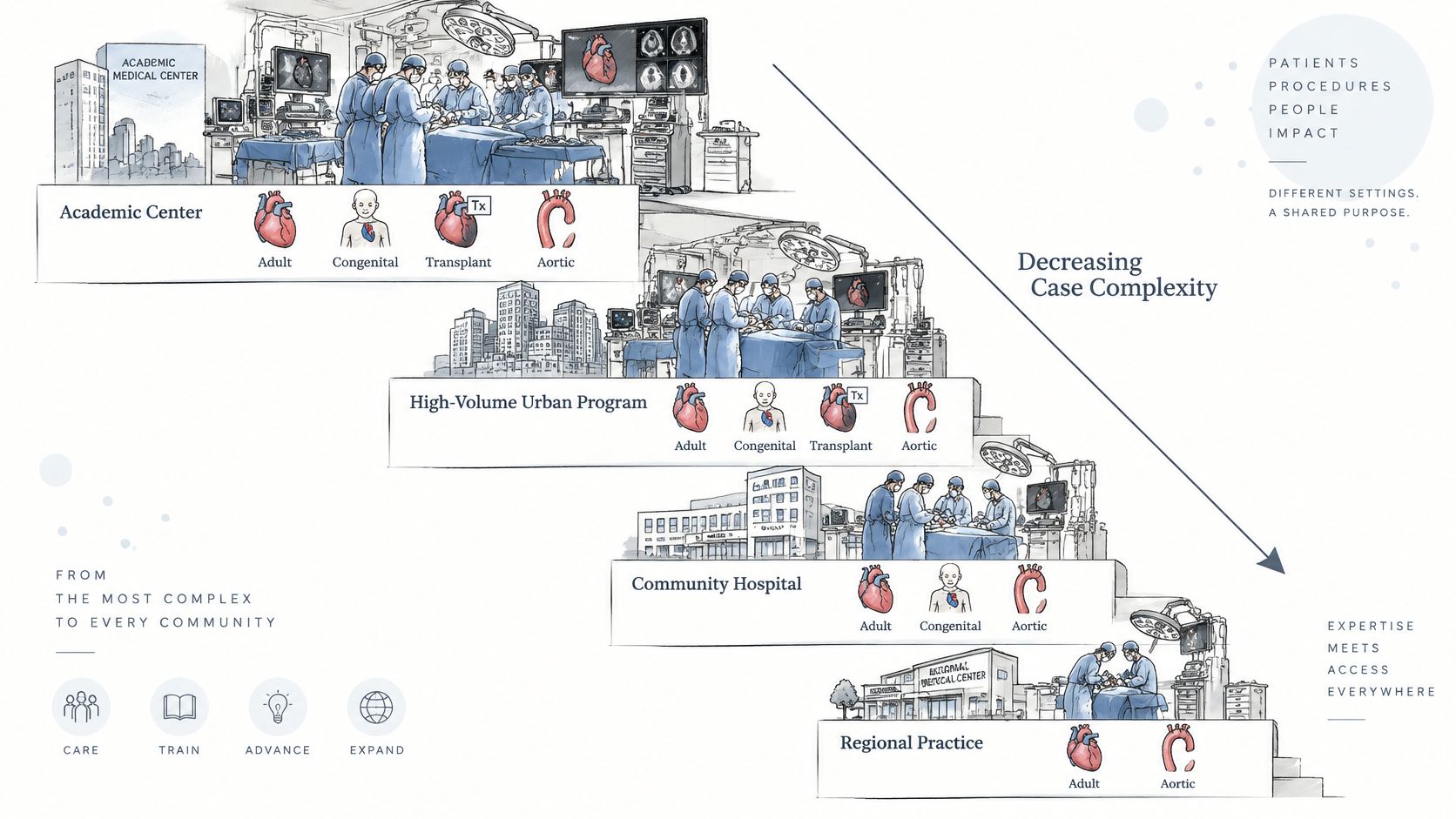
Academic and high-volume urban centers | Adult, congenital, transplant and structural work | Permanent surgeons | Full ICU, perfusion, imaging, rehabilitation and emergency backup |
Community hospitals | Coronary and valve operations | Permanent surgeon when volume is steady | ICU, perfusion, imaging, rehabilitation and emergency backup |
Rural hospitals | Selected coronary and valve cases | Visiting surgeons, locum tenens or hub-and-spoke partnership | Regional center backup and advanced practice providers |
Academic and high-volume urban centers carry adult, congenital, transplant, aortic, and structural work. They need permanent surgeons because complex referrals, research, training, and emergency backup depend on continuous presence.
Community hospitals usually concentrate on coronary and valve operations. A permanent surgeon becomes justified when volume is steady enough to maintain team proficiency and predictable call coverage. Intermittent volume creates a harder problem, because the ICU, perfusion, anesthesia, and nursing teams also need regular exposure.
Rural hospitals often rely on visiting surgeons, locum tenens coverage, or hub-and-spoke partnerships. Selected cases may remain local when imaging, ICU staffing, perfusion, rehabilitation, and transfer pathways are reliable. Advanced practice providers extend postoperative rounds, discharge coordination, clinic follow-up, and longitudinal surveillance, but they don't replace surgical backup for major complications.
Operational rule: Visiting coverage works only when the local team can manage the postoperative course after the visiting surgeon leaves.
Enhanced Recovery After Cardiac Surgery shows why staffing is a systems competency. A 2025 systematic review and meta-analysis found enhanced-recovery or fast-track programs reduced hospital length of stay by a mean 1.40 days, ICU stay by 13.22 hours, and mechanical-ventilation time by 4.68 hours versus conventional care. The same review rated certainty of evidence as low for several outcomes, so programs need eligibility criteria, rescue pathways, and auditing rather than universal targets.
A setting should therefore be assessed by the team around the surgeon. ICU staffing, perfusion depth, imaging access, rehabilitation, blood management, and emergency backup determine which recruitment promise is realistic.
Outcome Metrics Hiring Teams Should Check
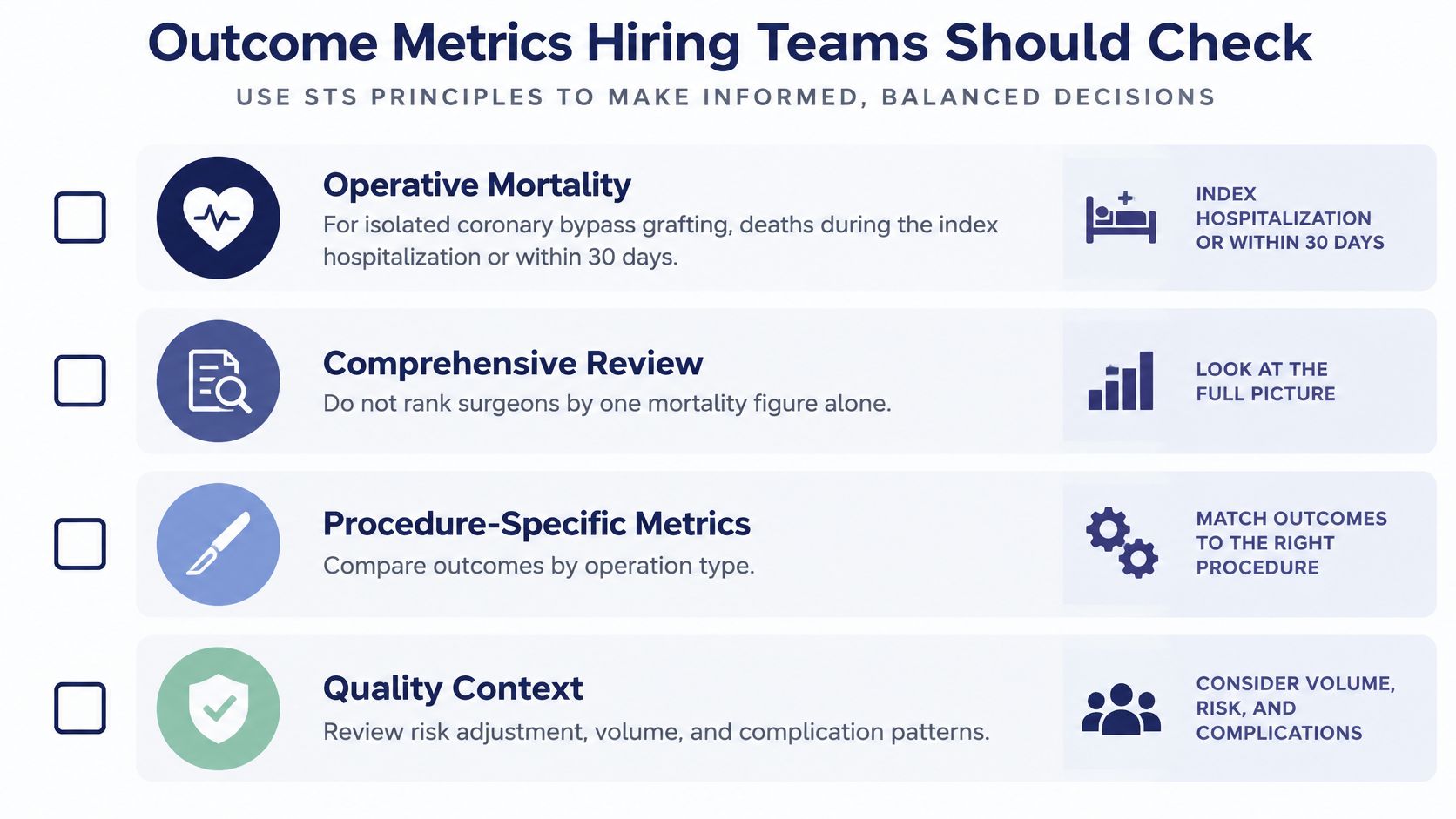
A mortality percentage alone gives an incomplete picture of a cardiac surgeon's performance. The Society of Thoracic Surgeons defines operative mortality for isolated coronary artery bypass grafting as death during the index hospitalization, even after 30 days, or death after discharge within 30 days of the procedure, according to the STS public participant report. The definition captures early post-discharge deaths that an in-hospital-only measure misses.
Why Small Differences Need Context
When CABG mortality is low, small differences in the rate can affect a quality rating. Case mix, urgency, prior operations, ventricular function, and comorbidity all shape the comparison. A crude percentage can obscure those differences.
The STS National Database contains data on nearly 10 million procedures from more than 4,300 surgeons and captures approximately 95% of adult cardiac-surgery procedures.
Risk estimation adds context to observed outcomes. The STS Adult Cardiac Surgery Risk Calculator captures more than 90% of adult heart surgeries, and its models are updated every three months.
Hiring teams should interpret mortality alongside other cardiology quality metrics, not as a standalone verdict.
Paired Measures for Credentialing Review
Complication rates: Compare major morbidity by procedure, rather than combining all cardiac cases.
Transfusion and prolonged ventilation: Review both as indicators of perioperative management and patient selection.
Stroke and renal failure: Assess these outcomes for their effects on patient function and resource use.
Readmission: Examine post-discharge performance, including follow-up and discharge planning.
Patient volume and case mix: Volume alone can misrepresent performance without the complexity of cases treated.
Validated risk adjustment: Compare outcomes with expectations that account for the patients treated.
The decision should reflect performance over time. Review several years of institutional outcomes, the surgeon's role in those results, and whether performance remained stable as case complexity changed. A surgeon with slightly higher mortality in a high-risk redo practice may demonstrate stronger capability than one with lower mortality among narrowly selected elective cases.
Plan Your Cardiac Surgery Hire or Career Step
A sound hiring process starts before a job specification is written. Each step narrows the search from institutional need to verifiable candidate capability.
Define the case mix first: Specify adult cardiac, structural, congenital, aortic, thoracic, transplant, or mechanical support volume. Separate current demand from aspirational program growth.
Choose the coverage model: Select permanent, visiting, or locum coverage based on case volume, call burden, ICU depth, perfusion availability, and emergency backup.
Verify training and certification: Confirm the training route and American Board of Thoracic Surgery status, then request case logs showing operative volume in the required subspecialty.
Request STS-based outcomes: Review several years of mortality, complications, stroke, renal failure, prolonged ventilation, transfusion, and readmission with risk adjustment.
Plan succession early: Map likely retirements and single-surgeon dependencies across the next decade before recruitment becomes urgent.
American Cardiology Group places candidates across all cardiac specialties, including general cardiology, sub-specialties, and surgical fields such as interventional and cardiothoracic surgery. Its services include Permanent Physician Recruitment, Locum Tenens Solutions, Advanced Practice Recruitment, and Executive Recruitment, with dedicated recruiters providing personalized support to both the facility and the locum provider throughout the process.
Candidates should apply the same checklist in reverse. Strong programs disclose case volume, call structure, ICU and perfusion support, heart-team participation, mentorship, and follow-up responsibilities. Vague answers about team depth or outcomes reporting deserve direct follow-up before contract discussions.
Turn the checklist into a shortlist scoring sheet covering case mix, coverage model, board status, logged volume, team support, and five-year outcomes before any interview round.
That scoring discipline protects both sides. Hospitals avoid hiring a credential that doesn't match the intended service line, and surgeons avoid joining programs that lack the infrastructure required to practice safely.
American Cardiology Group helps hospitals, academic centers, and community programs recruit cardiac surgeons and related specialists through permanent recruitment, locum tenens coverage, advanced practice recruitment, and executive search. Surgical candidates can also explore opportunities matched to subspecialty training, case volume, and program support. Visit American Cardiology Group to discuss a current vacancy or a planned career move.
Comments