
How to Hire a Physician: A Cardiology Recruitment Guide
The United States could face a shortfall of between 13,500 and 86,000 physicians by 2036, with 20,200 to 40,400 of that gap in primary care and 10,100 to 19,900 in surgical specialties, according to projections in the Association of American Medical Colleges 2024 workforce report. That range reframes how to hire a physician from a recruiting task into an operations problem. A signed offer doesn't restore cath lab coverage, protect call, or open clinic access. Clinical productivity does.
Hospitals lose candidates in the gaps between stages, not only at salary negotiation. The role is vague, the panel interviews slowly, the offer omits call, or credentialing starts after the start date has already been promised. A disciplined search treats every handoff as owned work with a due date.
Table of Contents
Physician Hiring Stages, Owners and Lead Times - Where the Timeline Breaks - A Worked Example
How to Define the Role Before You Post It - Five Steps Before the Posting
Sourcing Cardiac Specialists Beyond Job Boards - Match the Channel to the Scarcity - Outreach That Earns a Reply
Structured Interviews and Scoring That Hold Up - A Repeatable Interview Sequence
Negotiating the Offer Before Credentialing Starts - Write the Schedule the Candidate Was Sold - Define Privileges Inside the Offer Conversation
Credentialing and Privileging Without Losing the Candidate - Run the Checks in Parallel - Protect Coverage During the Runway
Onboarding and Retention Tracking From Day One - The First 90 Days in Writing
Physician Hiring Stages, Owners and Lead Times
A cardiology search doesn't move in a straight line. Credentialing, onboarding planning, and retention tracking overlap with interviewing and contracting, and the process stalls when leaders treat those tracks as sequential. The table below sets the minimum operating structure before a posting goes live.
Stage | Key output | Owner | Typical lead time |
|---|---|---|---|
Role definition | Validated scope, call model and competencies | Department chair with finance | 2-4 weeks |
Sourcing and outreach | Qualified slate of three to five candidates | Recruiter with service-line director | Part of the 119-day median search-to-fill |
Structured interviews | Scored comparison and recommendation | Interview panel | 2-3 weeks |
Offer and contract | Signed agreement with written resources | CMO and HR | 1-2 weeks |
Credentialing and privileging | License, DEA, privileges and payer enrollment | Medical staff office and credentialing team | From offer through start, about 110 days beyond median search-to-fill |
Onboarding | Schedule, EHR access and 90-day plan | Department leader and HR | 90 days |
Retention checks | 30-, 60- and 90-day and quarterly reviews | Accountable physician leader | Year one |
Where the Timeline Breaks
Role definition belongs to the department chair or service-line director, with finance validating volume, compensation structure, and support costs. The recruiter owns sourcing, but the service-line director owns the clinical pitch, including case mix, program growth, and subspecialty gaps. If those two accounts don't match, candidates hear one role during outreach and a different role on site.
Interviews require a panel owner who controls scheduling, scoring, and the recommendation deadline. HR and the CMO own contract terms, while the medical staff office owns privileging and coordinates license, payer, and malpractice dependencies. Onboarding sits with the department leader and HR, and retention checks need a named physician leader, not a generic HR follow-up.
Practical rule: The stage that breaks most often is the one nobody owns by name.
Lead times in the table are planning ranges, not guarantees. State licensing queues, medical staff committee calendars, and payer enrollment don't compress because a service line is under pressure. Leaders should use the ranges to set internal deadlines, then track slippage weekly once a finalist emerges.
A Worked Example
Say an electrophysiology search is posted in March. Interviews finish in May, an offer is signed in June, and only then does someone request privilege forms for ablation, device implantation, and lead management. That physician rarely starts before autumn, and the EP lab schedule promised during recruitment sits uncovered in the interim.
The avoidable error isn't the regulatory timeline. It's waiting until June to start work that could have begun during final interviews. Before posting, apply a simple test: if leadership can't name the owner and due date for every row, the search isn't ready to post.
How to Define the Role Before You Post It
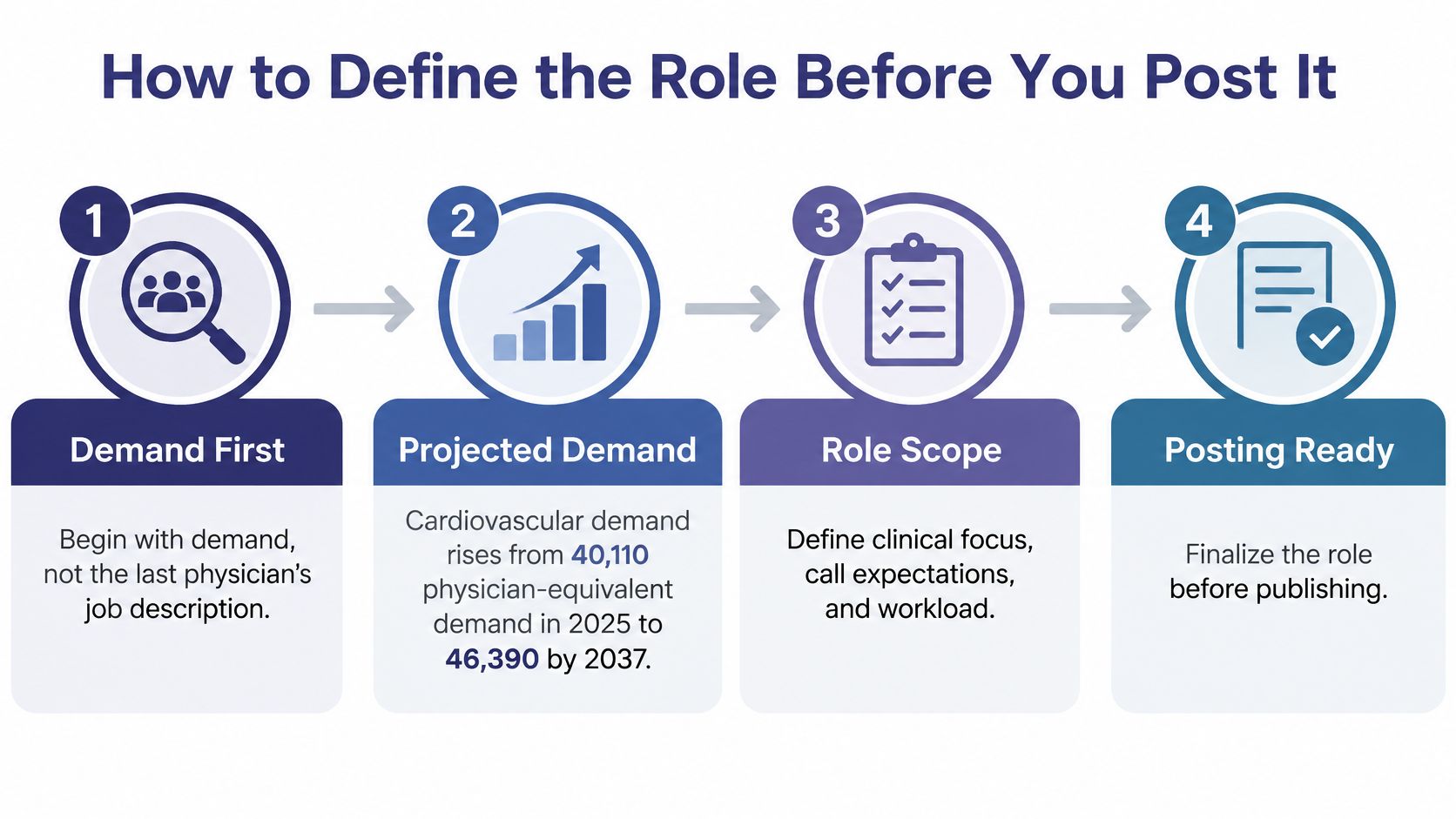
Compensation cannot repair a role that is poorly designed. Cardiovascular demand is projected to rise from 40,110 physician-equivalent demand in 2025 to 46,390 by 2037, a 15.7% increase, while supply is projected to grow only 2.0%, from 37,000 to 37,730, in research indexed by PubMed on cardiovascular workforce supply and demand. In a tight market, candidates weigh workload, call predictability, and available support alongside salary. A higher offer may secure acceptance, but an unclear or unsustainable workload can still cost the hire.
Many rural U.S. counties have no local cardiologist, and nonmetropolitan areas face weaker supply adequacy than metropolitan areas. A community hospital that copies an urban academic job description and offers more money may still leave the underlying workload problem unsolved. Define the work before setting the compensation: the aim is a role that can support both access and the physician's path to clinical productivity.
Five Steps Before the Posting
Quantify panel demand. Count patients in the catchment area who need cardiology evaluation, chronic disease management, and follow-up. Compare that demand with a realistic panel per cardiologist, and account for wait times and unfilled referrals rather than relying on current visit volume alone.
Measure call burden and procedural hours. Separate clinic, inpatient rounding, cath, EP, imaging, and call responsibilities. If a role is described as general cardiology with occasional procedures, specify the hours and expectations attached to each.
Track referral leakage and travel time. Identify which patients leave for other systems, what services they seek, and how far they travel. This can reveal missing competencies, such as heart failure, device management, or structural evaluation.
Define required competencies. Name the clinical work precisely, including device implant, heart failure clinic, imaging interpretation, or structural work where applicable. A clear scope helps prevent disagreement about duties and privileges later.
Choose the staffing model. Decide whether the service needs a full-time employed cardiologist, an APP-led clinic, a partnership, or a hybrid arrangement with telecardiology and rotating subspecialists.
A critical access hospital with one cardiologist may need a full-time core physician supported by telecardiology, advanced practice clinicians, protected procedural time, predictable call, and locum coverage during ramp-up. This arrangement spreads the work without expecting one physician to handle every consult, procedure, and night of call. Clear scope also helps candidates assess the role before applying. Well-structured physician job descriptions give candidates a concrete basis for that decision.
Field | What to record | Example entry |
|---|---|---|
Clinical scope | Subspecialties and services covered | General cardiology with device clinic |
Call model | Frequency, backup and stipend | One in four call with telecardiology backup |
Procedural time | Cath, EP and imaging hours per week | Six-hour weekly cath block |
Panel target | Patients per cardiologist the practice can sustain | Set from catchment count and referral leakage |
Staffing model | Employed, APP-led, partnership or hybrid | Full-time core with rotating subspecialists |
Use the finished specification to shape the posting, interview rubric, and offer letter. Every commitment discussed with candidates, from clinical scope to call and procedural time, should be stated clearly enough to guide hiring and support the physician's transition to clinical productivity.
Sourcing Cardiac Specialists Beyond Job Boards
A job board post reaches physicians who are already looking. It doesn't solve a shrinking pool. The number of cardiovascular patients per cardiologist is projected to rise from 1,087 in 2025 to 1,700 by 2035, an increase of approximately 56%, according to the joint analysis from the American College of Cardiology, American Heart Association, and MedAxiom. The same source reports 26.5% of cardiologists were age 61 or older in 2019.
That age profile turns succession planning into sourcing. Programs should map retirement risk by subspecialty and site, then start relationship building before a resignation letter arrives. Waiting for a vacancy concedes the strongest candidates to systems that already know the fellowship classes and regional practice groups.

Match the Channel to the Scarcity
Retained search fits scarce electrophysiology and heart failure roles, where the candidate pool is small and many viable physicians aren't applying publicly. Fellowship program directors, recent graduates, and physicians completing advanced training should be contacted before they finish training, with each graduating class tracked by year. Contingency recruitment can work for general cardiology where the pool is broader, provided the slate is screened against the written role specification.
For interventional cardiology and cardiothoracic surgery, the search should widen to regional centers early. Procedural volume, team composition, and program trajectory matter more in first outreach than a salary range with no clinical context. Candidates evaluate whether they'll maintain competence and whether the program will support complex work safely.
Locum tenens coverage protects access while a permanent search runs, but it shouldn't become an unplanned substitute for recruitment. Use it to cover call, clinic, or procedural gaps with a defined scope and end point. American Cardiology Group offers Permanent Physician Recruitment, Locum Tenens Solutions, Advanced Practice Recruitment and Executive Recruitment services, which reflects the range of channels a cardiac program may need across a single workforce plan.
Outreach That Earns a Reply
Effective outreach leads with the program, case mix, leadership, and the specific clinical problem the hire will solve. It also addresses relocation support, spousal employment help, and remote-friendly elements such as telecardiology follow-up where clinically appropriate. Generic messages about a great opportunity don't distinguish one shortage-market employer from another.
Set a target of three to five qualified candidates before scheduling interviews. That slate creates comparison without turning the process into a months-long search for a perfect profile that the market may not supply.
Structured Interviews and Scoring That Hold Up
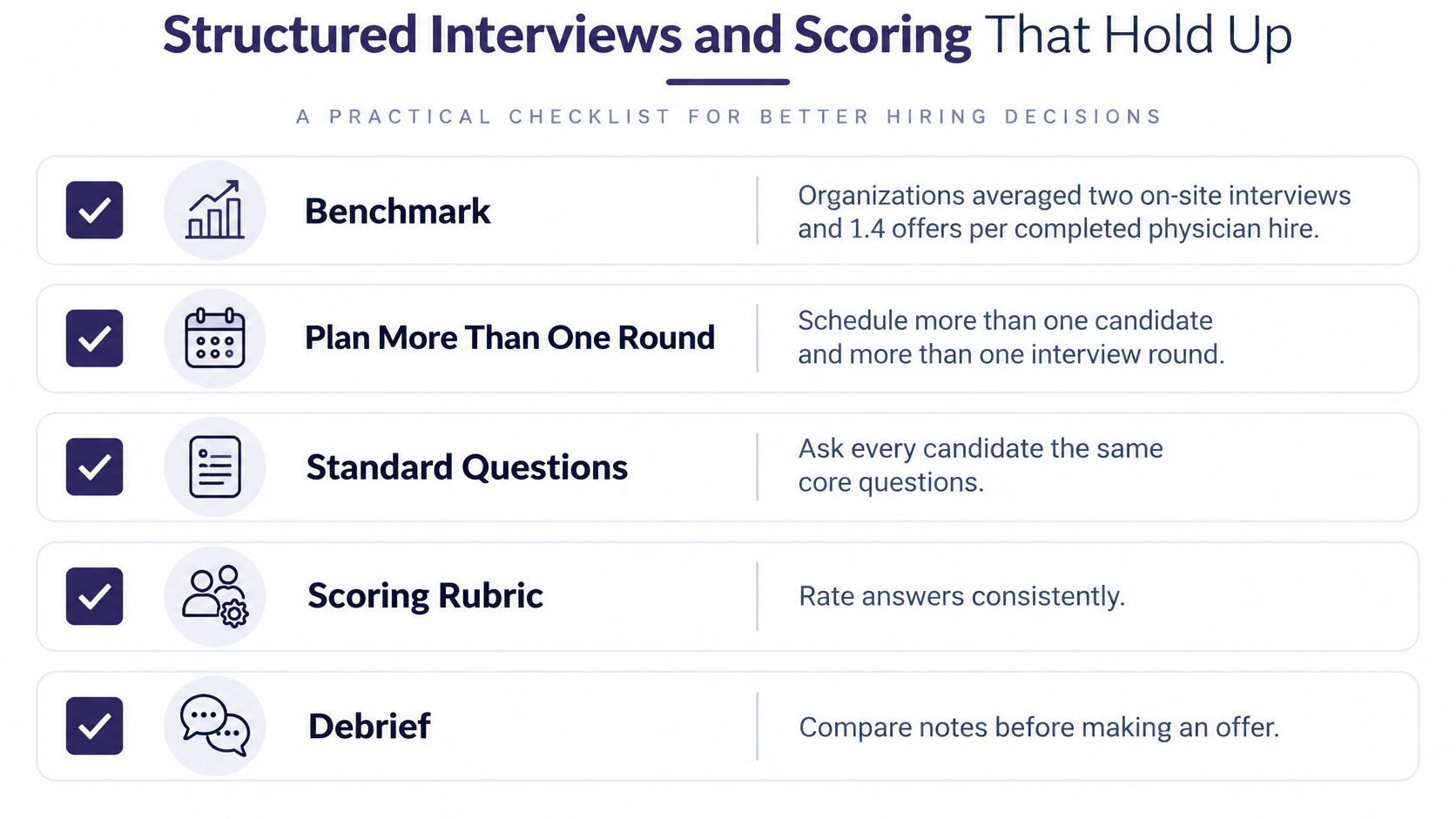
Organizations averaged two on-site interviews per physician hire and 1.4 offers per completed hire, according to the American Medical Association summary of the 2025 AAPPR Physician and Provider Recruitment Benchmarking Report. That report analyzed more than 15,000 searches conducted by 128 participating organizations, and 61% of those searches were for physicians. Planning for one candidate and one conversation isn't a hiring process. It's a hope.
Academic medical centers and university hospitals had the highest average number of physician interviews per hire, followed by multihospital or integrated delivery systems. Organizations employing 200 to 749 physicians and other health professionals extended an average of 1.6 offers before completing a hire, compared with approximately 1.3 offers among organizations of other sizes. Calendar time and candidate volume should reflect that reality.
A Repeatable Interview Sequence
Lock the core questions. Ask identical core questions of every candidate so answers can be compared on the same clinical and behavioral dimensions.
Assign the right panel. Include a clinical peer, an administrator, a nursing or cath lab lead, and an APP where the role depends on team-based care.
Build a scoring rubric. Rate procedural competence, call coverage, quality metrics, and team fit, with written anchors for scores of one, three, and five.
Score independently first. Each panelist records scores and evidence before group discussion, which reduces anchoring on the most senior voice in the room.
Verify references directly. Confirm training, licensure, board certification, employment, and privileges with the sources, using disciplined reference checking best practices rather than candidate-supplied summaries alone.
Discuss expectations openly. Address call, productivity, clinic templates, and procedural access before an offer is drafted, not after acceptance.
A useful question for an electrophysiologist is direct: describe a complication from an ablation and how the debrief was led afterward. The answer reveals procedural judgment, transparency, and team leadership under pressure. Follow-up questions should probe what changed in practice after that event.
Culture fit becomes defensible only when panelists can point to observable behavior, such as handoff quality or multidisciplinary case review, instead of personal comfort.
Unstructured impressions produce inconsistent decisions and weak documentation. A standardized rubric makes candidate comparisons auditable and gives the hiring authority a record that holds up when the preferred candidate declines and the second-ranked candidate needs a timely offer.
Negotiating the Offer Before Credentialing Starts
The offer letter is an operating document, not a summary of good intentions. It should specify base or productivity-based compensation, signing and relocation terms, call stipend or call equity, protected procedural time, support staff, clinic templates, leadership access, and CME allowance. Any family or geographic accommodations agreed during interviews belong in writing as well.
Call and productivity assumptions need explicit language. State the call frequency, backup structure, post-call expectations, and how call is credited or paid. State the productivity model, the measurement period, and which clinic, inpatient, imaging, and procedural work counts toward it.

Write the Schedule the Candidate Was Sold
Say a cardiologist is promised a six-hour weekly cath block during recruitment but receives three hours after starting. The gap affects income, procedural competence, referral credibility, and trust in leadership within the first quarter. A written schedule in the offer doesn't eliminate operational change, but it creates a clear baseline for any later adjustment.
The same discipline applies to clinic templates and support. Record APP support, nursing ratios where relevant, device clinic staffing, imaging slots, and administrative time. If those resources are phased in during ramp-up, state the sequence and target dates rather than presenting a future state as day-one reality.
Define Privileges Inside the Offer Conversation
Before the offer is final, list each procedure and device competency the physician will perform. For cardiology, that may include diagnostic catheterization, percutaneous coronary intervention, cardioversion, transesophageal echocardiography, pacemaker or defibrillator implantation, and ablation, depending on the role. Those named activities become the privileging request sent to the medical staff committee.
This sequence prevents a common failure. A contract promises an EP program, but the privilege application omits a procedure discussed during interviews, and the physician arrives unable to perform the work used to justify the hire. Clinical leadership should reconcile the offer, the role specification, and the privilege list line by line before signature.
Compensation transparency: Show how base pay, productivity, quality incentives, and call pay interact over a full year.
Resource commitments: Attach procedural blocks, clinic sessions, support roles, and equipment dependencies to dates and owners.
Accountability: Name the accountable physician leader and schedule the 30-day check-in before the contract is signed.
Negotiation shouldn't be treated as a contest over isolated terms. The objective is a workable clinical job that can be credentialed, scheduled, staffed, and retained. When a candidate pushes for clarity, that's usually diligence, not resistance.
Credentialing and Privileging Without Losing the Candidate
A median physician search-to-fill time of 119 days can still produce a start 229 days after the job was posted, according to benchmarking summarized by Becker's Physician Leadership. That gap sits in state licensure, payer enrollment, credentialing, hospital privileging, malpractice review, and service-line integration. Recruiters may count the signed offer as completion, but patients and call panels experience the later date.
For cardiology, privileges are highly specific. Device competency, ablation, intervention, imaging, and call obligations each require documentation that matches training and recent case experience. Time to clinical productivity should be the primary metric, with an owner assigned to every approval and dependency.
Requirement | Verified through | Start by |
|---|---|---|
State medical license | State medical board | Final interview round |
DEA registration | Drug Enforcement Administration | Offer |
Board certification and fellowship training | Specialty board and training program verification | Final interview round |
Hospital privileges, including procedures | Medical staff committee | Offer |
Payer enrollment | Commercial and government payers | Offer |
Malpractice and sanctions history | National Practitioner Data Bank query and carrier review | Offer |
Clinical references | Direct contact with prior chiefs and program directors | Final interview round |
Run the Checks in Parallel
Start license and DEA verification as soon as a candidate reaches the final round, subject to the organization's compliance process. Send privileging requests with the offer, naming the procedures the physician will perform so the medical staff committee can act without reconstructing the role from interview notes. Run payer enrollment, malpractice review, and sanctions checks in parallel rather than waiting for signature to release each step.
A clear explanation of what healthcare credentialing involves helps clinical leaders understand why document collection can't wait until the contract is countersigned. Candidates also need a single contact, a document checklist, and realistic status updates. Silence during credentialing reads as disorganization and gives competing employers time to reopen the conversation.
Protect Coverage During the Runway
Say a community hospital promises an EP hire a fixed start date but hasn't arranged interim ablation, device, or call coverage. The procedural block stays uncovered, referrals leak, and existing physicians absorb call that wasn't in the plan. Interim coverage needs its own owner, compliance check, scope, and written end date.
American Cardiology Group's team manages credentialing and compliance for locum providers so facilities can onboard quickly. Regardless of the staffing route, privileges should be verified before the offer is treated as final. A signed candidate who can't start leaves emergency coverage, cath lab capacity, and referral access constrained.
Onboarding and Retention Tracking From Day One
A placement is successful when the physician reaches durable clinical productivity and fits the organization, not when the offer is signed. Track progress at 12, 24, and 36 months. Overall physician turnover has a median of 7.3%, and nearly 60% of physicians leave their first post-training job within three years, according to benchmarks summarized in the AAMC physician workforce shortage overview. More than 25% consider leaving within the first year.
Positive onboarding is associated with higher job satisfaction. Retention work starts before arrival: translate offer commitments into scheduled resources, clarify workload, and resolve gaps that could delay clinical productivity. In shortage markets, a workable role and clear expectations can matter as much as compensation.
The First 90 Days in Writing
In week one, confirm clinic templates, scheduling and EHR access, and a shared list of any remaining onboarding milestones. Schedule introductions to primary care, emergency medicine, hospital medicine, and surgical referral partners. A named mentor from the same subspecialty gives the physician a direct contact for clinical and operational questions.
Set check-ins at 30, 60, and 90 days, then quarterly through year one. Ask whether the schedule is sustainable, leadership access matches what was promised, call is shared fairly, and resources are arriving on time. Review compensation transparency, support staff, procedural resources, advancement, and family or geographic needs together. Workload clarity can prevent an avoidable mismatch; adding salary alone will not fix an unsustainable schedule.
A retention conversation held after a resignation is an exit interview with better timing.
Four recurring placement risks are an idealized role description, unstated call or productivity assumptions, delayed credentialing, and no formal retention strategy. Address these during recruitment: the accountable physician leader should document concerns and assign corrective actions with deadlines.
Before posting the next role, choose three retention metrics and name an owner for each. Options include 12-month retention, time to a full clinic and procedural schedule, and adherence to promised call frequency. Review results after each search cycle. If outcomes fall short, adjust the role, interview rubric, or onboarding plan rather than relying on a higher offer alone.
For hospitals and practices hiring in general cardiology, interventional cardiology, electrophysiology, heart failure, or cardiothoracic surgery, American Cardiology Group offers permanent physician recruitment, locum tenens solutions, advanced practice recruitment, and executive recruitment focused exclusively on cardiac specialties. Its services connect facilities with cardiac candidates across the United States. Visit American Cardiology Group to discuss a vacancy, interim coverage need, or succession risk.
Comments