
Cardiothoracic Surgery Residency: Pathways and Match Odds
Thoracic surgery training positions were fully filled in the 2025 Thoracic and Vascular Surgery Match report. That points to a capacity constraint, rather than a shortage of applicant interest. For hospital executives and surgical candidates, cardiothoracic residency is a workforce pipeline: entry requirements, operative opportunities, and institutional support shape the supply of surgeons available for future recruitment.
Table of Contents
Two Routes Into Cardiothoracic Surgery Training - Career stage determines the practical choice
What the Six-Year Integrated Curriculum Covers - Early exposure should produce observable development - Advanced training requires breadth and appropriate limits
Case Volume Rules Trainees Must Meet - Pathway selection changes how volume should be interpreted - Case-log review should identify gaps before scheduling becomes urgent
Applicant Odds in the Integrated Match - Application preparation needs a sequence - Additional credentials need a defined purpose
Independent Fellowship Entry and Its Selectivity - Full subscription does not make fellowship a fallback - Established surgical preparation changes the recruiting relationship
Program Quality Beyond Prestige and Match Rate - Program quality should be tested with operational questions - Technology doesn't substitute for a sustainable learning environment
Choose a Pathway and Plan Program Capacity - Candidates need a documented program comparison - Employers should establish educational capacity before recruitment
Two Routes Into Cardiothoracic Surgery Training
Integrated and independent cardiothoracic surgery routes compared
Route | Entry point | Training length | Cardiothoracic exposure begins | Prerequisite |
|---|---|---|---|---|
Integrated thoracic surgery residency | Directly after medical school | Six years | Within the first three years | Medical school graduation |
Independent thoracic surgery fellowship | After another surgical residency | 60 months of general surgery, followed by the receiving program's fellowship term | Specialty fellowship begins after general surgery training; earlier exposure should be checked individually | 60 months of general surgery residency and American Board of Surgery certification |
The ACGME integrated thoracic surgery requirements describe the six-year integrated pathway, including progressive cardiothoracic exposure during the first three years; the associated joint-training guidance identifies 60 months of general surgery before American Board of Surgery certification and subsequent thoracic fellowship. The distinction is between early specialty commitment and later specialization after broad surgical preparation, not between shorter and longer versions of identical training.
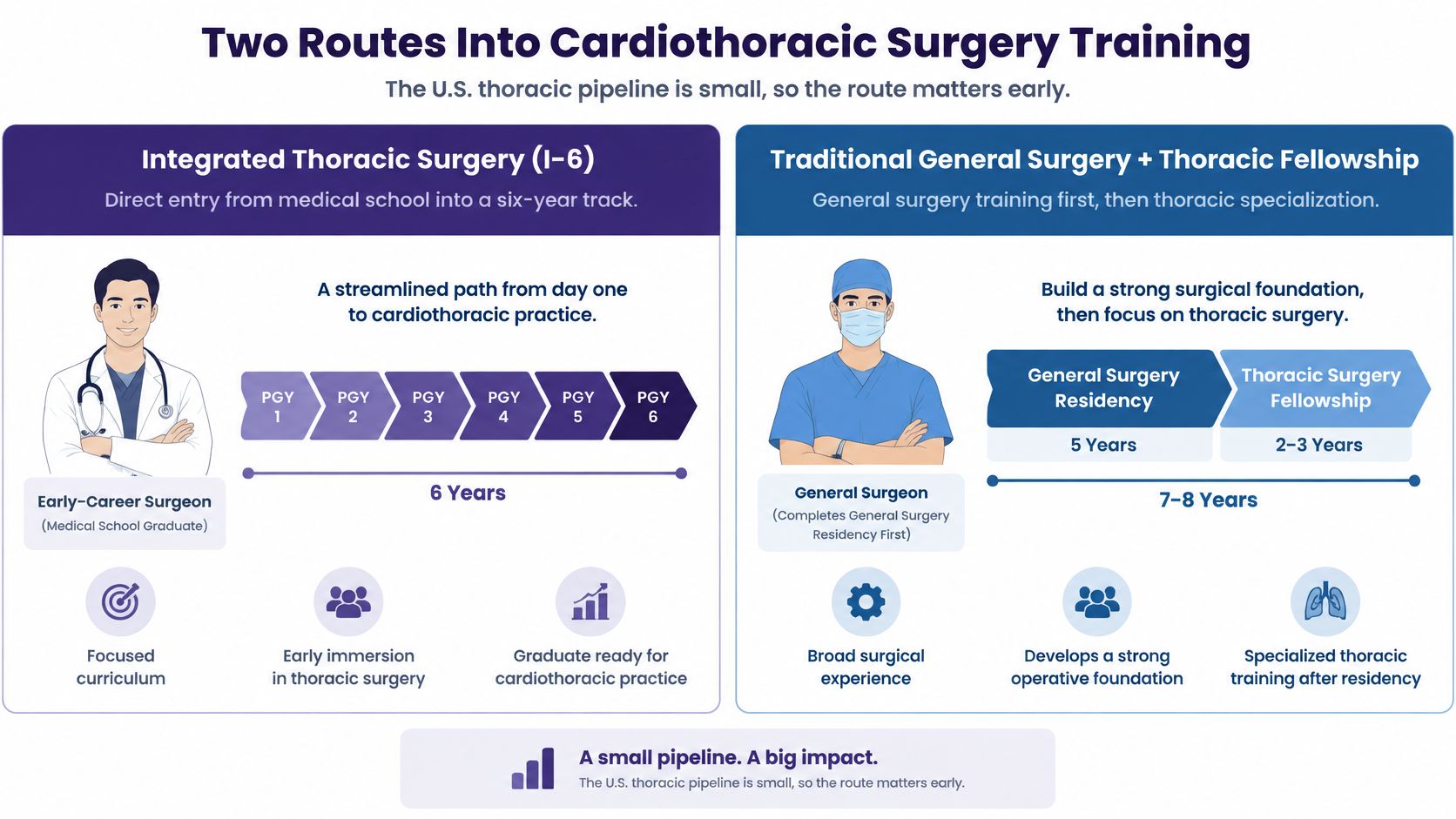
Career stage determines the practical choice
A prospective medical student can plan toward integrated training, but neither route permits entry before medical school graduation. Nor does an early interest in cardiac surgery eliminate the option of general surgery followed by independent fellowship. Candidates need enough clinical exposure to distinguish an interest in cardiovascular disease from a sustained commitment to operative practice.
A resident already training in general surgery will usually evaluate independent fellowship eligibility, mentorship, and application timing. The decision should account for completed training rather than assume that switching into an integrated position is straightforward.
Early commitment: Integrated applicants should evaluate whether their clinical experience supports a specialty decision before residency begins.
Later specialization: General surgery residents should establish cardiothoracic mentorship and confirm prerequisite documentation with prospective fellowships.
Joint pathways: Advisers may also describe a 4+3 route. Candidates should obtain the participating programs' written structure, eligibility rules, and certification implications before relying on that label.
A broader explanation of medical education and training stages can help candidates separate medical school eligibility, residency entry, fellowship selection, and eventual certification.
For employers, these routes create different recruiting relationships. An integrated program supports longitudinal specialty development, while an independent fellowship recruits physicians with established general surgical preparation. Hospital leaders should align faculty commitments, operative access, and anticipated hiring dates with the actual pathway rather than treat every trainee as an interchangeable future attending.
What the Six-Year Integrated Curriculum Covers
An integrated curriculum should be evaluated as a progression in responsibility, not a catalogue of rotations. Early surgical education establishes the foundation for later cardiothoracic decisions, while repeated specialty exposure gives faculty opportunities to assess how residents translate knowledge into patient care.
The pathway resembles a through-line rail service connecting the origin station to the destination. Independent training resembles a transfer after a broad general surgery base. Neither arrangement establishes quality by itself; the important question is whether the connections between clinical experiences are deliberate.
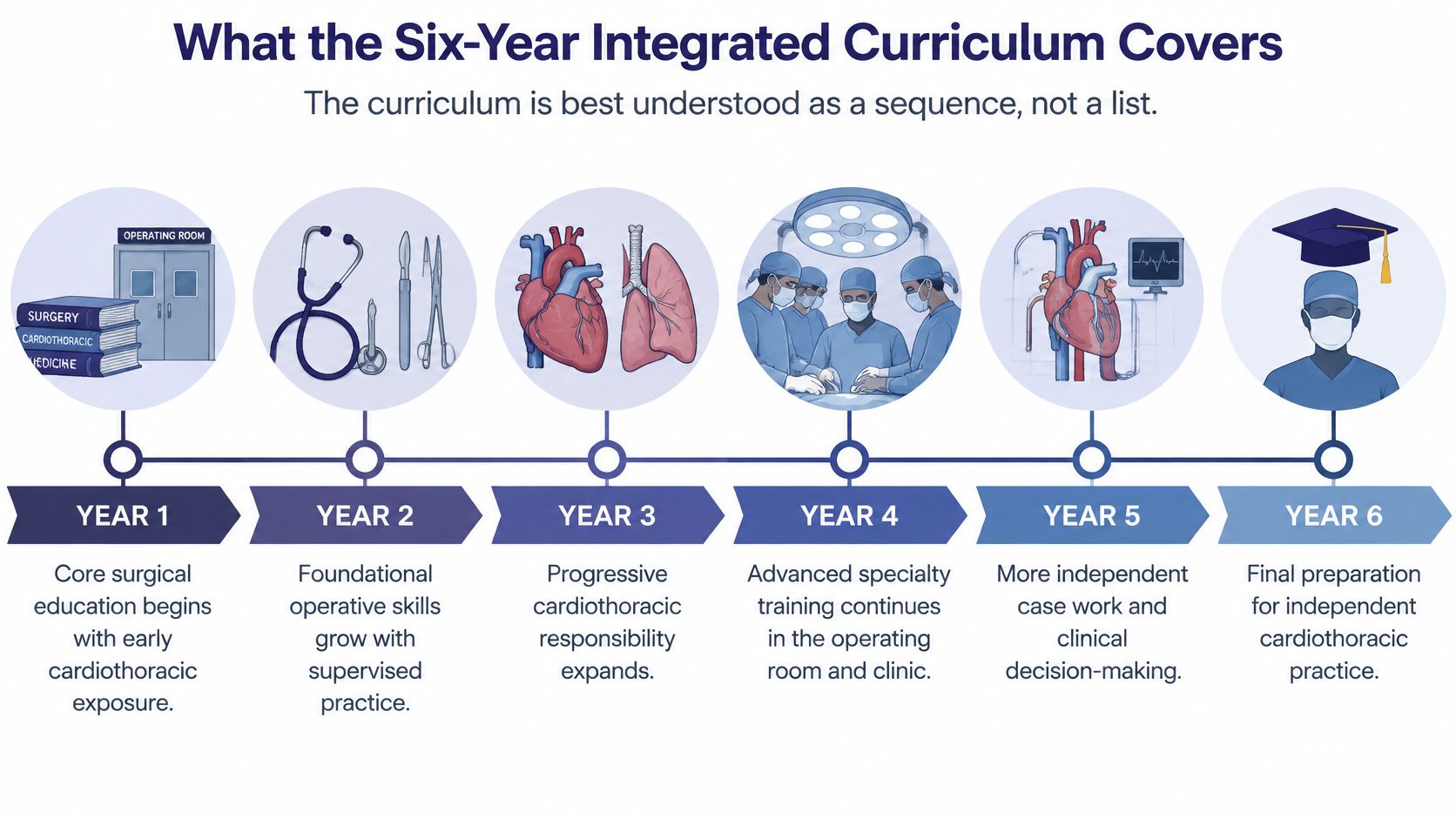
Early exposure should produce observable development
Consider a hypothetical third-year resident assigned to a thoracic service. Initially, the resident might assist with exposure, review imaging with the attending, and explain the proposed operation during preoperative planning. With demonstrated competence, that resident could lead selected procedural components under direct supervision.
The educational gain isn't merely additional time in the operating room. Faculty should be able to identify which decisions the resident understands, which technical steps can be entrusted, and where closer supervision remains necessary. A rotation that generates attendance without documented progression offers a different educational experience from one that develops responsibility.
The same principle applies outside the operating room. Residents need to connect operative planning with cardiopulmonary physiology, postoperative deterioration, and communication with patients and families.
Curriculum test: A useful rotation schedule explains not only where residents spend time, but what responsibility they should be ready to assume afterward.
Advanced training requires breadth and appropriate limits
Later training encompasses advanced thoracic, adult cardiac, and congenital cardiac surgery, alongside surgical critical care, transplantation, oncology, and minimally invasive techniques. Candidates should examine how those experiences connect rather than assume that a recognizable service name guarantees substantial participation.
The intended graduate develops operative and clinical capabilities across adult cardiac, congenital, general thoracic, and oncologic care, manages critically ill cardiothoracic patients, and participates in transplant services. However, curricular exposure isn't equivalent to unrestricted independent expertise in every subspecialty. Employers should assess a graduate's actual case experience, supervision history, and additional training needs against the proposed clinical role.
Program review should therefore address:
Rotation order: Which experiences prepare residents for subsequent responsibilities, and how are interrupted rotations recovered?
Critical care depth: Does the resident manage longitudinal postoperative problems, or mainly complete discrete service tasks?
Congenital and transplant access: Are these experiences scheduled and protected, or contingent on elective availability and external arrangements?
Assessment: Can faculty describe how clinical judgment and operative responsibility advance together?
A candidate choosing a program and an executive evaluating its graduates need the same evidence: a coherent sequence of supervised development, not merely an impressive list of affiliated services.
Case Volume Rules Trainees Must Meet
Operative requirements for integrated cardiothoracic residents
Requirement | Standard | Applies to | Counting rule |
|---|---|---|---|
ACGME early-training minimum | At least 375 procedures in PGY-1 to PGY-3, including at least 125 cardiothoracic | Integrated programs | Counted during the first three years |
ABTS annual operative average | 125 major cardiothoracic operations per year, 375 total | Integrated residents in PGY-4 to PGY-6 | Major cardiothoracic operations |
Pathway selection | Meet the applicable designated operative requirements for the selected pathway during the final three years | Cardiothoracic, general thoracic, or cardiac track | Requirements from another pathway cannot substitute |
Surgeon role | Resident serves as primary surgeon | Index cases | First-assistant cases excluded unless specifically permitted |
The ACGME integrated thoracic surgery requirements set an early-training minimum of 375 procedures in PGY-1 through PGY-3, including at least 125 cardiothoracic procedures. Separately, the American Board of Thoracic Surgery operative requirements call for an average of 125 major cardiothoracic operations annually during PGY-4 through PGY-6, totaling 375. These are distinct educational and certification-related measures.
Pathway selection changes how volume should be interpreted
Residents must meet the designated operative requirements for their selected cardiothoracic, general thoracic, or cardiac pathway. Cases from another pathway cannot fill a shortfall in the selected one. This does not make experience outside that pathway valueless; it means that aggregate volume alone cannot establish compliance.
Program directors should compare case distribution with the categories required for each pathway. A large case log may still fall short if its mix does not meet the selected pathway's requirements.
The resident's role also matters. Index cases generally require the resident to act as primary surgeon. First-assistant participation counts only where the applicable requirement specifically allows it.
A resident could attend many complex operations and assist regularly yet lack enough qualifying index cases. That experience may be educational, but it does not automatically satisfy a primary-surgeon requirement.
Operative access is measured by qualifying responsibility, not proximity to technically impressive surgery.
Case-log review should identify gaps before scheduling becomes urgent
Residents should log each operation promptly, recording its date, procedure, pathway category, and operative role. Resolve ambiguous entries with supervising faculty while details are clear.
Resident review: Compare credited experience with the applicable annual average and category requirements before formal progress meetings.
Faculty reconciliation: Confirm that recorded roles accurately reflect the resident's participation.
Program response: Adjust assignments when a resident lacks a required category or sufficient primary-surgeon opportunities.
For hospital leaders, service-line volume is only a starting point. Educational capacity also depends on suitable cases, appropriate supervision, and defensible allocation of operative responsibility among residents and fellows.
Applicant Odds in the Integrated Match
The published analysis of integrated thoracic surgery selection reports 54 postgraduate year-1 positions across 36 programs in the 2025 U.S. integrated I-6 Match, with more than 225 applicants; programs received an average of 148 applications, a 30% increase over five years. Those figures describe constrained access, not a selection process that an excellent résumé can make predictable.
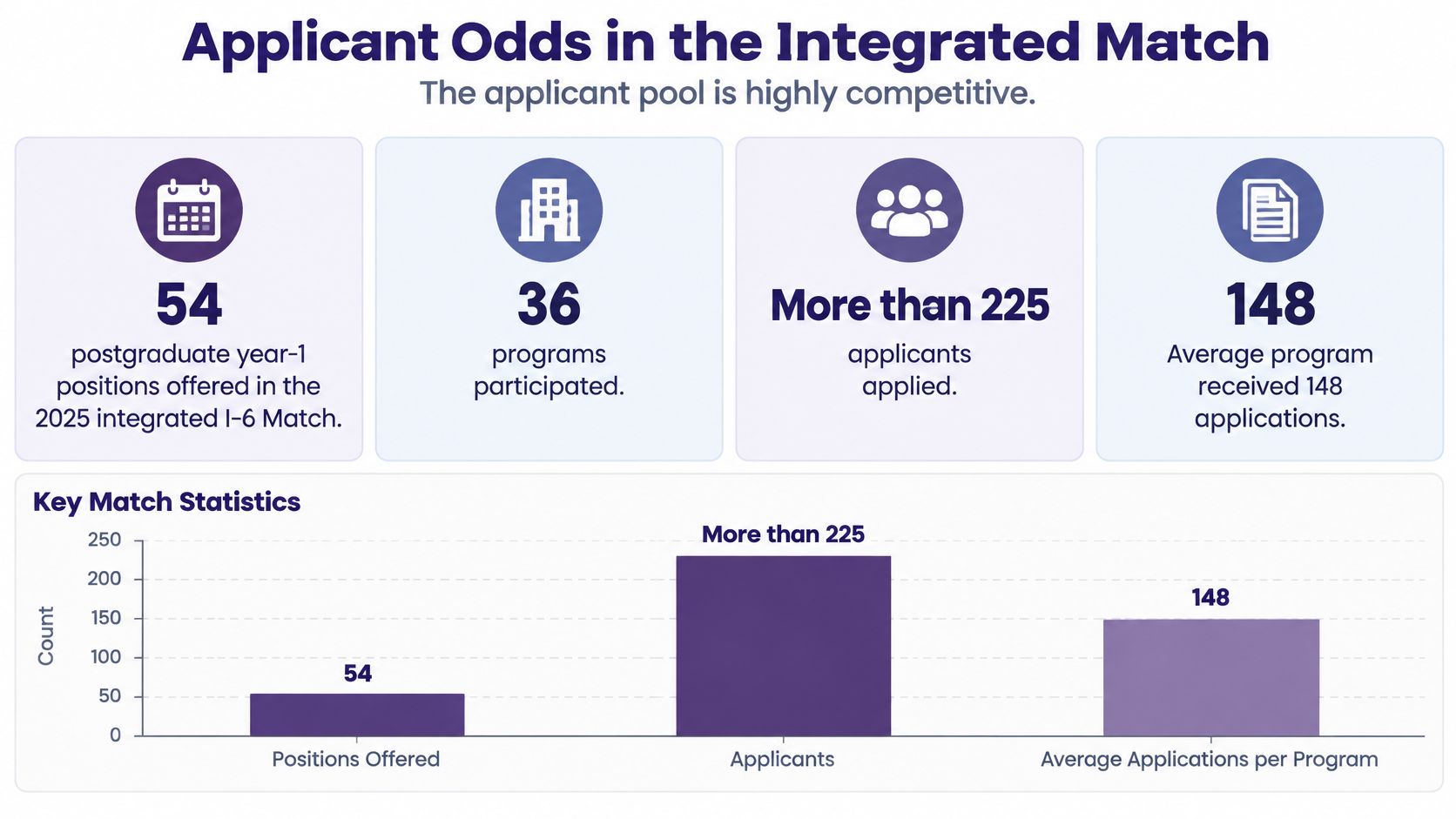
Application preparation needs a sequence
Confirm the route. Each target program's integrated, independent, or joint structure should be established before the candidate invests in an application strategy.
Build the examination record early. Preparation should precede testing because an existing reported result can't be replaced with a preferred result.
Document research contributions. Dates, project responsibilities, authorship, and completed outputs help distinguish substantive work from an accumulated publication count.
Evaluate educational fit. Operative exposure, index-case access, and mentorship deserve explicit weight in program comparison.
The same analysis reports that U.S. MD seniors' match rate remained approximately 41% despite a 150% rise in applications, while matched applicants averaged approximately 244 on USMLE Step 1, 249 on Step 2, and 10.5 publications. These are historical descriptive measures, not minimum admission standards or a formula for an individual applicant's probability.
Averages can't establish the marginal benefit of an additional paper. Nor do they show that a research year will improve a particular candidate's odds enough to justify its opportunity cost.
Additional credentials need a defined purpose
A research year is more defensible when it addresses an identifiable weakness: limited specialty mentorship, an unfinished substantive project, or insufficient understanding of academic cardiothoracic practice. An extra year devoted only to increasing a count has a less transparent rationale.
Candidates should ask mentors what new evidence the additional work would give a selection committee. If the answer is only another line on the curriculum vitae, the expected benefit remains uncertain.
For international medical graduates, the Society of Thoracic Surgeons pathway guide reports a 0% integrated thoracic surgery IMG match rate in 2024, compared with an overall IMG match rate across specialties of approximately 60%, or 9,045 of 14,772 applicants. That historical result warrants route-specific advice, not an assumption that overall residency outcomes describe specialty access.
Integrated, joint, and traditional pathways also differ in mentorship, geographic options, and fellowship planning. A strong applicant can still pursue a poorly matched route. Selection strategy should therefore address eligibility and educational fit before treating another score or publication as the decisive variable.
Independent Fellowship Entry and Its Selectivity
Reported measure | Independent thoracic surgery result |
|---|---|
Applicants preferring the specialty | 165 |
Applicants matched to the specialty | 97 |
Applicants not matched to any program | 65 |
Unfilled positions | None |
Listed graduate categories | 75 U.S. MD graduates, three DO graduates, eight foreign graduates, and one Canadian graduate |
Foreign-national designation | 10 applicants |
The 2025 NRMP Thoracic Surgery and Vascular Surgery Match report for the 2026 appointment year reports 165 applicants preferring thoracic surgery, of whom 97 matched and 65 did not match to any program. Every fellowship position filled, while many applicants went unmatched.
Full subscription does not make fellowship a fallback
General surgery provides a separate route into cardiothoracic surgery, not an easier guarantee of entry. The full subscription of fellowship positions shows that applicants compete for limited training capacity through this pathway as well.
Planning implication: A fully subscribed fellowship cannot be treated as spare capacity for interested general surgeons.
Established surgical preparation changes the recruiting relationship
A general surgery resident who develops a cardiothoracic interest late in training must assess fellowship availability and application readiness, while accounting for the possibility of going unmatched. Prior surgical training alone does not secure a fellowship position.
The resident and potential fellowship mentors should review operative preparation, recommendation strength, research obligations, and geographic constraints before settling on an application strategy. These factors shape not only selection prospects but also the training pipeline: fellowship capacity determines how many candidates can progress from general surgery into specialty training.
For employers, independent fellows arrive with substantial prior surgical preparation. Recruiting them into attending roles requires a clear account of the clinical work, mentorship after appointment, and fit between fellowship experience and institutional needs.
Interest alone does not increase workforce supply. Additional applicants become additional graduates only if institutions can support more accredited training capacity, including faculty, case access, and clinical infrastructure.
Program Quality Beyond Prestige and Match Rate
Earlier survey findings discussed in the Journal of Thoracic and Cardiovascular Surgery article on trainee well-being32147-4/fulltext) found that more than half of respondents were dissatisfied with professional-life balance, while more than 40% screened positive for depression. A positive screening result isn't a clinical diagnosis, but these findings make sustainability a legitimate program-selection criterion.
Prestige, institutional operative volume, and successful recruitment don't establish whether residents receive dependable supervision, appropriate autonomy, or a workable clinical schedule. A prestigious program can still leave important questions unanswered.
Program quality should be tested with operational questions
Applicants should request concrete descriptions rather than accept a general statement about a supportive culture.
Night-float design: How many nights per week does the assignment run, what recovery arrangements apply, and who covers unexpected absences?
ICU staffing: Which attending physicians, fellows, residents, and advanced practice clinicians are present overnight, and how does escalation work?
Parental leave: What is written in policy, how is coverage arranged, and how are affected educational requirements managed?
Psychological safety: How can residents raise concerns about harassment, supervision, or patient safety without depending entirely on their immediate evaluator?
Remediation: Who defines the improvement plan, what support is available, and how can a resident challenge an inaccurate assessment?
Primary-surgeon participation: What share of relevant operative cases involves the resident as primary surgeon, and how does responsibility progress?
Graduate destinations: Where do graduates practise, what additional training do they pursue, and how closely do their jobs match their preparation?
Applicants should speak privately with current residents and request attrition information with clear definitions. A departure for a different specialty, a dismissal, and an extended leave shouldn't be collapsed into an unexplained total.
Technology doesn't substitute for a sustainable learning environment
Access to advanced techniques matters only when residents can participate meaningfully. An institutional discussion of minimally invasive cardiac surgery should therefore lead to questions about supervision, procedural allocation, and how trainees develop competence, not whether the hospital owns specialized equipment.
The same scrutiny applies to workload. A program may offer excellent technical exposure while relying on residents to absorb unresolved staffing gaps. Candidates need to know whether educational assignments remain protected when service demands increase.
For employers, trainee well-being is a workforce and patient-continuity issue, not merely an optional benefit. Executives should assign responsibility for reviewing concerns, correcting staffing problems, and monitoring whether residents can progress without avoidable disruption. A training program is more credible when its leaders can explain how they respond to problems than when they insist problems never arise.
Choose a Pathway and Plan Program Capacity
Candidates and hospitals face different decisions, but both need to distinguish an attractive ambition from a supported plan. A candidate needs a feasible entry route and appropriate development. An institution needs enough educational capacity to deliver what it promises.
For a prospective medical student, integrated training is an option to investigate rather than an irreversible commitment made before clinical exposure. For a general surgery resident with an established cardiothoracic interest, independent fellowship is usually the more relevant eligibility and timing discussion.
Candidates need a documented program comparison
A shortlist should record each program's operative pathway, case-log procedures, mentorship arrangements, and response to resident concerns. Interview impressions are useful, but written policies and specific examples provide a stronger basis for comparison.
Candidates should also define their intended practice direction without treating it as permanent. Adult cardiac surgery, general thoracic oncology, and congenital cardiac surgery require different questions about experience and subsequent development.
Clinical direction: Does the available experience support the candidate's likely practice interests?
Educational evidence: Can the program explain how residents obtain qualifying responsibility and receive feedback?
Career transition: What support exists between graduation, further training, and the first attending appointment?
An assessment of the cardiothoracic surgeon job outlook can inform employment discussions, but anticipated opportunity shouldn't substitute for a close examination of training quality.
Employers should establish educational capacity before recruitment
The ACGME integrated thoracic surgery program requirements specify a minimum of two core faculty members per approved residency position in the final three years, or 10 core faculty members, whichever is smaller. They also require structured specialty education and formal clinical competency assessment, underscoring that expansion isn't an enrollment decision.
An institutional capacity review should begin with operative categories and realistic resident participation. Leaders should then map adult cardiac, congenital, and thoracic faculty coverage, critical care support, transplant access, and the arrangements needed for experiences unavailable locally.
Attending recruitment and advanced practice staffing should follow that educational design. Otherwise, administrators risk announcing positions before establishing who will supervise trainees, protect their learning, and cover clinical duties when faculty or residents are unavailable.
The final decision should rest on a written capacity check covering qualifying case access, faculty accountability, rotation agreements, ICU support, assessment processes, and resident support policies. The program director, surgical leadership, and responsible hospital executives should sign off before any residency position is announced.
American Cardiology Group offers permanent physician recruitment, locum tenens coverage, advanced practice placement, and executive recruitment for cardiovascular programs. Hospitals aligning cardiothoracic staffing with training capacity, and surgeons evaluating their next clinical role, can visit American Cardiology Group to discuss recruitment needs or career opportunities.
Comments