
How Much Do Obgyn Make in 2026
OB-GYNs earned a May 2025 median annual wage of $292,910, while physician surveys placed average compensation at about $367,000 for Medscape and $389,566 for Doximity. Those figures measure different kinds of pay, so a hospital's salary budget and a candidate's expected total compensation shouldn't be treated as interchangeable.
The more consequential question is what the employer expects that compensation to purchase: scheduled clinical work, overnight availability, surgical production, or responsibility for keeping an understaffed labor-and-delivery service open. Higher pay can represent a coverage premium rather than a better job. Executives and senior candidates need a benchmark that accounts for both the dollars and the obligations attached to them.
Table of Contents
National OB-GYN Pay Benchmarks and Source Gaps - Why wage and total compensation diverge - What the benchmarks mean for recruitment
State Markets That Sit Far From the Average - State averages aren't local offer prices - Build a band, not an automatic adjustment
Practice Settings and the Price of Coverage - Identify what the premium purchases - Test the assignment against its support
Recent Wage Movement and Career Stage - Career progression is a contract question - Test the transition, not just the guarantee
Build the Offer in Four Steps - Keep the approval record usable
Negotiation Checks and the Go or No-Go Rule - Evidence to request before acceptance - Decide on the written assignment
National OB-GYN Pay Benchmarks and Source Gaps
National OB-GYN compensation benchmarks
Benchmark | Figure | What it counts | Period |
|---|---|---|---|
$292,910 | Employed occupational wage midpoint | May 2025 | |
BLS mean annual wage | $279,040 | Employed occupational mean | May 2025 |
BLS hourly equivalent of the median | $140.82 | Median expressed hourly | May 2025 |
All physicians and surgeons median | $275,930 | Cross-specialty BLS median | May 2025 |
About $367,000 | Total-compensation survey average, 17th of 29 specialties | 2025 | |
$389,566 | Physician total-compensation survey average | 2025 | |
About $352,000 | Physician compensation survey average | 2024 | |
$239,200 | Separate published salary median | 2024 |
The government rows describe occupational wages, while the physician-survey rows describe compensation reported through different sampling and reporting methods. None is a guaranteed offer, a new-graduate starting salary, or a validated price for a particular call schedule. The separate U.S. News median also shouldn't be substituted for the BLS measure.
The BLS median represents the midpoint of employed OB-GYN wages, not the average. Its hourly equivalent is an expression of annual wages, not a quoted locum tenens rate or a measure of earnings for every hour spent on call.
Why wage and total compensation diverge
A hospital may advertise a guaranteed salary while a physician reports earnings that include productivity bonuses, call payments, or ownership distributions. Comparing those amounts without identifying their components makes an ordinary difference in compensation structure look like a disagreement about market value.
Medscape's survey covered 7,322 physicians, with responses collected October 2, 2024, through January 14, 2025. That is the physician survey's overall sample and collection window, not an OB-GYN-only sample size.
The approximately $96,656, or 33%, difference between the BLS median and Doximity average is therefore a comparison between unlike benchmarks. It isn't evidence that every employed OB-GYN is underpaid by that amount, nor does it establish a universally appropriate increase.
The BLS mean falls below its median, indicating that the distribution isn't symmetrical. Geography, seniority, practice setting, call responsibilities, productivity arrangements, and subspecialty work are relevant variables to investigate. The mean-median relationship alone cannot establish how much each variable contributes.
Benchmarking rule: Compare guaranteed wages with guaranteed wages, and achievable total cash compensation with survey total compensation. Keep benefits and contingent payments separately identified.
What the benchmarks mean for recruitment
The government median serves as a broad labor-market floor for initial planning, not a statutory minimum or a universal negotiating entitlement. Specialty-survey averages provide a separate recruiting check when the position includes substantial obstetric coverage, surgical production, and incentive opportunities.
Finance should distinguish the guaranteed expenditure from the modeled payout. Clinical leadership should then verify that the modeled payout is attainable under the actual clinic schedule, operating-room access, delivery workload, and staffing plan.
For example, an employed role might offer a defensible base but attach most upside to outpatient production. If the physician must frequently leave clinic to manage deliveries, the employer should test whether the production target remains realistic. A nominally competitive total becomes misleading when the clinical assignment prevents the candidate from earning it.
The practical answer to how much do OB-GYNs make is thus a set of clearly labeled measures, not a single interchangeable salary number. A credible offer identifies which measure informed the budget and explains why the position's obligations justify moving above or below it.
State Markets That Sit Far From the Average
2024 survey averages in selected state markets
Market | Reported average | Gap versus $352,000 national average |
|---|---|---|
Washington | About $307,000 | About $45,000 below |
Colorado | About $305,000 | About $47,000 below |
Tennessee | About $226,000 | About $126,000 below |
Utah | About $226,000 | About $126,000 below |
United States, Medscape 2024 | About $352,000 | Baseline |
The PSD Connect compensation summary citing Medscape reports the state averages and national baseline shown above, alongside a 4% increase in national average compensation from 2023 to 2024. The table's gaps are arithmetic comparisons with that published national average, not independently measured geographic premiums.
These are selected state survey averages. They aren't cost-of-living adjustments, county-level shortage measures, or current offer quotes. The snapshot also doesn't establish compensation in states that aren't listed.
State averages aren't local offer prices
A lower reported state average isn't permission to discount every vacancy in that state. Before interpreting the figure, recruiters should investigate payer mix, employed versus ownership arrangements, clinical scope, and the composition of the local candidate pool. The published summary doesn't isolate those influences.
Likewise, a higher state average doesn't establish that a candidate will have greater disposable income. Housing expenses, professional liability arrangements, commuting requirements, and benefit contributions require separate review. A state salary figure cannot resolve those household or contractual questions.
The sharpest recruiting mistake is applying a statewide average to a hospital whose coverage problem is unusually difficult. A generalist opening with established cross-coverage and a vacancy requiring responsibility for an isolated obstetric service are not equivalent assignments merely because both share a state border.
A local recruiting band should incorporate distinct evidence:
Published geography: Use the state snapshot as directional evidence, preserving its year and survey definition.
Clinical workload: Specify delivery responsibilities, surgical expectations, patient acuity, and outpatient access.
County-level supply: Establish whether nearby physicians can provide meaningful cross-coverage.
Observed recruiting response: Record qualified applicants' reasons for declining, distinguishing compensation objections from scheduling or staffing objections.
Build a band, not an automatic adjustment
Recruiters should start with the national wage and specialty-compensation benchmarks, then examine whether local evidence supports a different position within the planning band. Moving the number should require a stated reason rather than an assumption that an expensive city always pays more or a lower-cost state always pays less.
A useful approval memo names the benchmark, describes the local assignment, and records the unresolved recruitment risks. That gives finance a basis for approving exceptions without turning an isolated negotiation into an unexplained precedent.
A uniform national offer can overprice a straightforward assignment and still fail to recruit for a demanding one. Local calibration is necessary, but state averages alone aren't sufficient calibration.
Practice Settings and the Price of Coverage
A practice setting determines how compensation is assembled and which obligations sit outside the headline salary. The relevant comparison isn't a dollar ladder from academic employment to private practice. It's the relationship between pay, professional autonomy, coverage requirements, and available support.
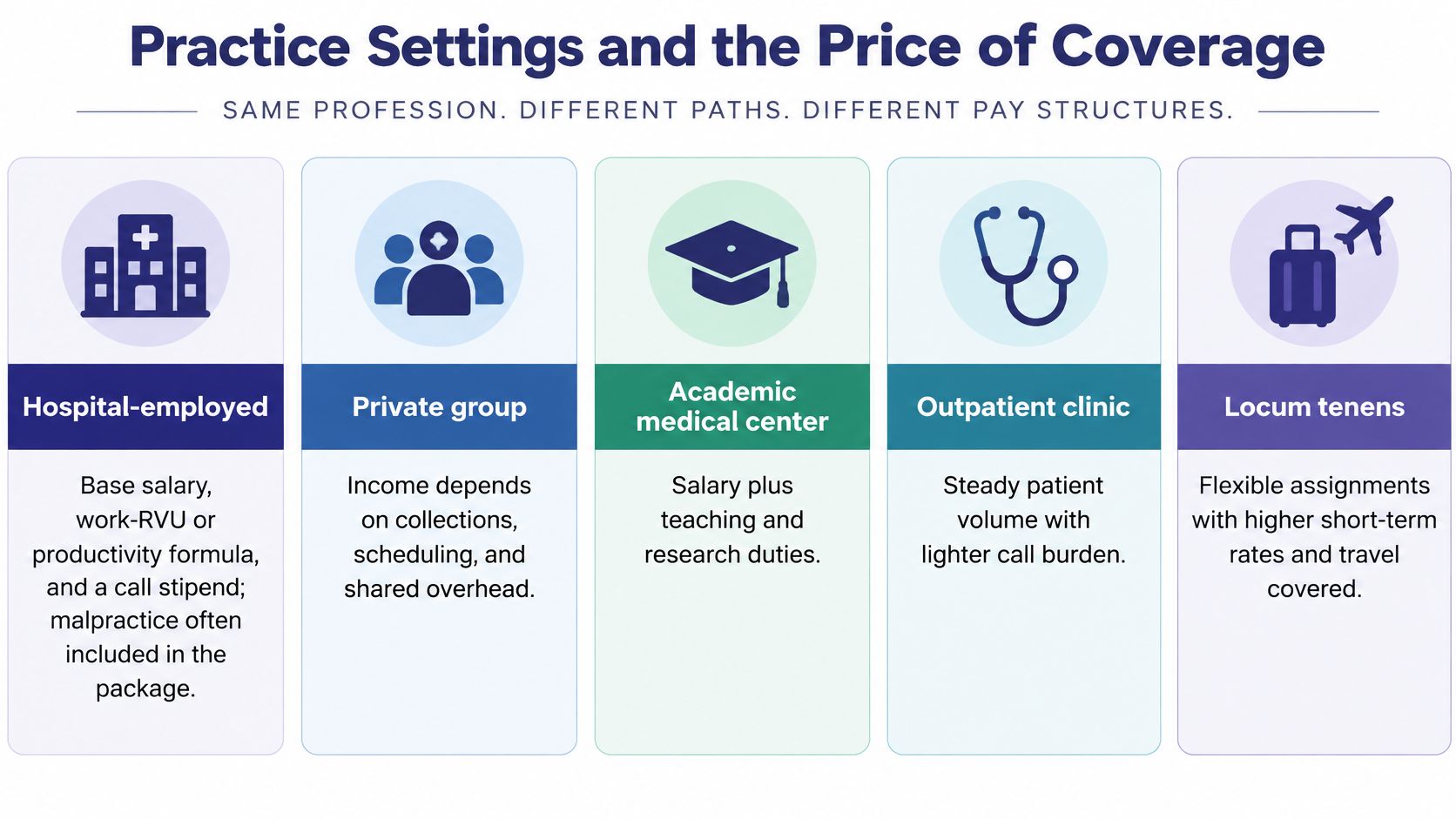
How OB-GYN pay is built by practice setting
Setting | Compensation shape | What extra pay buys | Base-only risk |
|---|---|---|---|
Hospital-employed | Base, wRVU or bonus, call stipend, benefits | Predictable income and often malpractice coverage | Call looks unpaid and the offer loses |
Academic medical center | Lower-cash structure, academic time, rank | Teaching, research, and subspecialty backup | Survey averages overstate cash pay |
Private group | Guarantee, then partner distributions | Volume upside and ownership income | BLS wages miss profit distributions |
Rural or critical access | Higher-cash package, signing, relocation, loan help | Continuous coverage with thin backup | Premium without team depth drives exits |
High-volume obstetrics | Production-heavy pay and night differentials | Deliveries and surgical productivity | Liability and call burden stay invisible |
These are package architectures to evaluate, not independently measured setting-specific salary rankings. A particular employer may combine elements differently, so the written agreement must establish what is included.
Identify what the premium purchases
Hospital-employed candidates should reconcile the work-relative value unit, or wRVU, formula with their delivery duties and call stipend. Academic candidates should establish whether protected teaching and research time reduces the clinical productivity target. Private-group candidates need a transparent explanation of collections, shared overhead, partnership eligibility, and distributions.
Rural employers should treat signing support and loan assistance as recruitment tools, not substitutes for operational backup. High-volume groups should identify night work and emergency surgical responsibilities explicitly rather than describing every payment as a production incentive. The same distinction between earnings structure and clinical obligations matters in other surgical fields, including plastic surgeon salary comparisons, without making those specialties interchangeable benchmarks.
An ACOG-related workforce presentation reports about 41 OB-GYNs per 100,000 women in metropolitan counties versus 13 in rural counties, with 48% of U.S. counties having no practicing OB-GYN. The same presentation cites a projected shortage of 7,980 OB-GYNs by 2037 and reports 30% burnout in a 2025 survey, with 23% reporting both burnout and depression.
Those workforce measures explain why salary alone is an incomplete measure of opportunity. They don't establish a dollar amount that compensates for isolation, liability exposure, or exhaustion.
Test the assignment against its support
Consider a metropolitan employed generalist position with shared call and in-house backup. A wage-oriented guarantee with a clearly achievable production plan may be appropriate if the schedule and support match the employer's description.
A rural hospital proposing hypothetical one-in-three or solo coverage presents a different budgeting problem. Leadership should cost additional staffing, relief coverage, and transfer arrangements before deciding how much additional physician compensation to authorize. An above-local-market package may be necessary, but it doesn't create a sustainable roster.
For a high-volume group, the evaluation should establish night differentials, maternal-fetal-medicine consultation access, anesthesia availability, and emergency operating-room support. Candidates should distinguish a busy but well-supported service from one whose compensation depends on absorbing unresolved staffing gaps.
A premium deserves a named purpose. If leadership cannot identify what the extra money pays for, the candidate cannot judge whether the obligation is acceptable.
Raising salary while leaving an untenable coverage model unchanged can recreate the conditions behind the vacancy. Retention planning belongs inside the compensation discussion, not after the physician accepts.
Recent Wage Movement and Career Stage
The BLS May 2023 occupational profile reported a mean annual OB-GYN wage of $278,660, a mean hourly wage of $133.97, and estimated employment of 19,820 physicians. The BLS May 2024 release reported $281,130 annually, $135.16 hourly, and approximately 19,900 jobs.
That comparison indicates relatively stable national mean wages alongside a small change in estimated employment. It doesn't support treating larger physician-survey compensation totals as evidence that occupational wages or physician headcount increased by the same amount.
Career progression is a contract question
The cited public benchmarks don't establish a reliable national salary ladder by postgraduate year. Assigning precise early-career, mid-career, and senior-career salaries would imply evidence that these sources don't provide.
A more defensible analysis follows changes in deal structure:
Early employed practice: Examine the guaranteed base, call stipend, onboarding schedule, and ramp before full productivity requirements apply.
Established clinical practice: Evaluate wRVU thresholds, surgical mix, referral access, and the economics of any partnership opportunity.
Senior or specialized roles: Separate compensation for medical directorships, administrative responsibilities, and subspecialty services from generalist clinical earnings.
Maternal-fetal medicine, gynecologic oncology, and reproductive endocrinology require scope-specific review. A position incorporating those services shouldn't be priced by merely adding an assumed seniority premium to a general OB-GYN benchmark.
Test the transition, not just the guarantee
The critical contract event may be the end of the income guarantee rather than an employment anniversary. Candidates should request the conversion date, attribution rules, and actual attainment history for physicians working comparable schedules.
An employer should model whether the incoming physician will have adequate clinic capacity, operating-room access, and referral development to reach the target. A production threshold copied from an established partner may be inappropriate for a physician still building a panel.
Career-stage check: A partner's realized income includes an established practice and potentially ownership economics. It isn't automatically a defensible starting guarantee for a new graduate.
Finance and recruitment teams should therefore distinguish wage movement from individual progression. A physician can move into a materially different compensation arrangement without the underlying national occupational wage series changing substantially.
Build the Offer in Four Steps
A defensible offer requires an auditable sequence from clinical assignment to financial terms. Each decision should leave a written assumption that finance, clinical leadership, and the candidate can inspect.
Define the benchmark role and coverage obligation. Specify general obstetrics and gynecology or a subspecialty scope such as maternal-fetal medicine, gynecologic oncology, or reproductive endocrinology. Record the call rotation, delivery responsibilities, clinic sessions, surgical expectations, and administrative duties. Without that role definition, selecting a compensation benchmark is premature.
Choose the matching pay measure and local position. Use an occupational wage measure for guaranteed-wage planning and a specialty-compensation measure to test expected total earnings. Apply the published state evidence cautiously, then document local recruiting conditions and obstetric workload. The resulting band should describe the actual assignment, not an undifferentiated specialty label.
Translate the band into separately priced components. Write the base, productivity formula, call compensation, signing and relocation support, malpractice coverage, tail responsibility, loan assistance, and leadership stipend individually. Distinguish recurring compensation from front-loaded payments and conditional earnings. A review of physician compensation models can help teams distinguish the incentives each structure creates.
Stress-test the package against the staffing plan. Model physician absences, delayed recruitment, delivery surges, and unavailable backup. Identify who assumes additional duties and whether that work triggers additional pay or relief coverage. If the proposed arrangement depends on uninterrupted availability from the incoming physician, leadership should revise the service model before final approval.
Keep the approval record usable
The compensation memo should contain the selected benchmark's definition, the local adjustment rationale, and the assumptions behind expected earnings. It should also name who owns unresolved coverage issues.
Approval should attach to the entire package, not merely the base salary. Otherwise, clinical leaders may approve one workload while finance funds another, leaving the candidate to discover the mismatch after joining.
Negotiation Checks and the Go or No-Go Rule
A candidate comparing competing offers should build a side-by-side term sheet rather than rank the advertised salaries. The decision requires a comparison of obligations, attainable earnings, and exit exposure.
Evidence to request before acceptance
The employer should provide the call roster, productivity methodology, guarantee conversion terms, and malpractice provisions. Candidates should also request the attainment history of comparable physicians, with enough context to distinguish a mature practice from a newly recruited position.
Call commitments: Record nights, weekends, holidays, cross-coverage, and whether scheduled clinic continues after overnight duty.
Production mechanics: Identify the wRVU threshold, conversion factor, attribution rules, and treatment of leave or protected time.
Ownership terms: Establish partnership timing, eligibility, buy-in requirements, and access to financial information.
Departure obligations: Review tail responsibility, bonus repayment terms, and relocation clawbacks with qualified contract counsel.
Preparation should include operational questions, not just a salary request. The same discipline used in structured physician interview preparation helps candidates obtain specific answers about staffing, leadership expectations, and clinical support.
Decide on the written assignment
Employers should identify the benchmark, practice setting, and call model inside the offer documentation. Signing and relocation payments should carry a stated retention period and clear repayment terms, so front-loaded cash doesn't obscure ongoing compensation or an inadequate coverage arrangement.
Every premium should map to a named obligation: overnight availability, delivery workload, professional liability exposure, or limited rural backup. Candidates should be able to distinguish compensation for clinical expertise from compensation for accepting additional operational risk.
The go or no-go rule is straightforward: post or sign the offer only when the dollar figure, coverage model, and local market rationale appear on the same page. If a material obligation remains undefined, the package isn't ready for a final decision, regardless of how attractive the base appears.
American Cardiology Group offers permanent recruitment, locum tenens coverage, advanced practice placement, and executive recruitment exclusively within cardiology and cardiac surgery. Hospitals and cardiac specialists applying this coverage-based approach to their own hiring or career decisions can visit American Cardiology Group to discuss opportunities aligned with clinical scope, staffing needs, and long-term program goals.
Comments