
Cardiothoracic Surgeon Jobs USA: The 2026 Hiring Guide
Fewer than 2 active cardiothoracic surgeons per 100,000 people in the U.S. tells the story behind cardiothoracic surgeon jobs USA. This is a structural scarcity market, not a normal vacancy market, and it changes everything for hospitals, search firms, and surgeons evaluating their next move.
That scarcity also explains why a single opening in this specialty carries outsized operational weight. A hospital is not just filling an OR schedule, it is protecting call coverage, structural heart support, thoracic oncology access, and the credibility of adjacent programs that depend on surgical backup.
Table of Contents
Why the US Cardiothoracic Surgery Market Behaves Differently
Workforce Supply, Training Pipeline, and the 2035 Shortfall - Training slots set the ceiling, not employer wish lists
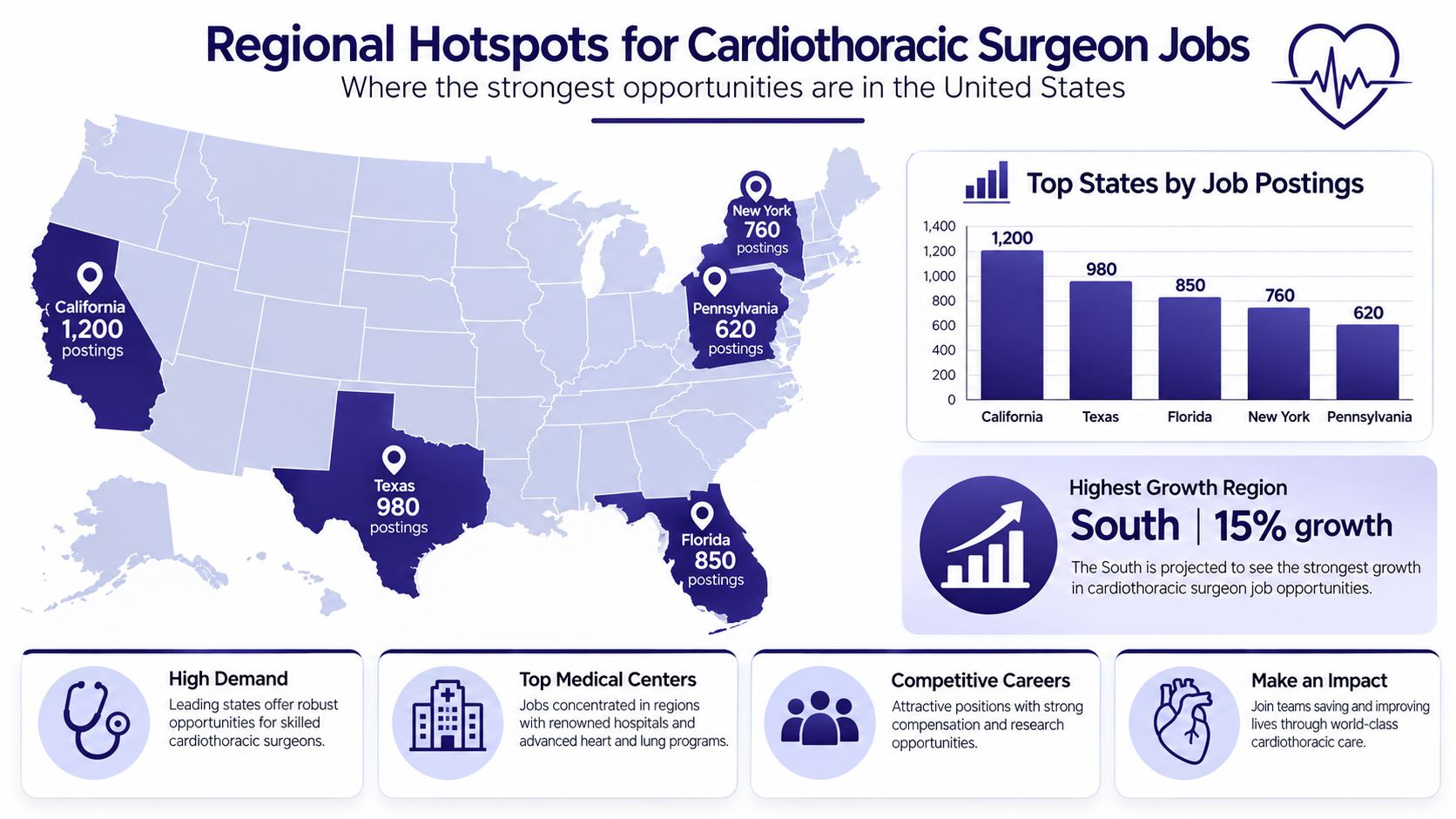
Regional Hotspots and Where Postings Actually Cluster - Dense states create competition, thin states create pressure
Compensation Benchmarks Across Aggregators and Recruiting Channels - Recruiting channels often pay differently than aggregators
Credentialing, Licensing, and Case-Complexity Expectations - The case mix is the real screening device
Permanent, Locum Tenens, and ASC Engagement Models - Permanent roles fit continuity, locums fit bridge coverage, ASCs fit elective flow
Working With a Specialist Recruiter Like American Cardiology Group - Generalist channels usually miss the nuance
A Practical Action Plan for Candidates and Employers - Candidate priorities
Why the US Cardiothoracic Surgery Market Behaves Differently
The U.S. cardiothoracic surgery market behaves differently because supply is narrow, geography is uneven, and case complexity is high. A Circulation workforce analysis found fewer than 2 active cardiothoracic surgeons per 100,000 people nationwide, with most concentrated in urban areas, and recorded 4,734 active surgeons in 2005, still below the nearly 5,100 peak in 2002 (Circulation workforce analysis). That is not a broad labor pool. It is a tightly managed specialty where every move matters.
For candidates, the strongest jobs are rarely the loudest postings. For hiring executives, a weak offer does not just sit unanswered, it delays service-line growth and forces the remaining surgeons to absorb more coverage. The right way to evaluate cardiothoracic surgeon jobs USA is to ask four questions in this order, where the surgeon should compete, what the contract should demand, how the credentialing story should be packaged, and whether a specialist recruiter changes the outcome. For a sharper view of the demand side, see the cardiothoracic surgeon job outlook.
Practical rule: In this specialty, a “good opening” is the one that solves a coverage problem without creating a retention problem six months later.
That lens matters because cardiothoracic surgery supports more than one clinical lane. Adult cardiac, general thoracic, structural heart, and aortic work often sit in the same operational ecosystem, but employers do not always buy the full package. Candidates who understand that mismatch negotiate better. Employers who understand it hire faster and make fewer false starts.
The market also punishes generic recruiting. A surgeon who is screened only on board eligibility can look fine on paper and still fail operationally if the hospital needs independent coverage for CABG, valve work, aortic surgery, and complex thoracic cases. The hiring conversation in this specialty has to be specific from the first call. Anything less wastes time.
Workforce Supply, Training Pipeline, and the 2035 Shortfall
The supply problem is structural, not cyclical. More recent workforce research showed practicing cardiothoracic surgeons increased from about 4,000 in 2005 to 5,200 in 2021. That is real growth, but it does not solve the harder issue, which is a specialty fed by a narrow training pipeline and slowed by long career arcs. The market stays tight because the system cannot replace departures quickly enough, and employers feel that gap long before a national shortage sounds obvious.
Training slots set the ceiling, not employer wish lists
A recent review found an average of 137 first-year cardiothoracic residency positions offered per year from 2019 to 2022, while programs graduated an average of 127 surgeons annually from 2018 to 2022, a figure that was 13% higher than in 2012 (Heart Surgery Forum review). That spread is small on paper. In practice, it matters because every cohort passes through years of training, a limited number of fellowships, and a workforce where retirement timing can shift the market quickly.
The projection that matters for hiring is the one tied to replacement pressure. Thoracic surgery organizations citing HRSA-linked modeling estimate a 31% shortfall by 2035, driven by about 900 expected retirements and a 20% increase in overall demand (Heart Surgery Forum review). The same research projects the U.S. population will grow 8% by 2050 and the population age 65+ will rise 42% (Heart Surgery Forum review). That matters for employers because an older population brings more valve disease, more coronary disease, more thoracic oncology, and more complex salvage work that cannot be covered by a generic surgical backfill.
For candidates, the lesson is simple. The best opportunities are not the jobs with the loudest posting. They are the ones backed by a real operating room mix, a call plan that does not burn out the new hire, and a group that understands how to sell the role correctly. For employers, the same scarcity means the offer has to be specific, credible, and fast. A broader recruiter view is laid out in American Cardiology Group's cardiothoracic surgeon job outlook, which matches what senior recruiters see in practice, the market rewards surgeons who can cover complex programs and stay put, and it punishes vague hiring strategies.
Regional Hotspots and Where Postings Actually Cluster
Geography drives this market because cardiothoracic surgeons are not evenly distributed, and the concentration is lopsided enough to change hiring behavior. Independent job-market data show large employed workforces in California (4,240), Texas (3,370), Ohio (2,620), Massachusetts (2,120), and New York (1,740), while much smaller states like Alaska (40), North Dakota (80), Idaho (70), and Wyoming (110) have very thin benches (career market data). That split shapes candidate negotiation power and employer urgency, and it should change how both sides evaluate a posting.
Dense states create competition, thin states create pressure
In the high-headcount states, demand is real, but the harder problem is retention. A system has to compete against larger referral centers, stronger call structures, and groups that can promise more predictable operating room coverage. In the thinnest markets, the problem is more severe. A small workforce means fewer local peers, more fragile coverage, and one departure can become a true access crisis almost immediately.
Recent postings also show roles in non-HPSA, non-MUA areas, which matters because vacancy pressure is not only a rural-shortage story. Specialty-program growth and replacement hiring in larger markets keep employers recruiting aggressively, even where the surrounding health system looks well supplied. The recruiter's job is to separate a role that is hard to reach from one that is hard to retain. Those are different hiring problems, and they require different offers.
A market can have plenty of hospitals and still have too few surgeons who are willing to absorb the call burden attached to a full service line.
Locum tenens demand rises where employed headcount is thin, but high-resource markets can be just as difficult if the service line needs a surgeon with the right operative profile and a stable call rotation. Candidates who chase only the biggest city names miss better negotiated terms in smaller or midsize systems. Employers who assume major metros are easier to staff usually pay for that mistake in time, turnover, and a weaker fit.
For a broader read on where this pressure comes from and how it affects hiring, American Cardiology Group's cardiothoracic surgeon job outlook matches what senior recruiters see in practice.
Compensation Benchmarks Across Aggregators and Recruiting Channels
Compensation data in this specialty should never be treated as a single number. The market is split across aggregators, recruiting channels, and subspecialty-specific labor markets, and each source tells a different part of the story. Salary.com reports an average of $533,860, with a typical range of $427,903 to $669,205, while PayScale reports $424,254 and ZipRecruiter reports $367,474 as of May 2026 (Salary.com benchmark). Those figures are useful, but they're not the whole market.
Recruiting channels often pay differently than aggregators
AMN Healthcare’s current permanent cardiothoracic surgery postings show pay rates ranging from $700,000 to $1.3 million annually, with an average placed salary of $866,000 over the last year and a current average posting salary of $977,000 as of July 5, 2026 (AMN Healthcare postings). That spread is exactly why candidates shouldn't anchor on the lowest visible salary aggregator and then assume the job market is depressed. Recruiting channels often reflect harder-to-fill coverage needs, broader scope, or a premium for independence.
US Cardiothoracic Surgeon Compensation Benchmarks (2026) | ||
|---|---|---|
Source | Cohort | Reported Compensation |
Salary.com | General cardiothoracic surgeon benchmark | Average $533,860, typical range $427,903 to $669,205 |
PayScale | General cardiothoracic surgeon benchmark | Average $424,254 |
ZipRecruiter | General cardiothoracic surgeon benchmark | $367,474 as of May 2026 |
AMN Healthcare | Permanent cardiothoracic surgery postings | $700,000 to $1.3 million, average placed salary $866,000, current posting average $977,000 as of July 5, 2026 |
SalaryDr | Cardiac cardiothoracic surgery | 2026 median total compensation $1,250,000, average $1,270,333, typical range $756,000 to $1,805,000 |
Subspecialization is its own labor market, not just a higher line on the same chart. SalaryDr reports a 2026 median total compensation of $1,250,000 for cardiac cardiothoracic surgeons, an average of $1,270,333, and a typical range of $756,000 to $1,805,000. It also notes that more than 10 years of experience corresponds to a typical salary of $1,527,500, a 102% increase from entry level (SalaryDr). The market is telling candidates something clear. General benchmarks and cardiac subspecialty compensation are not interchangeable.
Credentialing, Licensing, and Case-Complexity Expectations
Employers are no longer impressed by vague “board eligible” language. They want proof that a surgeon can step into a full program and stay there. That means ABTS board eligibility or certification, unrestricted state licensure, DEA registration, hospital privileges, and clean credentialing files with case logs and reference letters. The hiring filter is whether the surgeon can operate independently in a service line that includes complex cardiac and thoracic work.
The case mix is the real screening device
Current postings increasingly specify post-fellowship experience with coronary artery bypass grafting, mitral and aortic valve surgery, open and endovascular aortic procedures, and minimally invasive or robotic techniques such as MIDCAB and TECAB (Indeed cardiothoracic surgeon postings). That is not cosmetic language. It means employers are screening for surgeons who can cover high-acuity adult cardiac programs without leaning on another surgeon for every difficult case.
Operational expectations are just as important. A practical hiring benchmark in major U.S. markets is 3+ years of post-fellowship experience plus unrestricted licensure and DEA, with some systems asking for shared call rotations around 1:4 and at least 7 shifts per month, along with schedules built around 4 OR days plus 1 clinic day weekly (FACS surgeon jobs). That combination tells a candidate exactly what the employer values, continuous access, call durability, and enough outpatient throughput to support the operative calendar.
Hiring rule: If the credentialing file doesn't prove independent coverage potential, the interview process usually becomes a polite way of saying no.
For candidates, the fix is straightforward. Package the application around operative breadth, not prestige language. For employers, the fix is harder. The hospital has to decide whether it wants a surgeon who can cover a narrow niche or one who can sustain the broader program it claims to run. For licensure portability and interstate planning, the interstate medical licensure compact can be a useful reference point at American Cardiology Group.
Permanent, Locum Tenens, and ASC Engagement Models
Engagement model matters as much as salary. A permanent hospital role, locum tenens coverage assignment, and cardiovascular ASC contract each create a different trade-off among control, income, and call burden. The wrong model frustrates the surgeon and weakens the service line. The right model matches clinical scope to the actual operational need.
Permanent roles fit continuity, locums fit bridge coverage, ASCs fit elective flow
Permanent hospital employment usually offers the clearest path to continuity, team integration, and long-term service-line ownership. It also comes with call responsibility, committee work, and the expectation that the surgeon will help stabilize the program, not just staff it. That makes sense for major markets and academic or hybrid systems that need a durable adult cardiac and thoracic presence.
Locum tenens is different. It suits surgeons who want schedule flexibility, geographic mobility, and premium coverage work without equity or benefits. For employers, it's the bridge that keeps a program open while permanent recruitment is underway or while a call pool is rebuilt. A rural hospital using locums is not signaling failure, it's buying time to protect access.
Cardiovascular ASC work sits in its own lane. It usually means a narrower, more elective case mix, a smaller team, and often procedural-only work with no call. That model can be attractive for surgeons who want a more predictable week and for systems trying to shift suitable cases into lower-acuity environments. It is not a substitute for a full cardiothoracic service line.
A practical way to compare the models:
Permanent hospital role: Best for surgeons who want program ownership, broader scope, and a long runway.
Locum tenens assignment: Best for surgeons who want flexibility and for hospitals that need immediate call relief.
ASC engagement: Best for elective throughput, narrower scope, and reduced call burden.
The most important decision is not which model sounds better. It's which one fits the surgeon's tolerance for call and the employer's real service-line design. For a deeper explanation of locum work, see what locum means in practice.
Working With a Specialist Recruiter Like American Cardiology Group
The best evidence for specialist recruiting is not theory, it's the candidate pain points. In a survey of early-career cardiothoracic surgeons, 59% said they needed more support identifying jobs, 54.1% needed help comparing opportunities, 70.5% needed help with contract negotiation, and 77% needed help navigating salary guidelines (survey of early-career cardiothoracic surgeons). That is the core market problem. Candidates don't only need more postings. They need better decision support.
Generalist channels usually miss the nuance
Most job boards can list openings. They usually can't explain why one role has a fragile call structure, why another is underpaid relative to scope, or why a supposedly attractive market may be losing surgeons to adjacent systems. A specialist recruiter sees those patterns because cardiology and cardiac surgery are the core business, not one category among hundreds.
A firm like American Cardiology Group changes the outcome because it works across permanent physician recruitment, locum tenens coverage, advanced practice placement, and executive search. That range matters for both sides of the table. Employers get a tighter match between scope, culture, and coverage needs. Candidates get curated opportunities that fit their operative profile, career stage, and preferred level of call.
That's especially valuable in cardiothoracic surgery, where a strong-looking offer can still fail if it ignores subspecialty mix, call rotation, or credentialing friction. A general recruiter may move fast. A specialist recruiter moves correctly. In this market, correctness wins.
The shortest path to a bad hire is confusing a vacancy with a fit.
The right recruiter doesn't just fill a job. It interprets the market, filters noise, and protects both parties from a mismatch that would cost months to unwind. For a specialty defined by scarcity and complexity, that service is not optional.
A Practical Action Plan for Candidates and Employers
Candidates should start by benchmarking compensation against recruiter-channel data, not the lowest aggregator figure. That means comparing an offer against permanent posting ranges, then asking whether the scope includes adult cardiac, thoracic, aortic, or robotic work that justifies the pay. If the number looks strong but the case mix is narrow, the job may be cheaper than it first appears.
Candidate priorities
Benchmark the money correctly. Compare the offer to recruiter-channel compensation and subspecialty-specific pay, not only to generic salary sites.
Target states strategically. Use employed-headcount density to decide where competition is fiercest and where smaller markets may offer more advantage.
Document operative breadth. Keep case logs, reference letters, and procedure narratives organized around CABG, valves, aorta, and minimally invasive work.
Match the model to call tolerance. Permanent, locum, and ASC roles each solve a different career problem.
Use a specialist recruiter. Salary negotiation and contract language are too important to leave to a generic search funnel.
Employers need a different discipline. Define the service line by case complexity, not just FTE count. Set compensation against the right benchmark, because a surgeon covering full adult cardiac call is not being hired at the same labor price as a lower-acuity procedural role. Build credentialing infrastructure before the candidate arrives, not after the offer is accepted.
For hospitals and health systems, the smartest move is to treat recruitment as service-line risk management. That means planning for call coverage, outpatient throughput, and replacement hiring at the same time. It also means using a specialist partner that already understands how cardiology, interventional cardiology, electrophysiology, and cardiothoracic surgery fit together operationally.

American Cardiology Group works across permanent recruitment, locum tenens, and executive search for cardiology and cardiac surgery, so it can match cardiothoracic surgeons with roles that fit real operative scope, call expectations, and career stage. Hospitals that need hard-to-fill coverage and candidates who want a sharper search should visit American Cardiology Group and start the conversation with a specialist team that knows this market.
Comments