
Executive Recruitment Process for Cardiology Leaders
The chief of cardiology has announced a departure while the hospital is recruiting an electrophysiologist, reviewing catheterization laboratory capacity, and negotiating physician alignment. The board wants a successor quickly. Medical staff leaders want clinical credibility, finance wants accountable performance, and prospective candidates want to know whether the position comes with genuine authority. A defensible executive recruitment process must resolve those questions before anyone mistakes an impressive interview for evidence of leadership readiness.
Table of Contents
Why Cardiology Leadership Searches Demand More - Establish What the Appointment Must Protect
Define the Mandate Before You Search - Translate Priorities Into an Evidence-Based Scorecard - Assign Decision Rights Before Outreach
Build a Pipeline Without Delaying the Search - Separate Readiness From Interest - Make the Process Predictable for Candidates
Separate Mandatory Criteria From Development Goals - Cardiology Executive Qualification Matrix - Test Whether Development Is Realistic
Assess Clinical Credibility and Leadership Together - Ask for Decisions, Trade-Offs, and Attributable Results - Verify Credentials and Leadership Behavior Separately
Negotiate the Offer and Build the First 90 Days - Resolve Commitments Before Signature - Establish a Measurable Transition
Measure Decision Quality and Retention - Maintain a Search and Retention Dashboard - Assign Accountability Without Diluting Confidentiality
Why Cardiology Leadership Searches Demand More
A cardiac service-line vacancy isn't merely an empty position on an organizational chart. In a hospital facing the situation above, an interim leader may preserve daily operations while decisions about recruitment, referral relationships, procedural capacity, and capital allocation remain unresolved. The permanent appointment must address those dependencies, not just restore a reporting line.
The stakes extend beyond the departing executive. AAMC workforce projections identify physicians aged 65 and older as 20% of the clinical physician workforce, with another 22% aged 55 to 64. Hospital leaders should therefore examine retirement exposure across the cardiac program, rather than treating the executive's departure as an isolated event.

Establish What the Appointment Must Protect
Before approving a search, leadership should identify the clinical and organizational commitments that could lose momentum during the transition:
Care continuity: Identify responsibility for clinical escalation, quality oversight, and referral relationships during interim coverage.
Workforce stability: Establish who will support physician recruitment, manage call concerns, and address retention risks.
Strategic execution: Clarify which service-line investments require an executive decision and which can proceed under existing authority.
Stakeholder confidence: Assign responsibility for communicating with physicians, referring clinicians, faculty, and affected operational teams.
These priorities differ by setting. An academic medical center may need a leader who can reconcile faculty development, research expectations, and clinical productivity. A community hospital may prioritize coverage and access, while a cardiovascular ambulatory surgery center may require particular attention to procedural operations and hospital relationships.
Practical rule: The search should validate whether a candidate can lead the specific cardiac organization, not whether the candidate resembles its previous leader.
That distinction makes the appointment a clinical-and-operational validation system. The board, clinical directors, and recruitment partner should agree on the mandate, transition risks, and evidence of success before they begin comparing candidates. Otherwise, each stakeholder can recommend a different finalist while believing the committee is evaluating the same job.
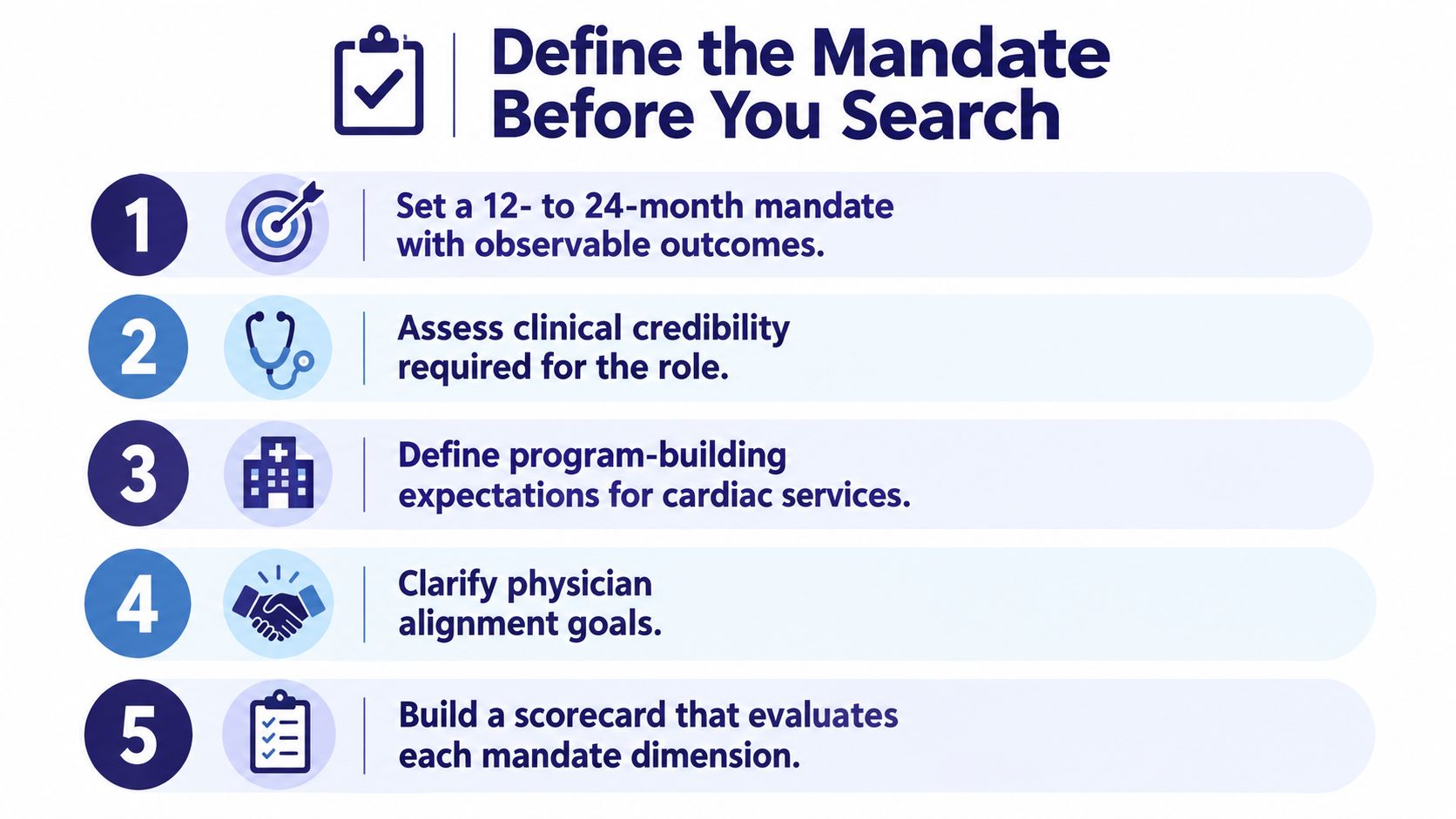
Define the Mandate Before You Search
Define the work before describing the person. A requirement for an accomplished physician executive says little about whether the hospital needs program expansion, workforce stabilization, academic development, or operational recovery. The mandate must state what the appointed leader is expected to change and what resources will support that change.
Succession planning deserves the same specificity. Russell Reynolds Associates' 2025 Global Board Culture and Director Behaviors Survey found that only 8% of surveyed directors reported proactive CEO succession planning more than five years ahead, while half planned only one to three years ahead. Those findings concern CEO succession, not cardiology appointments, but they reinforce the need to define leadership requirements before a vacancy creates urgency.
Translate Priorities Into an Evidence-Based Scorecard
Set a 12- to 24-month mandate as the organization's planning framework. Each objective should have a baseline, a responsible executive, dependencies, and an agreed method of evaluating progress. Access improvement, for example, requires a defined patient population and scheduling measure, not a broad promise to expand services.
The scorecard should distinguish related but separate capabilities:
Clinical credibility and quality: Sound clinical judgment, appropriate escalation, and evidence of effective quality oversight.
Program-building results: Demonstrated responsibility for developing services, improving access, or integrating clinical operations.
Physician governance: Experience resolving disagreement and securing physician participation in consequential decisions.
Workforce stabilization: Evidence of recruiting, developing, and retaining clinicians.
Financial stewardship: Understanding of budgets, capacity constraints, resource allocation, and implementation trade-offs.
Organizational alignment: Readiness for the institution's academic, community, or private-practice model.
For each dimension, specify what constitutes sufficient evidence. A candidate's participation in a service-line initiative isn't equivalent to accountability for its outcome. The intake team should distinguish sponsorship, direct execution, and supporting contributions.
Assign Decision Rights Before Outreach
The board, chief executive, medical staff leadership, finance, operations, human resources, and compliance should have defined roles. Each participant should know whether they supply evidence, advise on suitability, approve a specific condition, or make the final appointment decision.
For physician executive positions, the intake should also distinguish administrative authority from medical staff responsibilities. Candidates need clarity about clinical practice expectations, reporting relationships, budget ownership, and authority over physician performance.
The completed intake package should contain the mandate, scorecard, organizational chart, compensation parameters, essential qualifications, approval pathway, and known transition risks. The authorized decision-maker should approve it before sourcing begins. Late changes should require an explicit explanation and a review of candidates already assessed, not an informal shift in preference.
Build a Pipeline Without Delaying the Search
Internal succession and external sourcing should run in parallel. An internal contender shouldn't receive an implied promise of appointment, and an external candidate shouldn't participate in a process whose outcome has already been decided. Both groups deserve an accurate account of how the organization will select its next leader.
SHRM's 2025 recruiting research reported median time-to-fill of approximately one and a half months for executive and nonexecutive positions, compared with executive roles taking 16 days longer in 2022. This broad recruiting benchmark isn't a cardiology-specific deadline. Hospital leaders should use it as context, not as permission to compress necessary clinical and governance reviews.
Separate Readiness From Interest
Ready-now internal candidates should enter the active assessment process. Ready-later candidates should receive development guidance without being presented as immediate finalists. The executive sponsor must establish whether each person actually wants the role, including its administrative workload and clinical trade-offs.
The external search should map relevant leadership settings rather than rely on titles alone. A search partner should consider hospital, health-system, academic, private-practice, and cardiac-surgery leadership pools, then assess which settings match the mandate.
Relevant experience may involve interventional cardiology, electrophysiology, advanced heart failure, or cardiothoracic surgery. Subspecialty familiarity matters only when it translates into the leadership responsibilities being hired.
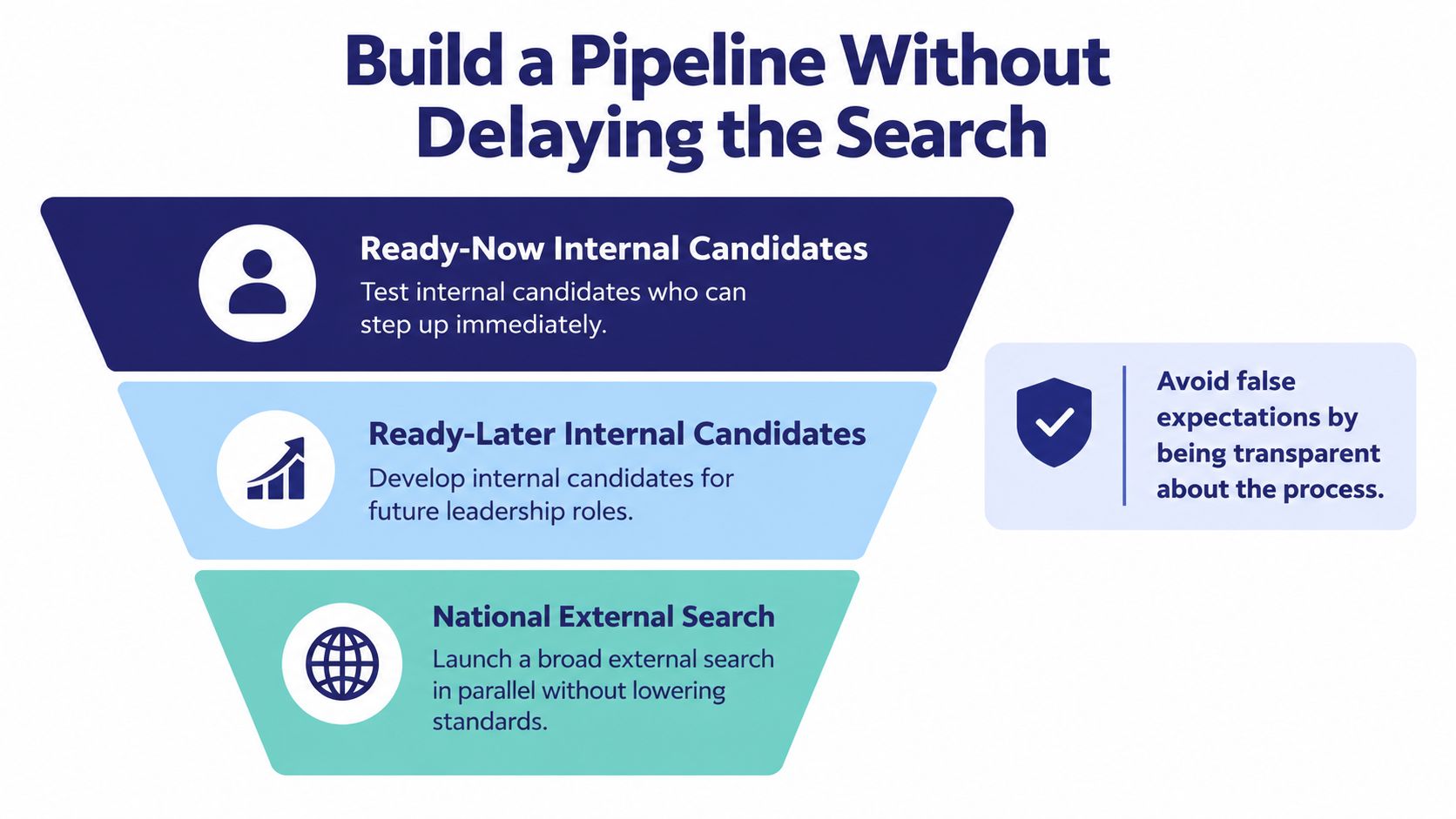
Make the Process Predictable for Candidates
Recruitment operations should establish service-level expectations for role approval, market launch, qualified-slate presentation, finalist selection, offer authorization, and candidate updates. Each milestone needs an owner and an escalation route when approvals stall.
Schedule in parallel: Reserve stakeholder interviews and relevant review meetings before finalists reach those stages.
Explain the opportunity: Disclose reporting lines, governance arrangements, clinical expectations, compensation parameters, and known resource constraints.
Maintain communication: Name a candidate contact and provide updates when a decision slips, even when no substantive outcome has changed.
Protect legitimate confidentiality: Restrict access to candidate identities and obtain permission before contacting current employers.
Confidentiality should protect sensitive organizational information and candidates' existing employment. It shouldn't conceal an unresolved reporting structure or disagreement about the role.
Candidates can assess a difficult mandate. They can't assess an opportunity accurately when the organization withholds the conditions required to deliver it.
The hospital's recruitment team or specialized search partner should maintain a controlled pipeline register with stage, evidence status, next action, owner, and outstanding approvals. That working record makes delays visible without exposing confidential candidate information to everyone involved.
Separate Mandatory Criteria From Development Goals
An over-specified profile can exclude a capable leader for reasons unrelated to performance. An under-specified profile can advance someone who lacks an essential clinical qualification. The committee should separate mandatory qualifications, preferred experience, and capabilities that can reasonably develop after appointment.
The distinction is particularly important in specialized talent pools. A 2025 interventional cardiology Match analysis reported that 272 of 326 available positions filled, leaving 54 unfilled, with 164 of 193 accredited programs participating. These are fellowship findings, not executive candidate counts. They provide workforce context without proving that any particular leadership requirement should be relaxed.
Cardiology Executive Qualification Matrix
Category | Cardiology example | Validation method |
|---|---|---|
Mandatory qualification | Appropriate licensure and board certification when required by the clinical mandate | Primary-source verification against the approved role requirements |
Mandatory capability | Demonstrated accountability for a cardiac program when the position requires immediate service-line leadership | Review of responsibilities, attributable outcomes, and corroborating references |
Preferred qualification | Experience in a comparable academic, community, or private-practice environment | Examination of governance, scale, constraints, and relevance to the new setting |
Preferred experience | Familiarity with the organization's service mix or expansion priorities | Discussion of comparable decisions and implementation responsibilities |
Trainable capability | Knowledge of local budgeting systems, internal reporting tools, or committee procedures | Documented development plan, named support, and review checkpoints |
A mandatory requirement should answer a direct question: What clinical, legal, or operational responsibility would become unsafe or unworkable without it? If stakeholders can't explain the connection, the requirement probably belongs elsewhere.
Prestige, tenure, publication history, and recognizable institutional names aren't substitutes for execution evidence. Publication history may be central to an academic mandate and peripheral to a community service-line role. A shorter tenure may warrant investigation, but it shouldn't automatically outweigh documented results or a credible explanation of organizational change.
Test Whether Development Is Realistic
Trainable doesn't mean optional. The organization must identify who will teach the capability, what access the executive will receive, and how progress will be evaluated.
The committee should also avoid disguising an essential gap as a development opportunity. A candidate who needs substantial support in physician governance may be unsuitable for an appointment whose immediate purpose is resolving physician conflict. The same candidate could be appropriate where governance is stable and the principal mandate concerns program development.
A narrower, outcome-linked profile supports clearer sourcing. A longer list of status signals doesn't necessarily produce a stronger appointment.
Assess Clinical Credibility and Leadership Together
Clinical authority and executive effectiveness require separate evidence, followed by an integrated judgment. A clinically respected physician may struggle to manage conflict or allocate resources. An operationally accomplished executive may lack the clinical judgment required by a physician leadership mandate.
The U.S. Office of Personnel Management reports that structured interviews improve validity and rater reliability, and identifies competency-based behavioral interviews as particularly useful for complex professional and managerial roles. Hospital committees should apply that principle through consistent questions, predefined rating anchors, independent scoring, and structured calibration.
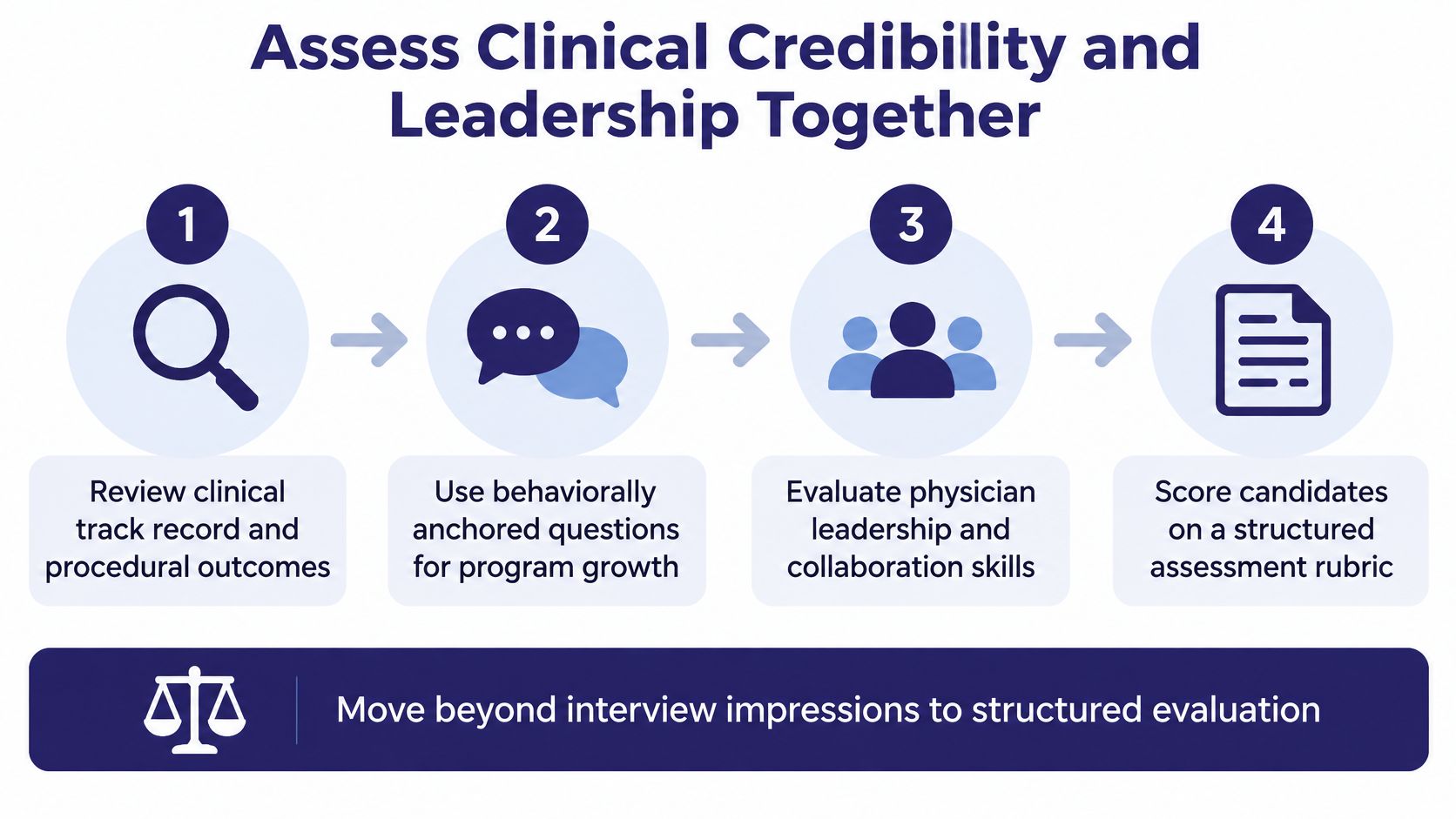
Ask for Decisions, Trade-Offs, and Attributable Results
Each assessment should probe what the candidate inherited, decided, implemented, and learned. Broad claims about collaboration or growth should trigger requests for specific actions and corroborating evidence.
Useful prompts include:
Program growth: Describe a cardiac service expansion, the capacity constraint, the investment decision, and the candidate's personal accountability.
Physician engagement: Explain a consequential disagreement with physician leaders, how competing interests were handled, and what changed.
Quality improvement: Describe an adverse performance signal, the clinical review, corrective action, and subsequent monitoring.
Access and staffing: Explain how recruitment, scheduling, call coverage, and available capacity were reconciled.
Financial stewardship: Identify a decision where clinical priorities exceeded available resources and explain the trade-off.
Retention and conflict: Describe a valued clinician's dissatisfaction and how the candidate addressed both individual concerns and organizational obligations.
Interviewers should record evidence before discussing impressions with colleagues. Rating anchors should distinguish an unsupported assertion from a detailed example and from a corroborated outcome. A polished presentation shouldn't receive the same rating as demonstrated execution.
During calibration, the committee should examine why ratings differ. One interviewer may have uncovered contradictory evidence; another may have interpreted a criterion differently. The chair should resolve those differences through evidence, not a popularity vote.
Verify Credentials and Leadership Behavior Separately
Credential verification isn't a standard background check. The hospital's credentialing and compliance teams should determine the applicable review of medical licensure, board certification, malpractice history, privileges, and NPI or Medicare enrollment where relevant. Administrative screening doesn't establish clinical eligibility.
Likewise, valid credentials don't establish leadership effectiveness. Structured references should include former supervisors, peers, and at least one former direct report. With appropriate consent, reference interviewers should use the same core questions and rating anchors across candidates, covering physician retention, conflict management, program execution, quality oversight, and budget accountability.
Evidence standard: An unresolved contradiction belongs in the decision record, not beneath a favorable overall impression.
When a candidate describes successful collaboration but references describe unilateral decisions, the committee should investigate context and seek clarification. Organizational politics may explain a discrepancy, but that explanation also requires scrutiny.
The final decision memorandum should record the evidence supporting appointment, remaining uncertainties, verification status, and onboarding risks. No finalist should advance because stakeholders assume another interviewer has already checked the difficult claim.
Negotiate the Offer and Build the First 90 Days
An executive offer should define the conditions for delivery, not just compensation. Before presenting final terms, the authorized stakeholders should align on administrative authority, clinical commitments, protected leadership time, reporting relationships, resources, start date, and performance expectations.
Candidate willingness also deserves explicit confirmation. Stanford's Rock Center research found that more than half of surveyed organizations couldn't immediately name a CEO successor, 39% reported no viable internal candidates, and 65% hadn't asked internal candidates whether they wanted or would accept the role. Those CEO succession findings underline a basic requirement: perceived readiness isn't acceptance.
Resolve Commitments Before Signature
Finance should confirm funded resources, medical staff leadership should clarify clinical responsibilities, and legal or compliance advisers should review applicable terms. If the board expects service expansion while finance assumes a constrained operating budget, the executive sponsor must resolve that conflict before the candidate accepts.
The hospital should evaluate physician compensation models against the actual balance of clinical and administrative work. Incentives shouldn't reward clinical production while the organization expects substantial time devoted to physician leadership and service-line development.
Verbal commitments about recruitment support, capital access, or staffing should become written commitments with appropriate conditions. The candidate should also receive a realistic account of unresolved disputes and inherited obligations.
Establish a Measurable Transition
Use a 30/60/90-day plan as a proposed onboarding framework, shaped to the mandate rather than treated as a universal performance benchmark:
By day 30: Complete priority physician and stakeholder conversations, review quality and operational baselines, and establish an agreed risk register.
By day 60: Present prioritized findings on recruitment, access, capacity, and financial constraints, with accountable owners for proposed actions.
By day 90: Secure approval for the service-line execution plan, confirm resource decisions, and report progress on agreed early actions.
The executive sponsor should schedule corresponding reviews and help resolve barriers the new leader can't remove alone. Leading indicators can include completion of essential consultations, recruitment activity, quality-review actions, budget decisions, and implementation readiness.
Early onboarding shouldn't demand mature clinical or financial outcomes before the executive has assessed inherited conditions. It should demonstrate sound judgment, credible relationships, and disciplined follow-through.
Onboarding is the first stage of succession execution, not an administrative handoff. The sponsor remains accountable for ensuring that the authority and support described during recruitment exist after the start date.
Measure Decision Quality and Retention
Offer acceptance is a milestone, not proof of a successful appointment. Hospital leaders should judge the executive recruitment process by the evidence behind the decision and the executive's subsequent ability to perform the mandate.
Healthcare executive searches average about 92 days to fill, with longer timelines attributed to credential checks and health-system governance approvals. That benchmark shouldn't become a deadline detached from role complexity. A committee should examine avoidable waiting separately from necessary validation.
Maintain a Search and Retention Dashboard
A compact dashboard should connect recruitment operations with appointment outcomes:
Funnel progression: Track role approval, market launch, qualified slate, finalist selection, offer acceptance, and start date using consistent milestone definitions.
Candidate experience: Record withdrawals, reasons for withdrawal, communication gaps, and acceptance decisions.
Governance discipline: Monitor stakeholder attendance, overdue approvals, unresolved authority questions, and compensation decisions.
Evidence completeness: Identify outstanding credential checks, reference concerns, and unsupported claims before appointment.
Post-hire outcomes: Review mandate progress and 12-month retention, alongside the executive's access to promised resources and authority.
Retention should mean more than continued employment. An executive can remain in position while struggling with unclear authority, weak physician alignment, or commitments the hospital hasn't fulfilled. The sponsor should review those conditions alongside performance, using practical physician retention strategies where workforce relationships affect the mandate.
Assign Accountability Without Diluting Confidentiality
The search partner should own pipeline accuracy and candidate communication. The hiring organization should own timely decisions and truthful disclosure. The executive sponsor should own transition support and escalation.
Access to sensitive records should remain role-based. Leadership can review process delays and outstanding decisions without circulating confidential reference narratives.
After appointment, the committee should document which assessment findings proved useful, which risks emerged, and which requirements need revision. That review improves the next search and helps distinguish an appointment problem from an organizational support problem.
American Cardiology Group offers specialized executive recruitment for cardiac healthcare organizations, alongside permanent physician recruitment, locum tenens coverage, and advanced practice placement. Hospital leaders preparing a cardiology leadership appointment can visit American Cardiology Group to discuss the mandate, candidate evidence requirements, and transition priorities before launching a search.
Comments