
How to Improve Medication Adherence in Cardiology
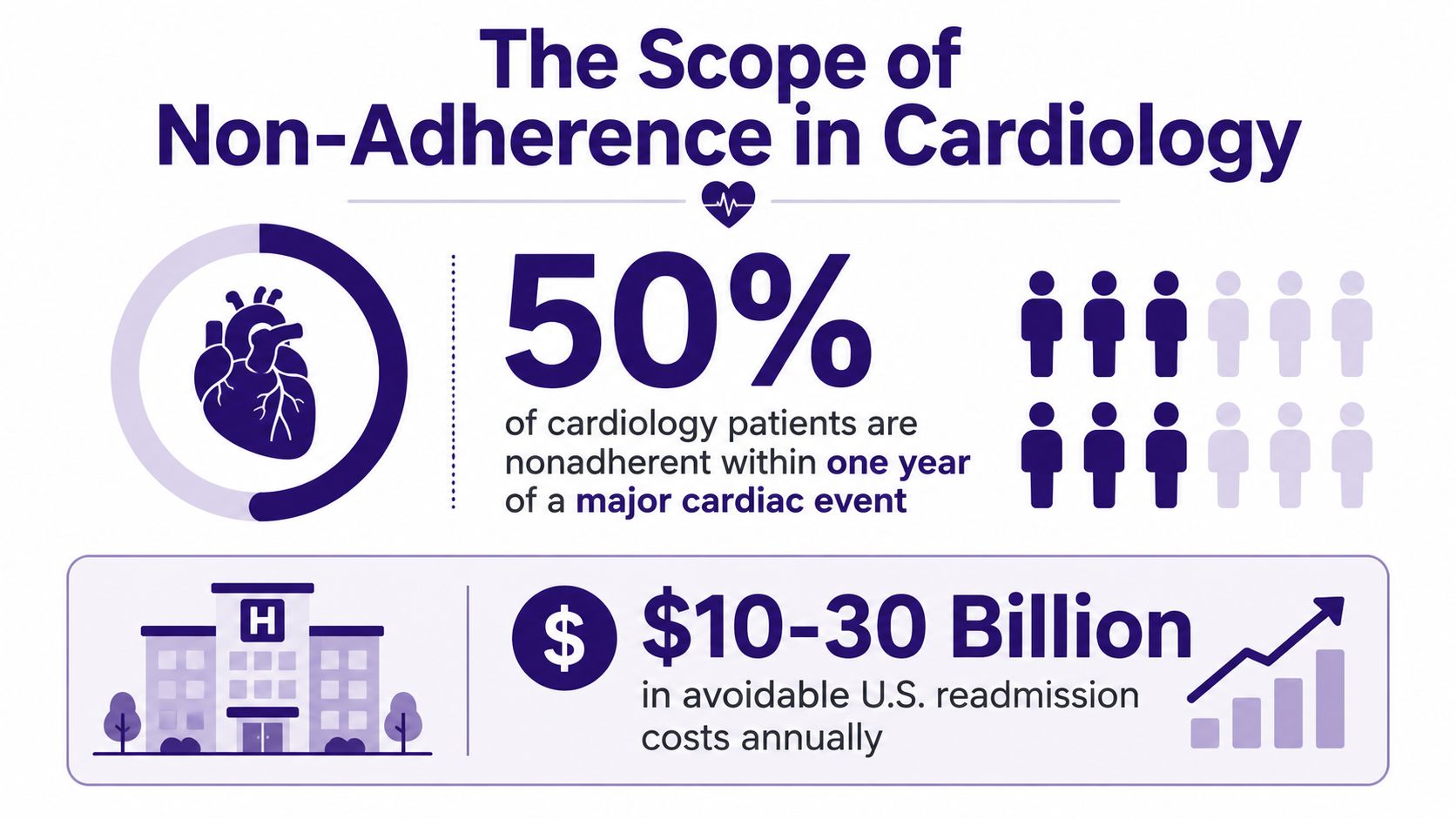
Medication nonadherence is not a patient discipline problem. It is a care-delivery failure that shows up later as avoidable readmissions, fragmented treatment plans, and burned-out cardiology teams. National summaries put long-term adherence at about 50% in the general population, and nearly 1 in 3 new U.S. prescriptions are never filled at all (systematic overview of medication adherence).
For hospital leadership, that is the wrong place to assign blame. The right question is operational: who owns reconciliation, who checks the first refill, who follows up when a patient stalls, and who fixes the barriers that sit between discharge and the next outpatient visit? If those owners are vague, adherence will stay inconsistent no matter how good the counseling script sounds.
Table of Contents
Why Medication Adherence Is a Cardiology Workforce Problem - Ownership beats intention
Diagnosing the Real Barrier Before Choosing an Intervention - Use the behavior as the clue
A 30-Day Clinic Workflow That Actually Moves Adherence - Days 0 to 7 need hard ownership
Choosing the Right Intervention for the Right Patient - Build from the lowest-friction tool upward
Improving Adherence Across the Discharge Transition - Wire the transition like a safety process
Metrics, Quality Indicators, and the Executive View - Measure where accountability lives
A 90-Day Roadmap and What to Build Into the Cardiology Team - Build the team around the work
Why Medication Adherence Is a Cardiology Workforce Problem
Cardiology programs lose control of adherence when they treat it as a motivation issue instead of a workforce and operating-model issue. The strongest gains come from structured pharmacist-led programs, targeted digital outreach, and multicomponent workflows, not one-time advice or unassigned reminders. A meta-analysis of 40 randomized trials involving 8,822 older adults found that pharmacist-led interventions improved adherence with an effect size of 0.57. Benefits weakened over longer follow-up and varied substantially, so staffing, ownership, and follow-through determine whether an intervention lasts (pharmacist-led adherence meta-analysis).
Ownership beats intention
A cardiology service line cannot improve adherence by asking each clinician to remember a counseling point. Assign medication reconciliation, post-discharge contact, refill verification, and barrier resolution to named roles. Nurse navigators also need protected time for follow-up. See nurse-patient relationship practices for the relationship work that supports sustained contact.
Practical rule: if no role is named, no process exists.
This requirement applies across electrophysiology, heart failure, and interventional cardiology. Each program depends on sustained medication use and reliable transitions. Unassigned work shifts to whichever clinician is available, increasing variation and burnout. It also hides failure: the chart may document counseling while the patient never obtains the medication.
Leadership should therefore measure both the intervention and the handoffs around it. Identify who confirms access, who responds to side effects or cost barriers, and who escalates a missed refill. Those decisions turn adherence from an individual expectation into a measurable care-system responsibility.
Diagnosing the Real Barrier Before Choosing an Intervention
The fastest way to waste money on adherence is to buy a tool before identifying the barrier. Cost, regimen complexity, system fragmentation, and patient-level concerns do not respond to the same fix. A patient who never starts a prescription is signaling a very different problem from a patient who refills twice and then disappears.
Use the behavior as the clue
If the first script never gets filled, cost or access is usually the leading suspect. If the patient fills the medication but stops around month three, side effects, fear, or a belief problem is more likely. If fills are irregular, the issue is often fragmented care, confusing instructions, or competing prescribers who never reconciled the list.
A short screen at every cardiology visit is enough to start. Ask whether the patient has had any trouble paying for medications or getting them on time, then ask whether anything about the regimen makes it hard to take as prescribed. That is not exhaustive, but it separates the patients who need financial navigation from the patients who need simplification or pharmacist counseling.
Barrier Categories and Identifying Signals | ||
|---|---|---|
Observed Behavior | Likely Dominant Barrier | First-Line Response |
Never fills the first prescription | Cost or coverage | Check formulary, substitute a lower-cost option, and route to pharmacy support |
Fills initially, then stops after several weeks or months | Side effects, beliefs, or misunderstanding | Pharmacist review, counseling, and symptom-specific troubleshooting |
Fills inconsistently across medications | Fragmentation or access problems | Reconcile all active prescriptions and align prescribers |
Patient reports confusion about timing or purpose | Regimen complexity | Simplify dosing, reduce pill burden where clinically appropriate |
Patient says the drug is unaffordable or delayed | Access and affordability | Address benefits, refills, delivery, and assistance pathways |
A brief pharmacist-led medication review at program entry should be standard, not optional. That review catches the hidden issues that a routine clinic note misses, including duplicate therapies, outdated instructions, and conflicting specialty plans. For hospitals with fragmented care teams, the open question is not whether the patient needs education, it is whether the system has made education usable.
A 30-Day Clinic Workflow That Actually Moves Adherence
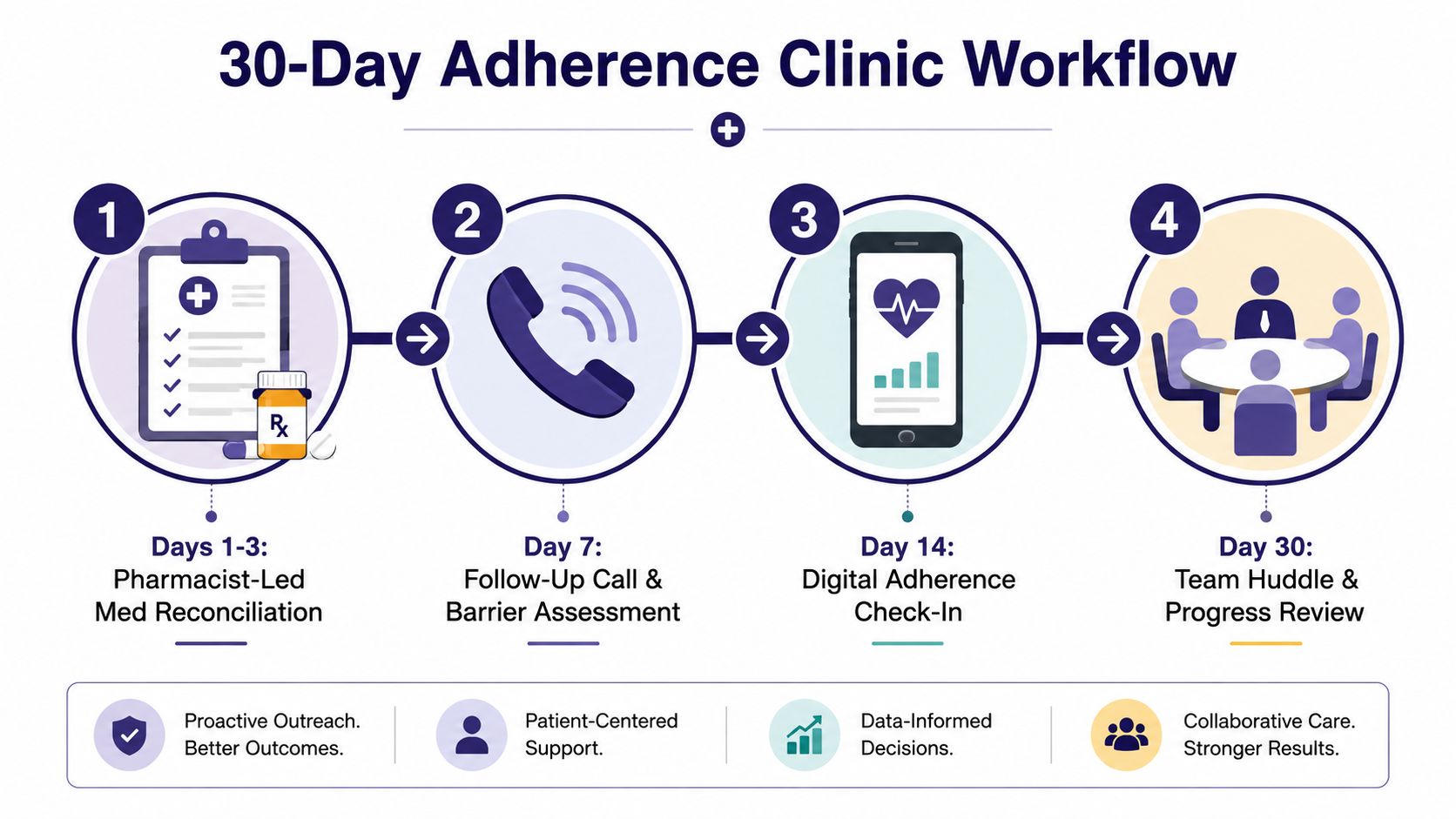
A real adherence workflow starts with medication reconciliation within 72 hours of enrollment, not with a pep talk. The strongest model is operational choreography, because a single educational visit decays fast when the patient leaves with confusion, cost pressure, or a list that still contains conflicting orders. A pharmacist, nurse, and scheduler each need a defined action, an artifact, and a deadline.
Days 0 to 7 need hard ownership
Day 0 should be pharmacist-led reconciliation plus teach-back. The artifact is a reconciled medication list and a documented note showing the patient could state the purpose and timing of each drug. If that step is skipped, the team starts the program with a bad list and a false assumption that understanding exists.
Day 3 should confirm refill status, because a prescription that never leaves the queue is already a failure. Day 7 should be a nurse-led call that checks side effects, access, and whether the patient started the regimen. That call is where systems catch the patients who would otherwise drift until the next hospitalization.
Day 14 should be a clinic or telehealth touchpoint, and the question is simple, did the plan still make sense after a week of use? Day 30 should close the loop with a documented adherence review and a refill check, not an informal “doing okay?” conversation. For teams building this inside a broader cardiovascular operations model, the logic aligns with remote blood pressure monitoring workflows, because both depend on defined follow-up rather than passive observation.
Operational truth: repeated follow-up beats a single strong conversation every time.
Regimen simplification belongs in that same workflow. Fixed-dose combinations, once-daily dosing, and deprescribing where clinically appropriate reduce friction without pretending every barrier is behavioral. The one thing not to do is assume counseling alone will hold the line after discharge.
Choosing the Right Intervention for the Right Patient
Interventions should match the barrier, not the budget cycle. Teams that layer every tool onto every patient waste staff time and still miss the people who are at risk. The sequence should be simple, start with reconciliation and pharmacist review, then add scalable support based on what the patient needs.
Build from the lowest-friction tool upward
Text-message support is the easiest broad add-on because it reaches patients who won't open an app and doesn't require a heavy workflow. The evidence is strong. A meta-analysis of 2,742 patients found text messaging improved adherence with an odds ratio of 2.11, and the authors translated that into adherence rising from 50% to 67.8% in chronic disease settings, an absolute increase of 17.8 percentage points (text-message adherence meta-analysis).
Pharmacist-led adherence programs should still be the anchor for complex cardiology patients, especially where reconciliation, side effects, and regimen simplification matter. Automated telecommunication also helped in cardio-metabolic medication studies, but the heterogeneity was very high, so reminders alone are not enough. The message for leadership is blunt, digitize follow-up, but do not mistake automation for engagement.
Intervention comparison: effectiveness, cost, effort, and best-fit barrier | |||||
|---|---|---|---|---|---|
Intervention | Evidence strength | Relative cost | Staff effort | Best-fit barrier | Payoff when |
Pharmacist-led reconciliation and counseling | Strong | Moderate | High | Confusion, regimen complexity, side effects | The patient needs a clean regimen and a trusted medication review |
Two-way text messaging | Strong for scalable outreach | Low | Low to moderate | Forgetfulness, missed follow-up | The patient responds to simple nudges and check-ins |
App-connected reminders | Mixed, situation dependent | Moderate | Moderate | Forgetfulness with digital comfort | The patient already uses smartphones consistently |
Refill synchronization and longer fills | Operationally useful | Low to moderate | Moderate | Access friction, repeated pharmacy trips | The patient is stable and the main problem is refill burden |
RPM-linked escalation pathways | Best in selected high-risk cohorts | High | High | Post-event monitoring and rapid deterioration | Clear triggers and accountable escalation already exist |
Reimbursement and staffing have to follow that sequence, not the other way around. Teams that buy expensive digital tools before fixing med rec and refill flow usually get prettier dashboards and the same adherence problem.
Improving Adherence Across the Discharge Transition
The discharge window is where cardiology programs lose the most control. Medication plans leave the inpatient unit, enter a messy outpatient environment, and immediately collide with pharmacy delays, duplicative lists, and patient confusion. If the system does not impose structure in the first few days, the plan starts to degrade before the first follow-up visit.
Wire the transition like a safety process
Medication reconciliation at discharge should produce the most accurate medication list possible, with verification, clarification, reconciliation, and transmission built into the process (medication reconciliation review). The discharge summary should not be a free-text dump. It should transmit the reconciled list, the medication purpose, dose, frequency, route, planned duration, and reasons for changes, because that is what the outpatient clinician needs to continue care (discharge planning guidance).
The patient should leave with medication in hand, not with a promise that the pharmacy will sort it out later. That is where many programs fail, because they document a discharge order and confuse it with actual access. Within seven days, a clinician or pharmacist should verify fills, side effects, and affordability, then re-engage the patient if the regimen is slipping.
A structured teach-back before discharge still matters, but only if it is paired with the rest of the workflow. The patient should be able to name each drug, say why it is being taken, and identify the timing. For teams that already run cardiology follow-up infrastructure, the same discipline fits alongside heart failure program development, because both depend on clean handoffs and rapid outpatient correction.
Discharge rule: if the first outpatient touchpoint is the first time anyone checks access, the system is already late.
The point is not to make discharge more complicated. The point is to stop pretending discharge ends when the paper leaves the printer.
Metrics, Quality Indicators, and the Executive View
Executives fund what they can see, and adherence is invisible until it is measured well. The most useful metric is Proportion of Days Covered, or PDC, especially at the 80 percent threshold for each therapeutic class. Medication Possession Ratio, or MPR, is useful as a supporting measure, but PDC is the cleaner management number because it aligns better with sustained coverage.
Measure where accountability lives
PDC should not sit only in a monthly enterprise report. It should appear at the panel, clinic, and clinician level, because leadership cannot manage what stays aggregated. If the dashboard only says the health system is doing poorly, no service line knows where to intervene.
Tie adherence to the outcomes leadership already tracks, especially 30-day all-cause cardiac readmissions, post-MI mortality, and heart failure hospitalization days. Those are the measures that matter to penalty avoidance, shared savings, and quality scoring, so they belong in the same conversation as the medication work itself. The clinical argument gets stronger when the operational and financial signals line up.
The reporting problem is that many systems only learn about adherence after the fact. Real-time fill-data feeds and an EHR flag for at-risk patients shift adherence from retrospective reporting to active management. That matters because a clinician cannot intervene on a problem the system surfaces three weeks too late.
Executive standard: if the EHR cannot show who is drifting, the program is measuring instead of managing.
Clinician-facing adherence flags should be simple, not noisy. A good flag gives the team a reason to act, a reason to act now, and a path to the right staff member. Anything more complicated becomes another dashboard nobody opens.
A 90-Day Roadmap and What to Build Into the Cardiology Team
The first 30 days should be a baseline audit, not a product purchase. Map the discharge workflow, identify where medication reconciliation breaks, and assign a pharmacist owner who can hold the process together. If the current state is unknown, every later investment is guesswork.
Build the team around the work
Days 31 to 60 should pilot one or two interventions in a single cardiology clinic. Keep the scope tight, define success thresholds, and let the pharmacist, nurse navigator, and operations lead see the same adherence data. Days 61 to 90 should expand the model, embed the metric in the EHR dashboard, and hardwire the follow-up cadence into clinic templates.
The workforce question is the one leaders avoid until the pain is already visible. Adherence does not survive as an add-on. It needs an ambulatory cardiology pharmacist for reconciliation and regimen optimization, a nurse navigator for follow-up and barrier checks, a pharmacy technician for med rec support, and a population health analyst to track panel performance and surface risk.
That team design also matters for recruitment. Cardiology talent is competitive, and retention improves when the role has protected time, clear scope, and visible results. A pharmacist or nurse navigator who spends every week cleaning up invisible process gaps will not stay engaged for long.
Audit first: baseline PDC, discharge handoffs, and refill failure points.
Assign owners: name one accountable person per workflow step.
Pilot narrowly: start in one clinic, not across the whole service line.
Instrument the EHR: surface refill gaps and missed follow-up in real time.
Scale only after the workflow holds: expansion without process control just spreads the same failure.
The trade-off is simple. Buying a tool is faster, but building a workflow lasts longer. Hospitals that want better adherence need both the clinical spine and the operational muscle, or the problem stays where it is.
American Cardiology Group helps hospitals and health systems build stronger cardiology teams by placing the specialists, advanced practice providers, and leadership talent needed to support programs like adherence management, discharge coordination, and heart failure follow-up. If your organization is trying to improve medication adherence without overloading the current staff, visit American Cardiology Group to see how the right recruitment strategy can support the clinical workflow you need.
Comments