
Locum Tenens Coverage for Cardiology: A Practical Guide
A cardiac service line rarely fails because demand disappears. It fails when one physician leaves, takes leave, or hasn't yet been hired, and there's no credible plan to keep consults, procedures, and follow up moving. Locum tenens coverage is that plan when it's designed before the crisis, scoped to the exact clinical work, and measured by access preserved rather than shifts filled.
Table of Contents
When a Cardiac Program Loses a Physician Overnight - What Coverage Actually Means in Cardiology - Why Cardiac Stakes Are Higher
How Locum Tenens Coverage Became a Mainstream Strategy - Scale Changes the Conversation - The Cardiology Connection
When Cardiology Programs Need Locum Coverage Most - Highest Value Deployment Situations - Measure Access, Not Shifts
What the Evidence Says About Quality and Cost - The Right Quality Question - Cost Beyond the Daily Rate
Credentialing and Billing Compliance for Cardiac Locums - Privilege the Procedure, Not the Label - Medicare Billing Rules That Need Controls
Contracting, Pay Models, and the Breakeven Decision - Calculate the Fully Loaded Cost - Set the Breakeven Checkpoint in Advance
Best Practices for Integrating Locum Cardiologists - Make Handoffs Explicit - Use a Scorecard and a Transition Plan
When a Cardiac Program Loses a Physician Overnight
A community hospital's only interventional cardiologist resigns on short notice. The cath lab schedule is full, inpatient consults keep arriving, and referring physicians need an answer they can give patients today, not after a permanent search closes. The chief medical officer has three bad options: transfer patients who could have been treated locally, cancel procedural days, or ask an already stretched team to absorb call it can't safely sustain.
That's the moment where locum tenens coverage stops being an emergency purchase and becomes a service line preservation strategy. A qualified locum cardiologist doesn't solve the permanent vacancy. The locum protects the revenue, referral relationships, and clinical reputation that make the permanent job worth taking in the first place.
What Coverage Actually Means in Cardiology
In this context, locum tenens coverage means a credentialed, privileged physician temporarily performs a defined scope of work for an absent or not yet hired physician. That scope might be inpatient consults and rounding, outpatient clinic, noninvasive testing interpretation, device follow up, or procedural work in the cath lab. The definition matters because cardiology isn't interchangeable labor, and a general label doesn't tell a medical staff office what a physician is allowed to do.
Permanent recruitment and locum deployment answer different questions. Recruitment asks who'll build the program over years, take longitudinal responsibility for patients, and invest in the community. Coverage asks who'll keep essential services available this month without lowering the standard for credentialing, handoffs, or accountability.
A vacant cardiology position is a recruiting problem. A closed cath lab, diverted patients, and burned out partners are organizational problems, and they're more expensive.
Why Cardiac Stakes Are Higher
Cardiac programs run on time sensitive decisions and tight interdependencies. A delayed consult affects length of stay and discharge planning. A missed procedural day pushes patients to competitors and disrupts anesthesia, nursing, and cath lab staffing built around that schedule. Device patients, heart failure patients, and post procedural patients need continuity even when their usual physician isn't available.
The permanent team feels the gap first. Partners covering extra call tolerate it briefly, then they start weighing their own options. Advanced practice providers and nursing staff can stabilize workflows, coordinate follow up, and manage protocol driven care, but they can't replace physician judgment for complex cases or privileges they don't hold.
Executives should therefore judge the first coverage decision quickly and explicitly. Define which services must not stop, which can be reduced, and which can be referred out safely. Name the clinical leader who owns the locum's schedule, orientation, and escalation pathway, then set the date when leadership will reassess the permanent search against the cost of continuing coverage.
Programs that wait for certainty usually lose optionality. The strongest approach is direct: stabilize access with a tightly scoped assignment, run the permanent search in parallel, and review both tracks on the same dashboard until the vacancy closes.
How Locum Tenens Coverage Became a Mainstream Strategy
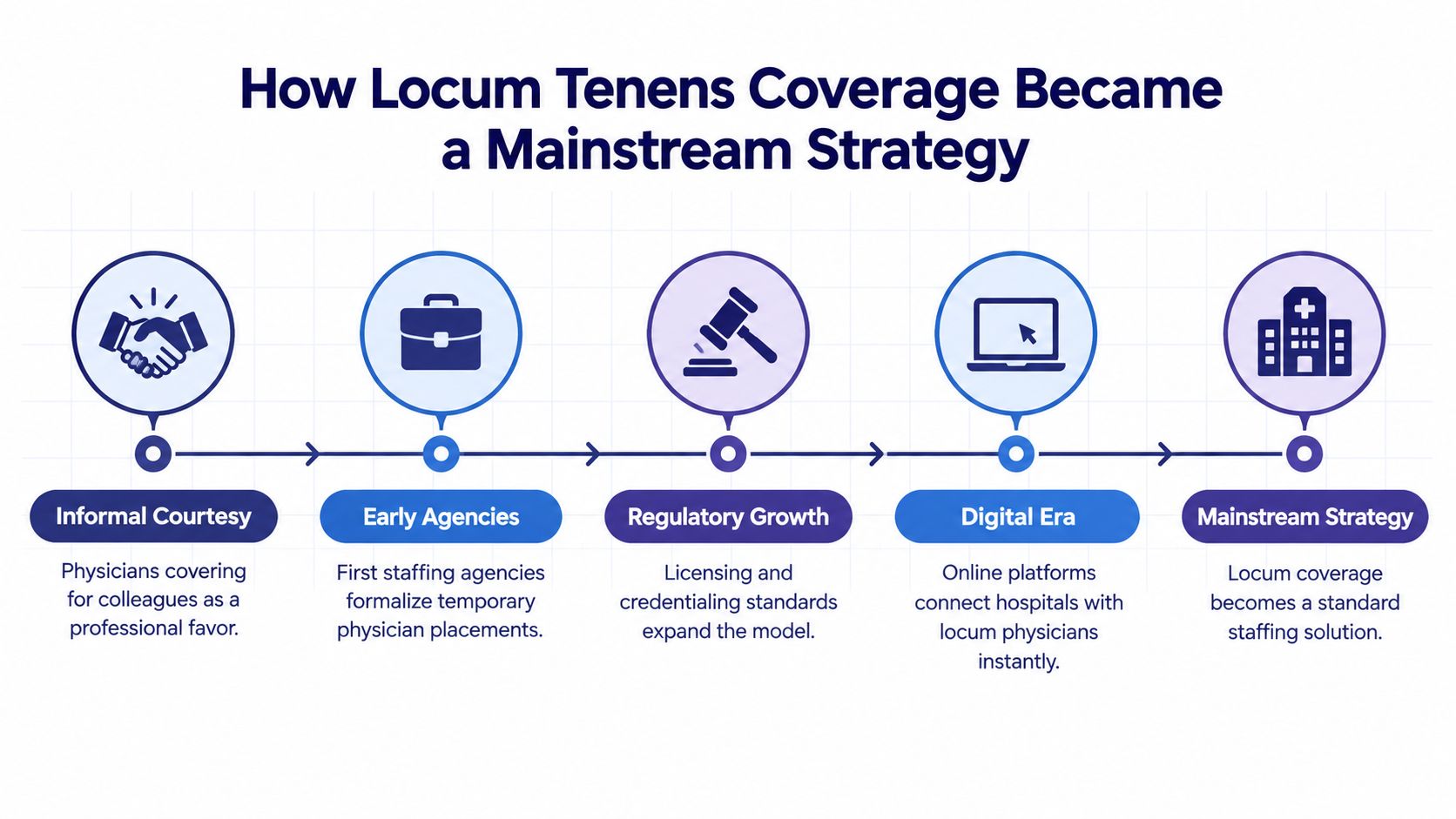
Temporary physician coverage didn't begin as an industry. It began as professional courtesy, with physicians covering for ill, traveling, or otherwise absent colleagues, a practice that later developed into a systematic staffing model as hospitals needed something more reliable than goodwill. That shift matters for cardiology leaders because the model was built around access and continuity, not convenience.
During the 1970s, federal government grants designed to place physicians in medically underserved areas helped expand temporary staffing into a broader national service, according to the 2020 Staff Care survey history of locum tenens growth. The same source material explains how locum tenens developed from informal courtesy into a systematic model during that decade. Once agencies, credentialing processes, and repeatable contracting existed, hospitals could plan coverage instead of improvising it.
Scale Changes the Conversation
Estimates cited in the 2020 Staff Care survey indicate that approximately 52,000 physicians worked as locum tenens in 2019, compared with 26,000 in 2002, an increase of 100% over 17 years, and a 2022 survey cited by the American Medical Association found that nearly 90% of hospitals, medical groups, and other healthcare facilities had used locum tenens hiring while permanent searches were underway, as summarized in the American Medical Association overview of locum tenens use by specialty. Those figures describe a mainstream workforce tool. They don't describe a last resort for desperate facilities.
Adoption also varies by survey and facility type, and leaders shouldn't treat any single estimate as a universal benchmark. The directional point is consistent: organizations use locums to preserve clinical capacity during vacancies and to reduce the operational risk of waiting for a permanent hire. A hospital that refuses temporary coverage on principle isn't avoiding risk. It's choosing transfer risk, backlog risk, and retention risk instead.
What changed structurally:
From favor to system: Informal colleague coverage became contracted, credentialed, and scheduled through repeatable processes.
From absence to access: Coverage expanded from covering illness or travel to sustaining services in underserved communities.
From stopgap to strategy: Health systems now build locums into recruitment timelines, leave planning, and service line launches.
The Cardiology Connection
Geographic maldistribution has always sat at the center of this model. Cardiac subspecialists cluster unevenly, and smaller or rural programs can lose an entire capability when one electrophysiologist, heart failure specialist, interventional cardiologist, or cardiothoracic surgeon departs. A large urban center absorbs that loss across a group. A community program may not have a group to absorb it.
That's why locum tenens coverage belongs in workforce planning for hard to fill cardiac roles. Used early, it buys recruiting time without surrendering market position. Used late, after volumes and referrals have already moved, it becomes an expensive attempt to rebuild trust that should never have been allowed to erode.
The mature position for executives is straightforward. Don't ask whether the organization believes in locums. Ask which services can't pause, how quickly a qualified physician can be credentialed for them, and what trigger will start coverage before a vacancy becomes a closure.
When Cardiology Programs Need Locum Coverage Most
Recent U.S. hospital data show that only 53.5% of hospitals offered general cardiology, 43.7% diagnostic catheterization, and 40.7% interventional catheterization, and rural hospitals were substantially more likely than urban hospitals to lack each service, with odds ratios of 2.88, 4.68, and 5.43, respectively, according to reporting on uneven access to key cardiac services across the United States. Read that as an access problem, not a staffing statistic. Where a service exists at all, losing the physician who sustains it can remove local care for an entire community.
Locum coverage creates the most value when it protects a capability that's difficult to restart. A cath lab that goes dark loses team proficiency, referral confidence, and procedural momentum. An electrophysiology or heart failure clinic that pauses follow up creates backlogs that permanent physicians inherit later, often with sicker patients and frustrated referring partners.

Highest Value Deployment Situations
Sudden departure of a procedural specialist is the clearest case. If the departing physician holds unique privileges for interventional work, device implantation, or structural procedures, coverage must be matched to that exact scope or the program should state plainly which cases will transfer. Pretending a general cardiologist can absorb a procedural schedule creates safety and credibility problems.
Parental or medical leave is more predictable, so there's no excuse for scrambling. Leaders can credential early, align the locum's clinic templates with the returning physician's panel, and design handoffs for patients whose care will span the leave. Planned leave coverage also protects the returning physician from an unmanageable backlog, which supports retention.
Fellowship transitions create a different gap. A program may know a fellow will join, or a senior physician will retire, but the dates don't align. Locum coverage bridges that interval without forcing the organization to rush a permanent decision or overload trainees and partners beyond appropriate supervision and scope.
New service line launches: Temporary physicians can establish clinic access and procedural volume while permanent recruitment catches up with pro forma assumptions.
Prolonged subspecialist searches: Electrophysiology, advanced heart failure, structural heart, and cardiothoracic surgery searches often require a longer runway, making interim coverage a condition of program viability.
Rural access preservation: Rotational coverage can keep consultative and diagnostic services local while the system builds telecardiology, APP support, or a permanent pipeline.
Volume surges and backlog recovery: Focused clinic or testing coverage can reduce appointment delays without committing prematurely to permanent headcount.
Measure Access, Not Shifts
The framing shift executives need is simple. Don't measure coverage only by filled shifts. Measure avoided transfers, preserved catheterization capability, shorter appointment delays, consult responsiveness, and continuity during recruitment. A locum who fills a schedule but operates outside local protocols, communicates poorly, or generates avoidable transfers hasn't preserved the service line.
Decision rule: Deploy coverage when the clinical and referral cost of pausing a service exceeds the fully loaded cost of a well scoped assignment, and stop using that logic when a sustainable permanent model is available.
Every deployment should define clinical scope, transfer thresholds, local APP and nursing capacity, emergency backup, and the transition plan to permanent recruitment before the physician arrives. Locum tenens coverage is most defensible as an access equity strategy that keeps essential cardiac care reachable. It isn't a substitute for building a durable workforce, and programs that treat it as one will pay premium rates to postpone decisions they still have to make.
What the Evidence Says About Quality and Cost
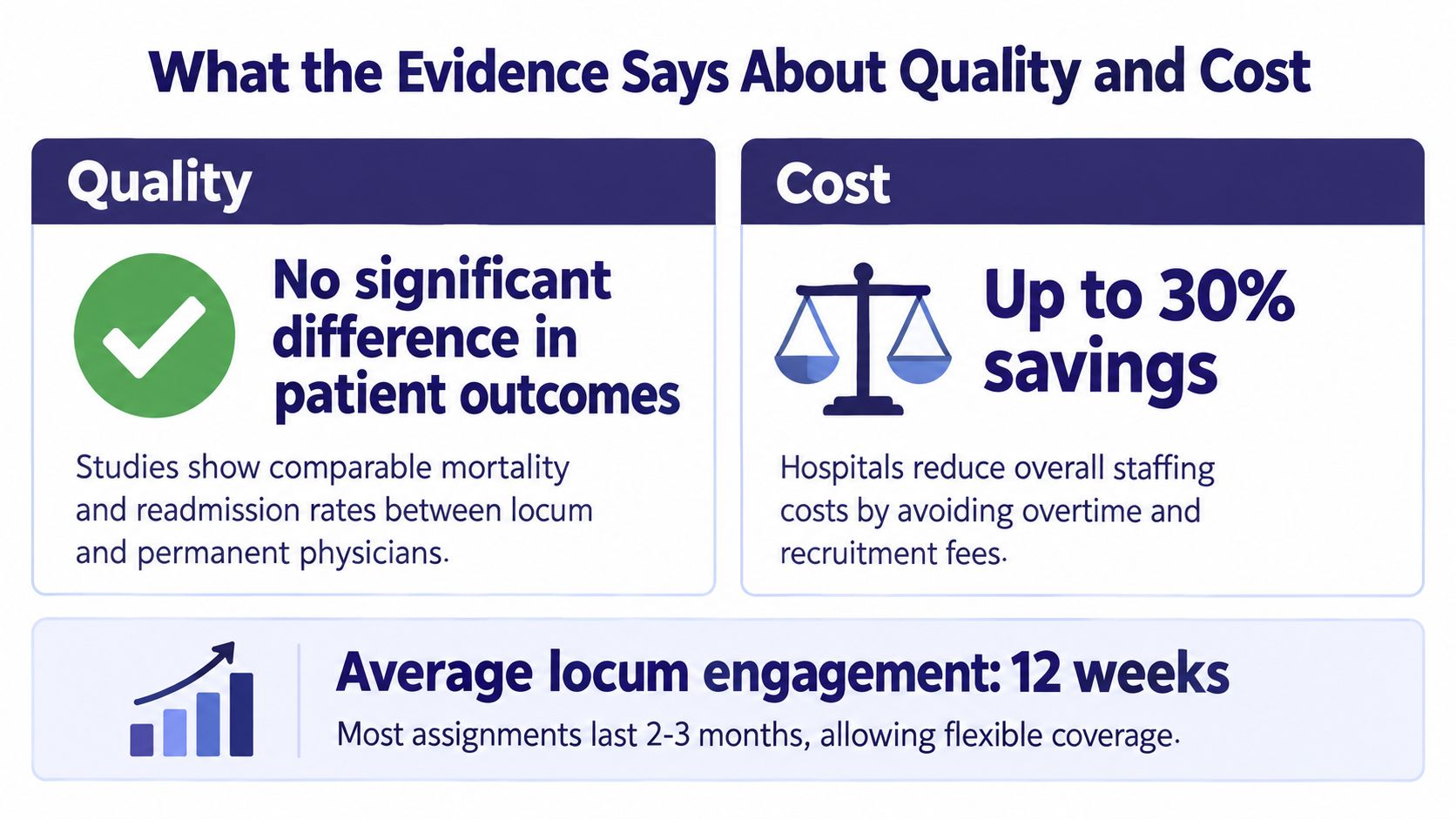
Leaders usually ask two blunt questions: will a locum physician harm quality, and will the organization pay more for worse performance? The available inpatient evidence doesn't support the assumption that temporary physicians necessarily worsen outcomes. It does show trade offs that belong in the financial model, and it leaves the operational burden where it belongs, on the hospital that designs the assignment.
A large retrospective cohort study of 1,818,873 Medicare beneficiaries hospitalized between 2009 and 2014 found 30 day mortality of 8.83% for patients treated by locum tenens internal medicine physicians versus 8.70% for permanent physicians, a 0.43 day longer adjusted mean length of stay, $124 higher adjusted Medicare Part B spending per admission ($1,836 versus $1,712), and a 1.00 percentage point lower 30 day readmission rate (22.80% versus 23.83%), in the Medicare cohort analysis of locum tenens outcomes and spending. No statistically significant mortality difference was found. Length of stay, spending, and readmissions still moved, which is why daily rate alone is a weak evaluation tool.
The Right Quality Question
The useful question isn't whether locums are safe in the abstract. It's which operational conditions make coverage safe and economically rational for a specific cardiac service. Routine inpatient coverage with strong protocols is not the same assignment as joining a highly integrated electrophysiology, heart failure, structural heart, or interventional cardiology program where team familiarity and procedural workflow drive outcomes.
Onboarding quality, credentialing speed, EHR familiarity, handoff design, and scheduling clarity determine much of the result. A locum who can't work through order sets, doesn't know transfer criteria, or receives patients without structured handoffs will create friction that looks like a physician problem but is a system design problem. Programs should align these controls with their broader cardiology quality metrics rather than judging temporary coverage in isolation.
Conditions that raise risk:
Vague scope: The assignment description doesn't distinguish consultative, noninvasive, invasive, and procedural responsibilities.
Weak handoffs: Inpatient lists, pending tests, device issues, and discharge barriers move between physicians without a standard format.
No local sponsor: Nobody owns orientation, escalation, feedback, and early course correction during the first days on site.
Mismatched case mix: The physician is competent generally but not privileged or current for the specific procedures the program expects.
Cost Beyond the Daily Rate
Financial evaluation should include length of stay effects, professional billing, discharge coordination, readmissions, avoided transfers, and revenue preserved by keeping procedural and clinic capacity open. It should also include the cost of not covering: lost referrals, partner burnout, delayed diagnoses, and a permanent candidate market that views an unstable program as risky. Cheap coverage that disrupts throughput isn't cheap.
Other cited findings in industry reporting describe settings where locum care was associated with lower hospital cost when length of stay was shorter, and settings with no meaningful differences in complications or utilization, as discussed in the CHG Healthcare state of locum tenens report. Those mixed results reinforce the same conclusion. Case mix and assignment design matter, and leaders shouldn't generalize from one setting to a complex cardiac program without local measurement.
Build a scorecard before the assignment starts. Track time to credential, orientation completion, consult response, transfer decisions, length of stay, readmissions, patient experience, documentation timeliness, and permanent hire conversion. If locum tenens coverage preserves access without degrading those measures, it's performing. If it doesn't, fix the assignment design or end it, but don't hide behind a generic debate about temporary physicians.
Credentialing and Billing Compliance for Cardiac Locums
Credentialing is where good intentions become defensible practice. Locum tenens credentialing is not a reduced version of permanent physician credentialing, and treating it as a shortcut exposes the hospital, the medical staff, and patients. Temporary status changes the employment relationship. It doesn't change the obligation to verify competence for every privilege granted.
Primary source verification should cover medical education, residency and fellowship training, board certification, state licensure, DEA registration, malpractice history, and National Practitioner Data Bank information, consistent with locum credentialing guidance for medical staff offices. That guidance also identifies a Focused Professional Practice Evaluation for newly privileged practitioners, including locum physicians. Temporary privileges require confirmation of licensure, an NPDB query, no known basis for denial, and approval by the medical staff president or designee.
Privilege the Procedure, Not the Label
Cardiac privileging must match the precise scope of practice. Electrophysiology, invasive cardiology, structural heart procedures, device work, advanced imaging interpretation, and cardiothoracic surgery aren't interchangeable credentials under a broad cardiology heading. The medical staff office should map requested privileges to training, recent experience, case requirements under local bylaws, and proctoring or focused evaluation where policy requires it.
Schedulers need the same precision. If a locum is privileged for diagnostic catheterization but not intervention, the cath lab schedule, call expectations, and transfer pathway must reflect that boundary before patients are booked. Ambiguity discovered during a call night is a governance failure, not an unfortunate surprise.
Leaders building this process should align medical staff, quality, and service line leadership around what healthcare credentialing requires, then apply those standards without exception for urgency. Urgency justifies starting earlier and staffing the process properly. It doesn't justify granting privileges the file doesn't support.
Medicare Billing Rules That Need Controls
Under Medicare's locum tenens rules, a regular physician may submit claims for covered services delivered by a substitute physician when the regular physician is unavailable, the substitute is paid on a per diem or similar fee for time basis, and the substitute does not treat Medicare patients for more than 60 continuous days, with each service identified by HCPCS modifier Q6 and claims generally submitted under the National Provider Identifier of the physician being replaced, under CMS locum tenens transmittal guidance. CMS also requires the regular physician or practice to retain documentation for services provided by the locum and make those records available upon request. Assignment calendars, compensation structure, and claim workflows therefore need monitoring together, not in separate silos.
Modifier discipline matters. Q6 identifies service furnished by a locum tenens physician, while reciprocal coverage by another physician maintaining an independent practice uses Q5, a distinction explained in practice guidance on when to bill locum tenens and reciprocal services. Submitting under the wrong mechanic, appending the modifier inconsistently, or losing the link between the substitute's service record and the replaced physician's NPI creates audit exposure in high volume consultative, testing, device, and procedural services.
Minimum compliance controls:
Assignment record: Document the unavailable physician, substitute identity, dates of service, compensation basis, and clinical scope for every engagement.
Claim review: Verify NPI use, modifier selection, procedure or evaluation and management coding, and supporting service records before submission.
Duration monitoring: Track continuous Medicare service by assignment so operational scheduling doesn't drift beyond the billing framework.
Privilege check: Confirm billed services fall inside the privileges granted at the facility.
Compliance shouldn't sit solely with revenue cycle. The service line leader who requests coverage, the medical staff office that privileges the physician, and the practice that submits claims all own part of the control environment. When those functions reconcile scope, dates, and documentation weekly during an assignment, locum tenens coverage stays clinically useful and administratively defensible.
Contracting, Pay Models, and the Breakeven Decision
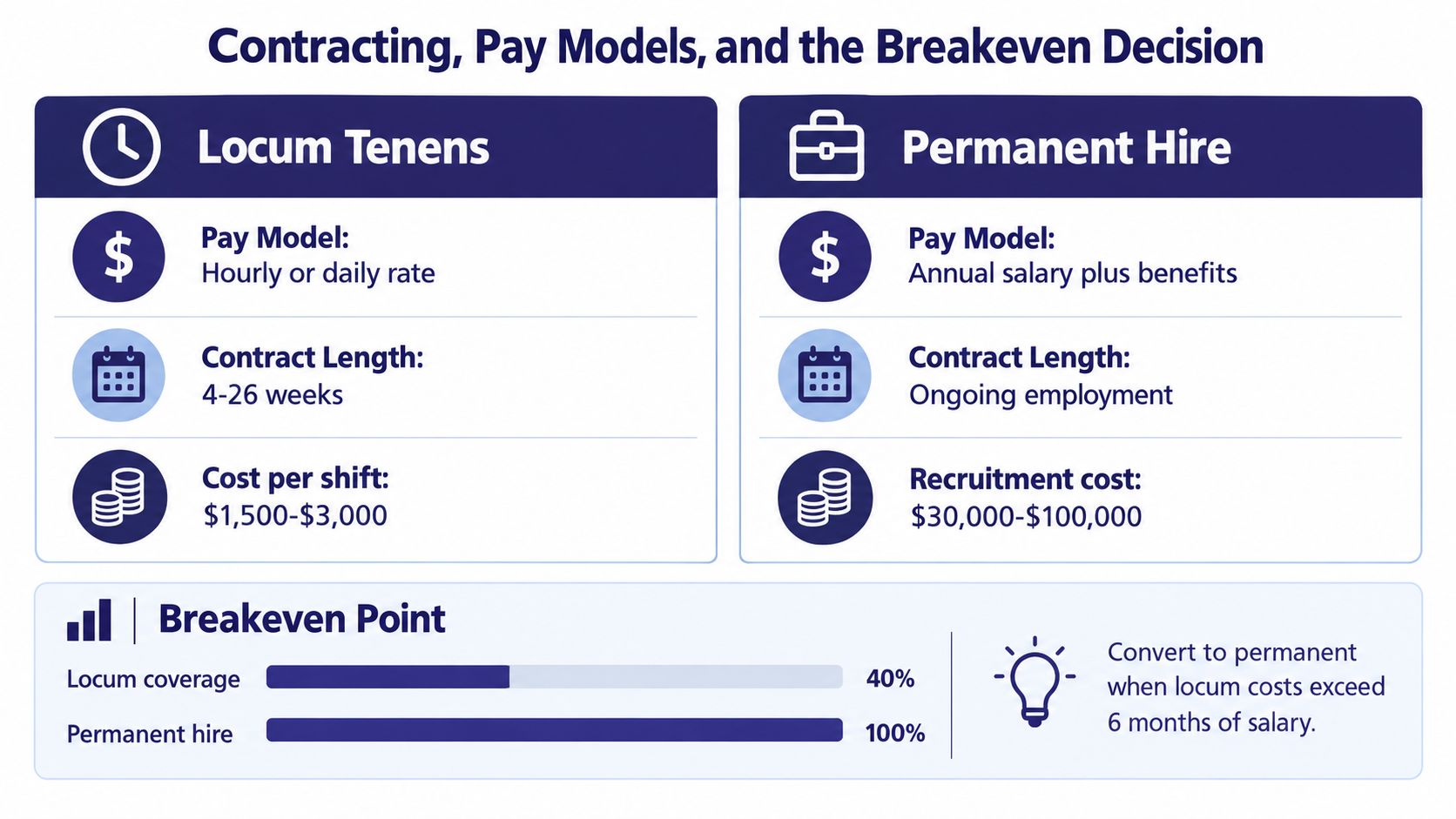
A locum contract should state what the hospital is buying in operational terms: clinical hours, call responsibility, procedural availability, response expectations, documentation standards, and the circumstances that trigger extension or termination. Rate negotiation without those definitions invites disputes. Two assignments with the same headline rate can produce very different total cost and clinical value.
Hourly models fit variable consult, clinic, and coverage schedules where worked time needs precise tracking. Per diem models fit defined days of service and align naturally with fee for time billing structures, but leaders must define what a day includes, especially call, rounding, procedures, and post call availability. Procedure influenced arrangements require extra care because incentives must support appropriate access and quality, not volume for its own sake.
Calculate the Fully Loaded Cost
The comparison that matters is fully loaded locum cost versus the full cost and risk of the alternatives. Include clinical rate, call pay, travel, lodging, credentialing support, malpractice arrangements, agency or administrative overhead, orientation time, and internal management effort. Then compare permanent recruitment expense, compensation and benefits, vacancy related lost revenue, transfer leakage, and the clinical risk of inadequate coverage.
That broader frame aligns with structured physician compensation models, because locum spending shouldn't be judged against salary alone. A permanent hire brings continuity, program building, citizenship, and longitudinal accountability that a temporary physician can't replicate. A locum brings speed and flexibility, but usually at a premium that grows harder to justify as duration extends.
Decision input | Locum coverage | Permanent hire |
|---|---|---|
Speed | Faster access preservation | Slower search and onboarding |
Continuity | Assignment dependent | Longitudinal program ownership |
Cost profile | Variable and duration sensitive | Recruitment cost plus ongoing compensation |
Flexibility | Scope can change with need | Fixed role and expectations |
Strategic value | Bridges gaps and tests demand | Builds referrals, culture, and capability |
Set the Breakeven Checkpoint in Advance
A peer reviewed Monte Carlo simulation using 10,000 iterations estimated an average breakeven point of 665 clinical hours, approximately 11 weeks at 60 hours per week, at which hiring a full time anesthesiologist became more cost effective than continuing locum coverage, and 28% of modeled scenarios reached breakeven before 60 days, in the Monte Carlo analysis of locum versus full time staffing breakeven. The model concerns anesthesiology, not cardiology, so leaders shouldn't import its threshold mechanically. Its decision framework transfers directly: every extended assignment needs a modeled horizon where conversion or permanent recruitment becomes the rational course.
Use locums confidently for predictable short term needs such as parental leave, fellowship transition, service line expansion, or a defined recruitment gap. Set a formal checkpoint before projected breakeven, review the permanent pipeline and service performance, and decide whether to convert, replace, extend with justification, or redesign the role. Extensions granted by inertia are how a bridge becomes an expensive permanent operating model without permanent accountability.
Contract for that decision upfront. Address notice periods, schedule changes, malpractice responsibility, travel and lodging terms, credentialing cooperation, exclusivity limits, conversion terms where applicable, and performance concerns. Clear contracts protect both sides and keep the conversation focused on coverage value rather than preventable administrative conflict.
Best Practices for Integrating Locum Cardiologists
Integration determines whether patients experience temporary coverage as continuity or disruption. Start before arrival. The locum should receive EHR access planning, clinic and procedural schedule expectations, call rosters, transfer criteria, key contacts, order set guidance, and a concise orientation packet that reflects how the cardiac service runs. If the physician spends the first clinical day hunting for access and basic workflow information, the organization wasted premium time.
Assign a named clinical sponsor, ideally the cardiology leader or a respected partner who can answer questions, review early cases where appropriate, and give direct feedback. Pair that sponsor with an operational contact for scheduling, documentation support, housing or travel issues, and payer or billing questions. Locum physicians perform better when they know exactly who owns which problem.
Make Handoffs Explicit
Handoffs need a standard structure for inpatient census, pending diagnostics, procedural plans, device concerns, discharge barriers, and family communication issues. Clinic coverage needs the same discipline for results follow up, medication changes, and patients who'll return to the permanent physician. A brief daily touchpoint during the early assignment catches misunderstandings before they become safety events or referring physician complaints.
Integration essentials:
Pre arrival readiness: Confirm privileges, EHR training, schedule templates, call coverage, and emergency escalation contacts before the start date.
Focused evaluation: Use the Focused Professional Practice Evaluation process already required for newly privileged practitioners to assess early performance against granted scope.
Communication chain: Publish how consults are requested, who responds, expected response behavior, and when cases escalate to permanent leadership or transfer partners.
Patient facing clarity: Train front desk and nursing teams to introduce the covering physician confidently and explain how follow up will be coordinated.
Referring physicians should hear from the program, not discover the change through a delayed consult. A short, factual update on coverage, access, and contact pathways protects referral trust. Don't oversell permanence that doesn't exist, and don't apologize so heavily that the covering physician sounds like a compromise.
Use a Scorecard and a Transition Plan
Track time to credential, orientation hours, consult response times, transfer rates, length of stay, readmissions, patient experience, documentation completion, and permanent hire conversion. Review results with service line and medical staff leadership while the assignment is active. That scorecard turns locum tenens coverage from a purchased schedule into managed clinical capacity.
Treat a strong locum assignment as both coverage and market intelligence. It reveals true demand, workflow weaknesses, call burden, and what the permanent role must offer to succeed.
Where fit is strong, discuss permanent conversion early and directly, subject to contract terms and the physician's goals. Where fit isn't strong, use the assignment data to refine the permanent profile rather than repeating the same search. Every engagement should end with a transition note covering active patients, pending results, program observations, and unresolved operational risks.
The decision sequence is consistent: define the service that must be preserved, credential to exact scope, contract around a breakeven horizon, integrate deliberately, and measure outcomes that matter to patients and referrers. Programs that follow that sequence don't merely survive a vacancy. They protect access while building the permanent team the service line needs.
Hospital leaders facing a cardiology vacancy, leave gap, or stalled subspecialist search can use American Cardiology Group for cardiology and cardiac surgery locum tenens coverage, candidate matching, and credentialing support alongside permanent recruitment. To discuss a coverage plan that protects access while the permanent search moves forward, visit American Cardiology Group.
Comments