
Cardiology Electrophysiology Jobs That Build Programs
The popular advice on cardiology electrophysiology jobs treats abundant openings as proof that hiring should be straightforward. That advice misreads the market. A vacancy in clinical cardiac electrophysiology isn't filled by raising compensation and widening a job posting, because the constraint is rarely awareness. It's a narrow, fellowship trained workforce, unevenly distributed, supporting procedures that can't be absorbed by general cardiology. Executives and candidates who start with program viability, referral base, laboratory readiness, and ramp up, make better decisions than those who start with salary alone.
Table of Contents
Why Cardiology Electrophysiology Jobs Stay Hard to Fill - Operational Consequences of an Empty EP Slot
What an Electrophysiology Role Actually Requires - Reading a Procedural Log Against the Thresholds
Where Electrophysiology Jobs Sit Across Care Settings - Program Viability Looks Different in Each Setting
How Geography Shapes a Viable EP Program - A Site Readiness Score for Interviews
Fellowship Bars and the Competitive Training Pipeline - Converting Fellowship Competitiveness Into Employability
How to Search Interview and Choose a Recruiting Partner - Interview Prompts for Both Sides
Start an Electrophysiology Search with ACG - What Employers Should Submit - What Candidates Should Submit
Why Cardiology Electrophysiology Jobs Stay Hard to Fill
A signed contract does not open an electrophysiology lab. Programs that treat an EP vacancy as a headcount problem learn that after the hire arrives: the physician is credentialed, the lab runs below capacity, and referral volume never materializes. A Heart Rhythm Society workforce study found recruitment of new EP physicians could be challenging and uncertain, with geographic dispersion identified as the principal instability in the electrophysiology workforce. National supply figures conceal that instability. A hospital can sit in a market with no sustainable coverage while established programs elsewhere appear adequately staffed.
Scale explains part of the problem. Workforce reporting puts practicing U.S. cardiac electrophysiologists in the low thousands against a cardiology workforce in the tens of thousands, a candidate pool far narrower than general cardiology. An EP vacancy therefore behaves differently from a general cardiology opening. It can restrict access to complex ablation, device, and rhythm management services even when other cardiologists remain on staff.
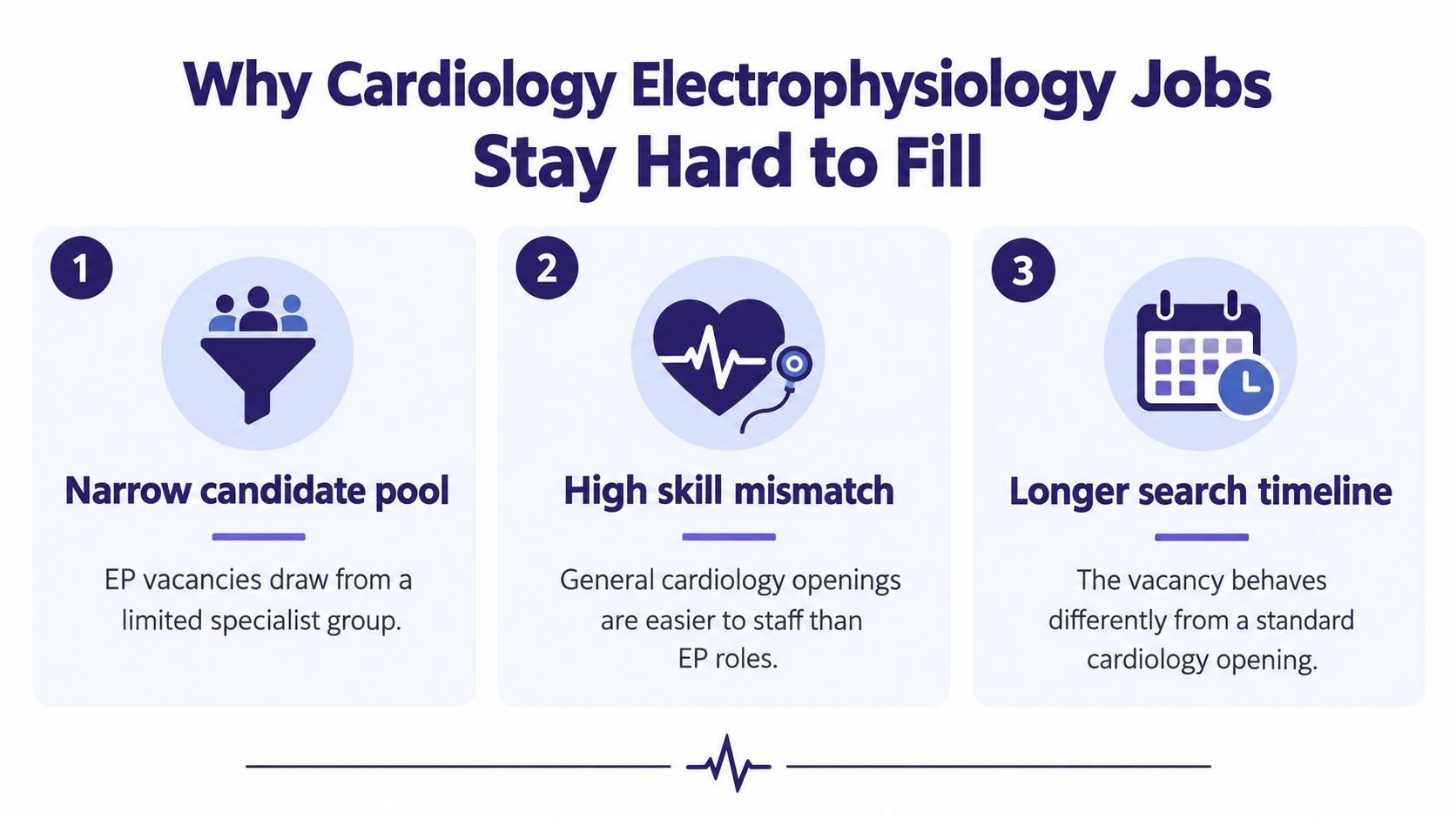
Operational Consequences of an Empty EP Slot
When procedural capacity runs near saturation, one unfilled position lengthens waits and pushes referrals elsewhere. Referral leakage, delayed atrial fibrillation evaluation, and postponed device follow up surface as lost service line revenue rather than scheduling inconveniences. The American College of Cardiology reported average patient wait time for a general cardiovascular visit increased 26% from 2017 to 2022, reaching 26.6 days, in its workforce crisis feature on cardiovascular access. General cardiologists absorbing that rising referral volume, with no EP capacity behind them, push still more demand toward arrhythmia consultation.
Geography sharpens the risk. Large portions of the country, particularly rural counties, have no practicing cardiologist to generate referrals at all. Employers that treat compensation as the only variable miss the operating requirement behind the hire. A viable EP placement needs trained lab nurses and technologists, anesthesia support, device clinic infrastructure, and credible call coverage already in place. Without those elements, a signed agreement produces a recruited physician inside an unready program, and retention risk follows within the first contract cycle.
What an Electrophysiology Role Actually Requires
Hiring fails earlier than most programs assume. A posting that reads "board certified cardiologist, EP preferred" tells a fellowship trained candidate almost nothing about the work. Clinical cardiac electrophysiology covers arrhythmia evaluation, catheter ablation, implantable device management, and longitudinal rhythm care. That scope separates EP from interventional cardiology, which centers on coronary and structural procedures, and from general cardiology, which manages broader diagnosis and medical therapy. Specifications that blur those boundaries attract mismatched applicants, and the cost surfaces only after lab schedules, call structure, and referral patterns have been built around the wrong physician.
Employers and candidates need the same yardstick for procedural exposure. The ACC/AHA/HRS advanced training framework defines minimum volumes for a two year clinical cardiac electrophysiology fellowship: each trainee should complete at least 175 electrophysiologic procedures for arrhythmia evaluation and 160 catheter ablation procedures, with case type minimums inside those totals, under the advanced training requirements for clinical cardiac electrophysiology.
Reading a Procedural Log Against the Thresholds
Supraventricular ablation depth: The statement specifies a minimum of 50 supraventricular ablations within the ablation total. A log concentrated in one arrhythmia type signals narrower readiness.
Atrial fibrillation volume: The same framework sets 50 atrial fibrillation ablations, tying the requirement to the most common complex ablation demand in many programs.
Ventricular arrhythmia exposure: It further specifies 30 ventricular tachycardia or premature ventricular contraction ablations, which separates routine exposure from complex case readiness.
Thresholds describe training, not a contemporary job. Competence in three dimensional mapping, remote monitoring platforms, and outpatient candidate selection now sits inside baseline expectations. Physicians also shape service line design, including lab workflow, clinic throughput, and standardized post procedure protocols. Those duties belong in the written specification. Expectations surfaced after hire become retention problems.
Standard fellowship output also varies in depth. Some physicians arrive with additional expertise in complex ablation, advanced device management, or structural heart rhythm care. Others carry a broad general EP profile and need proctoring for selected complex cases. Neither profile is superior. The hiring error is failing to state which profile the lab, referral base, and call model can absorb in year one.
Screening principle: A procedural log answers what a candidate has done. A credible job specification answers what the site will let that candidate do safely in year one.
Executives should write postings around case mix, laboratory readiness, and the expected scope of independent practice. Candidates should map their logs directly to the fellowship thresholds and name the gaps requiring mentorship. Shared language turns cardiology electrophysiology jobs from generic physician postings into assessable program decisions.
Where Electrophysiology Jobs Sit Across Care Settings
The same job title can describe four different careers. Employer type controls referral flow, teaching load, call design, and the capital available for lab upgrades, so academic centers, private practices, community hospitals, and cardiovascular ambulatory surgery centers are rarely interchangeable. A comparison of community hospital cardiology program models is useful precisely because it separates institutional purpose from brand prestige.
Site of care migration is rewriting specifications inside each setting. CMS has approved electrophysiology study and ablation procedures for the ambulatory surgery center environment, and cardiovascular ASC procedure volume is projected to rise 15% between 2023 and 2028, as noted earlier. Treat that figure as a directional signal rather than a local guarantee. What it does change is the skill profile: competitive roles increasingly assume efficient mapping and ablation workflows, anesthesia and vascular risk management, and disciplined outpatient selection.
Program Viability Looks Different in Each Setting
Diligence questions should follow the setting, not a generic checklist. In an academic center, the binding constraint is usually access: how much lab block time survives competition with structural heart and general cardiology, and whether fellows extend an attending's capacity or absorb the complex cases. In a private practice, the question is contractual, covering who staffs the device clinic, what the hospital lab agreement guarantees, and how partnership terms treat ramp up. A community hospital role stands or falls on coverage depth, since a single electrophysiologist without call partners or defined transfer pathways inherits personal risk alongside clinical influence. In a cardiovascular ASC, everything rests on patient selection protocols and the emergency transfer process, because the model only holds inside a narrow acuity band.
Electrophysiology Practice Settings Compared
Setting | Typical program purpose | Infrastructure to verify | Candidate trade off |
|---|---|---|---|
Academic medical center | Complex ablation, teaching, research, tertiary referrals | Lab access amid competing services, fellow coverage, anesthesia depth | Broad case complexity, but less control over schedule and program design |
Private or multispecialty practice | Efficient rhythm care tied to established referral relationships | Device clinic staffing, hospital lab agreements, partnership terms | Practice autonomy balanced against dependence on external facilities |
Community or rural hospital | Local access, reduced referral leakage, program building | Capital plan, call partners, advanced practice coverage, transfer pathways | Greater clinical influence, with higher exposure if support is thin |
Cardiovascular ASC | Selected outpatient EP studies and ablations | Patient selection protocols, anesthesia support, post procedure monitoring, emergency transfer process | Focused procedural efficiency, narrower inpatient scope |
A competitive specification quantifies expected annual case mix, lab utilization, inpatient versus ASC allocation, outreach obligations, and infrastructure readiness. Posted clinic volumes and nominal call frequency leave the viability question unanswered. Compensation belongs in the discussion as one term among coverage, ramp up, and case sustainability, rather than as a substitute for those variables.
How Geography Shapes a Viable EP Program
Openings cluster where programs already work. The harder question is whether a given market can sustain one. As noted earlier, large parts of the country lack local cardiology coverage entirely, and electrophysiology training, lab infrastructure, and referral networks concentrate heavily in metropolitan hubs. The gap between where arrhythmia patients live and where ablation capacity sits is the geographic fact every candidate and employer should price into the decision.
That maldistribution creates opportunity and trap in equal measure. An underserved market with referrals, lab capacity, and shared coverage can support rapid program growth. A vacancy caused by inadequate support or thin procedural volume cannot be cured by relocation incentives or a larger signing package.
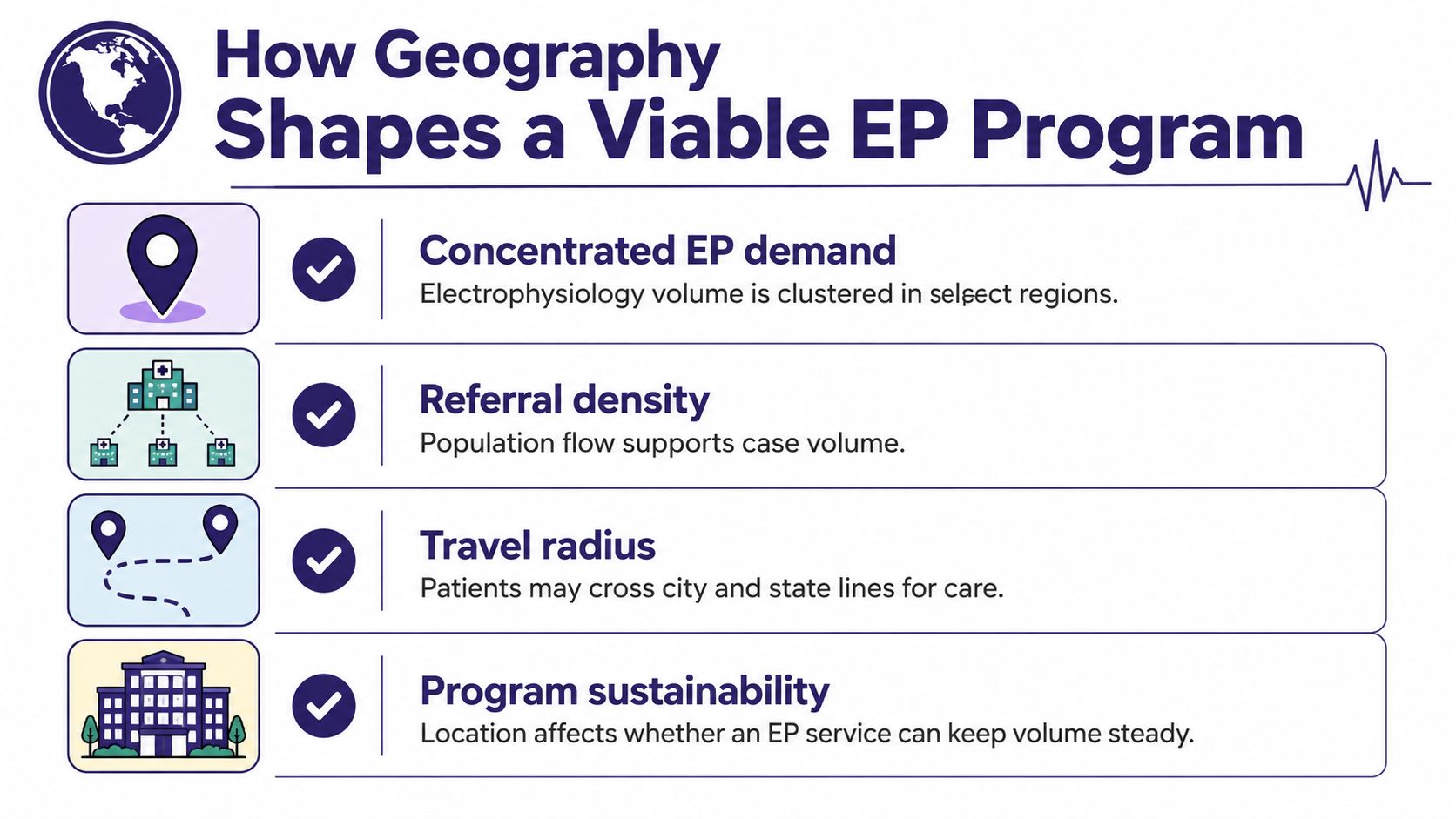
A Site Readiness Score for Interviews
Candidates and executives can score each factor as present, planned with funding, or absent.
Referral population: Defined catchment, referring cardiologists, and documented arrhythmia prevalence rather than assumed demand.
Backlog evidence: Current ablation wait, device volume, and cases referred out for lack of EP coverage.
Lab and anesthesia readiness: Existing EP lab capacity, trained staff, mapping systems, and reliable anesthesia support.
Coverage sustainability: Call burden, advanced practice coverage, and a realistic plan for vacation and illness.
Capital commitment: A health system plan for lab expansion, device clinic space, and remote monitoring infrastructure.
A scalable underserved market shows documented demand plus funded infrastructure. A hollow vacancy shows demand alone.
The contrarian implication deserves emphasis. A community or regional hospital with a defined referral base and a credible coverage plan can outperform a flagship academic center as a long term role. Such a site offers greater influence over lab design, referral relationships, and program priorities. Hybrid outreach and regional referral networks give workable coverage where a full time electrophysiologist in every county is not feasible. Geography functions as a clinical operating condition, and it should be weighed with the same rigor as compensation, call, and case mix.
Fellowship Bars and the Competitive Training Pipeline
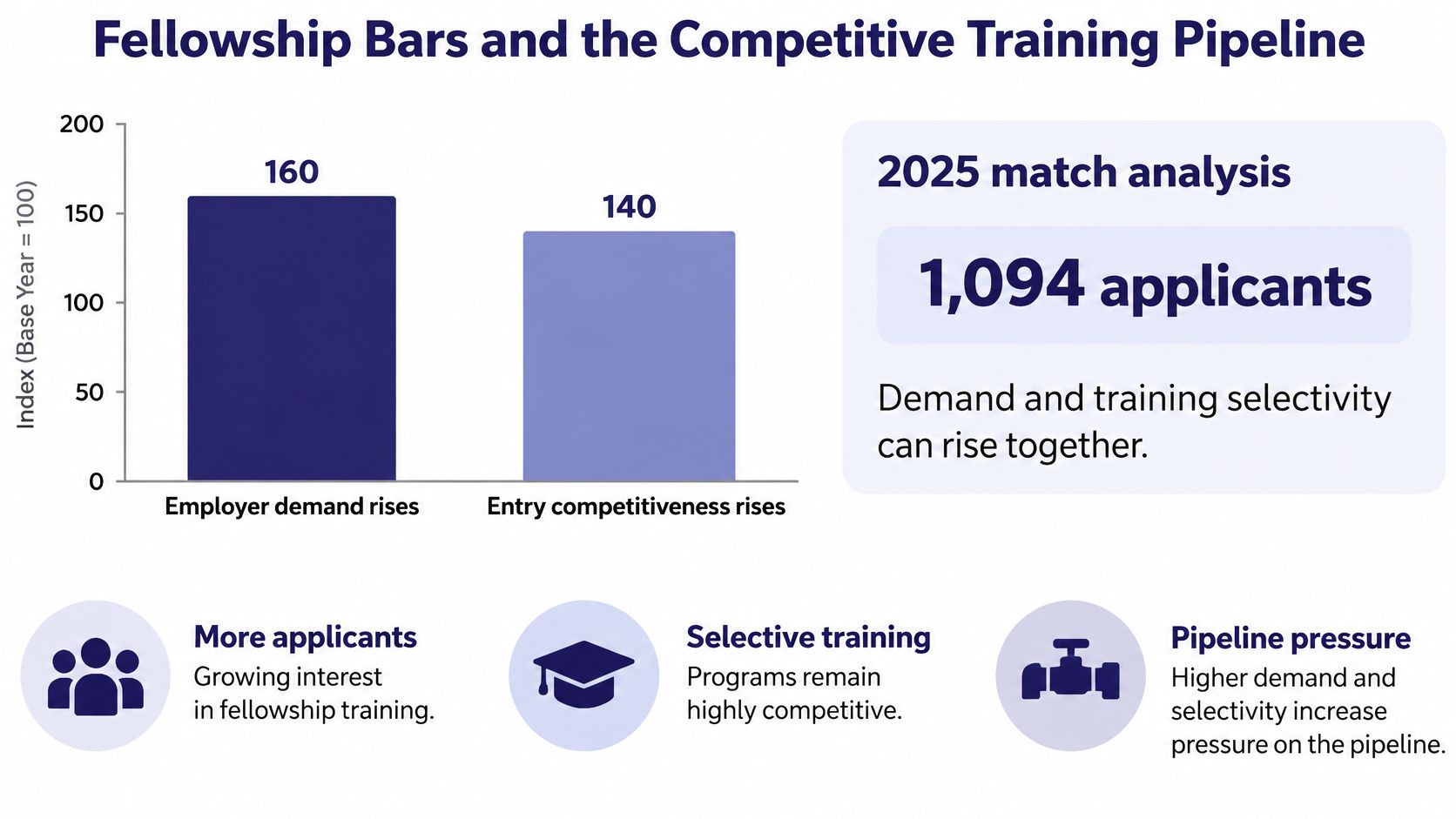
Fellowship match data points to a pipeline tightening faster than training capacity can expand. As noted earlier, employer demand and entry competitiveness have risen together, which contradicts the assumption that cardiology electrophysiology jobs sit open for anyone seeking entry. Applicant interest in clinical cardiac electrophysiology has grown faster than the number of funded training positions, and unfilled fellowship slots have become rare. Hospitals can't count on a large free-agent pool outside fellowship timing. Fellows can't treat a matched position as a finished career plan.
For a hiring program, the competitive pipeline changes the negotiation. A fellow weighing multiple offers is comparing more than salary: lab readiness, expected case volume, mentorship depth, and the referral base that determines whether early cases exist at all. A program that lands a sought-after graduate and then delivers a slow first year has spent scarce pipeline access on a poor outcome.
Converting Fellowship Competitiveness Into Employability
Programs need physicians who support complex ablation and device services, adopt evolving mapping and remote monitoring systems, and contribute to service line development. Procedural competence alone doesn't close a hiring case. Structured preparation in understanding medical education pathways helps fellows frame training choices around eventual practice scope.
Both sides should negotiate transition terms before a start date. Protected ramp up, mentorship, proctoring for complex cases, call transition, technology training, and measurable first year expectations reduce early attrition. Employers should distinguish graduates of standard clinical cardiac electrophysiology training from physicians adding complex ablation or device depth, then align privileges accordingly.
Retention carries equal weight with recruitment when annual graduate volume is limited. A poor first year fit reopens the vacancy and returns the program to a constrained pipeline at the next fellowship cycle, with backlog and referral relationships further weakened.
How to Search Interview and Choose a Recruiting Partner
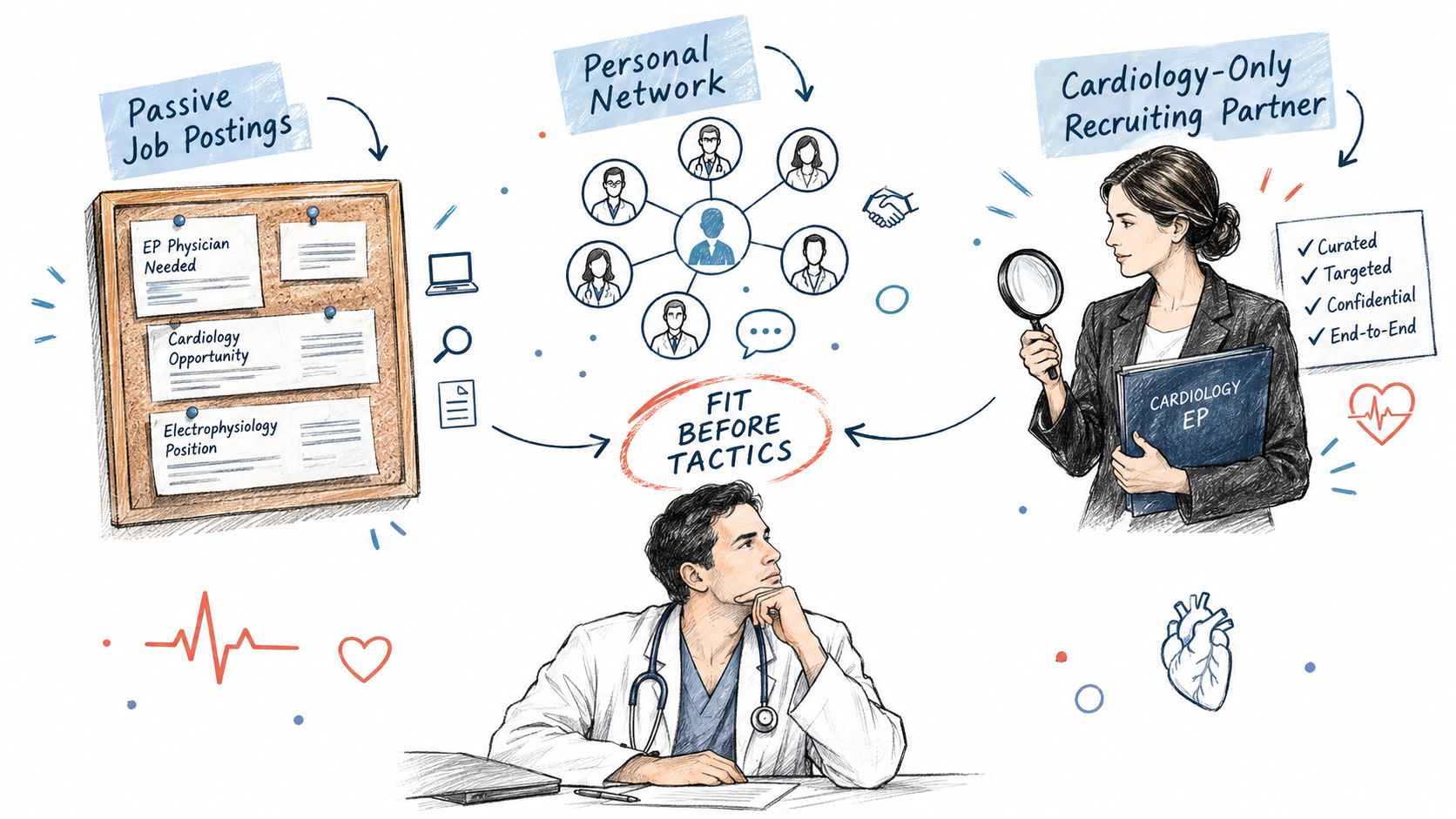
Channel choice matters less than timing and specification quality. Passive postings reach physicians already looking, personal networks reach physicians already known, and a cardiology-only retained partner can work a defined fellowship and practicing-physician market. Any of the three fails when the hiring site cannot describe the program it is staffing.
Timing is structural. The 2025 Medicine and Pediatric Specialties Match included 150 clinical cardiac electrophysiology positions, with 98% of positions filled, as reported in coverage of interventional cardiology and electrophysiology training positions. Employers recruiting outside graduation cycles compete for a thin pool of immediately available physicians, so search calendars should track fellowship completion dates.
Interview Prompts for Both Sides
Case mix clarity: Expected ablation, device, and consultation volume in year one and year two.
Infrastructure readiness: Lab staffing, anesthesia support, mapping technology, and device clinic capacity.
Referral base evidence: Which referring cardiologists and facilities send EP cases now, and what happens to that flow during a vacancy.
Site allocation: Inpatient versus ASC split, outreach obligations, and transfer expectations.
Program authority: Candidate influence over lab workflow, hiring, and referral development.
A structured review of healthcare staffing agencies and search models helps executives compare generalist reach with specialty depth. Speed is easy to promise. Market coverage is the harder test: whether the firm knows which fellows finish each cycle, which practicing electrophysiologists would consider moving, and which competing programs are recruiting in the same referral territory.
American Cardiology Group operates as a U.S. cardiology and cardiac surgery recruitment partner placing electrophysiology physicians through permanent recruitment and locum tenens, with additional support for advanced practice and executive hiring around a cardiac program. Its nationwide network and data driven process match a candidate's procedural portfolio and growth goals to a site's infrastructure, referral base, and ramp up plan across hospitals, academic centers, private groups, rural hospitals, and cardiovascular ASCs.
A placement succeeds when the hire sustains volume, coverage, and referral trust after the search closes. The interview is where both sides test whether that outcome is plausible.
Start an Electrophysiology Search with ACG
A search is usually lost before the first candidate call. Sites that cannot state arrhythmia backlog, lab readiness, or the first-year ramp produce broad slates and slow decisions, even when national demand favors employers with clarity.
What Employers Should Submit
Send an operational one-page summary, not a recruitment brochure. State current arrhythmia backlog, device and ablation mix, anesthesia coverage, lab staffing gaps, and the call model. Specify inpatient versus ASC intent, outreach obligations with travel radius and frequency, and transfer expectations. Put capital commitments in writing: lab expansion timing, mapping systems, device clinic staffing, and advanced practice coverage. A site that can support only a limited first-year program should say so; overstating capacity invites a mismatch that appears after onboarding, when ramp-up and referral trust are harder to repair.
What Candidates Should Submit
Present a procedural portfolio separated into independent scope and cases that still require proctoring. Map volumes to fellowship thresholds where relevant, then name geography, call tolerance, technology experience, mentorship needs, and the program authority sought. Regional build-outs, established academic labs, and cardiovascular ASCs reward different risk profiles, so target markets should reflect the influence a candidate wants over workflow, hiring input, and referral development.
American Cardiology Group works as a U.S. cardiology and cardiac surgery recruitment partner for electrophysiology permanent recruitment and locum tenens, with support for advanced practice and executive hiring around the service line. As noted earlier, generalist reach matters less than specialty fit. Employers submit readiness criteria. Candidates submit training goals and target markets. Fit is defined before interviews begin, which is where durable EP placements are decided.
Comments