
Michigan Travel Nurse Jobs How to Land Top Assignments
Michigan hospitals reported nearly 8,500 vacant nursing positions in 2023, while the state's hospitals were missing 13% of the workforce they needed, according to the Michigan workforce shortage analysis. For cardiovascular programs, that shortage has a direct operational consequence: an unfilled RN position can restrict telemetry capacity, delay procedural throughput, and place additional pressure on interventional cardiology, electrophysiology, cardiac cath lab, and heart failure services.
Michigan travel nurse jobs therefore deserve a more disciplined evaluation than a quick search of weekly rates. The strongest assignments combine a credible clinical fit, verified Michigan licensure, transparent contract economics, and a facility prepared to onboard a traveler safely. Nurses and hospital leaders who treat those factors as one staffing decision are more likely to avoid delayed starts, poor unit alignment, and expensive turnover.
Table of Contents
Why Michigan Remains a High Demand Market for Travel Nurses - Why demand persists across acuity levels
Michigan Licensing and Credentialing Without Compact Privilege - A controlled endorsement workflow
Where to Target Assignments Across Michigan Healthcare Markets - Match the facility to the clinical objective - Questions that reveal the real assignment
How to Evaluate Agencies and Secure the Right Contract - Four contract controls
Understanding Pay Benchmarks and Take Home Economics in Michigan
Relocation Interview and Assignment Success Checklist - Before accepting - During onboarding
Why Michigan Remains a High Demand Market for Travel Nurses
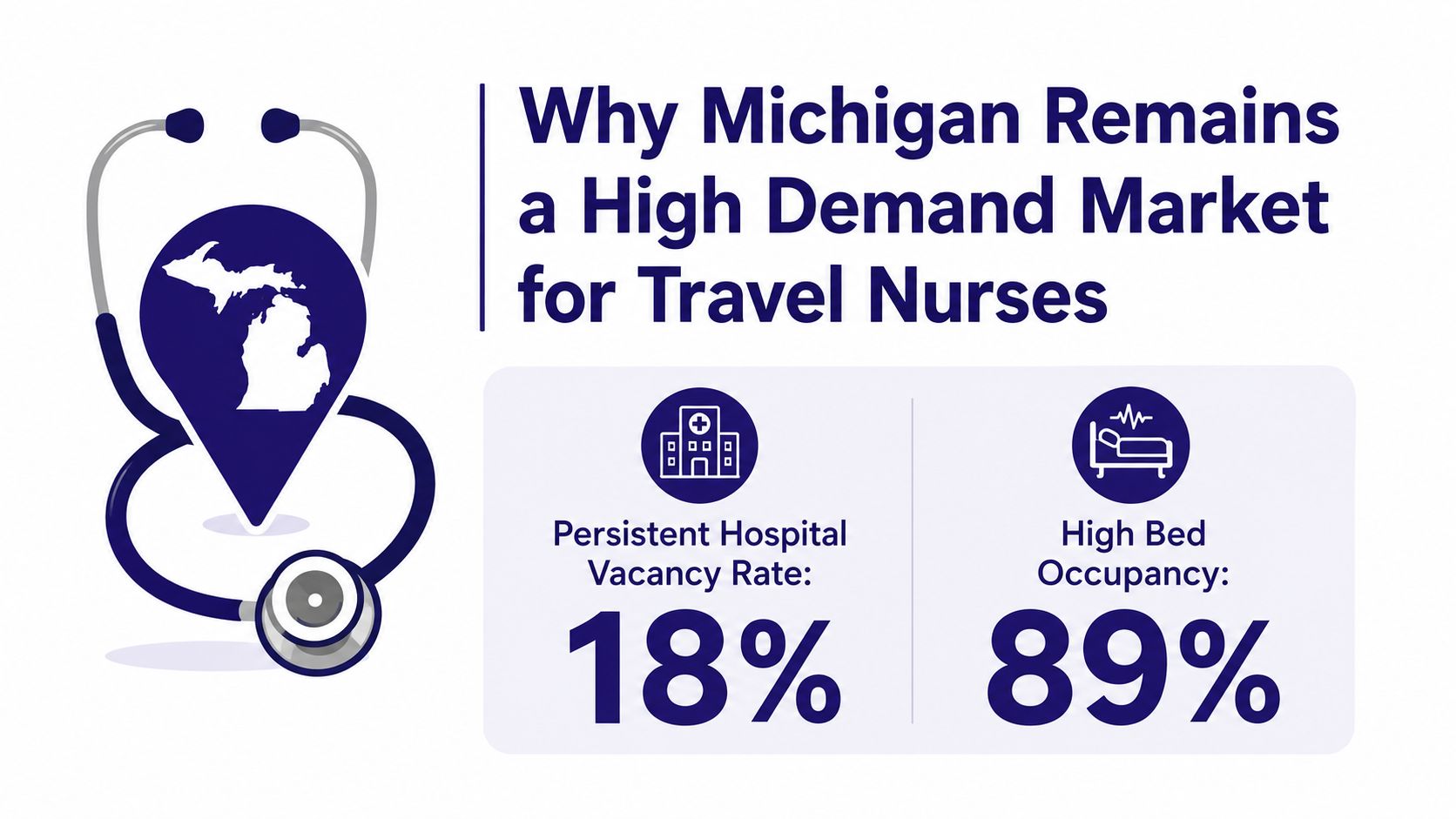
Michigan's travel nursing demand reflects a structural staffing problem rather than a short-lived seasonal surge. In 2023, hospitals across the state reported more than 27,000 open jobs overall, including nearly 8,500 nursing vacancies, while the Michigan Health Association reported that hospitals were missing 13% of the workforce they needed. A separate state analysis found that about 39% of surveyed Michigan nurses intended to leave their jobs within a year, and staffing constraints had already contributed to the loss of 1,700 staffed beds since 2020. Those figures are documented in the state workforce shortage report.
For hospital executives, the implication is practical. Travel nurses help preserve bed capacity and service-line continuity while organizations recruit permanent staff and address retention. In cardiovascular care, that may mean maintaining safe coverage for telemetry, progressive care, cardiovascular intensive care, procedural recovery, or a cath lab schedule that can't be supported by a thin core team.
Why demand persists across acuity levels
Michigan isn't dependent on one employer or one metropolitan area. Assignments appear across academic medical centers, regional systems, community hospitals, and facilities serving rural populations. A staffing source listed 106 travel nurse opportunities in Michigan as of May 26, 2026, indicating active placement volume rather than isolated openings, as shown in the Michigan travel nurse location listings.
Pay reinforces the market's competitiveness. Indeed reported an average of $2,287 per week for Michigan travel nurses, approximately 5% above the U.S. average of $2,172 per week, with higher rates in selected markets and specialties, according to its Michigan travel nurse salary data. That doesn't mean every contract is premium. It does mean Michigan can be a rational target for nurses seeking meaningful acuity and competitive compensation without assuming that only the largest coastal markets offer strong opportunities.
Market filter: Michigan is a credible go-to market for nurses who value sustained hospital demand, cardiovascular exposure, and geographic choice. It isn't the right fit for anyone unwilling to manage a separate state license or compare contract economics beyond the headline rate.
Michigan Licensing and Credentialing Without Compact Privilege
Michigan isn't a compact state for nursing practice. An out-of-state nurse generally needs a Michigan RN license by endorsement before the first shift, so a multistate license from another jurisdiction doesn't remove the state-specific licensing requirement. The Michigan travel nurse licensing guidance emphasizes the operational point that matters most to staffing teams: licensure should be initiated before a start date is treated as firm.
A controlled endorsement workflow
The process should be managed as a tracked workstream, not as paperwork left to the final stage of recruitment.
Confirm eligibility and submit early. Review the Michigan Board of Nursing requirements, complete the endorsement application, and assemble identity, education, licensure, and verification materials before accepting a start date.
Prepare primary-source verification. Arrange verification from every state where the nurse holds or has held a license, and respond quickly if the board or credentialing team requests clarification. Missing verification can hold up an otherwise complete file.
Wait for issuance before booking commitments. Don't schedule the first shift, nonrefundable travel, or long-term housing until the Michigan license has been issued and the agency confirms that facility credentialing is complete.
The broader packet still matters after licensure. Hospitals commonly review current specialty certifications, immunization records, occupational-health clearance, background checks, skills documentation, references, and employment history. A cardiovascular traveler should also expect focused competency review for the actual assignment, particularly if the role involves electrophysiology, cardiac catheterization, interventional cardiology, or post-procedure monitoring.
For a clear explanation of how organizations verify qualifications, review this guide to healthcare credentialing. The distinction is important: a state license establishes legal authority to practice, while facility credentialing confirms that the nurse is prepared for the specific unit, equipment, patient population, and workflow.
Operational rule: The license application, primary-source verification, facility packet, and start-date approval should each have an owner and a documented status. A recruiter's verbal assurance isn't a substitute for an issued license.
Where to Target Assignments Across Michigan Healthcare Markets
The best Michigan travel nurse jobs depend on clinical objectives, not the city named in the posting. Detroit and Ann Arbor generally appeal to nurses seeking complex academic or tertiary exposure, while Grand Rapids offers a large-system environment with a distinct regional profile. Lansing and Grand Blanc can suit clinicians who want meaningful hospital acuity without automatically choosing the largest urban campus.
Match the facility to the clinical objective
A nurse pursuing interventional cardiology or advanced cardiac care should ask whether the hospital has the procedural infrastructure and patient volume needed to maintain competency. An academic medical center may offer exposure to complex structural, transplant, heart failure, or electrophysiology pathways, but the environment can demand faster adaptation to specialty protocols, multidisciplinary rounding, and higher patient complexity.
Regional health systems create a different trade-off. They may provide strong cardiovascular service lines, clearer ownership of the traveler role, and a more direct relationship with unit leadership. That can be valuable for a nurse prioritizing predictable integration, while still allowing experience with telemetry, stepdown, critical care, or procedural recovery.
Community hospitals and Upper Peninsula facilities can offer broader bedside responsibility and closer team relationships. They may be a stronger match for adaptable generalists or experienced cardiac nurses who are comfortable working with fewer layers of support. The trade-off is that a smaller site may not provide the same subspecialty breadth, procedural volume, or formal academic infrastructure as a major medical center.
Questions that reveal the real assignment
Before accepting a posting, the nurse should ask:
Clinical scope: Which cardiac diagnoses, procedures, and acuity levels are typical on the unit?
Procedural exposure: How often does the role support cardiac cath, electrophysiology, interventional cardiology, or post-anesthesia recovery?
Staffing model: How are travelers assigned, floated, precepted, and supported by charge nurses?
Continuity expectations: Will the nurse manage discharge education, device care, anticoagulation coordination, or complex heart failure transitions?
Local fit: How do housing availability, winter travel, commute, and scheduling affect daily reliability?
A facility's reputation can't answer those questions for a specific unit. The assignment should be judged by the actual manager, workflow, orientation plan, and patient population.
How to Evaluate Agencies and Secure the Right Contract
A capable agency should make the assignment easier to verify, not harder to understand. The recruiter should explain the submission process, identify whether the facility has accepted the profile, and provide a written offer that separates taxable wages, stipends, benefits, and contingencies. Vague answers at this stage often become practical problems after relocation.
Four contract controls
Submission transparency matters because duplicate submissions can create confusion and weaken a candidate's position with a facility. The nurse should know which hospital, unit, shift, and start date the agency is submitting, and whether the profile has been sent with permission.
Bill rate disclosure gives both parties a basis for evaluating the package. A nurse doesn't need every internal margin detail to assess an offer, but the agency should explain how the weekly package is constructed and which components may change.
Cancellation clauses deserve close reading. The contract should state who can cancel, what notice applies, whether the nurse receives any protection after relocation, and what happens if the facility changes census or cancels the assignment.
Guaranteed hours should be defined rather than assumed. The agreement should clarify the scheduling period, exclusions, call requirements, and whether orientation counts toward the guarantee.
Cardiac specialists need additional clinical detail before signing. An electrophysiology traveler should confirm lab workflows, device procedures, mapping-platform familiarity, sedation responsibilities, call expectations, and emergency response duties. A cardiac cath lab nurse should verify procedure mix, sheath management expectations, recovery responsibilities, and the competency validation process. A heart failure or cardiovascular intensive care nurse should ask about vasoactive medication management, mechanical circulatory support exposure, staffing ratios, and escalation pathways.
Benefits also change the value of an offer. Compare health coverage, housing support, compliance assistance, malpractice coverage, orientation length, extension terms, and reimbursement obligations. A package that looks attractive on paper may be less useful if the housing arrangement is impractical or the facility expects specialty competencies that weren't disclosed during screening.
Contract discipline: A strong recruiter can explain the assignment in operational language. If the answers stay at the level of “standard orientation” or “typical cardiac experience,” the nurse should request unit-specific terms before committing.
Understanding Pay Benchmarks and Take Home Economics in Michigan
Headline weekly pay is only a starting point for evaluating Michigan travel nurse jobs. Market reports place statewide averages between about $1,934 and $2,287 per week, depending on methodology, specialty, facility, and assignment timing. Review current Michigan travel nurse opportunity listings alongside cardiac specialty pay benchmarks from Vivian rather than treating one statewide figure as a guaranteed offer.
Cardiology, electrophysiology, and cardiac cath lab assignments can command higher weekly pay than general postings because they require narrower competencies and support high-acuity procedural capacity. Benchmarks list $3,172 for Cardiology, $3,059 for Electrophysiology Lab, and $2,985 for Cardiac Cath Lab roles. Those figures are reference points, not promises. Confirm whether the contract reflects call, procedure mix, device exposure, floating, and required competency validation.
Housing treatment can change take-home economics even when two contracts show similar gross pay. A Grand Blanc assignment with a $3,409 market-specific benchmark may look stronger than a Detroit-area offer, but the comparison depends on housing eligibility, rent, commute, and the taxable wage allocation. A lower-cost housing arrangement can leave more usable income than a higher headline rate paired with expensive agency-arranged housing. Confirm the stipend amount, documentation requirements, and whether the assignment qualifies for tax-free housing treatment before comparing locations.
Use Michigan travel nurse pay calculator assumptions to separate taxable wages from qualifying stipends. Michigan applies a 4.3% state income tax to taxable wages, while federal taxes, filing circumstances, housing eligibility, and agency structure affect the final result. The contract should show the taxable hourly rate, stipend components, benefit deductions, and any reimbursement obligations.
A calculator example places a $2,500 weekly contract at about $2,256 after federal and state taxes plus stipends, according to Michigan travel nurse compensation guidance. This is an illustration, not a personal tax quote.
For nurses comparing staff, per diem, and travel models, review what per diem nursing means before assigning the same value to every pay component. Benefits, guaranteed hours, cancellation exposure, and clinical support can outweigh a small gross-pay difference, particularly in cardiac units managing census swings and procedural demand.
Relocation Interview and Assignment Success Checklist
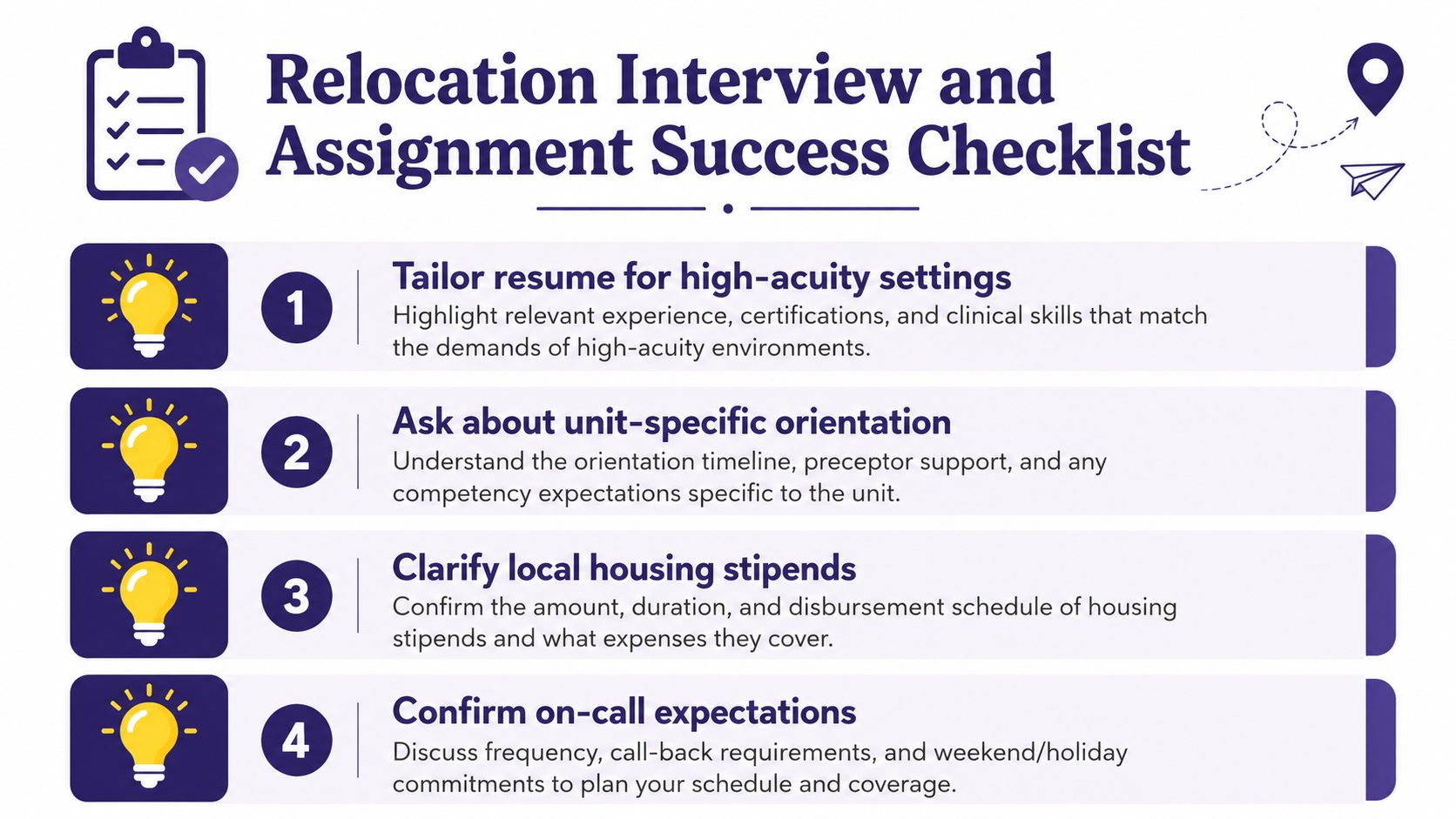
A successful relocation starts before the nurse boards a plane or drives across the state. The resume and interview should present the exact competencies the receiving unit needs, especially for high-acuity cardiovascular roles.
Before accepting
Tailor the resume: Lead with recent cardiac, telemetry, cardiovascular ICU, cath lab, electrophysiology, or interventional cardiology experience. Name the systems, devices, procedures, and patient acuity the nurse can safely manage.
Secure relevant references: Choose charge nurses, managers, or procedural leaders who can speak specifically to clinical judgment, emergency response, sterile technique, documentation, and teamwork.
Verify the interview scope: Use targeted nurse interview questions to clarify orientation, floating, scheduling, call, and escalation expectations.
Clarify housing economics: Confirm whether the package uses agency-arranged housing or a stipend, what documentation applies, and how the arrangement affects the nurse's budget.
Plan for seasonal logistics: Michigan winter travel can affect driving, housing access, commuting, and arrival timing. The nurse should plan a reliable route and avoid a first-shift arrival that leaves no margin for delays.
During onboarding
Bring current credentials, immunization records, competency evidence, and identification in an organized file. Ask for the unit map, emergency procedures, medication escalation process, documentation standards, and contact information for the charge nurse or educator.
The first week should focus on safe integration rather than proving speed. The traveler should identify how the unit handles rapid response, post-procedure complications, rhythm changes, handoffs, and consult communication. A concise end-of-shift review with the preceptor or manager can surface gaps before they affect patient care.
Assignment standard: The best traveler is not the nurse who says yes to every task. It's the clinician who confirms scope, escalates early, documents accurately, and earns trust through consistent execution.
After the first week, the nurse should assess whether the assignment matches the written contract and interview description. Any discrepancy involving floating, call, orientation, or specialty duties should be documented and raised through the agency and facility leadership promptly.
American Cardiology Group connects hospitals, health systems, academic programs, private practices, and cardiac specialists through focused recruitment and placement support. For organizations and clinicians evaluating Michigan travel nurse jobs alongside broader cardiovascular staffing needs, visit American Cardiology Group to discuss clinically aligned opportunities and recruitment solutions.
Comments