
What Is an Ambulatory Surgery Center? a Strategic Guide
More than 80% of surgeries in the United States now take place in outpatient settings, according to the Centers for Disease Control and Prevention's National Hospital Ambulatory Medical Care Survey. For hospital boards, that fact changes the practical meaning of a basic question like what is an ambulatory surgery center.
An ASC is not merely a lower-cost site of care or a regulatory category. It is a service-line strategy with direct consequences for cardiovascular volume, physician alignment, labor planning, and capital allocation. That matters because the same forces shifting orthopedic, GI, and ophthalmology cases out of the hospital are now reaching interventional cardiology and electrophysiology, where patient selection, imaging capability, emergency transfer protocols, and recovery design determine whether outpatient migration creates margin or introduces risk.
For cardiovascular leaders, the strategic issue is specific. Which procedures can move safely into an ASC. Which cases should remain in the hospital outpatient department because of acuity, comorbidity, or backup requirements. Which physicians will support a joint venture versus keep cases inside the health system. Which staffing model can recruit and retain nurses, techs, anesthesia coverage, and recovery teams in a market where cardiac talent is already constrained.
Boards that treat ASCs as a generic outpatient trend usually respond too late. By the time a market sees measurable cardiac case migration, the more important decisions have already been made around physician ownership, payer contracting, credentialing standards, and the operating model needed to support cardiovascular care outside the hospital.
Table of Contents
Defining the ASC Model Core Characteristics and Regulations - Why the legal definition matters - How facility design shapes clinical operations
The ASC Financial Ecosystem and Reimbursement Landscape - The market signal is already clear - Why reimbursement strategy changes service line planning
The New Frontier Expanding Cardiac Services into the ASC - Cardiology is no longer peripheral to the ASC story - What this means for interventional cardiology and electrophysiology
ASC vs Hospital Outpatient Department A Strategic Comparison - Where the ASC model wins - Where the hospital outpatient department still holds the advantage
Staffing and Credentialing for a High-Performance Cardiac ASC - The staffing model is lean by design - Credentialing has to match the clinical ambition
Building Your Cardiac ASC Strategy A Guide for Leaders - Boards should make four decisions early - Why talent is the limiting factor
The Unstoppable Rise of the Ambulatory Surgery Center
Ambulatory surgery has shifted from a niche delivery setting to a major operating model in U.S. procedural care. Over the past two decades, ASC use and industry revenue have expanded sharply, enough that health systems now have to treat the category as part of core service line strategy rather than a peripheral outpatient option, as noted earlier.
Scale matters here. A care setting that can absorb meaningful procedural volume changes referral behavior, payer expectations, physician preferences, and capital planning. For hospital boards, the strategic question is no longer whether ASCs matter. It is which cases, which physicians, and which margins will move first.
That question is especially important in cardiovascular services.
Historically, the ASC narrative centered on orthopedics, ophthalmology, and gastroenterology. That framing is now incomplete. Cardiology leaders are facing a different operating environment in which selected electrophysiology, vascular, and interventional procedures are increasingly evaluated through a site-of-care lens. Once that shift begins, the implications extend well beyond real estate or scheduling convenience.
They show up in four places:
Volume migration risk: Lower-acuity cardiovascular cases can leave the hospital setting first, reducing contribution margin in areas that often help support higher-cost inpatient infrastructure.
Physician alignment: Interventional cardiologists and electrophysiologists often value block control, predictable turnover times, and fewer hospital bottlenecks alongside compensation.
Capital deployment: Every dollar committed to cath lab expansion, outpatient buildout, or hybrid procedural space carries an opportunity cost. Systems need a clear view of which platform can support the right case mix over time.
Recruitment pressure: Physicians trained in efficient outpatient procedural workflows may prefer organizations that can offer both hospital-based complexity and ambulatory throughput.
The operational logic behind ASC growth is straightforward. These facilities are built around standardization, tight case selection, shorter stays, and fewer handoff points than a hospital. That structure can support better schedule reliability and lower unit costs for the right procedures. It can also expose a hospital's inefficiencies with unusual clarity. If a cardiovascular team can complete selected cases in a focused ambulatory setting with less delay and lower overhead, hospital leaders need to know whether the system is capturing that value or yielding it to competitors.
Boards should also avoid a common analytical error. ASC growth is not only a utilization trend. It is a control shift. As more procedural activity becomes suitable for outpatient settings, physicians gain more influence over where cases are performed, private operators gain more relevance in local markets, and hospitals lose some of the natural protection that came from housing nearly all invasive cardiac care inside the main campus.
For cardiovascular programs, that changes the strategic baseline. The issue is not whether all cardiac care belongs in an ASC. It does not. The issue is whether the system has a deliberate plan for ambulatory-appropriate cardiac volumes before independent centers, joint ventures, or competing health systems define that market first.
Defining the ASC Model Core Characteristics and Regulations
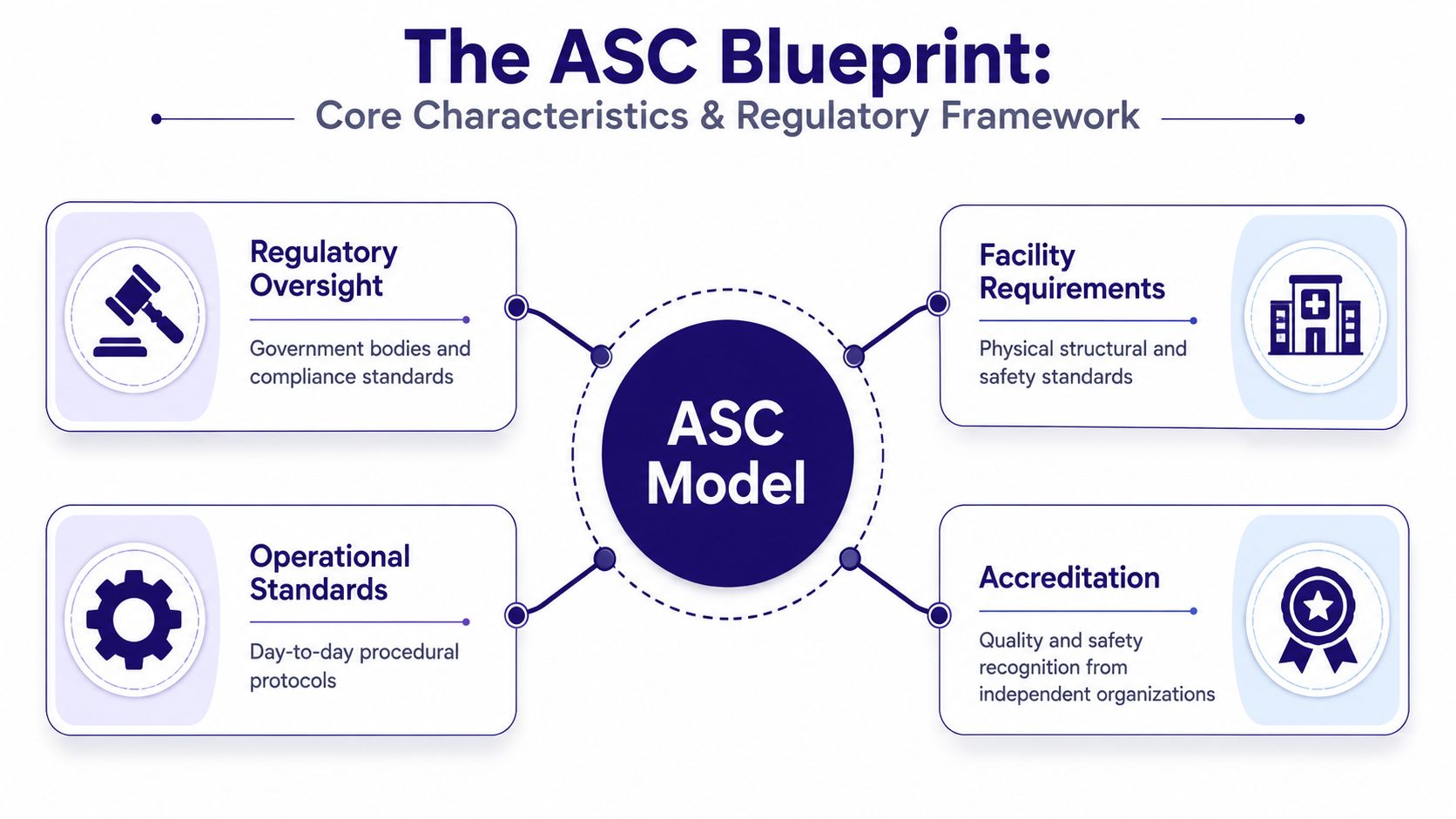
For cardiology leaders, the defining feature of an ambulatory surgery center is not convenience. It is regulatory fit. An ASC is a separately governed surgical facility designed for patients who can be treated and discharged the same day, within a tightly limited observation window. That requirement shapes the entire operating model, from scheduling discipline to emergency transfer protocols.
In practical terms, the ASC model assumes a narrow clinical promise. The patient arrives for a planned procedure, receives care in a controlled environment, recovers on site, and leaves without inpatient admission. Once a service line starts producing a meaningful share of cases that need prolonged monitoring, unplanned admission, or broad specialty backup, the economics and compliance profile change quickly.
Why the legal definition matters
Boards often frame ASCs as lower-cost procedural sites. That view is incomplete. The legal definition determines which patients belong there, what support systems must be built around them, and how much clinical variance the facility can tolerate.
For cardiovascular services, that distinction matters more than it does in many orthopedic or ophthalmology programs. A diagnostic cath, peripheral intervention, device-related procedure, or selected electrophysiology case may be operationally suitable for an ASC only if the program has disciplined screening criteria, anesthesia alignment, post-procedure monitoring standards, and a transfer pathway that works under real conditions rather than policy assumptions.
The strategic implication is straightforward. An ASC does not reduce the need for governance. It increases it. A hospital can absorb some variation because it has ICU beds, hospitalists, blood bank access, and multiple specialty consults nearby. A cardiac ASC has far less room for operational drift.
A high-performing center excludes poor-fit cases with the same discipline it brings to throughput.
How facility design shapes clinical operations
The clinical model is reinforced by physical plant requirements. ASC design standards specify procedure room dimensions, infection-control features, recovery space, and workflow elements intended to support same-day care. The ASC physical plant requirements outline details such as durable surfaces, hand hygiene infrastructure, and room configuration.
Those details affect more than compliance. They affect labor productivity, turnover reliability, and emergency response time. In cardiovascular care, layout decisions can also influence sheath management workflows, recovery observation capacity, medication access, equipment staging, and the speed with which a patient can be stabilized for transfer if a case deviates from plan.
Operational domain | Why it matters in an ASC |
|---|---|
Case selection | The model works only when expected recovery and discharge are realistic before the patient enters the building |
Facility layout | Room placement, recovery capacity, and equipment flow directly affect turnover time and staff utilization |
Infection prevention | Surface standards, hand hygiene access, and clean-to-dirty workflow design support safe same-day procedural care |
Emergency escalation | Narrow service scope requires a defined response plan, transfer agreements, and staff who can act without delay |
For hospital executives evaluating cardiovascular ASC strategy, the facility should be viewed as a purpose-built operating platform, not a smaller version of the outpatient department. That has staffing implications as well. Leaders often need flexible coverage models to support ramp-up periods, physician vacations, or recruiting gaps, which is one reason many programs assess locum tenens coverage options for procedural and perioperative teams before opening additional ambulatory capacity.
The board-level question is whether the organization can maintain hospital-grade clinical judgment inside a narrower, faster, and more standardized environment. If the answer is yes, an ASC can strengthen a cardiovascular network. If the answer is unclear, the risk sits in patient selection, staffing discipline, and governance long before it appears in financial results.
The ASC Financial Ecosystem and Reimbursement Landscape
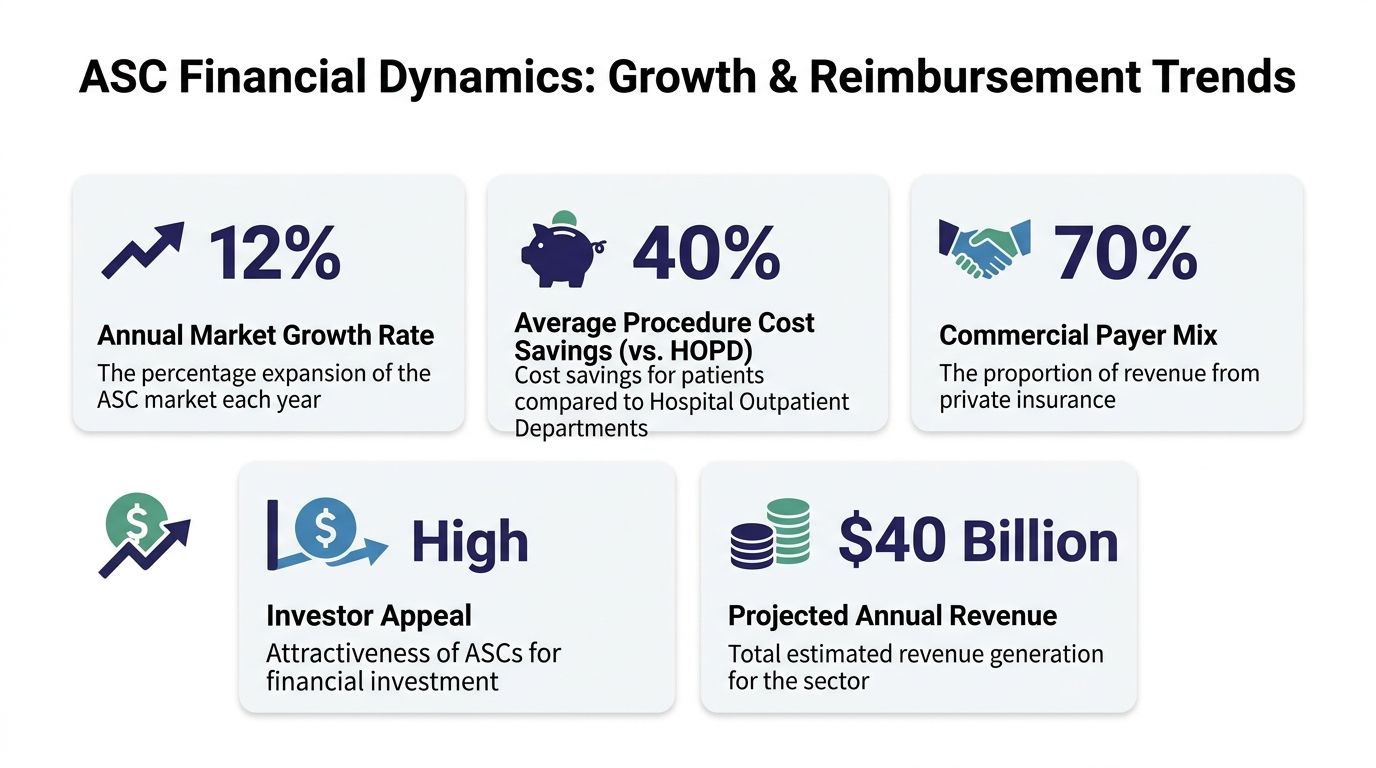
For hospital boards, the ASC economic case is no longer a niche outpatient question. It is a capital allocation and service line mix question with direct consequences for cardiovascular margin, physician alignment, and payer contracting.
The underlying logic is straightforward. ASCs concentrate lower-acuity procedural work in a setting with tighter staffing models, faster room turnover, and fewer hospital overhead layers. That cost structure matters because payers and Medicare continue to favor lower-cost sites of care when quality and safety are acceptable. In cardiovascular services, where procedural volume often supports broader referral relationships, the financial effect reaches beyond the individual case.
The market signal is already clear
The ASC model creates value through operating discipline, not through a lower-cost building. Focused case mix, standardized workflows, and narrower ancillary requirements can reduce avoidable cost per case. For cardiovascular leaders, that means the question is which procedures belong in an ambulatory setting without weakening hospital economics or clinical governance.
Executives usually test the business case across three dimensions:
Volume protection. If commercially attractive cardiac procedures migrate to independent ambulatory competitors, the hospital loses case revenue and may also lose downstream testing, follow-up, and physician loyalty.
Cost position. Selected same-day cardiovascular cases can often be delivered more efficiently in an ASC than in a hospital outpatient department, especially when scheduling, recovery, and equipment use are tightly standardized.
Physician alignment. Predictable block time, lower cancellation risk, and a more controlled procedural day can matter as much as compensation in cardiology recruitment and retention.
Staffing decisions sit inside that financial analysis. A board may approve the strategic direction before the permanent workforce model is fully built, which is why some organizations use locum tenens cardiology coverage during ASC ramp-up while they finalize recruitment, governance, and case volume assumptions.
Why reimbursement strategy changes service line planning
Reimbursement shapes the ASC model at the case level. It determines which procedures are payable in the setting, how much margin remains after staffing and supply costs, and whether growth improves enterprise economics or instead shifts profitable volume away from the hospital.
For cardiovascular programs, several implications follow.
Case selection is both a clinical and financial filter. A well-chosen ambulatory cardiac case supports throughput, discharge reliability, and payer acceptance. A poorly chosen case can consume recovery capacity, increase transfer exposure, and erase the expected margin benefit.
Hospital outpatient departments face case-mix compression. As lower-acuity procedures move out, the HOPD is left with sicker patients, longer recovery needs, and a cost base that is harder to flex downward.
Joint ventures become easier to justify. Hospitals do not always need full ownership to protect strategic value. In many markets, referral retention, physician participation, and governance rights matter more than owning every asset on the balance sheet.
This is why reimbursement policy and physician strategy should be discussed together. In cardiology, the two are linked. A favorable payment structure without committed operators produces underused capacity. Strong physician interest without disciplined payer analysis can shift volume into a site that does not support target margins.
The strongest systems evaluate ASCs service by service, payer by payer, and physician by physician. That approach is especially important in cardiovascular care, where one ambulatory decision can affect hospital cath lab utilization, HOPD economics, recruitment priorities, and negotiating position with both payers and cardiology groups.
The New Frontier Expanding Cardiac Services into the ASC
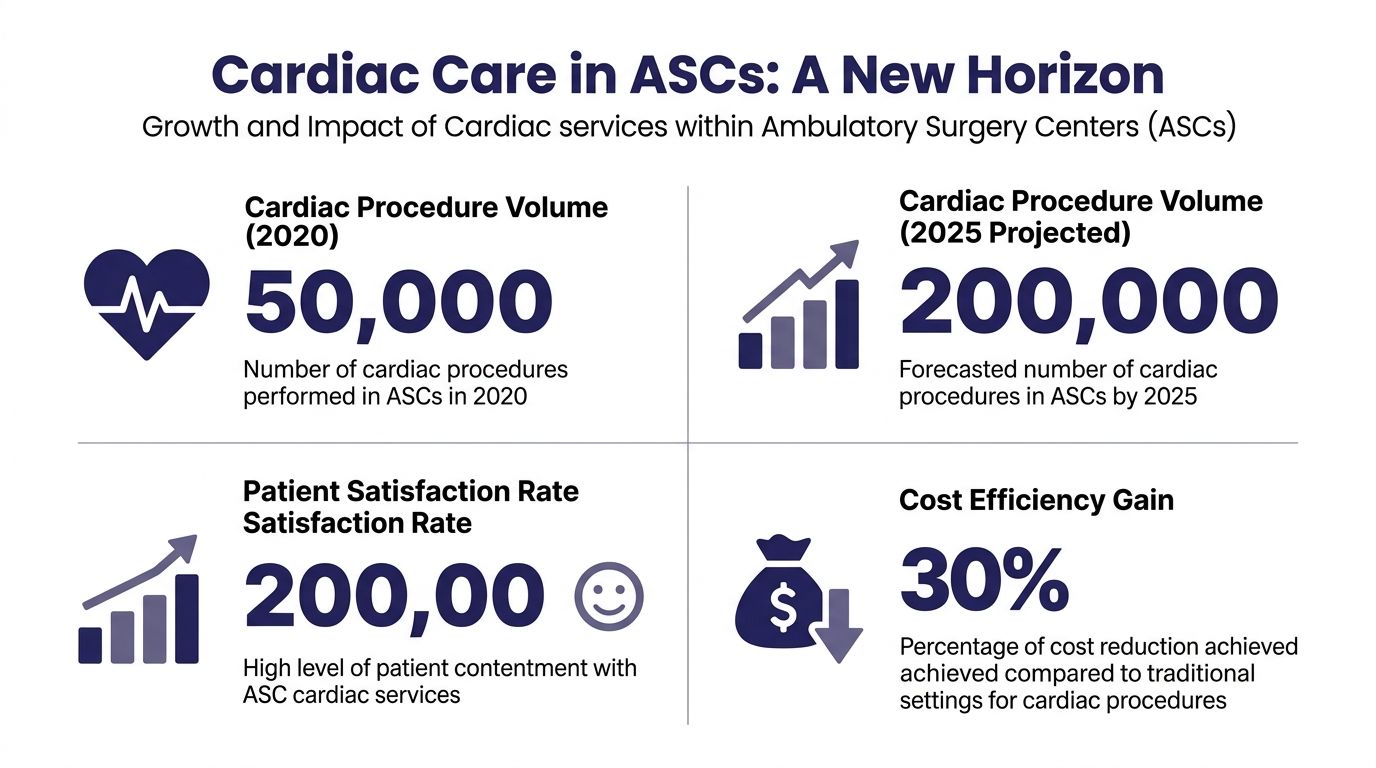
Cardiovascular care has moved from a speculative ASC use case to a measurable one. The rate of percutaneous coronary interventions in ASCs increased from 0.01 per 10,000 person-years in 2018 to 0.87 in 2022, an 87-fold surge, according to SCAI's summary of the nationwide PCI study. That isn't a marginal shift. It signals a meaningful change in where selected coronary procedures can be delivered.
The broader procedural feasibility is equally important. Approximately 66% of current catheterization laboratory procedures can be executed in an ASC setting, according to Nimble RCM's cardiology ASC analysis. For hospital boards, that figure reframes the issue. The practical question isn't whether ambulatory cardiac migration is technically possible. For many routine cath lab cases, it already is.
Cardiology is no longer peripheral to the ASC story
Historically, many executives viewed ASCs as largely irrelevant to complex cardiovascular service lines. That assumption doesn't hold up well now. Advances in interventional technique, perioperative management, imaging support, and discharge protocols have made selected cardiac procedures more compatible with a same-day care model.
The strategic implication is that cardiac ASCs shouldn't be evaluated as a copy of a general surgery center. They require a more selective model built around procedure appropriateness, rapid recovery, and disciplined contingency planning.
A workable ambulatory cardiac portfolio often begins with cases that share several traits:
Predictable post-procedure recovery
Low anticipated need for prolonged monitoring
Clear discharge criteria
A physician team comfortable with ambulatory escalation protocols
What this means for interventional cardiology and electrophysiology
For interventional cardiology, the migration of selected PCI volume into ASCs changes the strategic map. Hospitals that previously assumed coronary intervention would remain almost entirely campus-based now have to decide whether to build, partner, or defend. None of those choices are neutral.
For electrophysiology, the implications are similar, though the right procedural mix depends heavily on local expertise, anesthesia support, and post-procedure observation capabilities. The ASC environment rewards teams that can standardize workflow without compromising case selection discipline.
A board-level review of cardiac ASC potential should examine at least four dimensions:
Strategic question | Why it matters |
|---|---|
Which procedures fit the ambulatory setting? | Determines safety profile, throughput, and reimbursement viability |
Which physicians are ready to practice there? | Technical skill alone isn't enough. Operators need ambulatory mindset and protocol discipline |
What backup model exists? | Transfer pathways and hospital relationships must be explicit |
How will recruitment change? | High-performing subspecialists may prefer settings with more control over workflow |
A cardiac ASC is not simply a lower-cost venue. It is a narrower operating model that rewards precise patient selection and physician consistency.
The competitive effect is easy to miss. Once a market establishes ambulatory cardiac capability, physician candidates start comparing platforms differently. They assess not only call burden and compensation, but also procedural autonomy, staffing reliability, and the ability to perform selected cases in a highly controlled outpatient environment. That can reshape recruitment dynamics faster than many systems expect.
ASC vs Hospital Outpatient Department A Strategic Comparison
For most health systems, the live decision isn't ASC or hospital outpatient department in absolute terms. It's which services belong in each setting. Both models matter. The mistake is forcing them into a winner-take-all framework.
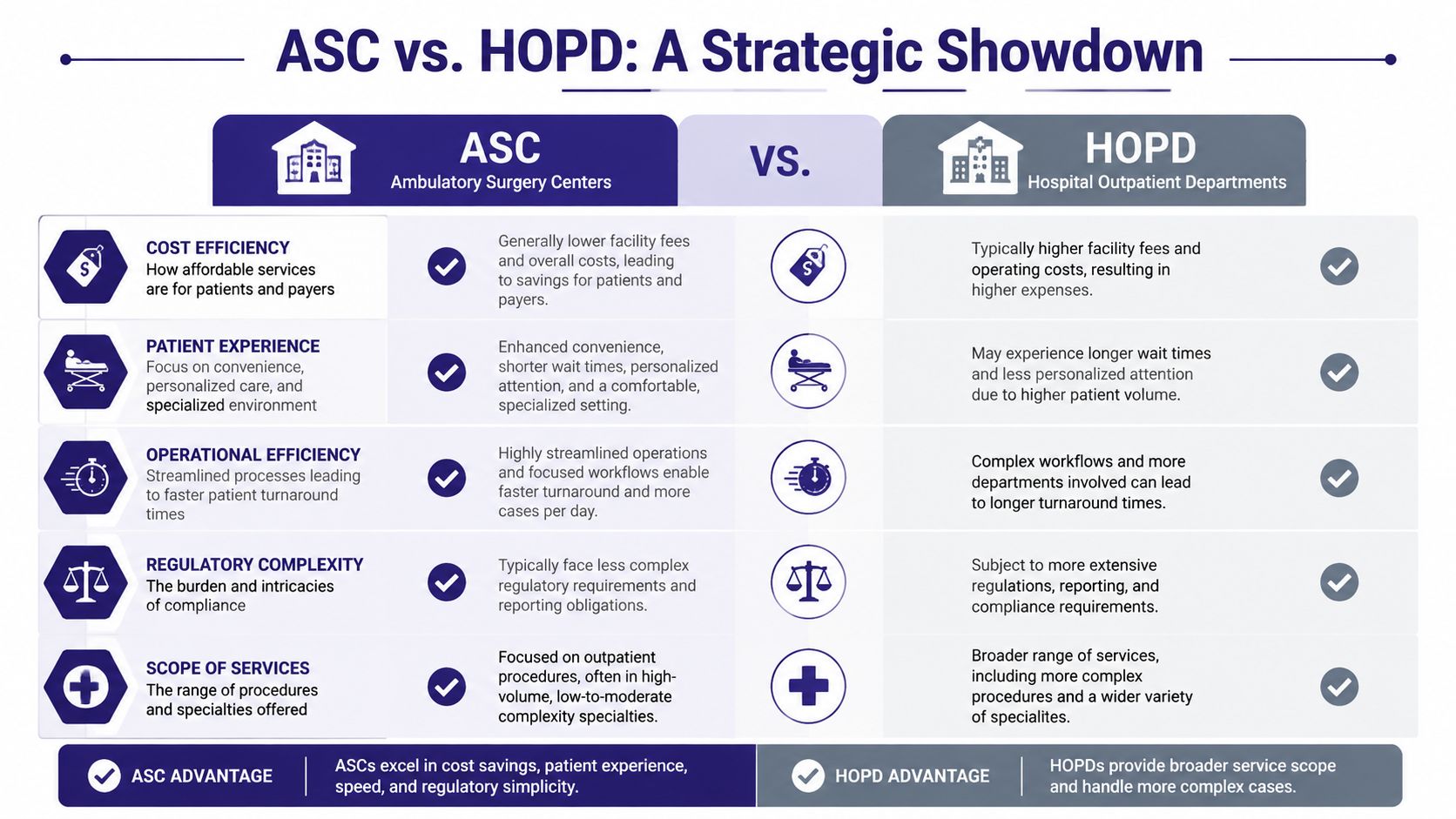
The more useful comparison starts with function. An ASC is designed for narrow-scope, same-day procedural efficiency. A hospital outpatient department supports broader clinical complexity and sits closer to inpatient rescue capacity. In cardiovascular care, that distinction becomes decisive.
Where the ASC model wins
Clinical data shows that the average procedure time for cardiovascular interventions is 41% to 61% shorter in clinic or ASC settings than in traditional in-bed operating rooms, according to this peer-reviewed analysis of cardiovascular procedure times. That's a major operational advantage. Shorter average procedure time affects room turnover, staffing intensity, physician scheduling, and daily case capacity.
The ASC also tends to create a different patient experience. The setting is more focused, navigation is simpler, and the workflow is built around discharge rather than extended hospital circulation. For selected cardiac cases, that can support a more controlled and less fragmented encounter.
Key ASC advantages often include:
Operational speed: Focused case mix supports efficient scheduling and room use.
Tighter staffing alignment: Teams usually work in a narrower procedural environment.
Physician efficiency: A controlled schedule can reduce friction around delays and competing hospital priorities.
Where the hospital outpatient department still holds the advantage
The hospital outpatient department remains the stronger venue when patient risk, case complexity, or post-procedure uncertainty rises. Cardiac services that may need immediate access to broader hospital support should remain close to that infrastructure.
That includes situations where leaders value:
Immediate escalation capacity for patients whose recovery may deviate from plan.
Broader multispecialty backup when comorbidities or procedural complexity create uncertainty.
Integration with inpatient pathways for admissions, monitoring, or rescue interventions.
The strategic issue isn't whether HOPDs are less efficient. It's that they're built to absorb complexity that ASCs are specifically designed to avoid.
Decision criterion | ASC | HOPD |
|---|---|---|
Best fit | Standardized, selected same-day procedures | Higher-acuity or less predictable outpatient care |
Throughput | Often faster for focused case sets | More variable because of broader operational demands |
Rescue resources | Narrower on-site support | Immediate access to wider hospital capabilities |
Cardiac use case | Selected interventional and procedural volumes | Complex patients, unstable risk profiles, expanded backup needs |
Hospital leaders should stop asking which site is better. The more useful question is which site is better for this patient, this procedure, and this physician team.
For cardiac strategy, that distinction protects both quality and margin. ASCs can relieve pressure on hospital outpatient departments, but only if governance is strict enough to keep case migration disciplined. Once inappropriate cases enter the ambulatory channel, the model loses its advantage quickly.
Staffing and Credentialing for a High-Performance Cardiac ASC
A cardiac ASC succeeds or fails on talent density. The setting is lean, the margin for workflow drift is small, and escalation options are narrower than in the hospital. That puts unusual pressure on hiring and privileging decisions.
The staffing model has to support speed without cutting corners. In cardiovascular settings, that usually means aligning interventional cardiologists, electrophysiologists where appropriate, advanced practice providers, cath lab professionals, perioperative nurses, anesthesia support, and administrators around a tightly defined case mix. Broad clinical competence isn't enough. The team must function well inside a narrow ambulatory protocol.
The staffing model is lean by design
Hospital leaders sometimes underestimate how different ASC staffing feels in practice. In the hospital, redundancy can mask inconsistency. In an ASC, inconsistency shows up fast through delays, discharge variation, documentation gaps, or protocol workarounds.
Strong cardiac ASC teams usually share several traits:
Subspecialty fit: Clinicians understand the procedural boundaries of ambulatory interventional cardiology or electrophysiology.
Cross-functional reliability: Nurses, technologists, APPs, and physicians work from the same discharge and escalation logic.
Comfort with pace: The environment rewards precise handoffs and disciplined room readiness.
Low tolerance for ambiguity: Because the facility is narrower in scope, every team member needs clear role definition.
For technical staffing, many organizations also need flexible coverage for cath lab operations during ramp-up periods, vacancy gaps, or volume spikes. In those situations, leaders often evaluate the market for travel cath lab tech support to keep throughput stable while permanent hiring catches up.
Credentialing has to match the clinical ambition
Credentialing in a cardiac ASC can't be a simplified version of hospital privileging. It has to be narrower and, in some ways, more demanding. The board may approve a growth strategy in principle, but the medical staff office and service line leadership have to translate that strategy into exact privilege criteria.
That usually means defining:
Which procedures are approved in the ASC
Which physicians may perform them
What patient characteristics exclude ambulatory treatment
Which transfer and escalation pathways apply when recovery diverges from plan
Those decisions should be written operationally, not aspirationally. If the privilege set is broad but the staffing model is immature, the center takes on risk it can't manage well.
The safest cardiac ASC is rarely the one with the broadest menu. It's the one where staffing, privileges, and case selection match exactly.
Recruitment strategy should reflect that reality. A physician with strong hospital-based procedural volume isn't automatically the right fit for an ASC. Leaders should screen for ambulatory judgment, comfort with standardized pathways, and willingness to practice inside a narrower but more accountable operating model. The same principle applies to APPs and cath lab personnel. Technical skill opens the door. Cultural fit protects the program.
Building Your Cardiac ASC Strategy A Guide for Leaders
Boards that approach cardiac ASCs as a real estate project usually underperform. The stronger approach starts with service line design. The physical plant matters, but strategy comes first.
Cardiovascular ASCs create value only when four elements align: case mix, physician participation, payer logic, and staffing depth. If any of those are weak, the center may still open, but it won't operate as a durable competitive asset.
Boards should make four decisions early
The first decision is scope. Leaders need a disciplined view of which cardiac procedures fit ambulatory delivery and which should remain in the hospital. That decision should be based on clinical predictability and team readiness, not optimism.
The second is organizational model. Some systems will build internally. Others will partner or use joint-venture structures. The right choice depends on capital priorities, market competition, physician alignment, and how much operational control the organization needs.
The third is governance. Cardiac ASC decisions can't sit in a gray zone between administration and medical staff leadership. Someone must own case criteria, transfer policy, quality review, and recruitment priorities.
The fourth is talent sequencing. Many projects fail because leaders treat recruitment as the final workstream instead of the first operational constraint. Cardiac ASCs require a narrower workforce than hospitals, but a more specialized one. That combination makes hiring harder, not easier.
A useful strategic checklist includes:
Procedure selection discipline: Define the cardiac cases that match the ASC model and keep the list tight early on.
Physician alignment: Identify operators who want ambulatory efficiency and can practice within strict protocols.
Operational backup: Establish hospital transfer relationships and escalation pathways before the first case.
Leadership accountability: Tie quality, throughput, and staffing oversight to named executives and physician leaders.
Why talent is the limiting factor
The market often talks about ASCs as an efficiency play. In cardiovascular services, they're also a recruitment play. High-performing interventional cardiologists, electrophysiologists, APPs, and technical staff increasingly evaluate whether an employer offers an ambulatory platform that supports focused procedural work.
That doesn't mean every candidate prefers an ASC-heavy model. Many don't. But organizations that can articulate where ambulatory cardiac care fits into the broader service line usually present a more coherent opportunity. Candidates notice that.
Boards should also recognize that ambulatory expansion changes management requirements inside the practice. Scheduling, throughput oversight, physician utilization, credentialing, and APP deployment all become more tightly linked. Leaders building this capability often need a stronger operational backbone in parallel, especially in multisite groups. Resources on cardiology practice management strategy can help frame those operating questions before they become staffing problems.
The strategic conclusion is straightforward. An ambulatory surgery center is not just a site of care. In cardiovascular services, it is a selective platform for lower-acuity procedural migration, physician alignment, and operational redesign. Health systems that treat ASCs as part of a deliberate cardiac network strategy will be in a stronger position than those that react only after volume and talent begin moving elsewhere.
American Cardiology Group helps hospitals, health systems, cardiac ASCs, and physician practices recruit the specialized talent required to build durable cardiovascular programs. For organizations planning ambulatory cardiac expansion, American Cardiology Group offers focused support across permanent physician search, locum coverage, APP placement, and cardiac leadership recruitment.
Comments