
Cardiologist Salary Texas Guide for 2026
The May 2025 BLS Texas benchmark for cardiologists is a $410,150 median annual wage, but that figure is an occupational median, not a typical negotiated offer or a total-compensation estimate. Using it as a universal recruiting target or negotiation anchor mistakes a statewide labor-market measure for the value of a specific clinical contract.
The better question is what an employer is purchasing: outpatient capacity, procedural expertise, emergency coverage, program leadership, or an ownership commitment. A useful cardiologist salary Texas comparison starts with the benchmark, then evaluates those obligations separately.
Table of Contents
Why One Texas Salary Figure Misleads - Different measures answer different questions
Reading the Texas Compensation Distribution - What the distribution doesn't establish
Comparing Texas Metro Compensation Signals - Compare the underlying positions
Comparing Cardiology Subspecialty Compensation - General and interventional cardiology require different comparators - Electrophysiology and advanced heart failure need local validation
Comparing Academic Hospital and Private Practice - Evaluate what the agreement recognizes - Compare enforceable terms, not setting labels
Normalizing Total Compensation and Contract Value - Establish the guaranteed floor - Model the contingent earnings - Test operational feasibility and downside
Negotiating Offers and Recruiting in Underserved Markets - Candidate negotiations should identify the unresolved risk - Employers should design for sustained coverage
Why One Texas Salary Figure Misleads
Texas cardiology compensation behaves like a market, not a single price tag. The May 2025 BLS-based Texas estimate reports a median annual wage of $410,150 and a mean of $386,680, but neither establishes what a hospital should offer an electrophysiologist or what a general cardiologist should accept for extensive inpatient coverage.
The popular advice to find the statewide average and negotiate above it skips the most important analytical step: determining whether the comparison measures the same work. An occupational wage estimate, an advertised recruitment package, and a physician-reported income figure aren't interchangeable.
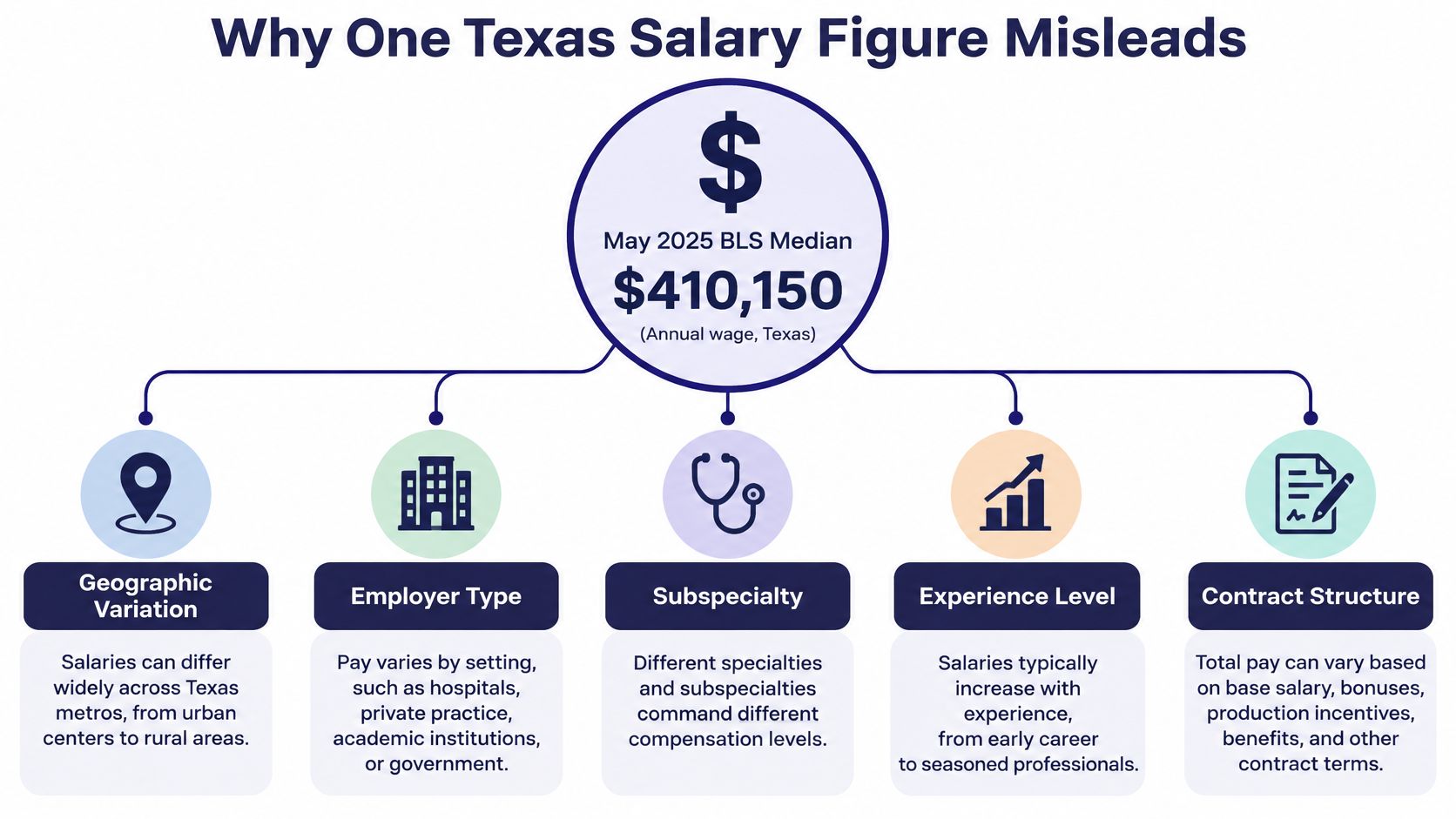
Different measures answer different questions
Occupational wages describe pay across an employed population. Advertised packages describe recruitment opportunities, sometimes with contingent incentives. Physician-reported compensation can reflect arrangements that require closer examination of ownership, productivity, benefits, and reporting definitions.
For executives, this distinction prevents a compensation budget from being built around an incompatible survey. For candidates, it prevents an attractive advertised amount from being mistaken for unconditional income.
Clinical scope: General cardiology, interventional cardiology, electrophysiology, and advanced heart failure require separate role definitions.
Work commitment: Clinic sessions, procedures, inpatient rounding, outreach, and call should be specified before compensation is compared.
Economic structure: Guaranteed wages, contingent earnings, benefits, and ownership proceeds should remain distinct categories.
Experience and geography also require interpretation rather than automatic adjustments. An established physician with an existing referral base isn't necessarily comparable with a new recruit building a service, even when both hold the same specialty designation.
Benchmarking rule: A salary comparison is useful only when the clinical obligations and compensation definitions are sufficiently similar.
The practical objective isn't to identify the largest published number. It's to establish a defensible comparison group and determine which contractual differences justify departures from it.
Reading the Texas Compensation Distribution
The distribution matters more than the headline average because it shows how little a single central estimate reveals about an individual position. The Texas occupational and recruiting compensation summary reports the following May 2025 benchmarks, alongside a national median comparison.
May 2025 Texas Cardiologist Wage Benchmarks
Measure | Reported figure | How to interpret it |
|---|---|---|
Employed cardiologists | Approximately 2,050 | A statewide workforce estimate, not an available-candidate count |
Median annual wage | $410,150 | The midpoint of the reported wage distribution |
Mean annual wage | $386,680 | The arithmetic average, below the reported median |
10th-percentile wage | $97,140 | A lower-distribution observation, not a recommended starting offer |
90th-percentile wage | $703,430 | An upper-distribution observation, not a guaranteed specialist rate |
National median | $496,010 | A national reference that requires comparable methodology |
Texas median relative to national median | Approximately 17.3% lower | A broad geographic comparison, not a required offer discount |
Median hourly equivalent | Approximately $197.19 | An annual-wage conversion using a 2,080-hour year |
Mean hourly equivalent | Approximately $185.90 | A standardized conversion, not an observed clinical hourly rate |
These figures describe a wide compensation distribution. They don't identify which observations correspond to particular career stages, employment arrangements, workloads, or cardiovascular subspecialties.
What the distribution doesn't establish
The mean sitting below the median deserves particular care. It doesn't support a simple narrative that highly compensated procedural physicians pull the statewide average above the typical worker's wage. The summary statistics alone can't establish the underlying composition.
Similarly, the upper percentile demonstrates that substantially higher reported wages exist, but it doesn't prove that every senior cardiologist should receive that amount. Assigning a percentile requires a relevant comparison population, not merely a preferred negotiating position.
Avoid career-stage assumptions: A lower percentile shouldn't automatically be labeled an entry-level salary.
Avoid schedule assumptions: Standardized hourly conversions shouldn't substitute for actual clinical, administrative, and call hours.
Avoid supply assumptions: An employed workforce count doesn't measure willingness to relocate or availability for recruitment.
An employer should therefore use the distribution to test the plausibility of a proposed budget, then validate the position against comparable openings and contract terms. A candidate should use it to frame questions, not to infer an entitlement to a particular percentile.
The methodological boundary remains important: an occupational wage estimate doesn't itemize the proposed agreement's signing payment, benefits, additional call compensation, or potential partnership interest. Those components require separate documentation before anyone can compare the benchmark with a negotiated package.
Comparing Texas Metro Compensation Signals
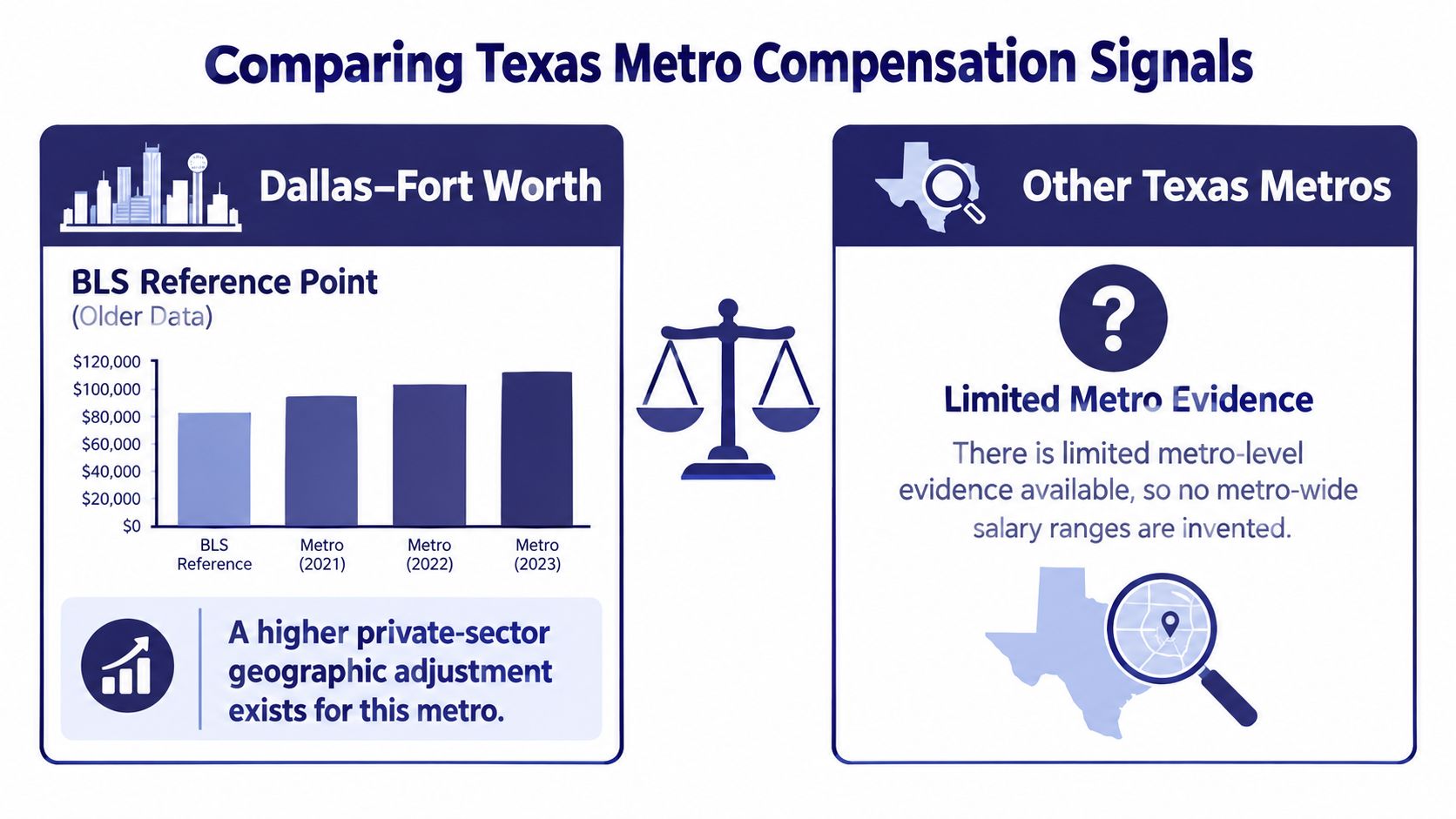
Dallas–Fort Worth illustrates why geographic benchmarking needs a date and a defined population. The May 2023 BLS release reported a Dallas–Fort Worth–Arlington mean annual cardiologist wage of $310,500, approximately 560 employed cardiologists, and a Texas statewide mean of $323,310. That is an older occupational reference, not a current recruitment quote.
A separate physician compensation report estimates Dallas pay at 15%–20% above Austin for comparable physicians and presents a Houston cardiologist average near $463,000, alongside a clinical-only offer of $300,000 plus $30 per wRVU, 70 weekly hours, and 1:5 call. The Dallas adjustment concerns physicians broadly, so it shouldn't be treated as a verified cardiology-specific premium.
Compare the underlying positions
The Houston example is useful because its terms expose the weakness of a city-level average. The advertised base doesn't describe expected realized compensation without the productivity rules, and the workload statement requires clarification about whether administrative duties and call-related work are included.
A recruiting committee should resist interpreting the Dallas and Houston observations as a ranking. They come from different reporting approaches and don't establish a consistent metropolitan hierarchy.
Geographic signal | Appropriate use | Inappropriate conclusion |
|---|---|---|
Older metropolitan BLS estimate | Historical occupational context | A current guaranteed offer level |
Broad physician geographic adjustment | A reason to investigate local differences | A cardiology-specific premium |
Reported city average | A preliminary comparison point | A rate applicable to every local employer |
Individual advertised position | Analysis of a particular opportunity | A representative metro-wide package |
For a candidate comparing cities, the appropriate next step is a matched-role review. The comparison should hold subspecialty, employment model, clinical sessions, expected productivity, and benefit definitions as constant as possible.
For an employer, local competition should mean organizations recruiting for similar clinical work, not every institution within the same metropolitan boundary. An academic referral center and a community practice can occupy the same city while offering materially different professional commitments.
A geographic adjustment is defensible only after the positions are comparable. A city name alone isn't a compensation methodology.
The available evidence supports investigating geographic differences. It doesn't support inventing salary ranges for Austin, San Antonio, or other Texas markets where a comparable local estimate hasn't been established.
Comparing Cardiology Subspecialty Compensation
Interventional cardiology has the clearest numerical subspecialty evidence available for this comparison. The Texas interventional cardiology dataset reports average compensation of $915,000, approximately $730,396 in base pay, $176,466 in bonuses, and bonus receipt among 83% of reporting physicians; it also reports approximately 11,064 wRVUs, compensation near $67 per wRVU, and a Dallas–Fort Worth community-hospital offer of $763,000, $63 per wRVU, a 55-hour workweek, and 1:4 call.
Those reported averages shouldn't be reconstructed into a universal compensation formula. The base and bonus components don't reconcile exactly to the reported total, and the reported compensation-per-wRVU figure shouldn't automatically be interpreted as the contractual conversion factor for every respondent.
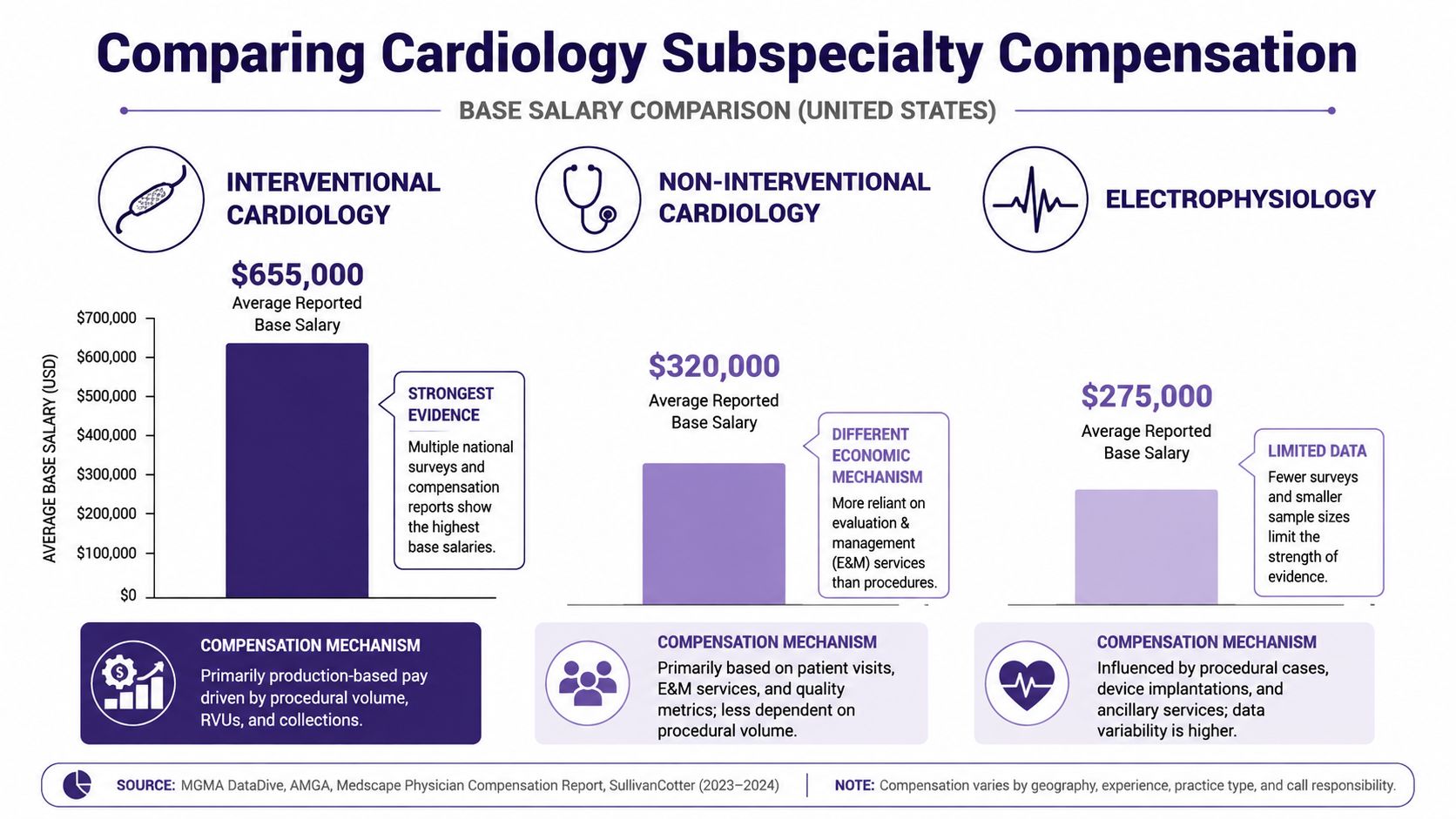
The illustration shouldn't be read as a verified pay ranking across subspecialties. Comparable Texas-specific averages for electrophysiology and non-interventional cardiology aren't established by the figures presented here.
General and interventional cardiology require different comparators
The statewide occupational benchmark offers context for general cardiology, but it isn't a general-cardiology-only estimate. A noninvasive position still requires a defined mix of consultations, imaging interpretation, inpatient service, and outpatient follow-up before a compensation comparison becomes meaningful.
For interventional recruitment, the employer should document catheterization laboratory responsibilities, emergency coverage, procedural expectations, and any structural heart scope. The detailed community-hospital offer demonstrates why the procedural job description and coverage commitment belong beside the advertised compensation. Additional context is available in this interventional cardiologist salary analysis.
Electrophysiology and advanced heart failure need local validation
An electrophysiology negotiation should identify ablation expectations, device implantation responsibilities, device-clinic supervision, laboratory access, and after-hours coverage. Without those details, applying an interventional cardiology premium to an electrophysiology position would create an unsupported benchmark.
Advanced heart failure agreements warrant a different review. Candidates and clinical directors should specify inpatient service, transplant or mechanical circulatory support responsibilities where applicable, multidisciplinary program duties, and protected leadership time.
Electrophysiology: Request a local comparison matched to procedural scope and device-service obligations.
Advanced heart failure: Evaluate whether program development and complex longitudinal care receive explicit contractual recognition.
General cardiology: Distinguish outpatient-focused work from broad inpatient and outreach coverage.
The defensible conclusion is narrower than a salary leaderboard: interventional cardiology has a documented high-compensation signal in the available Texas reporting. Other subspecialties require verified local offers rather than borrowed premiums or assumed rankings.
Comparing Academic Hospital and Private Practice
Identical reported medians don't establish identical economics. One Texas cardiology dataset reports an $800,000 median for both private-practice and hospital-employed cardiologists, based on only nine private-practice observations and four hospital-employed observations.
Those small samples can't resolve whether either setting consistently pays more. They also don't establish an academic compensation benchmark, which requires its own comparison population and appointment details.
Evaluate what the agreement recognizes
An academic offer should be evaluated against the actual allocation of clinical work, research, teaching, and administration. Candidates should request written definitions of protected time, promotion expectations, research support, and any productivity adjustment associated with nonclinical responsibilities.
Hospital employment requires scrutiny of the compensation plan and the service expectations attached to it. Executives should specify whether quality performance, access targets, medical directorship, and service-line development are separately compensated or included within the clinical guarantee.
Setting | Central evaluation question | Documents to request |
|---|---|---|
Academic appointment | Does the workload allocation match the evaluation criteria? | Appointment terms, effort allocation, promotion criteria |
Hospital employment | Are clinical and leadership expectations reflected in the plan? | Compensation policy, incentive schedule, directorship agreement |
Private practice | What rights and risks accompany the ownership opportunity? | Partnership agreement, financial statements, buy-in and buyout terms |
Private practice requires an additional distinction between compensation for physician work and returns attributable to ownership. A partnership opportunity shouldn't be valued as though admission, distributions, and future equity proceeds are guaranteed.
Compare enforceable terms, not setting labels
A candidate evaluating private practice should examine governance rights, expense allocation, ancillary economics, capital obligations, and the conditions for becoming a partner. The presence of a partnership track isn't enough; the agreement should explain who decides admission and what happens if it doesn't occur.
Hospital and academic candidates should apply the same discipline to benefits and institutional support. Malpractice coverage, retirement contributions, leave, professional development funding, and administrative assistance should be documented rather than presumed from the employer's category.
Guarantee durability: Identify what can change during the agreement and who controls revisions.
Nonclinical recognition: Confirm whether teaching, quality oversight, and management duties reduce clinical targets.
Exit economics: Review repayment obligations, ownership redemption, and responsibility for outstanding liabilities.
The setting label describes an organizational arrangement, not the full value of the offer. A sound decision compares written obligations, available resources, downside exposure, and realistic career objectives without assuming that employment or ownership is superior.
Normalizing Total Compensation and Contract Value
An offer-comparison worksheet should distinguish guaranteed cash, contingent cash, noncash benefits, and ownership value. Combining them into an advertised total obscures which amounts the physician can rely on and which depend on future events.
A Texas salary compilation illustrates the need for that separation: it presents Marit figures of approximately $464,537 in base pay, $46,680 in bonuses, 10,206 wRVUs, and 51.9 weekly hours, while noting that SalaryDr's overall Texas estimate rests on 13 verified physicians and its hospital-employed estimate on three submissions in that particular reporting view (Texas cardiology salary methodology and comparisons). These observations shouldn't be merged with differently defined samples.
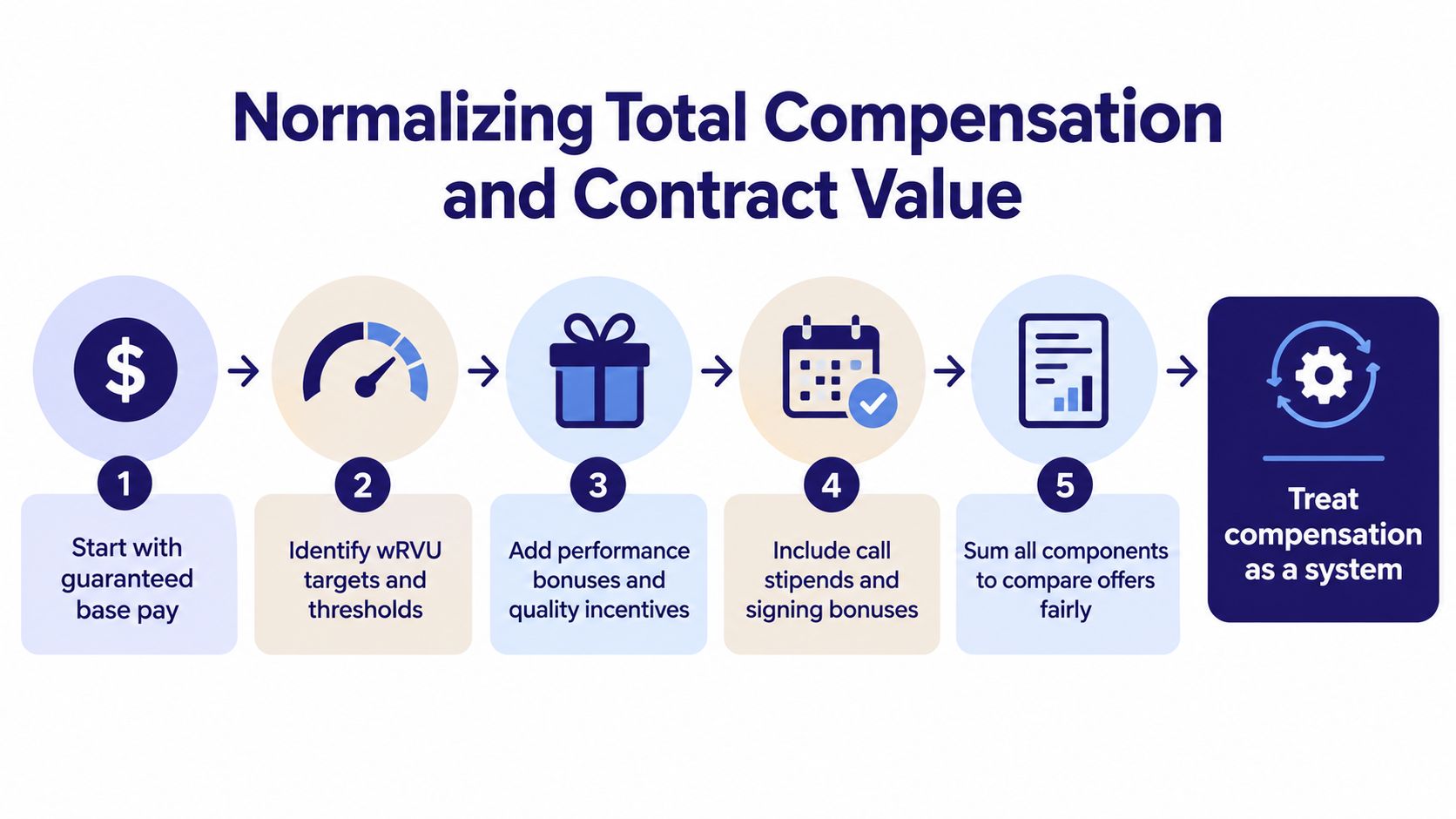
Establish the guaranteed floor
The worksheet should begin with the contractual guarantee and its duration. Signing payments, relocation assistance, and loan support belong in separate fields because repayment provisions can change their value if employment ends early.
Benefits should also remain visible rather than disappearing inside a broad total-compensation label. The evaluator should record employer contributions, malpractice terms, leave, and other documented benefits without assigning unsupported cash equivalents.
Model the contingent earnings
Productivity analysis requires the full formula, not just the advertised conversion factor. The employer and candidate should establish:
Threshold mechanics: Whether productivity pay begins immediately or only above a defined target.
Crediting rules: Which services count, how shared work is allocated, and when adjustments occur.
Payment timing: Whether incentives are settled periodically, reconciled later, or subject to recovery.
Collections exposure: Whether reimbursement, denials, or practice expenses affect physician earnings.
The previously described interventional and Houston offers can't be compared through nominal salary alone. Their different clinical scope, schedules, call arrangements, and productivity terms require separate operating assumptions.
The physician compensation models guide provides a useful framework for distinguishing salary, productivity, collections-based, and ownership-linked arrangements.
Test operational feasibility and downside
A projected incentive isn't equivalent to a guarantee. Candidates should ask whether the proposed schedule, referral access, laboratory availability, and support staffing make the productivity expectation feasible, particularly during onboarding.
Administrative time and call should be recorded as obligations, even when the contract doesn't pay for them separately. A call ratio requires clarification about weekends, holidays, inpatient census, backup coverage, and recovery time.
Contract-value test: Every material payment should have an identifiable trigger, and every material obligation should have an identifiable place in the workload.
Finally, ownership distributions should be evaluated separately from wages and bonuses. A useful comparison shows a guaranteed floor, an achievable operating scenario based on disclosed assumptions, and the consequences if volume or partnership expectations aren't met.
That approach produces a decision model rather than a single inflated total. It also gives compensation committees a clearer explanation of what the organization is committing to purchase.
Negotiating Offers and Recruiting in Underserved Markets
Access requirements change the recruiting question. A Texas physician-desert study identified cardiologist deficiencies in 196 counties using a maximum reasonable travel distance of 50 miles, while statewide supply reporting placed availability at 4.4 cardiologists per 100,000 people, with substantial metropolitan variation.
Those findings support a geographic access concern, not a universal rural salary premium. The appropriate package depends on the actual coverage gap, the available clinical infrastructure, and the responsibilities the incoming physician will assume.
Candidate negotiations should identify the unresolved risk
A candidate should enter negotiations with a matched-role comparison and a clear statement of which obligations require clarification. A request tied to emergency coverage, travel, or an underdeveloped referral base is more analytically grounded than a request based solely on a statewide average.
Negotiation should also distinguish an income concern from an operating concern. A larger signing payment doesn't resolve inadequate backup coverage, limited procedural access, or a schedule that leaves no time for outreach.
Coverage uncertainty: Request a written call and backup plan.
Ramp-up uncertainty: Seek explicit referral-development support and realistic productivity treatment during onboarding.
Travel demands: Define outreach locations, travel expectations, and protected time.
Retention concerns: Address professional support, schedule flexibility, and the intended long-term clinical model.
Employers should design for sustained coverage
Hospitals should define the service before setting the compensation budget. A general cardiologist supporting local access, an interventional cardiologist covering emergency procedures, and an electrophysiologist building a regional program represent different recruiting assignments.
The employer should also distinguish a scarce-skill requirement from a temporary vacancy response. Otherwise, an urgent payment may fill an immediate gap without resolving the conditions that make the position difficult to retain.
A rural physician recruitment approach should therefore evaluate referral coordination, telecardiology support where appropriate, emergency transfer arrangements, outreach scheduling, and access to professional colleagues. These operating provisions deserve consideration alongside signing support, relocation, loan assistance, and guaranteed income.
The stronger executive question is whether the complete package supports a viable service. That assessment should include the consequences of an unfilled position, such as transfers, delayed procedures, patient travel, and disrupted continuity, without assigning speculative financial values.
The final negotiating anchor should be a documented clinical role with a sustainable operating model. When candidates and employers agree on that foundation, compensation becomes a means of securing the required service rather than a contest over an unrelated statewide number.
American Cardiology Group offers cardiology-focused permanent recruitment, locum tenens coverage, advanced practice placement, and executive recruitment for employers and candidates. Hospitals defining a Texas cardiology position and physicians evaluating opportunities can visit American Cardiology Group to discuss clinical scope, coverage requirements, and opportunities aligned with their compensation and career priorities.
Comments