
Physician Staffing Solutions: A Cardiac Program Guide
The AAMC workforce studies project physician demand will outpace supply through 2036, while the U.S. population aged 65 and older continues to grow. For cardiac programs, that pressure shows up on the procedure schedule. An unfilled interventional cardiology or electrophysiology seat removes procedural capacity, stretches call coverage, and sends referrals to hospitals that can start cases sooner. Effective physician staffing solutions protect patient access and retention, with headcount as the least useful measure.
Table of Contents
Four Staffing Models Compared at a Glance - The Four Models in Practice
Why Cardiac Shortages Make Staffing a Continuity Problem - What a Single Vacancy Removes
Matching a Staffing Model to Your Coverage Gap - Tradeoffs by Model
Selection Criteria for a Cardiology Staffing Partner - The Scorecard to Run on Any Shortlisted Firm
How to Implement a Cardiac Staffing Plan - Seven Steps From Vacancy to Stable Coverage
KPIs and ROI for Cardiac Staffing Programs - Culture Belongs on the Same Scorecard
Tailored Recommendations by Cardiac Program Type - Designing the Rural Portfolio
Four Staffing Models Compared at a Glance
Physician staffing solutions are the sourcing, coverage and integration services that keep a service line staffed when in-house recruitment cannot. Say a community hospital loses its only electrophysiologist. The chief medical officer doesn't face one problem, but three at once, uncovered device clinics next week, an ablation schedule with no operator, and a permanent seat that won't fill quickly. Each model below solves a different layer of that problem.
The Four Models in Practice
Permanent placement fills the long-term seat. A recruiter sources, vets and presents cardiologists or cardiac surgeons for direct employment, and the hospital judges success by time-to-fill and first-year retention. It delivers continuity, referral relationships and program building, but it moves at the speed of a scarce subspecialty market. An electrophysiology search, for example, draws from a far smaller pool than general cardiology, so expectations set for a hospitalist hire won't hold.
Locum tenens supplies a temporary physician for a defined period, usually weeks to months. In the scenario above, a locum electrophysiologist keeps device checks and consults running while the permanent search proceeds. The facility approves the provider, the agency handles contracting, and coverage starts sooner than a permanent hire can. The tradeoff is cost per day and handover risk if assignments rotate.
Advanced practice provider integration places nurse practitioners and physician assistants inside cardiology clinics and inpatient teams. APPs absorb routine follow-up, heart failure titration visits, pre-procedure workups and discharge rounding under physician supervision. That frees cardiologists for new consults and procedures. It doesn't replace procedural capacity, since APPs can't perform cath lab or ablation cases, but it stabilizes the volume around those cases.
Managed service provider and vendor management system models route all external staffing through one contract. An MSP manages multiple agencies under a single rate card, while a VMS platform tracks requisitions, credentials and spend. Health systems with several hospitals gain consolidated reporting and consistent rates. Smaller programs often find the added management layer heavier than the problem it solves.
Model | Solves | Typical duration | Cost structure | Hiring control |
|---|---|---|---|---|
Permanent placement | Long-term vacancy in general cardiology or a subspecialty | Open-ended | Placement fee, usually a share of first-year compensation | Full: the hospital makes the offer |
Locum tenens | Coverage gap during a vacancy, leave or surge demand | Days to months | Daily or hourly rate plus agency fee | Shared: the facility approves the provider |
APP integration | Clinic capacity, follow-up visits and inpatient volume | Ongoing | Salary or contracted rate per APP | Full, after credentialing |
MSP/VMS | Consolidated external staffing spend across several vendors | Multi-year contract | Management fee or markup on contracted rates | Facility sets the rules; vendor sources candidates |
Practical rule: Treat the four models as layers, not rivals. Most cardiac programs run two or three simultaneously, with locums protecting the schedule, APPs protecting clinic throughput, and permanent recruitment protecting the program's future.
The common failure is choosing one model to solve every layer. A locum can't build a structural heart program, and a permanent search can't cover next month's call roster. Programs that map each gap to the model built for it spend less on premiums and lose fewer referrals while searches run.
Why Cardiac Shortages Make Staffing a Continuity Problem
The scale of the national gap explains why cardiac staffing can't be treated as a sequence of one-off searches. The AAMC 2024 workforce analysis projects the United States could face a shortage of 13,500 to 86,000 physicians by 2036, with primary care alone short 20,200 to 40,400 physicians and surgical specialties short approximately 10,100 to 19,900 physicians. That wide range isn't imprecision. It reflects different assumptions about economic growth, healthcare utilization, retirement, migration and graduate medical education expansion, so executives should plan against scenarios rather than a single point estimate.
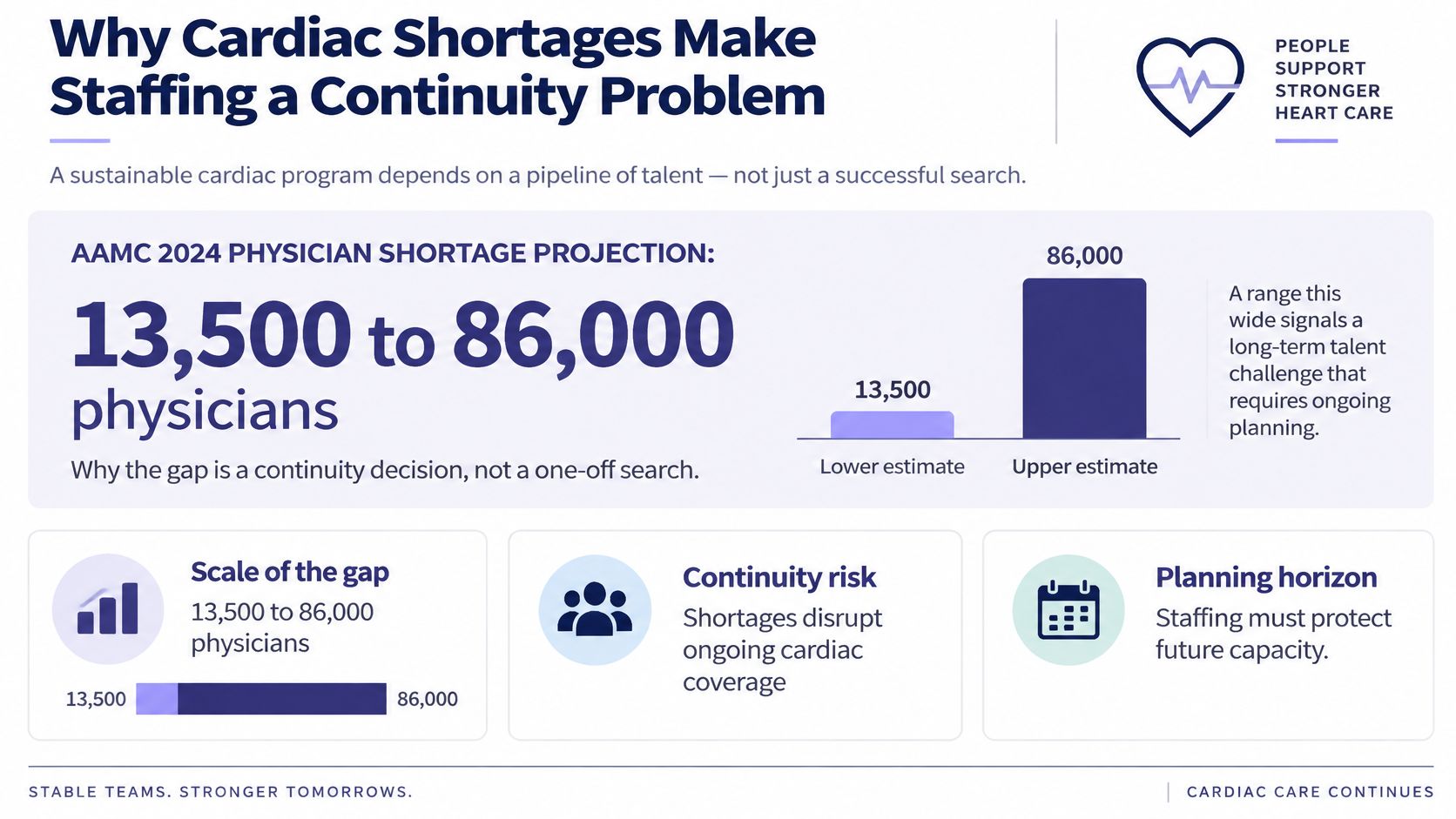
Supply growth barely keeps pace with population growth even in favorable scenarios. Under status quo modeling, physician supply rises from about 854,000 active physicians in 2021 to between 919,000 and 961,100 in 2036, growth of 7.6% to 12.4%, while the U.S. population grows 8.4% over the same period. At the low end, supply per capita shrinks. Cardiac demand, driven by an older population with more heart failure, atrial fibrillation and valvular disease, grows faster than headcount suggests.
What a Single Vacancy Removes
Procedural capacity: An empty interventional seat idles cath lab block time and pushes STEMI call onto fewer operators.
Call coverage: Remaining cardiologists absorb more nights, which accelerates the next resignation.
Referral intake: Primary care physicians route patients to systems that can see them sooner, and those patterns don't automatically return.
Geography compounds each effect, a dynamic explored in the analysis of the rural physician shortage. A vacancy in a market with one cardiology group removes the service entirely, while a metropolitan vacancy mainly redistributes volume. The planning question for every program is therefore concrete. How long can current coverage hold, at current call frequency and clinic wait times, before a single resignation becomes a service-line risk? Programs that answer that question in writing, with named backups for each subspecialty, negotiate from strength. Programs that don't will negotiate during a crisis, at crisis prices.
Matching a Staffing Model to Your Coverage Gap
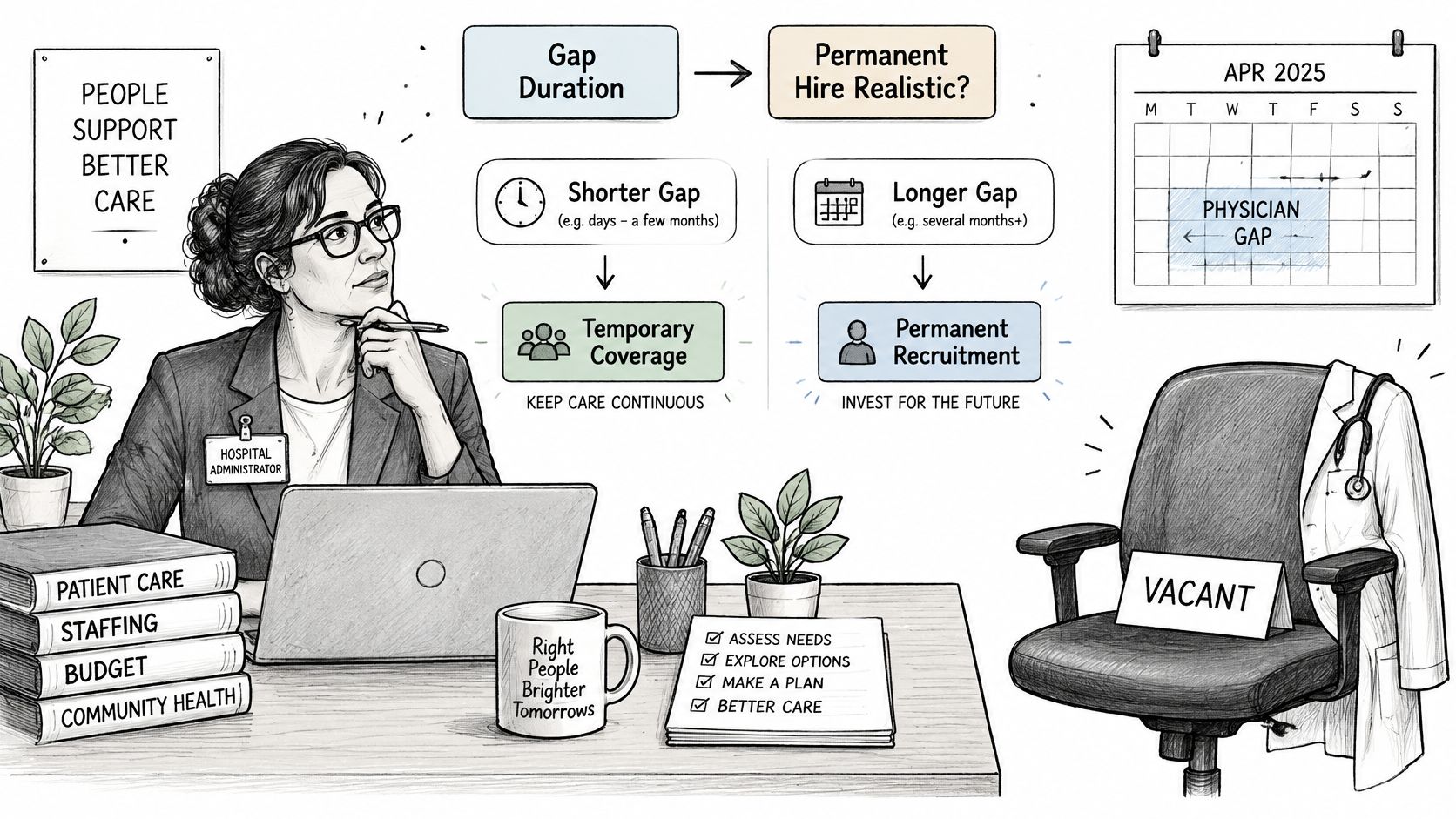
Start with two facts about the gap, its expected duration and whether a permanent hire is realistic within it. If the seat will sit empty for under six months while a search runs, locum tenens is the usual bridge. If the gap is structural, recurring call shortfalls, a subspecialty with few candidates, or clinic demand that permanently exceeds physician supply, permanent placement combined with APP integration fits better. Duration decides the first move, structure decides the lasting one.
Tradeoffs by Model
Permanent placement: Strongest long-term fit, referral continuity and program ownership, but the longest time-to-fill and the highest cost when a hire fails in year one.
Locum tenens: Fastest route to restored coverage, at a higher daily cost, with continuity risk when a different locum arrives each cycle and no one owns longitudinal patients.
APP integration: Stabilizes clinic volume, follow-up and inpatient rounding at sustainable cost, but cannot substitute for interventional, electrophysiology or surgical procedural cases.
MSP/VMS: Adds spend visibility and rate discipline across vendors, but adds a management layer that can slow decisions for a single hard-to-fill subspecialty search.
The bridge pattern is now mainstream practice rather than emergency improvisation. In the 2024 AMN Healthcare locum tenens survey, 67% of healthcare organizations reported using locums until a permanent candidate is found, and 61% used them after a physician had left the organization. Locum tenens appeared in 16.4% of physician searches in 2024, the highest rate recorded in that dataset, and about 8% of U.S. physicians, approximately 57,000 doctors, were actively working locum tenens as of May 2024.
That depth of supply matters for cardiac programs evaluating locum tenens coverage, because a thicker locum market means better subspecialty matching and shorter lead times. It doesn't remove the need for judgment. A rotating series of one-week locums may cover call while eroding referring physicians' confidence.
Two questions settle most model choices. Is the gap temporary, and does the work require a physician? Temporary plus physician-required points to locums, permanent plus delegable points to APPs, and permanent plus physician-required points to a permanent search with a locum bridge.
Selection Criteria for a Cardiology Staffing Partner
Partner selection should follow the failure points that cost cardiac programs most. The costliest is a thin subspecialty pipeline. Cardiology operates as several labor markets. General cardiology and procedural subspecialties draw from different training pipelines, and procedural roles narrow further at each step. Sourcing reach therefore has to be verified subspecialty by subspecialty. A firm that fills general cardiology roles reliably may have little reach into electrophysiology or advanced heart failure. For a program, that difference shows up as unfilled call shifts and canceled procedural lists, not as a recruiting inconvenience.
The Scorecard to Run on Any Shortlisted Firm
Criterion | What to verify | Red flag |
|---|---|---|
Subspecialty depth | Recruiters who work in cardiac roles and can name electrophysiology, heart failure and interventional candidates | Generalist search firm with no recent cardiology placements |
Credentialing and compliance | Who handles licensure, privileges and payer enrollment, and how long each step takes | Onboarding timeline that stops at offer acceptance |
Candidate vetting | Documented vetting steps and references completed before submission | Candidate lists sent without clinical verification |
Engagement model | Retained or contingency terms, a named dedicated recruiter and reporting cadence | No named contact or no time-to-fill reporting |
Time-to-fill and retention | Recent cardiology time-to-fill and first-year retention figures | Refusal to share outcome data |
Cultural alignment | Pre-placement discussion of leadership style, workload and mentorship | Matching only on CV and salary |
Credentialing deserves scrutiny equal to sourcing because it sets the actual start date. A signed cardiologist waiting months for privileges, state licensure or payer enrollment restores no coverage during that wait. Executives should ask who owns each step, what documentation the facility must supply, and where delays typically occur for procedural privileges such as cath lab or device implantation rights.
Retention belongs on the same scorecard because a placement that ends within a year returns the program to the same vacancy. The second search repeats the disruption to referral patterns, call schedules and the remaining team's workload. Cultural alignment is a coverage variable for that reason. A candidate who fits the clinical role but not the call rotation or mentorship structure can reopen the gap after the program has already counted the seat as filled.
American Cardiology Group's process shows the level of detail to request. Its dedicated recruiters provide personalized support to both the facility and the locum provider throughout the process. Its team manages credentialing and compliance for locum providers so facilities can onboard quickly, and each locum professional in its network is carefully vetted before placement. Any shortlisted firm, specialist or generalist, should state its equivalent processes with the same specificity. Vague assurances about a large database do not answer the scorecard. Firms that can document time-to-fill, first-year retention and credentialing handoffs are easier to hold to a coverage timeline after signature.
How to Implement a Cardiac Staffing Plan
A staffing plan fails when it counts seats instead of capacity. The seven steps below convert a vacancy into a managed workload problem, with triggers that force action before the remaining team absorbs unsustainable strain.
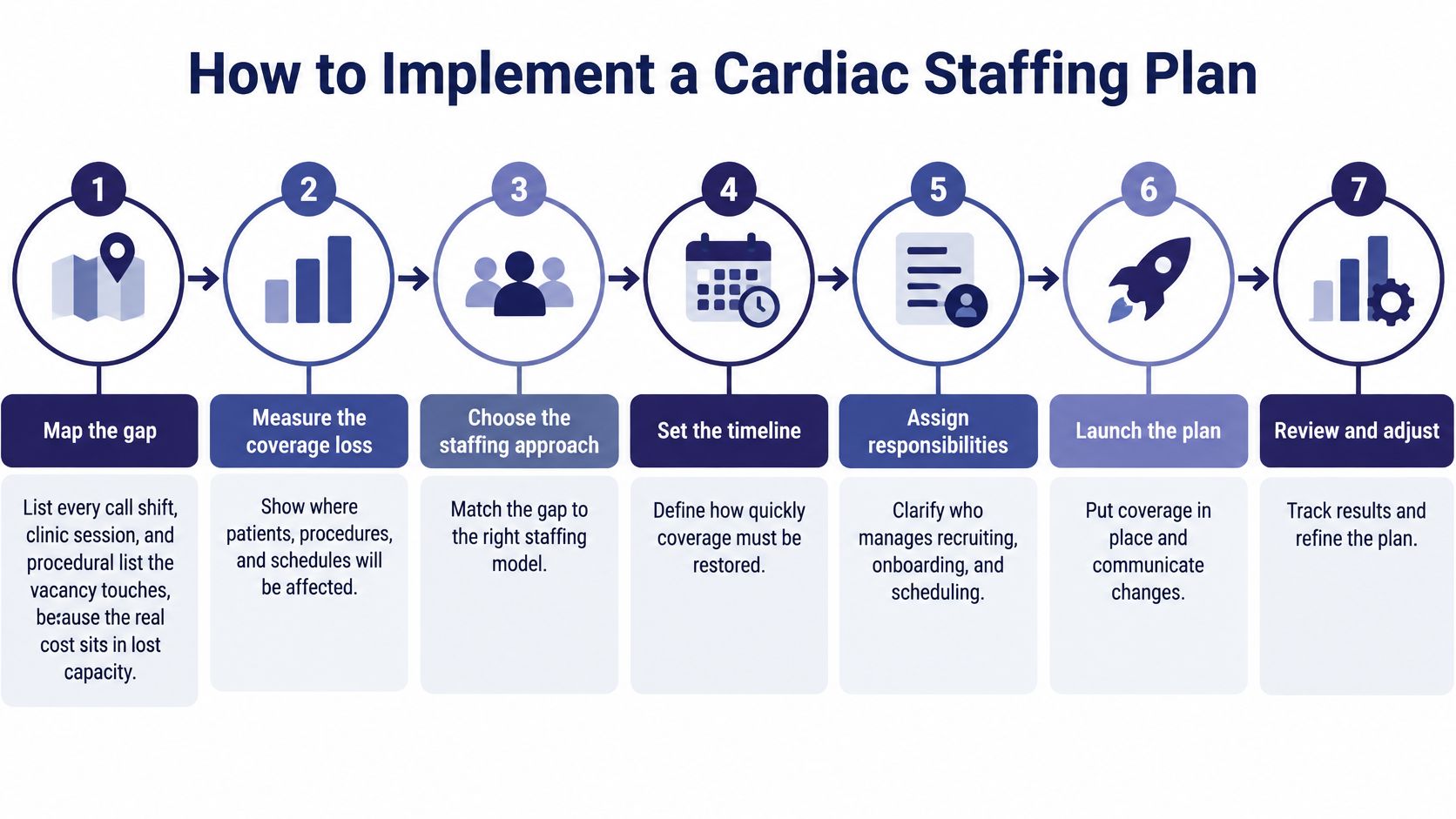
Seven Steps From Vacancy to Stable Coverage
Map the gap: List every call shift, clinic session, consult block and procedural list the vacancy touches. The main cost lies in that lost capacity, not in the empty seat itself.
Model the full team: Set physician-to-NP/PA ratios, clinic template capacity, inpatient and consult coverage, call frequency, scribes and nursing support. The AMA Organizational Biopsy analysis found nearly half of surveyed physicians reported working with an incompletely staffed team more than one-quarter of the time, and those physicians were more than twice as likely to report burnout.
Set trigger thresholds: Adopt the indicators defined in the KPI table that follows, incomplete-team frequency, unfilled call shifts, after-hours consult volume, clinic cancellations and reported intent to reduce hours. In that same 970-physician sample, 47.9% met burnout criteria, 26.4% reported intent to reduce clinical hours, and 15.4% indicated an intention to leave their organization.
Choose the first layer: Apply the two-question test, temporary or structural, physician-required or delegable, to select a locum bridge, APP deployment or an immediate permanent search.
Start credentialing early: Begin licensure, privileging and payer enrollment at candidate identification, not at signature. Lead time often decides the start date more than the search itself, particularly for procedural privileges.
Run the permanent search in parallel: Keep long-term recruitment moving while interim coverage holds the schedule, and set a written handover date for any locum so continuity transfers deliberately rather than expiring.
Review at 90 days against the triggers: Route each breached threshold to a graduated response, temporary coverage, APP deployment, workflow redesign or permanent recruitment, and document which response fired and why.
Step two carries more weight than its position suggests. A replacement cardiologist hired into the same incomplete team, with the same consult load and no scribe or APP support, inherits the conditions that produced the vacancy. Short-term placement reduces immediate schedule loss, but retention requires correcting the workload that created the departure or reduced-hours risk in the first place.
Staffing adequacy should therefore be tracked as a patient-access and retention variable, reviewed alongside clinic wait times and transfer refusals, not filed as an HR metric. When incomplete-team frequency rises two months running, that's an access warning with a measurable burnout consequence, and it warrants intervention before the next resignation letter arrives.
KPIs and ROI for Cardiac Staffing Programs
ROI in staffing is a comparison, the cost of the vacancy against the cost of the solution. Vacancy cost includes lost procedural revenue from dark cath lab or EP lab time, referrals that migrate to competing systems, locum premiums and overtime paid to remaining physicians. Solution cost includes placement fees, locum rates, APP salaries and credentialing time. A worked formula keeps the comparison honest. Net monthly gain equals lost procedural revenue avoided, plus referral revenue retained, plus locum premium and overtime avoided, minus the placement fee amortized over 12 months, minus the locum daily rate multiplied by locum days, minus APP salary and credentialing cost. Each term should come from the program's own figures, and any term the program can't source should be marked unknown rather than estimated.
KPI | Definition | Trigger to act | Review cadence |
|---|---|---|---|
Time-to-fill | Days from approved requisition to signed offer | Above the target set in the search agreement | Monthly |
Incomplete-team frequency | Share of shifts worked with an incompletely staffed team | Sustained rise over two consecutive months | Monthly |
Unfilled call shifts | Call slots left uncovered after scheduling | Any uncovered shift | Weekly |
After-hours consult volume | Consult requests per physician outside clinic hours | Sustained growth against baseline | Monthly |
Clinic session cancellations | Sessions cancelled because no provider was available | Any cancellation caused by staffing | Weekly |
Intent to reduce hours | Physician-reported plan to cut clinical hours | Any stated intent | Quarterly survey |
12-month retention | Share of placed physicians still employed at 12 months | Below the program's baseline | Quarterly |
These measures belong beside the operational indicators in a program's cardiology quality metrics review, because staffing failures surface as access and quality failures.
Culture Belongs on the Same Scorecard
Compensation and time-to-fill dominate most staffing dashboards, yet culture drives the retention those dashboards later record. A 2022 American College of Cardiology survey analyzed in the ACC study of workplace mistreatment among cardiologists, covering 1,583 U.S. cardiologists, reports that 77% of surveyed cardiologists experienced incivility, harassment or discrimination, while 29% reported burnout. A higher offer won't solve turnover inside a harmful environment. Programs should run a pre-search culture audit, covering psychological safety, leadership behavior, call burden, mentorship and promotion equity, then track the placed physician on a 12-month retention scorecard after start. Retention at 12 months is the figure that proves the placement worked.
Tailored Recommendations by Cardiac Program Type
Geography changes the staffing math more than any other variable. According to the Rural Health Research Gateway analysis of cardiologist supply, rural areas had only 2.6 cardiologists per 100,000 residents in 2022, compared with 7.3 per 100,000 in urban areas, and rural cardiologist supply per capita fell 5.8% from 2012 to 2022. A model that works for an academic center, permanent subspecialists in every discipline, can't be staffed in most rural markets. Each setting needs its own mix.
Program type | Lead model | Support layer | Watch point |
|---|---|---|---|
Academic medical center | Permanent placement in electrophysiology and interventional roles | APPs for clinic and inpatient follow-up | Subspecialty sourcing depth and academic promotion pathways |
Community hospital | Permanent general cardiology plus locum bridge for call | APP integration for clinic volume | Call burden and onboarding time |
Rural hospital | Rotating subspecialists with a permanent anchor only where volume justifies it | Telehealth and APP follow-up | Transfer agreements, procedure access and travel time |
Private practice or multispecialty group | Permanent placement tied to a partnership track | MSP/VMS governance for locum spend | Equity terms and retention |
Ambulatory surgery center | Contracted surgeon schedules | Locum surgeons for peak volume | Credentialing completed before the first case |
Designing the Rural Portfolio
Rural leaders already combine visiting specialists, referrals to larger centers, community-based specialists, telehealth and primary-care management supported by specialists. The design task is assembling those pieces around acuity, referral volume, travel time, cath-lab capability, emergency transfer agreements and clear follow-up responsibility, rather than buying each piece separately. Telehealth alone can't serve patients who need procedures or diagnostics, and a full-time cardiologist isn't financially realistic everywhere. A rotating subspecialist schedule anchored by APP follow-up and explicit transfer pathways usually delivers safer access than either extreme.
Willingness matters as much as availability in these markets. As one Montana Chief Medical Officer put it, "They found specialists willing to make a difference in a rural setting." That distinction should shape sourcing criteria, since a reluctant placement in a small community rarely survives the first winter. The strategic question then becomes conversion, how rotating and temporary coverage matures into durable regional access and, eventually, a permanent recruitment pipeline. Programs that track which visiting specialists build local referral trust can recruit from demonstrated fit instead of cold outreach.
Decide Before the Next Vacancy
One decision separates stable programs from reactive ones, act while the seat is still filled, or wait until the gap is already a service-line risk. Acting early costs a planning conversation. Waiting costs uncovered call, cancelled clinics and a search conducted under duress, when every candidate knows the program is desperate.
Three artifacts should be on the table at the first conversation with any staffing partner. First, the gap map, every call shift, clinic session and procedural list a vacancy would touch, quantified before it happens. Second, the lead-model choice, a written answer to whether the anticipated gap is temporary and whether the work requires a physician. Third, a shortlist scored on the partner criteria, with subspecialty depth and credentialing lead time documented for each firm. A partner presented with those three artifacts can quote realistic timelines instead of generic assurances.
American Cardiology Group offers Permanent Physician Recruitment, Locum Tenens Solutions, Advanced Practice Recruitment and Executive Recruitment, covering cardiac specialties from general cardiology through interventional and surgical roles. Facilities can begin through its Request Staffing form, which requires first name, last name, email and state, with phone, title and organization optional. Whichever partner a program selects, the final step belongs on the calendar now, not after placement. Set the date for the first 90-day review against the trigger thresholds, and treat that review as the moment the plan proves itself.
American Cardiology Group provides permanent, locum tenens, advanced practice and executive recruitment dedicated exclusively to cardiology and cardiac surgery, helping hospitals protect procedural capacity and call coverage before a vacancy becomes a service-line risk. Programs ready to build that coverage plan can start the conversation at American Cardiology Group.
Comments