
Medical Oncologists Salary: 2026 Benchmarks by Setting
Median compensation for hematology and medical oncology physicians reached $533,402 in 2024, up 7.1% from $498,062, according to AMGA compensation findings reported by Becker's Oncology. That's a total-compensation benchmark, not a guaranteed salary offer. For hospital executives and oncology candidates, the distinction changes both recruiting budgets and the economic value of an employment contract.
Table of Contents
Medical Oncologist Salary at a Glance - Which benchmark answers which question
How Practice Setting Changes Oncologist Pay - The trade-off behind the setting
Regional and Experience-Level Pay Differences - Geography requires a matched role
Market Trends and Real Pay Growth - Pay growth isn't solely a productivity story - A disciplined market review
Productivity Benchmarks That Set Variable Pay - Translate production into compensation - Production needs an economic and clinical context
Workload, Burnout and Employer Cost Trade-offs - Put the denominator into the comparison
Verify Every Component Before You Sign - Establish the dependable floor - Test the contingent earnings - Value benefits without confusing them with cash
Medical Oncologist Salary at a Glance
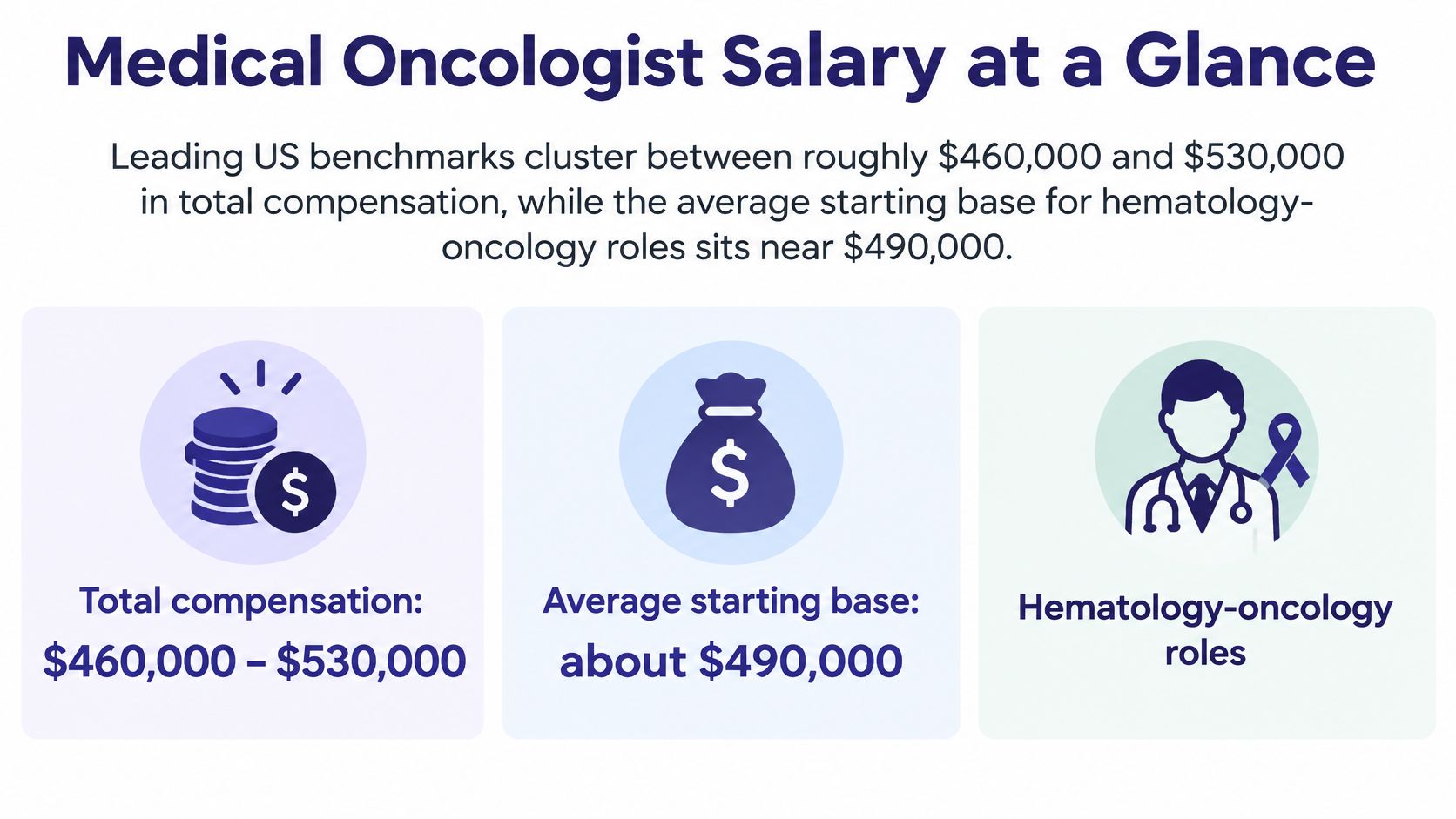
Leading U.S. benchmarks cluster around $460,000 to $530,000 in total compensation, while starting base pay for hematology-oncology positions sits near the middle of that range. These figures aren't interchangeable: they describe different physician populations, reporting periods, and components of pay.
The Medscape 2026 Oncologist Compensation Report, based on responses from 5,916 physicians, reported average total oncologist compensation of $464,000 in 2025, down approximately 2% from $472,000 in 2024. Oncologists ranked ninth among 29 specialties. The publication year therefore shouldn't be mistaken for the earnings year.
National oncologist pay benchmarks by source and measure
Source | Measure | Period | Figure |
|---|---|---|---|
Medscape Oncologist Compensation Report | Average total compensation | 2025 | $464,000 |
Medscape Oncologist Compensation Report | Average total compensation | 2024 | $472,000 |
Average compensation, nominal | 2024 | $502,465 | |
Doximity | Compensation adjusted for inflation, in 2017 dollars | 2024 | $392,057 |
AMGA | Median total compensation, hematology and medical oncology | 2024 | $533,402 |
AMN Healthcare | Average starting base salary, hematology-oncology, excluding bonuses, allowances, and benefits | 2024–2025 | $490,000 |
BLS Physicians, All Other, discussed in the Doximity analysis | Median wage, not a valid standalone oncologist benchmark | May 2025 | $265,930 |
Doximity's inflation adjustment illustrates why nominal compensation and purchasing power require separate evaluation. Its analysis places inflation-adjusted oncology compensation approximately 3%, or $12,114, below the 2017 level. A larger dollar amount on a contract doesn't necessarily represent an improvement in economic value.
Which benchmark answers which question
Starting base salary answers what an employer initially guarantees before incentives and benefits. Total compensation answers what physicians receive across the pay components captured by a survey. A mean and a median also describe different positions within a compensation distribution.
The BLS occupational category pools unrelated physician specialties, so its median shouldn't anchor a medical oncology offer. Likewise, an established medical-group compensation median shouldn't automatically become a fellowship graduate's guaranteed base.
Reading rule: Match the source to the measure needed, base or total compensation, before comparing any pair of figures.
A useful medical oncologists salary comparison begins with classification, not ranking. Otherwise, an employer can mistake a competitive guarantee for an under-market package, or a candidate can mistake contingent earnings for dependable income.
How Practice Setting Changes Oncologist Pay
Practice setting affects both compensation opportunity and who carries the financial risk. Doximity's setting averages provide context, but they cover all physicians, not oncologists specifically.
The following all-physician figures come from Becker's Oncology's discussion of Doximity compensation data. The hematology-oncology starting salaries come from AMN Healthcare's recruiting-incentive findings reported by Becker's Oncology, which exclude bonuses, allowances, and benefits.
Average compensation by practice setting
Setting | Average | Source | Measure |
|---|---|---|---|
Single-specialty group | $476,807 | Doximity 2025 | Total compensation, all physicians |
Multispecialty group | $461,671 | Doximity 2025 | Total compensation, all physicians |
Hospital | $439,319 | Doximity 2025 | Total compensation, all physicians |
Health system | $438,983 | Doximity 2025 | Total compensation, all physicians |
Academic setting | $382,223 | Doximity 2025 | Total compensation, all physicians |
Non-academic hematology-oncology | $511,000 | AMN Healthcare 2024–2025 | Starting base salary, excluding bonuses |
Academic hematology-oncology | $453,000 | AMN Healthcare 2024–2025 | Starting base salary, excluding bonuses |
AMN's specialty-specific comparison shows a $58,000 gap, with non-academic starting base salaries approximately 12.8% higher. Its historical series also shows academic starting averages increasing from $267,000 in 2021–2022 to $453,000 in 2024–2025, approximately 69.7%, while non-academic averages increased from $426,000 to $511,000, approximately 20.0%.
The trade-off behind the setting
Private-practice upside can depend on productivity thresholds, collections, ownership expectations, and call obligations. A candidate should distinguish compensation earned for personal clinical work from distributions associated with ownership. Partnership eligibility isn't equivalent to a guaranteed distribution.
Hospital and health-system roles may offer greater income predictability and employer-supported benefits. Academic positions may add research infrastructure, protected nonclinical time, and access to leadership responsibilities. Those features have value only when the institution makes them operationally available.
A lower academic base therefore deserves a closer examination rather than automatic rejection. The candidate should establish who covers clinic during protected time, whether research support includes personnel, and whether leadership duties displace clinical obligations or add to them.
For executives, the academic salary trajectory suggests that mission alone isn't a complete recruiting strategy. Protected time must be funded, scheduled, and reflected in productivity expectations. Otherwise, the institution is asking the physician to absorb a cash discount without receiving the promised alternative.
The Doximity rows remain context proxies, not oncologist-specific setting benchmarks. They shouldn't be used to calculate a specialty-specific hospital or academic discount.
Regional and Experience-Level Pay Differences
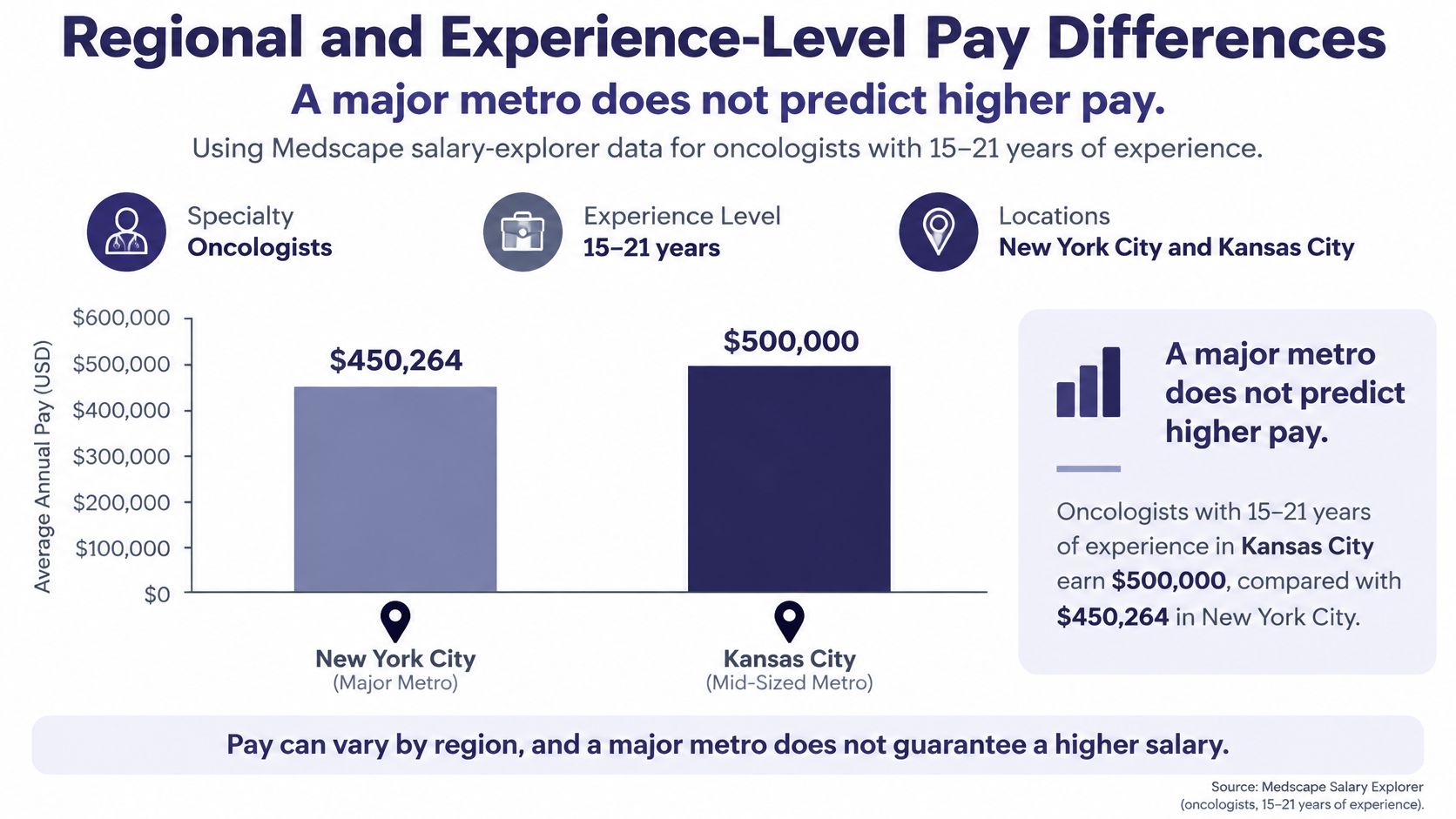
A major metropolitan address doesn't reliably predict higher oncology compensation. In a MDLinx comparison using Medscape salary-explorer data, oncologists with 15–21 years of experience averaged $450,264 in New York City, $489,321 in Kansas City, Kansas, and $553,025 in Rochester, Minnesota.
Average oncologist compensation for 15–21 years of experience by location
Location | Experience band | Average compensation | Source |
|---|---|---|---|
New York City | 15–21 years | $450,264 | Medscape salary explorer, via MDLinx |
Kansas City, Kansas | 15–21 years | $489,321 | Medscape salary explorer, via MDLinx |
Rochester, Minnesota | 15–21 years | $553,025 | Medscape salary explorer, via MDLinx |
The table gives the precise published city values and should govern numerical comparisons with the illustration. These observations don't establish a universal ranking of local oncology markets.
Geography requires a matched role
Physician supply, institutional demand, payer mix, call burden, and local cost structures can produce different outcomes. A hospital recruiting for an isolated service line is purchasing a different coverage commitment from a large group adding a physician to an established rotation.
Hospital-employed positions generally provide steadier salary arrangements. Private-practice and large-group positions may offer additional participation in practice revenue, but candidates need the distribution formula and eligibility conditions before assigning that upside a value.
For rural and community roles, the comparison should include colleagues available for cross-coverage, travel between sites, infusion support, and access to inpatient consultation resources. A location premium may compensate for a broader job rather than represent higher pay for equivalent work.
A geographic premium should be evaluated against the responsibilities attached to the location, not against the city's reputation or population alone.
The available city comparison covers only the stated mid-career experience band. Early-career and late-career figures aren't available in this comparison, and interpolating them would create false precision. Candidates should compare offers within the same experience band and location type whenever matched observations exist.
The sources also don't establish oncology subspecialty pay differentials. Disease-focused programs should request their group's own subspecialty targets rather than apply an unsupported premium.
Compensation committees overseeing multiple service lines can use the same geographic discipline when reviewing cardiologist salary comparisons in Texas, while keeping cardiology and oncology benchmarks separate.
Market Trends and Real Pay Growth
A decline in a national survey and an increase in medical-group compensation aren't necessarily contradictory. Survey participants, specialty classifications, compensation definitions, and summary measures differ, so the findings can describe different labor-market segments.
The distinction matters for salary-band decisions. A hospital shouldn't freeze an employed oncology range merely because a broader survey shows weaker average earnings. Nor should a candidate assume every employer's compensation increased because a medical-group median rose.
Pay growth isn't solely a productivity story
A SullivanCotter oncology compensation study found that hematology-oncology wRVUs grew at a 1% compound annual rate from 2015 through 2019, while compensation per wRVU increased at a 2% compound annual rate. The divergence indicates that measured output alone didn't explain compensation changes.
Recruitment difficulty, leadership responsibilities, advanced practice provider supervision, and call coverage are plausible additional influences, not individually proven explanations for every increase. Executives should identify which responsibilities changed before deciding whether a larger compensation budget reflects higher production, a more demanding role, or competitive recruiting pressure.
Inflation adds another test. A nominal increase that trails the relevant price index reduces purchasing power, even when the contract's face value rises. The inflation-adjusted oncology comparison demonstrates why compensation committees need both current-dollar and constant-dollar views.
A disciplined market review
Confirm the earnings year. The report's publication date isn't necessarily the period when physicians earned the compensation.
Read the escalator. Establish whether annual adjustments follow an inflation index, a fixed contractual amount, or an employer's discretionary review.
Match the population. Compare the offer with a same-year benchmark for the relevant setting, specialty grouping, and compensation measure.
Separate role expansion. Additional call, supervision, or leadership should be identified rather than absorbed into an apparent annual raise.
The practical conclusion isn't that oncology pay is universally rising or falling. Employers and candidates need to determine whether the same work, in the same setting, commands greater real compensation. Without that control, a trend line can confuse changes in job design with changes in market price.
Productivity Benchmarks That Set Variable Pay
A work relative value unit, or wRVU, measures the physician-work component of professional services. Contracts can use it to calculate incentive compensation, but a production volume becomes meaningful only alongside the conversion rate, attribution rules, and payment threshold.
A published oncology hospital-alignment analysis describes approximately 5,000–6,000 annual wRVUs for a busy full-time hematologist-oncologist providing office and inpatient services. It also presents a practice-level model paying $105 per wRVU, including nurse practitioner-generated wRVUs, with approximately 30,000 annual wRVUs producing $3.15 million in professional-service compensation.
The ASCO 2019 Survey of Oncology Practice Operations offers a separate reference: among 38 respondents reporting productivity, the average was 7,320 annual wRVUs, with interquartile boundaries of 5,738 and 8,582.
Annual wRVU productivity benchmarks for oncology
Benchmark | Annual wRVUs | Source |
|---|---|---|
Busy full-time hematologist/oncologist, office and inpatient | 5,000–6,000 | Oncology alignment analysis |
ASCO survey, lower interquartile boundary | 5,738 | ASCO 2019 Survey of Oncology Practice Operations |
ASCO survey, average | 7,320 | ASCO 2019 Survey of Oncology Practice Operations |
ASCO survey, upper interquartile boundary | 8,582 | ASCO 2019 Survey of Oncology Practice Operations |
Example model at $105 per wRVU, practice total | 30,000, about $3.15 million | Oncology alignment analysis |
Translate production into compensation
The basic arithmetic is credited wRVUs multiplied by the contractual conversion rate. In a threshold-based bonus arrangement, the calculation instead applies the rate to eligible production above the threshold. Candidates shouldn't assume all production receives incremental payment.
APP attribution changes the calculation materially. A contract should specify whose services generate credited units, whether shared attribution is permitted, and whether those units count toward both the threshold and bonus. The practice-level example isn't an individual oncologist salary benchmark.
A compensation worksheet should show the guarantee, target production, threshold, conversion rate, and resulting payment separately. The operational distinctions among these arrangements also matter when evaluating physician compensation models.
Production needs an economic and clinical context
These historical references aren't current universal production requirements. The sources don't split productivity by oncology subspecialty, so candidates should obtain the group's disease-specific expectations and clarify how clinical trials, complex consultations, and nonclinical assignments affect them.
ASCO also reported average practice revenue of $7,323,900 against expenses of $7,261,026 per full-time-equivalent physician, while cautioning that service differences complicate comparisons. That narrow reported spread illustrates why executives shouldn't equate practice revenue with funds available for physician compensation.
A defensible incentive model must connect achievable professional work with sustainable practice economics. Infusion revenue, professional-service compensation, and personal salary belong in separate analytical categories.
Workload, Burnout and Employer Cost Trade-offs
The highest compensation figure isn't automatically the strongest offer. A physician receiving more cash while covering additional sites, inpatient consultations, and weekend calls may receive less compensation for each hour committed.
A 2025 longitudinal oncology study reported compensation dissatisfaction among 80.6% of surveyed oncologists, inadequate monthly salary for expenses among 62.5%, insufficient annual leave among 74%, and limited medical resources among 72%. High emotional exhaustion increased from 33.3% in 2018 to 56.5% in 2023. These are findings from that study population, not national U.S. compensation or burnout estimates.
The paper also discusses earlier U.S. evidence that approximately 44.7% of oncologists had at least one burnout symptom and that direct patient-care hours were the dominant professional predictor of burnout. Those findings support examining workload, but they don't establish a universal salary premium for difficult assignments.
Put the denominator into the comparison
Candidates can calculate annual guaranteed cash divided by scheduled clinical sessions or annual guaranteed cash divided by workdays. The same denominator must be used across offers, and the worksheet should identify paid leave and protected nonclinical time separately.
A session-based comparison still needs a coverage ledger:
Infusion oversight. Identify responsibility outside scheduled clinic and the availability of urgent support.
Inpatient coverage and call. Record scheduled obligations, backup arrangements, and expected availability.
Travel. Include intersite travel and whether it displaces patient-facing work.
Program responsibilities. Identify tumor boards, trial activity, administrative duties, and vacancy coverage.
Employer test: Price the complete coverage obligation before deciding that a higher guarantee is excessive or that a lower guarantee is economical.
An unfilled position also requires a staffing plan. Executives should identify who absorbs consultations, call, and continuity responsibilities, then compare that arrangement with the proposed permanent role rather than treating vacancy coverage as costless.
Academic programs that can't match non-academic cash offers should protect research time and support it with staffing and realistic production expectations. Compensation design then becomes part of physician retention strategies, not merely an annual recruiting exercise.
Verify Every Component Before You Sign
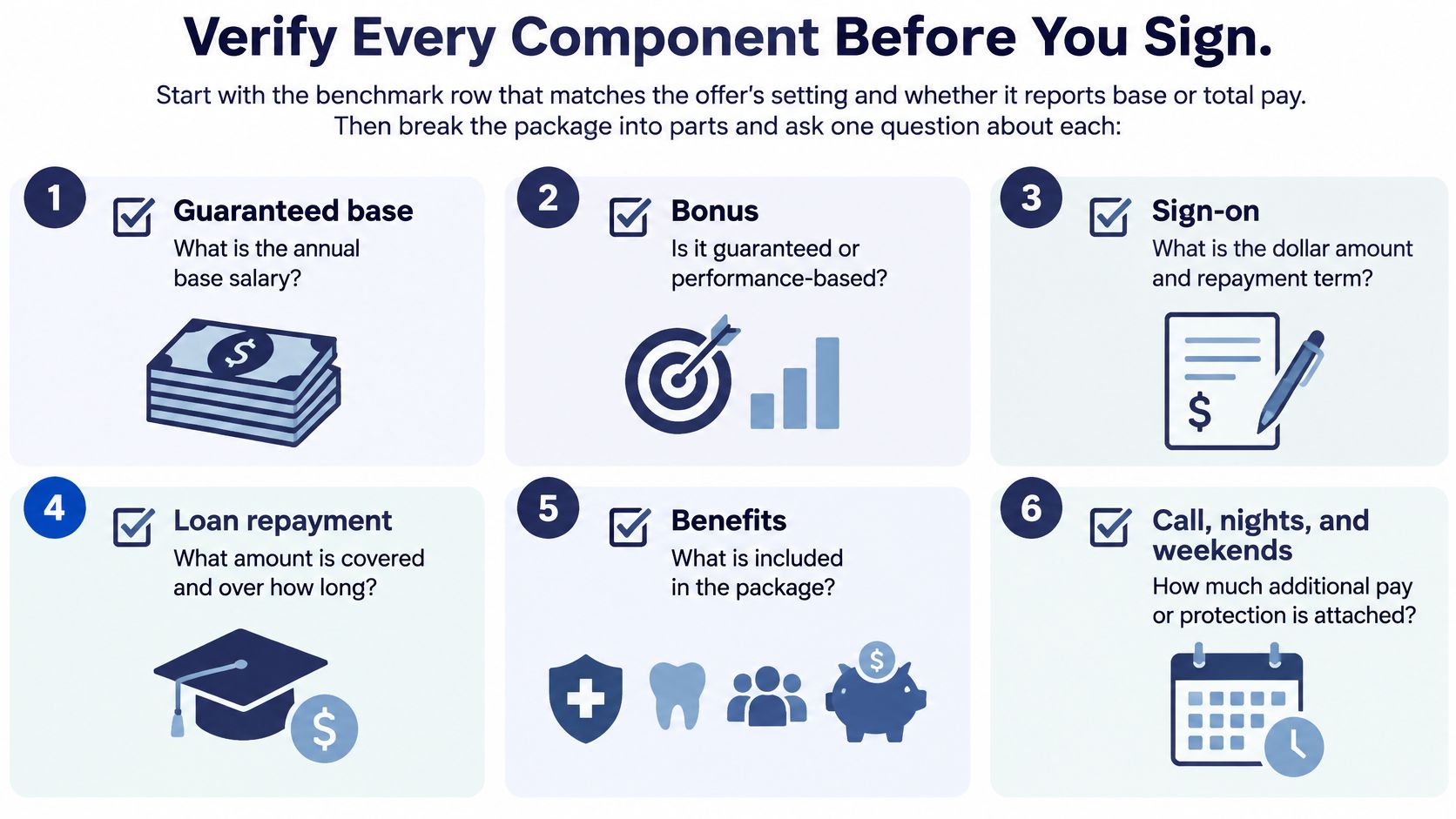
A signed offer locks in two different numbers. The guaranteed base sets the floor the physician keeps in a low production year. Expected total compensation shows what the package could pay if thresholds, quality scores, and coverage payments all materialize. Executives and candidates should compare guarantees only to guarantees, and totals only to totals, then require written terms for each line that bridges the gap.
Establish the dependable floor
Guaranteed base. What annual cash amount is protected, and for how long? The contract should identify what happens when the guarantee expires, whether a production shortfall creates repayment exposure, and whether the employer can change the schedule or work location.
Distinguish a genuine salary floor from an advance against future collections or productivity. Both arrive as regular payroll deposits. Only one leaves the physician with no debt if volume falls short.
Sign-on, relocation, and loan repayment. What amount is payable, when does it vest, and what triggers repayment? Record these payments apart from recurring compensation and review departure provisions before assigning them full value. A large first year payment can mask a weak recurring package, so compare ordinary employment years separately from the transition year.
Test the contingent earnings
Component | Question that must have a written answer |
|---|---|
Productivity bonus | What threshold, conversion rate, attribution method, and reconciliation schedule apply? |
Target attainment | What share of comparable physicians reached the stated target during the last completed performance period? |
Quality payments | Which metrics determine payment, who controls measurement, and what proportion of expected compensation is contingent? |
Call compensation | Which obligations are included in base, and which trigger additional payment? |
APP supervision | Is oversight separately compensated or embedded in base and productivity expectations? |
Leadership duties | Which responsibilities receive protected time, a stipend, or adjusted clinical targets? |
APP supervision is sometimes compensated separately from base salary. Practice varies by employer and role design, so the contract needs an explicit answer for this position rather than an assumption carried over from another offer.
Test bonus attainment against the actual assignment. A group wide achievement rate has limited value when the proposed role carries different clinical sessions, patient access, trial responsibilities, or support staffing. Ask the employer to explain in writing how the target reflects those differences.
Value benefits without confusing them with cash
Retirement contributions, health benefits, and malpractice coverage belong in the package assessment, but they do not convert directly to take home pay. Obtain plan documents, eligibility dates, contribution conditions, and vesting provisions instead of relying on a benefits summary. Malpractice review should establish the policy structure and responsibility for any required tail coverage on departure, plus whether coverage extends to the full scope of clinical and administrative duties.
Protected time needs the same precision. Tumor board leadership, clinical trials, teaching, and program building should have named allocations, a scheduling owner, and matching treatment in production expectations. An informal promise of flexibility does not reduce a clinical assignment.
Keep the calculation in five separate buckets: guaranteed recurring cash, contingent cash, one-time payments, employer-funded benefits, and required work. Calculate session based or workday based pay from the actual schedule, add a separate assessment of call and coverage hours, and leave uncertain incentive income distinct from dependable earnings.
Negotiation should start with the levers that change economics most clearly. Base floor, conversion rate, call stipend, protected time, and leave often matter more than a higher headline target tied to volume the physician cannot control. Employers should apply the same sequence in reverse. Define required coverage, price each responsibility, set the guaranteed budget, then confirm variable pay supports clinical and organizational goals that the assigned resources can achieve.
American Cardiology Group's dedicated recruiters provide personalized support to both the facility and the locum provider throughout the process. Its recruiting focus is cardiology and cardiac specialties, so oncology benchmark analysis shouldn't be interpreted as an oncology placement offering.
A base only comparison understates packages with attainable incentives and strong support. A total only comparison overstates packages whose upside depends on uncertain production or unprotected time. Accept the offer only if the guaranteed figure alone, without any bonus, still justifies the workload.
American Cardiology Group offers Permanent Physician Recruitment, Locum Tenens Solutions, Advanced Practice Recruitment, and Executive Recruitment for cardiology and cardiac specialties. Hospitals and cardiovascular candidates applying this same compensation discipline can visit American Cardiology Group to discuss recruitment or coverage needs alongside the role's pay structure, workload, and clinical responsibilities.
Comments