
Cardiothoracic Surgery Physician Assistant Roles
3,557 certified physician assistants named cardiothoracic and vascular surgery as their principal specialty in 2020, equal to 3.3 percent of every certified PA in the United States, according to the NCCPA 2020 specialty report.
That figure reframes a conversation hospital executives keep having about surgeon shortages. A cardiothoracic surgery physician assistant is not substitute headcount for a surgeon, and hiring one doesn't automatically create operating-room capacity.
The role is a matrix of credentialed procedures, each with its own training requirement, proctoring standard, supervision rule, and review date. Capacity appears where case logs, supervision structure, and service-line metrics line up. Where they don't, a hospital buys a salary and gets a clinician whose scope nobody has defined.
Table of Contents
A Full Perioperative Day in Practice - Before the incision - In the room - After the case
Privileges That Define the Role - A privilege list is a set of keys, not a master key - Where ambiguity concentrates - Build the matrix by procedure and by setting
Outcome Evidence for First Assist Work - What the evidence does and does not prove - Title against log
Qualifications Programs Should Verify - The baseline file is table stakes - What separates two candidates holding the same license - The judgment test behind the paperwork
The Cardiothoracic Surgery PA Workforce
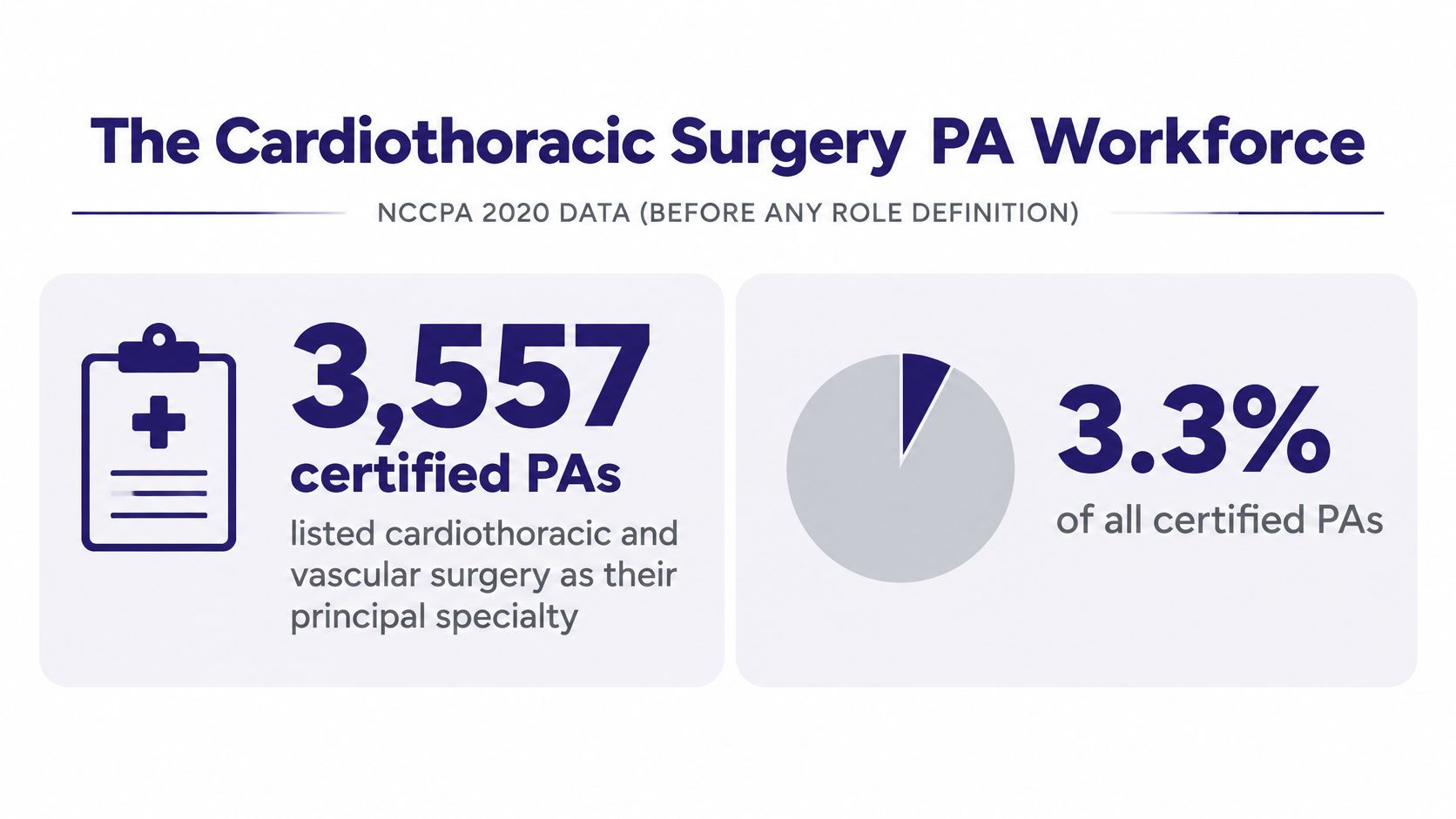
The workforce expanded from 3,158 certified PAs with cardiothoracic and vascular surgery as their principal specialty in 2016 to 3,557 in 2020, a 12.6 percent increase, a rise of 399 clinicians that reflects recruitment, retention, and the maturation of programs already inside cardiac surgical services rather than one hiring cycle. The infographic showing that 3,557 certified PAs specialize in cardiothoracic and vascular surgery, representing 3.3% of all PAs. places that growth in a broader specialty context. For executives, the useful conclusion is narrower than the headline: a cardiothoracic surgery physician assistant adds capacity only when privileges, supervision, case logs, and service-line measures are aligned.
The role has six decades behind it. The University of Alabama at Birmingham established a surgeon's assistant program in 1967, with cardiac surgeon John Kirklin promoting the training of nonphysician professionals to perform selected tasks traditionally handled by surgeons. By 1973, two PAs were employed on the cardiothoracic surgical service at Emory University Hospital, handling operating-room assistance alongside pre- and postoperative care (the role of the advanced practice provider in cardiac surgery). That history matters because it frames the PA as a purpose-built extension of cardiac surgical practice, not a temporary response to staffing pressure.
Density tells a second story. The specialty carried 408.6 certified PAs per 1,000 physicians in 2016 and 422.3 per 1,000 in 2020, a ratio that rose while cardiothoracic and vascular surgeon supply stayed under pressure. The increase in ratio is more revealing than the headcount alone because it shows the PA workforce growing relative to the physician group it supports. It still does not prove operative capacity. It shows that the specialty has a larger adjunct workforce available for defined tasks.
Measure | 2016 | 2020 |
|---|---|---|
Principal-specialty certified PAs | 3,158 | 3,557 |
Certified PAs per 1,000 physicians | 408.6 | 422.3 |
Participation crosses job boxes, which most workforce summaries miss. 400 PAs whose principal position sat in the specialty also held a secondary position in another specialty, 146 held a second position inside cardiothoracic and vascular surgery, and 213 PAs from other principal specialties reported a secondary position here. That last group matters most, because it describes PAs whose working credential lives in cardiothoracic surgery even when the payroll code says otherwise. A staffing plan built only on principal specialty undercounts the people already operating across the service line.
The executive reading is short. This is an operating-room, inpatient, perioperative, and continuity-of-care workforce with measurable depth, and it counts most where surgeon capacity binds. A service line that cannot add a surgeon this year can still add credentialed capacity around the surgeon it already has. American Cardiology Group's dedicated focus on recruiting for cardiology and cardiac specialties, including advanced practice planning for cardiac service lines, fits that staffing logic when the role is defined around procedures rather than vague shortage coverage.
A count tells you how many clinicians the specialty holds. A case log tells you what any one of them may be trusted to do after hours with a reopened chest.
Headcount is how a department staffs a rota. Privileges are how it staffs a case, and those are granted one procedure at a time with evidence attached.
A Full Perioperative Day in Practice
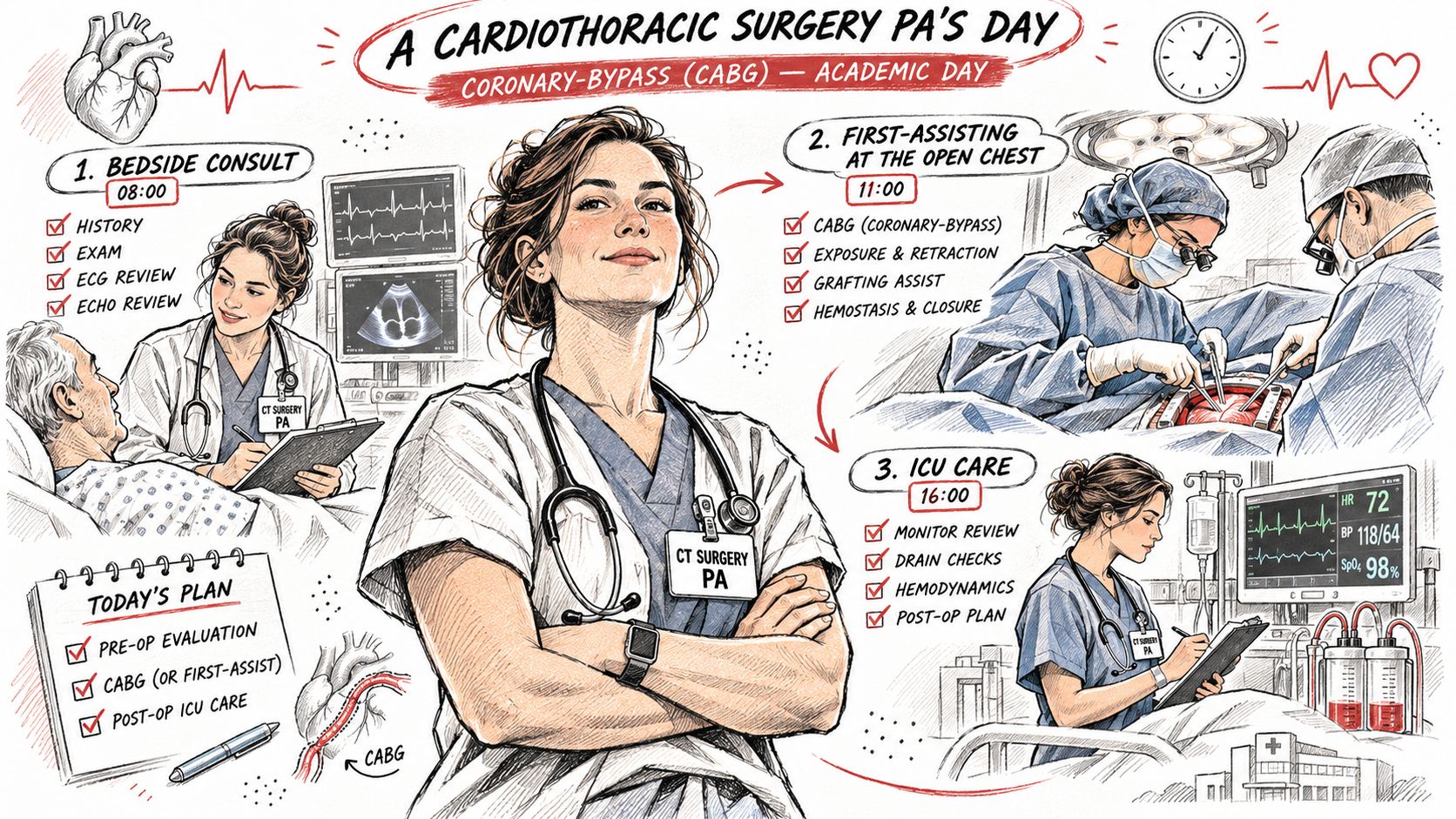
Start with a coronary bypass day at an academic medical center, where the PA holds the perioperative continuum instead of one slot in the room. The documented version of that job runs from inpatient and outpatient consultation through history and examination, diagnostic ordering, treatment planning with the attending surgeon, blood-product supervision, ICU and floor coverage, discharge planning, clinic follow-up, and coordination with other specialty teams (University of Utah posting for an academic cardiothoracic surgery PA role). Chest-tube placement and removal, arterial and central-line placement, endoscopic vein harvesting, radial-artery harvesting, and assistance in all aspects of cardiothoracic surgery sit in the same description.
The setting changes several times before the day ends.
Before the incision
The first task is usually a consultation rather than a case. A patient on the ward has new chest pain, a rising troponin, or a cold leg, and the PA is the first member of the surgical team to see the data. That means a history and examination, a read of the ECG, echocardiogram, and catheterization findings, then a plan agreed with the attending surgeon. The PA rarely decides the operation. The PA makes the decision ready for the person who does.
In the room
On the case itself the work is conduit and assistance rather than retractor holding. Endoscopic or open saphenous-vein harvest, radial-artery harvest, sternotomy, and first assistance sit inside the same scope, so the surgeon's hands stay on the anastomosis while the PA manages the harvest site and the field. The deployment pattern is well established: 250 respondents, or 89.3 percent, in a national survey of advanced practice providers in cardiothoracic surgery identified APPs as filling the vein-harvest assistant role (national survey of APPs in cardiothoracic surgery).
After the case
The same clinician follows the patient to the ICU. Arterial and central access, chest-tube placement or removal, blood-product supervision, ventilator and hemodynamic checks, and calls to heart failure, electrophysiology, pulmonary, and infectious-disease colleagues all land on the same shift. Then discharge planning, then clinic follow-up, so the surgeon who repaired the valve hears about readmission risk from the person who watched the recovery.
Think of a relay runner who stays on the track between exchanges instead of leaving after the handoff. Continuity is the product, and it's what a mature program funds when it creates the post.
Program work rides alongside. The same role description includes research-data collection, which is how an academic service converts routine case volume into registry entries and publications without adding staff. Continuity becomes throughput in the room, consistency on the floor, and program development at the same time. What a representative schedule never settles is which of those duties a given hospital will credential, because a schedule and a privilege matrix answer different questions.
Privileges That Define the Role
Privileges for a cardiothoracic surgery physician assistant are procedure-specific, and the credential does not travel intact from one hospital to the next. Privileges follow documented training, observed competency, state law, institutional policy, and physician supervision, the framework the Society of Thoracic Surgeons endorsement statement applies to the specialty.
STS identifies conduit procurement for coronary artery bypass grafting, surgical first assistance, arterial and central venous access, pulmonary-artery catheter placement, thoracentesis, intra-aortic balloon pump insertion and removal, chest-tube management, and pre- and postoperative care as appropriate supervised duties. A broader set of duties appears in many institutional matrices: endoscopic or open saphenous-vein and radial-artery harvest, ultrasound-guided central access, transvenous pacing, extracorporeal membrane oxygenation, mechanical ventilation, percutaneous ventricular-assist-device management, pericardiocentesis, sternotomy, thoracotomy, and management of epicardial pacing wires. Each line requires its own documented control, not a blanket grant.
Cluster | Example duties | Required control |
|---|---|---|
First assistance | Surgical first assist, sternotomy, thoracotomy | Case minimums, direct observation, surgeon supervision |
Conduit harvest | Endoscopic or open saphenous vein and radial artery | Procedure-specific proctoring and competency review |
Access and monitoring | Arterial and central lines, ultrasound-guided access, pulmonary-artery catheter, transvenous pacing | Documented training and escalation pathway |
Mechanical support | IABP insertion or removal, ECMO, percutaneous VAD, epicardial pacing wires | Separate privilege and emergency backup |
Bedside procedures | Chest tubes, thoracentesis, pericardiocentesis | Observation, proctoring, periodic review |
Perioperative care | Preoperative and postoperative management | State law, institutional policy, attending oversight |
A privilege list is a set of keys, not a master key
A set of keys opens a set of doors. It doesn't open every door in the building, and nobody hands it over without checking which locks the holder has already turned. Granting sternotomy access because the same PA manages intra-aortic balloon pump removal is how an unexamined scope grows, one convenience at a time.
Where ambiguity concentrates
Three clusters generate most of the friction: mechanical circulatory support, invasive hemodynamic monitoring, and postoperative bleeding or tamponade management. Each carries a failure mode that appears fast and outside business hours, so each needs its own privilege line, its own proctoring record, and a named emergency backup reachable in minutes rather than hours. These are also the lines where a staffing plan meets its real constraint. A PA adds surgical capacity only where the case log, supervision model, and service-line metrics are already defined.
Practical rule: attach a named control to every line of the matrix. Minimum case exposure, direct observation, a proctoring period with an exit criterion, an escalation path, and a review date. A privilege without a control is a hope with a signature.
Build the matrix by procedure and by setting
A single row labeled cardiothoracic PA in the medical staff bylaws is unworkable. Write one line per procedure, then attach the care setting, because operating-room privileges don't automatically extend to intensive care, the ward, the clinic, or the organ-recovery pathway. Five controls do the work: case minimums before independent performance, direct observation by a privileged provider, defined proctoring, an escalation pathway with names attached, and periodic competency review with a date. A hospital that defines the first four and skips the review date has converted a one-time assessment into a permanent grant.
The scope question behind whether a PA can perform surgery gets settled in this paperwork rather than in conversation. The answer is procedure-specific, and it changes with the evidence and the institution. That is the discipline a service line needs before it treats a new privilege as new capacity.
Outcome Evidence for First Assist Work
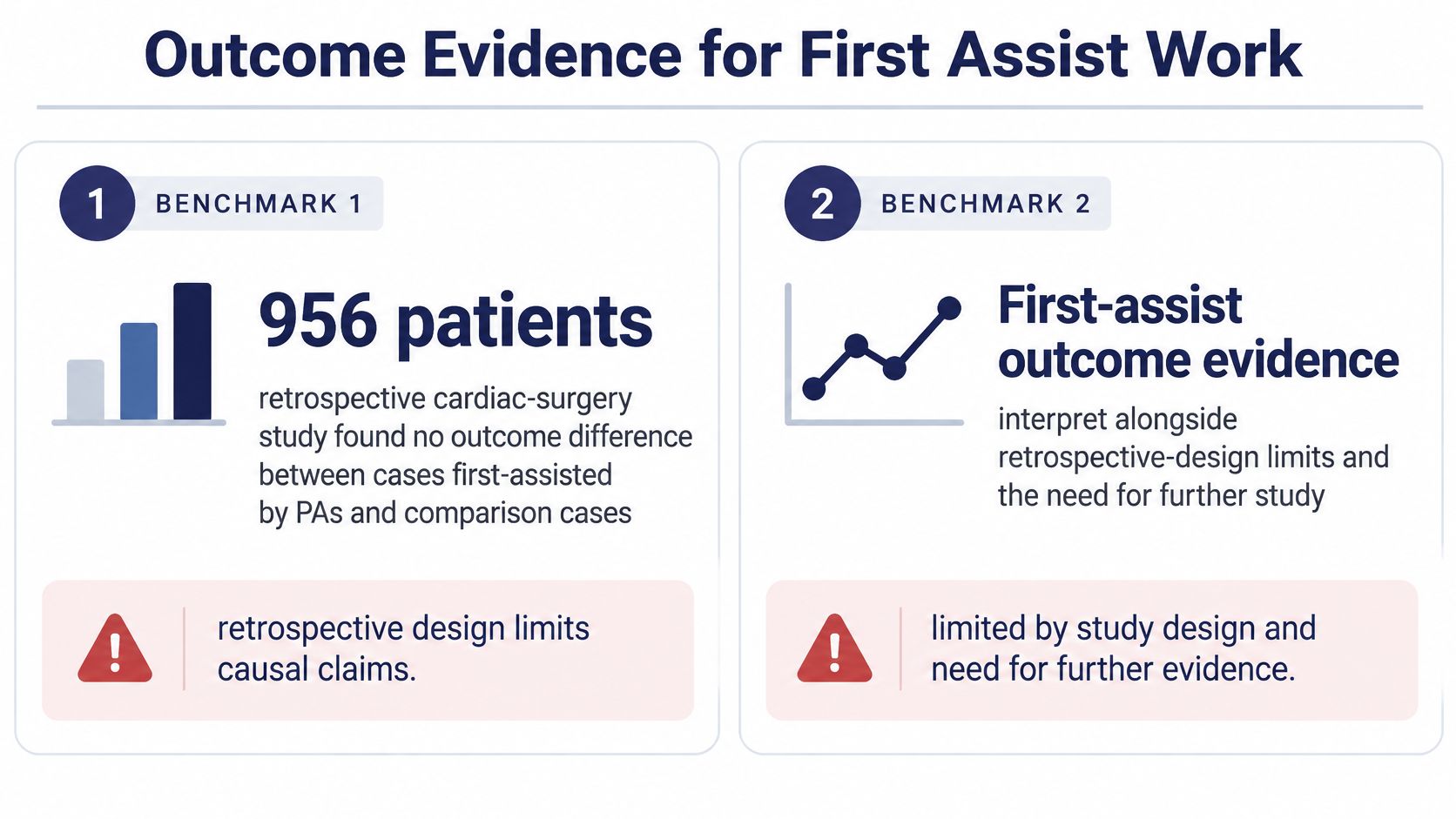
A retrospective study of 956 patients found no outcome differences between cardiac surgery cases first-assisted by PAs and cases first-assisted by surgeons, supporting PA participation when credentialing and supervision are appropriate (PubMed record of the PA first-assist outcomes study). This is a general benchmark for first-assist work inside a supervised system. It is not evidence of independent operating. The study answers whether a PA first assistant changes outcomes when the program already controls case selection, supervision, and escalation. It does not answer whether a given PA should hold a specific privilege.
Transplant recovery is a tougher test. Some single-center series report PAs participating in donor recovery, including donation-after-circulatory-death cases where retrieval technique and judgment carry more weight. Those reports can show what a program has privileged and proctored, but they do not carry the same evidentiary weight as the 956-patient comparison. A transplant director should read them as local capability evidence, not a universal standard for every recovery pathway.
What the evidence does and does not prove
The 956-patient study supports a narrow conclusion: experienced PAs can first-assist without a measurable outcome difference in the studied setting. It does not establish equivalence for every procedure, every hospital, or unsupervised practice. Retrospective design limits causal claims because teams already decide who takes which case. A community program cannot use a single-center donor-recovery series to justify handing a new hire an ECMO circuit or an independent harvest line. Capacity appears where case logs, supervision, and service-line metrics line up. That is the privilege-by-procedure test, and it is why the role is not an automatic fix for a surgeon shortage.
Title against log
Two candidates can both describe themselves as cardiothoracic PAs and be nowhere near equivalent. One holds a title. The other arrives with a recovery and first-assist log that matches the institution's case mix, evidence of competency validated inside a prior program, and a history of working under protocols that were monitored and revised. Onboarding should test for that second profile: actual cardiothoracic case logs, ICU and mechanical-support experience, validated competency, and readiness for the operative and transplant complexity of the hiring site. Standardized protocols and outcome monitoring make the benchmark reproducible. The evidence earns a role for experienced PAs inside a surgeon-led system, not for a job title alone.
Qualifications Programs Should Verify
The median experience among PAs in cardiovascular and cardiothoracic surgery is 14 years, per the AAPA analysis of PA specialties and pay. That is a small, senior pool, and it does not respond to a generalist search. A hiring manager who treats a high-acuity cardiac post like any other advanced-practice requisition will spend months learning the difference. Verification belongs before the interview, not after the offer.
The baseline file is table stakes
Four items clear the floor: accredited PA education, current NCCPA certification, an active state license, and current life-support credentials. Add either a cardiothoracic surgery postgraduate program or a documented, proctored transition from another surgical specialty. None of that distinguishes one candidate from another.
What separates two candidates holding the same license
Operative case logs do the separating. Ask for volumes by procedure rather than totals, with conduit-harvest numbers broken out, because a PA who has taken two hundred radial arteries is a different asset from one who has watched them. ICU readiness comes next: independent overnight management of a postoperative cardiac patient, familiarity with mechanical support, and working knowledge of temporary pacing. Then retention evidence, since a program that trains a PA and loses them to a competitor has funded someone else's service line.
The judgment test behind the paperwork
Federal position specifications for cardiothoracic surgery PAs show how much of the job is diagnosis and disposition rather than suturing. Listed duties include initial and interim histories and physical examinations, consultations from emergency and inpatient services, admission screening, ordering and initial interpretation of laboratory testing and imaging, and coordination with cardiology, heart failure, electrophysiology, pulmonary, vascular surgery, hematology and anticoagulation, and infectious disease (federal cardiothoracic surgery PA position specification).
The test set is explicit: CBC, chemistry panels, lactate, coagulation studies, type-and-cross, ECGs, echocardiographic results, catheterization results, and other diagnostic studies. A candidate who can read that panel and knows which result triggers a call to interventional cardiology is doing the job. Familiarity with the escalation routes separates the rest:
Interventional cardiology: new ischemia on ECG, a rising troponin trend, or a catheterization finding that changes the surgical plan.
Electrophysiology: new atrial fibrillation with hemodynamic effect, device interrogation questions, or pacing dependence after valve work.
Heart failure: worsening congestion, a marginal ventricle, or a candidate for mechanical support who is sliding.
Pulmonary and infectious disease: ventilator weaning trouble, new infiltrates, or a fever curve that threatens the graft.
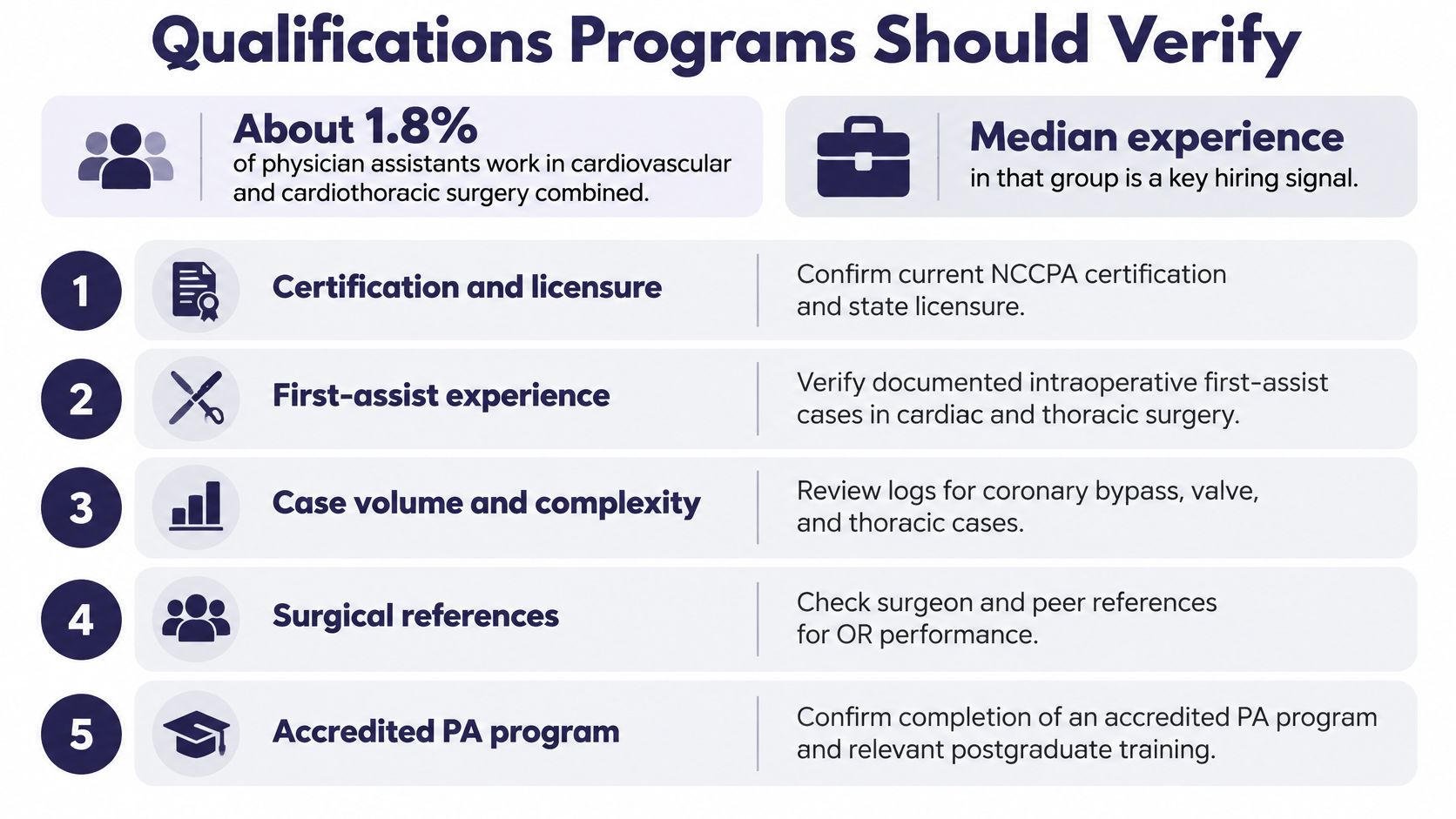
The medical staff office should run a checklist that mirrors the privilege matrix: case-log review against the exact procedures on the matrix, competency validation with a named observer, and a succession plan. This is a privilege-by-procedure role, granted where the log, the supervision record and the service-line metrics line up, not where a title does. A workforce this experienced also ages, and a cardiac program without a named successor for its senior PA finds out on a Monday morning.
Career Paths for Cardiothoracic PAs
Cardiothoracic PAs build careers in four recognizable settings. Academic heart and transplant programs offer the highest case mix and the widest procedural variety. Community hospitals hire for ICU and ward coverage alongside a smaller operative schedule. Rural hospitals often hand over perioperative continuity because nobody else holds it. Independent surgical groups use PAs to run outreach clinics and keep the operating schedule full.
Progression runs in defined steps:
Supervised first assistant. Builds the case log that every later privilege depends on.
Proctored procedural operator. Adds conduit harvest, access, and bedside procedures under observation with a defined exit criterion.
ICU or service-line lead. Takes responsibility for protocols, staffing patterns, and escalation design rather than only for patients.
Program builder. Writes credentialing standards, supervises newer PAs, and carries registry and research work.
The specialty's pool is small and senior, so the durable path bends toward responsibility for credentialing, supervision, and succession rather than toward more of the same cases. A PA who can write a privilege matrix and defend it to a medical executive committee is scarcer than one who can harvest a radial artery.
Candidates should map each step to documented case logs and competency reviews, because the next role is granted on the same evidence as the last. Hospitals should write the path down, with named milestones and proctoring exit criteria, so retention rests on defined advancement rather than tenure.
Where a PA Adds Surgical Capacity
A Medicare-based study of surgical groups from 2010 to 2020 found that PA employment declined in cardiothoracic surgery while advanced-practice use increased in several other surgical specialties (Medicare analysis of surgical group staffing). That runs against the assumption behind most expansion plans, and it deserves a hearing before a service line builds a business case on a staffing trend.
In counties with the lowest cardiothoracic-surgeon supply, APP employment in independent surgical groups still rose 36.9 percent. Broader analysis in the same work found that APP growth did not consistently align with the areas of greatest need.
A PA hire is not an access strategy. It becomes one when the seat, the backup, and the metric are chosen before the requisition opens.
Placement is the choice most programs never make explicitly, and it decides what the role produces. Four seats exist, and each is justified by a different number.
Setting | Justifying metric | Main risk |
|---|---|---|
Operating room | Surgeon operating-room capacity, first-assist cases | Dependent on the surgeon schedule |
Inpatient service | Length of stay, readmissions | Pulls the PA away from procedures when ICU coverage overlaps |
Outreach clinic | Time to consultation, transfers avoided | Coverage must be sized to supervision and local law |
Postoperative pathway | Readmissions, length of stay | Needs telehealth escalation to a surgeon |
Independent clinic coverage deserves its own sentence because it's the seat most often oversold. How much a PA can run alone depends on supervision requirements and local law, and a program that invents its own answer will meet a regulator holding a different one.
The metrics that justify the seat are operational rather than clinical: time to consultation, transfers avoided, length of stay, readmissions, and surgeon operating-room capacity. Pick one primary metric before hiring. A program that tracks all five reports none of them.
The bundled model is what converts a hire into access: PA recruitment paired with surgeon coverage, a telehealth escalation route to a cardiologist or surgeon, the privilege matrix, and explicit service-line targets with a review date. Take a community hospital an hour from the nearest cardiac surgical center. If it hires a PA into the operating room while the surgeon visits twice a month, the hire adds little. If the same PA anchors an inpatient and clinic pathway with a telehealth line to the surgeon and a defined transfer protocol, that hospital can measure time to consultation and transfers avoided inside a quarter.
The decision question isn't whether a PA can fill a gap. It's where this particular PA produces the greatest additional cardiac-surgery capacity, and the answer moves with the seat.
Staffing Decision and Next Steps
Two decisions come out of this, and they belong in a fixed order.
For a hospital or health system, the privilege matrix and the capacity metric come first. Write the procedures, attach the controls, choose the placement seat, and name the outcome the role will be judged on. Only then open the requisition, and settle on permanent advanced-practice placement or short-term locum coverage based on whether surgeon backup and credentialing are already defined rather than on how fast a start date looks. American Cardiology Group, which specializes exclusively in cardiac recruitment, runs permanent physician recruitment, locum tenens solutions, advanced practice provider recruitment, and executive recruitment, connecting cardiac specialists with facilities across the U.S., so a cardiothoracic PA search can run on its own track instead of inside a general APP pipeline.
For a candidate, the match runs the other direction: line up operative and ICU complexity, harvesting experience, and the desired setting against the program's real case mix, whether that's an academic transplant service or a rural community hospital where the PA holds perioperative continuity alone.
Executives should finish the matrix and the metric before the first interview. Candidates should assemble case logs and supervision history before the first call.
American Cardiology Group recruits exclusively for cardiology and cardiac surgery, including advanced practice placement for physician assistants working inside cardiothoracic and cardiovascular surgical teams. A facility that has finished its privilege matrix and chosen a capacity metric can bring that specification to a search built around cardiac case mix rather than general APP hiring. Visit American Cardiology Group to start a conversation about the role as it exists in the operating room, the intensive care unit, and the clinic.
Comments