
Electrophysiology Job Market in 2026: Demand and Pay
Electrophysiologists are roughly 7% of the active U.S. cardiology workforce yet account for about 15% of cardiology job openings, a mismatch documented in a workforce summary drawing on American College of Cardiology data. Hiring pressure at twice the workforce share is the defining fact of the electrophysiology job market, and it explains why so many EP searches run long.
A national ratio does not prove a local market can carry another EP; referral volume, lab capacity and competing programs decide whether the case load is real. Apply the same test to the offer: salary is a headline until call burden, procedural mix and incentive terms reveal the workload behind it.
Table of Contents
Where EP Demand Outpaces Supply Today - The shortage figures are 2009 projections, and they should be labeled that way - Applicant interest is rising faster than training capacity
Why Fellowship Capacity Limits EP Hiring - What a 98% match means for a hospital with an opening - Three reasons supply can't answer demand quickly
Geographic Gaps Behind Local EP Vacancies - An electrophysiologist needs a platform, not just a job - What works in thin markets
Career Paths Across U.S. Healthcare Settings - Academic centers and large systems - Community and rural hospitals - Private groups and outpatient settings
What EP Pay Reflects Beyond the Headline Salary - The question behind the salary number - Where academic and community offers diverge
Where EP Demand Outpaces Supply Today
Cardiology counted 25,901 active cardiologists in full-time-equivalent positions when the 2009 American College of Cardiology workforce assessment set the baseline that still frames the electrophysiology job market. Electrophysiologists were 7% of that population, against 64% general cardiologists and 21% interventional cardiologists, according to the ACC workforce assessment. A subspecialty that small produces a thin hiring pool everywhere, and openings data since then have kept the same imbalance: EP postings run above the subspecialty's share of practicing cardiologists.
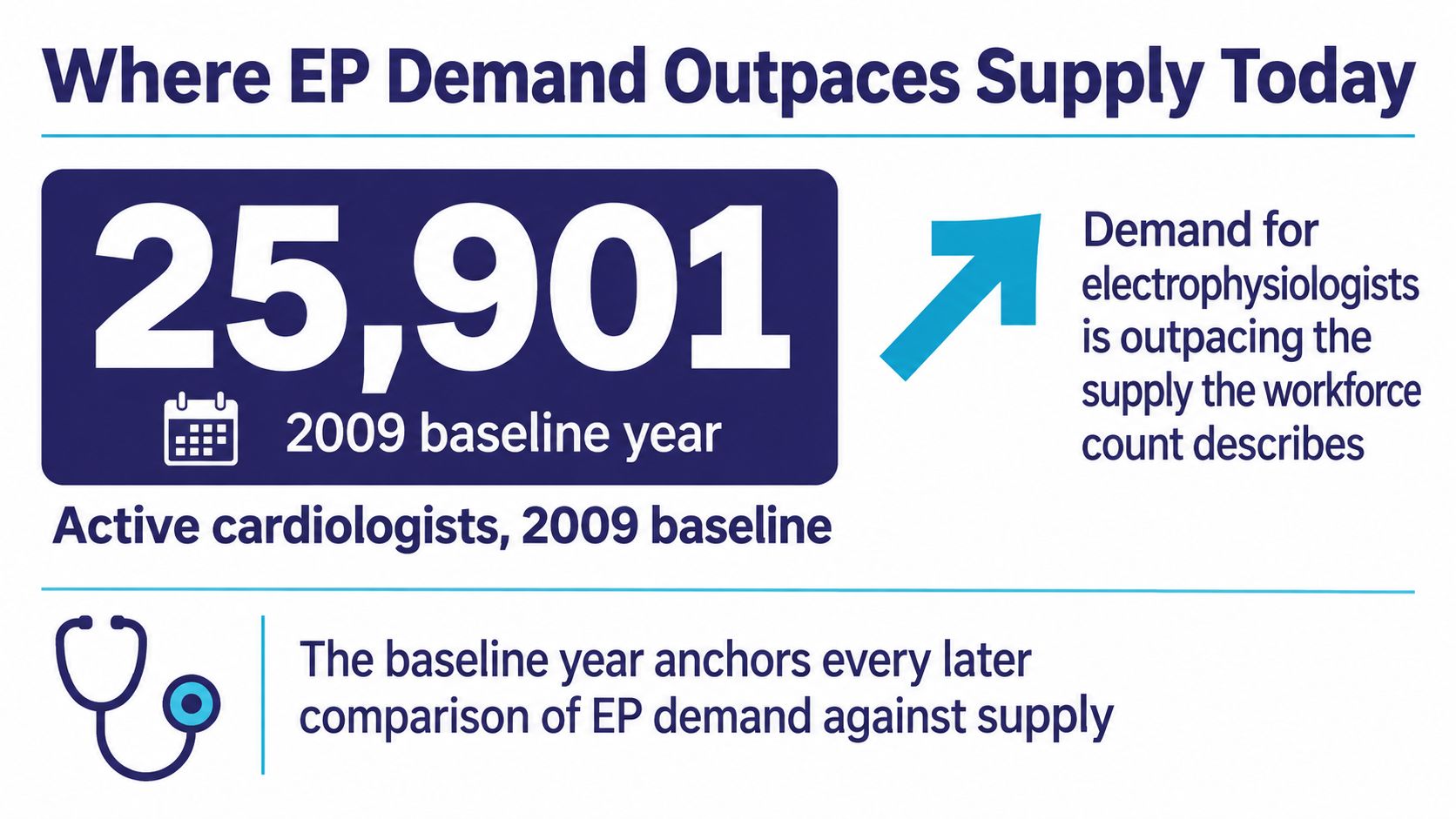
The shortage figures are 2009 projections, and they should be labeled that way
The same assessment projected a widening overall cardiology shortfall and expected demand for cardiovascular specialists to climb for decades, driven by population growth, rising cardiovascular disease, and the aging of both patients and physicians. It even anticipated that electrophysiology might eventually reach balance between supply and demand.
That balance did not arrive. Later literature kept identifying projected shortages and recruitment challenges, so the 2009 projections read best as scale markers rather than current vacancy counts. Put the year next to them whenever they go into a board deck, then follow with the local numbers that decide the hire.
Label before you quote: A 2009 projection tells you how small the subspecialty pool is. It cannot tell you how many electrophysiologists your market is short this quarter.
Indicator | Figure | Implication for hiring |
|---|---|---|
Electrophysiologists among active cardiologists | 7% | Smallest share of the three groups reported |
General cardiologists among active cardiologists | 64% | Majority of the workforce, so EP is a niche pool |
Interventional cardiologists among active cardiologists | 21% | Procedural peer group competing for similar hospital capacity |
EP share of cardiology job openings | Above its workforce share | Demand concentrated on the smallest subspecialty pool |
Projected shortfall in the 2009 ACC assessment | Specialty-level gap projected | A dated marker of scale, not a live vacancy count |
Applicant interest is rising faster than training capacity
A 2025 cross-sectional analysis of U.S. clinical cardiac electrophysiology training applications covering 2019 through 2025 found annual applicants rising from 89 to 177, a 99% increase, while available positions grew from 130 to 152, only 17%, per the study indexed in PubMed. Across the seven-year window, 953 positions were available and 92 went unfilled, 10% overall.
Read both trends together and the market looks two-sided. More physicians want in, but the number of newly qualified specialists expands far more slowly than application volume, and the study itself warned that future shortages remain possible. Stronger interest in the specialty does not add trained electrophysiologists any faster, and no hospital should set a start date on the assumption that supply will loosen next year.
The practical conclusion follows from the pool size. EP hiring is a capacity and pipeline problem inside a small, highly trained segment of cardiology, so the first test of any opening is whether the local market can carry it: referral volume, lab capacity and program depth decide whether an EP hire succeeds, and no national projection supplies those figures. National searches, early contact with fellows, academic affiliations and a clinical program worth relocating for do more than a well-written local advertisement.
Why Fellowship Capacity Limits EP Hiring
Match outcomes for EP fellowships tightened faster than any other figure in this market. Participating programs rose from 83 in 2019 to 98 in 2025, offered positions from 130 to 152, and the match rate from 62% to 98%, according to national electrophysiology fellowship match data. In the latest reported cycle, nearly every funded slot filled.
Measure | 2019 | 2025 | Change |
|---|---|---|---|
Participating EP fellowship programs | 83 | 98 | +15 programs |
130 | 152 | +17% | |
Clinical EP applicants | 89 | 177 | +99% |
Match rate | 62% | 98% | Near-full fill by 2025 |
Applicant-to-position ratio | Applicants fewer than positions | About 1.2 | Applicant demand exceeds training capacity |
What a 98% match means for a hospital with an opening
The 2025 applicant-to-position ratio was approximately 1.2, which means demand from applicants exceeded available training capacity. A match rate that high carries a specific message for employers: the country isn't sitting on a reserve of trained electrophysiologists who failed to get a slot. Almost everyone who wanted training received it, and almost every slot was used. A vacancy that opens next quarter must be filled from a pool that is already working.
Three reasons supply can't answer demand quickly
Training runs on a multi-year clock. A fellow who starts this year isn't an independent operator at the end of it. Counting on the pipeline to close a current vacancy misreads the timeline entirely.
Program growth is gated by faculty, laboratory access and clinical volume. Adding a fellowship seat means adding room time, a supervising electrophysiologist and enough ablation and device cases to train on. Those expand one capital cycle at a time, which is why offered positions grew 17% while applications grew 99%.
Fellows choose subspecialties and cities for reasons other than money. Mentorship, call burden, research access, family geography and program reputation shape the decision. A fellowship with strong mentorship and a busy laboratory tends to recruit its own replacements, while a program without those advantages struggles to fill.
Understanding how medical education pathways feed subspecialty supply makes the constraint concrete. The bottleneck sits at the training seat, not at the job posting.
A fellowship pipeline is a long-term staffing source, not a fix for a vacancy that opens before the next match cycle. Searches should begin well before the date the role is needed, and the offer should describe what a fellow would be joining: case mix, protected laboratory time, mentorship and research support. Fellowship expansion hasn't yet produced a surplus of immediately deployable electrophysiologists, and health systems that plan otherwise end up extending their time-to-fill.
Geographic Gaps Behind Local EP Vacancies
National workforce totals can look stable while a single market stays empty for a year. The Heart Rhythm Society workforce study named geographic dispersion as the principal exception to an otherwise relatively stable U.S. EP workforce, and it warned that recruiting new electrophysiologists could be challenging and uncertain. A stable national count and a chronically vacant local post are compatible facts.
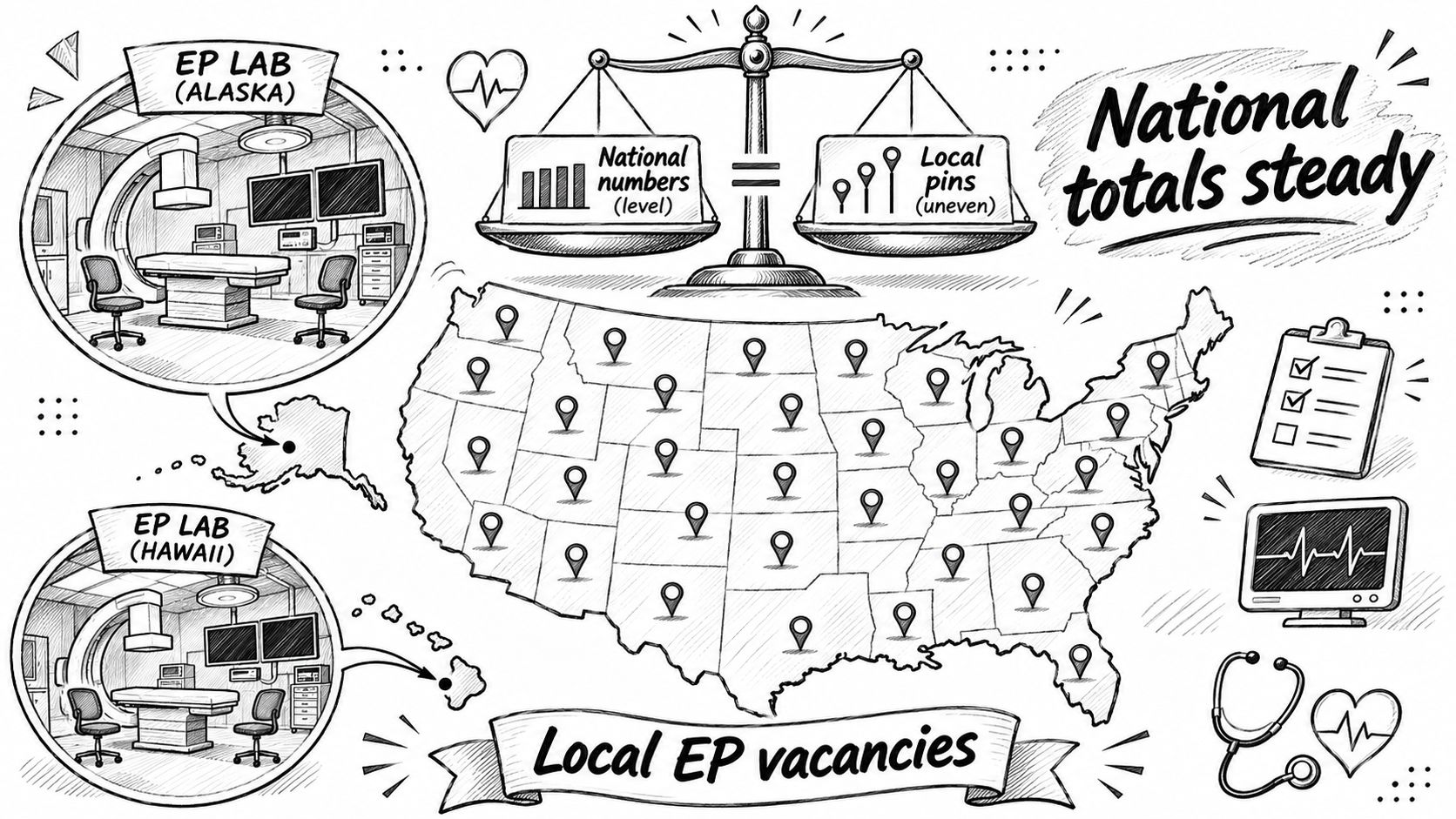
An electrophysiologist needs a platform, not just a job
An EP can't be dropped into a hospital the way a hospitalist can. The service depends on infrastructure that has to exist before the first case:
An electrophysiology laboratory with scheduled room time, not leftover space between catheterization cases.
Three-dimensional mapping and the technicians who run it.
Fluoroscopy or an alternative imaging setup, with a radiation safety program behind it.
Device follow-up systems, because every implant generates years of clinic visits and remote monitoring.
Anesthesia support for ablation cases, plus recovery capacity.
Referral volume high enough to keep case skills sharp and outcomes credible.
Strip out two or three of those and the role becomes a retention risk, whatever the salary. Rural hospitals and smaller community systems feel this most acutely: they compete for the same limited subspecialist pool while offering thinner procedural volume, fewer backup specialists and fewer academic incentives than a major center.
Practical rule: Before posting an EP role, write down the room hours, weekly case volume, anesthesia arrangement and call coverage the program can actually guarantee. If the list is thin, fix the platform first.
What works in thin markets
Regional hub-and-spoke arrangements let a community site share an electrophysiologist with a larger center and route complex ablations upward. Protected procedural time keeps the local room from being cannibalized by other service lines. Tele-rhythm consultation and remote device interrogation extend coverage without a full-time hire. Shared call models and locum coverage during ramp-up keep the service open while volume builds. The recruitment side of that problem is covered in this analysis of the rural physician shortage.
The test that matters is capability, not credentials alone: does the candidate build referral pathways, clinic workflows and device follow-up operations, or only perform procedures? A physician who can develop referral networks turns a marginal market into a viable one, which makes time-to-fill and retention strategy as consequential as compensation benchmarking.
One limit deserves stating plainly. The workforce literature gives no minimum procedure count, referral population or call frequency that makes an EP service line viable. Those thresholds have to come from your own laboratory capacity and referral base, and they should be set before anyone judges a market recruitable.
Career Paths Across U.S. Healthcare Settings
Setting shapes an electrophysiologist's daily work more than the salary band does. The same clinical skills produce very different jobs in an academic program, a community service line and an outpatient device clinic, and candidates who understand the trade-off choose better and stay longer.
Setting | Typical advantage | Typical constraint | Best-fit candidate |
|---|---|---|---|
Academic medical center | Fellowship teaching, research and complex referral volume | Lower direct pay and research expectations | Candidates who want teaching and program building |
Large health system | Full laboratory, anesthesia and backup coverage | Productivity targets and heavier call | Candidates who want infrastructure and support |
Community hospital | Local referral base and a lead role in the region | Limited backup during volume ramp-up | Candidates building a new service line |
Rural hospital | Autonomy with hub-and-spoke or tele-rhythm support | Thin procedural volume and professional isolation | Candidates open to shared coverage |
Private cardiology group | Partnership track and schedule control | Payer and overhead risk | Candidates seeking ownership |
Outpatient or ambulatory setting | Focused procedures and lower facility overhead | Narrower case mix and limited inpatient arrhythmia work | Candidates focused on device follow-up |
Academic centers and large systems
An academic medical center pairs fellowship teaching and research with the most complex referral volume in its region. The price is direct compensation that often trails private practice, plus research expectations that consume clinical days. Candidates who want to train the next cohort and build a program accept that trade knowingly, and they usually want it in writing how much protected time the department will defend.
Large health systems sell infrastructure: a fully staffed laboratory, anesthesia coverage and reliable backup for complications. In exchange they ask for productivity targets and a call schedule sized to the system. An electrophysiologist who wants high volume, dependable support and complex cases thrives there; one who wants schedule control does not.
Community and rural hospitals
A community hospital offers a local referral base and a lead role in building a regional service line, with the autonomy that comes from being the first or only EP on staff. The constraint shows up in year one, when backup is thin and volume hasn't arrived. Rural sites add professional isolation on top of limited procedural volume, which is why hub-and-spoke and tele-rhythm support matter more than the title.
A chief medical officer in Montana put the payoff of that trade-off plainly in a reference for American Cardiology Group: "They found specialists willing to make a difference in a rural setting."
Private groups and outpatient settings
A private cardiology group offers a partnership track and schedule control, and it hands the physician a share of payer and overhead risk that employed positions absorb. Ownership means living with the economics of the practice, including payer mix and room utilization. Outpatient and ambulatory settings concentrate on procedures and device follow-up with lower facility overhead, at the cost of a narrower case mix and little inpatient arrhythmia work.
Match the row to the career goal first: teaching, infrastructure, program building or ownership. Then test the actual offer against the terms in the next section. American Cardiology Group connects cardiac specialists with healthcare facilities across the U.S., including the community and rural sites where the platform test is hardest to pass.
What EP Pay Reflects Beyond the Headline Salary
Reporting based on MedAxiom data placed median electrophysiologist compensation near $803,000 in 2025, with median production of 14,853 work relative value units, the highest among cardiology subspecialties, per the MedAxiom-based compensation summary. In the same dataset, EP compensation increased only about 0.63% while EP work relative value units rose roughly 10%.
That gap tells the story. The headline moved barely at all while the measured work behind it climbed far faster, so the same paycheck now buys more procedures, more clinic hours and more documentation. A high salary can conceal intensifying workload, tighter productivity expectations or a falling rate of pay per unit of work.
The question behind the salary number
The useful question isn't "what does an electrophysiologist earn?" It's "what workload and infrastructure produce that income, and how portable is it across markets?" Two offers in the same metropolitan area can differ by a third of their real value once call, wRVU thresholds and advanced practice provider support are counted.
Transparent offers report compensation methodology, expected annual case and device volumes, wRVU thresholds, call frequency, ramp guarantees and support resources. Without those details, salary comparisons mislead both sides and contribute directly to failed placements.
Factor | What to request | Why it changes real value |
|---|---|---|
Compensation methodology | Written base, wRVU and bonus formula | Shows how the headline becomes take-home pay |
wRVU expectation | Annual target and bonus cutoff, compared with a 14,853 median | Sets the productivity bar behind the salary |
Call frequency | Calls per month and backup arrangement | Adds workload that salary figures do not show |
Procedural mix | Ablation, device implant and follow-up volumes | Determines income per case and clinic hour |
Ramp period | Guaranteed income and volume ramp length | Protects early-tenure income in new programs |
APP and staff support | APP, nurse and device-technician coverage | Sets productive hours per procedure |
Protected administrative and research time | Hours per week, written into the contract | Shows the real academic versus private trade-off |
Ownership or partnership terms | Equity, buy-in and partnership timeline | Changes long-term portability and total earnings |
Compare like with like: Two EP offers in one city can diverge by a third of their real value once call, wRVU thresholds and APP support are counted.
Where academic and community offers diverge
Academic centers often pay less directly, and the offset arrives as research time, teaching, referral prestige and schedule control. That offset is real only when it's contractual. A department that promises protected research days verbally and then fills them with clinic has matched the pay cut without delivering the compensation.
A community hospital competing against a large system has to match support and volume expectations, not just the number. A hospital that wins a candidate on salary alone and then provides one room, no APP and thin anesthesia coverage has bought a resignation in eighteen months. Reviewing how physician compensation models are structured helps frame those trade-offs before a negotiation starts.
The final filter is portability. Ask whether this income could be reproduced in another market with comparable infrastructure. If the answer is no because the volume depends on one referral source or one senior partner's schedule, the compensation is fragile, and the candidate should know that before signing.
How Employers Can Recruit EPs in a Tight Market
EP searches fail in a predictable order, and most stall at the platform-definition stage, long before a candidate reads the posting. The supply side explains why there's no slack to absorb a badly framed role. In a national survey of cardiology fellows-in-training, only 26% of respondents, 35 of 134 fellows, reported interest in applying for an electrophysiology fellowship, per the national fellows-in-training survey. The study also noted a high percentage of unfilled EP training positions over the preceding six years and named the limited applicant pool as a workforce concern.
Advertising more positions doesn't manufacture candidates. Supply depends on fellows choosing EP, completing advanced training, then entering the markets where hospitals need coverage. Academic centers hold an edge when they pair clinical recruitment with fellowship development and protected teaching time.
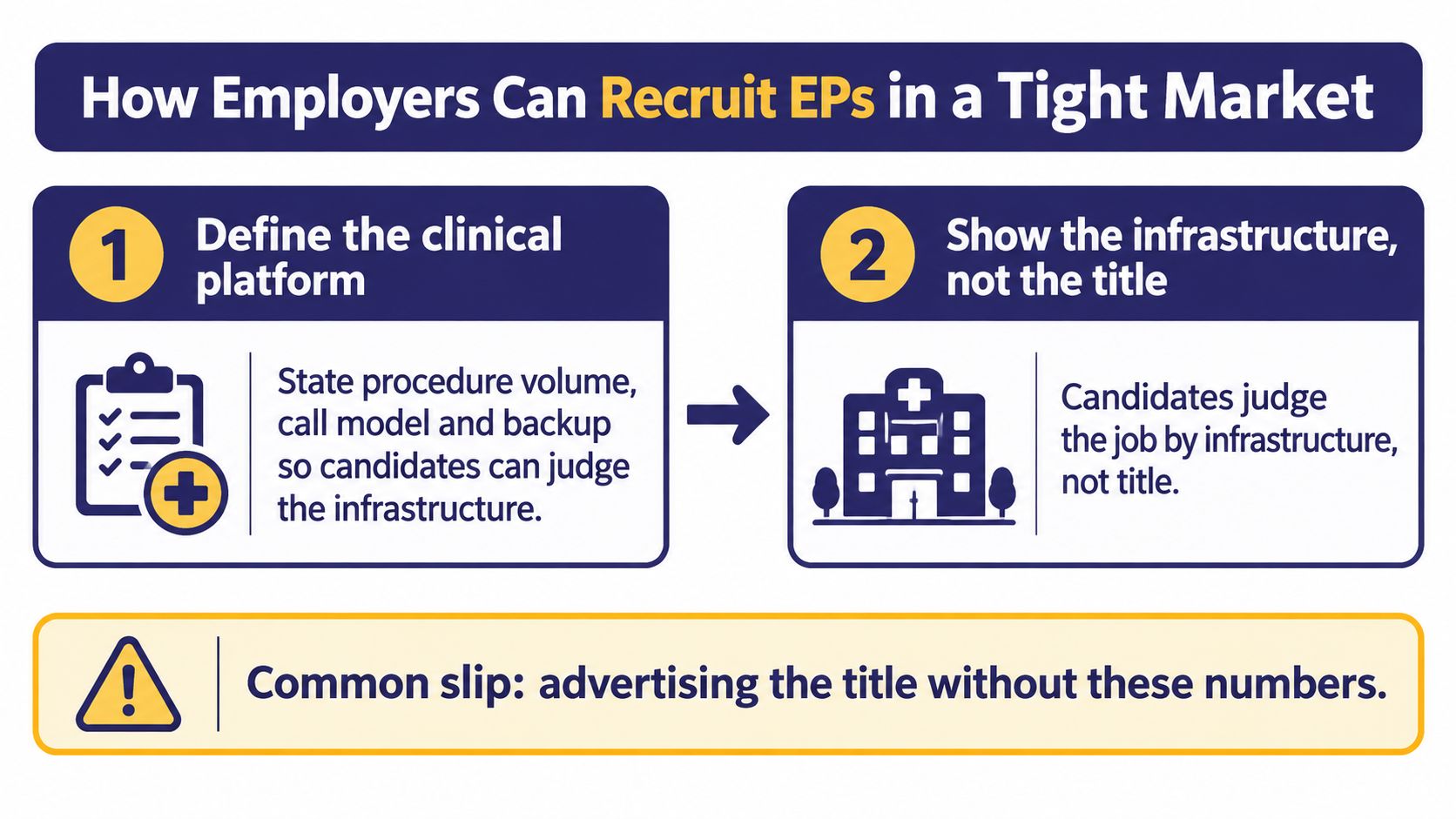
Define the clinical platform first. Put procedure volume, room hours, call model, anesthesia arrangement and complication backup on paper before anything goes live. Candidates judge the job by the infrastructure they would inherit, not by the title. The common slip is advertising the title with no numbers behind it.
Benchmark against wRVU and call data, not the salary headline. Compare the target against the productivity that recent hires in similar programs deliver, and price the call burden separately. The slip is matching a competitor's headline number while leaving call and support unchanged.
Start the search nationally and contact fellows early. Only a quarter of surveyed fellows express interest in EP, so the pool that fits your program may be a plane ride away. The slip is waiting for local applicants who don't exist.
Build an academic affiliation or fellowship link. A training relationship widens the pipeline over years and gives candidates a reason to see the program as a career, not a contract. The slip is treating training as a short-term fix for this year's vacancy.
Write a role brief rather than a job description. State the placement type, procedure mix, call model and start date. Employers can submit a Fill a Position request that asks for name, organization, state, type of placement and a note. The slip is sending a generic description and expecting a recruiter to infer the rest.
Start credentialing and compliance early. Privileging, payer enrollment and licensure run on their own clocks and delay a start date that was already hard to win. American Cardiology Group's team manages credentialing and compliance for locum providers so facilities can onboard quickly. The slip is waiting until the offer is signed to begin.
Fund the ramp. Commit staffing, APP coverage and first-year volume targets, and say who owns referral development in the first two quarters. The slip is leaving a new electrophysiologist to build volume alone in an empty laboratory.
Before the offer goes out, run one check: the candidate's workload, backup and referral network must already be in place. If any of the three depends on hiring another person later, the offer is describing a job that doesn't exist yet.
Decide Your Next Move in the EP Market
Candidates and employers leave this analysis with different next moves, and both should be decided on infrastructure rather than on a salary band. Two short paths follow.
For candidates: Test every EP offer against the compensation terms table, request wRVU history and call data for the past three years, and confirm in writing how the ramp period is protected before accepting. Candidates can search for jobs and apply through the website.
For employers: Confirm the clinical platform first, meaning procedure volume, backup and call, then decide whether the widest gap is a permanent hire, temporary coverage while volume builds, or leadership. American Cardiology Group's services include permanent physician recruitment, locum tenens solutions, advanced practice recruitment and executive recruitment.
Ask a recruiter to match each option to the platform rather than to the salary band. A locum who keeps a new laboratory open during ramp-up solves a different problem than a permanent electrophysiologist who builds referral pathways for a decade, and confusing the two wastes a search cycle.
The single decision rule stands. Match the offer to the infrastructure behind it, not the headline salary.
American Cardiology Group recruits exclusively for cardiology and cardiac specialties, including permanent physician recruitment for electrophysiologists, locum tenens coverage during ramp-up and advanced practice placement for EP teams, and it works with academic, community and rural facilities across the U.S. If the platform is ready and the terms are documented, the search can start now rather than after the next match cycle. Visit American Cardiology Group to review current cardiac openings or to submit a position.
Comments