
Locum Tenens Physician Staffing for Cardiac Programs
Eight percent of U.S. physicians, approximately 57,000 doctors, reported currently working locum tenens as of May 2024, according to CHG Healthcare's 2025 State of Locum Tenens Report. For cardiovascular leaders, that workforce represents more than temporary labor. It offers a way to preserve clinical capacity when a missing physician would otherwise interrupt consults, call coverage, procedures, and referral access.
Table of Contents
Why Cardiac Programs Turn to Locum Coverage - A Vacancy Removes Functions, Not Just Headcount - Coverage Must Fit the Operating Environment
Vacancy Cost Versus Locum Tenens Spend - Cardiac Vacancy Cost Versus Coverage Horizon - Build the Full Cost Stack
How a Locum Tenens Engagement Is Built - Translate the Vacancy Into an Executable Assignment - Separate Temporary Coverage From Other Workforce Roles
Privileges Call and Credentialing Before Day One - Lock Authority, Privileges, and Billing Readiness - Lock Workload, Continuity, and Deployment
Cardiology Use Cases That Justify Coverage - When Cardiac Programs Use Locum Coverage - Match Each Trigger to a Defined Outcome
Mortality Length of Stay and Handoff Risk - Locum Versus Permanent Internist Outcomes in Medicare - Different Operating Models Can Produce Different Results - Measure the Assignment as a Clinical Service
Match Coverage Length to the Permanent Search - Keep Temporary and Permanent Work Moving
Why Cardiac Programs Turn to Locum Coverage
Locum tenens physician staffing is contracted, time-limited physician coverage that keeps consults, call, clinic, and procedures running while a permanent search, leave, or program launch remains unfinished. The relevant planning unit isn't the vacant position alone. It's the set of services the hospital can no longer reliably deliver without that physician.
The demand pressure is substantial: the Association of American Medical Colleges' workforce projections anticipate 34.1% growth in the population aged 65 and older by 2036. Because cardiovascular disease burden and cardiac service use increase with age, hospital leaders should evaluate staffing against expected demand for diagnostic, procedural, and longitudinal care, not just the current headcount.
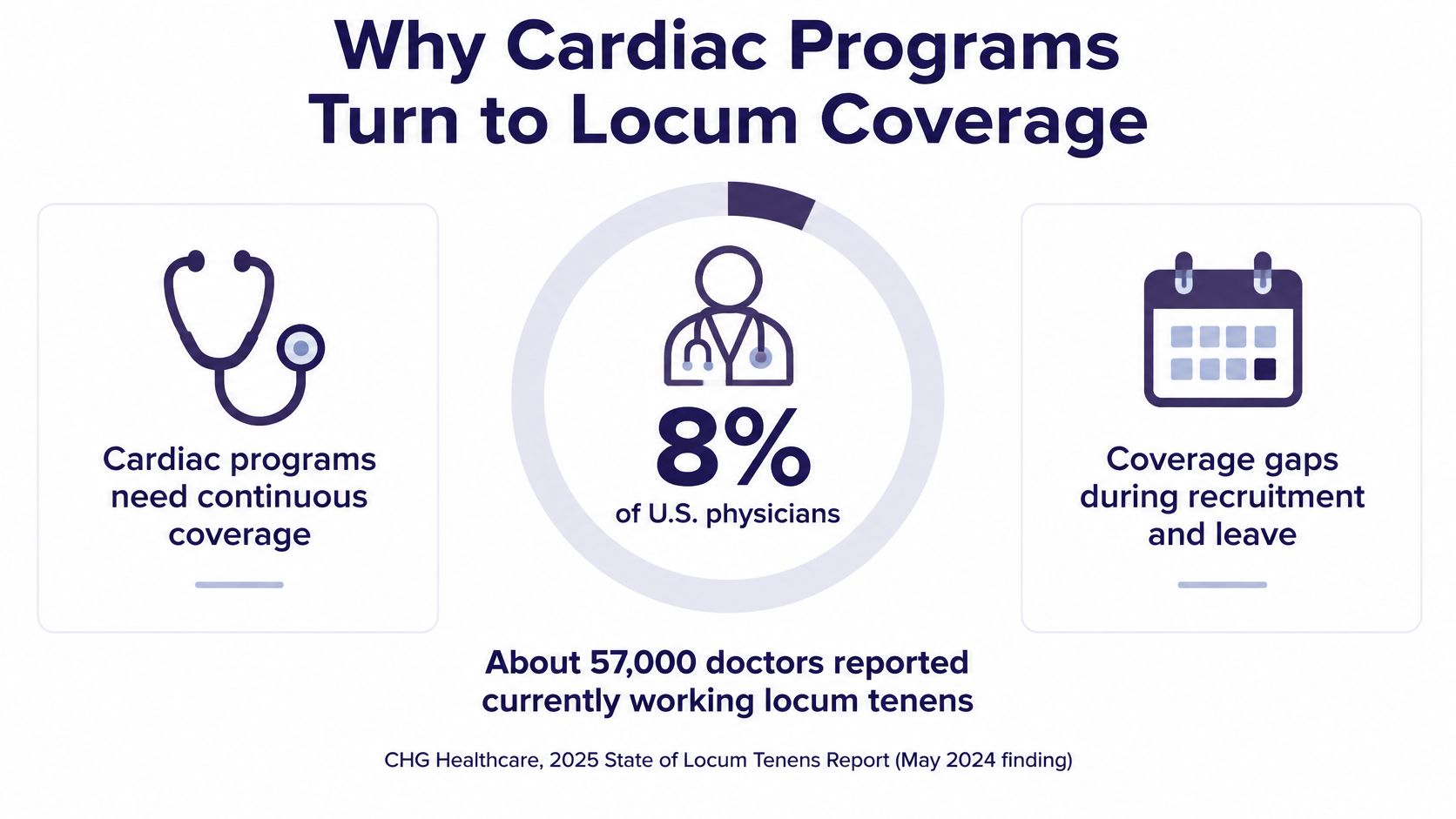
A Vacancy Removes Functions, Not Just Headcount
A general cardiologist's departure can interrupt inpatient consultation and discharge planning even when clinic appointments remain available. An interventional vacancy can compromise ST-elevation myocardial infarction (STEMI) call coverage despite an otherwise staffed cardiology department. Electrophysiology, advanced heart failure, and cardiothoracic surgery require different competencies, privileges, and supporting infrastructure.
That distinction changes the coverage request. A hospital seeking an electrophysiologist for device procedures and ablation shouldn't describe the need as cardiology coverage. A cardiac surgery program must distinguish operative responsibility from postoperative management and surgical call.
Consult response: Identify which inpatient decisions require the missing physician's expertise.
Emergency capability: Determine whether STEMI or surgical call remains supportable without the open position.
Procedural throughput: Identify which scheduled cases cannot proceed under the remaining physicians' privileges.
In-system access: Establish which patients would require outside referral or transfer.
Coverage Must Fit the Operating Environment
A qualified physician can't independently restore a service that lacks cath-lab personnel, anesthesia support, perfusion, intensive care capacity, or required backup. Leaders should confirm those dependencies before treating a locum assignment as recovered capacity.
The practical decision is therefore narrower than whether the hospital needs another cardiologist. Executives must decide which vacancy warrants coverage, how long the bridge should last, and which clinical conditions must be satisfied before work begins. Coverage is justified when the physician can perform a defined service safely and the organization can support the complete care pathway.
Vacancy Cost Versus Locum Tenens Spend
Comparing a locum daily rate with a permanent physician's prorated salary answers the wrong financial question. The useful comparison is incremental coverage expense versus the contribution margin and access preserved by keeping the service available.
CHG industry findings reported by Medical Economics associate a physician vacancy with approximately $2.6 million in annual lost revenue, while 63% of healthcare organizations identify locum cost as a primary concern. Those broad industry figures frame the problem; they aren't a cardiology-specific forecast or a substitute for the hospital's own financial model.
Cardiac Vacancy Cost Versus Coverage Horizon
Scenario | What is at risk | Planning figure |
|---|---|---|
Uncovered physician vacancy | Lost admissions, procedures, and referrals | About $2.6 million annual lost revenue |
Locum cost as the stated worry | Budget pressure on the daily or hourly rate | 63% of organizations cite locum cost as a primary concern |
30-day bridge | Call gaps, transfers, and delayed consults | Short window before patients leave the system |
90-day recruitment gap | Clinic access and procedural backlog | Specialty searches often remain open past one quarter |
180-day hard-to-fill subspecialty | Service-line contraction in EP, interventional, or CT surgery | Extended gap with a narrow skill set |
The coverage horizons are planning scenarios, not guarantees about recruitment duration. For the short bridge, the financial question is whether immediate call and consult coverage prevents avoidable transfers. For the recruitment gap, finance should assess whether delayed appointments and deferred procedures will be recovered or lost.
For an extended subspecialty vacancy, leaders should test a more consequential possibility: referring physicians may establish alternative pathways that remain in place after a permanent replacement arrives. Rural and single-cardiologist community hospitals should also assess whether the departure leaves enough capability to operate the cardiovascular service at all.
Build the Full Cost Stack
The worksheet should separate quoted compensation from the total cost of deployment. A discussion of locum tenens pay rates belongs inside that broader calculation.
Clinical coverage: Scheduled coverage days multiplied by the daily bill rate, or scheduled hours multiplied by the hourly rate, including separately priced call obligations.
Travel and lodging: Transportation, housing, and recurring travel arrangements, particularly for rural assignments.
Malpractice: Coverage structure, exclusions, and responsibility for any required tail coverage.
Onboarding: Credentialing work, orientation, and uncovered days before the physician becomes clinically productive.
Agency charges: Any margin already embedded in the bill rate and any separately invoiced fees.
Finance should compare that total with contribution margin protected per week of coverage, using local payer mix, expected collections, and margin per case. Admissions, imaging, device procedures, surgery, and downstream referrals shouldn't be double-counted across departments. Avoided transfers belong in the model only when the hospital could safely retain and treat those patients.
Financial rule: Lost revenue isn't lost margin, and scheduled volume isn't automatically recoverable volume.
The model should also include the probability that the permanent search remains open and the cost of extending coverage. The lowest rate-card option can become the most expensive operational choice when it leaves essential capacity unavailable.
How a Locum Tenens Engagement Is Built
A locum engagement works best as a relay that sustains an operating service, not as an improvised second permanent roster. The temporary physician needs a defined clinical segment, a clear transfer of responsibility, and an endpoint tied to the staffing plan.
A 2019 survey summarized by Healthcare Finance News found that 85% of hospitals, medical groups, and other healthcare facilities had used locum tenens physicians during the preceding 12 months, chiefly to maintain services during recruitment and cover turnover. The same reporting estimated about 52,000 locum physicians, approximately 6% of the active physician workforce, with 72% of managers actively seeking locums in 2019 versus 47% in 2016, and surgeon use rising to 21% from 10.8% over that period.
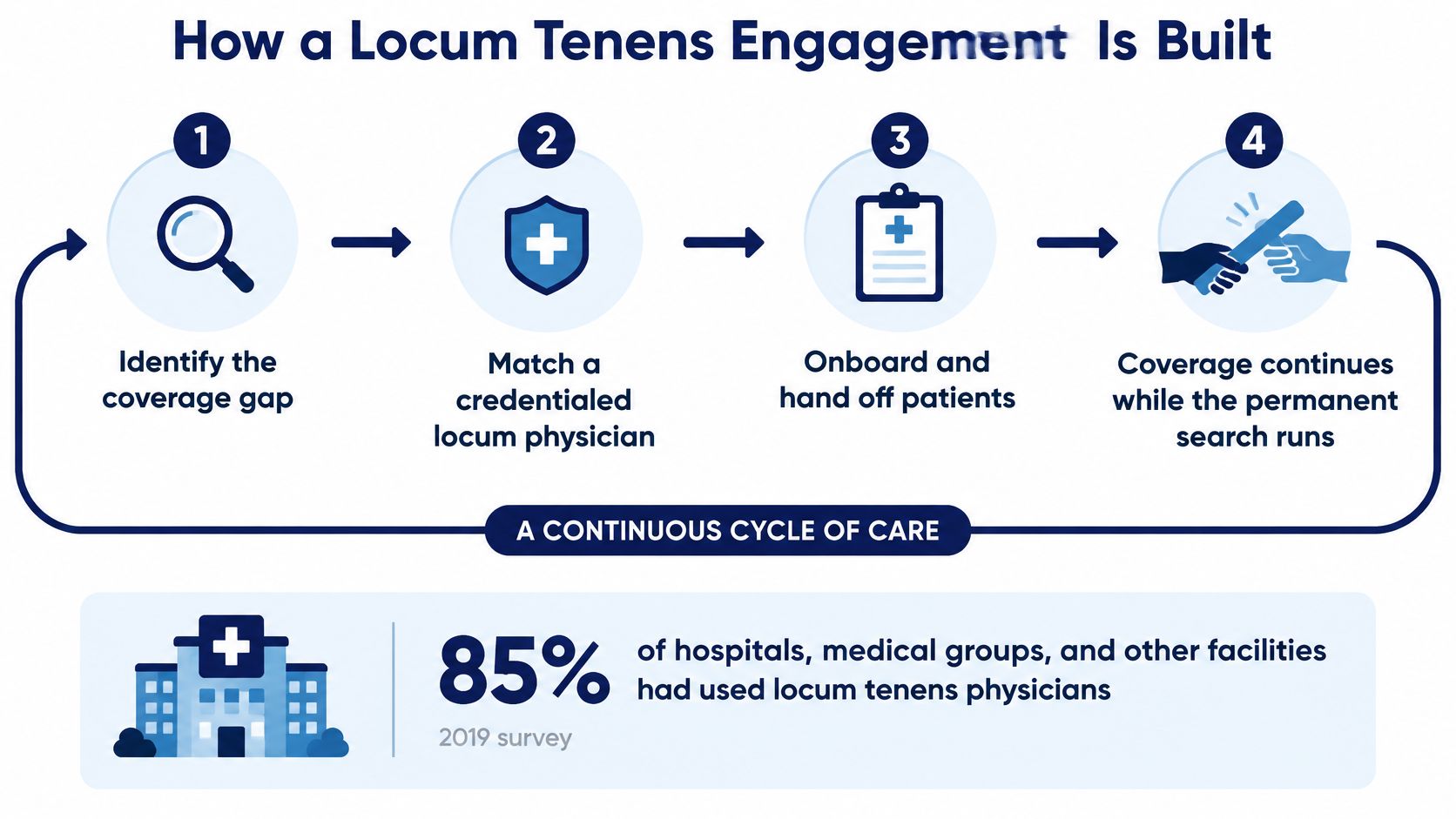
Translate the Vacancy Into an Executable Assignment
Name the coverage requirement. Specify the subspecialty, dates, location, and whether the assignment requires full-time service, clinic sessions, procedural blocks, or call only. A multisite request must identify travel and coverage boundaries.
Define the clinical workload. List procedures, expected panel responsibilities, consult demand, and backup agreements. For invasive work, identify the lab, operating room, and support teams available during the assignment.
Match qualifications to actual work. Review board certification, state licensure, and recent case mix against the requested responsibilities. A broad specialty designation doesn't establish competence for every structural, electrophysiology, or surgical procedure.
Clear the pre-start gate. Medical staff services and the clinical director should resolve the credentialing, privilege, payer, malpractice, and logistics decisions in the checklist below before confirming an executable start.
Assign continuity responsibilities. Establish handoffs, approved order sets, and ownership of pending results, postoperative concerns, and follow-up appointments. Include the permanent group's escalation contact.
Review the completed block. Evaluate volume, complications, length of stay, and unresolved care obligations. Extension decisions should reflect clinical performance and continued need, not just schedule availability.
Separate Temporary Coverage From Other Workforce Roles
A properly licensed, privileged, and enrolled locum physician can provide billable physician services and take authorized independent call while the permanent requisition remains open. An advanced practice provider can extend clinic capacity within the applicable scope and supervision structure but doesn't replace interventional cardiology or cardiac surgical privileges.
The permanent hire remains the intended source of durable clinical ownership. Temporary coverage should protect the time needed to select that physician carefully.
Candidate acceptance alone doesn't establish readiness. Credentialing lag can derail a proposed 30-day start even when physician availability isn't the constraint, so the medical staff office must validate the start date alongside recruiting.
Privileges Call and Credentialing Before Day One
A matched cardiologist who arrives without the correct privileges hasn't restored capacity. The clinical director should treat onboarding as a set of locked operating decisions, not a document collection exercise.
The hospital's healthcare credentialing process should connect verified qualifications to the specific work authorized at that facility. Recruiting can coordinate the request, but clinical leadership must own its scope and safety.
Lock Authority, Privileges, and Billing Readiness
Clinical authorization: Confirm board certification and the exact privilege set for general cardiology, interventional cardiology, structural procedures, electrophysiology, advanced heart failure, or cardiothoracic surgery.
Licensure and prescribing: Verify state license status and applicable Drug Enforcement Administration registration requirements.
Initial oversight: Establish the focused professional practice evaluation (FPPE), proctoring, or first-case review plan, including the responsible reviewer.
Revenue readiness: Resolve payer enrollment timing and the permitted billing pathway rather than assuming hospital privileges establish reimbursement eligibility.
A new program without an available proctor may be unable to activate the intended procedural scope. An exclusive service agreement may also prevent an outside interventionalist from practicing even when the physician otherwise meets credentialing requirements.
Lock Workload, Continuity, and Deployment
Call design: Specify call ratio, response expectations, post-call clinic responsibilities, and STEMI or surgical backup. The assignment shouldn't expand after acceptance.
Clinical systems: Provide electronic medical record access, documentation standards, order sets, and escalation contacts before patient care begins.
Care ownership: Name the clinician accepting pending results after departure and the permanent group receiving complication reports.
Risk allocation: State whether malpractice coverage is occurrence or claims-made and identify responsibility for tail coverage where applicable.
Rural logistics: Confirm housing, transportation, and travel arrangements before the offer becomes operationally binding.
Unresolved housing or transportation can make an accepted rural assignment impossible to staff. License or visa timelines can likewise make a proposed rapid start infeasible; those constraints require confirmation before scheduling patients.
A signed assignment isn't a usable coverage plan until the physician can legally practice, access the clinical systems, and complete the authorized work.
The chief medical officer and service-line leader should sign a one-page coverage brief specifying specialty, dates, procedures, call obligations, and the metric they'll review at day 30. That document is the handoff into sourcing, not a second process manual. Any unresolved exception should have a named owner and an explicit decision deadline.
Cardiology Use Cases That Justify Coverage
A broad physician shortage doesn't establish which cardiac vacancy deserves immediate temporary coverage. Leaders should identify the specific clinical bottleneck, the resources needed to relieve it, and the consequences of leaving it unresolved.
The Association of American Medical Colleges projects a U.S. physician shortage ranging from 13,500 to 86,000 by 2036, including a projected 10,100 to 19,900 shortage in surgical specialties. These are scenario ranges, not a cardiology vacancy forecast, but they support maintaining flexibility around difficult specialty recruitment.
When Cardiac Programs Use Locum Coverage
Clinical need | Typical trigger | Coverage goal | If left uncovered |
|---|---|---|---|
General cardiology consults | Turnover, leave, or clinic backlog | Consult response and discharge flow | Delayed care and lost inpatient volume |
Interventional cardiology and STEMI call | Call-panel vacancy | PCI capability and in-system emergency care | Transfers and lost procedural revenue |
Electrophysiology | Device or ablation backlog, or an open search | Lab access and wait-time control | Cancelled cases and referral leakage |
Advanced heart failure | Leave or program growth | Clinic continuity and therapy management | Interrupted follow-up and downstream admissions |
Cardiothoracic surgery | OR-block or call gap | Surgical coverage and case completion | Diverted cases and idle operating time |
Rural or single-cardiologist hospital | Departure of the only cardiologist | Keeping the cardiovascular service open | Service-line contraction |
General cardiology coverage should target consult completion and discharge decisions rather than adding clinic sessions by default. Interventional coverage requires a different test: whether the locum restores a clinically supportable percutaneous coronary intervention (PCI) and emergency call pathway, with the necessary team available.
Electrophysiology assignments should distinguish device work from ablation and specify the relevant procedural platform and support. Filling an EP clinic template won't resolve an ablation backlog if the physician lacks the requested privileges or the lab lacks capacity.
Match Each Trigger to a Defined Outcome
For advanced heart failure, the coverage objective may be reliable medication management and follow-up during leave or program expansion. Leaders should distinguish that work from advanced therapies responsibilities that require additional institutional capability.
Cardiothoracic surgery coverage must address the full perioperative episode, not the operating schedule alone. A locum surgeon needs explicit postoperative, intensive care, reoperation, and backup arrangements if the assignment is to preserve case completion safely.
A rural hospital losing its only cardiologist faces a different decision from an academic center covering faculty leave. The rural executive should test the minimum sustainable service configuration; the academic director should test teaching responsibilities, procedural supervision, and the launch or leave endpoint.
Academic centers should examine leave and program-launch needs, while community hospitals should examine whether the remaining call panel can support the advertised service. Neither setting should assume that an additional physician automatically creates usable capacity.
Locum coverage is most defensible beside an active permanent search for appropriately board-certified talent. It shouldn't become an unexamined substitute for core faculty, long-term program leadership, or partnership-track physicians. An open requisition warrants a coverage block when the clinical failure is specific, the supporting infrastructure exists, and the assignment has an observable operating goal.
Mortality Length of Stay and Handoff Risk
The national Medicare general-internist analysis examined 1,818,873 fee-for-service hospitalizations, including 38,475 patients, or 2.1%, treated by locum tenens physicians, and reported the following adjusted outcomes.
Locum Versus Permanent Internist Outcomes in Medicare
Metric | Locum physicians | Permanent physicians | Difference |
|---|---|---|---|
30-day mortality | 8.8% | 8.7% | Not significant |
Adjusted Part B spending | $1,836 | $1,712 | $124 higher |
Length of stay | 5.64 days | 5.21 days | 0.43 days longer |
30-day readmission | 22.80% | 23.83% | 1.00 point lower |
These findings concern general internal medicine, not invasive cardiac care. They don't establish that an electrophysiology, interventional cardiology, or cardiac surgery locum is outcome-neutral. The mortality comparison also doesn't demonstrate equivalence across every hospital, physician, or clinical circumstance.
The reported readmission difference reflects the study's adjusted comparison; the displayed group rates are rounded. Spending refers to Part B spending, not total hospitalization cost, so it shouldn't be treated as the complete financial effect of locum care.
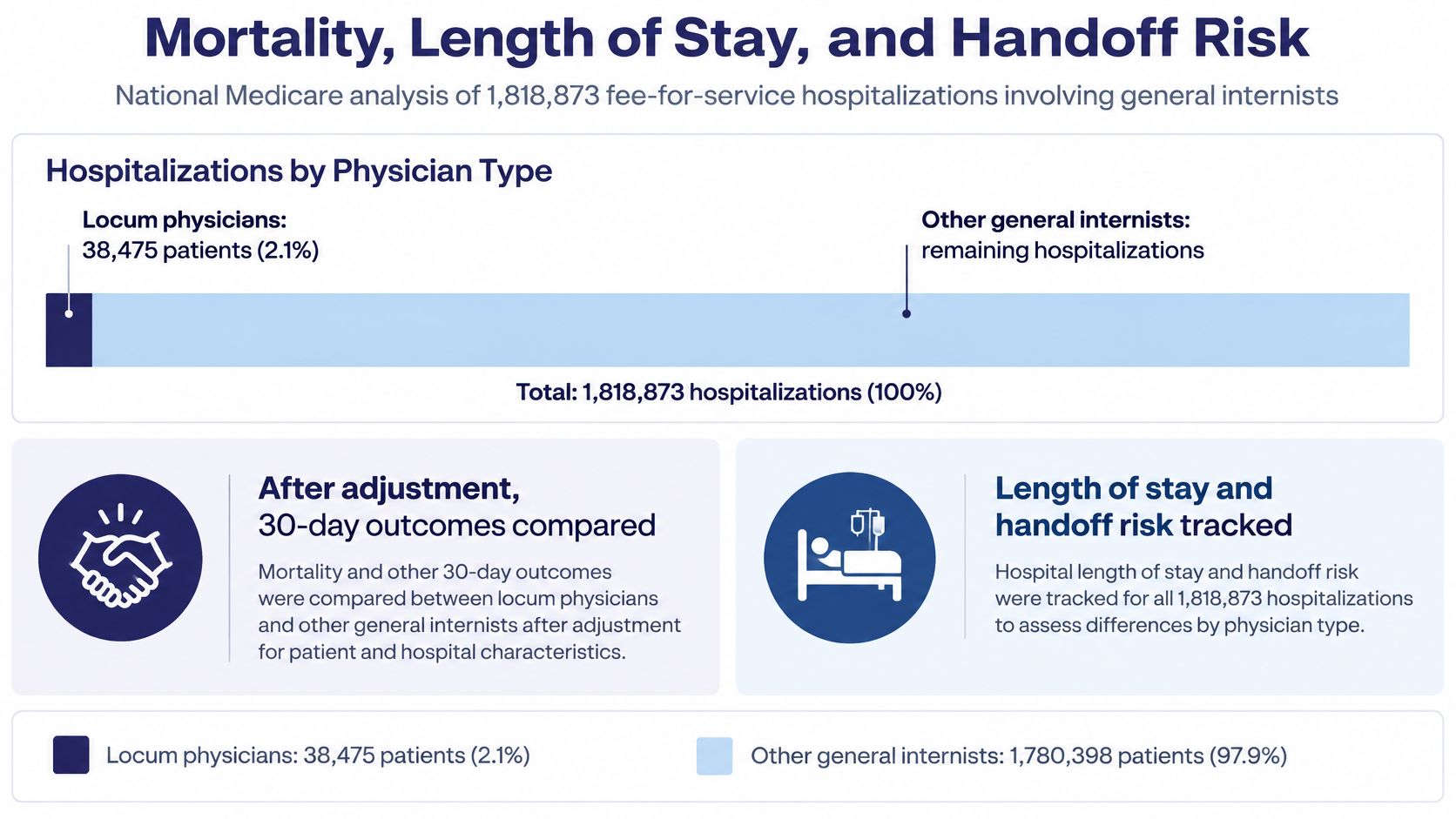
Different Operating Models Can Produce Different Results
A prospective tertiary-center hospitalist cohort study found that exclusive locum care was associated with an adjusted stay approximately one day shorter, $1,339 lower hospital cost per admission, and an estimated 23% lower hospitalization cost, without an increase in readmissions or mortality. This, too, was an internal-medicine setting and shouldn't be extrapolated directly to cardiac subspecialties.
The contrasting utilization findings argue against assuming that employment status determines efficiency. Leaders should examine how the physician was deployed, which patients were treated, and how the service organized transitions and clinical decisions. Neither study establishes the expected performance of a particular cardiac assignment.
Measure the Assignment as a Clinical Service
The service-line dashboard should combine safety, throughput, continuity, and economics rather than reducing performance to billed encounters.
Safety: Mortality, procedural complications, and unplanned escalation, reviewed with case mix and clinical context.
Flow: Length of stay, consult response, and door-to-balloon time where applicable.
Continuity: Readmissions, pending-result closure, and completed follow-up.
Economics: Contribution margin per case and the volume preserved through coverage.
For cardiac programs, unfamiliar cath-lab teams, device inventory, and call expectations are operational risks to address before invasive work. The physician should review local STEMI activation, anticoagulation, contrast management, device workflows, and postoperative escalation pathways with the relevant team.
A named handoff recipient, shared order sets, and proctoring or first-case review provide concrete controls. Quality leaders should review individual events and small case counts carefully rather than interpreting a short assignment's crude rate as a reliable comparative result.
Quality boundary: Internal-medicine outcomes support evaluating locum coverage seriously. They don't remove the obligation to validate cardiac privileges, teamwork, and local performance.
Match Coverage Length to the Permanent Search
Coverage length should reflect the work remaining in the permanent search, not an arbitrary purchasing cycle. A 30-day block is a planning option for defined leave or a near-complete general cardiology hire; a 90-day block can protect clinic and call while a specialty search proceeds.
A 180-day or renewable block may be appropriate for a difficult electrophysiology, interventional cardiology, or cardiothoracic surgery search, provided the permanent requisition stays active. These are recommended planning windows, not national estimates of time to hire. Each agreement should include an extension decision point and a transition plan tied to the incoming physician's actual readiness.
Keep Temporary and Permanent Work Moving
The retained search the service line already needs should continue through the physician recruitment process. Temporary coverage shouldn't postpone candidate assessment or obscure the permanent role's unresolved requirements.
American Cardiology Group offers flexible, short-term locum tenens staffing for cardiac care, with a provider network spanning general cardiology, interventional cardiology, and surgical roles. Its team manages credentialing and compliance for locum providers to support quick onboarding.
The next operational step is to send the signed coverage brief to sourcing. Scope confirmation should precede a promised start date.
American Cardiology Group can help hospitals define cardiac locum coverage around the subspecialty, procedures, call obligations, and duration that preserve usable capacity. Hospital executives and clinical directors can visit American Cardiology Group to request staffing and arrange a conversation using the signed coverage brief.
Comments