
Physician Assistant Solutions for Healthcare Employers
Federal workforce modeling projects a U.S. shortage of 7,270 cardiology physicians, alongside a projected deficit of 70,610 primary-care physicians, according to the Health Resources and Services Administration (HRSA) workforce projections. For hospital executives and cardiovascular service-line directors, that deficit changes how advanced practice staffing has to be evaluated. Treating physician assistant solutions as a transactional hourly labor purchase no longer works when physician capacity is structurally constrained across inpatient consults, outpatient clinics, and procedural programs.
National headcount expansion can also mislead hiring committees. Under prevailing training and utilization patterns, HRSA's 2013 to 2025 primary-care workforce projections estimated active primary-care PA supply would grow 76%, rising by 25,380 full-time equivalents from 33,390 in 2013 to 58,770 in 2025, while projected demand rose 17% to 39,060 FTEs. A surplus in aggregate primary-care supply doesn't translate into ready availability for rural community hospitals, heart-failure clinics, or electrophysiology practices competing for clinicians with relevant cardiovascular experience.
The central error health systems make is evaluating PA placement on headline hourly rate instead of matching the staffing mechanism to the clinical problem. Buying temporary coverage to solve a recurring service-line deficit inflates total annual expenditure through repeated agency fees, lost clinic throughput, and clinician turnover. Effective workforce planning separates time-bound coverage gaps from permanent program needs before a single job requisition opens.
Table of Contents
Matching PA Models to Coverage Gaps and Program Needs - Separating Coverage Gaps From Program Needs - Three Filters and the Total Annual Cost Formula
Mapping PA Roles to Service Lines and Supervision Tiers - Pre-Launch Governance and Performance Dashboards
Weighing Specialty Experience Against Adaptability - Scoring Clinical Transition Risk Before Onboarding
State Scope and Supervision Checks Before Deployment - Building a Multi-Site Compliance Matrix
How Medicare Payment Rules Shape PA Staffing Budgets - Translating Reimbursement Differentials Into Service-Line Economics
Three Employer Scenarios and the Model Each Chose - Rural Critical-Access Hospital Bridging to Permanent Coverage - Academic Cardiac Program Expanding Heart-Failure Access - Outpatient Cardiology Group Managing Panel Surge
Matching PA Models to Coverage Gaps and Program Needs
Choosing the right staffing mechanism starts by comparing how five standard placement models allocate risk, speed, and long-term cost across cardiovascular programs.
Model | Best for | Typical engagement | Main trade-off |
|---|---|---|---|
Permanent direct hire | Sustained growth in a stable service line | Open-ended employment | Longest time to fill and full long-term cost |
Retained search | Hard-to-fill roles such as heart failure or structural heart | Search fee paid in stages, then placement | Upfront commitment; slower than locum for urgent gaps |
Contingency search | High-volume roles with several qualified candidates | Fee paid only on placement | Less exclusive; less role-specific alignment |
Locum tenens | Leave coverage, urgent gaps and pilot programs | Days to months | Premium rates; continuity depends on rotation |
Fixed-term contract PA | Defined projects such as a new clinic launch | Set contract term | Limited continuity; ramp-up needed when the term ends |
Separating Coverage Gaps From Program Needs
Every PA requisition falls into one of two operational categories, and confusing them is the fastest way to overspend a departmental budget. A coverage gap is time-bound and triggered by an identifiable disruption such as a sudden clinician departure, an extended medical or parental leave, or a seasonal referral surge. Consider an illustrative scenario where a community hospital's sole interventional cardiologist takes a six-month medical leave; the facility needs immediate continuity for inpatient rounding and post-procedure follow-up, not a permanent addition to payroll.
A program need, by contrast, represents recurring clinical demand embedded in a growing service line. Examples include an expanding outpatient heart-failure titration clinic, longitudinal post-procedural follow-up for structural heart patients, or a dedicated inpatient cardiology consult service. Filling a permanent program need with rolling short-term placements creates chronic scheduling friction, forces cardiologists to repeatedly supervise unfamiliar clinicians, and degrades patient continuity.
When temporary disruption does drive the requisition, physician assistant locums protect clinic revenue and prevent referral leakage while leadership assesses permanent demand. Using locum coverage intentionally as a bridge, rather than as an indefinite substitute for permanent hiring, preserves both access and budget discipline.
Three Filters and the Total Annual Cost Formula
Clinical directors can narrow the five models down to a viable shortlist by running every open requisition through three sequential filters:
Duration of clinical demand. Determine whether the underlying patient volume is recurring or strictly temporary. Recurring service-line growth points directly to a permanent direct hire or a retained search, whereas temporary surges belong in locum tenens or fixed-term structures.
Weeks remaining before start date. Short lead times eliminate retained searches and direct internal recruiting, which require multi-month sourcing and credentialing cycles. Urgent coverage windows require locum tenens providers who can step in rapidly, while defined multi-month launches such as a new ambulatory cardiology clinic align with a fixed-term contract PA.
Market scarcity of the clinical skill set. High-volume generalist outpatient roles with multiple qualified local applicants fit contingency search or internal recruiting. Hard-to-fill subspecialties, including electrophysiology device management, advanced heart failure, or structural heart coordination, warrant retained search so a dedicated partner actively recruits passive candidates.
Pricing these models requires looking past hourly bill rates or base salaries. Finance teams should calculate full departmental exposure using one standardized formula:
Total annual cost formula: Annual cost = (hourly or salaried rate x clinical hours worked) + search or agency fees + onboarding and ramp-up time + turnover replacement.
That formula exposes a common procurement trap. Suppose a health system opts for repeated short-term placements with a modest hourly rate instead of funding a permanent search for a recurring outpatient cardiology role. Each time a short-term contract expires, the clinic absorbs weeks of reduced visit volume during electronic health record training, physician chart co-review, and referral rebuilding. Once agency markups, credentialing administration, and turnover replacement are added back in, repeated short-term staffing frequently exceeds the annual cost of a salaried permanent PA.
Macroeconomic labor data confirm why relying on ad hoc hiring grows riskier every year. The Bureau of Labor Statistics Occupational Outlook Handbook reported roughly 162,700 physician assistant jobs in 2024 and projected employment to reach 195,800 by 2034, an increase of about 33,200 positions, or 20.4%. While the broader PA labor pool is expanding rapidly, cardiovascular employers still compete fiercely for experienced clinicians in specialized and underserved markets. Before engaging external vendors, leadership teams should select two or three candidate models from the comparison table, such as permanent direct hire alongside a locum bridge, or retained search paired with a fixed-term ramp-up, and stress-test them against governance, clinical scope, and reimbursement constraints.
Mapping PA Roles to Service Lines and Supervision Tiers
Headcount alone doesn't expand cardiovascular access unless clinical workflows clearly divide responsibilities between PAs and cardiologists. A BMJ Open systematic review of physician assistants in secondary care found that integrating PAs into physician-led hospital teams increases service capacity, improves patient throughput, reduces waiting times, strengthens continuity of care, and adds medical coverage, all while showing little or no adverse effect on patient outcomes or cost compared with medical staff.
To capture those gains in cardiology, programs need a deliberate tiered operating model rather than informal delegation. The diagram below illustrates how PA clinical responsibilities align across hospital service lines and supervision tiers.
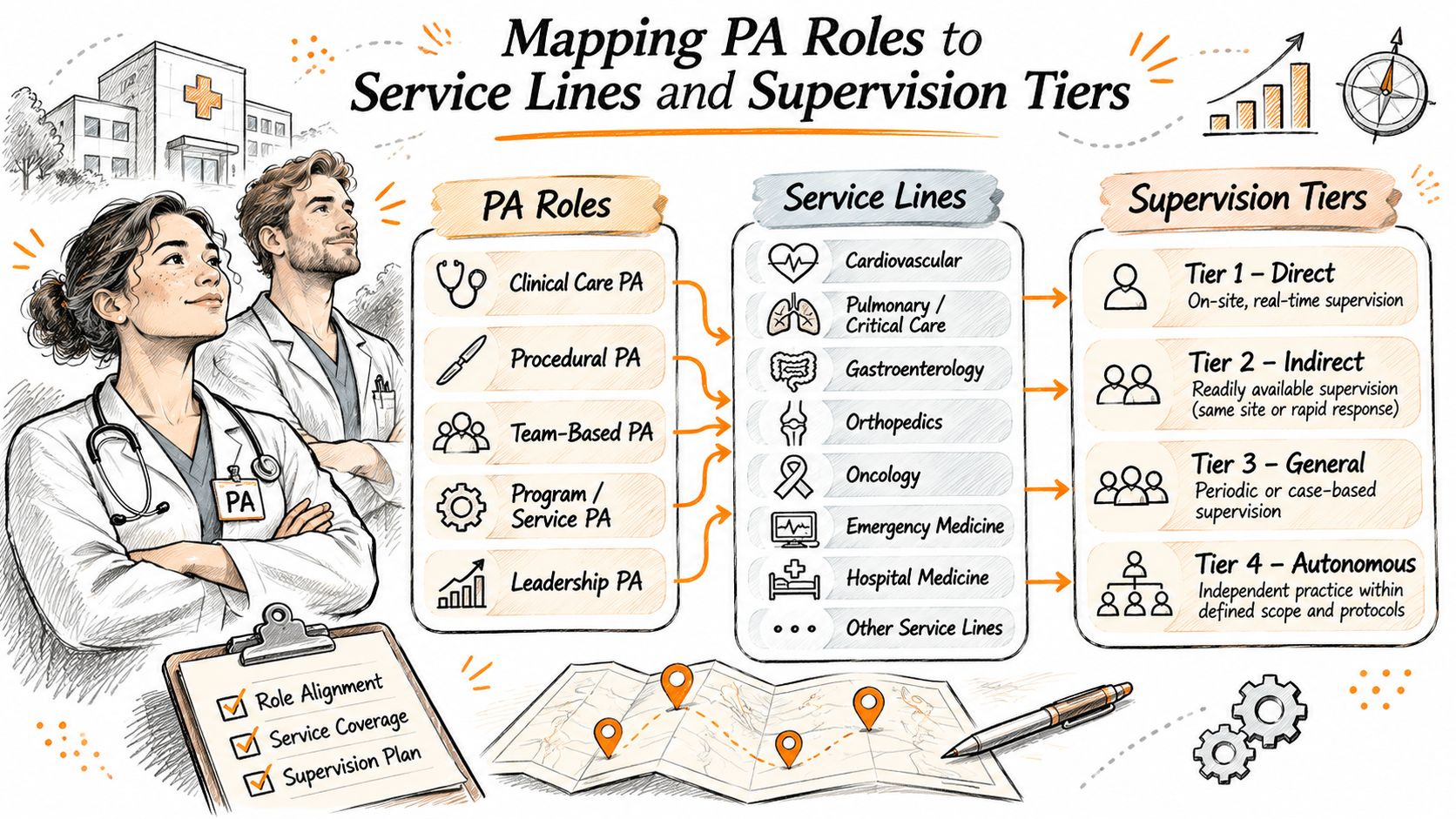
In a well-structured cardiovascular tiering architecture, PAs independently manage protocolized clinical assessments, longitudinal follow-up visits, medication reconciliation, patient education, and selected diagnostic workflows such as routine stress-test monitoring or stable echocardiogram result review. Cardiologists retain direct ownership of complex undifferentiated diagnoses, invasive procedures in the catheterization or electrophysiology lab, and high-acuity clinical escalation decisions.
Across specific cardiology service lines, that split translates cleanly into daily clinic schedules:
Structured new-patient triage: PAs gather focused cardiovascular histories, order baseline diagnostics such as 12-lead ECGs and transthoracic echocardiograms, and fast-track unstable presentations to the attending cardiologist.
Stable heart-failure and coronary-disease follow-up: PAs execute guideline-directed medical therapy titrations, review laboratory panels for renal or electrolyte shifts, and monitor symptom stability between physician visits.
Post-discharge surveillance: PAs conduct rapid seven-day hospital follow-ups after acute myocardial infarction or heart-failure admission to catch volume overload and medication discrepancies early.
Preventive risk-factor and procedural follow-up: PAs oversee lipid management, hypertension control, routine wound checks after pacemaker or structural interventions, and diagnostic-result communication.
Clinical directors designing these teams also have to decide how PA workflows sit alongside nurse practitioners on the same roster. Reviewing clinical training distinctions when comparing APRN and physician assistant roles helps leadership align surgical assist duties, inpatient consult rounding, and clinic templates with each clinician's statutory authority and background.
Pre-Launch Governance and Performance Dashboards
Before a newly placed PA sees the first clinic patient, department chairs and medical staff leadership should codify four operational rules in writing:
Explicit supervision ratios. Define the exact number of PAs assigned per collaborating cardiologist in outpatient clinics versus inpatient consult services so physicians aren't overloaded with unscheduled chart reviews.
Referral thresholds. Specify objective clinical triggers, such as new reduced ejection fraction, recurrent syncope, or refractory angina, that automatically route a patient from a PA template to a subspecialist cardiologist.
Escalation pathways. Document who answers real-time clinical questions during clinic hours, how urgent inpatient consults transfer to the attending, and what turnaround time applies to abnormal diagnostic results.
Call coverage boundaries. Clarify weekend rounding expectations, night-float participation, and post-call recovery rules in the initial contract so scope creep doesn't trigger early burnout.
Once the operating model goes live, leadership should move past anecdotal physician feedback and track a seven-metric outcome dashboard:
Access time: Measure wait times for routine and urgent consults, anchored by time to third-next-available appointment.
Clinical throughput: Track completed patient visits per clinical FTE across ambulatory and inpatient assignments.
Escalation rate: Monitor the percentage of PA visits escalated to a cardiologist to verify whether triage protocols and training are calibrated properly.
30-day readmissions: Compare post-discharge hospital readmission rates for heart-failure and acute coronary cohorts managed through PA surveillance clinics.
Adverse events: Audit clinical safety reports, anticoagulation complications, and missed diagnostic follow-ups.
Patient experience: Separate access satisfaction scores from clinician communication scores to isolate scheduling bottlenecks from bedside care.
Physician workload: Measure whether cardiologists recapture time for procedural volume and complex referrals, or lose those hours to inefficient supervision.
Governance rules only protect patients when the clinician stepping into the role has verified technical competence. Each locum professional in American Cardiology Group's network is carefully vetted before placement, giving clinical directors concrete assurance that a candidate's background matches the department's written escalation thresholds before day one.
Weighing Specialty Experience Against Adaptability
Cardiology hiring committees often default to requiring prior cardiology experience, a filter that can shrink an already thin candidate pool far beyond what the role requires. The opposite extreme carries its own cost: hiring for generic adaptability without specialty safeguards exposes patients to diagnostic delays and loads informal supervision onto attending cardiologists.
The experience filter also distorts the coverage-versus-program calculation. A role left open while a committee waits for an exact resume match becomes recurring locum coverage at premium rates, and a model that looks cheap per hour often becomes the most expensive line in the staffing budget once the gap recurs month after month. An adaptable hire carries a bounded, one-time ramp-up cost instead of an open-ended coverage bill.
Workforce mobility data show how much talent rigid title-matching excludes. According to the NCCPA 2025 Statistical Profile of Board Certified PAs, 59.4% of PAs rate the ability to change specialties as extremely or very important, and surgical subspecialties, which encompass cardiothoracic surgery, account for 18.3% of current PA practice areas nationwide. Among PAs who transitioned between fields, common prior practice areas included family medicine or general practice, surgical subspecialties, emergency medicine, and internal-medicine subspecialties.
That mobility creates a practical recruiting pipeline for cardiovascular programs. An experienced hospitalist, emergency medicine, intensive care, or internal-medicine PA already understands hemodynamic instability, acute chest pain workups, inpatient workflow coordination, and complex comorbidity management. With structured clinical ramp-up, those clinicians can succeed in outpatient heart failure, electrophysiology, or structural heart clinics, or in procedural roles alongside a cardiothoracic surgery physician assistant. Employers using this approach report the fit holds after placement: “They brought us highly qualified candidates who not only fit the role but also aligned with our organization's culture,” said a vice president of clinical operations in New York.
Insisting on prior cardiology experience unnecessarily narrows the candidate pool, while hiring for adaptability without structured clinical validation transfers unmeasured risk onto attending physicians.
Scoring Clinical Transition Risk Before Onboarding
Hiring leaders can replace all-or-nothing judgments about job titles with a seven-domain transition-risk framework. During final-round clinical interviews and pre-start assessments, the collaborating cardiologist scores each domain as independent, supervised, or not yet:
Diagnostic reasoning: Ability to differentiate ischemic, arrhythmic, valvular, and non-cardiac chest pain or dyspnea presentations without over-ordering low-value imaging.
Anticoagulation management: Practical fluency with direct oral anticoagulants, warfarin bridging, renal dosing adjustments, and perioperative interruption protocols for atrial fibrillation and mechanical valves.
ECG interpretation: Speed and accuracy in recognizing bundle branch blocks, acute ST-segment changes, QT prolongation, and pacing rhythms before escalating complex tracings.
Cardiac device exposure: Familiarity with pacemaker and implantable cardioverter-defibrillator interrogation summaries, remote monitoring alerts, and pocket-site evaluations.
Procedural competencies: Technical readiness for first-assist operating-room duties, central venous access, sheath removal, or bedside ultrasound where facility privileges apply.
Escalation thresholds: Judgment regarding when a decompensating clinic patient requires same-day physician evaluation, intravenous diuresis, or emergency department transfer.
Time to productivity: Realistic ramp-up duration required to reach standard clinic visit templates without degrading documentation accuracy or chart closure speed.
Every domain scored supervised or not yet should map to a scheduled block of protected clinical education, structured case reviews, and co-signed visits before the PA assumes independent panel management. An emergency medicine PA entering a general cardiology clinic might score independent on acute ECG triage and escalation thresholds on day one, supervised on outpatient anticoagulation titration for the first 30 days, and not yet on cardiac device interrogation until completing formal device-clinic shadowing. The rubric converts cross-specialty hiring from a gamble into a managed onboarding plan, and it gives leadership a concrete ramp-up timeline to weigh against the recurring cost of leaving the position unfilled.
State Scope and Supervision Checks Before Deployment
Clinical operating models fail fast when they collide with state licensing statutes or federal payer rules. Under 42 CFR 410.74, Medicare Part B covers physician assistant professional services only when the PA is qualified, legally authorized in the state where care is delivered, and practicing strictly within that state's laws and scope-of-practice rules. Where state law specifies a supervisory or collaborative relationship, those statutory requirements govern Medicare supervision. In states without explicit supervision statutes, the PA must maintain a documented working relationship with one or more supervising physicians that defines scope of practice and oversight at the practice level.
Federal policy reinforces why national health systems can't copy and paste one corporate template across state lines. Following the CMS Calendar Year 2020 policy implementation reinterpreting Medicare's physician-supervision requirement under 42 CFR 410.74, federal supervision rules defer directly to state scope-of-practice laws and collaborative terms. As a result, credentialing offices, medical staff bylaws, and cardiology department privileging criteria must mirror the exact jurisdiction where each clinic, hospital, or ambulatory surgery center delivers care.
State scope rules don't just affect compliance risk; they also alter recruitment economics and long-term retention. A 2025 labor-market study in the Journal of Labor Research found that PAs were approximately 3% more likely to relocate under optimal scope-of-practice conditions, with the retention effect stronger in rural areas than in non-rural markets, while roughly 25% of PAs practice in primary-care settings. Those retention dynamics arrive as cardiovascular teams carry heavier loads: the study notes a 2025 cardiovascular workforce survey showing cardiology programs raising their APP-to-physician ratio to 0.75 while patient panels approached 2,000 per physician FTE and new-patient office visits declined across several years. Offering a higher rural salary rarely solves turnover if restrictive local hospital protocols strip away clinical autonomy or stall career progression.
Building a Multi-Site Compliance Matrix
Regional health systems operating cardiology clinics across state borders should maintain a standardized site-by-site compliance matrix before posting positions or onboarding temporary clinicians. That matrix records every statutory requirement, collaborative signature, and hospital privilege boundary tied to each physical location.
Check | What to verify | Usual sign-off |
|---|---|---|
State authorization | Legal authority to practice in each state where care is delivered | Credentialing office |
Supervision or collaboration | Written relationship required by state law, including explicit collaborative terms | Medical staff office and legal counsel |
Scope of practice | Services the PA may perform independently versus with physician review | Department chair and privileging committee |
Procedural privileges | Facility-specific clearance for procedural assists and device exposure | Credentialing and privileging committee |
Medicare billing | Enrollment and billing rules that apply in the state of service | Revenue cycle team |
In practice, delays rarely come from clinical interviewing; they accumulate inside fragmented credentialing packets, missing collaborative practice agreements, or unverified procedural logs. American Cardiology Group's team manages credentialing and compliance for locum providers so that facilities can onboard quickly, ensuring each row of the facility's compliance matrix is verified before the provider's start date arrives.
How Medicare Payment Rules Shape PA Staffing Budgets
Even a clinically sound cardiology PA program will face pushback from finance committees if leadership projects revenue using physician fee-schedule parity. According to CMS Medicare Physician Fee Schedule guidance for PAs, for PA services delivered outside a hospital or skilled nursing facility, Medicare generally pays 80% of the lesser of the actual charge or 85% of the physician fee-schedule amount.
Running an illustrative calculation clarifies how that statutory cap behaves across different billed charges. Assume an illustrative physician fee-schedule amount of $100 for a given outpatient cardiology evaluation and management visit, which places the 85% PA ceiling at $85. Medicare then pays 80% of whichever figure is lower: the clinic's actual charge or that $85 cap.
Actual charge | Lesser of charge or 85% of fee schedule | Illustrative Medicare payment (80%) |
|---|---|---|
$70 | $70 | $56 |
$90 | $85 | $68 |
$120 | $85 | $68 |
The arithmetic highlights two immediate budget realities for ambulatory cardiology practices. First, when a clinic's actual charge sits below the 85% threshold, such as the illustrative $70 charge, Medicare pays 80% of that actual charge ($56). Second, once the actual charge exceeds the 85% physician fee-schedule cap, whether the practice bills $90 or $120, reimbursement flattens at $68 (80% of $85). Increasing billed charges doesn't erase the 85% ceiling.
Translating Reimbursement Differentials Into Service-Line Economics
Because an independently billed outpatient PA visit generates a defined reimbursement differential compared with a physician-only visit, the financial case for ambulatory PA staffing doesn't rest on per-visit rate parity. Instead, cardiovascular service lines capture net financial return through capacity expansion and case-mix optimization.
When PAs absorb routine chronic-disease follow-ups, medication titrations, and stable post-discharge checks, clinics increase total visits per clinical FTE and cut referral wait times that otherwise drive patients to competing health systems. Equally important, cardiologists regain calendar blocks for high-acuity new-patient consults, transesophageal echocardiograms, coronary interventions, and electrophysiology procedures that carry higher clinical complexity and procedural margin.
Finance teams must also respect strict regulatory boundaries when constructing pro formas:
Setting distinctions: The 85% physician fee-schedule formula described above governs PA services delivered outside a hospital or skilled nursing facility. Inpatient hospital billing, split-or-shared visit policies, and skilled nursing facility claims follow separate CMS payment structures.
Compliance prerequisites: Applying the correct payment differential never waives foundational obligations to verify state legal authorization, scope-of-practice compliance, documented medical necessity, Medicare assignment rules, and internal facility billing policies.
Financial modeling rule: Build side-by-side revenue and cost models for PA-delivered and physician-only coverage using the exact same patient panel, visit acuity mix, and downstream procedural conversion rate before finalizing the staffing budget.
Evaluating both models on identical clinical inputs prevents finance teams from underestimating the value of available physician procedural time or overestimating raw outpatient PA collections.
Three Employer Scenarios and the Model Each Chose
Where cardiology programs deploy PAs directly reflects how patient demand distributes across care settings. Workforce data from HRSA's physician assistant model components estimate roughly 5,364 cardiology PA positions nationwide, including about 1,711 office-based and 3,347 outpatient roles. Roughly 32% of projected cardiology PA demand sits in office-based settings and 62% in outpatient clinics, supporting an estimated 25.5 million cardiology-office visits and 13.0 million outpatient visits in 2023.
The following three illustrative composite scenarios demonstrate how different healthcare organizations align staffing models, clinical guardrails, and tracking metrics to real-world operational constraints. They represent composite decision architectures rather than reported outcomes from specific facilities.

Rural Critical-Access Hospital Bridging to Permanent Coverage
The gap: A rural critical-access hospital lacks a full-time cardiologist on site, leaving local patients facing multi-month waits for outpatient consults and driving avoidable transfers to regional tertiary centers.
The model chosen: Leadership contracts a locum tenens PA to cover designated clinic and inpatient consult days for a defined window while recruiting a permanent PA with strong cardiology interest. If permanent hiring runs past the target deadline, the agreement converts the temporary placement into a fixed-term ramp-up contract to prevent abrupt coverage loss.
The guardrail added: Medical staff leadership establishes written remote collaboration terms with a regional cardiologist, complete with clear diagnostic escalation triggers and mandatory chart review thresholds.
The measure tracked: Total locum clinic days covered alongside elapsed time to permanent hire.
Academic Cardiac Program Expanding Heart-Failure Access
The gap: An academic medical center expands its multidisciplinary heart-failure clinic to absorb surging post-discharge volume, but local applicants with dedicated heart-failure subspecialty experience are scarce.
The model chosen: The department commissions a retained search targeting adaptable PAs from hospitalist or intensive care unit backgrounds rather than waiting indefinitely for a niche cardiology resume.
The guardrail added: The hire begins with a protected education period scored against diagnostic and medication-titration competencies, backed by a written escalation pathway for clinically decompensated patients.
The measure tracked: Monthly heart-failure clinic visits completed and the percentage of visits escalated to attending cardiologists.
Outpatient Cardiology Group Managing Panel Surge
The gap: An independent outpatient cardiology group sees established patient panels outpace physician clinic availability, crowding out urgent referrals and delaying post-hospitalization follow-ups.
The model chosen: Partners execute a permanent direct hire to anchor a tiered ambulatory PA panel dedicated to stable coronary-disease follow-up, lipid management, and seven-day post-discharge surveillance.
The guardrail added: Physicians codify strict referral thresholds outlining which symptom changes, rhythm findings, or biomarker abnormalities trigger immediate cardiologist re-evaluation.
The measure tracked: Completed visits per clinical FTE paired with 30-day hospital readmission rates across the post-discharge cohort.
Confirm Your Placement Path Before You Commit

Most failed PA placements share the same root cause: the engagement agreement was signed before the clinical specification was finished. A locum invoice or a retained-search fee only reveals whether the model was right months later, when the coverage gap either closed or became a recurring expense line. Clinical, legal, and finance leaders can remove that risk by working through seven checkpoints in sequence before contacting any staffing firm.
Complete the following pre-commitment steps in order so every internal stakeholder and external recruiting partner executes against the same clinical specification:
Define the exact clinical deliverable. Put the target service line, expected visits per week, inpatient or procedural scope, and written escalation rules on one page before drafting a job description. Vague scopes attract mismatched candidates and stall interviews.
Confirm the placement model against the three operational filters. Test whether demand is recurring or temporary, count the weeks remaining before the required start date, and gauge subspecialty scarcity. A locum rate looks cheaper on a weekly basis; spread across twelve months of a recurring need, cumulative premiums frequently exceed the total annual cost of a permanent hire.
Sign off on supervision terms and the state compliance matrix. Have medical staff leadership and legal counsel verify state authorization rules, collaborative agreements, and site-specific privileging requirements for every clinic or hospital location where the PA will practice.
Build a realistic credentialing and privileging timeline. Map state licensing lead times, hospital committee meeting dates, and payer enrollment windows so start dates reflect administrative reality rather than optimistic scheduling.
Run parallel Medicare reimbursement models. Have finance teams project both PA-delivered and physician-only outpatient scenarios using the same patient panel and visit acuity mix, capturing both the 85% fee-schedule differential and additional physician procedural capacity.
Record pre-launch operational baselines. Document current access wait times, visits per clinical FTE, and physician escalation rates before day one. Without clean baseline data, clinical directors can't verify whether the first 90 days of deployment expanded throughput.
Select a specialized cardiology partner and submit structured placement details. Matching the intake channel to the placement type speeds execution. Facilities requesting temporary coverage through American Cardiology Group submit a Request Staffing form capturing first name, last name, email, and state, with optional phone, title, and organization fields. Employers launching a permanent search submit a Fill a Position request specifying name, organization, state, type of placement, and a project note. Throughout sourcing, onboarding, and placement, American Cardiology Group's dedicated recruiters provide personalized support to both the facility and the locum provider.
The highest-value step happens internally. Complete items 1 and 2 this week, before any agency or search-firm call. Walking into partner discussions with a documented clinical deliverable and a verified placement model forces every proposal to price the service line's actual coverage need rather than the lowest hourly figure.
American Cardiology Group specializes exclusively in cardiology and cardiac surgery recruitment across the United States, offering permanent physician recruitment, locum tenens coverage, advanced practice placement for PAs and NPs, and executive search across general cardiology, electrophysiology, heart failure, interventional cardiology, and cardiothoracic surgery. Whether a health system needs rapid temporary coverage to protect clinic continuity or a targeted permanent hire to expand a cardiovascular service line, clinical and administrative leaders can connect with a dedicated specialist team at American Cardiology Group to align candidate vetting, credentialing, and long-term staffing strategy.
Comments