
Cardiology Physicians PA Delaware: Supply Gap by State
Delaware logged 46,634 all-age cardiovascular disability-adjusted life-years in 2016, up from 40,801 in 1990, even as the age-standardized rate fell from roughly 5,515 to 3,230 per 100,000 people, according to a JAMA Cardiology analysis of all 50 states. Per-person risk improved and total need grew anyway, because the population carrying that risk became larger and older. A staffing model built on declining incidence will undercount the work every year.
That distinction runs through the entire hiring picture for Cardiology Physicians PA Delaware. A hospital can post a vacancy, fill it, and still fail to shorten a catheterization queue or an imaging wait, because the constraint sits in procedure rooms, call nights and scanner time rather than in the number of names on the roster.
Most pages ranking for this keyword treat it as one place. It's three, and the projections attached to each aren't interchangeable. The analysis below separates them, then works from supply to subspecialty demand to diagnostic access to the coverage model that closes the gap.
Table of Contents
Reading the Location Context Before the Numbers - Why state averages hide the access problem
Delaware and Pennsylvania Supply Gap at a Glance - Why the proportional gap matters more than the headcount gap
Subspecialty Demand and Procedure Bottlenecks - The preventive workload sitting behind the acute cases - Where the queue actually forms
Diagnostic Access Beyond Physician Headcount - Four questions that reveal whether a hire fixes access - Who absorbs the travel burden
Recruitment Models That Close Coverage Gaps - What each model costs and what it buys - The only capacity metric that counts
Reading the Location Context Before the Numbers
A workforce projection is only as useful as the boundary around it. For a search framed as cardiology physicians PA Delaware, one phrase can point to three distinct labor markets, and each produces a different business case.
Delaware County, Pennsylvania is a southeastern county in the Philadelphia suburbs. The published state modeling provides no county-level cardiologist projection, so a local count has to come from state licensing records, hospital medical staff directories or payer network files. Statewide ratios do not substitute for that evidence.
The state of Delaware is the unit behind the adequacy figures that follow. It spans the dense Wilmington corridor and rural southern counties, which do not share the same access profile.
The state of Pennsylvania carries a much larger physician base and proportionally less pressure than its smaller neighbor. Borrowing Delaware's figures for a Philadelphia suburban search therefore produces the wrong business case.
National modeling projects cardiologist supply to rise just 2.0%, from 37,000 to 37,730 full-time-equivalent physicians between 2025 and 2037, while demand climbs 15.7%, from 40,110 to 46,390, pulling overall adequacy down from 92.2% to 81.4% and leaving nonmetropolitan adequacy far below metropolitan adequacy, according to a national cardiology workforce projection.
Why state averages hide the access problem
A state average can conceal a county that still lacks covered nights, procedure sessions or timely imaging. That is the practical issue behind planning for a rural physician shortage: the coverage question starts with how many cardiologists are available, then asks where their schedules create usable capacity. A candidate who cannot take call at a critical access hospital may strengthen the roster without improving access where coverage is needed.
That distinction carries more weight in a small market. Delaware's statewide result can mask an access gap in its rural southern counties because Wilmington-area supply does not automatically become appointment capacity elsewhere. Pennsylvania creates the opposite trap for a Delaware County search: its broader physician base can coexist with local competition for the same subspecialty coverage. In either state, a hire closes the gap only when the contract produces clinic sessions, call nights, procedure time and imaging throughput.
Labeling rule: tag every workforce figure with the county, state and service line, as in "Kent County, Delaware, interventional cardiology." Without all three, the number cannot be matched to the projection, facility or coverage gap it is meant to describe.
Delaware and Pennsylvania Supply Gap at a Glance
Delaware's projection is the one to lead with. Becker's ASC summary of state-by-state cardiology projections, drawing on Health Resources and Services Administration projections cited in 2026, puts Delaware at 120 cardiologists available against demand for 170 by 2036, a deficit of 50 physicians and 71% adequacy, while Pennsylvania's larger physician base covers 95% of projected demand on the same basis.
How to check an adequacy ratio: divide available supply by projected demand. Delaware's 120 divided by 170 gives 0.71. Pennsylvania's 95% comes from the same division run on a far larger base, which is why its ratio looks healthy even where individual service lines run thin.
Geography | Adequacy | Reading for a hiring team |
|---|---|---|
Delaware | 71% | Access problem: nearly three of every ten units of projected demand sit uncovered |
Pennsylvania | 95% | Distribution problem: residual gaps concentrate in subspecialties and dispersed facilities |
Why the proportional gap matters more than the headcount gap
A 50-physician deficit looks modest next to a state many times Delaware's size, and that is the trap. Adequacy is the column that describes coverage. Pennsylvania's base absorbs 95% of projected demand. Delaware's covers 71%, so nearly three of every ten units of projected cardiology demand have no assigned physician behind them.
That difference changes what a search is for. In Pennsylvania, hiring is a targeted instrument aimed at subspecialties whose coverage is hard to distribute across dispersed facilities. In Delaware, hiring is an access strategy, and treating it as routine vacancy replacement guarantees that queues grow while the org chart looks complete. Scale amplifies the effect: one unfilled seat in a small state carries a measurable share of county-level capacity, so a single vacant interventional role in Kent County is a service-line event rather than an HR ticket.
The figure to carry into the rest of this analysis is 71%, the share of demand the current pipeline can absorb, and every service-line decision either protects it or erodes it further. Employers that treat the gap as a capacity problem tend to fund retention programs, advanced practice support, rural outreach and flexible locum coverage alongside permanent searches, because a signed offer alone does not restore clinic slots, imaging throughput or call coverage.
Subspecialty Demand and Procedure Bottlenecks
Where a cardiology shortage lands is a service-line question before it's a headcount question. Delaware's health department recorded 16,419 discharges for diseases of the circulatory system in 2011, representing 14.9% of all hospital discharges and the largest diagnostic-category share in the state, per its cardiovascular disease burden analysis. Within heart-disease discharges, three conditions dominated, and each one loads a different part of the roster.
Condition | Share of heart-disease discharges | Subspecialty most involved |
|---|---|---|
Congestive heart failure | 26.8% | Heart failure and general cardiology |
Cardiac dysrhythmias | 18.6% | Electrophysiology |
Acute myocardial infarction | 17.8% | Interventional and acute cardiac care |
The wider burden is what keeps those beds full. Delaware's tracking points to a large adult population already living with coronary heart disease, prior heart attack, angina or a surviving stroke, alongside steady emergency-department volume for cardiac and stroke-related syndromes. Heart failure and general cardiology absorb the chronic load, electrophysiology absorbs the rhythm load, and interventional plus acute cardiac care absorbs the infarction load. None of those three can cover for the others.
The preventive workload sitting behind the acute cases
Upstream demand is large enough to keep the pipeline pressured for years. In 2022, 6.6% of Delaware adults reported diagnosed coronary heart disease or a prior myocardial infarction, rising to 14.4% of adults aged 65 or older and 8.4% of those 55 to 64, according to Delaware cardiovascular risk-factor data. The same data set shows 36.2% of adults, roughly 288,000 people, reporting high blood pressure in 2021, including 42.5% of non-Hispanic Black adults, with 34.6% reporting high blood cholesterol.
That profile generates work in preventive cardiology, hypertension and lipid management, and geriatric cardiovascular care, which are clinic-based roles that a procedural hire doesn't backfill. A heart-failure or EP search leaves the preventive queue untouched, and vice versa.
Where the queue actually forms
Procedure capacity is the sharper constraint. A 2025 Pennsylvania legislative testimony cited approximately 820 cardiologists statewide, about 4.17 per 100,000 residents, alongside the finding that 62% of U.S. counties have no cardiologist and that rural Pennsylvania is disproportionately affected. Delaware planning discussions have long noted the absence of a dedicated cardiovascular ambulatory surgery center in the state, so catheterization and electrophysiology patients queue inside hospital lab schedules rather than competing for outpatient slots.
When a patient's electrophysiology procedure waits on lab time, the constraint isn't a physician shortage in the abstract. It's a room, a lab and a recovery bay that aren't free on the day the patient needs them.
The trend line compounds that pressure. Appropriate catheterization and electrophysiology cases are steadily migrating into outpatient settings across the region, which means the binding constraint increasingly sits with lab and procedure-suite capacity, so adding physicians alone doesn't clear the queue. Programs building interventional cardiology programs should map each condition to the subspecialty and the setting that absorbs it, then test that supply against local waits instead of statewide averages.
Diagnostic Access Beyond Physician Headcount
Hiring a cardiologist doesn't automatically shorten a patient's drive. A 2025 Delaware health-system presentation reported that Kent County, with about 191,000 residents, and Sussex County, with about 267,000 residents, had no non-facility-based cardiac PET/CT scanners, leaving patients to travel 35 to 60 or more miles each way for advanced cardiac imaging, per the Delaware cardiology capacity presentation. A physician can be credentialed, on staff and accepting referrals in a county where the scan still requires a half-day round trip.
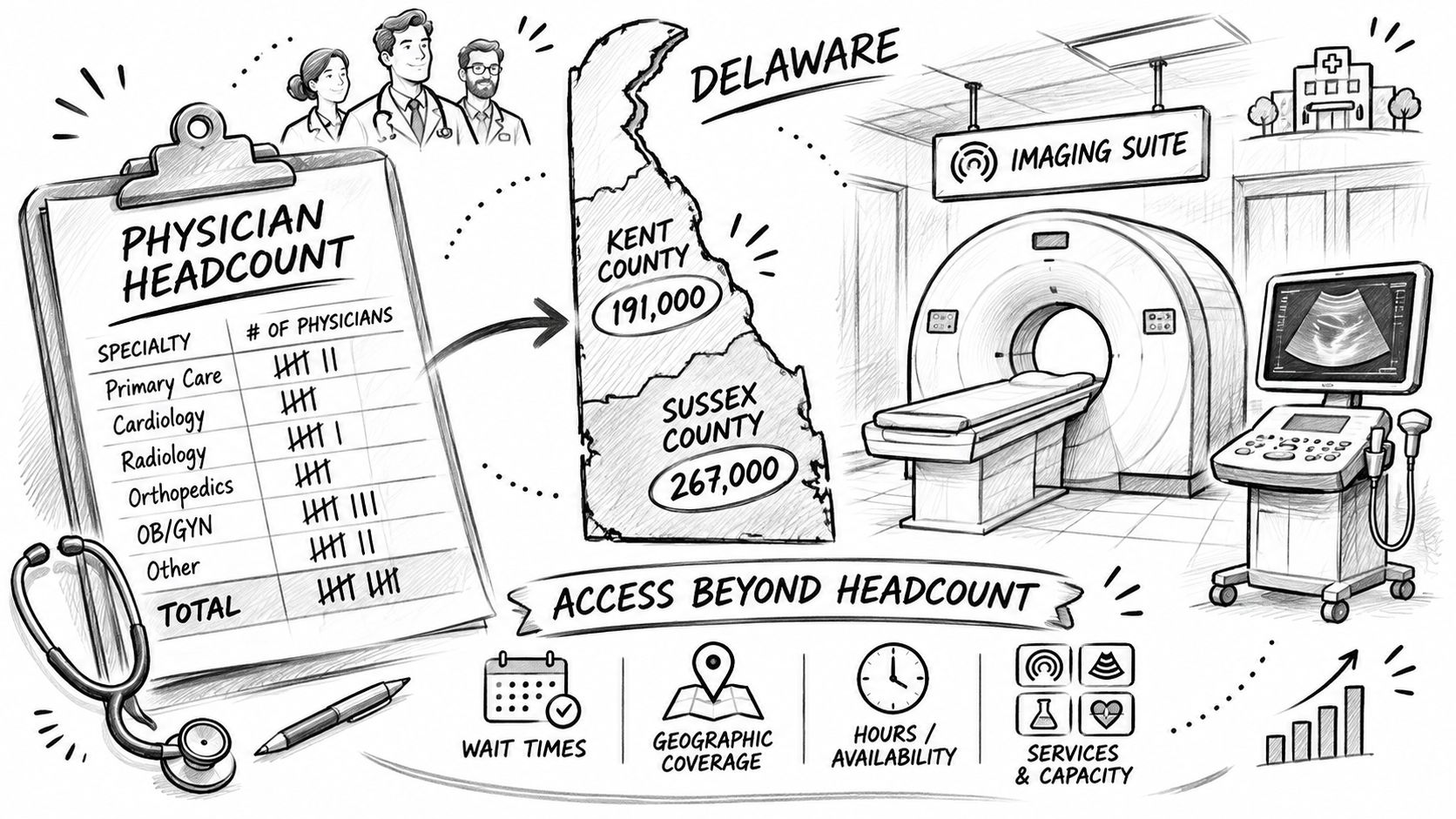
Four questions that reveal whether a hire fixes access
Where is the nearest PET/CT, and who owns it? A hospital-based scanner and an office-based scanner carry different scheduling rules, different referral pathways and different transport obligations.
How long is the wait for a slot? A scanner with a two-week queue is a bottleneck even when it's inside the same health system.
How often does follow-up require travel? Surveillance intervals for heart failure and structural disease drive repeat trips, and repeat trips drive noncompletion.
Can telecardiology absorb the visit without pretending to absorb the scan? Remote review of an echo or a device interrogation reduces trips. It doesn't replace the imaging suite.
Who absorbs the travel burden
Older adults, patients with heart failure and rural residents carry most of it, and the barriers are practical rather than clinical: transportation, work schedules, caregiver availability. A 60-mile round trip is a manageable inconvenience for a working patient with a car and an insurmountable one for an 82-year-old without either. Programs that count physicians without counting those trips routinely overstate their own access.
Geography check: Kent and Sussex are Delaware state counties. These travel distances describe southern Delaware, not Delaware County, Pennsylvania, and they shouldn't be applied to a Philadelphia-suburban search.
The contrarian conclusion is uncomfortable for anyone defending a headcount target. Adding physicians alone may not solve access if diagnostic infrastructure stays concentrated in northern Delaware and neighboring Pennsylvania. Capital planning for imaging has to move in the same cycle as physician recruitment, or the new hire spends the first year managing referrals out of the county.
Recruitment Models That Close Coverage Gaps
Delaware's 50-physician shortfall belongs in the capacity and access column, not the vacancy column, as Becker's Cardiology analysis of the state projections makes clear. A gap that size in a small market distorts call coverage, pushes referrals across state lines, stretches wait times and disrupts procedural scheduling long before it shows up as an unfilled requisition.
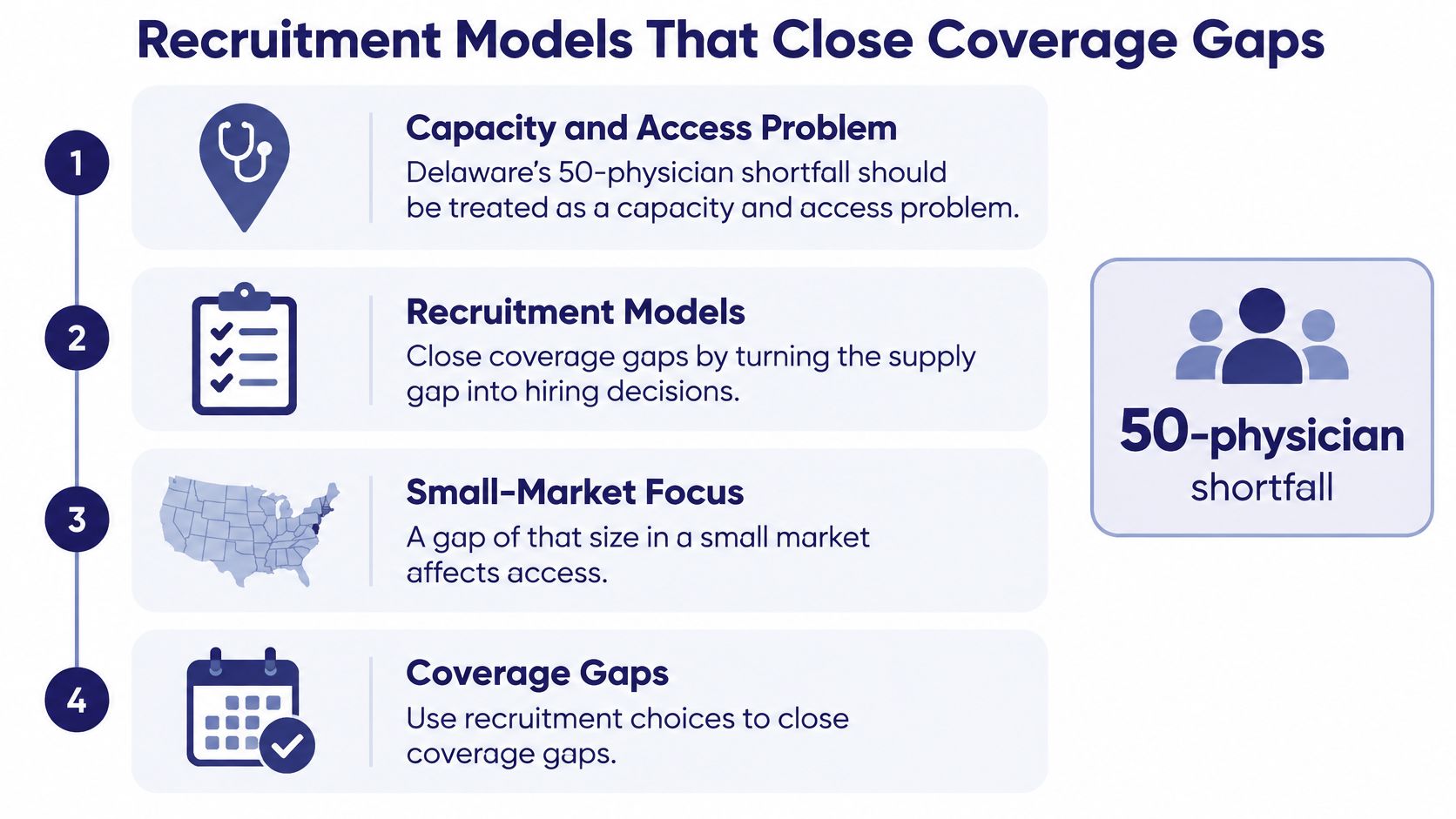
The practical move is to score candidates by service-line capability (general cardiology, interventional cardiology, electrophysiology, heart failure, imaging) rather than by headcount, then choose the coverage model that produces usable capacity fastest.
Coverage model | Best fit | Capacity signal |
|---|---|---|
Permanent hire | Sustained call and procedure volume | Time to independent practice and call burden |
Locum tenens | Short gaps and leave coverage | Coverage days filled and credentialing time |
Advanced practice provider | Clinic and follow-up volume | Expected new-patient capacity; median $126,583 private practice vs $122,873 integrated in 2023 |
Shared call pool and telecardiology | Thin coverage across dispersed sites | Downstream procedural access and referral leakage |
What each model costs and what it buys
Compensation benchmarks shape the comparison. Pennsylvania cardiologists averaged $408,950 in 2023 against a state average household income of $100,015, a comparison Becker's ASC published using Bureau of Labor Statistics and U.S. Census data. Advanced practice capacity is cheaper per unit of clinic volume: median 2023 compensation for private-practice cardiovascular advanced practice providers was $126,583, compared with $122,873 for providers in integrated programs, according to MedAxiom's 2024 compensation and production survey.
Those figures frame a real trade. A permanent interventional hire protects procedure volume for a decade but takes months to recruit and longer to credential. A locum covers the gap next quarter at a higher per-day cost and adds no long-term call stability. An APP absorbs follow-up volume immediately and frees physician hours for procedures and new-patient evaluation.
The only capacity metric that counts
Measure usable capacity, not signed contracts. Four signals separate a real addition from a nominal one: time to independent practice, call burden absorbed, expected new-patient capacity, and downstream procedural access. A physician absorbed by inpatient coverage adds little to outpatient access, and a subspecialist without room time adds nothing to a procedure queue.
Pennsylvania's smaller proportional deficit still supports targeted hiring, especially for subspecialties whose coverage requirements are hard to spread across geographically dispersed facilities. The hiring question there is which service line, not whether to hire at all.
When interim coverage carries the load, vetting and onboarding speed decide whether the bridge holds. American Cardiology Group vets each locum professional in its network before placement, and its team manages credentialing and compliance for locum providers so facilities can onboard quickly. Programs comparing physician staffing solutions should ask for those two timelines in writing before signing.
Confirm the Coverage Model Before You Post the Role
Four decisions should be settled before a requisition goes live, and each one changes the candidate pool.
Lock the geography. County, state or metro, using county-level data the state publishes. A state average applied to a single hospital campus produces a business case nobody can defend at budget review.
Name the service-line gap. General cardiology, electrophysiology, interventional cardiology, heart failure or imaging. "Cardiologist" as a job title attracts generalists to an EP problem.
Quantify the call and procedural coverage the role must carry. Call nights per month, procedure sessions per week, new-patient slots per clinic day. These are the numbers that determine whether the hire relieves pressure.
Choose the coverage model and plan interim cover. Permanent, locum, advanced practice or a shared call pool, with a bridge in place while the permanent search runs.
Succession risk is the argument for doing this early rather than well. The Association of American Medical Colleges' 2024 workforce analysis projects an overall U.S. physician shortage of up to 86,000 physicians by 2036, with specialty shortages inside that range. Nearly two in five active physicians are expected to retire within the next decade, and Medicare-funded residency positions have stayed capped since 1997.
Retirements, long training pathways and fixed graduate-medical-education capacity hit high-acuity cardiac services hardest, because the replacement pipeline is the narrowest part of the system.
Every cardiology role therefore needs a succession plan, not just a job description: fellowship-trained subspecialty coverage, advanced practice support, and interim coverage during recruitment. Programs that post first and plan later end up rebuilding the same search two years in a row. American Cardiology Group specializes exclusively in cardiac recruitment and connects cardiac specialists with healthcare facilities across the U.S., which is the difference between a generalist search firm learning a service line and one that already knows where the candidates are.
The shortfall in this corridor is a coverage problem with a defined shape: 71% adequacy in Delaware, procedure waits measured in weeks, and imaging deserts across two southern counties. American Cardiology Group works only on cardiac searches, from general cardiology and electrophysiology to interventional and cardiothoracic surgery, and pairs permanent recruitment with locum coverage when a service line needs a bridge before the permanent hire starts. Bring the coverage plan, the geography and the service-line gap, and visit American Cardiology Group to start the search.
Comments