
Interventional Cardiology Medical Group Roles and Staffing
13,500 to 86,000 physicians. That's the shortfall the Association of American Medical Colleges projects for the United States by 2036, and cardiology sits inside the deficit rather than beside it. Population growth of 8.4% by 2036 pushes demand for coronary, structural, electrophysiology and heart-failure care upward while retirements and geographic maldistribution pull supply down.
For an interventional cardiology medical group, that framing changes the hiring question. The vacancy on the org chart isn't the planning unit. The planning unit is the set of procedures the group must deliver, the coverage pattern that keeps a catheterization laboratory safely staffed through a weekend, and the reimbursement each case generates. Design around those three, and the physician slot becomes an output rather than the starting point.
Table of Contents
How an Interventional Cardiology Medical Group Is Structured
An interventional cardiology medical group is a physician practice organized around catheter-based treatment of coronary and structural heart disease. The definition matters for staffing, because everything the group owns sits downstream of a procedure: operators, lab sessions, device inventory, sedation and hemodynamic support, and the referral base that fills the schedule.
The specialty drew its boundaries in one afternoon. On September 17, 1977, Andreas Grüntzig performed the first successful coronary balloon angioplasty in Zurich, treating an 85% narrowing in the left anterior descending artery of a 38-year-old man with severe angina, as a Circulation review of PCI's evolution documents. Early angioplasty reduced stenosis in 32 of 50 patients, cutting average narrowing from 84% to 34% and the translesion pressure gradient from 58 to 19 mmHg. The hardware kept arriving, with the first human coronary stent in 1986, the first bioresorbable coronary scaffold in 1998 and the first drug-eluting stent in 1999, and the success curve moved with it: from a 63% success rate with 24% of patients needing bypass before discharge to 94% to 97% procedural success in the stent era.
The organizational chart below shows how the roles stack, from physician ownership down to the referral network that feeds the lab.
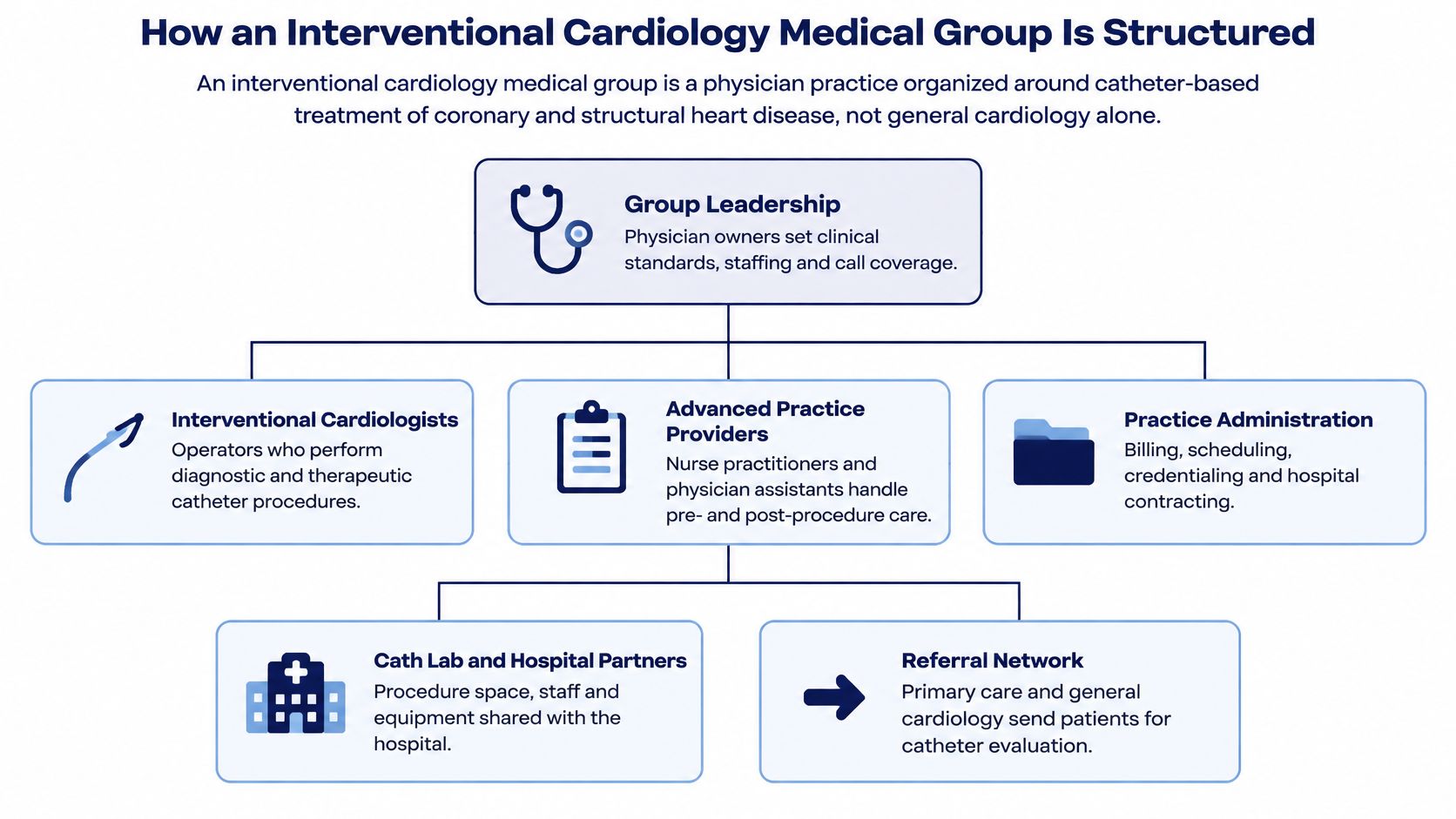
Read the chart as a dependency chain rather than a reporting line. The group sits above a catheterization laboratory, and the lab only functions when nursing, imaging, device support and hospital scheduling land in the same block of time. A group that hires a strong operator into a lab with no protected turnover time has bought a credential, not capacity.
The medical director carries the part of the structure that never appears in a job description. Privileging decisions, protocol ownership, peer review and the risk-adjusted dashboard all route through that seat, and in a smaller group the same physician often holds it alongside a full clinical schedule. Underfund the role and the gap surfaces at the first adverse event, when someone has to run the review and nobody owns the data.
Role | Core responsibility | Coverage model |
|---|---|---|
Interventional cardiologist | Diagnostic catheterization, PCI, complex coronary and structural cases | Core operator, scheduled and on call |
Cardiac electrophysiologist | Ablation and device implantation, often in the same lab | Shared or separate coverage |
Advanced practice provider | Pre- and post-procedure care, rounds, discharge teaching | Extends physician capacity |
Cath lab nurse and technologist | Sedation support, hemodynamic monitoring, equipment setup | Staffed per lab session |
Medical director | Quality review, privileging, protocols | Oversees group performance |
Practice administrator | Scheduling, credentialing, payer contracts | Dedicated or shared across service lines |
A structure audit takes fifteen minutes and beats a strategic plan. List every role in the table and mark it filled, shared or missing. Shared roles are where quality problems hide, because two organizations each assume the other is reviewing the data. The fastest fix is usually administrative rather than clinical: advanced practice providers absorb pre- and post-procedure work, and the mid-level provider models used in cardiology practices show how much of the daily load can come off a physician's calendar.
Service Lines and What Each Procedure Pays
Procedure complexity sets payment, and the spread between routine and complex work in a cardiac program is wide. The 2026 outpatient rates below come from a reimbursement summary of the CMS outpatient prospective payment final rule, and every tier in the schedule tells the same story.
Procedure | APC level | Outpatient payment |
|---|---|---|
Diagnostic cardiac catheterization | Level 1 | $3,312 |
Angioplasty (CPT 92920) | Level 2 | $5,815 |
Bare-metal stenting | Between level 2 and level 4 | $7,309 |
Drug-eluting stenting | Between level 2 and level 4 | $7,500 |
Drug-coated balloon treatment | Between level 2 and level 4 | $7,438 |
Atherectomy with stenting, chronic total occlusion stenting, complex stenting | Level 4 | $18,729 |
Case mix, not raw volume, decides whether a cardiac program pays for itself. A group running a heavy diagnostic schedule is operating a screening service; the same lab with a steady share of complex stenting, atherectomy and chronic total occlusion work is running a therapeutic business. Reimbursement follows operator capability, so the block schedule should be built around which physicians can legitimately take the complex cases.
That creates a trap for groups built around routine catheterization. If nobody on staff can perform atherectomy or complex stenting, those referrals leave the building and land at a competitor holding the credential. The gap isn't marginal: the complex tier pays several times a diagnostic study, and drug-coated balloon treatment rose 123% from its prior amount in the same schedule.
Facility economics cut the other way in 2026. CMS finalized a 50% reduction in the indirect practice-expense component allocated using work relative value units for hospital-furnished services, which the American College of Cardiology's summary of the 2026 fee schedule estimates produces total relative-value-unit reductions of about 10% for facility-based pacemaker implantation, transcatheter aortic-valve replacement, percutaneous coronary intervention and ablation. A 2.5% efficiency adjustment applies to most non-time-based services, and the conversion factor rises to $33.4009 for clinicians outside a qualifying alternative payment model and $33.5675 for those participating. Those increases don't erase the procedure-specific pressure created by the site-of-service methodology.
Run three checks before the next budget cycle:
List every procedure the group performs, including the ones only one operator can do.
Map each to its payment tier so the revenue mix is visible rather than assumed.
Compare the tier mix against the operators who can cover it, and flag any high-value procedure with a single point of failure.
Workforce Supply and Fellowship Pipeline
The national headcount looks workable until it's tested against where care is delivered. A workforce analysis counted 6,443 interventional cardiologists who submitted Medicare claims in 2008, noting that no complete national database identified every practicing operator, and the same Circulation: Cardiovascular Interventions workforce analysis found 7,129 physicians had received interventional board certification by 2014, with 5,742 certificates still valid.
Training capacity grew alongside that base. ACGME-approved fellowship programs rose from 83 in 2003 to 142 by 2014 and trained 313 interventional fellows. Two other findings constrain what that growth delivers: more than 20% of the interventional workforce was aged 60 or older, and fewer than 10% of interventional cardiologists and electrophysiologists combined were women.
Why a certificate count is not a capacity figure
A credentialed operator may be structurally unavailable to a given hospital. They can be locked into an academic group, held by a non-compete, unwilling to carry STEMI call, or settled in a metro where the jobs already cluster. Capacity is local and temporal: it describes whether a specific lab can be staffed on a specific night. National supply describes a market.
Capacity test: if the group can't name the operator covering a 2 a.m. STEMI three weeks from now, the region's supply statistics are irrelevant to that gap.
The 2026 Match paradox
If training slots were the binding constraint, every fellowship would fill. They don't. For the 2026 appointment year, 307 interventional cardiology positions were offered and only 244 applicants entered the Match, a ratio of 0.79 applicants per position, and 49 programs went unfilled even though 96.3% of applicants who preferred interventional cardiology matched, per the published analysis of the 2026 appointment year.
An unfilled fellowship and an understaffed program are two symptoms of one distribution problem. Something between the end of training and the first attending contract filters candidates away from the roles hospitals most need filled.
Four drivers explain most of the gap:
Geographic concentration. Candidates cluster where colleagues, schools and spousal job markets already exist, so a well-funded program in a thin market competes against geography, not against other offers.
Call burden and lifestyle. Around-the-clock STEMI coverage remains the least attractive element of the role, and groups that can describe a team-based rotation in the interview move faster than those that describe solo call.
Compensation uncertainty. Procedural income now depends on site-of-service rules and payer mix, and candidates price that volatility into negotiations.
Job design mismatch. Hospitals post the role they need covered rather than the role a physician wants to hold, which leaves clinical leadership, program building and protected complex case time off the table.
Groups compete for a smaller pool than the national headline implies, and each type competes differently. Academic centers sell mentorship, research time and complex case exposure. Rural hospitals sell protected time and a named coverage team instead of a solo rotation. Private groups sell flexible call structures, a partnership path and control over schedule. Candidates read the field the way hospitals read the market, and a plain-language overview of the interventional cardiology fellowship pathway is often where a trainee starts comparing what the next decade looks like at each type of program.
The conclusion is uncomfortable for organizations that treat recruitment as advertising. A group wins candidates by designing a clinical role a physician wants to hold for twenty years: a call rotation with a team behind it, protected time for complex cases, and a defined path to program leadership. Posting the opening is the last step, not the strategy.
Operator Volume and Quality Metrics to Track
Annual procedure counts are widely cited, but they provide limited evidence of quality on their own. In a U.S. analysis linking the NCDR CathPCI Registry with physician certification and provider databases, early-career interventional cardiologists performed a median of 59 PCI cases annually, compared with 57 among non-early-career operators, according to the VA Health Services Research citation of the analysis. A two-case difference in median annual PCI volume is not a meaningful quality signal by itself.
Risk adjustment showed differences that volume alone could not capture. Early-career status was associated with higher odds of in-hospital mortality (OR 1.08; 95% CI 1.05-1.17) and bleeding (OR 1.08; 95% CI 1.05-1.12). Similar case counts can therefore coexist with different risk profiles. For hospital leaders, volume describes activity; it does not establish whether case selection and clinical support are appropriate.
The same distinction applies to lab capacity. At one academic medical center, 326 complications among scheduled, non-emergent cardiac catheterization procedures corresponded to an overall complication rate of 2.0%. The lowest rates occurred on days with 6 to 11 procedures, while unusually light and heavy days had higher rates, according to the published analysis of cath-lab volume and complications. Daily volume had only a weak correlation with complications (Spearman rho = 0.11). Staffing mix, workflow interruptions, patient selection and operational congestion may matter alongside the number of cases.
Build the dashboard around outcomes, process and capacity, then review results by operator and service line:
Risk-adjusted mortality: review quarterly to account for differences in case mix.
Bleeding rates: monitor as an outcome related to access-site technique and protocol adherence.
Urgent revascularization: track to identify incomplete results or complications that emerge after the procedure.
Contrast volume per case: interpret in relation to renal risk.
Radiation exposure: monitor for patient and staff safety.
Access-site complications: compare closure-device performance and technique across the group.
Door-to-device time: review STEMI performance by operator and shift, not only as a facility average.
Complications per 100 procedures: compare outcomes across lighter and heavier operating days.
Cancellation and delay rates: use as indicators of lab capacity.
Staffing-to-case ratio: assess whether each case has the team it requires.
Scheduling should reflect those measures. Pair a new operator with experienced procedural coverage during ramp-up, treat turnover time as a fixed cost, and review peak-load days separately from routine schedules. The cardiology quality metrics that programs report to governance can help shape the dashboard. To guide staffing and case allocation, report results by operator and service line rather than relying on group-wide totals.
Access Models for Rural and Community Hospitals
Rural access is a supply problem with an operating-model solution. A national rural-health analysis found 2.6 cardiologists per 100,000 rural residents against 7.3 per 100,000 in urban areas in 2022, and rural cardiologist supply per capita fell 5.8% between 2012 and 2022, according to the Rural Health Research Gateway analysis.
Treating coverage as a binary choice between a permanent physician and shipping every patient to a regional center is why so many small programs underperform. Rural health-system leaders describe a mix of intermittent specialist visits, referrals to larger cities, community-based specialists, telehealth and primary-care management with specialist support, not a single staffing model. What a community hospital needs is a combination matched to the case volume it generates.
Model | Best fit | Key requirement |
|---|---|---|
Permanent interventional cardiologist | High, steady PCI volume | Protected call and succession planning |
Locum tenens coverage | Gaps from vacancy or leave | Credentialing completed before the start date |
Tele-interventional support | Stable STEMI pathway with a regional PCI partner | Transfer protocol and shared quality data |
Visiting specialist clinic | Scheduled diagnostic and follow-up demand | Defined referral criteria |
Transfer to regional PCI center | Emergency STEMI without on-site PCI | Door-to-device targets agreed in advance |
The staffing decision isn't binary, and framing it that way pushes hospitals toward the weakest option: a standalone program with one interventionalist and too few cases to keep skills sharp. A deliberately designed hybrid, pairing a regional PCI center's operators with local diagnostic capability, tele-interventional reads and a rehearsed transfer protocol, is often safer and more financially viable than an underused full-time program. Skill maintenance and round-the-clock coverage both depend on volume a small catchment may not produce.
Local access doesn't require a full-time interventional cardiologist. It requires a defined pathway, a named operator and a transfer agreement both sides have rehearsed.
When a community hospital evaluates a candidate or a partner, procedural credentials are the entry ticket, not the deciding factor. Ask what the physician has built: a chest pain protocol, a referral pathway, a quality review, a call rotation that survived its first year. Write transfer and quality review into the agreement itself, with named contacts and agreed targets, because an informal referral relationship is the first thing to fail on a Saturday night.
Plan Your Next Hire Before the Vacancy Opens
The national projection makes a local point. The American College of Cardiology's workforce analysis projected a continuing U.S. deficit of approximately 1,900 interventional cardiologists through 2025, with specialty-specific estimates of 1,941 physicians in interventional cardiology including coronary and peripheral intervention, 1,685 in general cardiology and 660 in cardiac electrophysiology, as reported in the JACC workforce analysis.
A structural shortfall means recruiting only against current vacancies understates demand. The package matters as much as the pipeline: median total compensation for electrophysiology, invasive and interventional cardiologists exceeded $700,000 per full-time physician in 2024, per Becker's ASC Review's summary of cardiologist compensation and workforce data. Read that figure next to call burden and protected time rather than on its own, because a strong salary attached to an unsustainable rotation produces a short tenure.
The checklist below covers what needs to be settled before a search opens.
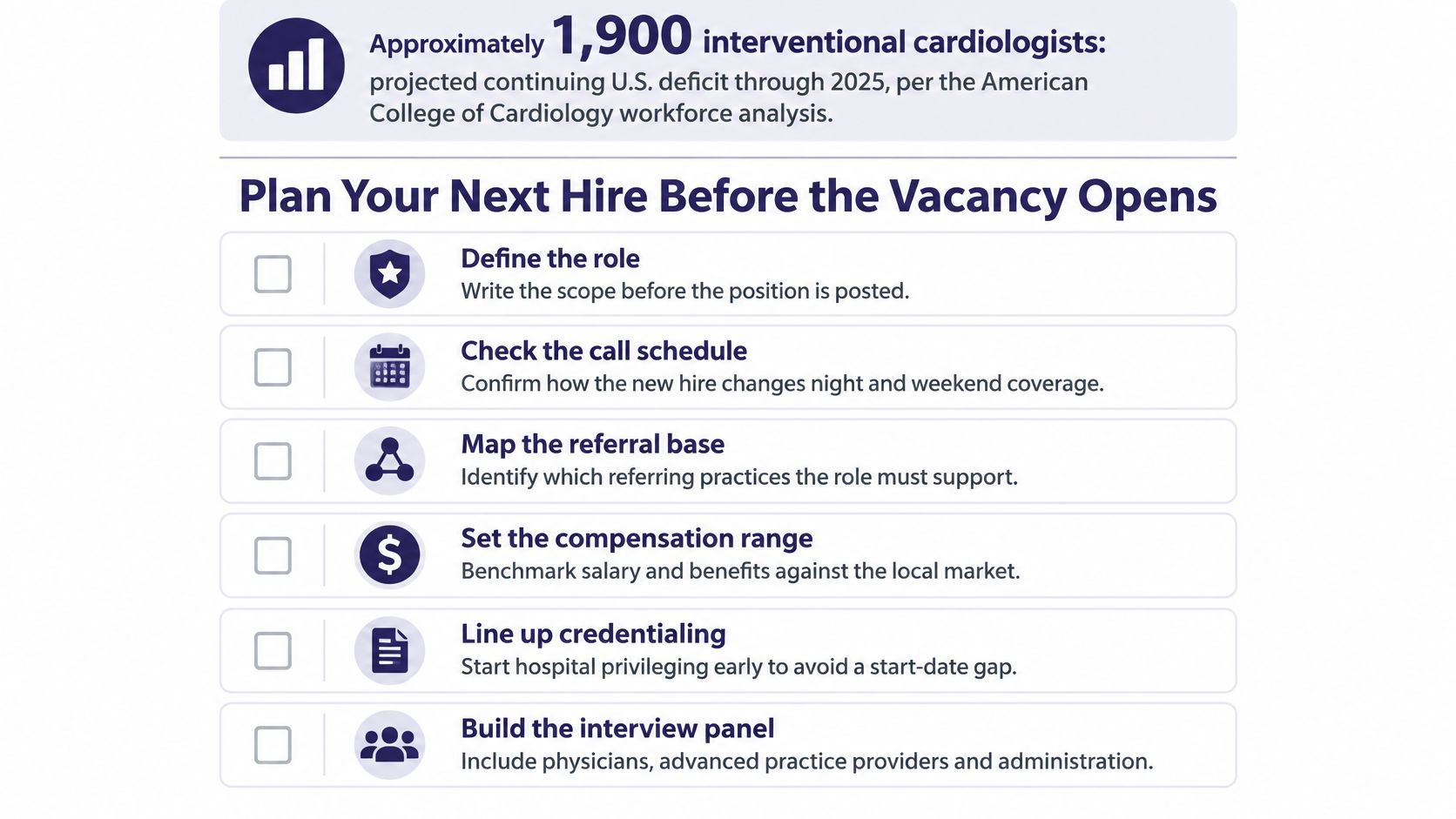
Map retirement windows by operator. A single retirement date can remove the only physician privileged for complex stenting, and the replacement timeline runs longer than the notice period.
Set a time-to-fill target for every open role. Measure it from the day the vacancy is anticipated, not the day it's posted, or the metric flatters the process.
Track call coverage by lab day. Coverage gaps show up first as scheduling workarounds, and those workarounds are the early warning.
Name the service lines that will grow. PCI, peripheral intervention, structural heart and 24/7 STEMI each demand a different credential and a different volume base.
Decide permanent versus temporary for each gap. Viable options are a permanent physician, locum coverage, an advanced practice provider absorbing part of the load, or an executive search for a program leader.
Where a gap has to close faster than a permanent search allows, American Cardiology Group's services include Permanent Physician Recruitment, Locum Tenens Solutions, Advanced Practice Recruitment and Executive Recruitment for cardiac programs. Write the twelve-month staffing plan this quarter, one page per role, with the coverage model that role supports and the recruiting route chosen for each gap. A plan written after the vacancy opens is a scramble with a budget attached.
American Cardiology Group recruits exclusively for cardiology and cardiac surgery, so the interventional and locum candidates presented for a catheterization laboratory role already understand what the call schedule involves. Whether a program needs a permanent interventional cardiologist, short-term lab coverage during a vacancy, or an advanced practice provider to take pre- and post-procedure work off a physician's calendar, the search is built around the coverage model rather than the job title. Visit American Cardiology Group to start a staffing plan for the next twelve months.
Comments