
Locum Tenens Pay Rates by Cardiology Specialty in 2026
Approximately 52,000 physicians annually worked locum assignments by 2019 and thereafter, compared with approximately 26,000 in 2002, according to historical estimates in CHG Healthcare's 2024 State of Locums report. For hospital executives, temporary physician compensation therefore deserves a workforce-budget framework, not an emergency purchasing decision. In cardiology, the highest advertised day rate can be the weakest offer when it bundles procedural work, unrestricted call, and uncompensated time into a single payment.
Table of Contents
Locum Tenens Pay Rates at a Glance - What the benchmarks actually measure
Effective Hourly Pay and Negotiation Levers - Build separate facility and candidate calculations - Negotiate risk before negotiating upside
Pay Rates Across Cardiology Subspecialties - Procedural growth changes the buying decision - Missing subspecialty rates require actual bids
Rural, Academic and Surgical Assignment Premiums - Match the incentive to the burden
Market Movement and Renewal Pricing - Turn renewal into a scope review - Use explicit renewal triggers
Sourcing and Updating Benchmark Figures - Classify the evidence before comparing it - Maintain a usable benchmark register
Confirm the Effective Rate Before You Sign - Complete the contract checks in order - Establish a clear walk-away condition
Locum Tenens Pay Rates at a Glance
Locum tenens pay rate benchmarks for cardiology
Benchmark | Figure | How to use it |
|---|---|---|
Locum physician day rate, all specialties | About $700 to more than $4,000, according to the 2024 locum provider survey | Range check for any quote |
Cardiology locum day rate | About $2,500 to $4,000, as discussed by Barton Associates | Starting range for cardiology bids |
Locum premium over permanent pay | About 30%, an industry expert estimate cited in the American Medical Association's locum tenens overview | Opening negotiation benchmark |
Hourly premium over permanent full-time, 2024 | $32.45 more per hour, according to Hanover Research's study with CHG Healthcare, reported by Weatherby Healthcare | Scale check on total hourly cost |
Median permanent cardiology compensation, 2025 report | $587,360, reported in Doximity's Physician Compensation Report | Permanent comparison only, not an hourly rate |
The broad physician day-rate range is a screening tool, not a cardiology rate card. It combines specialties and assignments with different workloads, geography, experience requirements, and call obligations. A quote outside that range warrants investigation, but a quote inside it isn't automatically competitive.
The cardiology-specific range narrows the discussion without resolving it. An outpatient general cardiology assignment and an interventional cardiology assignment with emergency catheterization coverage purchase different clinical capabilities. Procurement teams should request an explicit service description before treating either quote as comparable.
What the benchmarks actually measure
The premium estimate is an industry negotiation reference, not an AMA-established compensation standard. It can frame an opening position, but the final comparison must account for benefits, schedule intensity, subspecialty availability, and covered assignment expenses. Applying the premium to salary alone while ignoring permanent benefits can distort the comparison.
The hourly premium is an observed physician-wide comparison, not a cardiology-specific differential. It helps assess scale, but it shouldn't become an automatic addition to a cardiologist's permanent hourly equivalent.
Doximity's figure supplies a permanent compensation reference, not an hourly locum price. Converting it requires an actual work schedule, benefit valuation, paid leave treatment, and a clear understanding of call and productivity obligations.
Budget rule: A day rate prices a contract's defined obligations. Without those definitions, it doesn't price a comparable unit of cardiac care.
These benchmarks establish a starting envelope for bid review, not mandatory limits within which every assignment must fall. Travel, accommodation, professional liability coverage, and schedule design can change the economics materially. The strongest offer is the one with the best defensible effective value, rather than the largest number in the advertisement.
Effective Hourly Pay and Negotiation Levers
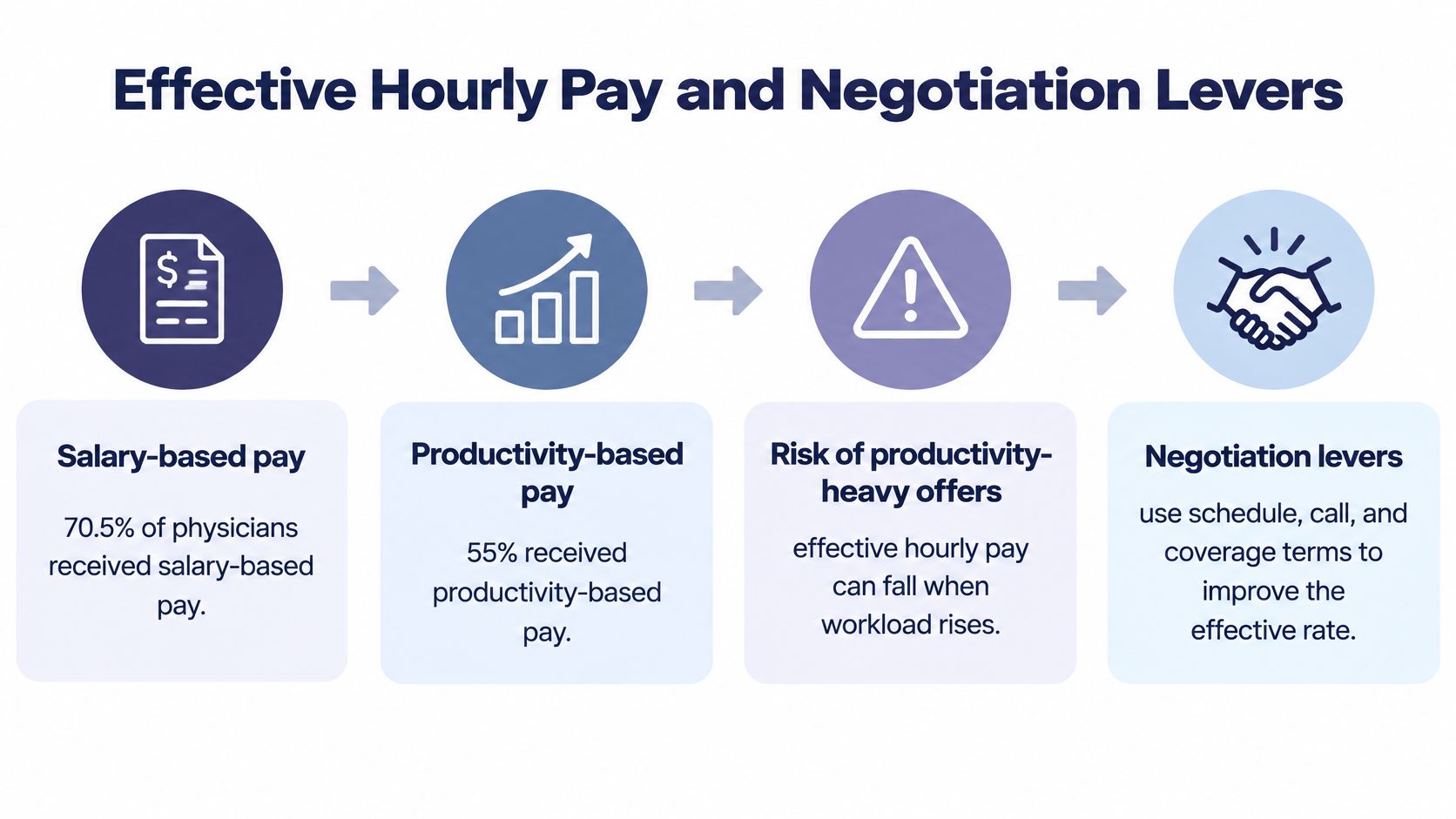
The AMA's 2024 Physician Practice Benchmark Survey found that 70.5% of physicians received some salary-based compensation, 55% received productivity-based compensation, and 39% received bonuses. Surgical specialists relied more heavily on productivity-based models than other specialties. These overlapping categories describe compensation structure, not locum rate schedules.
A productivity-heavy offer transfers part of the assignment's financial uncertainty to the physician. A candidate may accept a higher advertised earning opportunity but collect less if procedure availability, referral volume, or operating capacity doesn't support the expected output. Hospitals should distinguish compensation for availability, compensation for work performed, and compensation contingent on results.
Build separate facility and candidate calculations
Consider a hypothetical $3,200 day rate for a 10-hour clinical shift. Dividing the assumed payment by the assumed shift length produces $320 per clinical hour. That arithmetic establishes the scheduled base rate only; it says nothing about additional callback hours, unpaid chart completion, travel time, or cancellation exposure.
A useful spreadsheet needs separate columns for hospital expenditure and candidate economic value. Reimbursed airfare is a facility cost, but it isn't unrestricted physician income. Likewise, an agency charge belongs in the hospital's budget without being presented as physician compensation.
The calculation should proceed through the following adjustments:
Establish guaranteed compensation and call pay. Add guaranteed clinical payments, call stipends, and guaranteed callback payments over the assignment period. Divide that subtotal by scheduled clinical hours for an initial normalized measure. Record standby call hours separately, because availability restrictions aren't equivalent to active clinical work.
Add overtime, holiday differentials, and expected procedure or productivity payments. Separate guaranteed and contingent totals. For productivity compensation, document the applicable work relative value unit, or work RVU, basis, payment threshold, attribution rules, and payment timing. An expected payment should never appear in the guaranteed column.
Account for travel and housing without double-counting. Add reimbursed travel and accommodation to facility expenditure over the same budgeting period. For candidates, record reimbursement against the corresponding expense, then subtract any unreimbursed assignment costs. Reimbursement that merely offsets a required expense shouldn't be treated as extra take-home earnings.
Allocate malpractice and licensing costs. Include professional liability coverage, licensing expenses, and credentialing charges in the facility calculation when the facility pays them. Subtract them from candidate value when the physician bears them personally. The contract should identify coverage responsibilities, including any applicable post-assignment coverage obligations.
Estimate cancellation exposure from the actual agreement. Expected cancellation loss equals unpaid cancelled compensation weighted by the documented likelihood of cancellation. If the facility lacks reliable cancellation history, use clearly labeled scenarios rather than an invented frequency. Check whether notice periods, guaranteed shifts, and expense reimbursement reduce that exposure.
Calculate the final effective measures. Divide all-in facility expenditure by staffed clinical hours. Divide candidate net assignment value by clinical hours, then run a separate time-adjusted calculation that includes uncompensated administrative and travel time. For the permanent alternative, value salary, benefits, and paid leave consistently, using actual working obligations rather than an assumed universal annual-hours divisor.
This produces more than a single hourly number. It reveals whether an offer is expensive because of clinician pay, assignment logistics, service intensity, or contract risk.
Negotiate risk before negotiating upside
The negotiation sequence should begin with terms that protect the assignment's economic floor:
Guaranteed minimum pay: Define minimum paid shifts or hours and the circumstances that permit reductions.
Call and callback premiums: Separate standby availability from active work, including how callback interacts with the scheduled shift.
Overtime and holiday differentials: Specify the trigger, authorization process, and applicable compensation.
Procedure payments: State the work RVU basis or other productivity measure, including reconciliation and dispute procedures.
Cancellation protection: Establish notice requirements, payment obligations, and treatment of committed travel expenses.
Travel, housing, and malpractice: Identify covered items, approval limits, reimbursement timing, and responsible parties.
The industry premium benchmark can support an opening position on guaranteed base pay, provided both sides reconcile the full package before finalizing it. Candidates offering difficult dates or schedule flexibility can seek stronger guarantees in return, rather than accepting flexibility as an uncompensated obligation.
A high gross day rate can therefore deliver a lower effective return when the physician absorbs heavy callback, lengthy travel, or unpaid administrative work. A hospital may also pay more without obtaining dependable capacity if the agreement lacks protected shifts. The broader decision about whether locum tenens work is worth it depends on those operational terms as much as compensation.
Pay Rates Across Cardiology Subspecialties
The measured subspecialty changes in MGMA's 2024 Provider Compensation Data Report show why a single cardiology average is a weak pricing anchor: from 2022 to 2023, invasive cardiology compensation rose 3.76% while work RVUs rose 16.25%, invasive-interventional compensation rose 6.80% on 5.89% RVU growth, and noninvasive compensation rose 4.71% with almost flat RVU growth of 0.02%.
Subspecialty | Total comp change, 2022 to 2023 | Work RVU change, 2022 to 2023 | Pricing implication |
|---|---|---|---|
Invasive cardiology | +3.76% | +16.25% | Weight the rate toward procedural volume and productivity basis |
Invasive-interventional cardiology | +6.80% | +5.89% | Weight the rate toward procedural scope and call burden |
Noninvasive cardiology | +4.71% | +0.02% | Price clinic and consult time, with a smaller productivity-growth adjustment |
Electrophysiology, advanced heart failure and cardiac surgery pay bands should be set from specialty bid data, because the privileges, laboratory access and emergency coverage inside each role vary too much for a blended cardiology rate.
Procedural growth changes the buying decision
Invasive cardiology's reported productivity growth substantially exceeded its compensation growth. Comparing those growth factors implies a decline in compensation relative to work RVUs at the aggregate benchmark level, while still leaving open whether every individual physician's compensation per work RVU moved the same way, since reported medians do not necessarily describe identical physicians.
That gap changes locum budgeting. A bid anchored to historical compensation but attached to a larger procedural workload can understate the output being purchased. Attaching a procedural premium to a clinic-only assignment can overprice the required scope. The highest advertised day rate can be the weakest offer once broad procedural scope and heavy call sit behind the headline number, so the hospital should price the specified work and the candidate should price the same obligations.
Missing subspecialty rates require actual bids
Electrophysiology assignments should distinguish device management, inpatient consultation and ablation coverage. A role requiring procedural privileges and laboratory availability needs a different scope assessment from a consultation-only role.
For advanced heart failure, the specification should identify consult responsibilities and any mechanical circulatory support or transplant-related duties. Cardiac surgery requires separate assessment of operative responsibilities, emergency availability, postoperative management and backup arrangements.
Separate bands should account for procedural intensity, expected interventions, case complexity and support teams; call frequency, active callback and backup coverage; scarcity for the exact privileges and location; and productivity expectations with the basis for added payment. For interventional cardiology locum tenens coverage, emergency call and procedural scope should appear explicitly in the bid specification, not remain implied by the specialty title.
Rural, Academic and Surgical Assignment Premiums
71% of locum physician jobs were located at federally designated Health Professional Shortage Area worksites, according to reporting summarized in congressional testimony on healthcare workforce access. The same testimony puts rural assignments at 34% of populations served by locum providers, a measure of patients reached rather than the rural share of all jobs.
A shortage-area designation and a rural location aren't interchangeable. Both can inform recruitment planning, but neither establishes the premium required for a particular cardiology assignment. Rate bands for each setting depend on current bids, so the comparison below maps what pushes a bid up or drags it down.
Assignment settings and pay drivers
Setting | What raises the rate | What lowers its value |
|---|---|---|
Rural community hospital | Urgency, limited backup, travel, and credentialing complexity | Fewer procedures, lower volume, weaker infrastructure |
Metropolitan academic center | Subspecialty scarcity and complex consult load | Heavy teaching and administrative duties, competitive permanent market |
Outpatient cardiac procedure site | Procedure-based productivity and a defined schedule | Narrow scope and limited call support |
Health system with block scheduling | Guaranteed shifts and predictable call | Lower headline rate, less flexibility on dates |

Match the incentive to the burden
At a rural community hospital, a candidate may need compensation for travel and limited backup even when procedure volume is modest. Lower volume doesn't necessarily mean fewer availability restrictions. Planning coverage against the rural physician shortage works better when the facility prices infrastructure gaps alongside vacancy urgency, because a high day rate attached to solo call and thin procedural support can still be a weak offer.
An academic center should price teaching, supervision, and administrative expectations explicitly rather than folding them into clinical compensation. An outpatient procedure site should confirm that scheduled case volume and staffing support the productivity opportunity advertised.
For block-scheduled coverage, guaranteed shifts raise candidate certainty even when the headline rate is lower. The facility must still specify dates, handoffs, and call obligations so the discount buys something concrete.
The relevant question isn't whether rural assignments deserve a premium. It is which premium compensates for the actual burden, and which burdens the facility can remove.
Housing, predictable blocks, telecardiology support, and coordinated privileging can each remove a named barrier at lower cost than a larger daily rate. Expedited processes must still preserve credentialing standards. When two settings advertise the same day rate, the one carrying heavier call and broader procedural scope is the weaker offer, whatever the number on the posting.
Market Movement and Renewal Pricing
The American Medical Group Association's 2025 survey reported a 4.9% median compensation increase across cardiology, gastroenterology, and hematology/medical oncology, compared with 4% average compensation growth across all specialties, as described by the Massachusetts Medical Society. The combined median earnings figure for those specialty groups was $516,448, according to the same account.
Those figures are directional, not cardiology-only. They also compare a specialty-group median change with an all-specialty average change, so they don't justify applying the gap mechanically to every cardiology contract.
A rate negotiated against an older market reference can nevertheless become a weak renewal anchor. Hospital leaders should reopen the underlying comparison rather than merely applying a general physician increase to last year's invoice.
Turn renewal into a scope review
Select the relevant index. The compensation committee should identify the closest available specialty and regional comparison. If only a combined-specialty measure is available, the renewal memorandum should label that limitation and pair it with current assignment bids.
Examine the guaranteed base. A nominal increase may leave the physician's guaranteed compensation unchanged if the additional value sits entirely in contingent productivity payments. Finance should distinguish changes in base pay from changes in expected earnings.
Reassess permanent conversion. A locum-to-permanent comparison needs a current permanent package, not the salary budget approved when the vacancy opened. Benefits, paid leave, call, administrative duties, and productivity incentives should be valued on the permanent role's own terms.
Use explicit renewal triggers
A workable review policy can include the following triggers:
Specialty movement above the broad-market reference: Growth above the reported general benchmark should prompt investigation, not an automatic matching increase.
A change in subspecialty mix or call coverage: Adding electrophysiology responsibilities or emergency coverage changes the purchased service.
A new procedural service line: New capacity can change case mix, expected work RVUs, staffing dependencies, and the appropriate productivity basis.
The renewal decision should distinguish a market adjustment from a scope adjustment. Combining both into a single unexplained increase makes future negotiations harder and prevents executives from identifying why coverage costs changed.
The same discipline protects candidates. A rate can appear current while the hospital has expanded its obligations beyond the original agreement.
Sourcing and Updating Benchmark Figures
A defensible benchmark file records population, compensation basis, reporting period, and intended use. The source title alone isn't enough, particularly when publication year and underlying compensation year differ.
Classify the evidence before comparing it
MGMA's 2025 Provider Compensation Data Report represents more than 220,000 physicians and advanced practice providers from 8,000 organizations across 250 specialties, using 2024 compensation data. Its work RVU, compensation-to-productivity, and performance-quartile framework supports output comparisons, not direct locum day-rate pricing.
Other sources serve narrower purposes:
MGMA's earlier report: Subspecialty compensation and productivity movement support scope-sensitive pricing.
Doximity: Full-time physician compensation supplies a permanent-role comparison, not an assignment invoice benchmark.
American Medical Group Association: Combined-specialty movement provides directional renewal context, not an isolated cardiology index.
Locum provider surveys: Assignment pay observations help screen quotes but require specialty and workload qualification.
Hanover Research with CHG Healthcare: The locum-versus-permanent hourly comparison supplies broad context rather than a cardiology-specific premium.
Maintain a usable benchmark register
Record the original basis. Preserve daily, hourly, annual, guaranteed, and contingent labels before converting anything.
Normalize with documented assumptions. Translate figures to hourly, annual, and all-in views only when the required schedule and expense information exists. Otherwise, mark the comparison incomplete.
Refresh on evidence or scope changes. Update the register when a new report appears, a relevant bid arrives, or an assignment's obligations change.
Any figure without a subspecialty designation should remain labeled general. Unknown precision is preferable to a confidently misclassified rate.
Confirm the Effective Rate Before You Sign
Contract approval should require a documented effective-rate comparison, not merely confirmation that the advertised day rate looks competitive. Candidates and facilities have different financial perspectives, but both need the same schedule, scope, and payment definitions.
Complete the contract checks in order
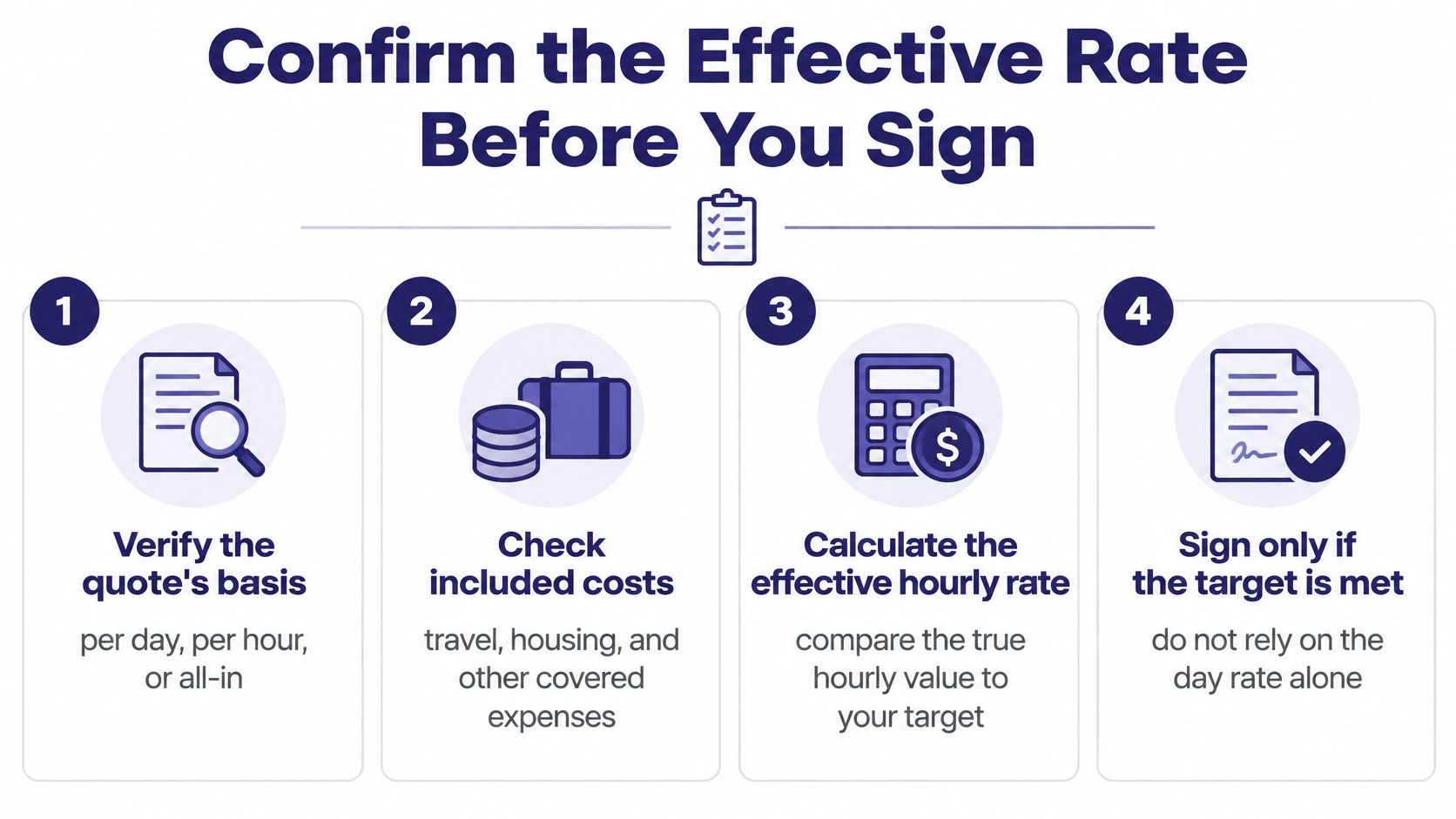
Verify the quote's basis. Establish whether the amount is per hour, per day, per block, or all-in. The written agreement should identify whether travel, housing, professional liability coverage, and agency charges are included or separate.
Run the effective-rate calculation. Use the actual proposed schedule and payment rules. Contingent productivity earnings should remain visibly separate from guaranteed compensation, and uncovered costs should have a named payer.
Compare the permanent equivalent. Evaluate the result against a role with comparable clinical scope, benefits, leave, and call expectations. Subspecialty, setting, and urgency should explain adjustments rather than serve as unsupported labels.
Confirm enforceable economic terms. Guaranteed minimums, call compensation, callback rules, and cancellation provisions belong in writing. Verbal expectations don't resolve an ambiguous payment clause.
Validate readiness for the start date. The medical staff office and recruitment team should confirm outstanding credentialing, privileging, compliance, and onboarding requirements before treating coverage as secured.
Establish a clear walk-away condition
A candidate should decline an offer whose effective value falls well below the comparable permanent opportunity unless a specific non-rate benefit justifies the difference. Guaranteed blocks, suitable housing, or a strategically valuable schedule can matter, but their value should be explicit rather than assumed.
Facilities should also reject superficially inexpensive proposals that leave essential coverage undefined. A lower quote isn't a saving if the contracted clinician isn't responsible for the services the hospital needs.
American Cardiology Group's team manages credentialing and compliance for locum providers to help facilities onboard quickly. Its dedicated recruiters provide personalized support to both the facility and the locum provider throughout the process.
Facilities can initiate a request through the Request Staffing form, which asks for first name, last name, email, and state, with phone, title, and organization optional. A useful accompanying staffing specification identifies the specialty, procedural privileges, schedule, call expectations, and intended coverage period.
American Cardiology Group offers cardiology-focused locum tenens staffing across general cardiology, subspecialty, and surgical roles. Hospital leaders and specialized candidates can visit American Cardiology Group to discuss coverage requirements and opportunities with its recruiting team, using clinical scope and effective compensation rather than the advertised day rate as the starting point.
Comments