
Physician Recruitment Process for Cardiology Programs
A signed contract is not coverage. The Association for Advancing Physician and Provider Recruitment puts the 2024 all-physician median time to fill at 118 days. The interval from posting to first day runs longer, stretching with subspecialty scarcity, credentialing, and notice periods. For cardiology, that gap separates an accepted offer from restored clinic capacity, procedural access, and call coverage.
A physician recruitment process that holds up treats those outcomes as separate milestones. Clinical leaders define the work and call burden, recruiters build the pipeline, and medical staff leaders decide whether the chosen cardiologist can safely perform the requested procedures. A signature starts the credentialing clock. It does not stop it.
Table of Contents
The Physician Recruitment Process at a Glance - Assign an owner to every handoff - Adapt the workflow to the cardiac service
Defining the Clinical Need for a Cardiology Role - Specify the work before advertising the position - Complete a one-page approval worksheet
How to Run Interviews, Vetting and Credentialing - Execute the assessment and approval sequence - Use evidence rather than assurances - Define ready to start operationally
Designing Offers for Rural and Hard-to-Fill Roles - Make operational commitments explicit
Retention Checkpoints That Predict Year-One Success - Treat onboarding as a clinical operating process - Score fit from both sides
Decide Your Next Recruitment Step This Quarter - Match the response to the clinical gap
The Physician Recruitment Process at a Glance
Stage | Core Question | Output Before Moving On |
|---|---|---|
1. Define the need | What clinical gap and procedural volume are being filled? | Role profile with call burden, productivity target, and financial model |
2. Build the candidate profile | Which competencies and subspecialty skills matter most? | Competency-based candidate profile |
3. Source | Where are qualified candidates working or training? | Shortlist from referrals, professional networks, and academic channels |
4. Screen and interview | Can the candidate perform and fit the team? | Structured, scored interview results |
5. Verify | Are board status, training, references, and procedural competence confirmed? | Completed verification file |
6. Offer | Is the package competitive and accepted? | Signed agreement with a target start date |
7. Credential, onboard and integrate | Can the physician start safely and stay? | Privileges granted and a 180-day integration plan |
Assign an owner to every handoff
The service chief owns the need statement and competency requirements, with finance validating the business model. The physician recruiter owns sourcing, candidate communication, and interview coordination. Incumbent physicians and the clinical director own the clinical assessment rather than delegating it to recruitment staff.
The credentialing coordinator assembles verification evidence, while the medical staff office routes credentialing and privileging through the hospital's approval process. The authorized executive owns the offer, and a designated physician onboarding lead owns integration. Each handoff needs a named recipient, not merely a shared inbox.
Stages overlap, but their approval gates remain distinct. Recruiters can collect training records during interview scheduling, and administrators can prepare an onboarding plan during negotiations. An offer shouldn't leave the organization before board status, training, and preliminary procedural competence have been checked; an unconditional clinical start shouldn't be promised before privileges are in writing.
Practical rule: Parallel work shortens administrative delay. Skipping an approval gate transfers unresolved risk to the next owner.
Adapt the workflow to the cardiac service
A generic checklist doesn't establish whether the hospital needs an electrophysiologist with complex ablation experience or a general cardiologist supporting outpatient access. Heart failure, interventional cardiology, electrophysiology, and cardiothoracic surgery draw from different candidate pools and require different evidence of competence.
The recruiter therefore needs a clinical specification, not a specialty label. Relevant case experience, equipment familiarity, referral support, and the intended scope of practice should shape both outreach and evaluation.
From the first week, the search owner should track days in sourcing, interview-to-offer conversion, and start-date slippage. These measures answer different questions: whether the organization can attract candidates, whether interviews produce an actionable match, and whether post-selection work supports the promised coverage date.
Defining the Clinical Need for a Cardiology Role
The Association of American Medical Colleges' 2024 workforce projections estimated a U.S. shortage of 13,500 to 86,000 physicians by 2036, including 20,200 to 40,400 primary care physicians and 10,100 to 19,900 physicians in surgical specialties. These are scenario-based national projections, not a cardiology vacancy forecast for an individual hospital.
The ranges reflect assumptions about healthcare utilization, retirement, migration, and training capacity. Hospital executives should use that uncertainty to justify local forecasting, rather than select a national number and apply it directly to their service line.
Specify the work before advertising the position
A useful need statement distinguishes unmet demand from replacement hiring. A retiring physician's job description may no longer represent the program's referral patterns, procedural strategy, or staffing model.
Before posting, the clinical director should document:
Exact discipline: Identify general cardiology, electrophysiology, heart failure, interventional cardiology, or cardiothoracic surgery. Separate essential competencies from capabilities the program could develop later.
Procedural volume and case mix: Describe the available work, not aspirational growth presented as established volume. Identify dependencies such as catheterization laboratory access, anesthesia, imaging, and surgical backup.
Call burden: State the rotation, the colleagues sharing it, and arrangements for leave or unexpected absence. Distinguish general cardiology call from subspecialty procedural coverage.
Productivity expectations: Explain the clinical sessions, procedures, inpatient responsibilities, and nonclinical duties behind the target. Identify how ramp-up and referral development will be handled.
Vacancy exposure: Model what happens if the position remains unfilled for six months, including deferred services, temporary coverage, and additional duties for existing clinicians.
This definition changes sourcing immediately. A heart failure position built around longitudinal disease management and advanced therapies requires different outreach from an interventional role centered on coronary procedures and acute coverage. Neither search improves when the recruiter receives an undifferentiated cardiologist requisition.
Complete a one-page approval worksheet
The worksheet should fit on a single page and make unresolved assumptions visible. Every field requires an accountable owner and sign-off date before the recruiter publishes the opportunity.
Field | Required entry | Accountable owner and sign-off |
|---|---|---|
Need statement | Named subspecialty, case mix, essential competencies, and intended service expansion or replacement | Service chief; name and date |
Call and productivity model | Call rotation, colleague coverage, clinical workload, ramp-up, and productivity expectations | Clinical director; name and date |
Financial model | Compensation assumptions, support resources, and cost of a six-month vacancy | Finance lead; name and date |
Accountability record | Named owner and sign-off date for every field, with unresolved decisions assigned | Executive sponsor; name and date |
Finance should distinguish lost gross charges from lost contribution margin and avoid counting deferred activity as permanently lost revenue without justification. Clinical leaders should also identify whether remaining physicians can absorb the gap without reducing other services.
A signed worksheet doesn't eliminate uncertainty. It establishes which assumptions leadership has accepted and which changes require renewed approval, preventing candidates from receiving different descriptions from the recruiter, service chief, and executive team.
Sourcing Channels and Time-to-Fill Benchmarks
Benchmark | Value | Planning note |
|---|---|---|
Median time to fill, all physician positions, 2024 | 118 days | AAPPR's 2025 benchmarking report gives the broad comparison. For cardiac roles, use it as a floor rather than a forecast. |
Cardiology positions filled, 2024 | 37% | PracticeLink's analysis also reports the cardiology median in the next row. Candidate flow can look healthy while the requisition stays open. |
Median time to fill, cardiology, 2024 | 248 days | Set the locum bridge decision against this specialty figure. It runs more than four months longer than the all-physician median. |
Average on-site interviews per physician hire, 2025 | 2 | AAPPR benchmarking, summarized by the American Medical Association. Two on-site visits set the travel and scheduling load for finalists. |
Recruiters using locum tenens | 16% in 2025, 9% in 2024 | AAPPR benchmarking cited by CHG Healthcare. Locum use is rising, but it remains a minority tactic. |
The 130-day gap between the all-physician median and the cardiology median is the planning number that matters. A general search can close inside four months; a cardiac search can run past eight. That spread justifies opening a locum conversation while the permanent requisition is still being built, not after the first two candidates withdraw.
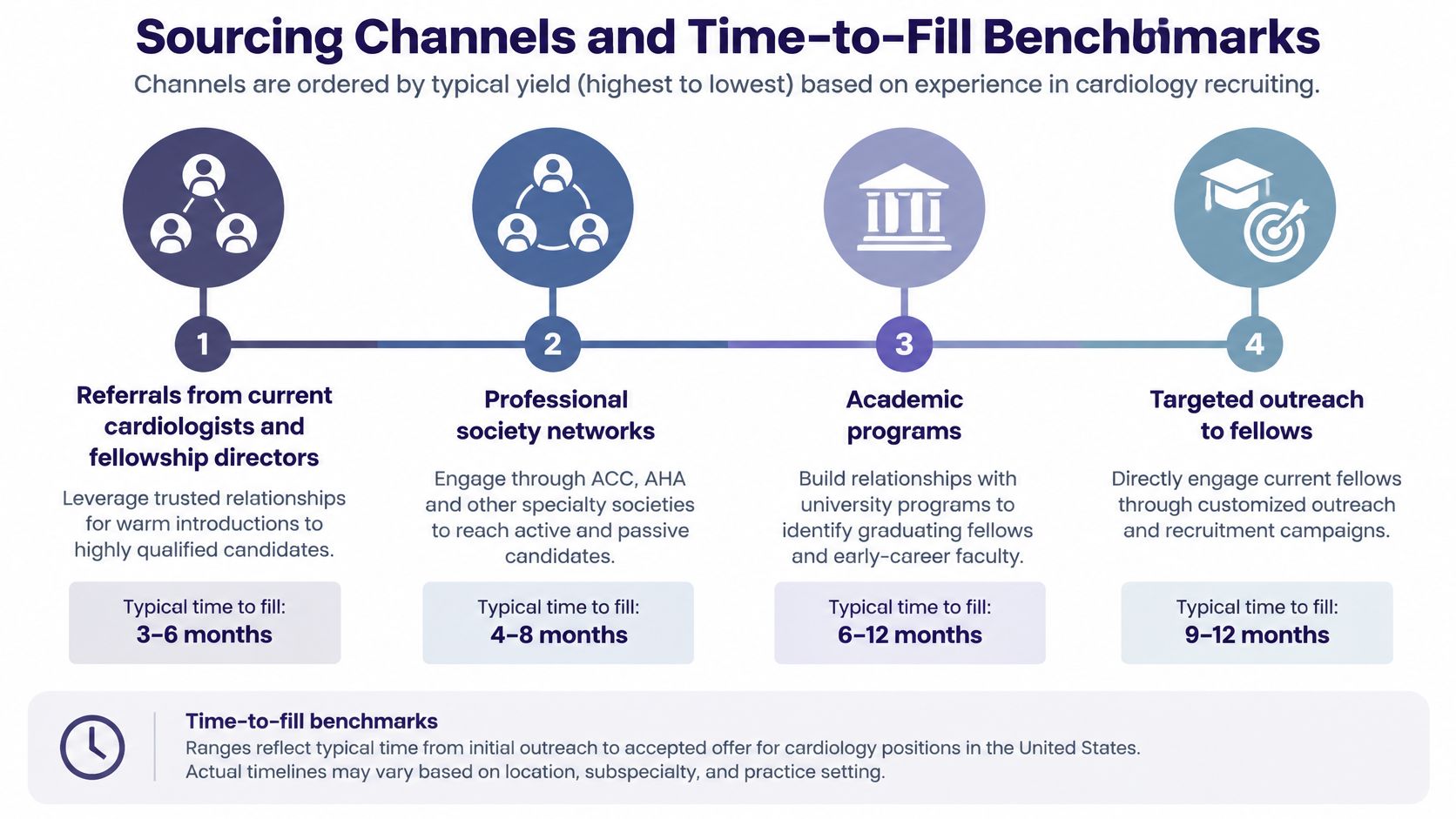
Referrals from current cardiologists and fellowship directors usually produce the highest conversion, followed by professional society networks, academic programs, and direct outreach to fellows nearing completion. Check that order against your own qualified-candidate yield. Referral channels generate fewer names but cleaner screening; broad job-board volume generates more resumes and more early withdrawals.
Fellowship outreach follows training cycles. Graduation does not establish availability. The AAMC's training-pipeline analysis describes the sequential requirements around training, licensure, certification, and credentialing that can push a start date past the verbal acceptance.
When comparing physician recruiting firms, executives should examine subspecialty reach and ownership of post-offer work. A firm that sources well but hands credentialing back to the hospital may not shorten the posting-to-start interval. Ask who owns each handoff before you sign.
American Cardiology Group's locum tenens solutions are designed for cardiac care, and facilities can request staffing through its Request Staffing form.
How to Run Interviews, Vetting and Credentialing
A cardiology interview must test clinical capability and operating fit separately. A candidate can have excellent training yet reasonably decline a role whose call expectations, laboratory access, or decision-making structure doesn't support the proposed practice.
The recruiter should circulate the role specification and evaluation rubric before the panel meets. The medical staff office should identify required evidence early enough that candidates aren't asked repeatedly for the same documents.
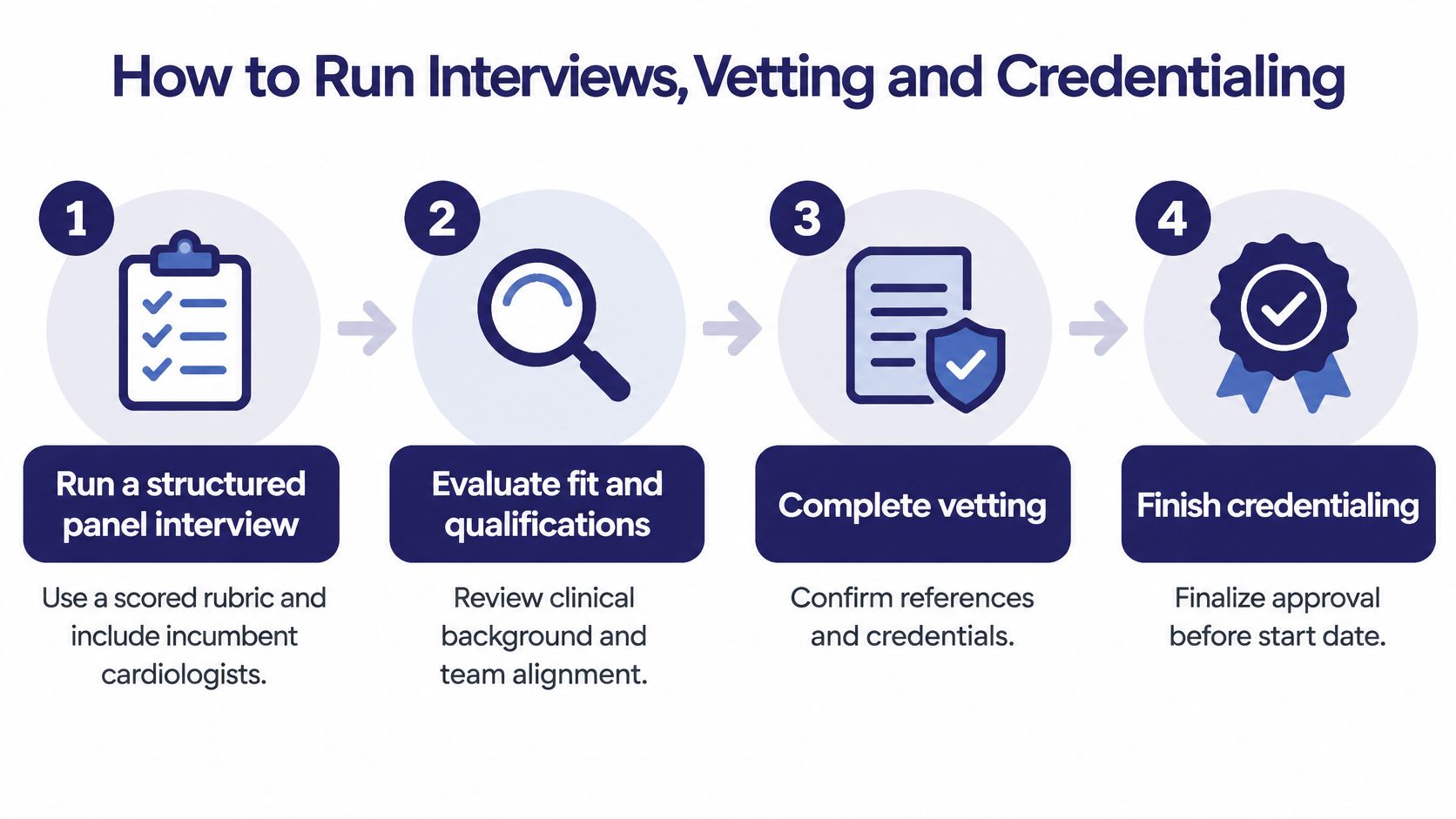
Execute the assessment and approval sequence
Run a structured panel interview. The clinical director should include incumbent cardiologists and assign scored criteria for clinical judgment, communication, teamwork, and the actual responsibilities of the position. Panelists should record evidence before discussing consensus, because scoring impressions such as likability makes disagreements difficult to resolve.
Verify qualifications and professional history. The credentialing coordinator should confirm board status, residency and fellowship records, references, malpractice history, work authorization, and procedural experience, recording the primary source and any discrepancy. Waiting until the contract is signed to discover missing records creates avoidable rework and can force leadership to revisit a selection already announced internally.
Confirm practice authorizations. The medical staff office should verify state licensure, applicable DEA registration, and the National Provider Identifier against the appropriate records for the intended practice arrangement. An NPI identifies a provider; it doesn't establish licensure, specialty competence, or hospital privileges.
Prepare procedure-specific privileging requests. The service chief and medical staff office should tie requested privileges to medical staff bylaws and documented experience, with proctoring or a supervised case plan where required for ablation or transcatheter valve work. A broad specialty designation isn't sufficient evidence for every procedure, and an incomplete request can delay committee review.
Release the offer after the verification gate clears. The authorized executive should confirm that required pre-offer checks are complete and that remaining conditions are explicit in the agreement. The target start date should remain conditional on outstanding approvals rather than becoming an unsupported promise to clinic schedulers or referring physicians.
Review the credentialing clock weekly. The coordinator should maintain an aging list showing each outstanding item, its external source, the latest follow-up, and the person responsible for escalation. A file marked pending without that detail doesn't tell leadership whether intervention is needed or whether the requested start remains feasible.
Use evidence rather than assurances
Criterion | Primary Source | Gate |
|---|---|---|
Board certification | Specialty board primary-source verification | Before offer |
Training records | Residency and fellowship program verification | Before offer |
Procedural competence | Case logs and proctoring or supervised case plan for ablation or transcatheter work | Before privileging request |
Malpractice history | National databank query and carrier report | Before offer |
State licensure, DEA registration and NPI | State board, DEA and NPPES records | Before start date |
Interview rubric | Scored criteria with incumbent panel notes | After each interview |
The clinical assessment should distinguish evidence already available from conditions still requiring approval. Preliminary case-log review can support selection, while final procedure-specific privileges require the hospital's formal decision.
Reference checks should also address the proposed work. A reference who can describe outpatient practice may not be positioned to assess complex procedural independence or performance during emergency call.
A staffing partner's vetting supports selection. It doesn't replace the hospital's responsibility to authorize the physician's clinical scope.
For locum placements, American Cardiology Group carefully vets each professional in its network before placement. Its team also manages credentialing and compliance for locum providers so facilities can onboard quickly.
The facility should still maintain a clear division of responsibilities between the staffing partner and medical staff office. A shared understanding of healthcare credentialing helps prevent either party from assuming the other has completed a required check.
Define ready to start operationally
The ready-to-start file should contain more than an approval email:
Written privileges: The approved scope matches the scheduled services and procedures.
System readiness: EHR access has been requested, with activation and training responsibilities assigned.
Coverage readiness: The physician appears on the call schedule, with escalation contacts and backup arrangements documented.
Practice logistics: Malpractice coverage, required enrollment work, orientation, and procedural support have identified owners.
Scheduling staff should receive a clear release to open appropriate appointments or procedural blocks. They shouldn't have to interpret credentialing correspondence to determine whether a physician can practice.
Designing Offers for Rural and Hard-to-Fill Roles
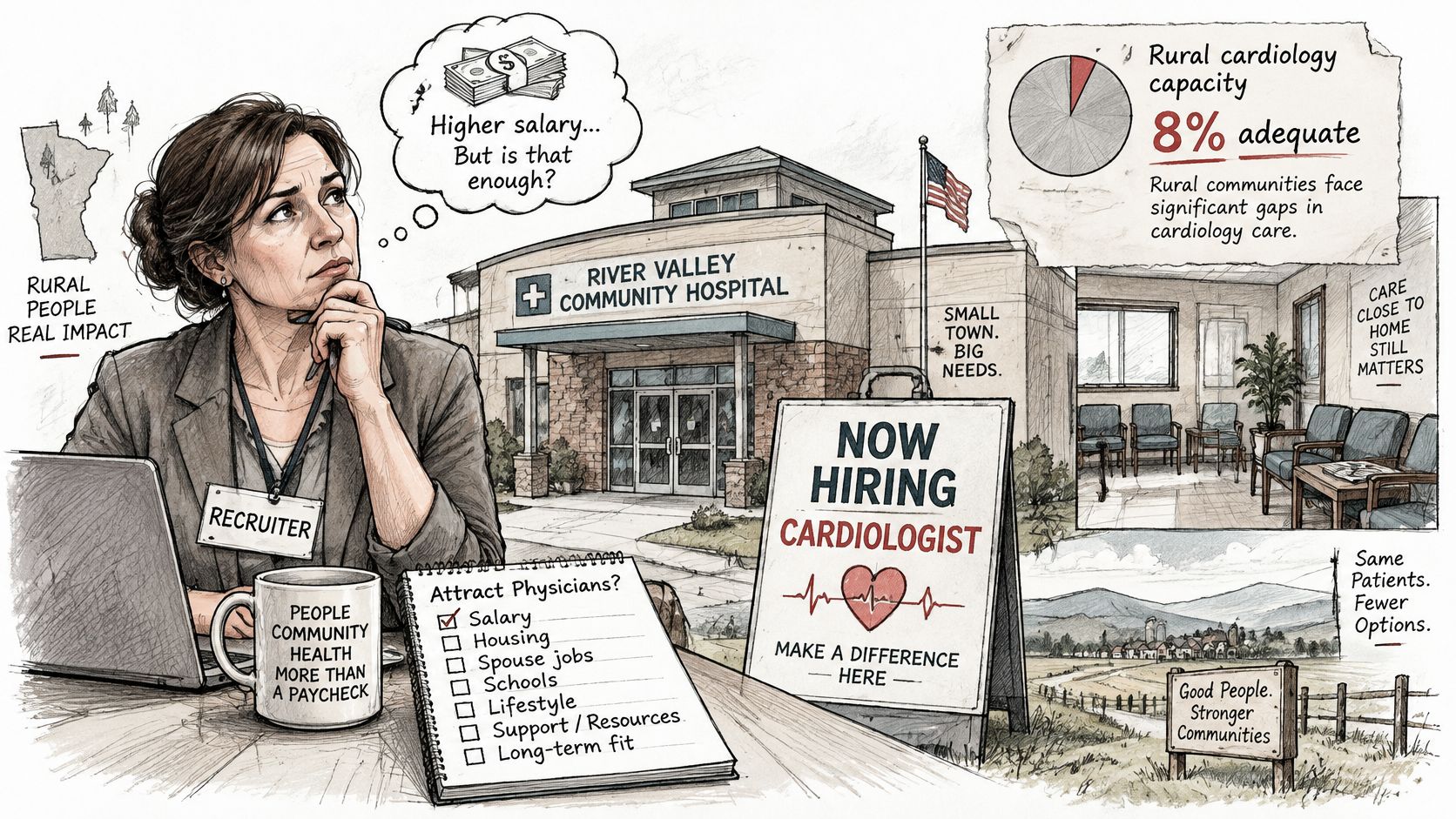
Salary alone won't make an unsupported rural cardiac role sustainable. Cardiovascular Business reported adequate rural cardiology capacity only 8% of the time, insufficient or fragile capacity at 62%, and reliance mainly on alternative coverage or no meaningful local capacity at 24%; among rural clinicians without adequate specialist or colleague backup, 67% were at least somewhat likely to leave within two years, compared with 44% with adequate backup.
Make operational commitments explicit
A credible rural physician recruitment offer should document:
Clinical backup: Named coverage partners, transfer pathways, and telecardiology support, reviewed for actual availability.
Practice support: APP integration and a minimum procedural-volume plan, checked against staffing and delivered cases.
Sustainable workload: Realistic call distribution and protected continuing-education time, audited against schedules.
Community fit: Spouse and family support commitments, with an assigned follow-up owner.
American Cardiology Group customizes each engagement by working closely with the client to understand its needs, values, and organizational goals. That discovery should expose role-design problems before compensation negotiations.
For financial context, AMA reporting on AMN Healthcare's recruiting-incentive survey gives an average physician signing bonus of $38,315, up 23%, relocation allowance of $12,019, up 12%, and combined signing, relocation, and continuing-medical-education benefits of $58,854. These are physician-wide benchmarks, not cardiology-specific prices.
Leadership should benchmark the package without treating a larger bonus as compensation for unsafe coverage. Each operational promise needs an onboarding checkpoint that tests delivery, not mere acknowledgment.
Retention Checkpoints That Predict Year-One Success
Assign a named physician-specific onboarding owner and schedule formal reviews at 30, 60, 90, and 180 days. Each review should cover clinical integration, schedule and call fit, EHR proficiency, referral development, and well-being, with increasing emphasis on whether the original role assumptions remain workable.
Checkpoint | Review emphasis | Required output |
|---|---|---|
30 days | Access, orientation, clinical support, early schedule friction | Issue log with owners and resolution dates |
60 days | Referral flow, EHR workflow, colleague relationships, backup reliability | Corrective actions for unresolved operating gaps |
90 days | Workload against the agreed model, call distribution, autonomy | Written comparison of promised and actual practice |
180 days | Sustainable productivity, development, well-being, long-term fit | Retention assessment and revised support plan |
Treat onboarding as a clinical operating process
The AMA's physician-onboarding analysis reports that 56% of physicians and other health professionals with positive onboarding were highly satisfied with their jobs, compared with 19% after negative onboarding; 73% of clinicians satisfied with onboarding reported a formal process, compared with 34% of dissatisfied clinicians. The same AMA analysis cites a report finding that nearly 60% leave their first post-training job within three years and more than 25% consider leaving within the first year.
Those associations don't establish that a checklist causes retention. They support treating onboarding as substantive work rather than a welcome session followed by an assumption that the physician will adapt.
The owner should reconcile feedback with operating evidence. A physician reporting excessive call needs a review of actual assignments and backup availability; a physician struggling with referral growth needs introductions, access analysis, and clarity about referral ownership.
Retention test: The question isn't whether the physician completed orientation. It's whether the organization delivered the practice environment described during recruitment.
Score fit from both sides
A two-way fit assessment should let the physician and clinical leader independently rate the same expectations. Written explanations matter more than an apparently precise composite score.
Autonomy and governance: Clarify which clinical and operational decisions the physician controls and how disagreements are resolved.
Call distribution and academic expectations: Compare actual assignments with agreed responsibilities, teaching duties, and protected time.
Compensation transparency: Confirm that the physician understands productivity calculations, statements, and reconciliation procedures.
Geographic and family needs: Identify unresolved relocation or community-integration issues without assuming every personal concern belongs to the employer.
Differences should produce specific actions. If the physician expects independent scheduling but the department requires centralized templates, leadership must resolve that discrepancy rather than label it poor cultural fit.
Cardiology leaders also need to consider staffing continuity. The AMA's specialty retention reporting states that 34.3% of cardiologists reported a definite, likely, or moderate likelihood of leaving their organization within two years, while 46.5% of physicians identified consistent staffing as a resource needed to maintain workload.
The recruitment leader should compare interview fit assessments and onboarding findings with six- and twelve-month retention outcomes. Persistent mismatches around autonomy, workload, or support should change the next role specification and interview rubric.
Placement volume alone can't show whether the organization hired successfully. A defensible quality measure includes whether the physician remains, practices within the intended scope, and can sustain the agreed workload without relying on unresolved exceptions.
Decide Your Next Recruitment Step This Quarter
The next vacancy requires a coverage decision and a workforce decision. They may require different solutions: a permanent search for durable capacity, a locum tenens bridge for an interim gap, or an advanced practice provider placement when the unmet work falls within an appropriate NP or PA scope.
Match the response to the clinical gap
Use a locum bridge selectively: When the expected gap is shorter than the likely permanent search, assess temporary coverage against call exposure, procedural needs, and onboarding feasibility. Temporary staffing still requires completed vetting and facility approvals.
Launch permanent recruitment early: Start when leadership signs the need statement, not when the incumbent leaves. An APP can strengthen team capacity but shouldn't be treated as a substitute for required physician procedural expertise.
Give the dashboard one owner: Assign a 90-day review covering sourcing duration, interview-to-offer conversion, offer acceptance, and start-date slippage, with subsequent retention outcomes attached.
American Cardiology Group's dedicated recruiters provide personalized support to both the facility and the locum provider throughout the process. After an employer submits the form, the next step is scheduling.
This week, the executive sponsor should convene the service chief, recruitment lead, and medical staff office to complete the need statement and review the last three searches against specialty benchmarks. That review should end with one assigned process change, a responsible owner, and an agreed review date.
American Cardiology Group offers permanent physician recruitment, locum tenens coverage, and advanced practice recruitment focused on cardiac care. Visit American Cardiology Group to submit the program's staffing need and discuss a recruitment approach aligned with its subspecialty requirements, coverage obligations, and long-term clinical goals.
Comments