
Cardiac Surgery Department: 2026 Structure Guide
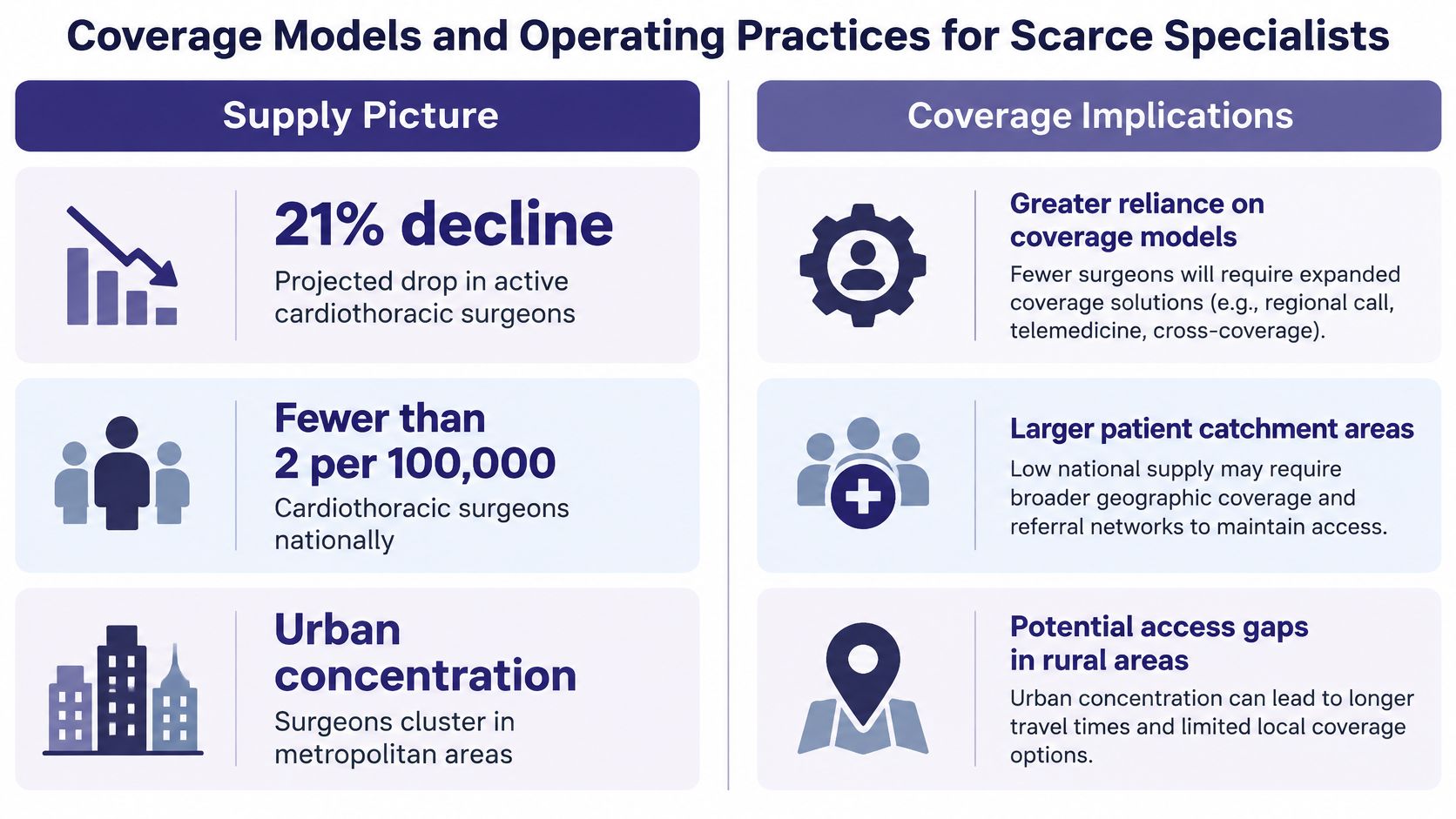
At least 1,500 cardiothoracic surgeons is the shortfall the United States was projected to face by 2025, roughly 25% of projected need, according to a workforce analysis published in Circulation. The same analysis counted fewer than two active cardiothoracic surgeons per 100,000 people nationally, clustered mainly in urban areas, and sized the coronary ecosystem those surgeons serve at about 160.7 bypass operations per 100,000 people against 184.7 coronary stenting procedures per 100,000.
The reflex is to read that as a recruiting problem and stop there. That reflex is why so many programs stay stuck. A cardiac surgery department performs or fails as an integrated operating system, and its throughput, safety and referral flow depend as much on intensivists, perfusionists, advanced practice providers, anesthesiologists and team continuity as on the number of surgeons on the roster. A department with five surgeons and no accountable night intensivist loses more cases to cancelled lists and failed rescues than a department with three surgeons and a wired escalation pathway.
What follows is a structural audit of that system: a unit-by-unit blueprint, a role and coverage map, a subspecialty portfolio and a KPI set, each paired with the thresholds that tell you whether your program sits inside or outside the evidence. Start by marking which units in your department have named coverage at 02.00 on a Sunday, and which have a name on an org chart only.
Table of Contents
The Cardiac Surgery Department at a Glance - Where the chain breaks
Staffing a Cardiac Surgery Department - The intensivist as a throughput lever - Why team continuity earns a fixed block - Who is in the building at 02.00
Clinical Functions and Cardiovascular Subspecialties - Four functions, one portfolio - Where programs expand first
Volume, Quality Metrics and Programme Scale - The mechanism is rescue, not complication rate - Why volume alone fails the audit
Coverage Models and Operating Practices for Scarce Specialists - Five coverage models and when each fits - Four practices that make any model work
The Cardiac Surgery Department at a Glance
A cardiac surgery department is not a ward with an operating theater attached. It is a chain of eight units that must behave as one system: pre-admission workup, the operating room, the cardiac ICU, step-down and telemetry, the inpatient ward, the quality and registry office, the heart team conference, and the outreach desk that pulls referrals in. Its remit covers adult cardiac surgery, meaning coronary bypass, valve repair and replacement, aortic and root surgery, arrhythmia surgery and mechanical circulatory support, and it runs on interfaces with interventional cardiology, electrophysiology, structural heart and advanced heart failure.
Those interfaces are why the chain gets measured with unusual precision. The specialty settled on a shared instrument decades ago: the STS Adult Cardiac Surgery Database was established in 1989 as a quality-improvement and patient-safety initiative, captures up to 1,000 clinical data points for each patient across more than 6.5 million procedure records, and draws on more than 3,700 surgeons and anesthesiologists. Because it represents over 90% of adult cardiac surgeries performed in the United States, a department can compare its risk-adjusted outcomes across major procedures instead of grading itself against its own last quarter.
The blueprint below is the audit instrument. Each row is a unit, and the final column is the coverage requirement that unit imposes on the department.
Unit | Clinical function | Core roles | Coverage requirement |
|---|---|---|---|
Pre-admission and surgical clinic | Risk assessment, informed consent, preoperative optimization, comorbidity management | Cardiac surgeon, advanced practice provider, clinic nurse, coordinator | Weekday outpatient hours; APP-led telephone follow-up |
Operating rooms | CABG, valve, aortic, arrhythmia and MCS procedures; cardiopulmonary bypass | Cardiac surgeon, cardiac anesthesiologist, perfusionist, scrub and circulating nurse, surgical first assistant | Scheduled lists plus 24/7 emergency coverage for STEMI, dissection and emergency CABG |
Cardiac surgery ICU | Immediate postoperative ventilation, hemodynamic support, bleeding and renal management, rescue from complications | Cardiac intensivist, APP, critical-care nurse, respiratory therapist, pharmacist | 24/7 in-house intensivist or physician coverage; high-intensity presence during the highest-volume daytime period |
Step-down and telemetry | Weaning from monitoring, mobilization, arrhythmia surveillance | Cardiac nurse, APP, monitor technician, physiotherapist | 24/7 nursing; telemetry monitoring with defined escalation triggers |
Inpatient ward | Postoperative recovery, wound care, discharge teaching | Cardiac nurse, APP, case manager, pharmacist | 24/7 nursing; weekday discharge rounds |
Quality and registry office | STS data abstraction, risk-adjusted outcome reporting, M&M review, guideline compliance | Data abstractor, quality analyst, physician quality lead | Continuous abstraction; quarterly governance reporting |
Heart team and case conference | Multidisciplinary decision-making on revascularization, valve and structural options | Cardiac surgeon, interventional cardiologist, imaging specialist, heart failure specialist, EP specialist | Weekly scheduled conference; ad hoc urgent review |
Outreach and referral office | Referral intake, transfer coordination, rural and community partnerships | Referral coordinator, nurse navigator, telehealth liaison | Weekday intake with after-hours transfer protocol |
Where the chain breaks
Most throughput loss in a cardiac program comes from two breaks, one upstream and one downstream. Upstream, a patient arrives at pre-admission with uncontrolled diabetes, unresolved anemia or an untreated infection, doesn't get conditioned in time, and the case cancels into an unused operating room block. Downstream, an ICU patient who is medically ready to leave has nowhere to go because step-down has no monitored bed, and the backlog pushes the next morning's first start past the scheduled cut-in time.
Capacity in a cardiac program is set by the slowest discharge unit, not by the number of operating rooms.
Neither break announces itself in a governance meeting. Both surface later as overtime, bumped cases and referral drift, which is why department design belongs on the same agenda as capital requests.
Run the audit before the next capital cycle. Walk the table row by row and mark any unit without a named person accountable for nights and weekends. The rows that come back blank are the ones generating your cancellations, your unplanned readmissions and your transfer refusals, and no amount of equipment fixes them.
Staffing a Cardiac Surgery Department
The surgeon is the hardest person in the room to replace and the smallest single determinant of whether the program runs well. Cardiac surgery performance is set by the team around the operating list, and departments that treat intensivists, perfusionists and advanced practice providers as support costs rather than capacity end up paying for that mistake in ICU hours, cancelled cases and expensive rescue.
The roster below is the minimum viable multidisciplinary team for a program doing CABG, valve and aortic work with a cardiac ICU on site.
Role | Clinical function | Coverage model | Hardest to fill |
|---|---|---|---|
Cardiac surgeon | Operative care, emergency call, heart team decisions | Scheduled lists plus 1-in-N call rotation | High |
Cardiac anesthesiologist | Anesthesia, transesophageal echocardiography, fast-track extubation decisions | Assigned per OR list, plus emergency call | Medium |
Cardiac intensivist | Postoperative hemodynamics, ventilation, bleeding, renal risk, rescue | High-intensity daytime plus 24/7 on-call or in-house | High |
Perfusionist | Cardiopulmonary bypass, ECMO and cell salvage | Per case; on-call for emergencies | High |
Advanced practice provider | Clinic follow-up, ward rounds, ICU support, discharge coordination | Weekday plus optional evening coverage | Medium |
Critical-care and step-down nurse | Continuous monitoring, titration, mobilization, escalation | 24/7 shift-based | Medium |
Respiratory therapist | Ventilator management, weaning protocols, airway support | 24/7 shift-based | Low |
Clinical pharmacist | Anticoagulation, antibiotic stewardship, medication reconciliation | Weekday plus on-call | Low |
Physiotherapist | Early mobilization, pulmonary rehabilitation, discharge conditioning | Weekday | Low |
VAD coordinator | Patient selection, device training, outpatient surveillance | Weekday plus on-call | Medium |
Data abstractor and quality analyst | STS abstraction, dashboards, M&M preparation | Continuous | Medium |
The intensivist as a throughput lever
In a comparative study of cardiac surgery intensive care units, a high-intensity daytime model staffed by dedicated cardiac surgery intensivists cut mean ICU length of stay from 43.3 to 40.8 hours, a 2.5-hour difference that was statistically significant at P<0.001, and reduced transfusion, infection and unexpected readmission rates, although early mortality did not change significantly, as reported in the Journal of Thoracic and Cardiovascular Surgery30937-7/fulltext). Read that correctly: a cardiac-trained intensivist in the building shortens the distance between a rising lactate and a decision about re-exploration or mechanical support.
The gain is flow, not survival in a headline. A department can hold mortality flat and still recover beds, because dedicated daytime intensivist presence accelerates ventilator liberation, hemodynamic assessment, bleeding evaluation and renal-risk management.
Why team continuity earns a fixed block
Continuity shows up in the evidence more narrowly. A 2024 multicenter observational study across three quaternary-care hospitals found that greater operative-team familiarity was not associated with a statistically significant difference in STS morbidity or mortality outcomes, but it was inversely correlated with cardiopulmonary bypass duration, per Circulation Cardiovascular Quality and Outcomes. A stable surgeon, anesthesia, perfusion and scrub lineup won't rescue a bad case mix, but it buys minutes on every complex case, and those minutes compound across a week of reoperations and aortic work.
The advanced practice provider is the connective tissue that makes this roster affordable, moving between preoperative clinic, ward rounds, ICU support and discharge coordination inside a single day. Scope-of-practice rules differ by state, so the role has to be written against your own regulations rather than copied from a neighboring system, and a practical guide to how the cardiothoracic surgery physician assistant role fits a surgical service is worth reading before the job description goes out.
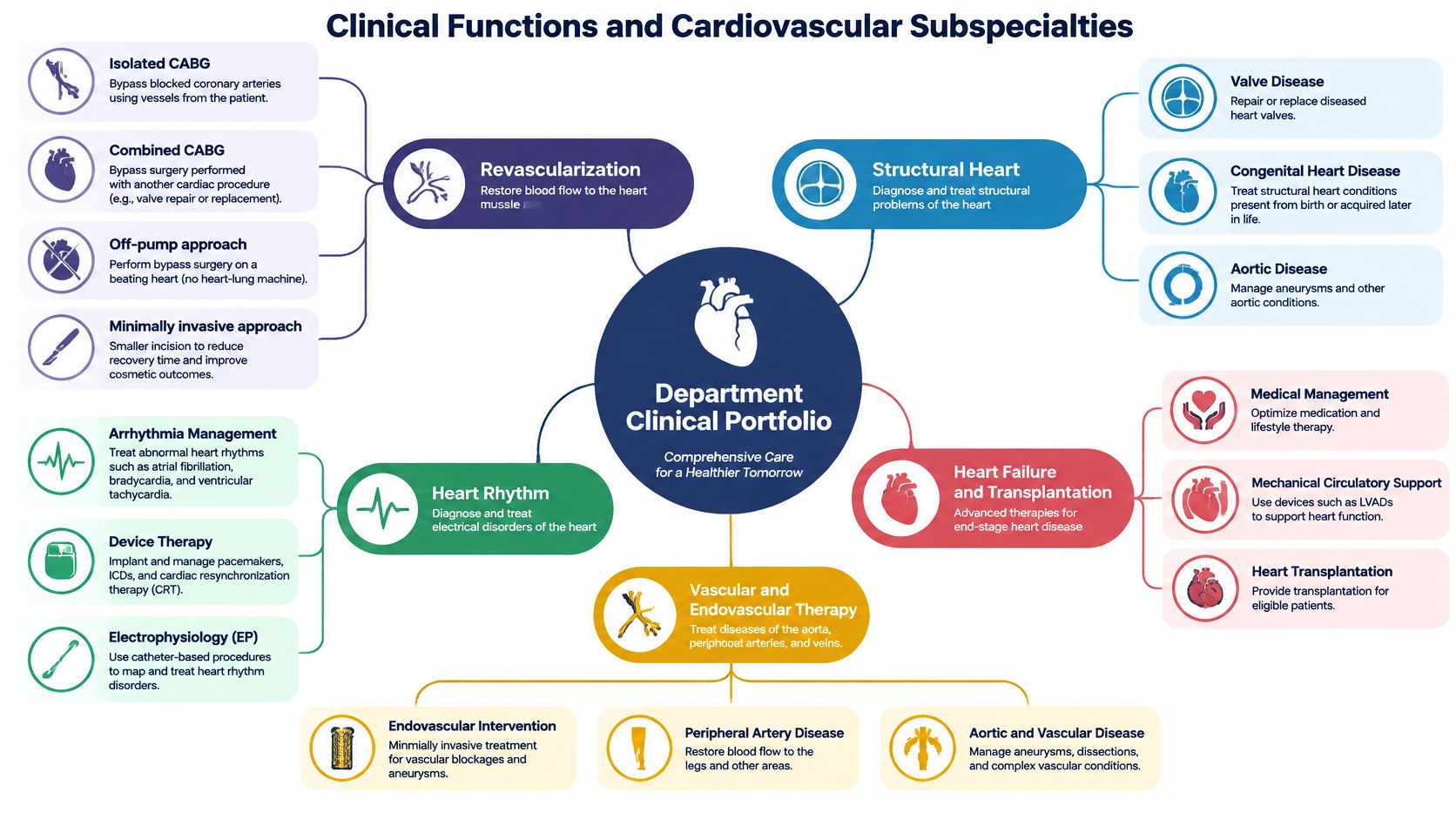
The staffing map has to match the clinical portfolio it serves, which is easiest to see when that portfolio is laid out by function rather than by procedure list.
Who is in the building at 02.00
In-house at 02.00: a physician able to assess and act on bleeding, tamponade or low cardiac output without waking a surgeon by phone.
First call: one named person for the ICU and one for the floor, with the escalation route printed and tested rather than assumed.
Reoperation authority: who can take a patient back to the operating room, and how long that decision takes on a Saturday.
Perfusion on call: response time for emergency bypass or ECMO, measured from page to pump.
APP handoff: whether the overnight plan is written by the person who will be paged at 03.00.
Coverage audit question: if the night intensivist is on call rather than in house, what is the documented time from recognition of tamponade to a surgeon at the bedside?
Answer those five and the staffing budget largely writes itself, because the gaps you find are exactly the ones producing poor outcomes and the most expensive rescues.
Clinical Functions and Cardiovascular Subspecialties
Case mix is a capability statement. A department's portfolio tells a referring cardiologist what can be kept in house, and the boundaries between functions are set by staffing depth rather than by ambition.
Four functions, one portfolio
Revascularization is the base load: isolated and combined CABG, off-pump variants and minimally invasive direct CABG. It anchors the operating schedule and funds the rest of the portfolio, and it depends on cardiac anesthesia, perfusion and an ICU able to rescue a graft that thromboses at hour six.
Valve and structural heart surgery covers aortic, mitral and tricuspid repair or replacement plus reoperative valve work, and it depends on the heart team rather than on one surgeon's judgment. Imaging quality and step-down capacity decide how many of these cases a program can absorb.
Aortic and complex disease means root, ascending and arch repair along with emergency dissection, and it imposes a 24/7 obligation on the operating room, perfusion, ICU and blood bank at the same time. Rhythm and mechanical support covers surgical ablation, left atrial appendage management, LVAD implantation and ECMO bridging, and it needs electrophysiology collaboration plus a durable device program behind it.
Subspecialty | Representative procedures | Referral source | Departmental dependency | Scarce roles to recruit |
|---|---|---|---|---|
Coronary revascularization | Isolated and combined CABG, off-pump CABG, minimally invasive direct CABG | Cardiology, emergency department, community transfer | OR time, cardiac anesthesia, perfusion, ICU rescue | Cardiac surgeon, perfusionist |
Valve surgery | Aortic and mitral repair or replacement, tricuspid repair, reoperative valve surgery | Cardiology, structural heart, imaging | Heart team decision-making, imaging, step-down capacity | Cardiac surgeon, imaging specialist |
Structural heart collaboration | Transcatheter aortic valve cases, surgical backup for transcatheter procedures | Interventional cardiology, structural heart | Hybrid room access, surgical backup coverage | Interventional cardiologist, cardiac surgeon |
Aortic and complex disease | Root, ascending and arch repair, emergency dissection | Emergency department, cardiology, regional transfer | 24/7 emergency OR, perfusion, ICU, blood bank | Aortic surgeon, cardiac anesthesiologist |
Arrhythmia surgery | Surgical ablation with or without concomitant valve surgery, left atrial appendage management | Electrophysiology, cardiology | EP collaboration, mapping, hybrid workflows | Electrophysiologist, cardiac surgeon |
Mechanical circulatory support and transplant referral | LVAD implantation, ECMO bridge, transplant evaluation | Advanced heart failure, ICU | ICU capability, VAD coordinator, durable support program | Heart failure specialist, VAD coordinator, intensivist |
Robotic and minimally invasive surgery | Robotic mitral repair, atrial septal defect closure, minimally invasive CABG | Cardiology, valve clinic | Team training, proctoring, case-selection governance | Robotic-trained surgeon, OR team |
Where programs expand first
Most community hospitals start with isolated CABG and valve replacement, then add aortic and structural work only when coverage depth allows. Adding a subspecialty without the night-time rescue capability behind it doesn't extend the program. It concentrates risk in whichever surgeon happens to be on call.
Robotic and minimally invasive work follows the same logic with a longer runway. A 2024 review covering robotic mitral valve repair, atrial septal defect closure and CABG found operating times comparable to or shorter than conventional approaches, mortality comparable with conventional surgery, fewer postoperative complications and shorter hospital stays in the reviewed literature, while emphasizing an initial learning curve and the need for procedure-specific training and technical expertise, as summarized in this review of robotic cardiac surgery. Program planning therefore has to fund credentialing, proctoring, case selection and enough volume to sustain competence. Buying the console is the easy part.
Match your current case mix against the table and name the subspecialty whose absence is diverting referrals to a competitor. That answer sets next year's recruitment order.
Volume, Quality Metrics and Programme Scale
The number to hold in mind is 415. A five-country European analysis found overall 30-day in-hospital CABG mortality of 3.0%, with mortality of 5.2% in low-volume hospitals against 2.1% in high-volume hospitals, and the relationship flattened above approximately 415 CABG cases per hospital per year, according to this analysis of CABG volume and mortality.
Treat that figure as an operational marker rather than an accreditation badge. Above roughly 415 cases a year, a program keeps team familiarity, perfusion expertise, ICU readiness and rapid access to specialized rescue resources sharp, because those capabilities get rehearsed weekly instead of quarterly.
The mechanism is rescue, not complication rate
The same analysis found hospital volume was more strongly associated with failure to rescue, the probability of death after a complication, than with complication incidence itself. That distinction matters when you allocate budget. A department that adds a second operating room without adding night-time rescue capacity will do more cases and lose the same proportion of them.
Why volume alone fails the audit
Volume has a weaker case than its loudest advocates admit. An analysis of STS National Cardiac Database records banded hospitals by annual volume at 150 or fewer cases, 151 to 300, 301 to 450 and more than 450, then tested a proposed referral threshold of at least 500 CABG cases annually. That threshold would have closed as many as four fifths of STS sites while potentially preventing fewer than 3% of national STS mortality events, and the authors described the volume-outcome association as small but consistent, recommending risk-adjusted outcome monitoring with multiyear trend analysis at low-volume centers because their estimates carry wide 95% confidence intervals, as published in JAMA.
An executive reading both findings should conclude that volume is a proxy, and a leaky one. The defensible position is to pair volume with adjusted outcomes and read the trend, not the cutoff.
Metric | Benchmark context | What it reveals | Review cadence |
|---|---|---|---|
Annual isolated CABG volume | Relationship flattens above roughly 415 cases per hospital per year | Team familiarity, perfusion and ICU readiness | Annual, with quarterly trajectory |
Risk-adjusted operative mortality | Overall 30-day in-hospital CABG mortality of 3.0% in the five-country European analysis | Overall safety, adjusted for case mix | Quarterly |
Failure to rescue | More strongly associated with hospital volume than complication incidence itself | Recognition and rescue of deterioration | Quarterly |
Major morbidity | STS composite includes absence of major morbidity | Complication burden | Quarterly |
Stroke and renal failure | Both sit inside the STS composite measures | Technical and perioperative quality | Quarterly |
Prolonged ventilation | Falls with dedicated intensivist cover and fast-track pathways | ICU flow and weaning practice | Monthly |
Unplanned reoperation | Flags bleeding, tamponade and technical complications | OR and ICU surveillance | Monthly |
30-day readmission | Reduced in high-intensity intensivist models | Discharge planning and follow-up | Monthly |
Cardiopulmonary bypass and cross-clamp time | Shorter with stable, repeatedly collaborating teams | Team continuity and efficiency | Per case, with quarterly trend |
ICU length of stay and ventilation hours | Lower in high-intensity daytime intensivist models | Throughput and bed capacity | Monthly |
Stratified outcomes by demographic and socioeconomic group | Income-linked gaps persist after risk adjustment | Equity of access and outcomes | Annual |
The dashboard feeds three governance obligations. Confirm your STS/ACSD participation status and exactly which of your procedures fall under public reporting, since the CABG composite measures cover operative survival, absence of major morbidity, internal mammary artery use and evidence-based perioperative medications. Confirm whether any payer or referral policy imposes a volume threshold on the program. Then put surgeon, perfusionist and intensivist credentialing files on the same quarterly cadence as the dashboard, so a low-volume outlier gets investigated before a referral relationship does.
A metric nobody reviews on a schedule isn't a quality program. It's a filing cabinet.
Standardizing the definitions behind those numbers is its own project, and a published framework for cardiology quality metrics is a reasonable starting point for the audit trail.
Coverage Models and Operating Practices for Scarce Specialists
Coverage is a design problem before it is a recruiting problem. Specialist access is geographically uneven, and the global picture is blunt: one recent review estimates that roughly six billion people lack timely access to cardiac surgical care, more than half of countries and territories have no cardiac surgeons at all, and sub-Saharan Africa sits at approximately one surgeon per 3.3 million people, with rural recruitment and retention named as persistent barriers, per this review of cardiac surgical workforce access. A program that cannot recruit its way out of a coverage gap has to engineer around it instead.
Five coverage models and when each fits
Permanent employed team with 1-in-N call. The right structure for a stable program with predictable volume, because it builds the continuity that shows up in bypass times and in how fast a night-time problem gets escalated.
Hybrid permanent plus locum. Use this when a vacancy would otherwise suspend emergency coverage. Locum coverage is a bridge with a defined end date, not a permanent operating model, and the locum tenens staffing approach for cardiac programs is worth studying before the first contract.
APP-led clinic, ward and step-down coverage. Frees surgeons for the operating room and keeps the discharge pipeline moving, provided the scope rules and the escalation triggers are written down.
Shared regional call and transfer agreements. A community hospital and a hub can each carry part of the night burden, but only if the acceptance criteria and transport timeline are agreed in advance rather than negotiated during a dissection.
Telehealth for preoperative and postoperative follow-up. This extends a rural program's reach and cuts travel for patients, without pretending to replace in-person assessment of a sternal wound or a new murmur.
Each model protects a different thing and endangers a different thing, so the useful comparison is not cost but failure mode:
Model | What it protects | Where it breaks first |
|---|---|---|
Permanent employed team | Team continuity, escalation speed | A single resignation opens the call schedule |
Hybrid permanent plus locum | Emergency coverage during vacancies | Costs compound if the bridge never ends |
APP-led coverage | Surgeon operating-room time, discharge flow | Unwritten scope rules stall escalations |
Shared regional call | Night coverage neither site can carry alone | Acceptance disputes during active emergencies |
Telehealth follow-up | Rural reach, patient travel burden | Physical findings that need hands on the patient |
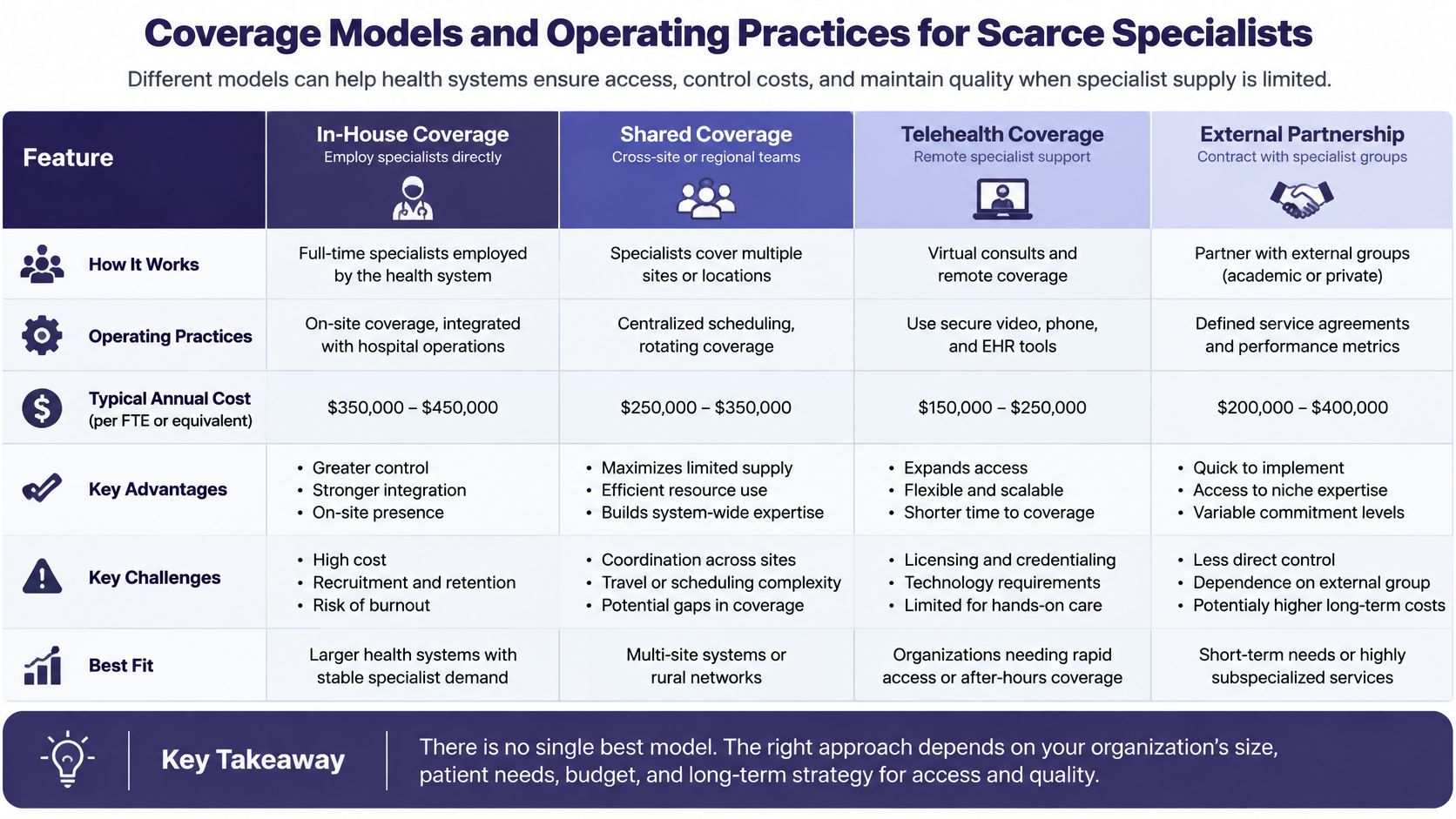
Most programs end up blending two or three of these. The blend matters less than whether each piece has written scope, written triggers and a written end condition.
Four practices that make any model work
Fast-track operating-room extubation. A national STS database analysis found postoperative mortality significantly lower among patients extubated in the operating room after CABG, with an odds ratio of 0.54 and a 95% confidence interval of 0.46 to 0.65, a corresponding odds ratio of 0.43 for aortic valve replacement (0.24 to 0.77) and 0.48 for mitral valve replacement (0.26 to 0.89), per this analysis of operating-room extubation. That evidence doesn't make immediate extubation correct for every patient. It makes ventilation duration a protocol decision with selection criteria, anesthesia sign-off and ICU readiness defined in advance rather than a habit.
Fixed team blocks for complex cases. Reserve a stable anesthesia and perfusion pairing for reoperations, aortic work and robotic cases, since continuity pays out in bypass minutes even where risk-adjusted scores don't move.
Escalation triggers for bleeding, low cardiac output and renal deterioration. Write the numbers that trigger a call, who receives it, and how fast a reoperation or support decision has to be made. Triggers that live only in someone's head become hallway conversations at shift change.
Equity measurement as an operating metric. In the large outcomes analysis cited in this JACC state-of-the-art review, even after risk adjustment, patients in the lowest income group had higher odds of in-hospital mortality (adjusted odds ratio 1.61), postoperative complications (1.19) and 30-day nonelective readmission (1.07), and the review names underrepresented racial and ethnic populations, rural communities and low-socioeconomic-status communities as groups with less access to cardiologists and cardiothoracic surgeons and worse perioperative outcomes. Publish referral-to-treatment times, transfer delays, language access and follow-up completion by group, and stop treating high risk as an immutable patient characteristic.
Standardize this quarter: extubation criteria, escalation triggers, and one equity metric reported by demographic and socioeconomic group.
Score the program against each of the five coverage models, pick the blend that fits your geography, and put the three standardized items above into policy. They cost little and move more than a new piece of capital equipment.
What Strong and Struggling Departments Look Like
Three program types recur, and each fails in a predictable place. The differences aren't prestige. They're staffing depth and what happens at 02.00.
The academic quaternary center runs a weekly heart team, structural heart and aortic programs, transplant and mechanical support referral, dedicated 24/7 intensivist coverage, a staffed STS abstraction office and stratified outcome reporting. Its bottleneck is almost never the operating room. It's ICU bed capacity, and the first fix is step-down expansion plus a transfer-in protocol that doesn't cannibalize its own beds.
The community hospital doing isolated CABG and valve work inside the 150 to 415 annual band runs leaner: two to four employed surgeons, locum coverage for vacancies, APP-led clinic and step-down rounding, shared call with a regional hub, and multiyear outcome trend analysis because its yearly estimates carry wide confidence intervals. Its weak point is failure-to-rescue capability, and the first fix is written intensivist escalation triggers plus a transfer protocol with a defined response time.
The rural or critical-access program has one or two surgeons, on-call coverage without an in-house intensivist overnight, and sits one resignation away from suspending emergency coverage. What separates continuity from closure is unglamorous: telehealth follow-up, a signed transfer agreement, and a standing pipeline of cardiothoracic and advanced practice candidates.
Programme type | Surgeon count | Intensivist coverage | Annual CABG volume band | Call model | Top risk | First fix |
|---|---|---|---|---|---|---|
Academic quaternary center | 5 to 10, by subspecialty | 24/7 dedicated | More than 450 | 1-in-5 to 1-in-8, subspecialty-weighted | Capacity and ICU bed pressure | Stratified outcome reporting and step-down expansion |
Community hospital | 2 to 4 | Daytime high-intensity plus night on-call | 150 to 415 | 1-in-2 to 1-in-4 with regional shared call | Failure-to-rescue capability | Intensivist escalation triggers and transfer protocol |
Rural or critical-access program | 1 to 2 | On-call without in-house | 150 or fewer | 1-in-2 or locum-supported | Single vacancy suspends coverage | APP-led clinic plus locum coverage and transfer agreement |
Name your archetype and your single binding constraint before deciding what to fund. Programs that try to fix three constraints at once usually fix none of them.
Your Next Step for Building the Department
Sequence matters more than ambition here. Five decisions, in this order.
Locate the program on the archetype table. Name the binding constraint as surgeon depth, intensivist coverage, OR capacity or referral access. Only one of them limits you at a time, and naming the wrong one wastes a budget cycle.
Fix the rescue constraint first. Failure to rescue is the mechanism most consistently tied to volume and outcome, so the intensivist escalation pathway and the transfer protocol come before the second robot or the new hybrid room.
Set the coverage mix deliberately. Permanent employed roles for the core, locum tenens for vacancy gaps, advanced practice for clinic and ward, and executive recruitment where leadership is the gap rather than headcount.
Build one dashboard that pairs volume with risk-adjusted outcomes and adds stratified access metrics, then review it quarterly with credentialing files open on the same table.
Fill the remaining gaps with a specialist recruitment partner. American Cardiology Group places candidates across all cardiac specialties, including interventional and cardiothoracic surgery, and its services cover permanent physician recruitment, locum tenens solutions, advanced practice recruitment and executive recruitment. Its team manages credentialing and compliance for locum providers so facilities can onboard quickly, and rural programs are part of the territory rather than an afterthought: "They found specialists willing to make a difference in a rural setting," as one Chief Medical Officer in Montana put it.
The single decision to make this quarter is the one that moves the binding constraint. Authorize the intensivist coverage model, sign the transfer agreement, or open the two searches. Do only that, and let the next quarter handle the second constraint.
A cardiac surgery department is built from people long before it is built from rooms, and the shortages that hurt most are rarely the ones on the surgeon roster. American Cardiology Group recruits exclusively for cardiology and cardiac specialties, placing permanent, locum tenens, advanced practice and executive candidates into cardiac programs across the United States, including the rural sites where one placement decides whether emergency coverage survives. If the audit above surfaced a gap in intensivist coverage, perfusion or surgical depth, visit American Cardiology Group to start the search.
Comments