
Locum Tenens Provider Explained: Coverage, Rules and Uses
A locum tenens provider is a licensed clinician who temporarily fills an established clinical role while the permanent clinician is absent or a permanent hire is pending. In 2024, 8% of physicians reported working as locum tenens clinicians, and another 27% said they had worked in locum tenens previously.
Those adoption figures come from a 2024 report on locum tenens utilization summarized by Patient Safety & Quality Healthcare, and they explain why the model now sits inside mainstream workforce planning rather than at its edges.
The request usually arrives with a date attached. An electrophysiologist's medical leave begins in five weeks, the device clinic is booked through the quarter, and the ablation schedule has no slack. The central question isn't whether a locum exists. It's whether one can be privileged, oriented and billing correctly before the first patient walks in.
That gap between availability and deployability is where cardiac programs lose time and money. Coverage works when it's run as a controlled clinical transition with defined outputs and a billing mechanism that survives an audit, not as a fill rate on a dashboard.
Table of Contents
What a Locum Tenens Provider Does
A locum tenens provider holds an established clinical role for a defined stretch and then hands it back. The Latin phrase means "holding the place," and that is the entire concept. The patients are already on the schedule, the referral stream is already running, and someone has to keep the work moving until the regular clinician returns or a permanent hire starts.
The difference from a permanent hire is structural, not attitudinal. A locum has a start date, an agreed end date, a written scope of service and no expectation of staying. That boundary is what makes the arrangement auditable for the payer and manageable for the medical staff office. It also makes the output measurable: clinic sessions held, procedures performed, call nights covered, handover completed. Coverage either produces those outputs or it does not, and a program that tracks them can tell the difference between a filled shift and a successful transition.
Physicians, surgeons, nurse practitioners and physician assistants all work locum assignments. In cardiac programs the roles split finely, and the split matters because privileges don't transfer between them: general cardiology clinic, interventional and structural procedures, electrophysiology, advanced heart failure and cardiothoracic surgery each carry their own competency evidence and their own coverage risk. An interventionalist who can run the cath lab cannot just absorb the device clinic, and a general cardiologist cannot step into a cardiothoracic surgery vacancy.
Three situations trigger the need. The first is an absence, whether parental leave, medical leave, sabbatical or sudden illness. The second is a vacancy while a search runs. The third is a short, predictable surge in demand. A 2022 survey cited by the American Medical Association found that nearly 90% of hospitals, medical groups and other healthcare facilities used locum tenens clinicians while permanent searches were underway.
A locum works like a relief pitcher. He is called in for a defined stretch, expected to learn the sign system and the fielders' tendencies before he throws a pitch, and handed the ball back when the starter is ready. Nobody asks him to redesign the rotation. The same discipline applies to billing: the locum steps into an existing panel and an existing payer framework, and the arrangement only holds up under audit when the role, the dates and the documentation match what was agreed in writing.
The test to apply: is the need temporary, and does it attach to a specific role? A yes to both makes locum coverage a fit. A service line that needs more permanent capacity is a different problem with a different answer.
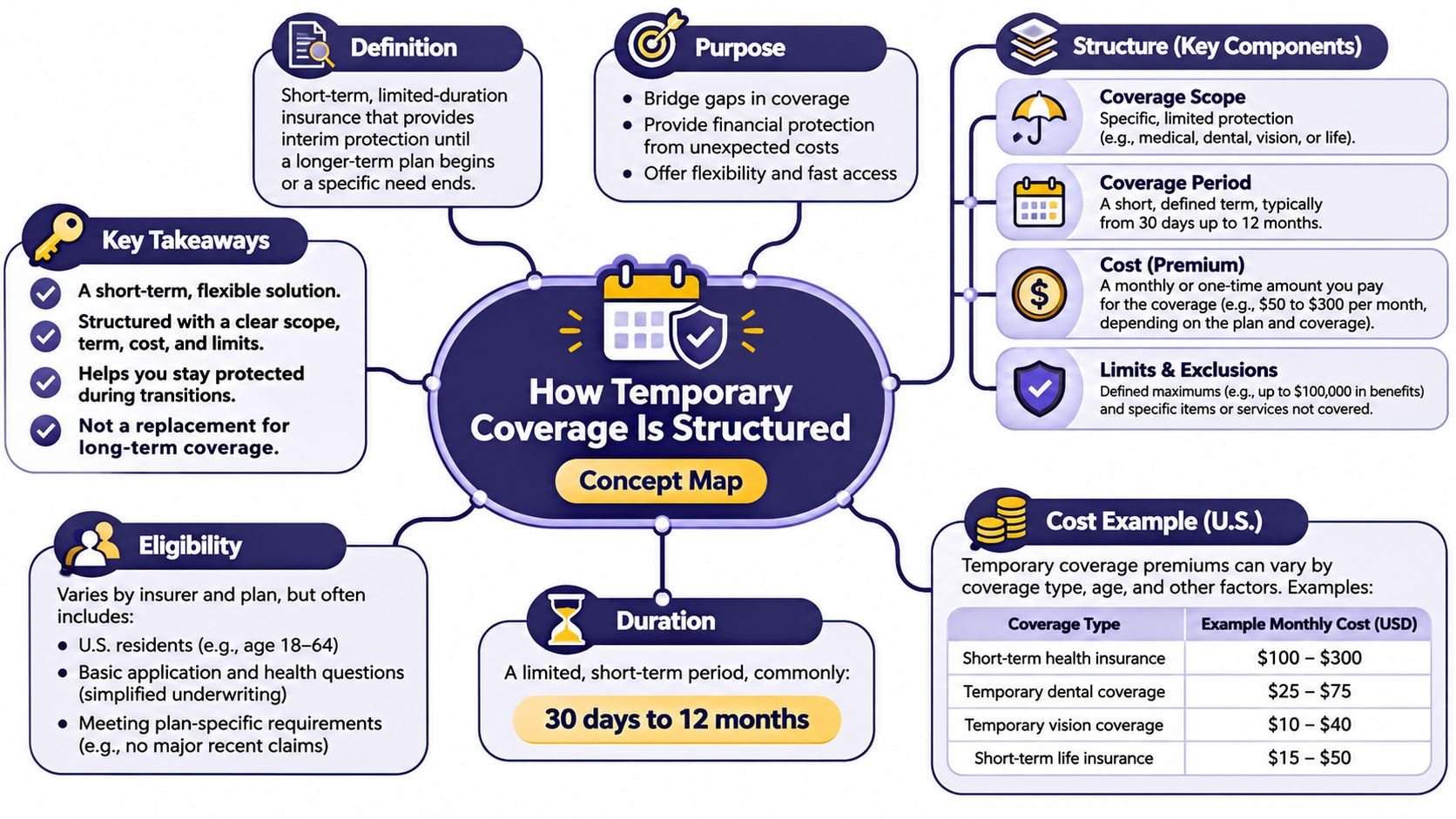
How Temporary Coverage Is Structured
Temporary coverage runs on three parties. The facility owns the clinical role, the schedule and the liability. The locum provider fills the role. A staffing firm often sits between them, recruiting, vetting and handling travel, housing and licensing logistics. When any of the three works from a different set of assumptions, the failure surfaces as a delayed start or an unbilled shift.
The assignment agreement is the control point. It fixes the scope of service, the duration, the schedule, the pay basis (daily, hourly or per session), the call expectation and who carries credentialing cost. Privileges, call rotation and the exact work being vacated belong in writing, not in a verbal understanding between a recruiter and a department chair.
Locum tenens became a formal healthcare delivery model in the United States during the 1970s, and its early development was associated with efforts in Utah to address rural physician burnout and to cover practices while doctors took time away, as a review of the locum tenens physician workforce documents. It has since become a national tool used by hospitals, health systems, academic centers and medical groups. The clinicians who fill these roles arrive experienced: in a 2017 survey of 897 locum tenens physicians, approximately 60% were medical specialists and 65% had practiced medicine for 21 years or more.
Classify the Vacancy Before You Sign
The vacancy type decides everything that follows: the length of the agreement, the number of sequential providers, and whether the payer will accept the claim at all.
Situation | Typical length | Fit for locum tenens |
|---|---|---|
Parental or medical leave | Weeks to a few months | Strong fit: replaces the absent physician and keeps the schedule intact |
Open permanent search | Months until a permanent start | Conditional: under Medicare, coverage must replace a specific absent physician, so check the payer rule |
Seasonal or volume surge | Weeks to months | Fit when the demand pattern is predictable |
Rural coverage gap | Ongoing, often rotating | Fit as a bridge, often paired with telehealth between onsite blocks |
Permanent service expansion | Indefinite | Poor fit: locum coverage does not replace a permanent hire |
Four of those five rows can be bridged by a temporary provider. The fifth cannot, and treating a growth plan as a coverage problem is how programs end up with a rotating cast and no permanent service line.
Before comparing candidates, confirm two commercial terms: the pay basis and who pays for credentialing. A daily rate that looks higher often carries the credentialing cost back to the facility, and a per-session structure can hide travel and housing. Put both numbers on the same line before anyone signs.
Examples of Locum Coverage in Cardiology Programs
Cardiac programs test the model in three recognizable shapes. Each one has a different failure mode, and each one needs its own set of measured outputs.

Case one: an electrophysiologist takes ten weeks of leave. The gap covers device clinic, ablation scheduling and inpatient consults. The locum starts only after privileges were mapped to that exact scope and EHR orientation was complete, because a locum who arrives credentialed but unoriented spends the first two weeks asking where the rhythm strips live. Track consult response time and the share of scheduled ablations that stayed on the calendar.
Case two: a rural critical access hospital with no full-time cardiologist. A rotating locum covers heart failure clinic and echocardiogram reads, with telehealth filling the weeks between onsite blocks. Telehealth supply is the constraint, not demand: 47% of locum physicians reported being very or extremely interested in telehealth assignments, while only 20% said such opportunities were available in the prior year, according to the CHG locum tenens 2025 usage report. Rural communities accounted for 27% of locum physician assignments in 2025, so confirm virtual availability before promising it to a referring network.
Case three: a cardiac surgery program where one surgeon is on leave during a nine-month permanent search. The locum replaces that surgeon's scheduled cases while permanent surgeons keep call. The measured output is case volume retained in house versus cases transferred out.
Across all three, the metrics that matter are clinic appointment availability, consult response time, procedural volume, cancellation rate and handoff completion. None of them is a fill rate.
What the Evidence Covers, and What It Doesn't
The strongest independent evaluation of temporary physician care comes from a Medicare study of acute-care hospitalizations from 2009 through 2014, which analyzed 1,708,398 hospitalizations involving non-locum internal medicine physicians and 38,475 involving locum tenens physicians across 1,590 hospitals, with locum cases representing approximately 2.1% of the total, as reported in the Medicare locum tenens outcomes study. It examined 30-day mortality and costs.
Its specialty is internal medicine, not cardiology. Read it as a general signal that temporary physician care has been measured at national scale, and treat cardiology-specific quality as a local question your own data has to answer.
Case | Coverage scope | Duration |
|---|---|---|
Electrophysiologist on leave | Device clinic, ablation scheduling, inpatient consults | Ten weeks |
Rural critical access hospital with no full-time cardiologist | Heart failure clinic, echocardiogram reads, telehealth between onsite blocks | Rotating |
Cardiac surgery, one surgeon on leave during permanent search | Scheduled cases of the absent surgeon, permanent surgeons keep call | Nine months |
American Cardiology Group offers flexible, short-term locum tenens staffing solutions designed to fit cardiac care, which is the shape all three of these cases take.
Locum coverage protects a schedule. It doesn't create a second one, and it won't fix a program that has no permanent spine.
Medicare Rules That Limit Locum Coverage
A cardiac surgery program planning nine months of coverage around one surgeon's leave has to answer a billing question before it answers a scheduling question. Under Medicare's locum tenens policy, the substitute must replace a specific physician who is temporarily absent, as the AAPC guidance on modifier Q6 sets out. Coverage for an absent interventional cardiologist, electrophysiologist or cardiothoracic surgeon can qualify. Adding a second physician to raise cath lab throughput cannot, because that is capacity, not replacement.
Every locum service is reported with HCPCS modifier Q6, and the claim must identify the regular physician being replaced. Billing staff need the absence record at the moment of claim submission, not at month end when the ledger is reconciled.
The clock is the second constraint. Medicare generally limits one locum tenens physician's qualifying coverage to 60 continuous days, beginning with the substitute's first date of service, per AAPC's coding guidance on the locum tenens limit. A nine-month absence therefore requires at least five sequential substitutes, each replacing that surgeon's work. Sequential use is permitted; an ongoing permanent staffing model under the locum mechanism is not.
Then there's the reset. If the regular physician returns to work, even for one day, the qualifying period may restart for a subsequent absence, and a temporary physician who leaves and later returns may begin a new qualifying period, according to AAPC's guidance on applying locum tenens to physician absence. Medicare requires a separate record of claims submitted for locum services, so log each absence as its own period with the absent physician, the dates, and each locum's first and last service dates.
Rule | What it requires | Planning effect |
|---|---|---|
Replacement requirement | Substitute must replace a specific absent physician | Adding capacity or a second surgeon does not qualify |
Modifier Q6 | Locum services reported with HCPCS Q6 | Claims must identify the locum and the replaced physician |
60 continuous days | Qualifying coverage limited to 60 continuous days per substitute | Plan sequential substitutes before the limit is reached |
Period reset | Period may reset when the regular physician returns, even for one day | Track each absence as a separate period |
Claims record | Separate record of locum claims must be kept | Maintain an absence log with first and last service dates |
Practical rule: name the absent physician first, then confirm the locum performs that physician's work. If the honest answer is that the role is new, the Medicare mechanism doesn't apply and the coverage needs a different commercial basis.
Two limits sit underneath all of this. These are Medicare rules, so commercial payers may differ, and they are written for physicians, so confirm with billing and compliance before assuming the same logic covers nurse practitioners or physician assistants. The locum tenens rules overview for cardiac programs covers the same ground from a recruitment standpoint. Settle these questions before the start date, not after the first claim denies.
Credentialing and Onboarding Before the First Shift
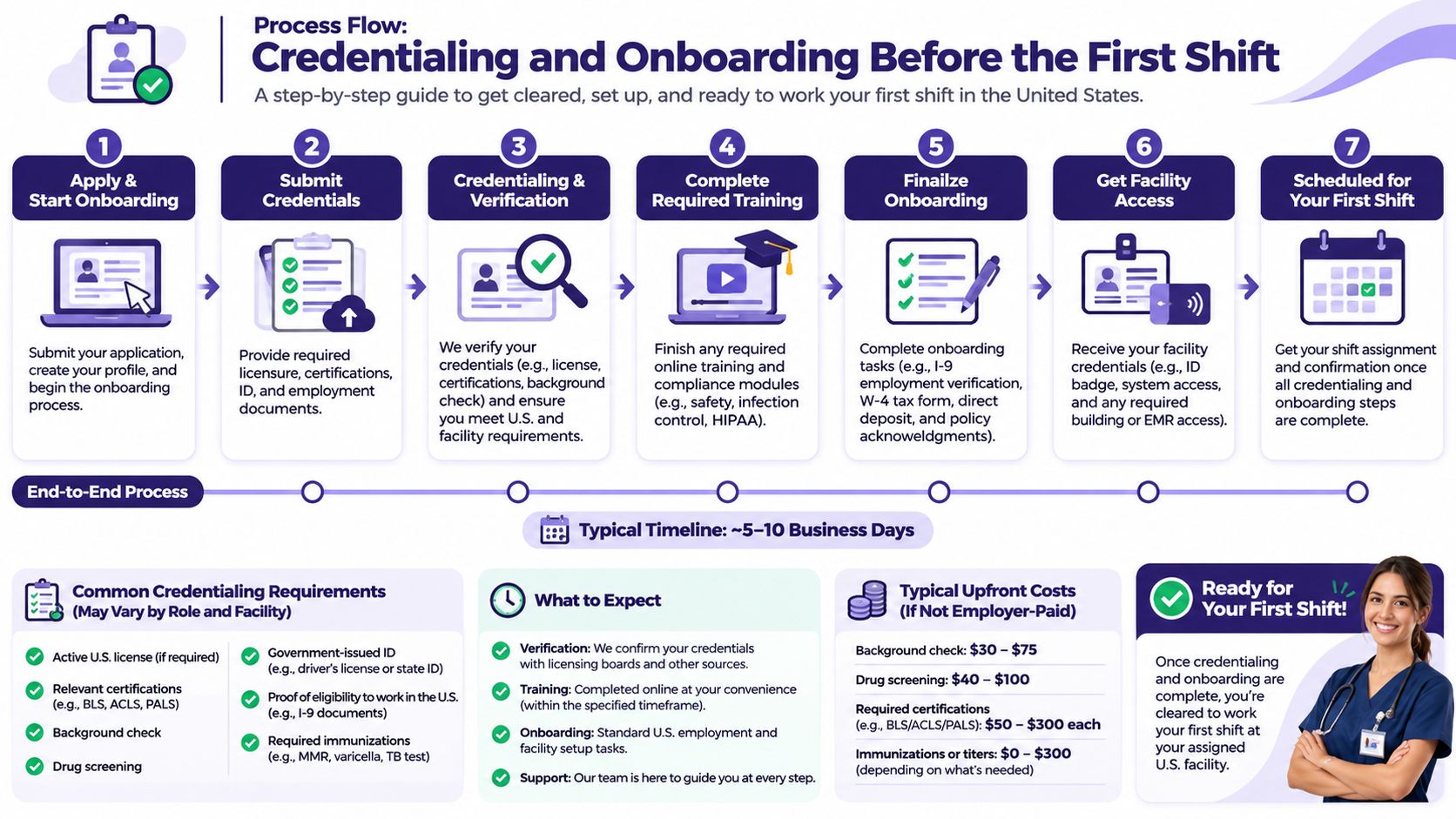
Credentialing is the principal technical bottleneck in locum tenens deployment, and the evidence is blunt: in a 2024 survey of 589 clinicians who had worked locum tenens during the preceding 18 months, 81% rated the credentialing process as a moderate or major challenge, according to the AMA's guidance on locum tenens for early-career physicians. The cause is cumulative. Separate state licensure, primary-source verification, privilege review, payer enrollment, malpractice documentation, references, case logs and health-system onboarding stack up for every assignment.
Six Steps From Signed Agreement to First Shift
Build one standard data packet. Board certification, fellowship history, state licenses, DEA status, immunization records, malpractice claims history, references, recent case volumes and procedure-specific competency evidence belong in a single file. The common slip is a thin case log, which stalls the privilege review even when everything else is clean.
Verify each item at the primary source. Resubmitted summaries and self-reported volumes don't survive a committee review. Primary-source verification is what lets the file move once and stay moved.
Map documented experience to the bylaws and privileging criteria for the exact scope. Electrophysiology ablation, interventional procedures, structural heart and imaging carry different criteria. A state license alone grants no privileges at all.
Enroll with payers and confirm state licensure for each assignment. Licensure is per state and per assignment, not portable by default. Payer enrollment lags privileging more often than programs expect.
Run site orientation before the first shift. EHR access, referral pathways, a named escalation owner and handoff standards turn a credentialed visitor into a functioning colleague.
Track expirations and open items in one dashboard. Credentials expire mid-assignment. A centralized view of dates and gaps is the difference between a renewal and a suspension.
Healthcare leaders identified credentialing delays as a leading technology-solvable workforce problem in 2025, cited by 49% of respondents, with scheduling conflicts at 44% and inefficient processes at 43%, per the CHG State of Locum Tenens report. The operational lesson is that speed alone doesn't solve it. A repeatable governance model covering verification, privileging, enrollment, orientation and recredentialing does.
The distinction worth carrying into any planning meeting is between credentialed and clinically deployable. A provider with a complete file, no EHR access and no named escalation owner is credentialed and not yet deployable. American Cardiology Group's team manages credentialing and compliance for locum providers so that facilities can onboard quickly, and a walkthrough of healthcare credentialing covers the workflow from the recruiter's side.
Decide Whether Locum Coverage Fits Your Vacancy
Five tests settle the question, and a no on any one of them changes the plan rather than the provider.
Is a named physician absent, or a named role open with a defined end date? A role that is growing has no locum case behind it, no matter how urgent the need feels.
Is the gap countable in 60-day blocks? Estimate the number of sequential substitutes and confirm each one would replace the absent physician's work under Medicare or the relevant payer rules.
Does credentialing lead time fit inside the gap? Compare the onboarding path against the date coverage is needed. If the file can't clear in time, start earlier or accept a shorter, later coverage window.
Can a rural or subspecialty gap be served by telehealth between onsite blocks? Confirm virtual availability before committing, because interest among locum physicians runs well ahead of posted opportunities.
Is one named person accountable for the output metrics? Appointment availability, consult response time, procedural volume, cancellation rate and handoff completion need an owner, or they get reported and ignored.
All five yes means locum coverage is a sound bridge. A permanent growth need sends the program back to a permanent search, and the honest version of that conversation is usually cheaper than a rotating sequence that never stabilizes.
American Cardiology Group offers permanent physician recruitment, locum tenens solutions, advanced practice recruitment and executive recruitment. Facilities can request locum tenens staffing through a Request Staffing form that asks for first name, last name, email and state, with optional phone, title and organization, and the physician staffing solutions overview explains how the two paths are matched to a vacancy. Confirm the vacancy type and expected gap length this week, before the leave date forces the decision.
American Cardiology Group recruits exclusively for cardiology and cardiac surgery, pairing permanent physician recruitment with locum tenens coverage, advanced practice placement and executive search. For a program weighing a locum bridge against a permanent search, the team can confirm scope, credentialing path and realistic start timing before a leave begins. Visit American Cardiology Group to start the conversation.
Comments