
Healthcare Leadership Positions: Roles That Drive Results
Women held just 15.3% of health-system CEO positions in a study of U.S. healthcare leadership reported by Fierce Healthcare. That finding challenges the assumption that healthcare leadership positions reflect the available talent pool. Hospital executives should examine how organizations define authority, identify candidates, and decide which experience counts.
A leadership vacancy deserves the same scrutiny as a proposed service-line investment. Before approving another executive position, the governing team should establish what decisions require an owner, which outcomes that person can influence, and whether the appointment is sustainable. In cardiovascular care, the right answer may be a program administrator, an enabled physician director, or a clinical-operational partnership rather than another senior title.
Table of Contents
Core Healthcare Leadership Positions and What They Own - Wider responsibilities require a different candidate profile
Choosing Between a Hire, an Interim Leader or a Redesign - Diagnose the work before selecting the response
Splitting Clinical and Operational Accountability - An electrophysiology example - Medical-staff eligibility remains a separate requirement
What Effective Healthcare Leaders Actually Do - Translate management functions into observable work - Score interpersonal leadership and system management separately
Evaluating Candidates and Running the Search - A disciplined search sequence - Keep missing evidence distinct from adverse evidence
Keeping Cardiac Leaders Sustainable After Appointment - Build retention into operating decisions - Protect continuity at the leadership level
Confirm the Structure Before You Post the Role - Select the next action
Core Healthcare Leadership Positions and What They Own
Core healthcare leadership roles, accountabilities and measures
Role | Core accountability | Typical reporting line | Measures owned |
|---|---|---|---|
Chief Executive Officer | Overall strategy, board accountability, capital and service-line approval | Board of trustees | Operating margin, quality ranking, community access |
Chief Medical Officer | Physician alignment, medical-staff quality, clinical governance | Chief Executive Officer | Credentialing timeliness, peer-review outcomes |
Chief Nursing Officer | Nursing workforce, staffing plans, patient safety | Chief Executive Officer, often in partnership with Chief Medical Officer | Staffing stability, nurse turnover, falls and infection rates |
Chief Operating Officer | Throughput, capacity and daily operations | Chief Executive Officer | Length of stay, operating room utilization, emergency department boarding time |
Chief Quality or Safety Officer | Quality governance and regulatory readiness | Chief Executive Officer or Chief Medical Officer | Core measure performance, readmission rates |
Cardiovascular Service-Line Director | Program design across catheterization lab, electrophysiology and heart failure | Chief Medical Officer or Chief Operating Officer | Door-to-balloon time, new-patient clinic access |
Cardiology Medical Director | Physician group oversight, scheduling and peer standards | Service-line director or Chief Medical Officer | Physician panel productivity, call coverage compliance |
Chief of Staff (Medical Staff) | Medical-staff governance and conduct under bylaws | Governing body | Bylaws compliance, privileging cycle completion |
This roster is a role-design starting point, not a universal organizational chart. Hospital bylaws, system structure, and delegated authority should determine the final reporting relationships. Measures listed as owned require an executive sponsor and explicit agreements with the departments contributing to performance.
For example, a cardiovascular service-line director can coordinate catheterization-lab readiness, but emergency department leadership and emergency medical services also influence the treatment pathway. The appointment document should distinguish the person accountable for reviewing performance from the operational partners responsible for changing it.
Wider responsibilities require a different candidate profile
The American Hospital Association's 2023 Health Care Workforce Scan identifies expanding leadership responsibilities in telehealth, quality and safety, behavioral health, patient experience, wellness, nursing informatics, and innovation. Examples include Chief of Telehealth or Distance Care Delivery, Chief Wellness Officer, Chief Nursing Informatics Officer, and Director of Innovation.
The practical implication is broader than adding specialist titles. A cardiology medical director overseeing virtual heart-failure follow-up should be assessed on referral workflows, escalation protocols, data-enabled operations, and clinician workload as well as clinical credentials. An excellent electrophysiologist shouldn't automatically receive responsibility for digital access without evidence of relevant management capability.
Role-design test: A title identifies organizational status. A measure, an authority boundary, and a named operational partner identify an executable job.
Before drafting the job description, the hiring team should map the vacancy to the closest row and identify its required measures. If responsibilities span several rows, the team should distinguish intentional integration from an accumulation of unrelated duties.
Choosing Between a Hire, an Interim Leader or a Redesign
Vacancy signals and the most suitable response
Vacancy signal | Likely response | First check |
|---|---|---|
Duplicated reports and spans of control above the organization's limit | Redesign the role before hiring | Reporting layers and decision rights |
Single program vacancy with a clinical lead still in place | Permanent hire of program administrator or medical director | Program maturity and physician alignment |
Strategic transition with financial pressure | Interim leader with a dated mandate, then a permanent decision | Financial runway and realistic search timeline |
Overlapping authority over quality metrics | Distributed clinical leadership with one accountable owner | Governance access and shared metrics |
Disputes at the clinical-administrative boundary | Dyad leadership model | Written split of clinical and operational decisions |
An unfilled position doesn't establish that the previous job should be recreated. A departure offers an opportunity to inspect duplicated approvals, unsupported responsibilities, and reporting arrangements that survived after their original purpose disappeared.
In 2025, at least 70% of health systems were reportedly optimizing staffing, including reevaluating staffing targets and spans of control, according to Becker's Hospital Review's coverage of Kaufman Hall's performance trends. That reporting also described scrutiny of administrative and leadership layers. The implication isn't that hospitals should eliminate leadership, but that they should establish what each layer contributes before replacing it.
Diagnose the work before selecting the response
A mature interventional cardiology program with stable physician leadership may need an administrator who can resolve scheduling, staffing, and supply constraints. Recruiting an enterprise-level executive would be difficult to justify if the unresolved work sits entirely within program operations.
Conversely, a developing cardiovascular service line may require physician alignment across independent practices, employed groups, and hospital departments. An administrator without clinical partnership or governance access may lack the authority needed to deliver that mandate.
The governing team should inspect:
Span of control: Count direct reports and assess their complexity against the organization's own approved limit.
Approval layers: Trace a staffing request from the program to the chief executive, identifying repeated reviews without distinct decision authority.
Decision work: Review the outgoing leader's calendar and distinguish actual decisions from report preparation and status meetings.
No universal span-of-control threshold is established by these sources. Hospitals should set their own limits explicitly rather than borrowing an unsupported benchmark.
A permanent search shouldn't become a substitute for an unresolved organizational-design decision.
Before initiating retained executive search, the sponsor should record the chosen response: permanent hire, interim appointment, redesign, or distributed clinical leadership. The record should include the rationale and a review date. For an interim appointment, it should also specify a dated mandate and name the owner of the permanent search before posting.
Splitting Clinical and Operational Accountability
A dyad leadership model pairs a physician leader with an operational leader around a service line. It doesn't require both people to approve every decision. Its value depends on separating decisions that require clinical judgment from those requiring operational execution, then establishing how disagreements reach resolution.

A practical division assigns clinical standards and peer review to the physician partner, with staffing deployment, throughput, and budget execution assigned to the operational partner. Both leaders work toward agreed access, quality, and program-development objectives.
An electrophysiology example
Consider an electrophysiology laboratory preparing to expand ablation capacity. The physician director establishes ablation case criteria, clinical protocols, and peer-review expectations; the program administrator manages scheduling capacity, equipment availability, and cost per procedure.
The partners jointly assess whether additional sessions can be delivered safely with available nursing, anesthesia, and recovery support. A written escalation route should resolve conflicts when clinical demand exceeds funded capacity. Without that route, shared accountability can deteriorate into reciprocal vetoes.
Clinical ownership: Define appropriateness standards and clinical escalation decisions.
Operational ownership: Translate approved activity into staffing, rooms, equipment, and expenditure.
Joint review: Evaluate access and outcomes together, while retaining a named owner for each corrective action.
Medical-staff eligibility remains a separate requirement
Under the CMS hospital medical-staff guidance, medical-staff members must select an individual to lead the staff under governing-body-approved bylaws; that leader must be an MD or DO, unless applicable state law permits a doctor of dental surgery, dental medicine, or podiatric medicine, and a majority of a medical-staff executive committee must be MDs or DOs.
An operational partner doesn't replace that required medical-staff leadership. Before shortlisting a candidate who isn't an MD or DO for chief of staff, the hospital should check applicable state law and its approved bylaws.
The practical scoping test is whether one person must independently determine both a clinical standard and its supporting budget. That combination warrants scrutiny: the role may be under-scoped and need a named partner rather than additional responsibilities.
What Effective Healthcare Leaders Actually Do
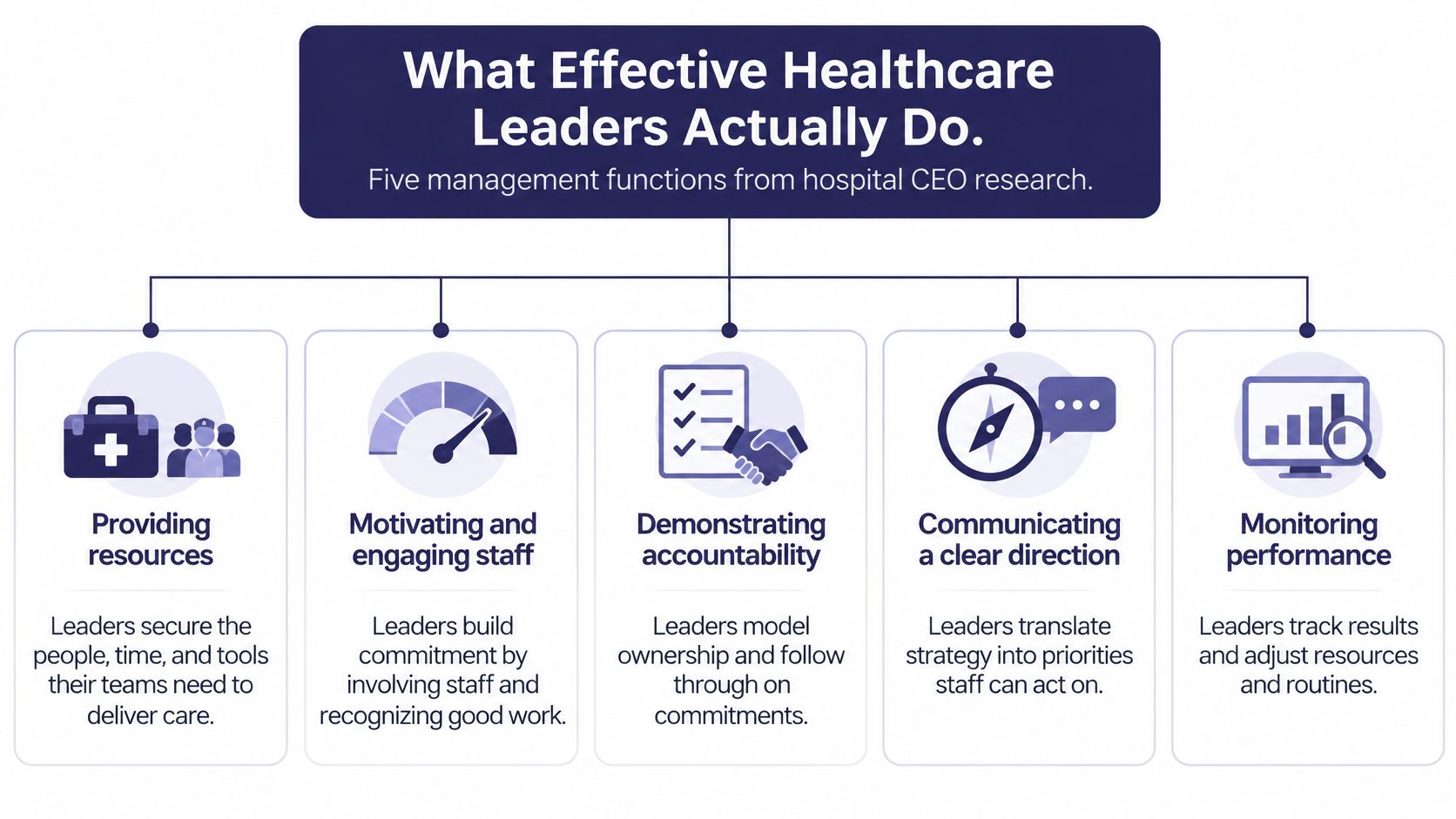
Effective leadership is observable in resource decisions, staff participation, performance reviews, and routines that continue after an initiative loses executive attention. A qualitative BMJ Open study of hospital CEOs involved in quality improvement identified five recurring functions: providing resources, motivating and engaging staff, demonstrating commitment and support, monitoring progress, and embedding changes into routine operations.
Translate management functions into observable work
Providing resources: A cardiac executive converts an access objective into funded clinic sessions, recruitment approvals, diagnostic capacity, and administrative support. An unfunded growth target isn't a staffing plan.
Motivating and engaging staff: Physician, nursing, and technical staff help identify the causes of catheterization-lab delays. The leader assigns named physician and nursing owners rather than issuing a general instruction to improve.
Demonstrating commitment and support: The executive attends problem-solving reviews, removes barriers within delegated authority, and follows through on promised resources. Participation matters most when a service problem crosses departmental boundaries.
Monitoring progress: The team reviews door-to-balloon time, referral-to-appointment intervals, or other relevant indicators weekly. Definitions and exclusions should remain consistent so an apparent improvement isn't merely a reporting change.
Embedding changes: A successful intervention becomes a standard operating procedure, an onboarding requirement, and an assigned audit responsibility. The leader verifies that staff can sustain the change without repeated executive intervention.
The hiring team should select cardiology quality metrics that match the role's actual authority. For example, a medical director accountable for heart-failure follow-up needs a clear agreement with scheduling and ambulatory operations, not merely a dashboard displaying missed targets.
Score interpersonal leadership and system management separately
A systematic review of clinical-manager competencies, covering 49 studies across 24 countries, found strengths in working with others and demonstrating personal qualities, alongside recurring gaps in managing services, improving services, and setting strategic direction. That distinction should shape executive assessment.
A candidate can communicate well and retain colleagues' respect while struggling to translate strategy into funded capacity. Another may understand financial models but fail to secure physician participation. A single overall leadership rating can conceal either weakness.
Hiring implication: Evidence of influence and evidence of execution belong on separate scorecard lines.
For interpersonal leadership, the panel should examine conflict resolution, ethical judgment, and multidisciplinary trust. For system management, it should inspect staffing models, improvement methods, resource decisions, and sustained results.
The decisive interview request is a completed improvement project with a baseline, intervention, outcome, and explanation of the candidate's contribution. Years in practice establish experience, but they don't establish that the candidate has successfully run a service.
Evaluating Candidates and Running the Search
Candidate evaluation criteria for cardiology leaders
Criterion | Evidence to request | Red flag |
|---|---|---|
Improvement track record | Named projects with baseline and result, such as reduced catheterization-lab delays | Credentials cited with no measured outcome |
Team influence | Multisource references from physicians and nurses | References from superiors only |
Service management | Operational dashboards the candidate has owned and reviewed | Strategy language without a staffing or capacity plan |
Decision rights | Written scope showing budget and hiring authority | Mandate depends on approvals nobody has defined |
Coverage and call load | Call schedule and protected administrative time | Leadership role with no administrative time and full clinical load |
Succession capacity | Named successors the candidate has developed | Program depends on one person |
Physician background | Evidence of execution, such as sustained program adoption | Assuming an MD background equals quality |
Candidate assessment must examine both the person's capability and the employer's job design. A weak answer about hiring authority may expose an incomplete employer mandate rather than a candidate deficiency. Keeping those evaluations separate prevents the panel from rejecting applicants for conditions the hospital hasn't resolved.
A disciplined search sequence
Write separate scorecard domains for leading people and running systems. Each domain should specify acceptable evidence and how panelists will assess it. The common slip is agreeing on desirable adjectives, such as collaborative or strategic, without defining observable behavior.
Document authority before posting. The position description should identify the reporting line, budget responsibility, hiring authority, and escalation route. An attractive title won't compensate for contradictory expectations from the chief executive, medical staff, and service-line sponsor.
Widen sourcing beyond familiar executive networks. In B.E. Smith's survey of 588 leaders, 43% described finding quality leadership candidates as very or extremely challenging, according to Advisory Board. Women constitute 67.2% of the global health and care workforce but hold about 25% of senior leadership positions, according to the World Health Organization. Retained search, nursing and physician networks, and program-peer referrals should supplement traditional contacts; representation should be examined across sourcing and assessment, not addressed only after the shortlist is complete.
Use structured interviews. Every candidate should receive the same core questions about completed improvement work, team conflict, and a service failure. Follow-up questions should establish personal contribution, unsuccessful actions, and who could succeed the candidate. Panels shouldn't confuse a polished account of collective achievement with evidence of individual accountability.
Obtain multisource references. Include a nurse leader and a physician peer alongside supervisory references. Specific questions about disagreements, resource constraints, and follow-through produce more useful evidence than a general request for an endorsement.
Verify credentials against the actual position. The credentialing and legal teams should confirm licensure, relevant qualifications, and MD or DO status where the applicable rules and bylaws require it. An administrative leadership title and a medical-staff office shouldn't be treated as interchangeable eligibility categories.
Make the offer with an explicit review agreement. A proposed 90-day review of two agreed metrics should assess both initial progress and whether promised organizational support materialized. This is an appointment-design recommendation, not a published performance benchmark; the common mistake is reviewing the leader without reviewing the conditions the employer committed to provide.
Keep missing evidence distinct from adverse evidence
An executive recruitment process should preserve an auditable connection between requirements, interview evidence, references, and the final decision. Panelists should record why a candidate meets each criterion rather than relying on impressions accumulated across informal conversations.
The intended endpoint is a shortlist of three candidates, each supported by evidence against every scorecard line. Missing documentation should be recorded as incomplete, not negative, and followed by a targeted work-sample request. A de-identified capacity plan or improvement summary can help resolve uncertainty without requiring disclosure of confidential patient or employer information.
Keeping Cardiac Leaders Sustainable After Appointment
In a large U.S. pandemic-era survey cited by the American College of Cardiology's workforce review, burnout was reported by 59% of cardiology nurses, 46% of cardiovascular team members, and 40% of physicians, while 23% to 45% expressed a desire to leave their jobs. Those findings describe a specific survey context, not a current prevalence estimate for every hospital. They nevertheless establish why a cardiac leader's mandate must include workforce sustainability.

Build retention into operating decisions
A newly appointed leader should inspect the conditions under which staff deliver care, not assume that recruitment alone will stabilize the program.
Workload design: Review rotations, call distribution, recovery coverage, and repeated dependence on the same staff.
Protected administrative time: Reserve time for management work rather than treating it as an addition to a full clinical schedule.
Psychological safety: Use structured debriefs after complex procedures to identify system problems without discouraging staff from raising concerns.
Succession planning: Develop deputies and document essential workflows so absence or departure doesn't interrupt the program.
Quarterly pulse surveys on workload, turnover by role, and time to fill vacancies can provide complementary signals. The governing team should examine these alongside service demand; aggregate turnover can conceal instability within a critical nursing or technical group.
Protect continuity at the leadership level
In B.E. Smith's 2025 survey of 588 healthcare executives, 46% planned to leave their organizations within the next 12 months, as reported by Becker's Hospital Review. Leader retention therefore belongs in succession planning at appointment, not after a resignation.
A practical 90-day plan should audit team roles, agree two measures with physician and nursing leads, and schedule a debrief after the first full case cycle. These are proposed management checkpoints, not evidence-based universal thresholds. The review should test whether the leader has sufficient support to improve the team's working conditions without becoming the program's sole problem-solver.
Confirm the Structure Before You Post the Role
The executive sponsor should complete a short readiness checklist before authorizing recruitment:
Role match: The vacancy maps to a core leadership role, with any additional responsibilities explicitly justified.
Written authority: Budget responsibility, hiring authority, and escalation decisions are documented.
Balanced assessment: The scorecard distinguishes leading people from running systems.
Eligibility review: Medical-staff requirements have been checked against applicable state law and hospital bylaws.
Select the next action
For an in-house search, the hiring team should use the candidate criteria and structured procedure to build a consistent assessment record. Interview questions, reference requests, and work samples should test the same requirements rather than introduce new preferences late in the process.
For external support, American Cardiology Group recruits for cardiology leadership roles and specializes exclusively in cardiac recruitment. The organization can be briefed with the same scorecard. Its dedicated recruiters also provide personalized support to both the facility and the locum provider throughout the locum recruitment process.
The recruitment brief should state measurable outcomes, such as the hospital's door-to-balloon time targets or clinic-access goals, together with the resources and authority attached to them. The final appointment decision should rest on the scorecard, not the title's prestige or the candidate's presentation style.
American Cardiology Group offers executive recruitment focused on cardiac leadership, alongside permanent physician, locum tenens, and advanced practice recruitment. Hospital teams preparing a leadership search can visit American Cardiology Group to discuss the position and bring a scorecard defining its outcomes, authority, and sustainability requirements.
Comments